Page 474 of 3502

ATC-96
TROUBLE DIAGNOSIS
Ambient Sensor CircuitBJS000GC
COMPONENT DESCRIPTION
Ambient Sensor
The ambient sensor is attached on the hood lock stay. It detects
ambient temperature and converts it into a resistance value which is
then input into the unified meter and A/C amp.
AMBIENT TEMPERATURE INPUT PROCESS
The unified meter and A/C amp. includes a processing circuit for the ambient sensor input. However, when the
temperature detected by the ambient sensor increases quickly, the processing circuit retards the unified meter
and A/C amp. function. It only allows the unified meter and A/C amp. to recognize an ambient temperature
increase of 0.33°C (0.6°F) per 100 seconds.
As an example, consider stopping for a few minutes after high speed driving. Although the actual ambient tem-
perature has not changed, the temperature detected by the ambient sensor will increase. This is because the
heat from the engine compartment can radiate to the front grille area, location of the ambient sensor.
DIAGNOSIS PROCEDURE FOR AMBIENT SENSOR
SYMPTOM: Ambient sensor circuit is open or shorted. (21 or − 21 is
indicated on unified meter and A/C amp. as a result of performing
self-diagnosis STEP-2.)
1. CHECK VOLTAGE BETWEEN AMBIENT SENSOR AND GROUND
1. Disconnect ambient sensor connector.
2. Turn ignition switch ON.
3. Check voltage between ambient sensor harness connector
E257 terminal 1 and ground.
OK or NG
OK >> GO TO 2.
NG >> GO TO 4.
RJIA2779E
RJIA1461E
1 – Ground : Approx. 5 V
RJIA2017E
Page 476 of 3502
ATC-98
TROUBLE DIAGNOSIS
COMPONENT INSPECTION
Ambient Sensor
After disconnecting ambient sensor connector M257, measure resis-
tance between terminals 1 and 2 at sensor side. Refer to the table
below.
If NG, replace ambient sensor.
Temperature °C (°F) Resistance kΩ
−15 (5) 12.73
−10 (14) 9.92
−5 (23) 7.80
0 (32) 6.19
5 (41) 4.95
10 (50) 3.99
15 (59) 3.24
20 (68) 2.65
25 (77) 2.19
30 (86) 1.81
35 (95) 1.51
40 (104) 1.27
45 (113) 1.07
RJIA2780E
Page 477 of 3502
TROUBLE DIAGNOSIS
ATC-99
C
D
E
F
G
H
I
K
L
MA
B
AT C
In-vehicle Sensor CircuitBJS000GD
COMPONENT DESCRIPTION
In-vehicle Sensor
The in-vehicle sensor is located on instrument driver lower panel. It
converts variations in temperature of compartment air drawn from
the aspirator into a resistance value. It is then input into the unified
meter and A/C amp.
Aspirator
The aspirator is located on driver’s side of heater & cooling unit
assembly. It produces vacuum pressure due to air discharged from
the heater & cooling unit assembly, continuously taking compartment
air in the aspirator.
RJIA3276E
RJIA3277E
RJIA1804E
Page 479 of 3502

TROUBLE DIAGNOSIS
ATC-101
C
D
E
F
G
H
I
K
L
MA
B
AT C
4. CHECK CIRCUIT CONTINUITY BETWEEN IN-VEHICLE SENSOR AND UNIFIED METER AND A/C
AMP.
1. Turn ignition switch OFF.
2. Disconnect unified meter and A/C amp. connector.
3. Check continuity between in-vehicle sensor harness connector
M29 terminal 1 and unified meter and A/C amp. harness con-
nector M45 terminal 40.
4. Check continuity between in-vehicle sensor harness connector
M29 terminal 1 and ground.
OK or NG
OK >> 1. Replace unified meter and A/C amp.
2. Go to self-diagnosis AT C - 4 7 , "
FUNCTION CONFIRMATION PROCEDURE" and perform self-
diagnosis STEP-2. Confirm that code No. 20 is displayed.
NG >> Repair harness or connector.
COMPONENT INSPECTION
In-vehicle Sensor
After disconnecting in-vehicle sensor connector M29, measure resis-
tance between terminals 1 and 2 at sensor side. Refer to the table
below.
If NG, replace in-vehicle sensor.1 – 40 : Continuity should exist.
1 – Ground : Continuity should not exist.
RJIA2024E
Temperature °C (°F) Resistance kΩ
−15 (5) 12.73
−10 (14) 9.92
−5 (23) 7.80
0 (32) 6.19
5 (41) 4.95
10 (50) 3.99
15 (59) 3.24
20 (68) 2.65
25 (77) 2.19
30 (86) 1.81
35 (95) 1.51
40 (104) 1.27
45 (113) 1.07
RJIA3278E
Page 483 of 3502

TROUBLE DIAGNOSIS
ATC-105
C
D
E
F
G
H
I
K
L
MA
B
AT C
Intake Sensor CircuitBJS000GF
COMPONENT DESCRIPTION
Intake Sensor
The intake sensor is located on the heater & cooling unit assembly. It
converts temperature of air after it passes through the evaporator
into a resistance value which is then input to the unified meter and A/
C amp.
DIAGNOSIS PROCEDURE FOR INTAKE SENSOR
SYMPTOM: Intake sensor circuit is open or shorted. (24 or −24 is
indicated on unified meter and A/C amp. as a result of performing
self-diagnosis STEP-2.)
1. CHECK VOLTAGE BETWEEN INTAKE SENSOR AND GROUND
1. Disconnect intake sensor connector.
2. Turn ignition switch ON.
3. Check voltage between intake sensor harness connector M256
terminal 1 and ground.
OK or NG
OK >> GO TO 2.
NG >> GO TO 4.
2. CHECK CIRCUIT CONTINUITY BETWEEN INTAKE SENSOR AND UNIFIED METER AND A/C AMP.
1. Turn ignition switch OFF.
2. Disconnect unified meter and A/C amp. connector.
3. Check continuity between intake sensor harness connector
M256 terminal 2 and unified meter and A/C amp. harness con-
nector M45 terminal 49.
OK or NG
OK >> GO TO 3.
NG >> Repair harness or connector.
RJIA3281E
RJIA1458E
1 – Ground : Approx. 5 V
RJIA1809E
2 – 49 : Continuity should exist.
RJIA1810E
Page 484 of 3502

ATC-106
TROUBLE DIAGNOSIS
3. CHECK INTAKE SENSOR
Refer to ATC-106, "
Intake Sensor" .
OK or NG
OK >> 1. Replace unified meter and A/C amp.
2. Go to self-diagnosis AT C - 4 7 , "
FUNCTION CONFIRMATION PROCEDURE" and perform self-
diagnosis STEP-2. Confirm that code No. 20 is displayed.
NG >> 1. Replace intake sensor.
2. Go to self-diagnosis AT C - 4 7 , "
FUNCTION CONFIRMATION PROCEDURE" and perform self-
diagnosis STEP-2. Confirm that code No. 20 is displayed.
4. CHECK CIRCUIT CONTINUITY BETWEEN INTAKE SENSOR AND UNIFIED METER AND A/C AMP.
1. Turn ignition switch OFF.
2. Disconnect unified meter and A/C amp. connector.
3. Check continuity between intake sensor harness connector
M256 terminal 1 and unified meter and A/C amp. harness con-
nector M45 terminal 41.
4. Check continuity between intake sensor harness connector
M256 terminal 1 and ground.
OK or NG
OK >> 1. Replace unified meter and A/C amp.
2. Go to self-diagnosis AT C - 4 7 , "
FUNCTION CONFIRMATION PROCEDURE" and perform self-
diagnosis STEP-2. Confirm that code No. 20 is displayed.
NG >> Repair harness or connector.
COMPONENT INSPECTION
Intake Sensor
After disconnecting intake sensor connector M256, measure resis-
tance between terminals 1 and 2 at sensor side. Refer to the table
below.
If NG, replace intake sensor.1 – 41 : Continuity should exist.
1 – Ground : Continuity should not exist.
RJIA1811E
Temperature °C (°F) Resistance kΩ
−15 (5) 18.63
−10 (14) 14.14
−5 (23) 10.85
0 (32) 8.40
5 (41) 6.57
10 (50) 5.18
15 (59) 4.12
20 (68) 3.30
25 (77) 2.66
30 (86) 2.16
35 (95) 1.77
40 (104) 1.46
45 (113) 1.21
RJIA3282E
Page 502 of 3502
ATC-124
AIR MIX DOOR MOTOR
AIR MIX DOOR MOTOR PFP:27732
Removal and InstallationBJS000HK
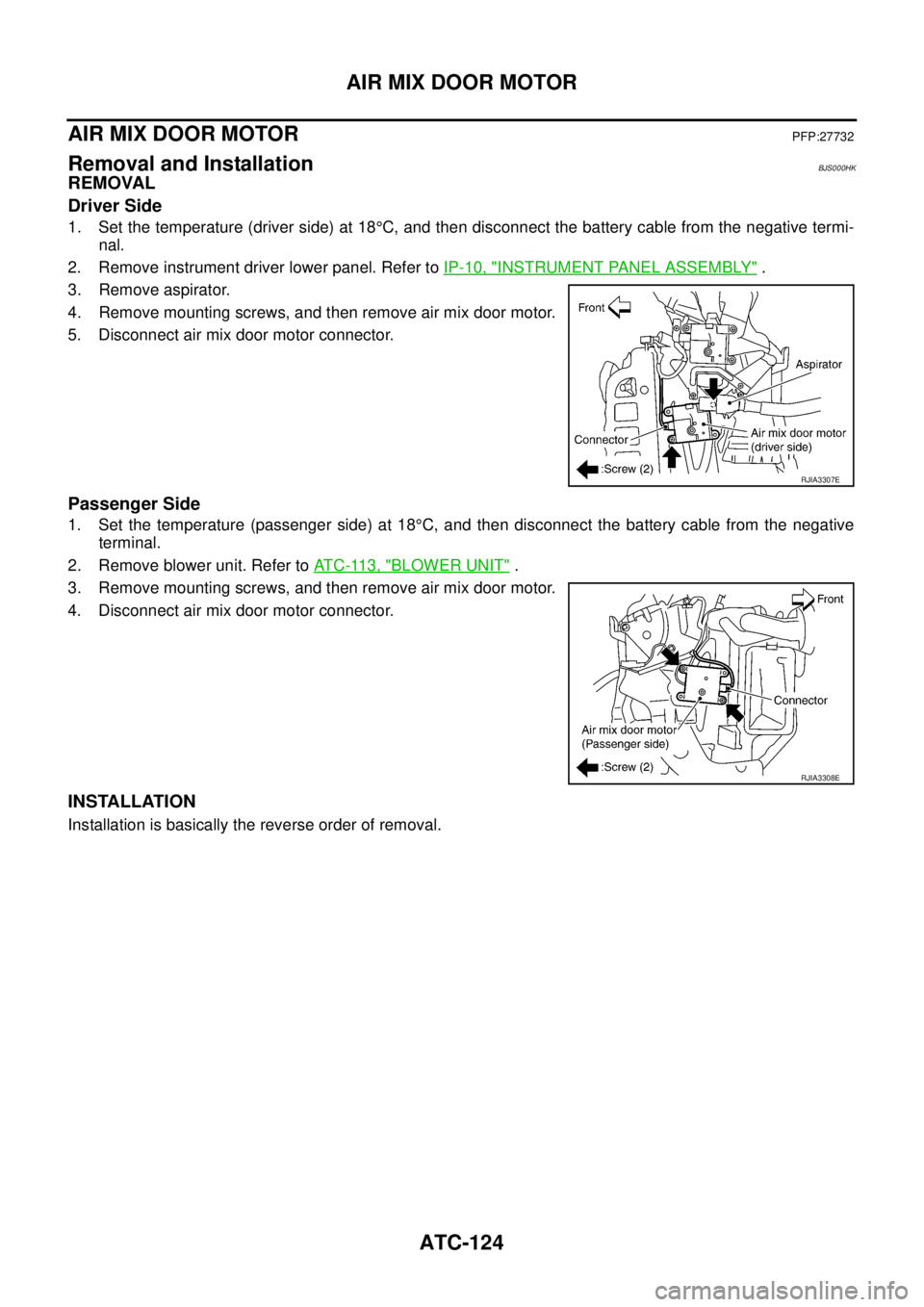
REMOVAL
Driver Side
1. Set the temperature (driver side) at 18°C, and then disconnect the battery cable from the negative termi-
nal.
2. Remove instrument driver lower panel. Refer to IP-10, "
INSTRUMENT PANEL ASSEMBLY" .
3. Remove aspirator.
4. Remove mounting screws, and then remove air mix door motor.
5. Disconnect air mix door motor connector.
Passenger Side
1. Set the temperature (passenger side) at 18°C, and then disconnect the battery cable from the negative
terminal.
2. Remove blower unit. Refer to AT C - 11 3 , "
BLOWER UNIT" .
3. Remove mounting screws, and then remove air mix door motor.
4. Disconnect air mix door motor connector.
INSTALLATION
Installation is basically the reverse order of removal.
RJIA3307E
RJIA3308E
Page 503 of 3502
HEATER CORE
ATC-125
C
D
E
F
G
H
I
K
L
MA
B
AT C
HEATER COREPFP:27140
Removal and InstallationBJS000HL
REMOVAL
1. Set the temperature (passenger side) at 18°C, and then disconnect the battery cable from the negative
terminal.
2. Remove heater & cooling unit assembly. Refer to AT C - 11 9 , "
HEATER & COOLING UNIT ASSEMBLY" .
3. Remove mounting screws, and then remove air mix door motor
(passenger side).
4. Disconnect air mix door motor connector.
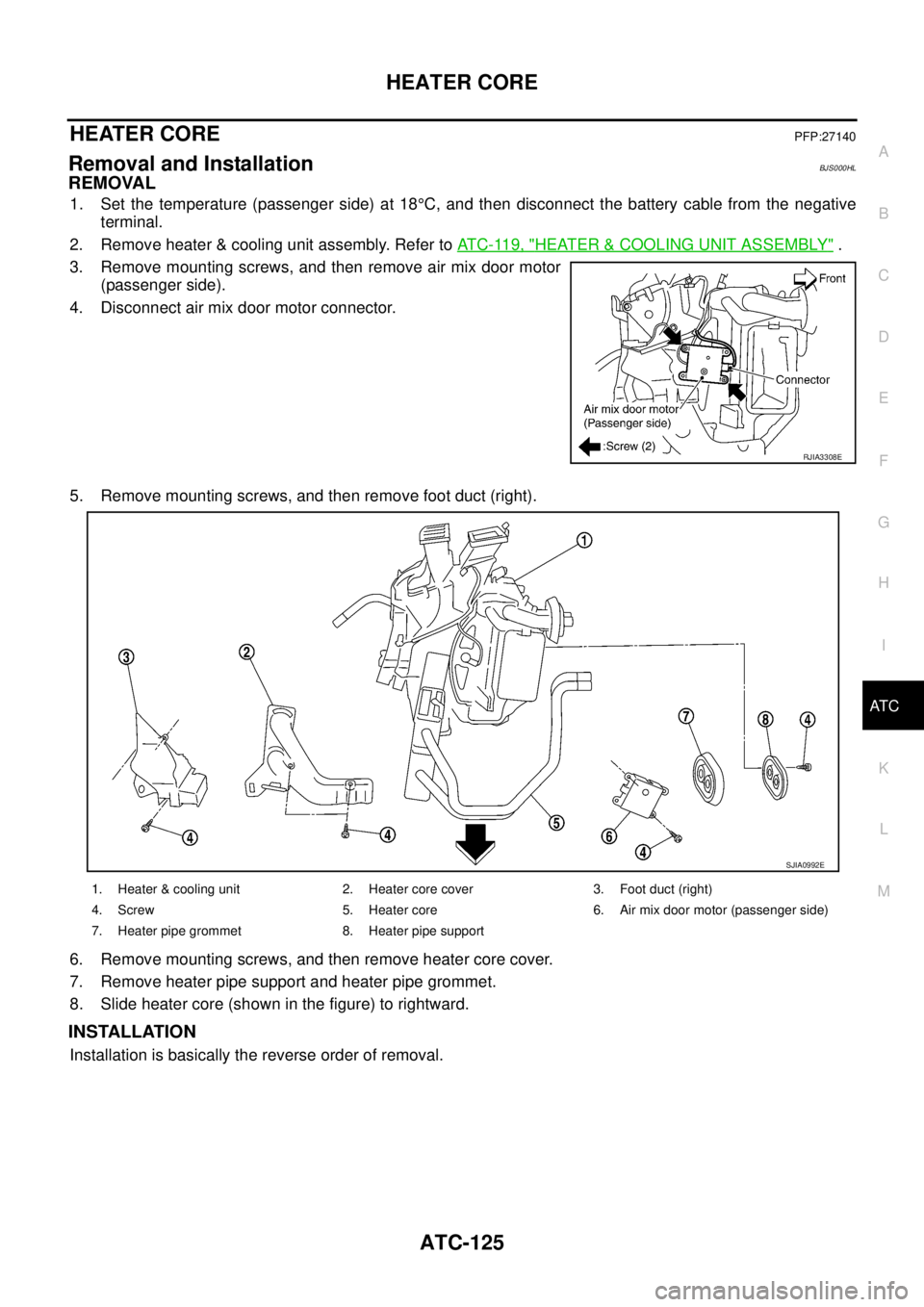
5. Remove mounting screws, and then remove foot duct (right).
6. Remove mounting screws, and then remove heater core cover.
7. Remove heater pipe support and heater pipe grommet.
8. Slide heater core (shown in the figure) to rightward.
INSTALLATION
Installation is basically the reverse order of removal.
RJIA3308E
1. Heater & cooling unit 2. Heater core cover 3. Foot duct (right)
4. Screw 5. Heater core 6. Air mix door motor (passenger side)
7. Heater pipe grommet 8. Heater pipe support
SJIA0992E