Page 446 of 3502
ATC-68
TROUBLE DIAGNOSIS
COMPONENT DESCRIPTION
Air Mix Door Motor
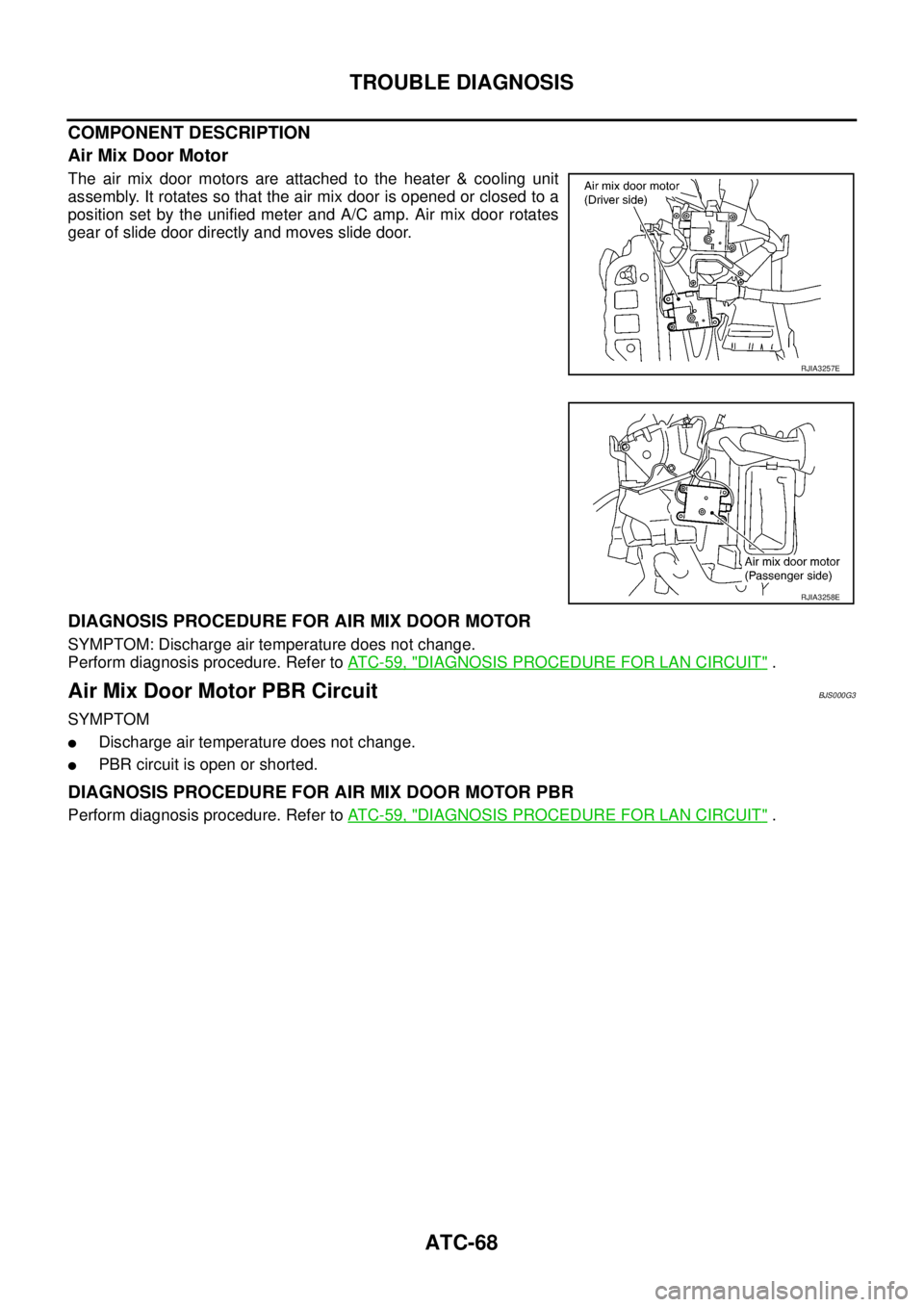
The air mix door motors are attached to the heater & cooling unit
assembly. It rotates so that the air mix door is opened or closed to a
position set by the unified meter and A/C amp. Air mix door rotates
gear of slide door directly and moves slide door.
DIAGNOSIS PROCEDURE FOR AIR MIX DOOR MOTOR
SYMPTOM: Discharge air temperature does not change.
Perform diagnosis procedure. Refer to AT C - 5 9 , "
DIAGNOSIS PROCEDURE FOR LAN CIRCUIT" .
Air Mix Door Motor PBR CircuitBJS000G3
SYMPTOM
�Discharge air temperature does not change.
�PBR circuit is open or shorted.
DIAGNOSIS PROCEDURE FOR AIR MIX DOOR MOTOR PBR
Perform diagnosis procedure. Refer to AT C - 5 9 , "DIAGNOSIS PROCEDURE FOR LAN CIRCUIT" .
RJIA3257E
RJIA3258E
Page 448 of 3502
ATC-70
TROUBLE DIAGNOSIS
SYSTEM DESCRIPTION
Component Parts
Intake door control system components are:
�Unified meter and A/C amp.
�Intake door motor (LCU)
�A/C LAN system (PBR built-in mode door motor, air mix door motor and intake door motor)
�In-vehicle sensor
�Ambient sensor
�Sunload sensor
�Intake sensor
System Operation
The intake door control determines intake door position based on the ambient temperature, the intake air tem-
perature and the in-vehicle temperature. When the DEF or OFF switches are pressed or A/C switch is OFF,
the unified meter and A/C amp. sets the intake door at the FRE position.
Intake Door Control Specification
SJIA1651E
RJIA4067E
Page 451 of 3502

TROUBLE DIAGNOSIS
ATC-73
C
D
E
F
G
H
I
K
L
MA
B
AT C
SYSTEM DESCRIPTION
Component Parts
Fan speed control system components are:
�Unified meter and A/C amp.
�A/C LAN system (PBR built-in mode door motor, air mix door motor and intake motor)
�Fan control amp.
�In-vehicle sensor
�Ambient sensor
�Sunload sensor
�Intake sensor
System Operation
Automatic Mode
In the automatic mode, the blower motor speed control signal is calculated by the unified meter and A/C amp.
based on the input from the PBR, in-vehicle sensor, sunload sensor, intake sensor and ambient sensor.
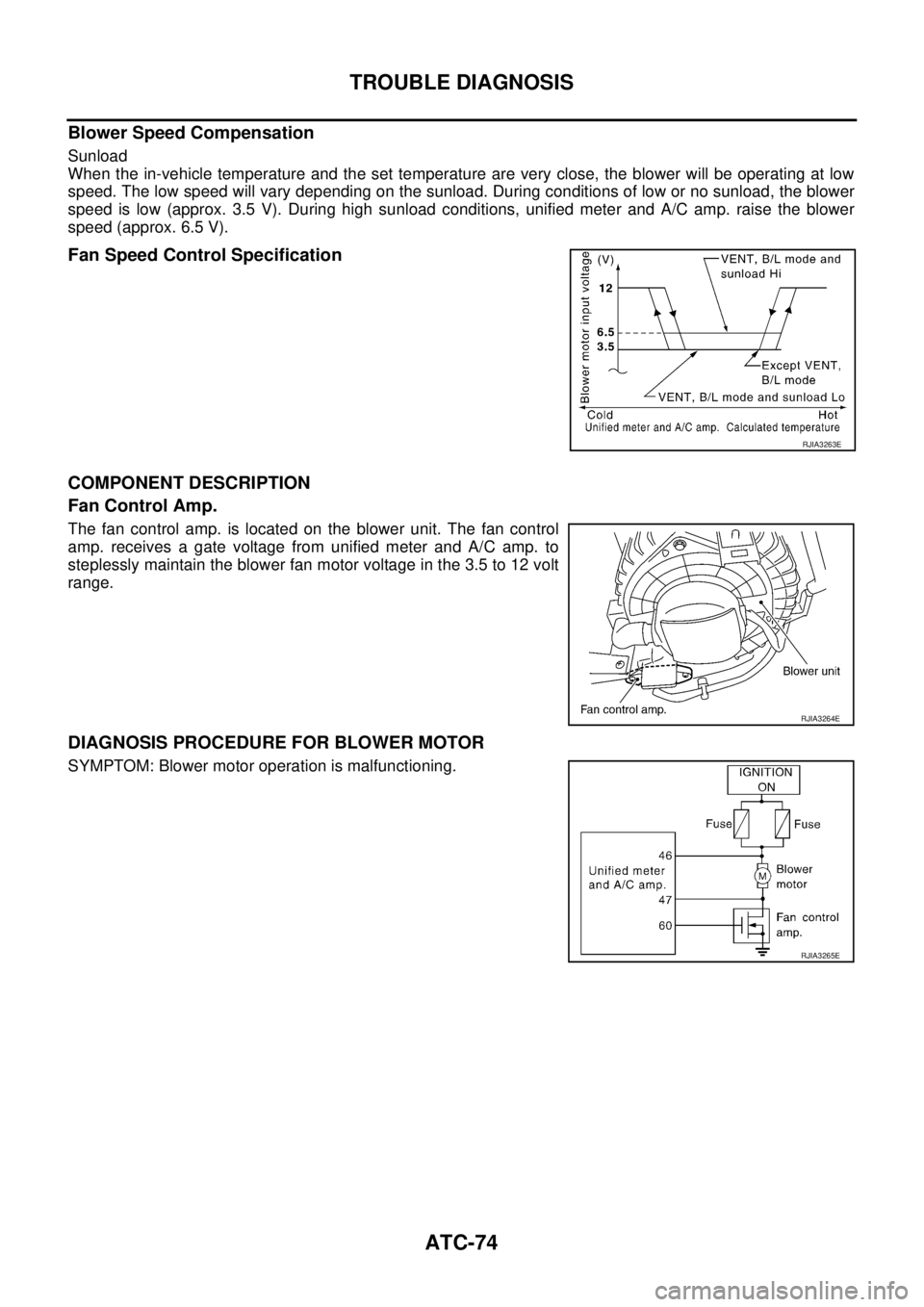
The blower motor applied voltage ranges from approximately 3.5 volts (lowest speed) to 12 volts (highest
speed).
The control blower speed (in the range of 3.5 to 12 V), unified meter and A/C amp. supplies a gate voltage to
the fan control amp. Based on this voltage, fan control amp. controls voltage supplied to the blower motor.
Starting Fan Speed Control
Start up from COLD SOAK Condition (Automatic mode)
In a cold start up condition where the engine coolant temperature is below 56°C (133°F), the blower will not
operate for a short period of time (up to 150 seconds). The exact start delay time varies depending on the
ambient and engine coolant temperature.
In the most extreme case (very low ambient) the blower starting delay will be 150 seconds as described
above. After this delay, the blower will operate at low speed until the engine coolant temperature rises above
56°C (133°F), and then the blower speed will increase to the objective speed.
Start up from usual or HOT SOAK Condition (Automatic mode)
The blower will begin operation momentarily after the AUTO switch is pressed. The blower speed will gradu-
ally rise to the objective speed over a time period of 3 seconds or less (actual time depends on the objective
blower speed).
RJIA3262E
Page 452 of 3502
ATC-74
TROUBLE DIAGNOSIS
Blower Speed Compensation
Sunload
When the in-vehicle temperature and the set temperature are very close, the blower will be operating at low
speed. The low speed will vary depending on the sunload. During conditions of low or no sunload, the blower
speed is low (approx. 3.5 V). During high sunload conditions, unified meter and A/C amp. raise the blower
speed (approx. 6.5 V).
Fan Speed Control Specification
COMPONENT DESCRIPTION
Fan Control Amp.
The fan control amp. is located on the blower unit. The fan control
amp. receives a gate voltage from unified meter and A/C amp. to
steplessly maintain the blower fan motor voltage in the 3.5 to 12 volt
range.
DIAGNOSIS PROCEDURE FOR BLOWER MOTOR
SYMPTOM: Blower motor operation is malfunctioning.
RJIA3263E
RJIA3264E
RJIA3265E
Page 457 of 3502

TROUBLE DIAGNOSIS
ATC-79
C
D
E
F
G
H
I
K
L
MA
B
AT C
SYSTEM DESCRIPTION
Unified meter and A/C amp. controls compressor operation by intake air temperature and signal from ECM.
Low Temperature Protection Control
Unified meter and A/C amp. will turn the compressor ON or OFF as determined by a signal detected by intake
sensor.
When intake air temperature is higher than 4°C (39°F), the compres-
sor turns ON. The compressor turns OFF when intake air tempera-
ture is lower than 2.5°C (37°F).
DIAGNOSIS PROCEDURE FOR MAGNET CLUTCH
SYMPTOM: Magnet clutch does not engage when A/C switch is ON.
1. CHECK INTAKE SENSOR CIRCUIT
Check intake sensor. Refer to AT C - 4 7 , "
FUNCTION CONFIRMATION PROCEDURE" , see No. 11.
OK or NG
OK >> GO TO 2.
NG >> Malfunctioning intake sensor: Refer to ATC-105, "
Intake Sensor Circuit" .
2. PERFORM AUTO ACTIVE TEST
Refer to PG-21, "
Auto Active Test" .
Does the magnet clutch operate?
YES >>�WITH CONSULT-II: GO TO 5.
�WITHOUT CONSULT-II: GO TO 6.
NO >> Check 10 A fuse (No. 79, located in IPDM E/R). Refer to PG-25, "
IPDM E/R Terminal Arrange-
ment" , and GO TO 3.
RHA094GD
PJIA0011E
Page 462 of 3502
ATC-84
TROUBLE DIAGNOSIS
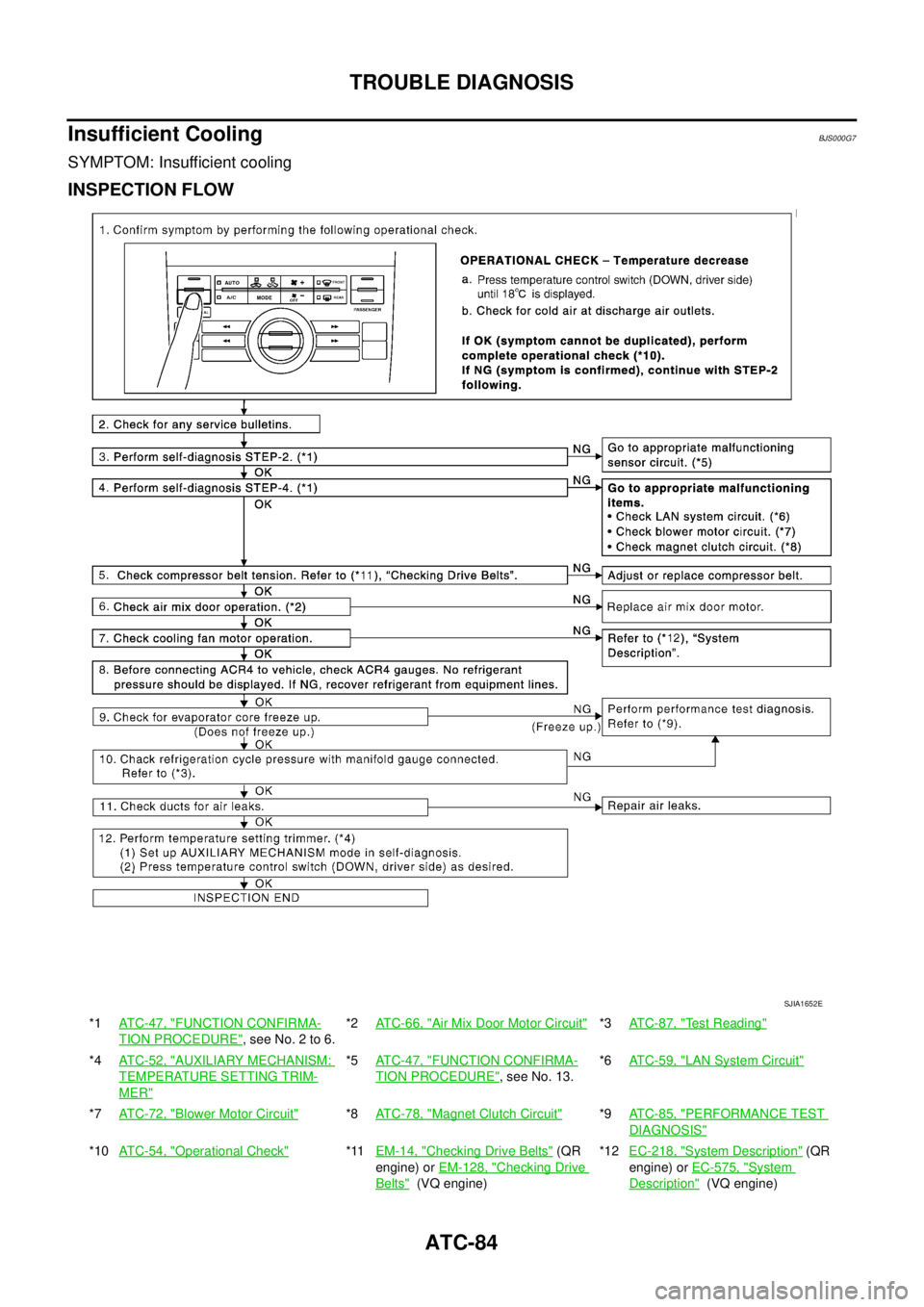
Insufficient CoolingBJS000G7
SYMPTOM: Insufficient cooling
INSPECTION FLOW
*1AT C - 4 7 , "FUNCTION CONFIRMA-
TION PROCEDURE", see No. 2 to 6.*2ATC-66, "
Air Mix Door Motor Circuit"*3ATC-87, "Test Reading"
*4AT C - 5 2 , "AUXILIARY MECHANISM:
TEMPERATURE SETTING TRIM-
MER"
*5ATC-47, "FUNCTION CONFIRMA-
TION PROCEDURE", see No. 13.*6ATC-59, "
LAN System Circuit"
*7AT C - 7 2 , "Blower Motor Circuit"*8ATC-78, "Magnet Clutch Circuit"*9ATC-85, "PERFORMANCE TEST
DIAGNOSIS"
*10AT C - 5 4 , "Operational Check"*11EM-14, "Checking Drive Belts" (QR
engine) or EM-128, "
Checking Drive
Belts" (VQ engine)*12EC-218, "
System Description" (QR
engine) or EC-575, "
System
Description" (VQ engine)
SJIA1652E
Page 465 of 3502

TROUBLE DIAGNOSIS
ATC-87
C
D
E
F
G
H
I
K
L
MA
B
AT C
PERFORMANCE CHART
Test Condition
Testing must be performed as follows:
Test Reading
Recirculating-to-discharge Air Temperature Table
Ambient Air Temperature-to-operating Pressure Table
Vehicle condition Indoors or in the shade (in a well-ventilated place)
Doors Closed
Door windows Open
Hood Open
TEMP. Max. COLD
Mode switch
(Ventilation) set
Intake switch
(Recirculation) set
Fan (blower) speedMax. speed set
Engine speed Idle speed
Operate the air conditioning system for 10 minutes before taking measurements.
Inside air (Recirculating air) at blower assembly inlet
Discharge air temperature at center ventilator
°C (°F) Relative humidity
%Air temperature
°C (°F)
50 - 6020 (68) 8.9 - 10.6 (48 - 51)
25 (77) 12.8 - 15.4 (55 - 60)
30 (86) 16.8 - 20.1 (62 - 68)
60 - 7020 (68) 10.6 - 12.2 (51 - 54)
25 (77) 15.4 - 17.9 (60 - 64)
30 (86) 20.1 - 23.4 (68 - 74)
Ambient air
High-pressure (Discharge side)
kPa (bar, kg/cm
2 , psi)Low-pressure (Suction side)
kPa (bar, kg/cm2 , psi) Relative humidity
%Air temperature
°C (°F)
50 - 7020 (68)780 - 970
(7.80 - 9.70, 7.96 - 9.89, 113.1 - 140.7)150 - 180
(1.50 - 1.80, 1.53 - 1.84, 21.8 - 26.1)
25 (77)920 - 1,140
(9.20 - 11.40, 9.38 - 11.63, 133.4 - 165.3)170 - 200
(1.70 - 2.00, 1.73 - 2.04, 24.7 - 29.1)
30 (86)950 - 1,190
(9.50 - 11.90, 9.69 - 12.14, 137.8 - 172.6)185 - 235
(1.85 - 2.35, 1.89 - 2.40, 26.8 - 34.1)
35 (95)1,080 - 1,350
(10.80 - 13.50, 11.02 - 13.77, 156.6 - 195.8)222 - 275
(2.22 - 2.75, 2.26 - 2.81, 32.2 - 39.9)
40 (104)1,250 - 1,550
(12.50 - 15.50, 12.75 - 15.81, 181.3 - 224.8)253 - 325
(2.53 - 3.25, 2.58 - 3.32, 36.7 - 47.1)
Page 467 of 3502
TROUBLE DIAGNOSIS
ATC-89
C
D
E
F
G
H
I
K
L
MA
B
AT C
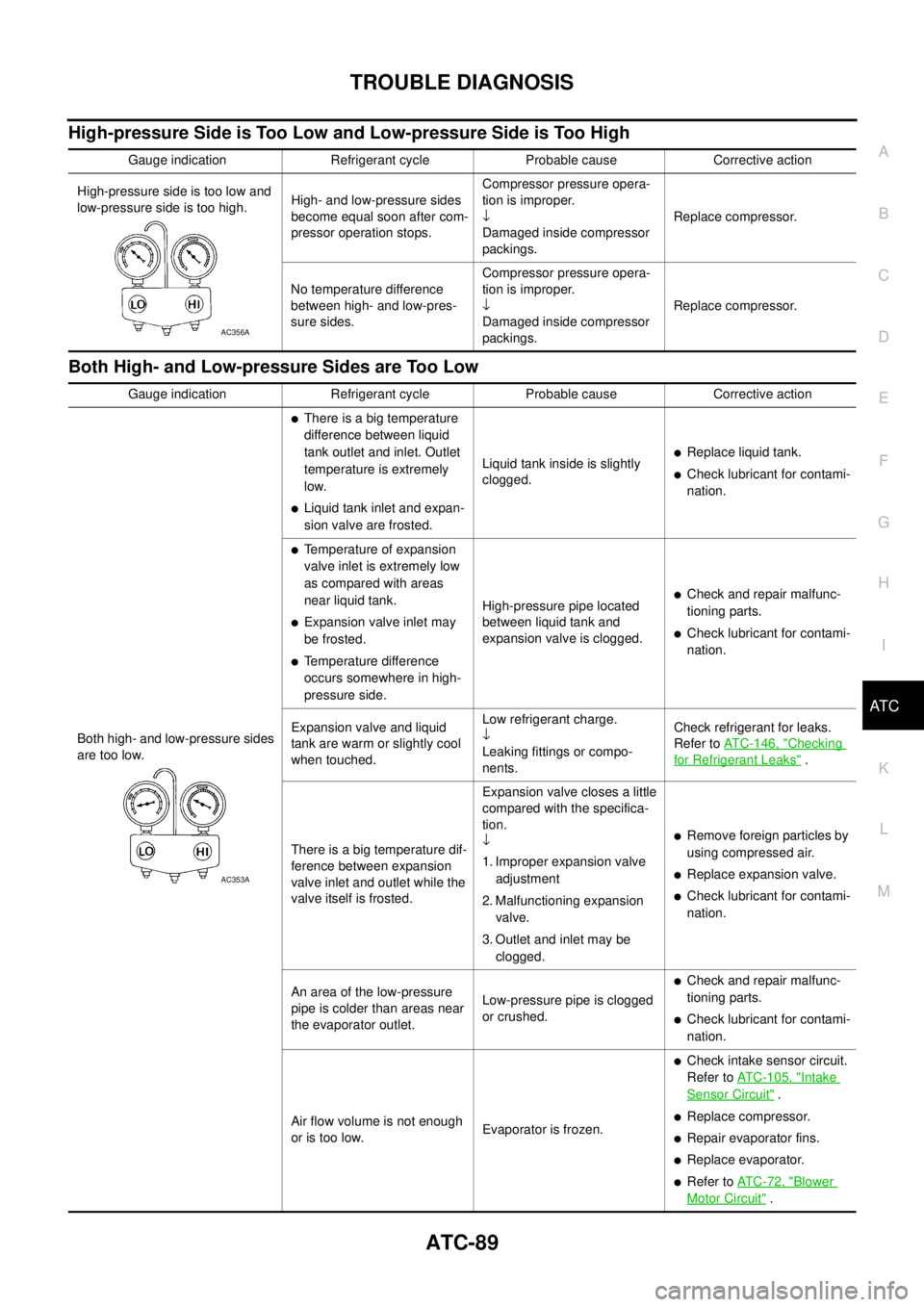
High-pressure Side is Too Low and Low-pressure Side is Too High
Both High- and Low-pressure Sides are Too Low
Gauge indication Refrigerant cycle Probable cause Corrective action
High-pressure side is too low and
low-pressure side is too high.High- and low-pressure sides
become equal soon after com-
pressor operation stops.Compressor pressure opera-
tion is improper.
↓
Damaged inside compressor
packings.Replace compressor.
No temperature difference
between high- and low-pres-
sure sides.Compressor pressure opera-
tion is improper.
↓
Damaged inside compressor
packings.Replace compressor.
AC356A
Gauge indication Refrigerant cycle Probable cause Corrective action
Both high- and low-pressure sides
are too low.
�There is a big temperature
difference between liquid
tank outlet and inlet. Outlet
temperature is extremely
low.
�Liquid tank inlet and expan-
sion valve are frosted.Liquid tank inside is slightly
clogged.
�Replace liquid tank.
�Check lubricant for contami-
nation.
�Temperature of expansion
valve inlet is extremely low
as compared with areas
near liquid tank.
�Expansion valve inlet may
be frosted.
�Temperature difference
occurs somewhere in high-
pressure side.High-pressure pipe located
between liquid tank and
expansion valve is clogged.
�Check and repair malfunc-
tioning parts.
�Check lubricant for contami-
nation.
Expansion valve and liquid
tank are warm or slightly cool
when touched.Low refrigerant charge.
↓
Leaking fittings or compo-
nents.Check refrigerant for leaks.
Refer to ATC-146, "
Checking
for Refrigerant Leaks" .
There is a big temperature dif-
ference between expansion
valve inlet and outlet while the
valve itself is frosted.Expansion valve closes a little
compared with the specifica-
tion.
↓
1. Improper expansion valve
adjustment
2. Malfunctioning expansion
valve.
3. Outlet and inlet may be
clogged.
�Remove foreign particles by
using compressed air.
�Replace expansion valve.
�Check lubricant for contami-
nation.
An area of the low-pressure
pipe is colder than areas near
the evaporator outlet.Low-pressure pipe is clogged
or crushed.
�Check and repair malfunc-
tioning parts.
�Check lubricant for contami-
nation.
Air flow volume is not enough
or is too low.Evaporator is frozen.
�Check intake sensor circuit.
Refer to ATC-105, "
Intake
Sensor Circuit" .
�Replace compressor.
�Repair evaporator fins.
�Replace evaporator.
�Refer to AT C - 7 2 , "Blower
Motor Circuit" .
AC353A