Page 3206 of 3502
RSU-14
FRONT LOWER LINK
FRONT LOWER LINKPFP:55110
Removal and InstallationBES00048
REMOVAL
1. Remove tires from vehicle.
2. Remove wheel sensor from axle housing, and then disconnect sensor harness from suspension arm.
Refer to BRC-33, "
WHEEL SENSORS" .
3. Remove coil spring. Refer to RSU-15, "
REAR LOWER LINK & COIL SPRING" .
4. Remove shock absorber assembly from vehicle. Refer to RSU-9, "
SHOCK ABSORBER" .
5. Remove mounting nut and bolt between front lower link and axle housing.
6. Remove mounting nut and bolt between front lower link and rear suspension member.
7. Remove front lower link from vehicle.
8. Remove front lower link protector.
INSPECTION AFTER REMOVAL
Check front lower link and bushing for deformation, cracks, and other damage. Replace front lower link as an
assembly if there are.
INSTALLATION
�Installation is the reverse order of the removal. For tightening torque, refer to RSU-7, "Component" .
NOTE:
Do not reuse non-reusable parts.
�Perform the final tightening each of parts, under unladen conditions, which were removed when removing
front lower link and shock absorber assembly. Check the wheel alignment. Refer to RSU-5, "
Wheel Align-
ment Inspection" .
�Check wheel sensor harness for proper connection. Refer to BRC-33, "WHEEL SENSORS" .
Page 3207 of 3502
REAR LOWER LINK & COIL SPRING
RSU-15
C
D
F
G
H
I
J
K
L
MA
B
RSU
REAR LOWER LINK & COIL SPRINGPFP:551B0
Removal and InstallationBES00049
REMOVAL
1. Remove tires from vehicle.
2. Set a jack under rear lower link to relive coil spring tension.
3. Loosen mounting bolt and nut in rear suspension member side of rear lower link, and then remove mount-
ing nut and bolt in axle housing side.
4. Gradually lower jack to remove upper seat, coil spring, and rubber seat from rear lower link.
5. Remove mounting bolt and nut in rear suspension member side of rear lower link, and then remove rear
lower link from suspension member.
INSPECTION AFTER REMOVAL
Check rear lower link, bushing, and coil spring for deformation, cracks, and other damage. Replace rear lower
link if necessary.
INSTALLATION
�Installation is the reverse order of the removal. For tightening torque, refer to RSU-7, "Component" .
NOTE:
Do not reuse non-reusable parts.
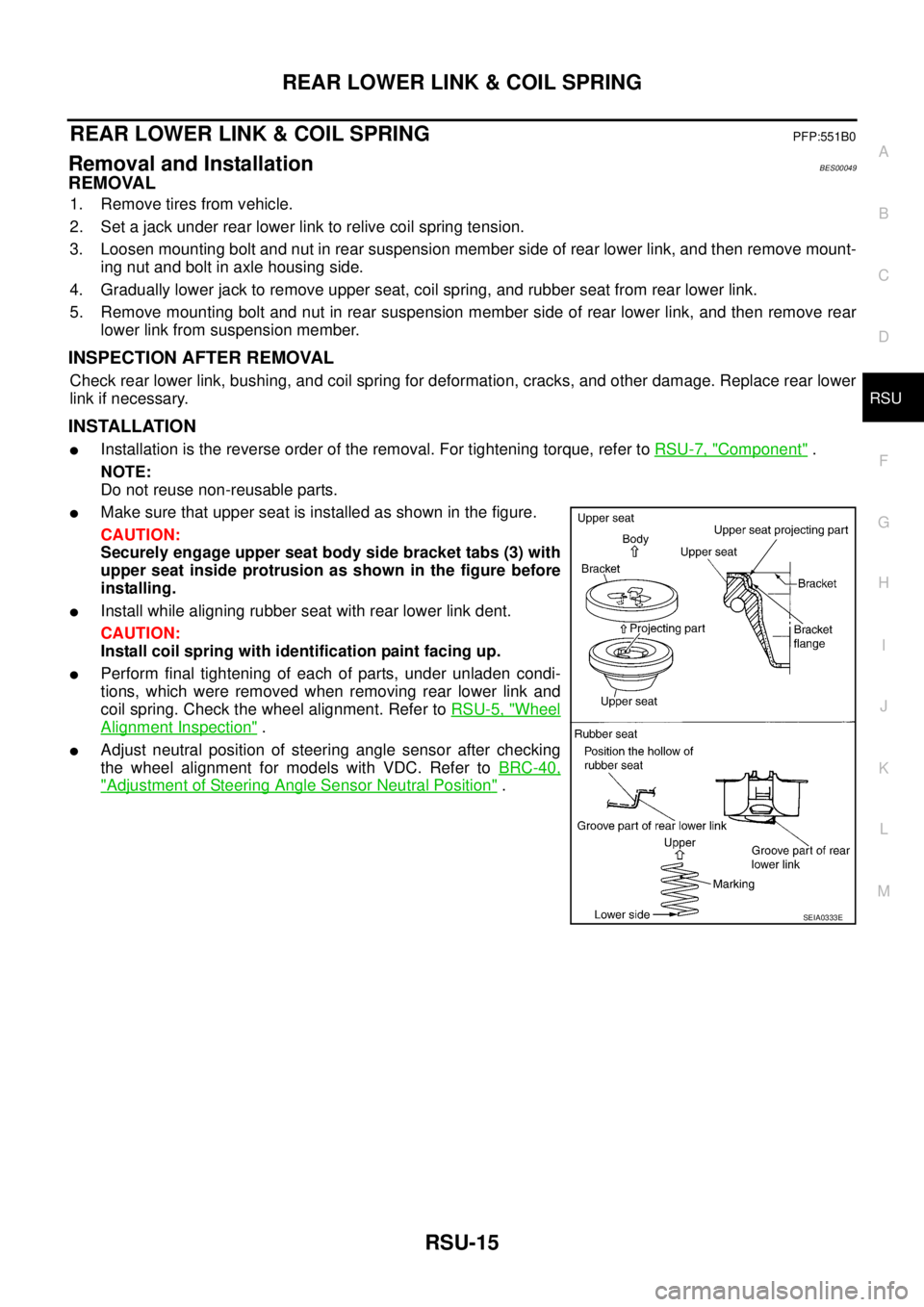
�Make sure that upper seat is installed as shown in the figure.
CAUTION:
Securely engage upper seat body side bracket tabs (3) with
upper seat inside protrusion as shown in the figure before
installing.
�Install while aligning rubber seat with rear lower link dent.
CAUTION:
Install coil spring with identification paint facing up.
�Perform final tightening of each of parts, under unladen condi-
tions, which were removed when removing rear lower link and
coil spring. Check the wheel alignment. Refer to RSU-5, "
Wheel
Alignment Inspection" .
�Adjust neutral position of steering angle sensor after checking
the wheel alignment for models with VDC. Refer to BRC-40,
"Adjustment of Steering Angle Sensor Neutral Position" .
SEIA0333E
Page 3208 of 3502
RSU-16
STABILIZER BAR
STABILIZER BARPFP:54611
Removal and InstallationBES0004A
REMOVAL
1. Remove tires from vehicle.
2. Remove mounting nut on lower side of connecting rod.
3. If necessary remove mounting nut on upper side of connecting rod. Remove connecting rod from mount-
ing bracket of suspension arm.
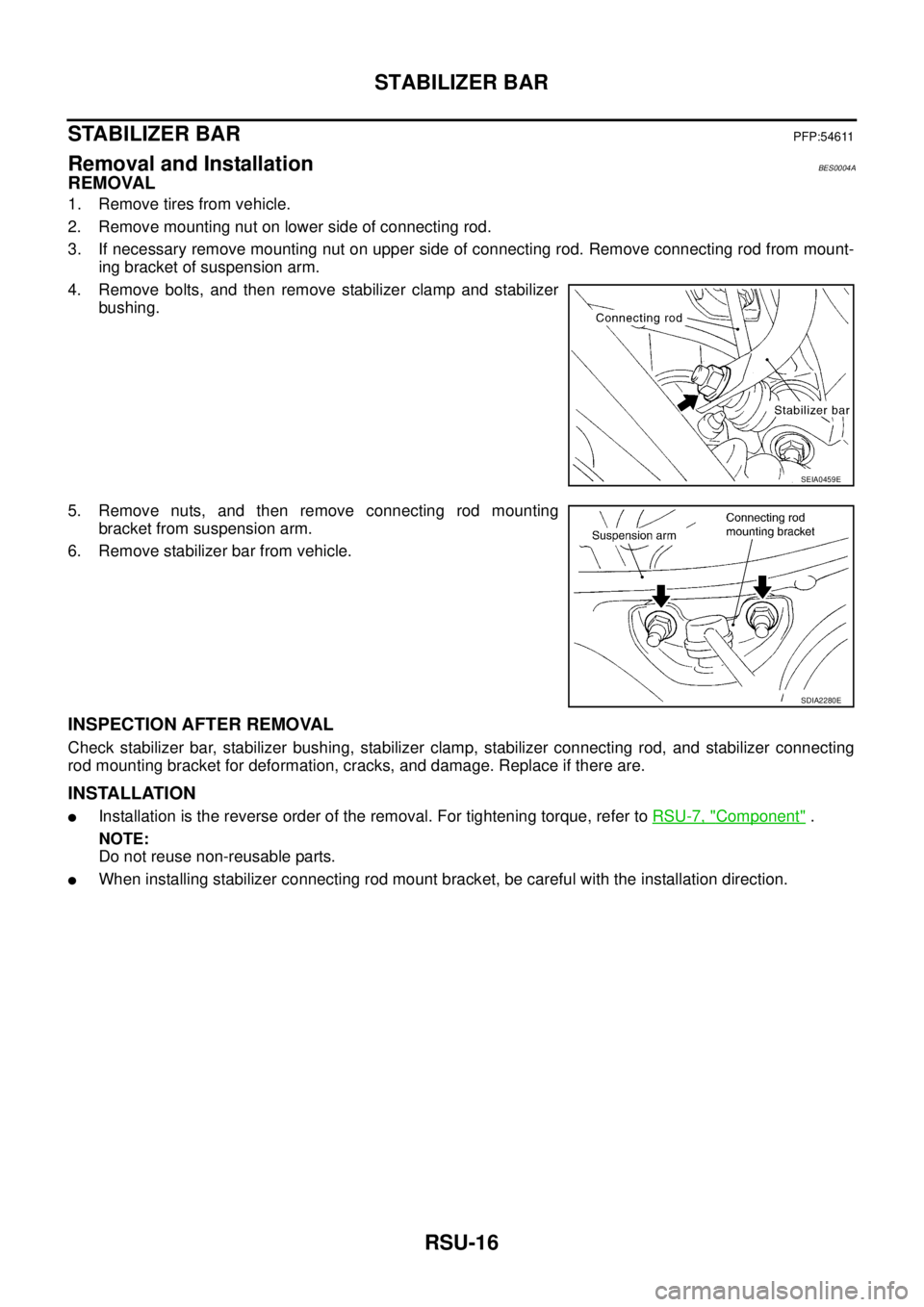
4. Remove bolts, and then remove stabilizer clamp and stabilizer
bushing.
5. Remove nuts, and then remove connecting rod mounting
bracket from suspension arm.
6. Remove stabilizer bar from vehicle.
INSPECTION AFTER REMOVAL
Check stabilizer bar, stabilizer bushing, stabilizer clamp, stabilizer connecting rod, and stabilizer connecting
rod mounting bracket for deformation, cracks, and damage. Replace if there are.
INSTALLATION
�Installation is the reverse order of the removal. For tightening torque, refer to RSU-7, "Component" .
NOTE:
Do not reuse non-reusable parts.
�When installing stabilizer connecting rod mount bracket, be careful with the installation direction.
SEIA0459E
SDIA2280E
Page 3209 of 3502
REAR SUSPENSION MEMBER
RSU-17
C
D
F
G
H
I
J
K
L
MA
B
RSU
REAR SUSPENSION MEMBERPFP:55501
Removal and InstallationBES0004B
REMOVAL
1. Remove tires from vehicle.
2. Remove wheel sensor from axle housing, and then disconnect sensor harness from suspension arm and
suspension member. Refer to BRC-33, "
WHEEL SENSORS" .
CAUTION:
Do not pull wheel sensor harness.
3. Remove torque member fixing bolts. Hang torque member in a place where it will not interfere with work.
Refer to BR-33, "
REAR DISC BRAKE" .
NOTE:
Do not depress brake pedal while brake caliper is removed.
4. Remove main muffler and center muffler. Refer to EX-2, "
EXHAUST SYSTEM" .
5. Remove stabilizer bar. Refer to RSU-16, "
STABILIZER BAR" .
6. Remove parking brake cable (rear cables) from rear suspension member and body. Refer to PB-2,
"PARKING BRAKE SYSTEM" .
7. Remove coil spring. Refer to RSU-15, "
REAR LOWER LINK & COIL SPRING" .
8. Remove mounting nuts on lower side of shock absorber assembly.
9. Set jack under rear suspension member.
10. Remove rear suspension member mounting nuts, and then remove rebound stopper.
11. Gradually lower jack to remove rear suspension member, suspension arm, radius rod, and front lower link
from vehicle as a unit.
12. Remove nuts and bolts, and remove suspension arm, radius rod, and front lower link from rear suspen-
sion member.
INSPECTION AFTER REMOVAL
Check rear suspension member for deformation, cracks, or other damage. Replace if there are.
INSTALLATION
�Installation is the reverse order of the removal. For tightening torque, refer to RSU-7, "Component" .
NOTE:
Do not reuse non-reusable parts.
�Perform final tightening of each of parts, under unladen conditions, which were removed when removing
rear suspension member. Check the wheel alignment. Refer to RSU-5, "
Wheel Alignment Inspection" .
�Adjust neutral position of steering angle sensor after checking the wheel alignment for models with VDC.
Refer to BRC-40, "
Adjustment of Steering Angle Sensor Neutral Position" .
�Check for the following after finishing work.
–Parking brake operation (stroke): Refer to PB-2, "On-Vehicle Inspection" .
–Check wheel sensor harness for proper connection: Refer to BRC-33, "WHEEL SENSORS" .
Page 3214 of 3502
SB-4
SEAT BELTS
6. Remove seat belt retractor mounting screw and anchor bolt.
7. Remove seat belt assembly.
INSTALLATION OF RETRACTOR
Install in the reverse order of removal.
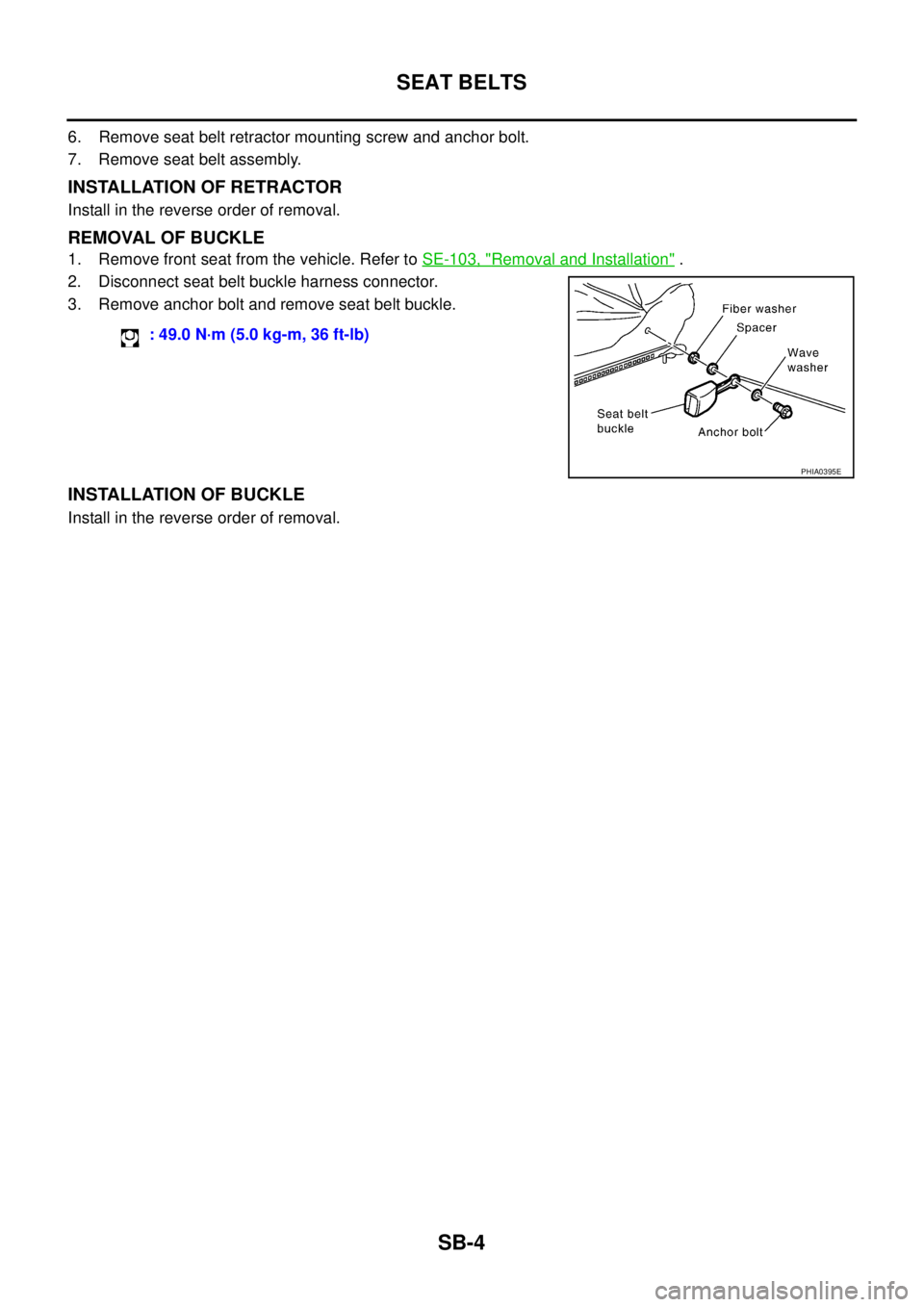
REMOVAL OF BUCKLE
1. Remove front seat from the vehicle. Refer to SE-103, "Removal and Installation" .
2. Disconnect seat belt buckle harness connector.
3. Remove anchor bolt and remove seat belt buckle.
INSTALLATION OF BUCKLE
Install in the reverse order of removal.: 49.0 N·m (5.0 kg-m, 36 ft-lb)
PHIA0395E
Page 3216 of 3502
SB-6
SEAT BELTS
REMOVAL
1. Remove rear seat cushion. Refer to SE-116, "Removal and Installation of Seat Cushion" .
2. Remove outer anchor bolt and inner anchor bolt.
3. Remove rear seatback. Refer to SE-117, "
Removal and Installation of Seatback" .
4. Remove rear seatback finisher and rear pillar finisher. Refer to EI-38, "
Removal and Installation" .
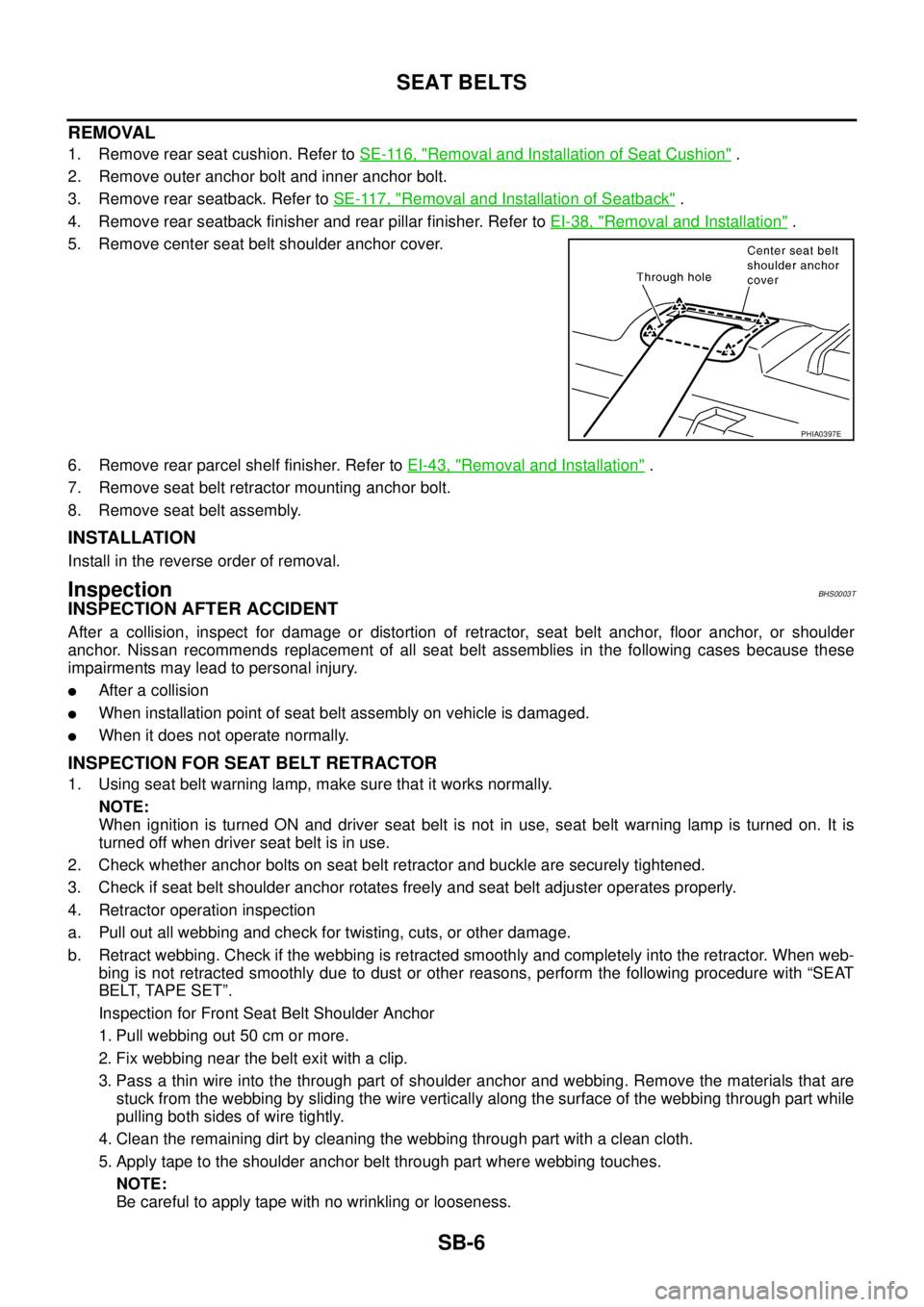
5. Remove center seat belt shoulder anchor cover.
6. Remove rear parcel shelf finisher. Refer to EI-43, "
Removal and Installation" .
7. Remove seat belt retractor mounting anchor bolt.
8. Remove seat belt assembly.
INSTALLATION
Install in the reverse order of removal.
InspectionBHS0003T
INSPECTION AFTER ACCIDENT
After a collision, inspect for damage or distortion of retractor, seat belt anchor, floor anchor, or shoulder
anchor. Nissan recommends replacement of all seat belt assemblies in the following cases because these
impairments may lead to personal injury.
�After a collision
�When installation point of seat belt assembly on vehicle is damaged.
�When it does not operate normally.
INSPECTION FOR SEAT BELT RETRACTOR
1. Using seat belt warning lamp, make sure that it works normally.
NOTE:
When ignition is turned ON and driver seat belt is not in use, seat belt warning lamp is turned on. It is
turned off when driver seat belt is in use.
2. Check whether anchor bolts on seat belt retractor and buckle are securely tightened.
3. Check if seat belt shoulder anchor rotates freely and seat belt adjuster operates properly.
4. Retractor operation inspection
a. Pull out all webbing and check for twisting, cuts, or other damage.
b. Retract webbing. Check if the webbing is retracted smoothly and completely into the retractor. When web-
bing is not retracted smoothly due to dust or other reasons, perform the following procedure with “SEAT
BELT, TAPE SET”.
Inspection for Front Seat Belt Shoulder Anchor
1. Pull webbing out 50 cm or more.
2. Fix webbing near the belt exit with a clip.
3. Pass a thin wire into the through part of shoulder anchor and webbing. Remove the materials that are
stuck from the webbing by sliding the wire vertically along the surface of the webbing through part while
pulling both sides of wire tightly.
4. Clean the remaining dirt by cleaning the webbing through part with a clean cloth.
5. Apply tape to the shoulder anchor belt through part where webbing touches.
NOTE:
Be careful to apply tape with no wrinkling or looseness.
PHIA0397E
Page 3231 of 3502
BATTERY
SC-13
C
D
E
F
G
H
I
J
L
MA
B
SC
Removal and Installation BKS001MD
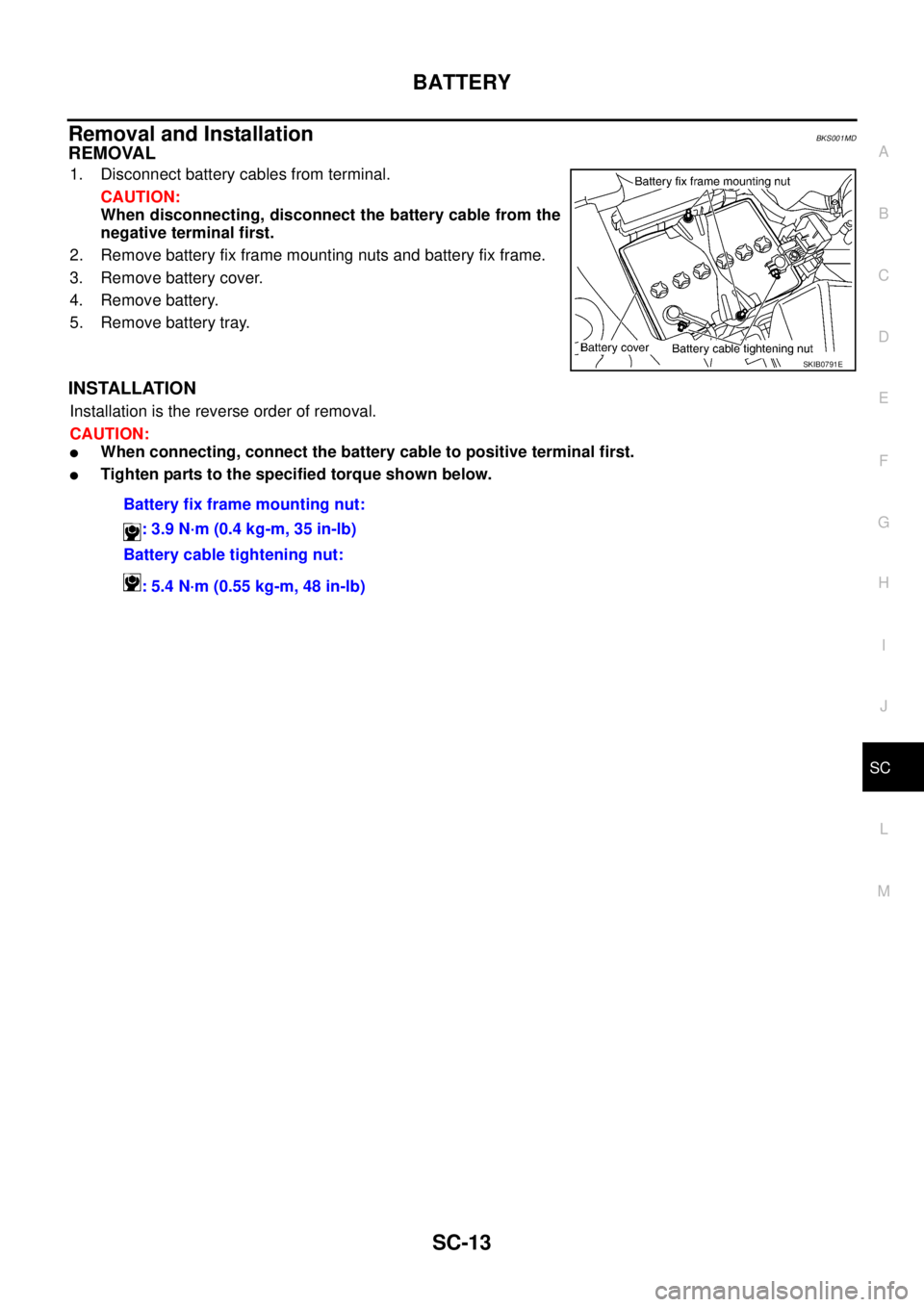
REMOVAL
1. Disconnect battery cables from terminal.
CAUTION:
When disconnecting, disconnect the battery cable from the
negative terminal first.
2. Remove battery fix frame mounting nuts and battery fix frame.
3. Remove battery cover.
4. Remove battery.
5. Remove battery tray.
INSTALLATION
Installation is the reverse order of removal.
CAUTION:
�When connecting, connect the battery cable to positive terminal first.
�Tighten parts to the specified torque shown below.
SKIB0791E
Battery fix frame mounting nut:
: 3.9 N·m (0.4 kg-m, 35 in-lb)
Battery cable tightening nut:
: 5.4 N·m (0.55 kg-m, 48 in-lb)
Page 3236 of 3502
SC-18
STARTING SYSTEM
Removal and Installation BKS001MH
VQ23DE AND VQ35DE MODELS
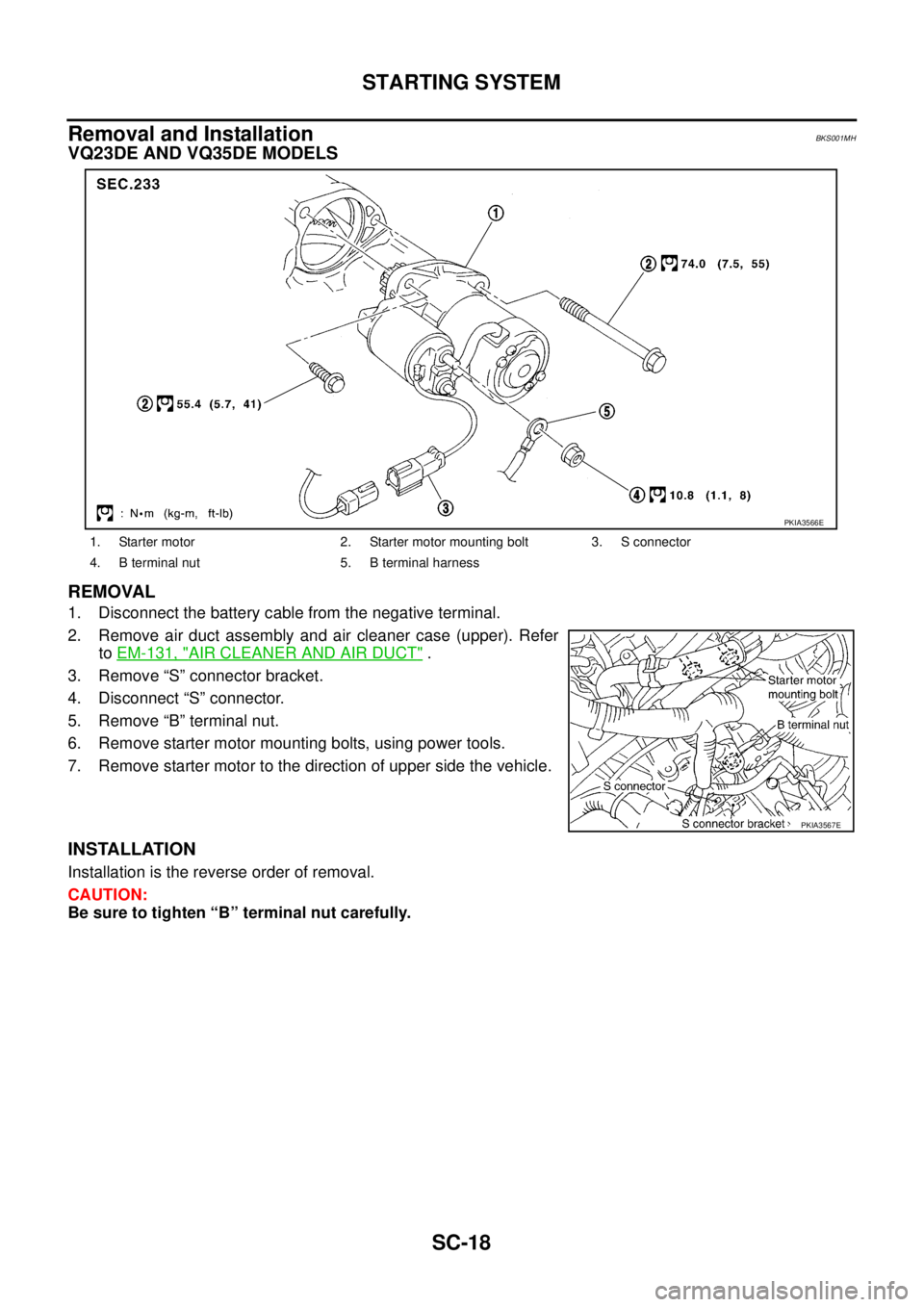
REMOVAL
1. Disconnect the battery cable from the negative terminal.
2. Remove air duct assembly and air cleaner case (upper). Refer
to EM-131, "
AIR CLEANER AND AIR DUCT" .
3. Remove “S” connector bracket.
4. Disconnect “S” connector.
5. Remove “B” terminal nut.
6. Remove starter motor mounting bolts, using power tools.
7. Remove starter motor to the direction of upper side the vehicle.
INSTALLATION
Installation is the reverse order of removal.
CAUTION:
Be sure to tighten “B” terminal nut carefully.
1. Starter motor 2. Starter motor mounting bolt 3. S connector
4. B terminal nut 5. B terminal harness
PKIA3566E
PKIA3567E