Page 480 of 4323

P22487
Vehicle Speed
SensorCombination
MeterECM 4±pulse 4±pulse DI±278
± DIAGNOSTICSENGINE
472 Author�: Date�:
2005 SEQUOIA (RM1146U)
DTC P0500 Vehicle Speed Sensor ºAº
DTC P0503 Vehicle Speed Sensor ºAº Intermittent/
Erratic/High
CIRCUIT DESCRIPTION
The No.1 vehicle speed sensor outputs a 4±pulse signal for every revolution of the rotor shaft, which is ro-
tated by the transmission output shaft via the driven gear. After this signal is converted into a more precise
rectangular waveform by the waveform shaping circuit inside the combination meter, it is then transmitted
to the ECM. The ECM determines the vehicle speed based on the frequency of these pulse signals.
DTC No.Proceed toDTC Detection ConditionTrouble Area
P0500Step 1
No vehicle speed sensor sig-
nal to ECM under following
conditions: (2 trip detection
logic)
�Vehicle is being driven
�Combination meter
�Open or short in vehicle speed sensor circuit
�Vehicle speed sensor
ECM
P0503DI±11Intermittent problem in the ve-
hicle speed sensor circuit�ECM
MONITOR DESCRIPTION
The ECM assumes that the vehicle is driven when the park/neutral position switch is OFF and it has been
over 4 sec. since the actual vehicle speed was 9 km/h (6 mph) or more.
If there is no signal from the vehicle speed sensor when these conditions are satisfied, the ECM concludes
that there is a fault in the vehicle speed sensor. The ECM will turn on the MIL and a DTC is set.
DID8B±01
Page 485 of 4323
± DIAGNOSTICSENGINE
DI±283
477 Author�: Date�:
2005 SEQUOIA (RM1146U)
DTC P0504 Brake Switch ºAº/ºBº Correlation
CIRCUIT DESCRIPTION
In addition to turning on the stop lamps, the stop lamp switch signals are used for a variety of engine, trans-
mission, and suspension functions as well as being an input for diagnostic checks. It is important that the
switch operates properly, therefore this switch is designed with two complementary signal outputs: STP and
ST1±. The ECM analyzes these signal outputs to detect malfunctions in the stop lamp switch.
HINT:
Normal condition is as shown in the table.
SignalBrake pedal releasedIn transitionBrake pedal depressed
STPOFFONON
ST1±ONONOFF
DTC No.DTC Detection ConditionTrouble Area
P0504
Conditions (a), (b) and (c) continue for 0.5 sec. or more:
(a) Ignition switch ON
(b) Brake pedal released
(c) STP signal is OFF when the ST1± signal is OFF�Short in stop lamp switch signal circuit
�Stop lamp fuse
�Stop lamp switch
�ECM
DID8C±01
Page 488 of 4323
B17446
Brake Pedal
DepressedBrake Pedal
Released ON
() ()
ST1±(+)E4
E6
E1(±)
DI±286
± DIAGNOSTICSENGINE
480 Author�: Date�:
2005 SEQUOIA (RM1146U)
3 Check STP signal and ST1± voltage.
PREPARATION:
(a) Connect the hand±held tester to the DLC3.
(b) Turn the ignition switch ON.
(c) Select the item ºDIAGNOSIS / ENHANCED OBD II /
DATA LIST / ALL / STOP LIGHT SWº.
CHECK:
Read the signal displayed on the hand±held tester.
OK:
Standard:
Brake PedalSpecified Condition
DepressedSTP Signal ON
ReleasedSTP Signal OFF
CHECK:
Measure the voltage between the specified terminals of the E4
and E6 ECM connectors.
OK:
Standard:
Tester ConnectionBrake PedalSpecified Condition
ST1± (E4±12) ±
E1 (E6±1)DepressedBelow 1.5 V
ST1± (E4±12) ±
E1 (E6±1)Released7.5 to 14 V
OK Check for intermittent problems (See page
DI±11).
NG
Page 500 of 4323

DI±298
± DIAGNOSTICSENGINE
492 Author�: Date�:
2005 SEQUOIA (RM1146U)
DTC P0617 Starter Relay Circuit High
MONITOR DESCRIPTION
While the engine is being cranked, the battery positive voltage is applied to terminal STA of the ECM.
If the vehicle is being driven and the ECM detects the starter control signal (STA), the ECM concludes that
the starter control circuit is malfunctioning. The ECM will turn on the MIL and a DTC is set.
DTC No.DTC Detection ConditionTrouble Area
P0617
When all conditions (a), (b) and (c) are satisfied for 20 seconds
with battery (+B) voltage 10.5 V or more
(a) Vehicle speed � 20 km/h (12.4 mph)
(b) Engine revolution � 1,000 rpm
(c) STA signal ON�Park/neutral position switch
�Starter relay circuit
�Ignition switch
�ECM
MONITOR STRATEGY
Related DTCsP0617Starter signal error
Rid / tMain sensors/componentsStarter signalRequired sensors/componentsRelated sensors/componentsVehicle speed sensor, Engine speed sensor
Frequency of operationContinuous
Duration20 sec.
MIL operationImmediate
Sequence of operationNone
TYPICAL ENABLING CONDITIONS
ItSpecificationItemMinimumMaximum
The monitor will run whenever this DTC is
not presentSee page DI±18
Battery voltage10.5 V±
Vehicle speed20 km/h (12.4 mph)±
Engine RPM1,000 rpm±
TYPICAL MALFUNCTION THRESHOLDS
Detection CriteriaThreshold
Starter signalON (at ºmore than 20 km/h (12.4 mph) and more than 1,000 rpmº)
DID8D±01
Page 502 of 4323

DI±300
± DIAGNOSTICSENGINE
494 Author�: Date�:
2005 SEQUOIA (RM1146U)
INSPECTION PROCEDURE
HINT:
Read freeze frame data using the hand±held tester. Freeze frame data records the engine conditions when
a malfunction is detected. When troubleshooting, freeze frame data can help determine if the vehicle was
running or stopped, if the engine was warmed up or not, if the air±fuel ratio was lean or rich, as well as other
data from the time when a malfunction occurred.
1 Connect hand±held tester, and check STA signal.
PREPARATION:
(a) Connect the hand±held tester to the DLC3.
(b) Turn the ignition switch ON, and push the hand±held tester main switch ON.
(c) When using hand±held tester, enter the following menu: DIAGNOSIS / ENHANCED OBD II / DATA
LIST / ALL / STARTER SIG.
CHECK:
Read the STA signal on the hand±held tester while the starter operates.
OK:
Standard:
Ignition Switch PositionONSTART
STARTER SIGOFFON
OK Go to step 5.
NG
2 Check park/neutral position switch (See page DI±576).
NG Replace park/neutral position switch.
Go to next step 5 after the replacement.
OK
3 Check ignition switch (See page BE±24).
NG Replace ignition switch.
Go the next step 5 after the replacement.
OK
Page 503 of 4323
± DIAGNOSTICSENGINE
DI±301
495 Author�: Date�:
2005 SEQUOIA (RM1146U)
4 Connect hand±held tester, and check STA signal.
PREPARATION:
(a) Connect the hand±held tester to the DLC3.
(b) Turn the ignition switch ON, and push the hand±held tester main switch ON.
(c) On the hand±held tester, enter the following menu: DIAGNOSIS / ENHANCED OBD II / DATA LIST
/ ALL / STARTER SIG.
CHECK:
Read the STA signal on the hand±held tester while the starter operates.
OK:
Standard:
Ignition Switch PositionONSTART
STARTER SIGOFFON
NG Repair or replace harness or connector.
OK
5 Check DTC reoccur
PREPARATION:
(a) Connect the hand±held tester.
(b) Turn the ignition switch ON and hand±held tester main switch ON.
(c) Clear DTC (See page DI±43).
(d) Drive the vehicle more than 40 km/h (25 mph) for 20 seconds or more.
CHECK:
Check DTC reoccur.
RESULT:
Display (DTC Output)Proceed to
P0617A
No DTC outputB
A Replace ECM (See page SF±80).
B
Check for intermittent problems
(See page DI±11).
Page 508 of 4323
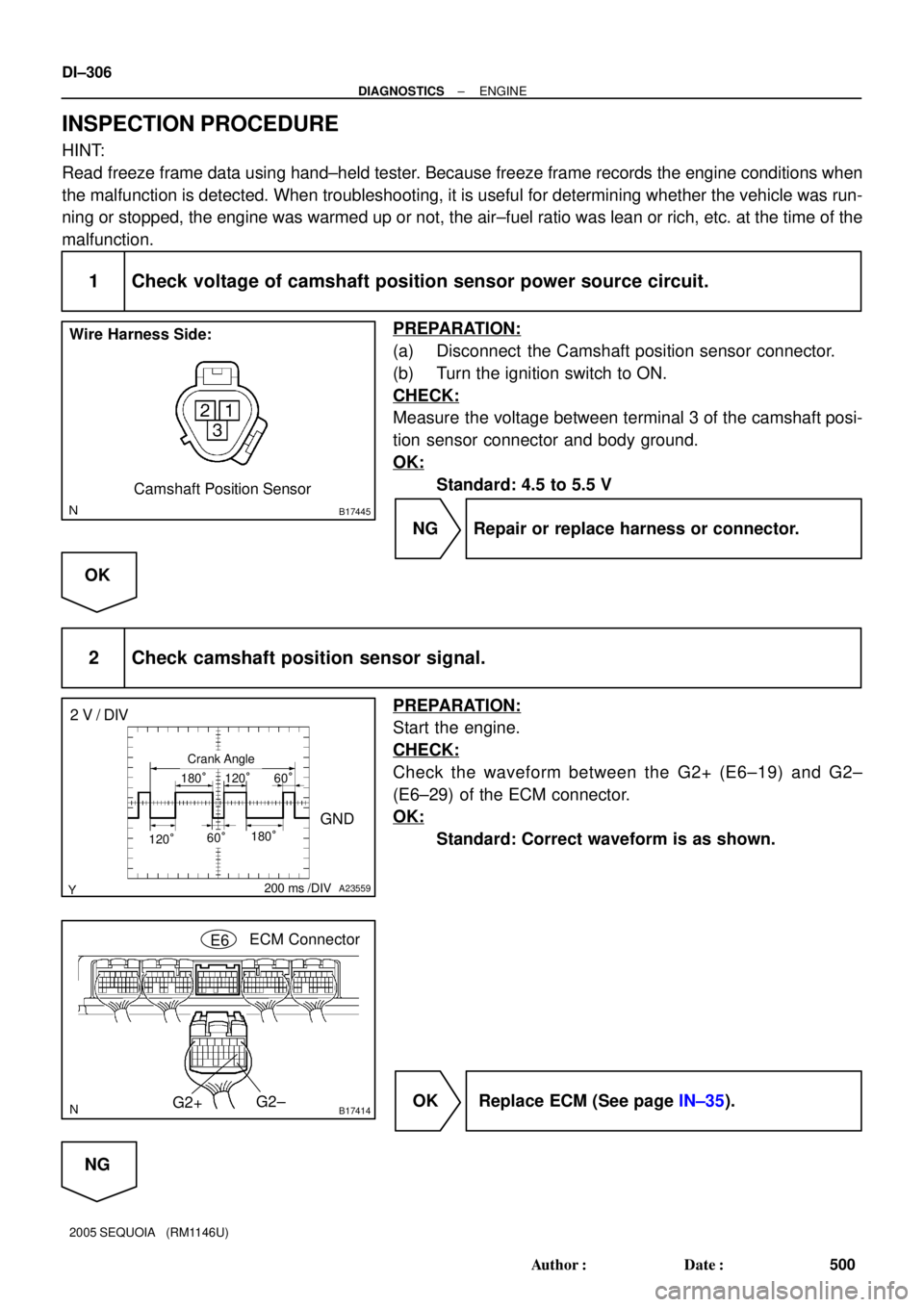
B17445
Wire Harness Side:
Camshaft Position Sensor
A23559
2 V / DIV
GND
Crank Angle
120°120° 180°
180°
60°60°
200 ms /DIV
B17414
E6ECM Connector
G2+
G2±
DI±306
± DIAGNOSTICSENGINE
500 Author�: Date�:
2005 SEQUOIA (RM1146U)
INSPECTION PROCEDURE
HINT:
Read freeze frame data using hand±held tester. Because freeze frame records the engine conditions when
the malfunction is detected. When troubleshooting, it is useful for determining whether the vehicle was run-
ning or stopped, the engine was warmed up or not, the air±fuel ratio was lean or rich, etc. at the time of the
malfunction.
1 Check voltage of camshaft position sensor power source circuit.
PREPARATION:
(a) Disconnect the Camshaft position sensor connector.
(b) Turn the ignition switch to ON.
CHECK:
Measure the voltage between terminal 3 of the camshaft posi-
tion sensor connector and body ground.
OK:
Standard: 4.5 to 5.5 V
NG Repair or replace harness or connector.
OK
2 Check camshaft position sensor signal.
PREPARATION:
Start the engine.
CHECK:
Check the waveform between the G2+ (E6±19) and G2±
(E6±29) of the ECM connector.
OK:
Standard: Correct waveform is as shown.
OK Replace ECM (See page IN±35).
NG
Page 547 of 4323

B17411
ECM Connector
E1AIDI
A16555
AIR INJ CHECK
AIR PUMP............................ON
EASV ............................OPEN
ASV1. .............................OPEN
ASV2...............................OPEN
A/F BANK1.......................19.05
A/F BANK2.......................19.05
PRESSURE....................17 kPa
PULSATION..............25.39 kPa
AI STATUS...........................OK
Remaining Time 05 sec.
Press [EXIT] to quit
± DIAGNOSTICSENGINE
DI±345
539 Author�: Date�:
2005 SEQUOIA (RM1146U) Case 3:
Diagnostic signal duty ratio from air injection driver0 %
Case 4:
Diagnostic signal duty ratio from air injection driver100 %
COMPONENT OPERATING RANGE
ParameterStandard Value
Diagnostic signal duty ratio from air injection driver
70 to 90% when secondary air injection system operating
and
0% when secondary air injection system not operating
WIRING DIAGRAM
Refer to DTC P0412 on page DI±234.
INSPECTION PROCEDURE
HINT:
The diagnostic information output from the AID can be confirmed by connecting an oscilloscope to the diag-
nostic information terminal of the AID. It narrows a trouble area search to read the waveform on the oscillo-
scope when performing the AI system intrusive operation function provided in the SYSTEM CHECK.
(a) Start the engine and warm it up.
(b) Turn the ignition switch to OFF.
(c) Connect a hand±held tester to the DLC3.
(d) Connect an oscilloscope probe to the AIDI terminal of the
ECM.
(e) Start the engine and turn the tester ON.
(f) On the tester, select the following menu items:
DIAGNOSIS / ENHANCED OBD II / SYSTEM CHECK /
AIR INJ SYSTEM.
(g) On the tester, select the following menu items:
DIAGNOSIS / ENHANCED OBD II / SYSTEM CHECK /
AIR INJ CHECK / MANUAL OPERATION / OPERATION
1 and 2.
HINT:
OPERATION 1: AP: OFF, EASV:CLOSE, ASV1:CLOSE,
ASV2:OFF
OPERATION 2: AP: ON, EASV:OPEN, ASV1:OPEN,
ASV2:OPEN