Page 357 of 4323
A19288
EFI Relay
± DIAGNOSTICSENGINE
DI±163
357 Author�: Date�:
2005 SEQUOIA (RM1146U)
16 Check EFI relay.
PREPARATION:
Remove the EFI relay from the engine room J/B.
CHECK:
Inspect the EFI relay.
OK:
Standard:
Terminal No.ConditionSpecified Condition
3 ± 5Always10 KW or higher
3 ± 5Apply B+ between
terminals 1 and 2Below 1 W
NG Replace EFI relay.
OK
Page 358 of 4323
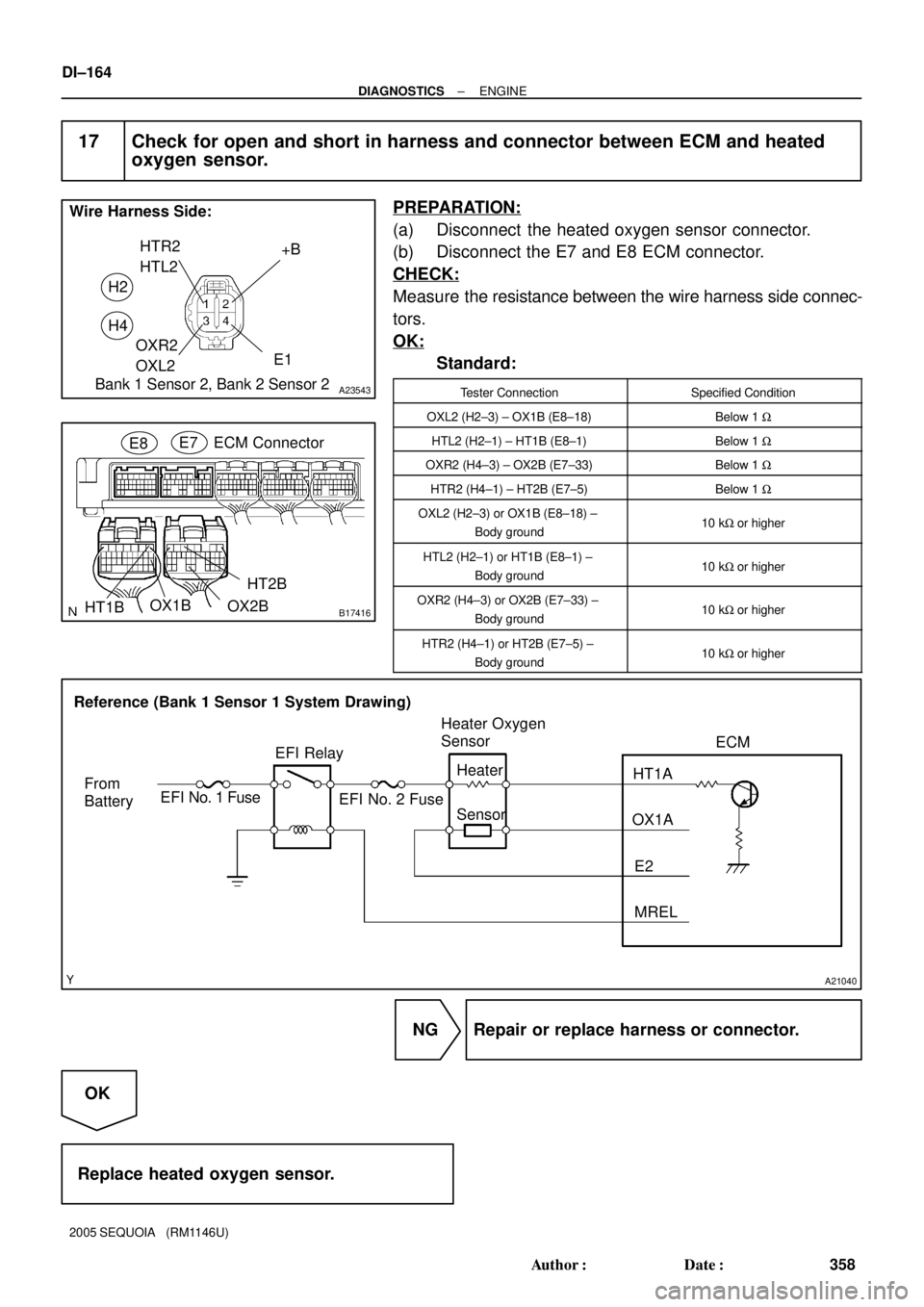
A23543
+B
OXR2
OXL2E1 HTR2
HTL2
H2
H4
Wire Harness Side:
Bank 1 Sensor 2, Bank 2 Sensor 2
B17416HT1BECM Connector E7OX1B E8
HT2B
OX2B
A21040
Reference (Bank 1 Sensor 1 System Drawing)
From
BatteryEFI No. 1 FuseEFI Relay
EFI No. 2 FuseHeater Oxygen
Sensor
Heater
SensorHT1A
OX1A
E2
MRELECM
DI±164
± DIAGNOSTICSENGINE
358 Author�: Date�:
2005 SEQUOIA (RM1146U)
17 Check for open and short in harness and connector between ECM and heated
oxygen sensor.
PREPARATION:
(a) Disconnect the heated oxygen sensor connector.
(b) Disconnect the E7 and E8 ECM connector.
CHECK:
Measure the resistance between the wire harness side connec-
tors.
OK:
Standard:
Tester ConnectionSpecified Condition
OXL2 (H2±3) ± OX1B (E8±18)Below 1 W
HTL2 (H2±1) ± HT1B (E8±1)Below 1 W
OXR2 (H4±3) ± OX2B (E7±33)Below 1 W
HTR2 (H4±1) ± HT2B (E7±5)Below 1 W
OXL2 (H2±3) or OX1B (E8±18) ±
Body ground10 kW or higher
HTL2 (H2±1) or HT1B (E8±1) ±
Body ground10 kW or higher
OXR2 (H4±3) or OX2B (E7±33) ±
Body ground10 kW or higher
HTR2 (H4±1) or HT2B (E7±5) ±
Body ground10 kW or higher
NG Repair or replace harness or connector.
OK
Replace heated oxygen sensor.
Page 363 of 4323

+25 %
±12.5 %
More than 3.35 V
Less than 3.0 V
1
A/F Sensor (Sensor 1)
Output Voltage
Injection volume
Output voltage
HO2 Sensor (Sensor 2)
Output VoltageMain Suspected
Trouble Areas
OK
+25 %
±12.5 %
More than 3.35 V
Less than 3.0V
Injection volume
Output voltage
+25 %
±12.5 %
More than 0.55 V
Less than 0.4V
Injection volume
Output voltage
A/F sensor+25 %
±12.5 %
More than 0.55 V
Less than 0.4V
Injection volume
Output voltage
+25 %
±12.5 %
Injection volume
Output voltage
NG
+25 %
±12.5 %
Injection volume
Output voltage
NG
+25 %
±12.5 %
Injection volume
Output voltage
NG
+25 %
±12.5 %
Injection volume
Output voltage
NG OK
OK
OK
Almost
no reaction
'
Almost
no reaction Almost
no reaction
Almost
no reaction
Case
2
3
4
A/F sensor circuit A/F sensor heater
HO2 sensor
HO2 sensor circuit HO2 sensor heater
(Air±fuel ratio extremely
lean or rich)Injector
Gas leakage from
exhaust system Fuel pressure
± DIAGNOSTICSENGINE
DI±169
363 Author�: Date�:
2005 SEQUOIA (RM1146U)
Standard:
Tester Display
(Sensor)Injection VolumesStatusVoltages
AFS B1S1 (AFS B2S1)
(A/F)+25 %RichLess than 3.0
AFS B1S1 (AFS B2S1)
(A/F)±12.5 %LeanMore than 3.35
O2S B1S2 (O2S B2S2)
(HO2)+25 %RichMore than 0.55
O2S B1S2 (O2S B2S2)
(HO2)±12.5 %LeanLess than 0.4
NOTICE:
The Air±Fuel Ratio (A/F) sensor has an output delay of a few seconds and the Heated Oxygen (HO2)
sensor has a maximum output delay of approximately 20 seconds.
�Following the A/F CONTROL procedure enables technicians to check and graph the voltage outputs
of both the A/F and HO2 sensors.
�To display the graph, select the following menu items on the tester: DIAGNOSIS / ENHANCED OBD
II / ACTIVE TEST / A/F CONTROL / USER DATA / AFS B1S1 and O2S B1S2, and press the YES but-
ton and then the ENTER button followed by the F4 button.
Page 364 of 4323

DI±170
± DIAGNOSTICSENGINE
364 Author�: Date�:
2005 SEQUOIA (RM1146U)
HINT:
�Read freeze frame data using a hand±held tester. Freeze frame data record the engine condition when
malfunctions are detected. When troubleshooting, freeze frame data can help determine if the vehicle
was moving or stationary, if the engine was warmed up or not, if the air±fuel ratio was lean or rich, and
other data, from the time the malfunction occurred.
�A low A/F sensor voltage could be caused by a rich air±fuel mixture. Check for conditions that would
cause the engine to run rich.
�A high A/F sensor voltage could be caused by a lean air±fuel mixture. Check for conditions that would
cause the engine to run lean.
1 Check any other DTCs output (in addition to DTC P0171, P0172, P0174 or P0175).
PREPARATION:
(a) Connect a hand±held tester to the DLC3.
(b) Turn the ignition switch to ON and turn the tester ON.
(c) Select the following menu items: DIAGNOSIS / ENHANCED OBD II / DTC INFO / CURRENT CODES.
CHECK:
(a) Read DTCs.
Result:
Display (DTC Output)Proceed To
P0171, P0172, P0174 or P0175A
P0171, P0172, P0174 or P0175 and other DTCsB
HINT:
If any DTCs other than P0171, P0172, P0174 or P0175 are output, troubleshoot those DTCs first.
B Go to DTC chart (See page DI±58).
A
2 Check connection of PCV piping.
OK:
PCV hose is connected correctly and is not damaged.
NG Repair or replace PCV piping.
OK
Page 365 of 4323

± DIAGNOSTICSENGINE
DI±171
365 Author�: Date�:
2005 SEQUOIA (RM1146U)
3 Check air induction system (See page SF±1).
CHECK:
Check the air induction system for vacuum leaks.
NG Repair or replace air induction system.
OK
4 Perform active test (A/F control).
(a) Connect the hand±held tester to the DLC3.
(b) Start the engine and turn the tester ON.
(c) Warm up the engine at an engine speed of 2,500 rpm for approximately 90 seconds.
(d) On the tester, select the following menu items: DIAGNOSIS / ENHANCED OBD II / ACTIVE TEST /
A/F CONTROL.
(e) Perform the A/F CONTROL operation with the engine in an idling condition (press the RIGHT or LEFT
button to change the fuel injection volume).
(f) Monitor the voltage outputs of A/F and HO2 sensors(AFS B1S1 (AFS B2S1) and O2S B1S2 (O2S
B2S2)) displayed on the tester.
HINT:
�The A/F CONTROL operation lowers the fuel injection volume by 12.5 % or increases the injection
volume by 25 %.
�Each sensor reacts in accordance with increases and decreases in the fuel injection volume.
Standard:
Tester Display
(Sensor)Injection VolumesStatusVoltages
AFS B1S1 (AFS B2S1)
(A/F)+25 %RichLess than 3.0
AFS B1S1 (AFS B2S1)
(A/F)±12.5 %LeanMore than 3.35
O2S B1S2 (O2S B2S2)
(HO2)+25 %RichMore than 0.55
O2S B1S2 (O2S B2S2)
(HO2)±12.5 %LeanLess than 0.4
Result:
Status
AFS B1S1
(AFS B2S1)Status
O2S B1S2
(O2S B2S2)A/F Condition and
A/F Sensor ConditionMisfiresSuspected Trouble AreasProceed To
Lean/RichLean/RichNormal''C
LeanLeanActual air±fuel ratio leanMay occur
�PCV valve and hose
�PCV hose connections
�Injector blockage
�Gas leakage from exhaust system
�Air induction system
�Fuel pressure
�Mass Air Flow (MAF) meter
�Engine Coolant Temperature (ECT)
sensor
A
Page 366 of 4323

DI±172
± DIAGNOSTICSENGINE
366 Author�: Date�:
2005 SEQUOIA (RM1146U)Rich
RichActual air±fuel ratio rich'
�Injector leakage or blockage
�Gas leakage from exhaust system
�Ignition system
�Fuel pressure
�MAF meter
�ECT sensor
A
LeanLean/RichA/F sensor malfunction'�A/F sensorB
RichLean/RichA/F sensor malfunction'�A/F sensorB
Lean: During A/F CONTROL, the A/F sensor output voltage (AFS) is consistently more than 3.35 V, and the
HO2 sensor output voltage (O2S) is consistently less than 0.4 V.
Rich: During A/F CONTROL, the AFS is consistently less than 3.0 V, and the O2S is consistently more than
0.55 V.
B Go to step 11.
C Go to step 15.
A
5 Read value of engine coolant temperature.
PREPARATION:
(a) Connect the hand±held tester to the DLC3.
(b) Turn the ignition switch to ON and turn the tester ON.
(c) Select the following menu items: DIAGNOSIS / ENHANCED OBD II / DATA LIST / ALL / COOLANT
TEMP.
CHECK:
(a) Read the COOLANT TEMP twice, when the engine is cold and also when warmed up.
Standard:
With cold engine: Same as ambient air temperature.
With warm engine: Between 75�C and 95�C (167�F and 203�F)
NG Replace engine coolant temperature sensor.
OK
Page 367 of 4323

± DIAGNOSTICSENGINE
DI±173
367 Author�: Date�:
2005 SEQUOIA (RM1146U)
6 Read value of mass air flow meter.
PREPARATION:
(a) Connect the hand±held tester to the DLC3.
(b) Turn the ignition switch to ON and turn the tester ON.
(c) Select the following menu items: DIAGNOSIS / ENHANCED OBD II / DATA LIST / ALL / MAF and
COOLANT TEMP.
(d) Allow the engine to idle until the COOLANT TEMP reaches 75�C (167�F) or more.
CHECK:
(a) Read the MAF with the engine in an idling condition and at an engine speed of 2,500 rpm.
Standard:
MAF while engine idling: Between 1.4 gm/s and 2.3 gm/s (shift position: N, A/C: OFF).
MAF at engine speed of 2,500 rpm: Between 5.4 gm/s and 7.9 gm/s (shift position: N, A/C: OFF).
NG Replace mass air flow meter.
OK
7 Check fuel pressure (See page SF±7).
CHECK:
Check the fuel pressure (high or low pressure).
NG Check and replace fuel pump, pressure regula-
tor, fuel pipe line and filter (See page SF±1).
OK
8 Check exhaust system for gas leakage.
OK:
No exhaust gas leakage.
NG Repair or replace exhaust gas leakage point.
OK
Page 368 of 4323

B17396
HT +B
AF± AF+ Sensor 1A/F Sensor Component Side:
Front View
DI±174
± DIAGNOSTICSENGINE
368 Author�: Date�:
2005 SEQUOIA (RM1146U)
9 Check for spark and ignition (See page IG±1).
HINT:
If the spark plugs or ignition system malfunction, engine misfire may occur. The misfire counter can be read
with the hand±held tester. Enter the following menus: DIAGNOSIS / ENHANCED OBD II / DATA LIST / MIS-
FIRE / CYL#1 (to CYL#8).
NG Repair or replace ignition system.
OK
10 Check injector injection (See page SF±29).
HINT:
If the injectors malfunction, engine misfires may occur. The misfire counter can be read with the hand±held
tester. Enter the following menus: DIAGNOSIS / ENHANCED OBD II / DATA LIST / MISFIRE / CYL#1 (to
CYL#8).
NG Replace injector.
OK
11 Check resistance of air±fuel ratio (A/F) sensor heater.
PREPARATION:
Disconnect the air±fuel ratio (A/F) sensor connector.
CHECK:
Measure resistance between the terminals of the A/F sensor
connector.
OK:
Standard:
Tester ConnectionSpecified Condition
HT (1) ± +B (2)1.8 to 3.4 W at 20�C (68�F)
HT (1) ± AF± (4)10 kW or higher
NG Replace air±fuel ratio (A/F) sensor.
OK