Page 948 of 1897
- DIAGNOSTICSENGINE
DI-69
225 Author�: Date�:
2001 AVALON (RM808U)
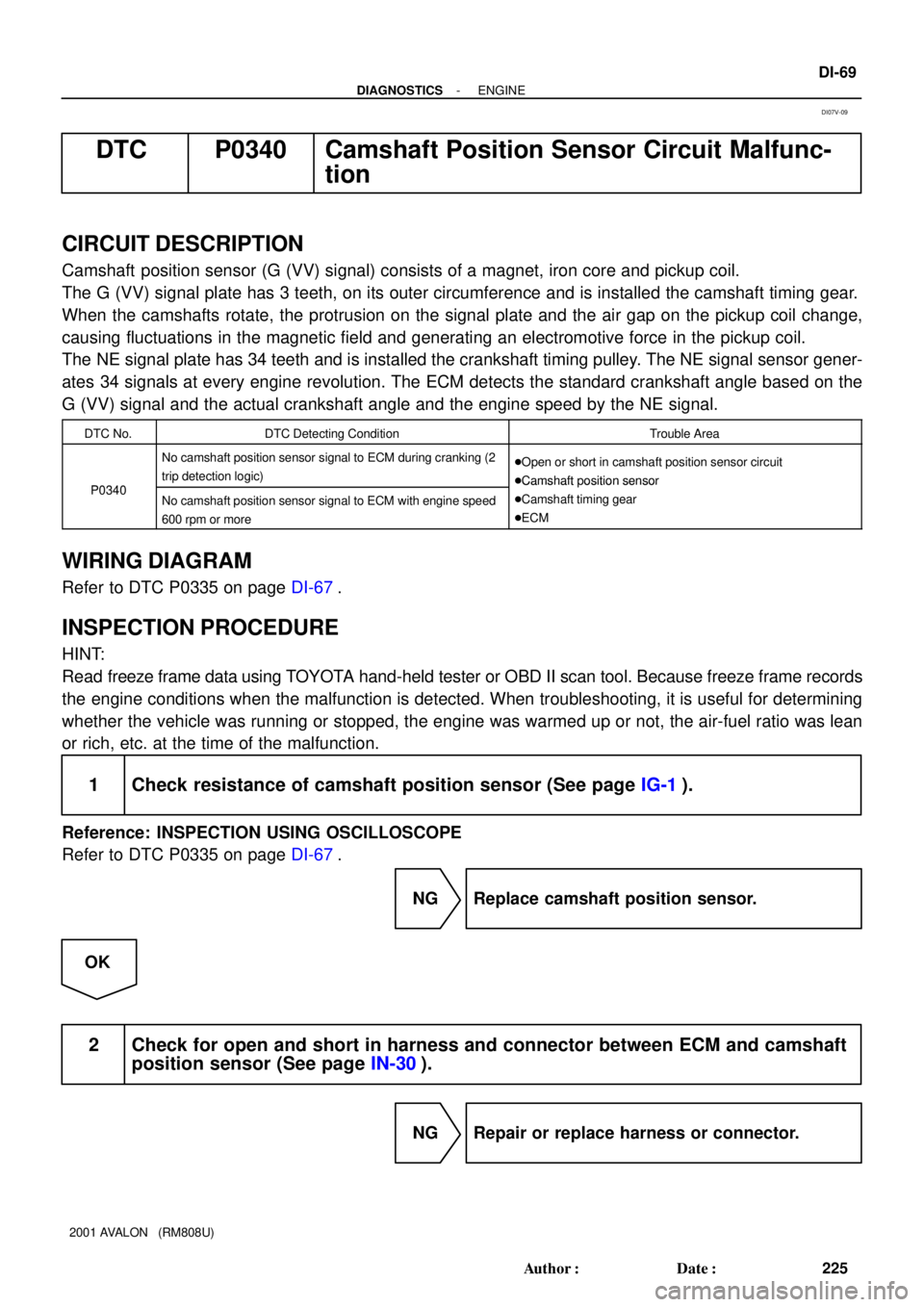
DTC P0340 Camshaft Position Sensor Circuit Malfunc-
tion
CIRCUIT DESCRIPTION
Camshaft position sensor (G (VV) signal) consists of a magnet, iron core and pickup coil.
The G (VV) signal plate has 3 teeth, on its outer circumference and is installed the camshaft timing gear.
When the camshafts rotate, the protrusion on the signal plate and the air gap on the pickup coil change,
causing fluctuations in the magnetic field and generating an electromotive force in the pickup coil.
The NE signal plate has 34 teeth and is installed the crankshaft timing pulley. The NE signal sensor gener-
ates 34 signals at every engine revolution. The ECM detects the standard crankshaft angle based on the
G (VV) signal and the actual crankshaft angle and the engine speed by the NE signal.
DTC No.DTC Detecting ConditionTrouble Area
P0340
No camshaft position sensor signal to ECM during cranking (2
trip detection logic)�Open or short in camshaft position sensor circuit
�Camshaft position sensor
P0340No camshaft position sensor signal to ECM with engine speed
600 rpm or more
�Camshaft osition sensor
�Camshaft timing gear
�ECM
WIRING DIAGRAM
Refer to DTC P0335 on page DI-67.
INSPECTION PROCEDURE
HINT:
Read freeze frame data using TOYOTA hand-held tester or OBD II scan tool. Because freeze frame records
the engine conditions when the malfunction is detected. When troubleshooting, it is useful for determining
whether the vehicle was running or stopped, the engine was warmed up or not, the air-fuel ratio was lean
or rich, etc. at the time of the malfunction.
1 Check resistance of camshaft position sensor (See page IG-1).
Reference: INSPECTION USING OSCILLOSCOPE
Refer to DTC P0335 on page DI-67.
NG Replace camshaft position sensor.
OK
2 Check for open and short in harness and connector between ECM and camshaft
position sensor (See page IN-30).
NG Repair or replace harness or connector.
DI07V-09
Page 949 of 1897
DI-70
- DIAGNOSTICSENGINE
226 Author�: Date�:
2001 AVALON (RM808U)
OK
3 Inspect sensor installation and signal plate teeth of camshaft timing gear.
NG Tighten sensor. Replace camshaft timing gear.
OK
Check and replace ECM (See page IN-30).
Page 950 of 1897

A01674
Waveform of
A/F Sensor
Normal CatalystWaveform of Heated Oxygen
Sensor behind Catalyst
Abnormal Catalyst
- DIAGNOSTICSENGINE
DI-71
227 Author�: Date�:
2001 AVALON (RM808U)
DTC P0420 Catalyst System Efficiency Below Threshold
(Bank 1)
CIRCUIT DESCRIPTION
The ECM observes the waveform of the heated oxygen sensor located behind the catalyst to determine
whether the catalyst performance has deteriorated.
If the catalyst is functioning normally, the waveform of the heated oxygen sensor located behind the catalyst
switches back and forth between rich and lean much more slowly.
When the waveform of the heated oxygen sensor located behind the catalyst alternates flutteringly between
rich and lean, it indicates that catalyst performance has deteriorated.
DTC No.DTC Detecting ConditionTrouble Area
P0420
After engine and catalyst are warmed up, and while vehicle is
driven within set vehicle and engine speed range, waveform of
heated oxygen sensor (bank 1 sensor 2) alternates flutteringly
between rich and lean (2 trip detection logic)�Gas leakage on exhaust system
�A/F sensor (bank 1, 2 sensor 1)
�Heated oxygen sensor (bank 1 sensor 2)
�Three-way catalytic converter
DI6T5-01
Page 951 of 1897

A00479
Engine Speed
3,000 rpm
Idling
IG SW OFF
Warmed up
3 min. or so
CheckTime (a)(c) (d)
(b) 2,000 rpm
2 sec. 2 sec.
DI-72
- DIAGNOSTICSENGINE
228 Author�: Date�:
2001 AVALON (RM808U)
CONFIRMATION ENGINE RACING PATTERN
(a) Connect the OBD II scan tool or TOYOTA hand-held tester to the DLC3.
(b) Start engine and warm it up with all the accessories switched OFF until the water temperature is stable.
(c) Race the engine at 2,500 - 3,000 rpm for about 3 min.
(d) When racing the engine at 3,000 rpm for 2 sec. and 2,000 rpm for 2 sec. alternately, check the wave-
form of the heated oxygen sensor (bank 1 sensor 2).
INSPECTION PROCEDURE
HINT:
Read freeze frame data using TOYOTA hand-held tester or OBD II scan tool. Because freeze frame records
the engine conditions when the malfunction is detected. When troubleshooting, it is useful for determining
whether the vehicle was running or stopped, the engine was warmed up or not, the air-fuel ratio was lean
or rich, etc. at the time of the malfunction.
1 Are there any other codes (besides DTC P0420) being output?
YES Go to relevant DTC chart (See page DI-14).
NO
2 Check gas leakage on exhaust system.
NG Repair or replace.
OK
Page 952 of 1897
- DIAGNOSTICSENGINE
DI-73
229 Author�: Date�:
2001 AVALON (RM808U)
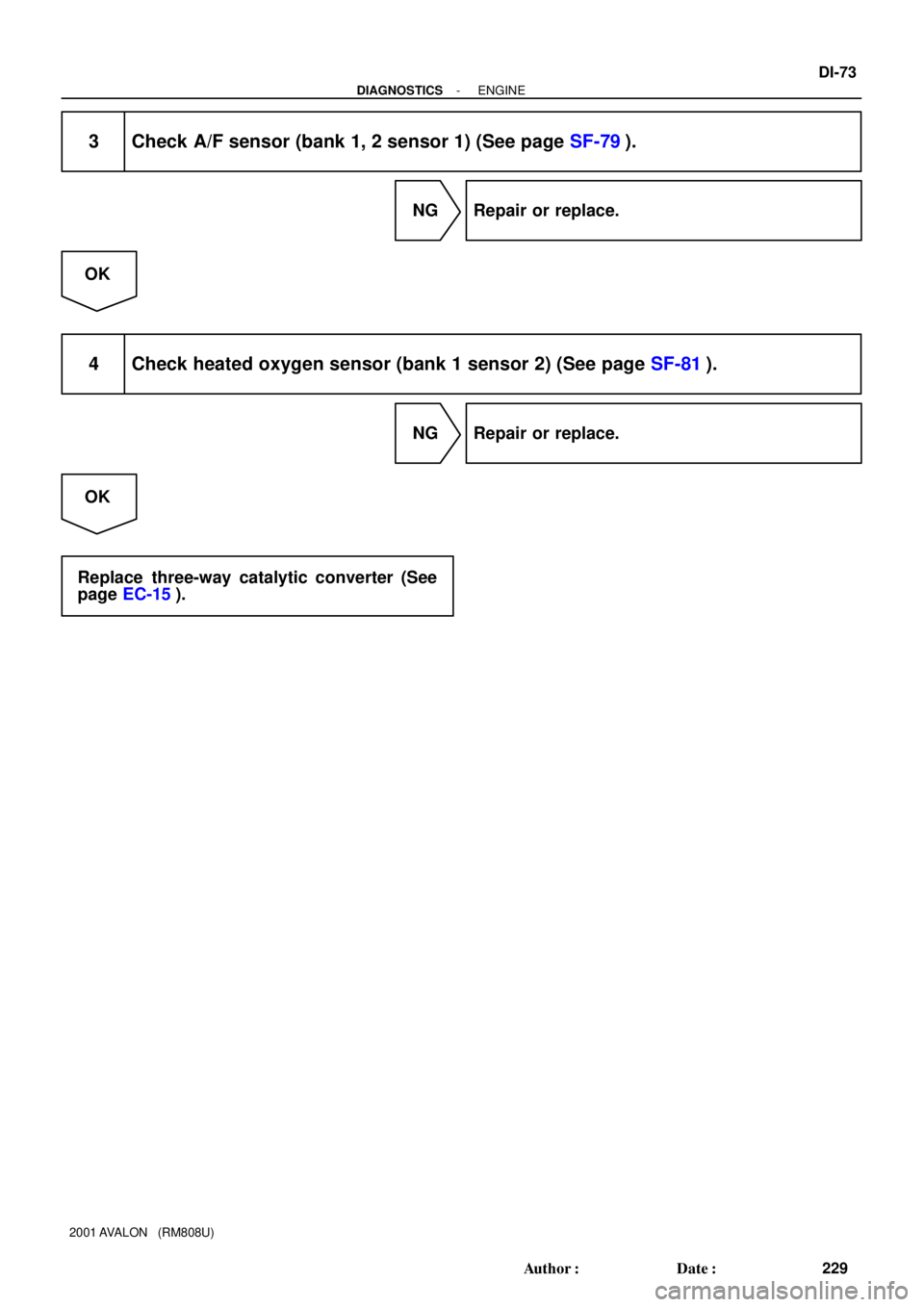
3 Check A/F sensor (bank 1, 2 sensor 1) (See page SF-79).
NG Repair or replace.
OK
4 Check heated oxygen sensor (bank 1 sensor 2) (See page SF-81).
NG Repair or replace.
OK
Replace three-way catalytic converter (See
page EC-15).
Page 953 of 1897

A10140
ECM
VSV
for EVAP
Charcoal Canister
Fuel Tank Fig. 1
(2)
(3) (4) (6)
(8)
(9)(1)
(5)
Fuel Tank Over
Fill Check Valve
(7)Vapor Pressure
Sensor
VSV for
CCVVSV for
Pressure
Switching
Valve
(10)
(11) DI-74
- DIAGNOSTICSENGINE
230 Author�: Date�:
2001 AVALON (RM808U)
DTC P0440 Evaporative Emission Control System Mal-
function
DTC P0442 Evaporative Emission Control System Leak
Detected (Small Leak)
CIRCUIT DESCRIPTION
The vapor pressure sensor, VSV for canister closed valve (CCV) and VSV for pressure switching valve are
used to detect abnormalities in the evaporative emission control system.
The ECM decides whether there is an abnormality in the evaporative emission control system based on the
vapor pressure sensor signal.
DTC P0440 or P0442 is recorded by the ECM when evaporative emissions leak from the components within
the dotted line in Fig. 1 below, or when the vapor pressure sensor malfunctions.
DTC No.DTC Detecting ConditionTrouble Area
P0440
P0442After cold starting and when generating certain swift pressure
value in fuel tank enabling not to hold that value (2 trip detec-
tion logic)
�Hose or tube cracked, hole, damaged or loose seal ((3) in
Fig. 1)
�Fuel tank cap incorrectly installed
�Fuel tank cap cracked or damaged
�Vacuum hose cracked, holed, blocked, damaged or discon-
nected ((1) or (2) in Fig. 1)
�Fuel tank cracked, holed or damaged
�Charcoal canister cracked, holed or damaged
�Open or short in vapor pressure sensor circuit
�Vapor pressure sensor
�Fuel tank over fill check valve cracked or damaged
�ECM
DI6T6-01
Page 954 of 1897

A11666
ECM
Vapor Pressure Sensor
2B6
P-B
VSV for EVAP
B-R
2
15 V
VC
PTNK
E1
E2
EVP1
E01
E01
TBP
3
2
Engine Room J/B
B-W
W-B
P
1
WE5
E82
17
18
7
3
E7
EFI Relay
PL-R
ID1 II215 4
5
E5
ID1 9
6 2G
4 2
53
2
1 EFI
No.1
From
Battery
20
G
VSV for Pressure
Switching ValveCCV
2
110
318
1
VSV for CCV
14
E01 L-R L-R
W WID1
ID1 II2
E5
E8 B-W
2B
2B 2FEFI
No.2
4
EDID1II1 G
B-W B-W
2
P-B
L-OFrom
Terminal
MREL of
ECM
B
B-W
- DIAGNOSTICSENGINE
DI-75
231 Author�: Date�:
2001 AVALON (RM808U)
WIRING DIAGRAM
INSPECTION PROCEDURE
HINT:
�If DTC P0441, P0446, P0450 or P0451 is output after DTC P0440 or P0442, first troubleshoot DTC
P0441, P0446, P0450 or P0451. If no malfunction is detected, troubleshoot DTC P0440 or P0442 next.
�Ask the customer whether, after the MIL came on, the customer found the fuel tank cap loose and tight-
ened it. Also ask the customer whether the fuel tank cap was loose when refuelling. If the fuel tank cap
was loose, it was the cause of the DTC. If the fuel tank cap was not loose or if the customer was not
sure if it was loose, troubleshoot according to the following procedure.
�Read freeze frame data using TOYOTA hand-held tester or OBD II scan tool. Because freeze frame
records the engine conditions when the malfunction is detected. When troubleshooting, it is useful for
determining whether the vehicle was running or stopped, the engine was warmed up or not, the air-fuel
ratio was lean or rich, etc. at the time of the malfunction.
�When the ENGINE RUN TIME in the freeze frame data is less than 200 seconds, carefully check the
vapor pressure sensor.
Page 956 of 1897

- DIAGNOSTICSENGINE
DI-77
233 Author�: Date�:
2001 AVALON (RM808U)
5 Check filler neck for damage.
PREPARATION:
Remove the fuel tank cap.
CHECK:
Visually inspect the filler neck for damage.
NG Replace filler pipe.
OK
6 Check vacuum hoses between vapor pressure sensor and fuel tank, charcoal
canister and VSV for pressure switching valve, and VSV for pressure switching
valve and charcoal canister.
CHECK:
(a) Check that the vacuum hose is connected correctly.
(b) Check the vacuum hose for looseness and disconnection.
(c) Check the vacuum hose for cracks, hole and damage.
NG Repair or replace.
OK
7 Check hose and tube between fuel tank and charcoal canister.
CHECK:
(a) Check for proper connection of the fuel tank and fuel evap pipe (See page EC-6), fuel evap pipe and
fuel tube under the floor, fuel tube under the floor and charcoal canister.
(b) Check the hose and tube for cracks, hole and damage.
NG Repair or replace.
OK
8 Check charcoal canister for cracks, hole and damage (See page EC-6).
NG Replace charcoal canister.