2001 NISSAN PICK-UP sensor
[x] Cancel search: sensorPage 244 of 1306

4 CHECK HEATED OXYGEN SENSOR 1
Without CONSULT-II
1. Reconnect all harness connectors disconnected.
2. Start engine and warm it up to normal operating temperature.
3. Set voltmeter probes between ECM terminal 50 (Heated oxygen sensor 1 signal) and engine ground.
AEC873A
4. Check the following with engine speed held at 2,000 rpm constant under no load.
+The voltage fluctuates between 0 to 0.3V and 0.6 to 1.0V more than five times within 10 seconds.
1 time: 0 - 0.3V®0.6 - 1.0V®0 - 0.3V
2 times: 0 - 0.3V®0.6 - 1.0V®0 - 0.3V®0.6 - 1.0V®0 - 0.3V
+The maximum voltage is over 0.6V at least one time.
+The minimum voltage is below 0.3V at least one time.
+The voltage never exceeds 1.0V.
CAUTION:
+Discard any heated oxygen sensor which has been dropped from a height of more than 0.5 m (19.7 in) onto
a hard surface such as a concrete floor; use a new one.
+Before installing new oxygen sensor, clean exhaust system threads using Oxygen Sensor Thread Cleaner
tool J-43897-18 or J-43897-12 and approved anti-seize lubricant.
OK or NG
OK©GO TO 5.
NG©Replace heated oxygen sensor 1.
5 CHECK SHIELD CIRCUIT
1. Turn ignition switch OFF.
2. Remove joint connector-3.
3. Check the following.
+Continuity between joint connector-3 terminal 1 and ground
+Joint connector-3
(Refer to ªHARNESS LAYOUTº, EL section.)
Continuity should exist.
4. Also check harness for short to power.
5. Then reconnect joint connector.
OK or NG
OK©GO TO 6.
NG©Repair open circuit, short to power in harness or connectors.
6 CHECK INTERMITTENT INCIDENT
Perform ªTROUBLE DIAGNOSIS FOR INTERMITTENT INCIDENTº, EC-3123.
©INSPECTION END
DTC P0134 HO2S1KA24DE (EURO OBD)
Diagnostic Procedure
EC-3219
Page 245 of 1306
SEF327R
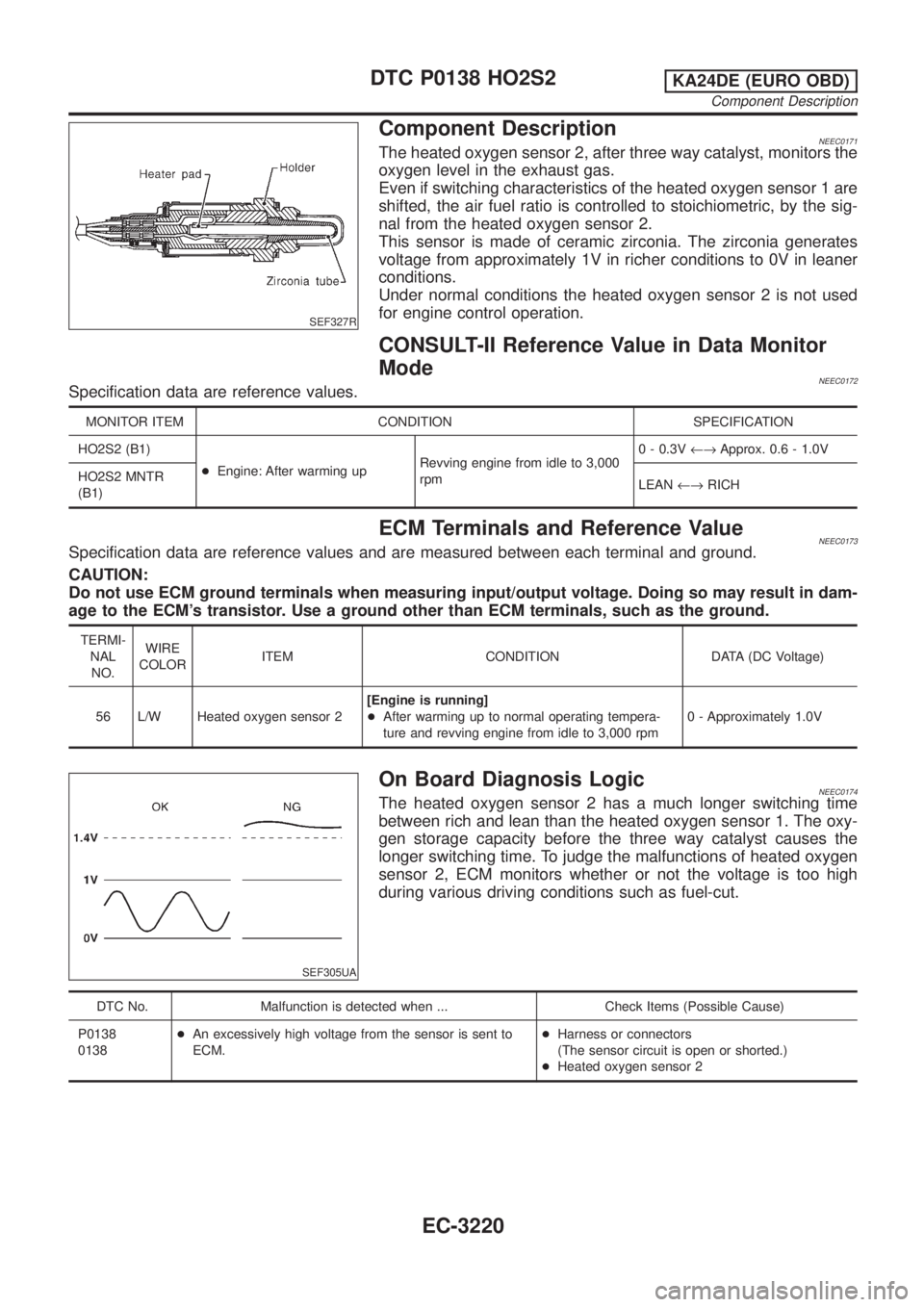
Component DescriptionNEEC0171The heated oxygen sensor 2, after three way catalyst, monitors the
oxygen level in the exhaust gas.
Even if switching characteristics of the heated oxygen sensor 1 are
shifted, the air fuel ratio is controlled to stoichiometric, by the sig-
nal from the heated oxygen sensor 2.
This sensor is made of ceramic zirconia. The zirconia generates
voltage from approximately 1V in richer conditions to 0V in leaner
conditions.
Under normal conditions the heated oxygen sensor 2 is not used
for engine control operation.
CONSULT-II Reference Value in Data Monitor
Mode
NEEC0172Specification data are reference values.
MONITOR ITEM CONDITION SPECIFICATION
HO2S2 (B1)
+Engine: After warming upRevving engine from idle to 3,000
rpm0 - 0.3V¨Approx. 0.6 - 1.0V
HO2S2 MNTR
(B1)LEAN¨RICH
ECM Terminals and Reference ValueNEEC0173Specification data are reference values and are measured between each terminal and ground.
CAUTION:
Do not use ECM ground terminals when measuring input/output voltage. Doing so may result in dam-
age to the ECM's transistor. Use a ground other than ECM terminals, such as the ground.
TERMI-
NAL
NO.WIRE
COLORITEM CONDITION DATA (DC Voltage)
56 L/W Heated oxygen sensor 2[Engine is running]
+After warming up to normal operating tempera-
ture and revving engine from idle to 3,000 rpm0 - Approximately 1.0V
SEF305UA
On Board Diagnosis LogicNEEC0174The heated oxygen sensor 2 has a much longer switching time
between rich and lean than the heated oxygen sensor 1. The oxy-
gen storage capacity before the three way catalyst causes the
longer switching time. To judge the malfunctions of heated oxygen
sensor 2, ECM monitors whether or not the voltage is too high
during various driving conditions such as fuel-cut.
DTC No. Malfunction is detected when ... Check Items (Possible Cause)
P0138
0138+An excessively high voltage from the sensor is sent to
ECM.+Harness or connectors
(The sensor circuit is open or shorted.)
+Heated oxygen sensor 2
DTC P0138 HO2S2KA24DE (EURO OBD)
Component Description
EC-3220
Page 246 of 1306
SEF189Y
DTC Confirmation ProcedureNEEC0175NOTE:
If ªDTC Confirmation Procedureº has been previously conducted,
always turn ignition switch OFF and wait at least 5 seconds before
conducting the next test.
With CONSULT-II
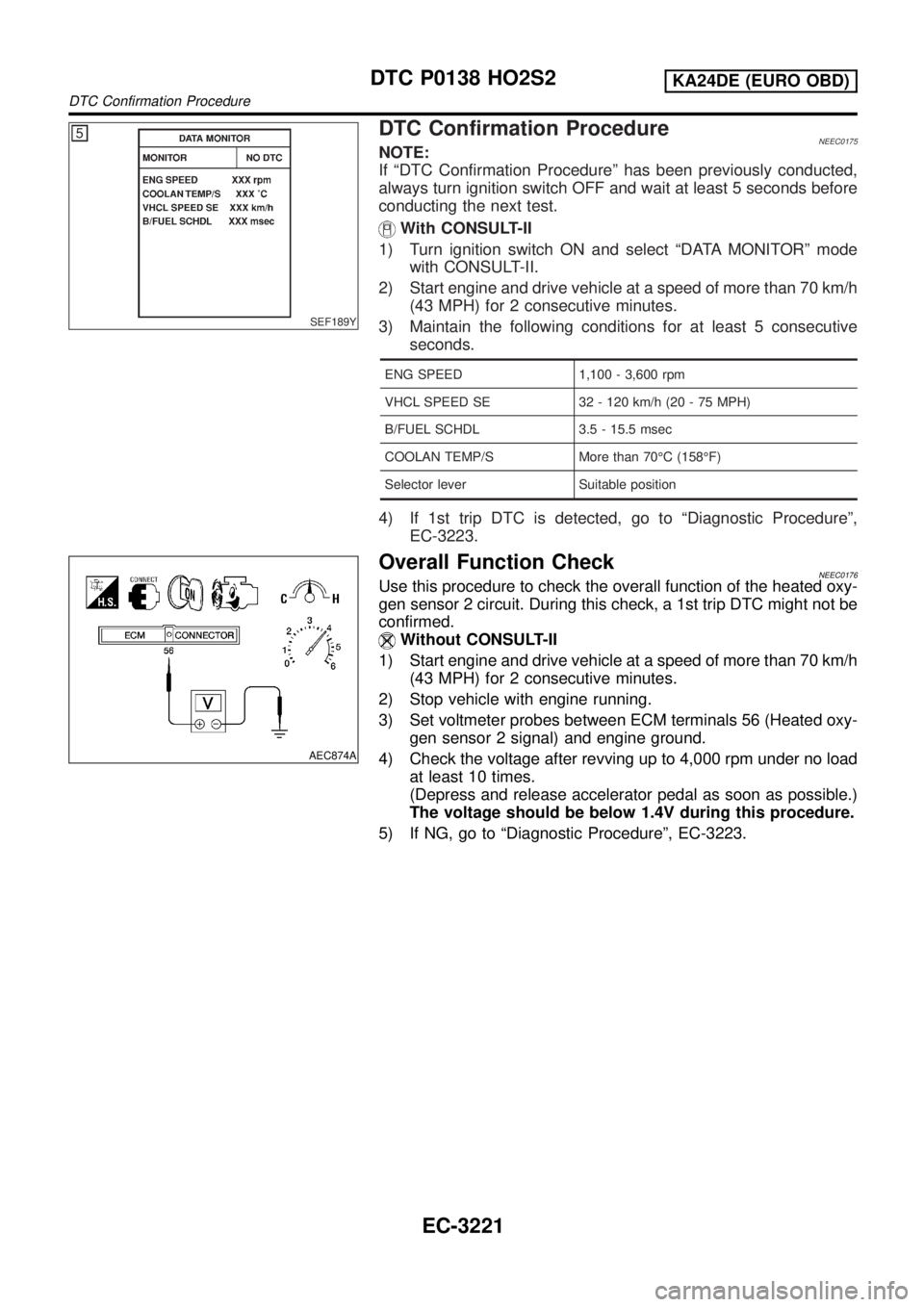
1) Turn ignition switch ON and select ªDATA MONITORº mode
with CONSULT-II.
2) Start engine and drive vehicle at a speed of more than 70 km/h
(43 MPH) for 2 consecutive minutes.
3) Maintain the following conditions for at least 5 consecutive
seconds.
ENG SPEED 1,100 - 3,600 rpm
VHCL SPEED SE 32 - 120 km/h (20 - 75 MPH)
B/FUEL SCHDL 3.5 - 15.5 msec
COOLAN TEMP/S More than 70ÉC (158ÉF)
Selector lever Suitable position
4) If 1st trip DTC is detected, go to ªDiagnostic Procedureº,
EC-3223.
AEC874A
Overall Function CheckNEEC0176Use this procedure to check the overall function of the heated oxy-
gen sensor 2 circuit. During this check, a 1st trip DTC might not be
confirmed.
Without CONSULT-II
1) Start engine and drive vehicle at a speed of more than 70 km/h
(43 MPH) for 2 consecutive minutes.
2) Stop vehicle with engine running.
3) Set voltmeter probes between ECM terminals 56 (Heated oxy-
gen sensor 2 signal) and engine ground.
4) Check the voltage after revving up to 4,000 rpm under no load
at least 10 times.
(Depress and release accelerator pedal as soon as possible.)
The voltage should be below 1.4V during this procedure.
5) If NG, go to ªDiagnostic Procedureº, EC-3223.
DTC P0138 HO2S2KA24DE (EURO OBD)
DTC Confirmation Procedure
EC-3221
Page 248 of 1306

Diagnostic ProcedureNEEC0178
1 RETIGHTEN GROUND SCREWS
1. Turn ignition switch OFF.
2. Loosen and retighten engine ground screws.
SEC309D
©GO TO 2.
2 CHECK INPUT SIGNAL CIRCUIT
1. Disconnect heated oxygen sensor 2 harness connector and ECM harness connector.
2. Check harness continuity between ECM terminal 56 and terminal 1. Refer to wiring diagram.
Continuity should exist.
3. Check harness continuity between ECM terminal 56 (or terminal 1) and ground. Refer to wiring diagram.
Continuity should not exist.
4. Also check harness for short to ground and short to power.
OK or NG
OK©GO TO 4.
NG©GO TO 3.
3 DETECT MALFUNCTIONING PART
Check the following.
+Harness for open or short between heated oxygen sensor 2 and ECM
©Repair open circuit or short to ground or short to power in harness or connectors.
4 CHECK GROUND CIRCUIT
1. Check harness continuity between heated oxygen sensor 2 terminal 4 and engine ground. Refer to Wiring Diagram.
Continuity should exist.
2. Also check harness for short to power.
OK or NG
OK©GO TO 6.
NG©GO TO 5.
5 DETECT MALFUNCTIONING PART
Check the following.
+Joint connector-3
+Harness for open or short between heated oxygen sensor 2 and engine ground
©Repair open circuit or short to power in harness or connectors.
DTC P0138 HO2S2KA24DE (EURO OBD)
Diagnostic Procedure
EC-3223
Page 249 of 1306
6 CHECK HARNESS CONNECTOR
Check heated oxygen sensor 2 harness connector for water.
Water should not exist.
OK or NG
OK (With CONSULT-II)©GO TO 7.
OK (Without CONSULT-
II)©GO TO 8.
NG©Repair or replace harness connector.
7 CHECK HEATED OXYGEN SENSOR 2
With CONSULT-II
1. Reconnect all harness connectors disconnected.
2. Start engine and drive vehicle at a speed of more than 70 km/h (43 MPH) for 2 consecutive minutes.
3. Stop vehicle with engine running.
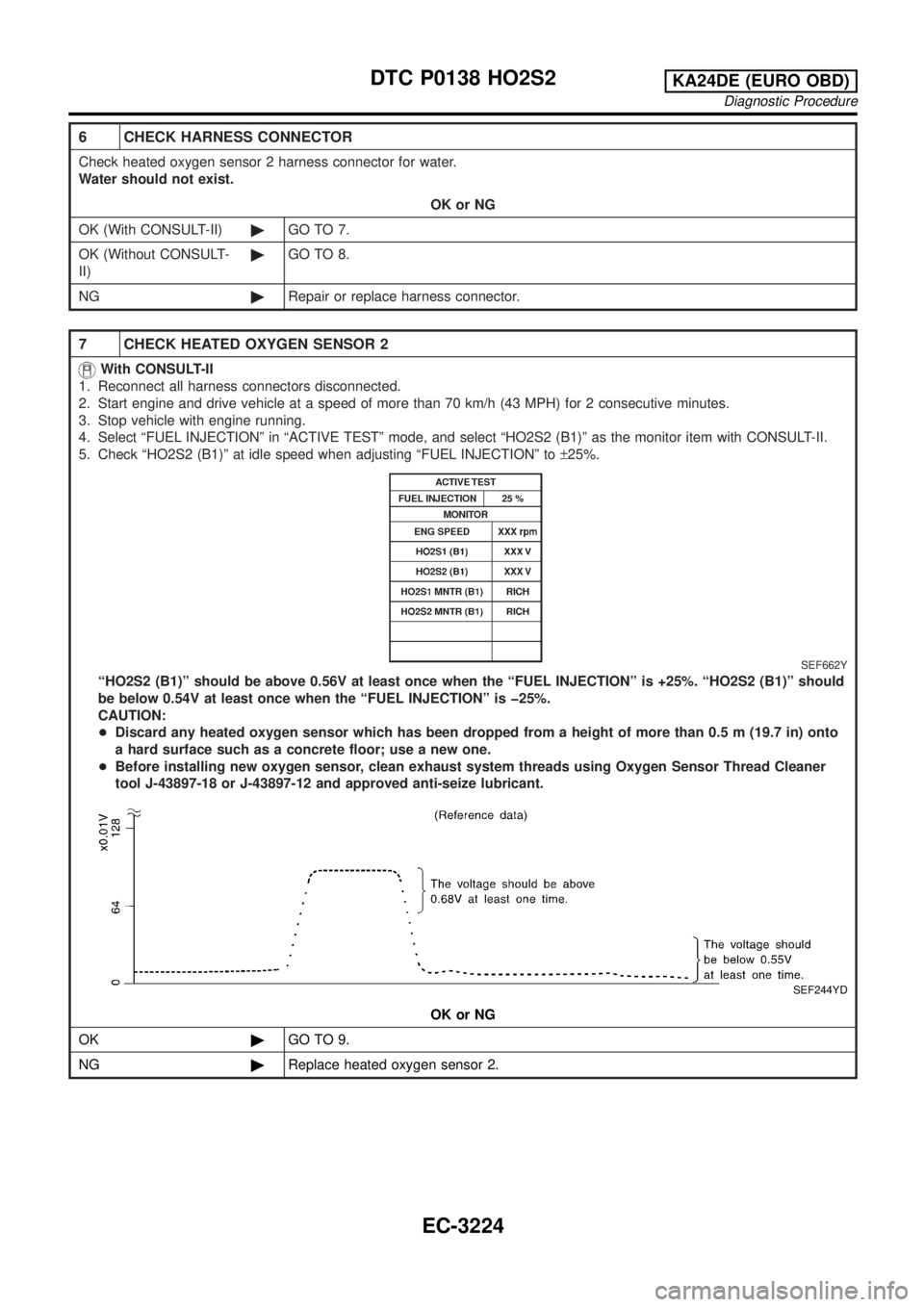
4. Select ªFUEL INJECTIONº in ªACTIVE TESTº mode, and select ªHO2S2 (B1)º as the monitor item with CONSULT-II.
5. Check ªHO2S2 (B1)º at idle speed when adjusting ªFUEL INJECTIONº to±25%.
SEF662Y
ªHO2S2 (B1)º should be above 0.56V at least once when the ªFUEL INJECTIONº is +25%. ªHO2S2 (B1)º should
be below 0.54V at least once when the ªFUEL INJECTIONº is þ25%.
CAUTION:
+Discard any heated oxygen sensor which has been dropped from a height of more than 0.5 m (19.7 in) onto
a hard surface such as a concrete floor; use a new one.
+Before installing new oxygen sensor, clean exhaust system threads using Oxygen Sensor Thread Cleaner
tool J-43897-18 or J-43897-12 and approved anti-seize lubricant.
SEF244YD
OK or NG
OK©GO TO 9.
NG©Replace heated oxygen sensor 2.
DTC P0138 HO2S2KA24DE (EURO OBD)
Diagnostic Procedure
EC-3224
Page 250 of 1306

8 CHECK HEATED OXYGEN SENSOR 2
Without CONSULT-II
1. Reconnect all harness connectors disconnected.
2. Start engine and drive vehicle at a speed of more than 70 km/h (43 MPH) for 2 consecutive minutes.
3. Stop vehicle with engine running.
4. Set voltmeter probes between ECM terminals 56 (Heated oxygen sensor 2 signal) and engine ground.
AEC874A
5. Check the voltage when revving up to 4,000 rpm under no load at least 10 times.
(Depress and release accelerator pedal as soon as possible.)
The voltage should be above 0.56V at least once.
If the voltage is above 0.56V at step 4, step 5 is not necessary.
6. Check the voltage when revving up to 5,000 rpm under no load. Or keep vehicle at idling for 10 minutes, then check
the voltage. Or check the voltage when coasting from 80 km/h (50 MPH) in 3rd gear position (M/T), ªDº position with
ªODº OFF (A/T).
The voltage should be below 0.54V at least once.
CAUTION:
+Discard any heated oxygen sensor which has been dropped from a height of more than 0.5 m (19.7 in) onto
a hard surface such as a concrete floor; use a new one.
+Before installing new oxygen sensor, clean exhaust system threads using Oxygen Sensor Thread Cleaner
tool J-43897-18 or J-43897-12 and approved anti-seize lubricant.
OK or NG
OK©GO TO 9.
NG©Replace heated oxygen sensor 2.
9 CHECK SHIELD CIRCUIT
1. Turn ignition switch OFF.
2. Disconnect joint connector-3.
3. Check harness continuity between joint connector-3 terminal 1 and ground. Refer to wiring diagram.
Continuity should exist.
4. Also check harness for short to power.
5. Then reconnect joint connector-3.
OK or NG
OK©GO TO 11.
NG©GO TO 10.
10 DETECT MALFUNCTIONING PART
Check the following.
+Joint connector-3 (Refer to ªHARNESS LAYOUTº, EL section.)
+Harness for open or short between joint connector-3 and engine ground
©Repair open circuit, short to power in harness or connectors.
DTC P0138 HO2S2KA24DE (EURO OBD)
Diagnostic Procedure
EC-3225
Page 252 of 1306
SEF327R
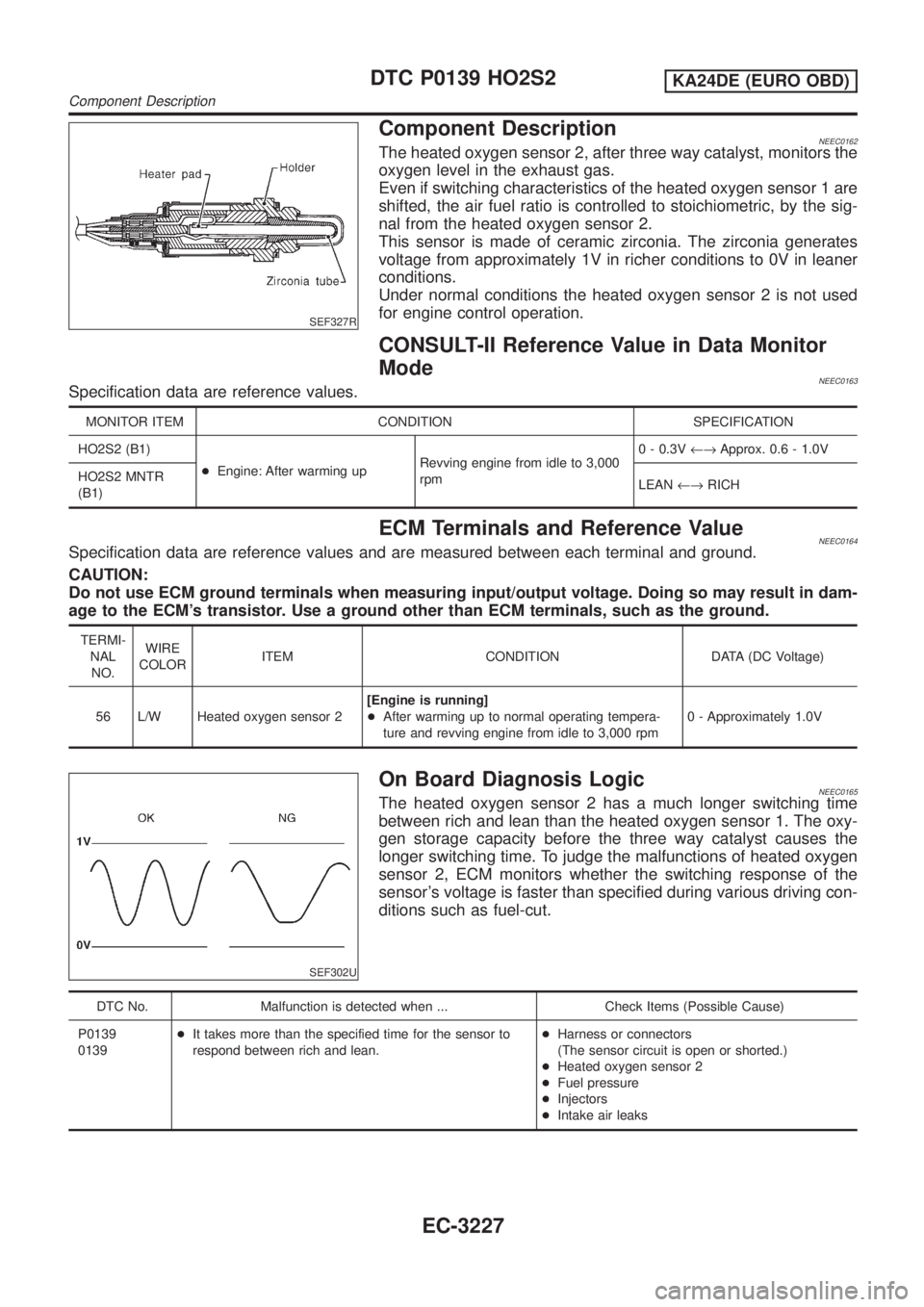
Component DescriptionNEEC0162The heated oxygen sensor 2, after three way catalyst, monitors the
oxygen level in the exhaust gas.
Even if switching characteristics of the heated oxygen sensor 1 are
shifted, the air fuel ratio is controlled to stoichiometric, by the sig-
nal from the heated oxygen sensor 2.
This sensor is made of ceramic zirconia. The zirconia generates
voltage from approximately 1V in richer conditions to 0V in leaner
conditions.
Under normal conditions the heated oxygen sensor 2 is not used
for engine control operation.
CONSULT-II Reference Value in Data Monitor
Mode
NEEC0163Specification data are reference values.
MONITOR ITEM CONDITION SPECIFICATION
HO2S2 (B1)
+Engine: After warming upRevving engine from idle to 3,000
rpm0 - 0.3V¨Approx. 0.6 - 1.0V
HO2S2 MNTR
(B1)LEAN¨RICH
ECM Terminals and Reference ValueNEEC0164Specification data are reference values and are measured between each terminal and ground.
CAUTION:
Do not use ECM ground terminals when measuring input/output voltage. Doing so may result in dam-
age to the ECM's transistor. Use a ground other than ECM terminals, such as the ground.
TERMI-
NAL
NO.WIRE
COLORITEM CONDITION DATA (DC Voltage)
56 L/W Heated oxygen sensor 2[Engine is running]
+After warming up to normal operating tempera-
ture and revving engine from idle to 3,000 rpm0 - Approximately 1.0V
SEF302U
On Board Diagnosis LogicNEEC0165The heated oxygen sensor 2 has a much longer switching time
between rich and lean than the heated oxygen sensor 1. The oxy-
gen storage capacity before the three way catalyst causes the
longer switching time. To judge the malfunctions of heated oxygen
sensor 2, ECM monitors whether the switching response of the
sensor's voltage is faster than specified during various driving con-
ditions such as fuel-cut.
DTC No. Malfunction is detected when ... Check Items (Possible Cause)
P0139
0139+It takes more than the specified time for the sensor to
respond between rich and lean.+Harness or connectors
(The sensor circuit is open or shorted.)
+Heated oxygen sensor 2
+Fuel pressure
+Injectors
+Intake air leaks
DTC P0139 HO2S2KA24DE (EURO OBD)
Component Description
EC-3227
Page 254 of 1306
![NISSAN PICK-UP 2001 Repair Manual PBIB0553E
Procedure for COND2NEEC0166S01021. While driving, release accelerator pedal completely from the
above condition [step 8] until ªINCOMPLETEº at ªCOND2º on
CONSULT-II screen has turned to](/manual-img/5/57372/w960_57372-253.png "NISSAN PICK-UP 2001 Repair Manual PBIB0553E
Procedure for COND2NEEC0166S01021. While driving, release accelerator pedal completely from the
above condition [step 8] until ªINCOMPLETEº at ªCOND2º on
CONSULT-II screen has turned to")
PBIB0553E
Procedure for COND2NEEC0166S01021. While driving, release accelerator pedal completely from the
above condition [step 8] until ªINCOMPLETEº at ªCOND2º on
CONSULT-II screen has turned to ªCOMPLETEDº. (If will take
approximately 4 seconds.)
NOTE:
If ªCOMPLETEDº already appears at ªCOND3º on CONSULT-II
screen before ªProcedure for COND3º is conducted, it is
unnecessary to conduct step 1 in ªProcedure for COND3º.
SEF668Y
Procedure for COND3NEEC0166S01031. Stop vehicle and let is idle until ªINCOMPLETEº of ªCOND3º
on CONSULT-II screen has turned to ªCOMPLETEDº. (It will
take a maximum of approximately 6 minutes.)
2. Make sure that ªOKº is displayed after touching ªSELF-DIAG
RESULTSº.
If ªNGº is displayed, refer to EC-3231, ªDiagnostic Procedureº.
AEC874A
Overall Function CheckNEEC0167Use this procedure to check the overall function of the heated oxy-
gen sensor 2 circuit. During this check, a 1st trip DTC might not be
confirmed.
CAUTION:
Always drive vehicle at a safe speed.
Without CONSULT-II
1) Start engine and drive vehicle at a speed of more than 70 km/h
(43 MPH) for 2 consecutive minutes.
2) Stop vehicle with engine running.
3) Set voltmeter probes between ECM terminals 56 (Heated oxy-
gen sensor 2 signal) and engine ground.
4) Check the voltage when revving up to 4,000 rpm under no load
at least 10 times.
(Depress and release accelerator pedal as soon as possible.)
The voltage should change at more than 0.06V for 1 sec-
ond during this procedure.
If the voltage can be confirmed in step 4, step 5 is not
necessary.
5) Keep vehicle at idling for 10 minutes, then check the voltage.
Or check the voltage when coasting from 80 km/h (50 MPH)
in 3rd gear position.
The voltage should change at more than 0.06V for 1 sec-
ond during this procedure.
6) If NG, go to ªDiagnostic Procedureº, EC-3231.
DTC P0139 HO2S2KA24DE (EURO OBD)
DTC Confirmation Procedure
EC-3229