2001 CHRYSLER VOYAGER wheel
[x] Cancel search: wheelPage 3995 of 4284
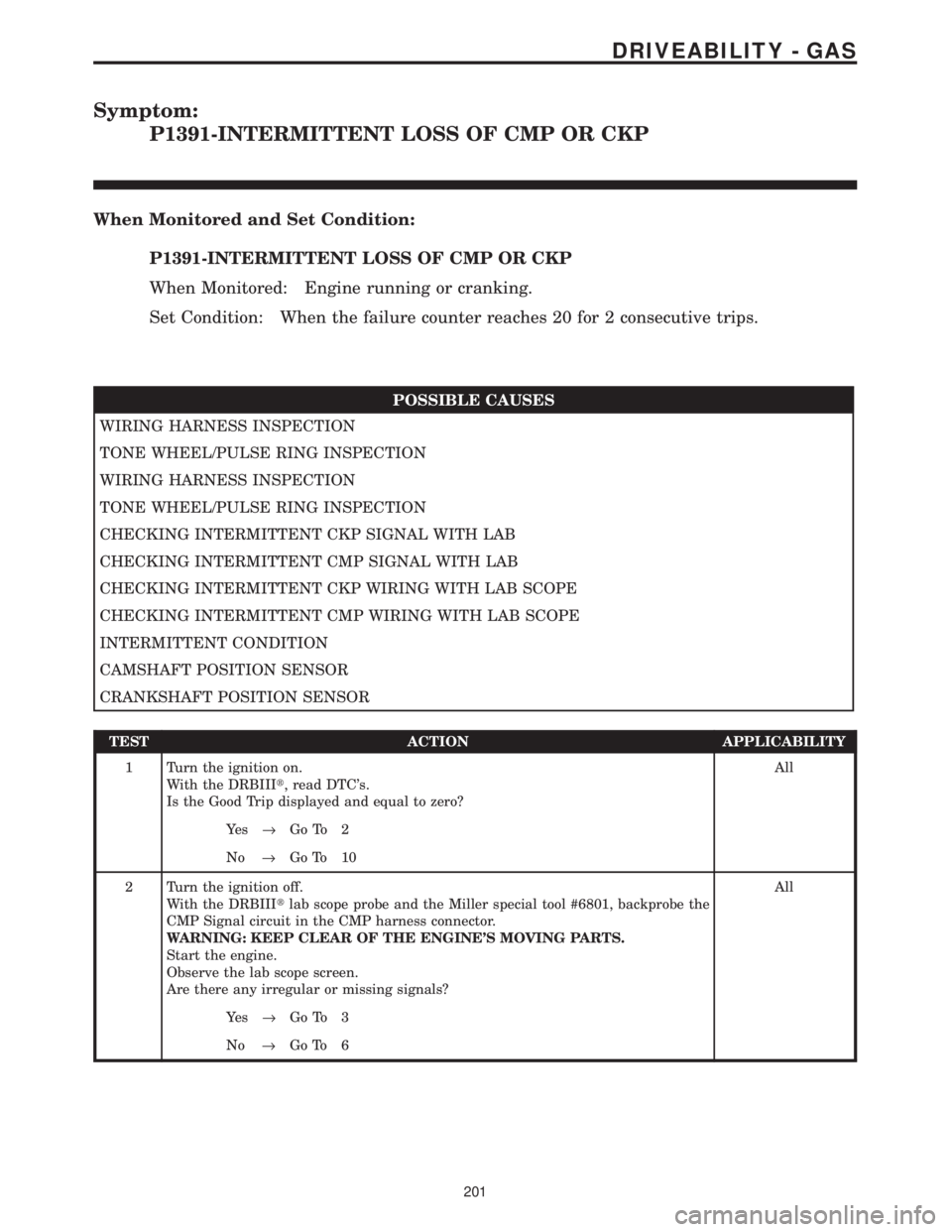
Symptom:
P1391-INTERMITTENT LOSS OF CMP OR CKP
When Monitored and Set Condition:
P1391-INTERMITTENT LOSS OF CMP OR CKP
When Monitored: Engine running or cranking.
Set Condition: When the failure counter reaches 20 for 2 consecutive trips.
POSSIBLE CAUSES
WIRING HARNESS INSPECTION
TONE WHEEL/PULSE RING INSPECTION
WIRING HARNESS INSPECTION
TONE WHEEL/PULSE RING INSPECTION
CHECKING INTERMITTENT CKP SIGNAL WITH LAB
CHECKING INTERMITTENT CMP SIGNAL WITH LAB
CHECKING INTERMITTENT CKP WIRING WITH LAB SCOPE
CHECKING INTERMITTENT CMP WIRING WITH LAB SCOPE
INTERMITTENT CONDITION
CAMSHAFT POSITION SENSOR
CRANKSHAFT POSITION SENSOR
TEST ACTION APPLICABILITY
1 Turn the ignition on.
With the DRBIIIt, read DTC's.
Is the Good Trip displayed and equal to zero?All
Ye s®Go To 2
No®Go To 10
2 Turn the ignition off.
With the DRBIIItlab scope probe and the Miller special tool #6801, backprobe the
CMP Signal circuit in the CMP harness connector.
WARNING: KEEP CLEAR OF THE ENGINE'S MOVING PARTS.
Start the engine.
Observe the lab scope screen.
Are there any irregular or missing signals?All
Ye s®Go To 3
No®Go To 6
201
DRIVEABILITY - GAS
Page 3996 of 4284
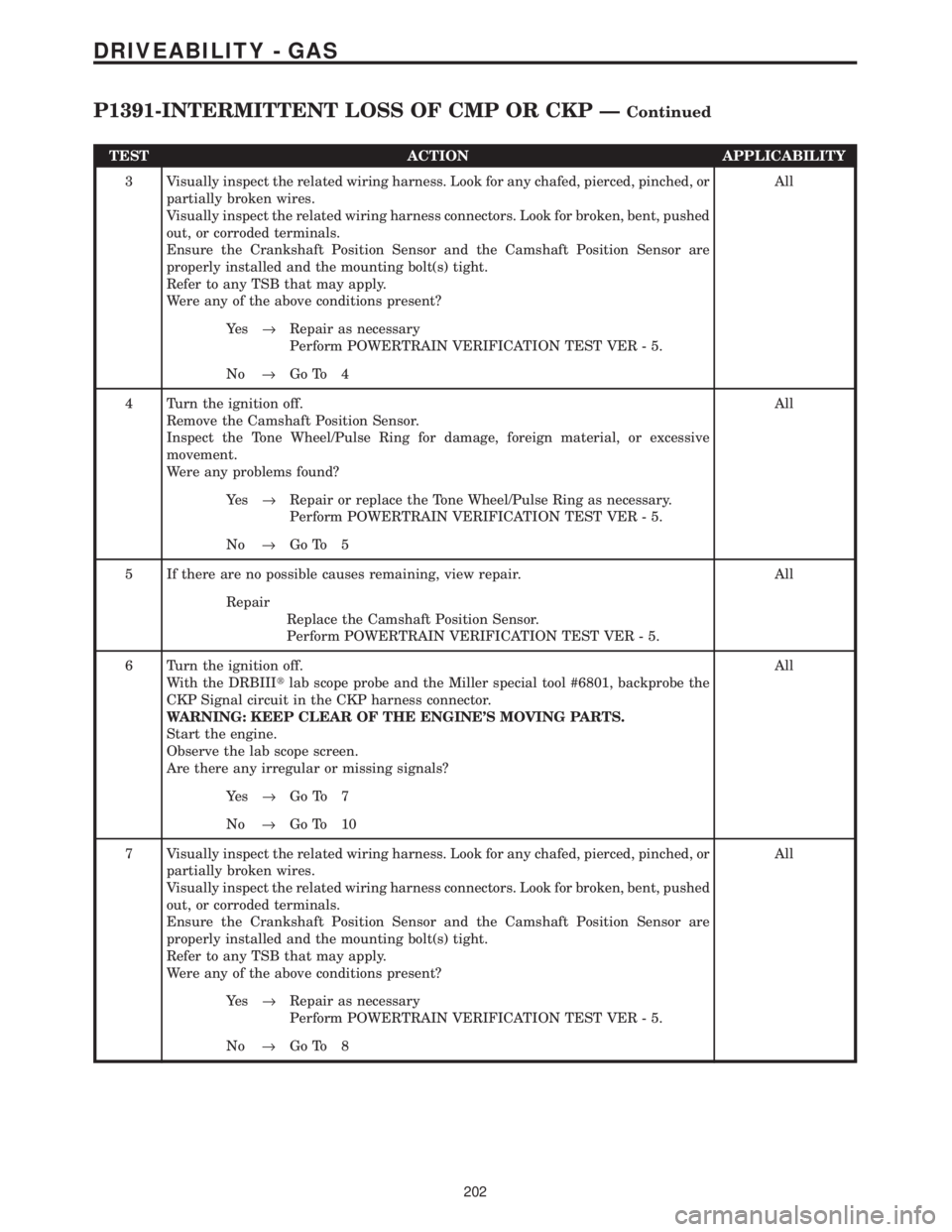
TEST ACTION APPLICABILITY
3 Visually inspect the related wiring harness. Look for any chafed, pierced, pinched, or
partially broken wires.
Visually inspect the related wiring harness connectors. Look for broken, bent, pushed
out, or corroded terminals.
Ensure the Crankshaft Position Sensor and the Camshaft Position Sensor are
properly installed and the mounting bolt(s) tight.
Refer to any TSB that may apply.
Were any of the above conditions present?All
Ye s®Repair as necessary
Perform POWERTRAIN VERIFICATION TEST VER - 5.
No®Go To 4
4 Turn the ignition off.
Remove the Camshaft Position Sensor.
Inspect the Tone Wheel/Pulse Ring for damage, foreign material, or excessive
movement.
Were any problems found?All
Ye s®Repair or replace the Tone Wheel/Pulse Ring as necessary.
Perform POWERTRAIN VERIFICATION TEST VER - 5.
No®Go To 5
5 If there are no possible causes remaining, view repair. All
Repair
Replace the Camshaft Position Sensor.
Perform POWERTRAIN VERIFICATION TEST VER - 5.
6 Turn the ignition off.
With the DRBIIItlab scope probe and the Miller special tool #6801, backprobe the
CKP Signal circuit in the CKP harness connector.
WARNING: KEEP CLEAR OF THE ENGINE'S MOVING PARTS.
Start the engine.
Observe the lab scope screen.
Are there any irregular or missing signals?All
Ye s®Go To 7
No®Go To 10
7 Visually inspect the related wiring harness. Look for any chafed, pierced, pinched, or
partially broken wires.
Visually inspect the related wiring harness connectors. Look for broken, bent, pushed
out, or corroded terminals.
Ensure the Crankshaft Position Sensor and the Camshaft Position Sensor are
properly installed and the mounting bolt(s) tight.
Refer to any TSB that may apply.
Were any of the above conditions present?All
Ye s®Repair as necessary
Perform POWERTRAIN VERIFICATION TEST VER - 5.
No®Go To 8
202
DRIVEABILITY - GAS
P1391-INTERMITTENT LOSS OF CMP OR CKP ÐContinued
Page 3997 of 4284
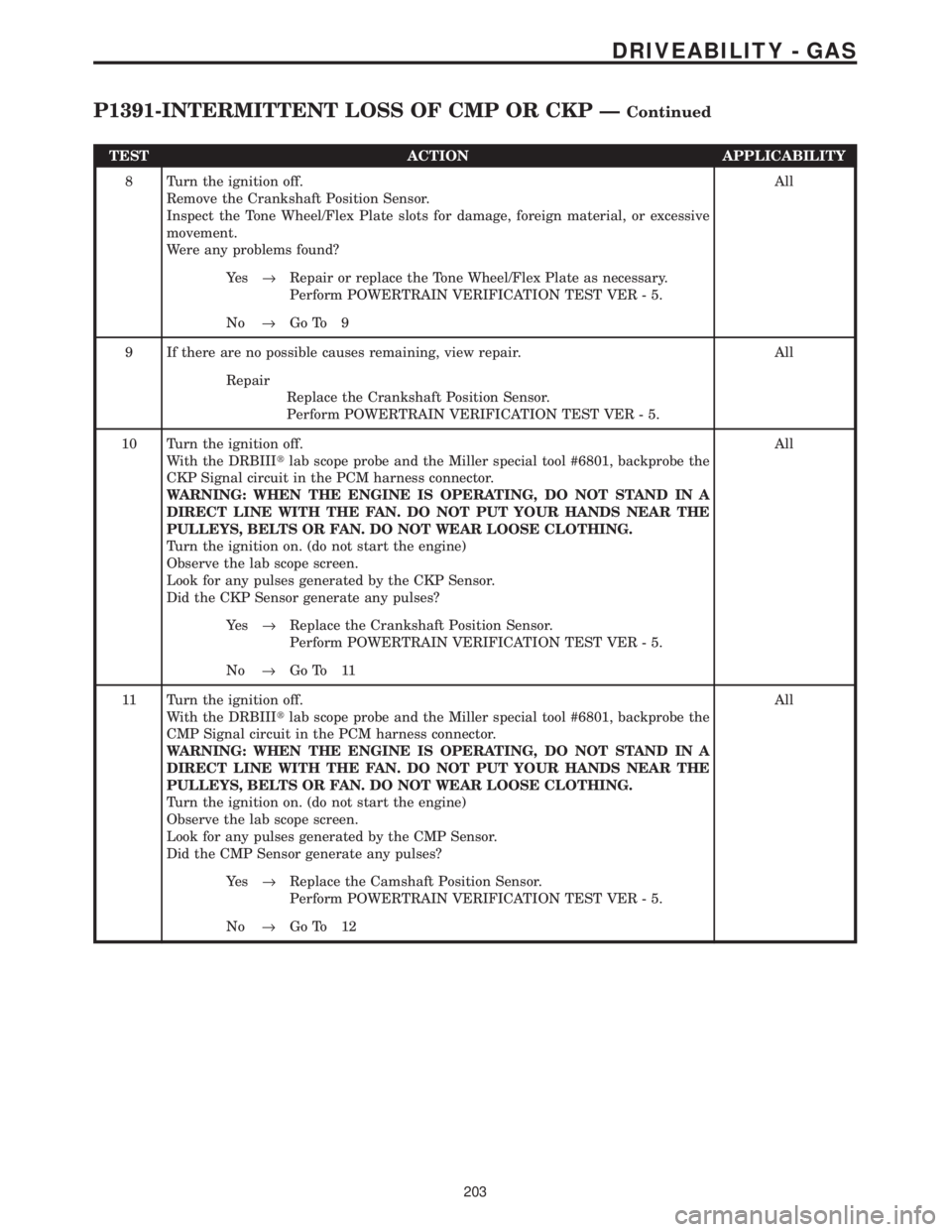
TEST ACTION APPLICABILITY
8 Turn the ignition off.
Remove the Crankshaft Position Sensor.
Inspect the Tone Wheel/Flex Plate slots for damage, foreign material, or excessive
movement.
Were any problems found?All
Ye s®Repair or replace the Tone Wheel/Flex Plate as necessary.
Perform POWERTRAIN VERIFICATION TEST VER - 5.
No®Go To 9
9 If there are no possible causes remaining, view repair. All
Repair
Replace the Crankshaft Position Sensor.
Perform POWERTRAIN VERIFICATION TEST VER - 5.
10 Turn the ignition off.
With the DRBIIItlab scope probe and the Miller special tool #6801, backprobe the
CKP Signal circuit in the PCM harness connector.
WARNING: WHEN THE ENGINE IS OPERATING, DO NOT STAND IN A
DIRECT LINE WITH THE FAN. DO NOT PUT YOUR HANDS NEAR THE
PULLEYS, BELTS OR FAN. DO NOT WEAR LOOSE CLOTHING.
Turn the ignition on. (do not start the engine)
Observe the lab scope screen.
Look for any pulses generated by the CKP Sensor.
Did the CKP Sensor generate any pulses?All
Ye s®Replace the Crankshaft Position Sensor.
Perform POWERTRAIN VERIFICATION TEST VER - 5.
No®Go To 11
11 Turn the ignition off.
With the DRBIIItlab scope probe and the Miller special tool #6801, backprobe the
CMP Signal circuit in the PCM harness connector.
WARNING: WHEN THE ENGINE IS OPERATING, DO NOT STAND IN A
DIRECT LINE WITH THE FAN. DO NOT PUT YOUR HANDS NEAR THE
PULLEYS, BELTS OR FAN. DO NOT WEAR LOOSE CLOTHING.
Turn the ignition on. (do not start the engine)
Observe the lab scope screen.
Look for any pulses generated by the CMP Sensor.
Did the CMP Sensor generate any pulses?All
Ye s®Replace the Camshaft Position Sensor.
Perform POWERTRAIN VERIFICATION TEST VER - 5.
No®Go To 12
203
DRIVEABILITY - GAS
P1391-INTERMITTENT LOSS OF CMP OR CKP ÐContinued
Page 3999 of 4284
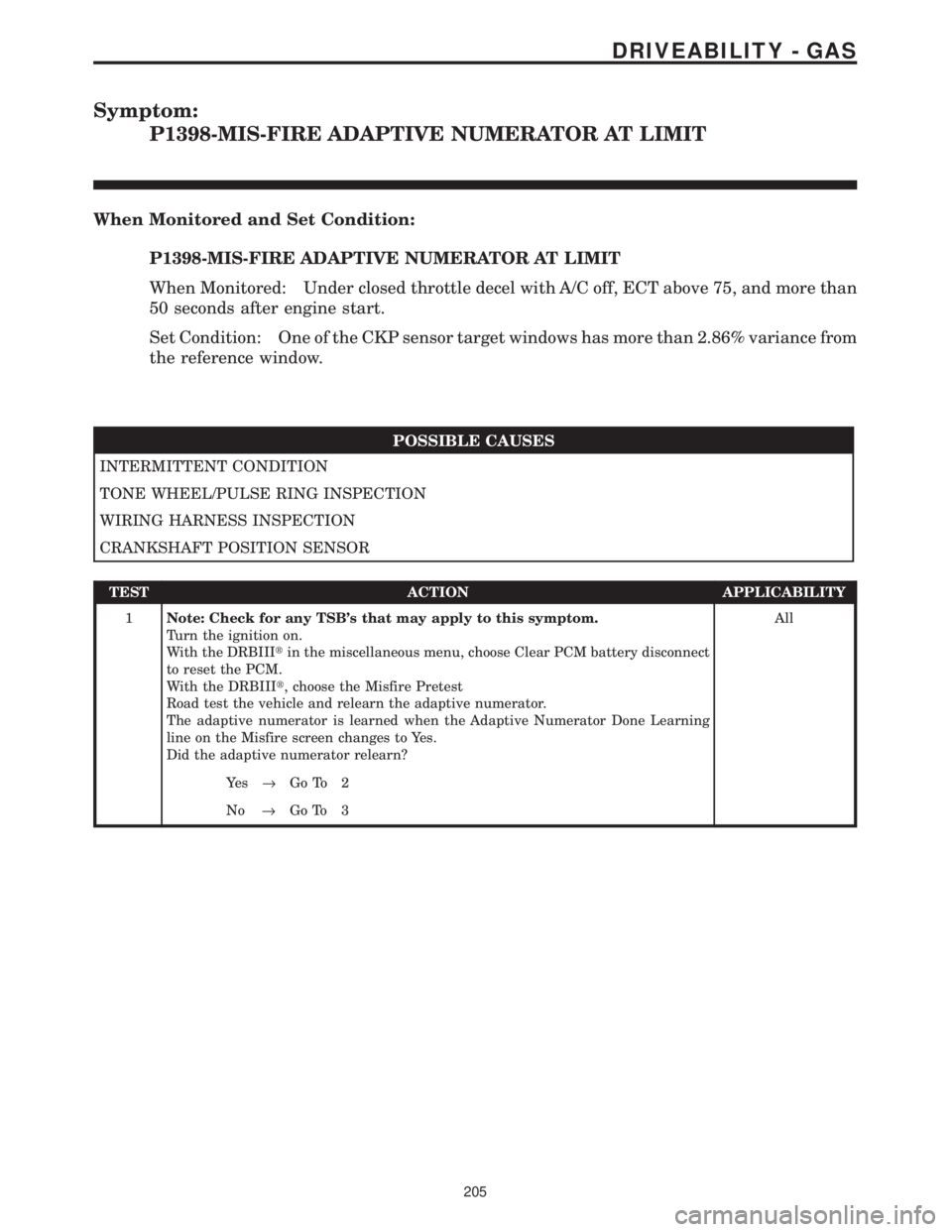
Symptom:
P1398-MIS-FIRE ADAPTIVE NUMERATOR AT LIMIT
When Monitored and Set Condition:
P1398-MIS-FIRE ADAPTIVE NUMERATOR AT LIMIT
When Monitored: Under closed throttle decel with A/C off, ECT above 75, and more than
50 seconds after engine start.
Set Condition: One of the CKP sensor target windows has more than 2.86% variance from
the reference window.
POSSIBLE CAUSES
INTERMITTENT CONDITION
TONE WHEEL/PULSE RING INSPECTION
WIRING HARNESS INSPECTION
CRANKSHAFT POSITION SENSOR
TEST ACTION APPLICABILITY
1Note: Check for any TSB's that may apply to this symptom.
Turn the ignition on.
With the DRBIIItin the miscellaneous menu, choose Clear PCM battery disconnect
to reset the PCM.
With the DRBIIIt, choose the Misfire Pretest
Road test the vehicle and relearn the adaptive numerator.
The adaptive numerator is learned when the Adaptive Numerator Done Learning
line on the Misfire screen changes to Yes.
Did the adaptive numerator relearn?All
Ye s®Go To 2
No®Go To 3
205
DRIVEABILITY - GAS
Page 4000 of 4284
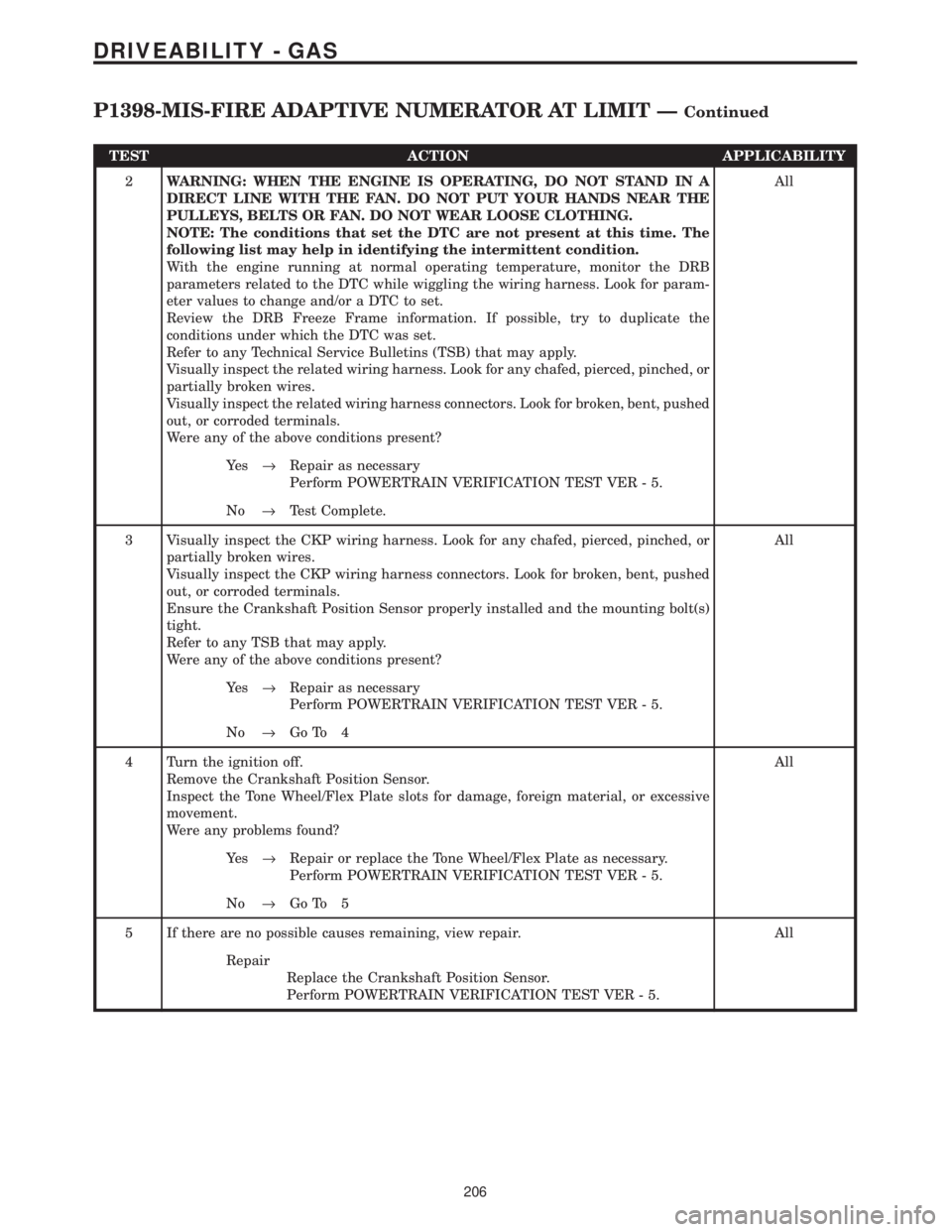
TEST ACTION APPLICABILITY
2WARNING: WHEN THE ENGINE IS OPERATING, DO NOT STAND IN A
DIRECT LINE WITH THE FAN. DO NOT PUT YOUR HANDS NEAR THE
PULLEYS, BELTS OR FAN. DO NOT WEAR LOOSE CLOTHING.
NOTE: The conditions that set the DTC are not present at this time. The
following list may help in identifying the intermittent condition.
With the engine running at normal operating temperature, monitor the DRB
parameters related to the DTC while wiggling the wiring harness. Look for param-
eter values to change and/or a DTC to set.
Review the DRB Freeze Frame information. If possible, try to duplicate the
conditions under which the DTC was set.
Refer to any Technical Service Bulletins (TSB) that may apply.
Visually inspect the related wiring harness. Look for any chafed, pierced, pinched, or
partially broken wires.
Visually inspect the related wiring harness connectors. Look for broken, bent, pushed
out, or corroded terminals.
Were any of the above conditions present?All
Ye s®Repair as necessary
Perform POWERTRAIN VERIFICATION TEST VER - 5.
No®Test Complete.
3 Visually inspect the CKP wiring harness. Look for any chafed, pierced, pinched, or
partially broken wires.
Visually inspect the CKP wiring harness connectors. Look for broken, bent, pushed
out, or corroded terminals.
Ensure the Crankshaft Position Sensor properly installed and the mounting bolt(s)
tight.
Refer to any TSB that may apply.
Were any of the above conditions present?All
Ye s®Repair as necessary
Perform POWERTRAIN VERIFICATION TEST VER - 5.
No®Go To 4
4 Turn the ignition off.
Remove the Crankshaft Position Sensor.
Inspect the Tone Wheel/Flex Plate slots for damage, foreign material, or excessive
movement.
Were any problems found?All
Ye s®Repair or replace the Tone Wheel/Flex Plate as necessary.
Perform POWERTRAIN VERIFICATION TEST VER - 5.
No®Go To 5
5 If there are no possible causes remaining, view repair. All
Repair
Replace the Crankshaft Position Sensor.
Perform POWERTRAIN VERIFICATION TEST VER - 5.
206
DRIVEABILITY - GAS
P1398-MIS-FIRE ADAPTIVE NUMERATOR AT LIMIT ÐContinued
Page 4119 of 4284
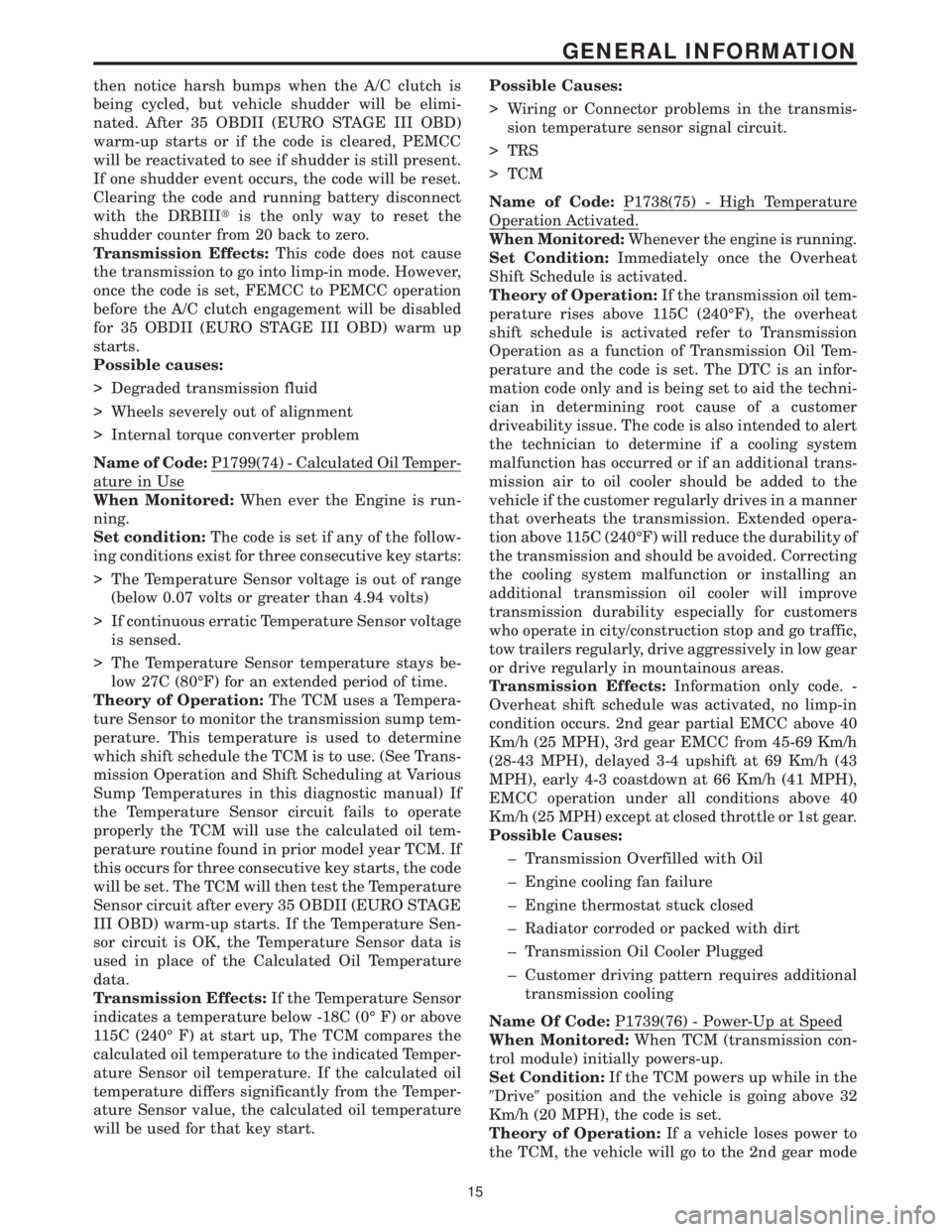
then notice harsh bumps when the A/C clutch is
being cycled, but vehicle shudder will be elimi-
nated. After 35 OBDII (EURO STAGE III OBD)
warm-up starts or if the code is cleared, PEMCC
will be reactivated to see if shudder is still present.
If one shudder event occurs, the code will be reset.
Clearing the code and running battery disconnect
with the DRBIIItis the only way to reset the
shudder counter from 20 back to zero.
Transmission Effects:This code does not cause
the transmission to go into limp-in mode. However,
once the code is set, FEMCC to PEMCC operation
before the A/C clutch engagement will be disabled
for 35 OBDII (EURO STAGE III OBD) warm up
starts.
Possible causes:
> Degraded transmission fluid
> Wheels severely out of alignment
> Internal torque converter problem
Name of Code:P1799(74) - Calculated Oil Temper-
ature in Use
When Monitored:When ever the Engine is run-
ning.
Set condition:The code is set if any of the follow-
ing conditions exist for three consecutive key starts:
> The Temperature Sensor voltage is out of range
(below 0.07 volts or greater than 4.94 volts)
> If continuous erratic Temperature Sensor voltage
is sensed.
> The Temperature Sensor temperature stays be-
low 27C (80ÉF) for an extended period of time.
Theory of Operation:The TCM uses a Tempera-
ture Sensor to monitor the transmission sump tem-
perature. This temperature is used to determine
which shift schedule the TCM is to use. (See Trans-
mission Operation and Shift Scheduling at Various
Sump Temperatures in this diagnostic manual) If
the Temperature Sensor circuit fails to operate
properly the TCM will use the calculated oil tem-
perature routine found in prior model year TCM. If
this occurs for three consecutive key starts, the code
will be set. The TCM will then test the Temperature
Sensor circuit after every 35 OBDII (EURO STAGE
III OBD) warm-up starts. If the Temperature Sen-
sor circuit is OK, the Temperature Sensor data is
used in place of the Calculated Oil Temperature
data.
Transmission Effects:If the Temperature Sensor
indicates a temperature below -18C (0É F) or above
115C (240É F) at start up, The TCM compares the
calculated oil temperature to the indicated Temper-
ature Sensor oil temperature. If the calculated oil
temperature differs significantly from the Temper-
ature Sensor value, the calculated oil temperature
will be used for that key start.Possible Causes:
> Wiring or Connector problems in the transmis-
sion temperature sensor signal circuit.
> TRS
> TCM
Name of Code:P1738(75) - High Temperature
Operation Activated.
When Monitored:Whenever the engine is running.
Set Condition:Immediately once the Overheat
Shift Schedule is activated.
Theory of Operation:If the transmission oil tem-
perature rises above 115C (240ÉF), the overheat
shift schedule is activated refer to Transmission
Operation as a function of Transmission Oil Tem-
perature and the code is set. The DTC is an infor-
mation code only and is being set to aid the techni-
cian in determining root cause of a customer
driveability issue. The code is also intended to alert
the technician to determine if a cooling system
malfunction has occurred or if an additional trans-
mission air to oil cooler should be added to the
vehicle if the customer regularly drives in a manner
that overheats the transmission. Extended opera-
tion above 115C (240ÉF) will reduce the durability of
the transmission and should be avoided. Correcting
the cooling system malfunction or installing an
additional transmission oil cooler will improve
transmission durability especially for customers
who operate in city/construction stop and go traffic,
tow trailers regularly, drive aggressively in low gear
or drive regularly in mountainous areas.
Transmission Effects:Information only code. -
Overheat shift schedule was activated, no limp-in
condition occurs. 2nd gear partial EMCC above 40
Km/h (25 MPH), 3rd gear EMCC from 45-69 Km/h
(28-43 MPH), delayed 3-4 upshift at 69 Km/h (43
MPH), early 4-3 coastdown at 66 Km/h (41 MPH),
EMCC operation under all conditions above 40
Km/h (25 MPH) except at closed throttle or 1st gear.
Possible Causes:
± Transmission Overfilled with Oil
± Engine cooling fan failure
± Engine thermostat stuck closed
± Radiator corroded or packed with dirt
± Transmission Oil Cooler Plugged
± Customer driving pattern requires additional
transmission cooling
Name Of Code:P1739(76) - Power-Up at Speed
When Monitored:When TCM (transmission con-
trol module) initially powers-up.
Set Condition:If the TCM powers up while in the
9Drive9position and the vehicle is going above 32
Km/h (20 MPH), the code is set.
Theory of Operation:If a vehicle loses power to
the TCM, the vehicle will go to the 2nd gear mode
15
GENERAL INFORMATION
Page 4147 of 4284
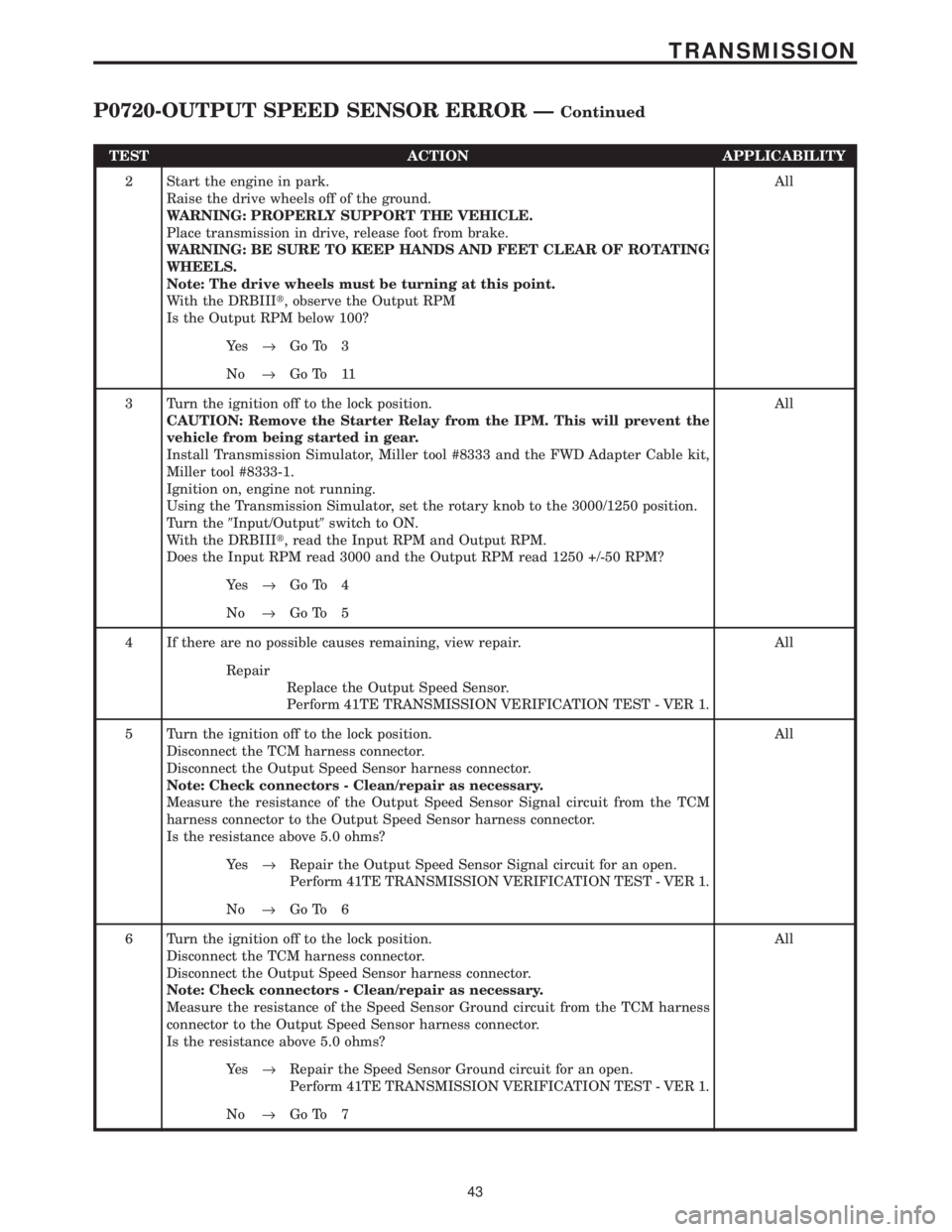
TEST ACTION APPLICABILITY
2 Start the engine in park.
Raise the drive wheels off of the ground.
WARNING: PROPERLY SUPPORT THE VEHICLE.
Place transmission in drive, release foot from brake.
WARNING: BE SURE TO KEEP HANDS AND FEET CLEAR OF ROTATING
WHEELS.
Note: The drive wheels must be turning at this point.
With the DRBIIIt, observe the Output RPM
Is the Output RPM below 100?All
Ye s®Go To 3
No®Go To 11
3 Turn the ignition off to the lock position.
CAUTION: Remove the Starter Relay from the IPM. This will prevent the
vehicle from being started in gear.
Install Transmission Simulator, Miller tool #8333 and the FWD Adapter Cable kit,
Miller tool #8333-1.
Ignition on, engine not running.
Using the Transmission Simulator, set the rotary knob to the 3000/1250 position.
Turn the9Input/Output9switch to ON.
With the DRBIIIt, read the Input RPM and Output RPM.
Does the Input RPM read 3000 and the Output RPM read 1250 +/-50 RPM?All
Ye s®Go To 4
No®Go To 5
4 If there are no possible causes remaining, view repair. All
Repair
Replace the Output Speed Sensor.
Perform 41TE TRANSMISSION VERIFICATION TEST - VER 1.
5 Turn the ignition off to the lock position.
Disconnect the TCM harness connector.
Disconnect the Output Speed Sensor harness connector.
Note: Check connectors - Clean/repair as necessary.
Measure the resistance of the Output Speed Sensor Signal circuit from the TCM
harness connector to the Output Speed Sensor harness connector.
Is the resistance above 5.0 ohms?All
Ye s®Repair the Output Speed Sensor Signal circuit for an open.
Perform 41TE TRANSMISSION VERIFICATION TEST - VER 1.
No®Go To 6
6 Turn the ignition off to the lock position.
Disconnect the TCM harness connector.
Disconnect the Output Speed Sensor harness connector.
Note: Check connectors - Clean/repair as necessary.
Measure the resistance of the Speed Sensor Ground circuit from the TCM harness
connector to the Output Speed Sensor harness connector.
Is the resistance above 5.0 ohms?All
Ye s®Repair the Speed Sensor Ground circuit for an open.
Perform 41TE TRANSMISSION VERIFICATION TEST - VER 1.
No®Go To 7
43
TRANSMISSION
P0720-OUTPUT SPEED SENSOR ERROR ÐContinued
Page 4258 of 4284
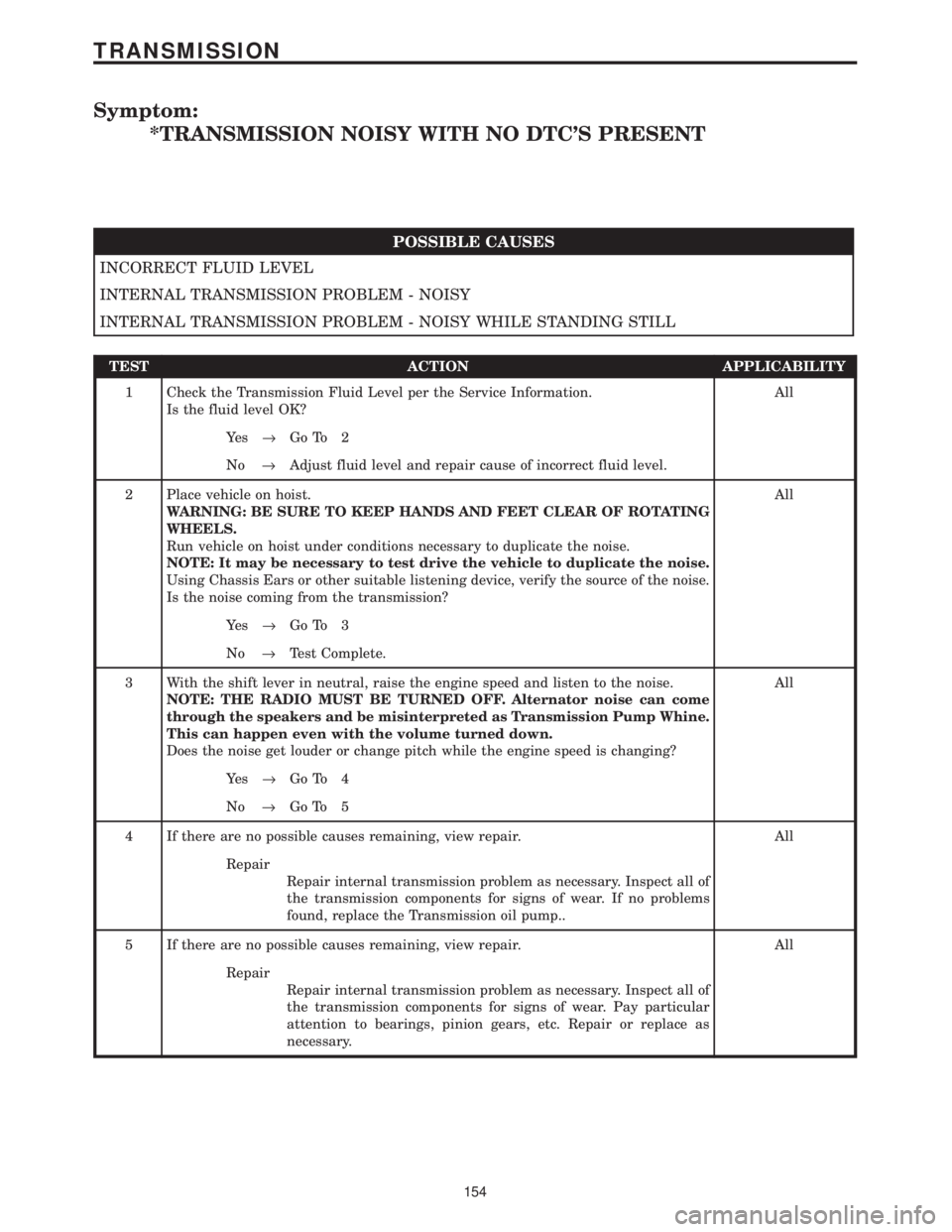
Symptom:
*TRANSMISSION NOISY WITH NO DTC'S PRESENT
POSSIBLE CAUSES
INCORRECT FLUID LEVEL
INTERNAL TRANSMISSION PROBLEM - NOISY
INTERNAL TRANSMISSION PROBLEM - NOISY WHILE STANDING STILL
TEST ACTION APPLICABILITY
1 Check the Transmission Fluid Level per the Service Information.
Is the fluid level OK?All
Ye s®Go To 2
No®Adjust fluid level and repair cause of incorrect fluid level.
2 Place vehicle on hoist.
WARNING: BE SURE TO KEEP HANDS AND FEET CLEAR OF ROTATING
WHEELS.
Run vehicle on hoist under conditions necessary to duplicate the noise.
NOTE: It may be necessary to test drive the vehicle to duplicate the noise.
Using Chassis Ears or other suitable listening device, verify the source of the noise.
Is the noise coming from the transmission?All
Ye s®Go To 3
No®Test Complete.
3 With the shift lever in neutral, raise the engine speed and listen to the noise.
NOTE: THE RADIO MUST BE TURNED OFF. Alternator noise can come
through the speakers and be misinterpreted as Transmission Pump Whine.
This can happen even with the volume turned down.
Does the noise get louder or change pitch while the engine speed is changing?All
Ye s®Go To 4
No®Go To 5
4 If there are no possible causes remaining, view repair. All
Repair
Repair internal transmission problem as necessary. Inspect all of
the transmission components for signs of wear. If no problems
found, replace the Transmission oil pump..
5 If there are no possible causes remaining, view repair. All
Repair
Repair internal transmission problem as necessary. Inspect all of
the transmission components for signs of wear. Pay particular
attention to bearings, pinion gears, etc. Repair or replace as
necessary.
154
TRANSMISSION