2001 CHRYSLER VOYAGER service
[x] Cancel search: servicePage 1424 of 4284
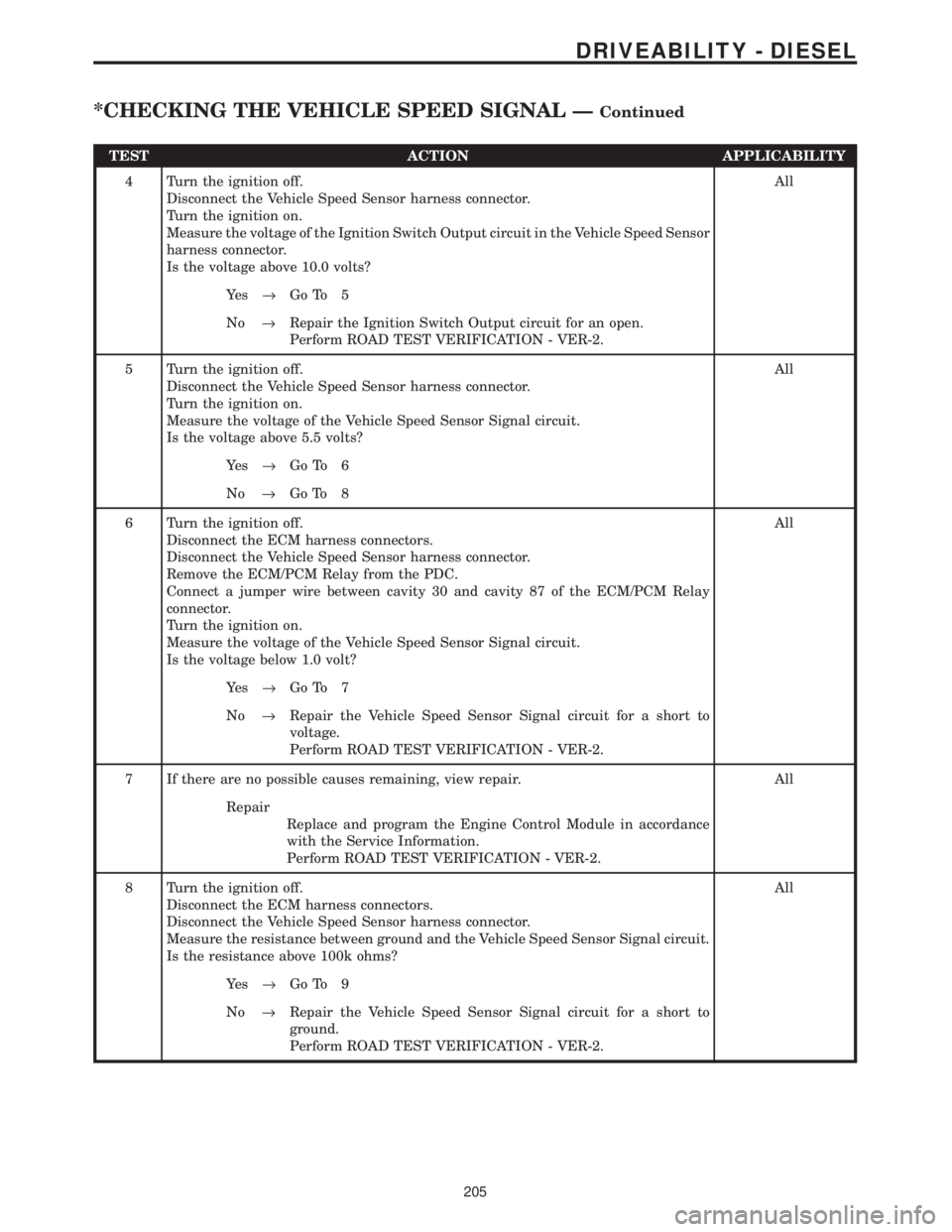
TEST ACTION APPLICABILITY
4 Turn the ignition off.
Disconnect the Vehicle Speed Sensor harness connector.
Turn the ignition on.
Measure the voltage of the Ignition Switch Output circuit in the Vehicle Speed Sensor
harness connector.
Is the voltage above 10.0 volts?All
Ye s®Go To 5
No®Repair the Ignition Switch Output circuit for an open.
Perform ROAD TEST VERIFICATION - VER-2.
5 Turn the ignition off.
Disconnect the Vehicle Speed Sensor harness connector.
Turn the ignition on.
Measure the voltage of the Vehicle Speed Sensor Signal circuit.
Is the voltage above 5.5 volts?All
Ye s®Go To 6
No®Go To 8
6 Turn the ignition off.
Disconnect the ECM harness connectors.
Disconnect the Vehicle Speed Sensor harness connector.
Remove the ECM/PCM Relay from the PDC.
Connect a jumper wire between cavity 30 and cavity 87 of the ECM/PCM Relay
connector.
Turn the ignition on.
Measure the voltage of the Vehicle Speed Sensor Signal circuit.
Is the voltage below 1.0 volt?All
Ye s®Go To 7
No®Repair the Vehicle Speed Sensor Signal circuit for a short to
voltage.
Perform ROAD TEST VERIFICATION - VER-2.
7 If there are no possible causes remaining, view repair. All
Repair
Replace and program the Engine Control Module in accordance
with the Service Information.
Perform ROAD TEST VERIFICATION - VER-2.
8 Turn the ignition off.
Disconnect the ECM harness connectors.
Disconnect the Vehicle Speed Sensor harness connector.
Measure the resistance between ground and the Vehicle Speed Sensor Signal circuit.
Is the resistance above 100k ohms?All
Ye s®Go To 9
No®Repair the Vehicle Speed Sensor Signal circuit for a short to
ground.
Perform ROAD TEST VERIFICATION - VER-2.
205
DRIVEABILITY - DIESEL
*CHECKING THE VEHICLE SPEED SIGNAL ÐContinued
Page 1425 of 4284
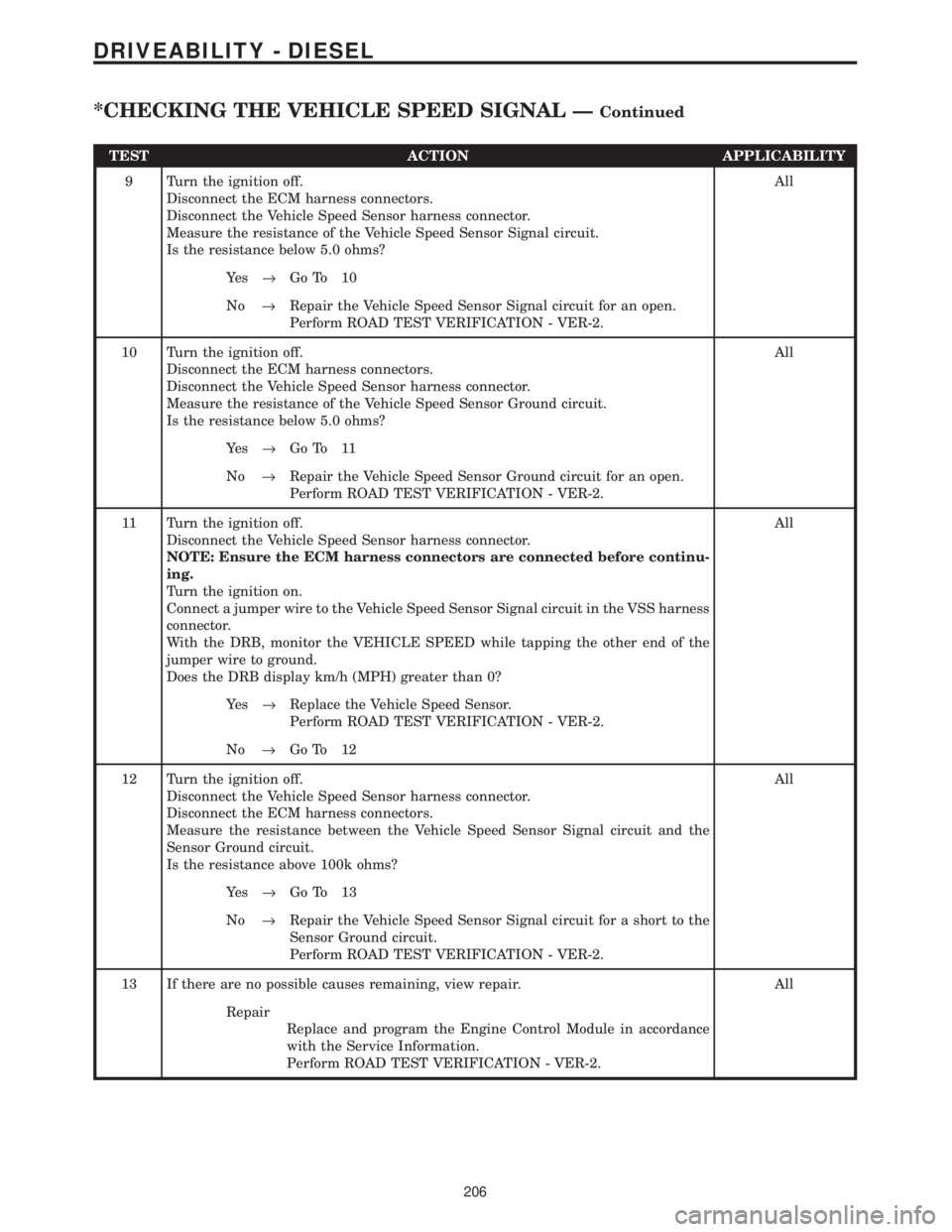
TEST ACTION APPLICABILITY
9 Turn the ignition off.
Disconnect the ECM harness connectors.
Disconnect the Vehicle Speed Sensor harness connector.
Measure the resistance of the Vehicle Speed Sensor Signal circuit.
Is the resistance below 5.0 ohms?All
Ye s®Go To 10
No®Repair the Vehicle Speed Sensor Signal circuit for an open.
Perform ROAD TEST VERIFICATION - VER-2.
10 Turn the ignition off.
Disconnect the ECM harness connectors.
Disconnect the Vehicle Speed Sensor harness connector.
Measure the resistance of the Vehicle Speed Sensor Ground circuit.
Is the resistance below 5.0 ohms?All
Ye s®Go To 11
No®Repair the Vehicle Speed Sensor Ground circuit for an open.
Perform ROAD TEST VERIFICATION - VER-2.
11 Turn the ignition off.
Disconnect the Vehicle Speed Sensor harness connector.
NOTE: Ensure the ECM harness connectors are connected before continu-
ing.
Turn the ignition on.
Connect a jumper wire to the Vehicle Speed Sensor Signal circuit in the VSS harness
connector.
With the DRB, monitor the VEHICLE SPEED while tapping the other end of the
jumper wire to ground.
Does the DRB display km/h (MPH) greater than 0?All
Ye s®Replace the Vehicle Speed Sensor.
Perform ROAD TEST VERIFICATION - VER-2.
No®Go To 12
12 Turn the ignition off.
Disconnect the Vehicle Speed Sensor harness connector.
Disconnect the ECM harness connectors.
Measure the resistance between the Vehicle Speed Sensor Signal circuit and the
Sensor Ground circuit.
Is the resistance above 100k ohms?All
Ye s®Go To 13
No®Repair the Vehicle Speed Sensor Signal circuit for a short to the
Sensor Ground circuit.
Perform ROAD TEST VERIFICATION - VER-2.
13 If there are no possible causes remaining, view repair. All
Repair
Replace and program the Engine Control Module in accordance
with the Service Information.
Perform ROAD TEST VERIFICATION - VER-2.
206
DRIVEABILITY - DIESEL
*CHECKING THE VEHICLE SPEED SIGNAL ÐContinued
Page 1427 of 4284
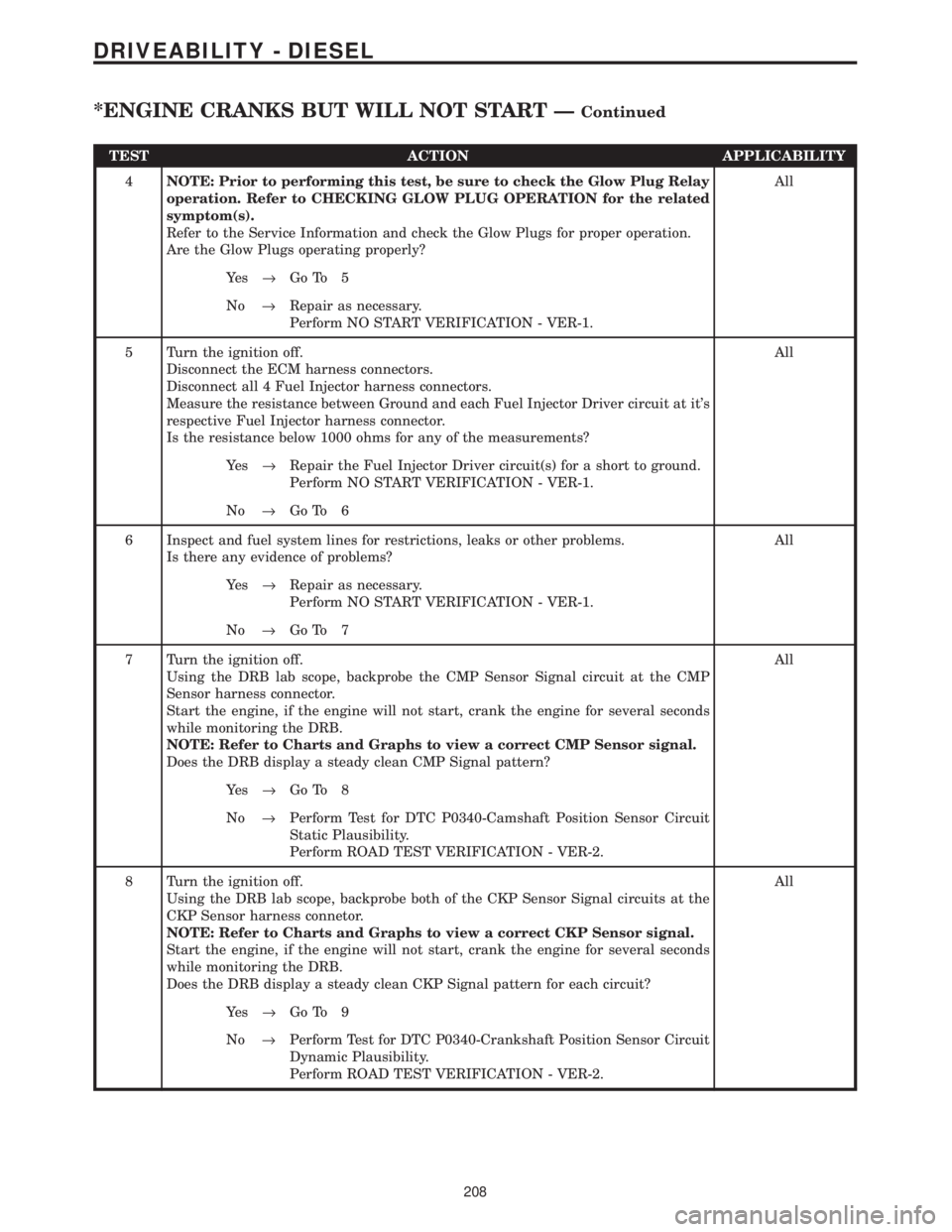
TEST ACTION APPLICABILITY
4NOTE: Prior to performing this test, be sure to check the Glow Plug Relay
operation. Refer to CHECKING GLOW PLUG OPERATION for the related
symptom(s).
Refer to the Service Information and check the Glow Plugs for proper operation.
Are the Glow Plugs operating properly?All
Ye s®Go To 5
No®Repair as necessary.
Perform NO START VERIFICATION - VER-1.
5 Turn the ignition off.
Disconnect the ECM harness connectors.
Disconnect all 4 Fuel Injector harness connectors.
Measure the resistance between Ground and each Fuel Injector Driver circuit at it's
respective Fuel Injector harness connector.
Is the resistance below 1000 ohms for any of the measurements?All
Ye s®Repair the Fuel Injector Driver circuit(s) for a short to ground.
Perform NO START VERIFICATION - VER-1.
No®Go To 6
6 Inspect and fuel system lines for restrictions, leaks or other problems.
Is there any evidence of problems?All
Ye s®Repair as necessary.
Perform NO START VERIFICATION - VER-1.
No®Go To 7
7 Turn the ignition off.
Using the DRB lab scope, backprobe the CMP Sensor Signal circuit at the CMP
Sensor harness connector.
Start the engine, if the engine will not start, crank the engine for several seconds
while monitoring the DRB.
NOTE: Refer to Charts and Graphs to view a correct CMP Sensor signal.
Does the DRB display a steady clean CMP Signal pattern?All
Ye s®Go To 8
No®Perform Test for DTC P0340-Camshaft Position Sensor Circuit
Static Plausibility.
Perform ROAD TEST VERIFICATION - VER-2.
8 Turn the ignition off.
Using the DRB lab scope, backprobe both of the CKP Sensor Signal circuits at the
CKP Sensor harness connetor.
NOTE: Refer to Charts and Graphs to view a correct CKP Sensor signal.
Start the engine, if the engine will not start, crank the engine for several seconds
while monitoring the DRB.
Does the DRB display a steady clean CKP Signal pattern for each circuit?All
Ye s®Go To 9
No®Perform Test for DTC P0340-Crankshaft Position Sensor Circuit
Dynamic Plausibility.
Perform ROAD TEST VERIFICATION - VER-2.
208
DRIVEABILITY - DIESEL
*ENGINE CRANKS BUT WILL NOT START ÐContinued
Page 1428 of 4284
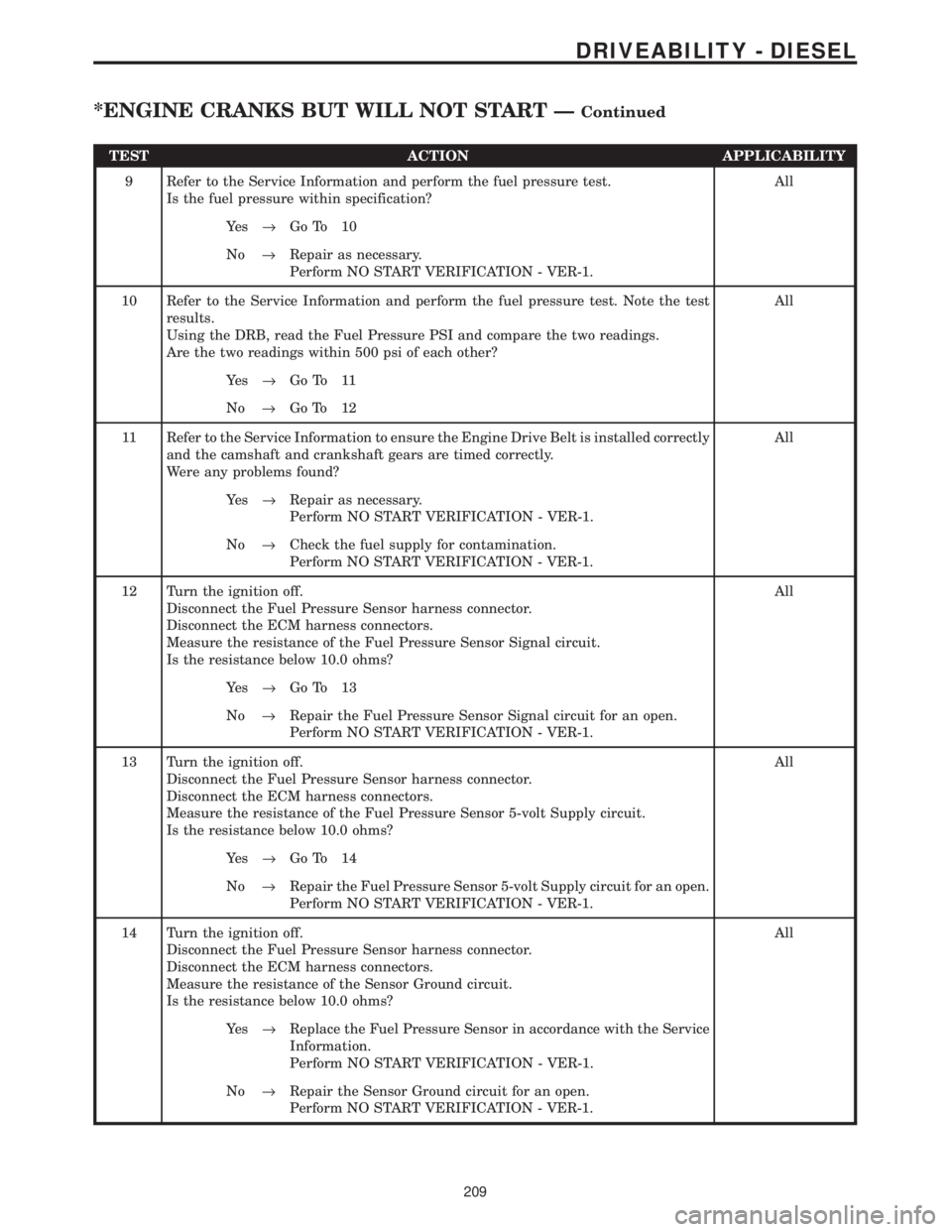
TEST ACTION APPLICABILITY
9 Refer to the Service Information and perform the fuel pressure test.
Is the fuel pressure within specification?All
Ye s®Go To 10
No®Repair as necessary.
Perform NO START VERIFICATION - VER-1.
10 Refer to the Service Information and perform the fuel pressure test. Note the test
results.
Using the DRB, read the Fuel Pressure PSI and compare the two readings.
Are the two readings within 500 psi of each other?All
Ye s®Go To 11
No®Go To 12
11 Refer to the Service Information to ensure the Engine Drive Belt is installed correctly
and the camshaft and crankshaft gears are timed correctly.
Were any problems found?All
Ye s®Repair as necessary.
Perform NO START VERIFICATION - VER-1.
No®Check the fuel supply for contamination.
Perform NO START VERIFICATION - VER-1.
12 Turn the ignition off.
Disconnect the Fuel Pressure Sensor harness connector.
Disconnect the ECM harness connectors.
Measure the resistance of the Fuel Pressure Sensor Signal circuit.
Is the resistance below 10.0 ohms?All
Ye s®Go To 13
No®Repair the Fuel Pressure Sensor Signal circuit for an open.
Perform NO START VERIFICATION - VER-1.
13 Turn the ignition off.
Disconnect the Fuel Pressure Sensor harness connector.
Disconnect the ECM harness connectors.
Measure the resistance of the Fuel Pressure Sensor 5-volt Supply circuit.
Is the resistance below 10.0 ohms?All
Ye s®Go To 14
No®Repair the Fuel Pressure Sensor 5-volt Supply circuit for an open.
Perform NO START VERIFICATION - VER-1.
14 Turn the ignition off.
Disconnect the Fuel Pressure Sensor harness connector.
Disconnect the ECM harness connectors.
Measure the resistance of the Sensor Ground circuit.
Is the resistance below 10.0 ohms?All
Ye s®Replace the Fuel Pressure Sensor in accordance with the Service
Information.
Perform NO START VERIFICATION - VER-1.
No®Repair the Sensor Ground circuit for an open.
Perform NO START VERIFICATION - VER-1.
209
DRIVEABILITY - DIESEL
*ENGINE CRANKS BUT WILL NOT START ÐContinued
Page 1431 of 4284
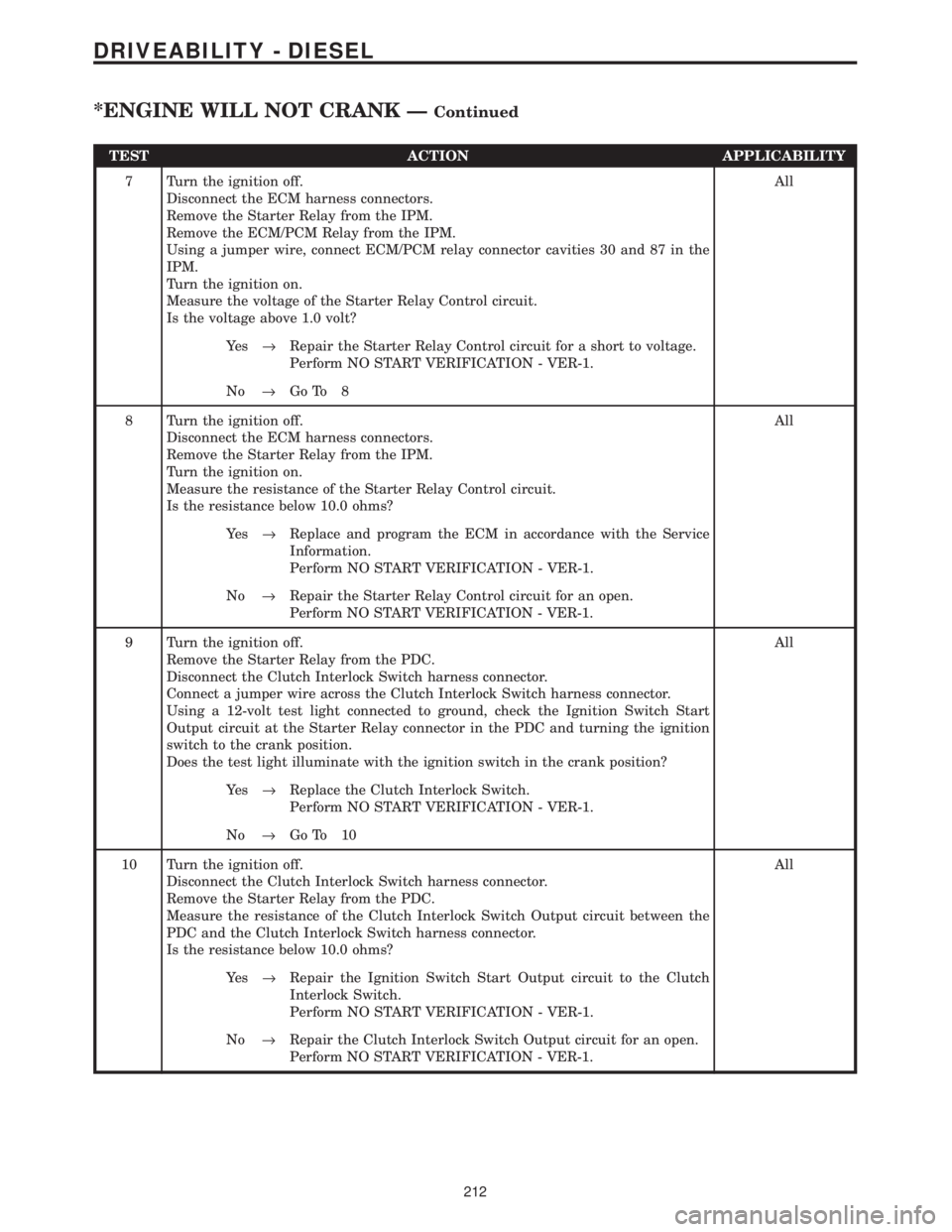
TEST ACTION APPLICABILITY
7 Turn the ignition off.
Disconnect the ECM harness connectors.
Remove the Starter Relay from the IPM.
Remove the ECM/PCM Relay from the IPM.
Using a jumper wire, connect ECM/PCM relay connector cavities 30 and 87 in the
IPM.
Turn the ignition on.
Measure the voltage of the Starter Relay Control circuit.
Is the voltage above 1.0 volt?All
Ye s®Repair the Starter Relay Control circuit for a short to voltage.
Perform NO START VERIFICATION - VER-1.
No®Go To 8
8 Turn the ignition off.
Disconnect the ECM harness connectors.
Remove the Starter Relay from the IPM.
Turn the ignition on.
Measure the resistance of the Starter Relay Control circuit.
Is the resistance below 10.0 ohms?All
Ye s®Replace and program the ECM in accordance with the Service
Information.
Perform NO START VERIFICATION - VER-1.
No®Repair the Starter Relay Control circuit for an open.
Perform NO START VERIFICATION - VER-1.
9 Turn the ignition off.
Remove the Starter Relay from the PDC.
Disconnect the Clutch Interlock Switch harness connector.
Connect a jumper wire across the Clutch Interlock Switch harness connector.
Using a 12-volt test light connected to ground, check the Ignition Switch Start
Output circuit at the Starter Relay connector in the PDC and turning the ignition
switch to the crank position.
Does the test light illuminate with the ignition switch in the crank position?All
Ye s®Replace the Clutch Interlock Switch.
Perform NO START VERIFICATION - VER-1.
No®Go To 10
10 Turn the ignition off.
Disconnect the Clutch Interlock Switch harness connector.
Remove the Starter Relay from the PDC.
Measure the resistance of the Clutch Interlock Switch Output circuit between the
PDC and the Clutch Interlock Switch harness connector.
Is the resistance below 10.0 ohms?All
Ye s®Repair the Ignition Switch Start Output circuit to the Clutch
Interlock Switch.
Perform NO START VERIFICATION - VER-1.
No®Repair the Clutch Interlock Switch Output circuit for an open.
Perform NO START VERIFICATION - VER-1.
212
DRIVEABILITY - DIESEL
*ENGINE WILL NOT CRANK ÐContinued
Page 1432 of 4284
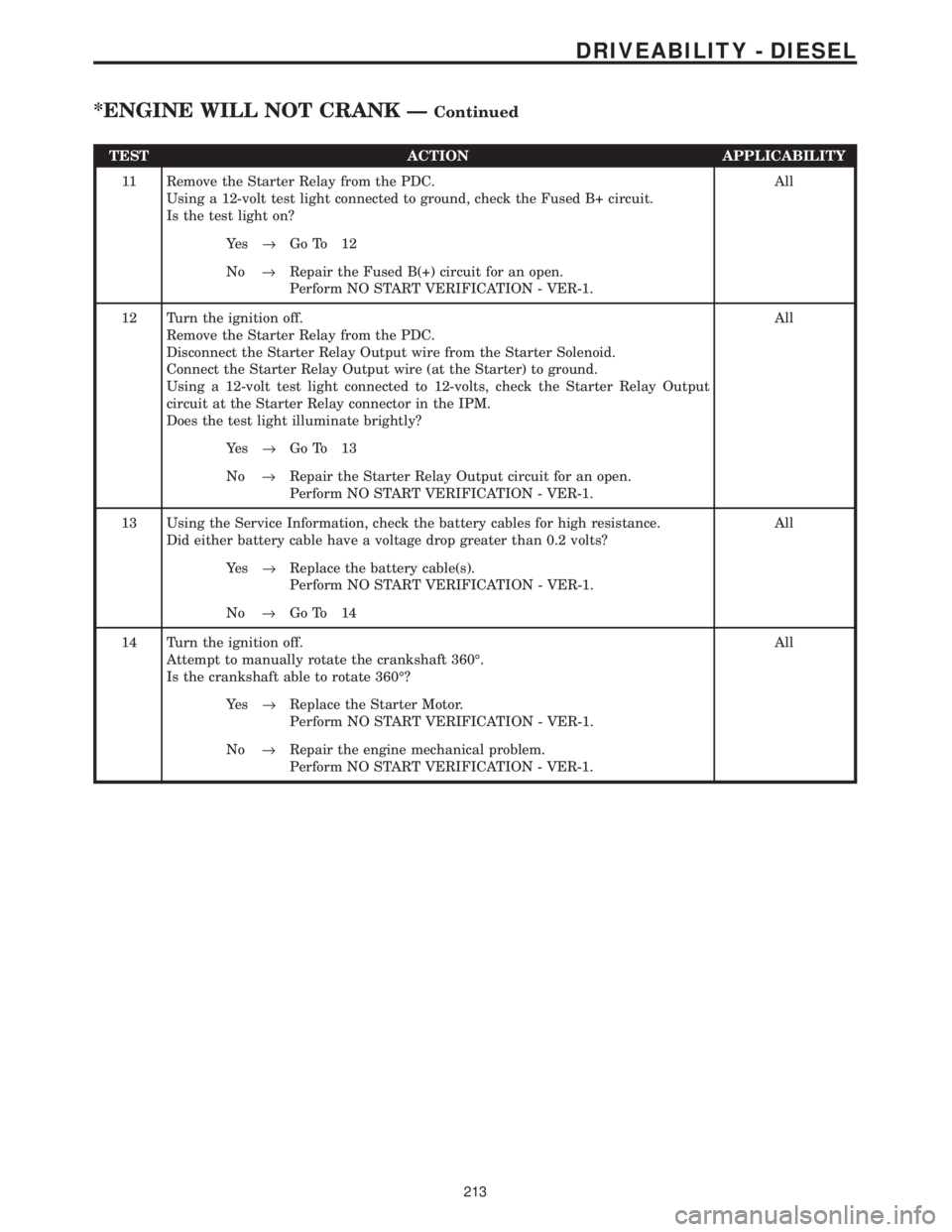
TEST ACTION APPLICABILITY
11 Remove the Starter Relay from the PDC.
Using a 12-volt test light connected to ground, check the Fused B+ circuit.
Is the test light on?All
Ye s®Go To 12
No®Repair the Fused B(+) circuit for an open.
Perform NO START VERIFICATION - VER-1.
12 Turn the ignition off.
Remove the Starter Relay from the PDC.
Disconnect the Starter Relay Output wire from the Starter Solenoid.
Connect the Starter Relay Output wire (at the Starter) to ground.
Using a 12-volt test light connected to 12-volts, check the Starter Relay Output
circuit at the Starter Relay connector in the IPM.
Does the test light illuminate brightly?All
Ye s®Go To 13
No®Repair the Starter Relay Output circuit for an open.
Perform NO START VERIFICATION - VER-1.
13 Using the Service Information, check the battery cables for high resistance.
Did either battery cable have a voltage drop greater than 0.2 volts?All
Ye s®Replace the battery cable(s).
Perform NO START VERIFICATION - VER-1.
No®Go To 14
14 Turn the ignition off.
Attempt to manually rotate the crankshaft 360É.
Is the crankshaft able to rotate 360É?All
Ye s®Replace the Starter Motor.
Perform NO START VERIFICATION - VER-1.
No®Repair the engine mechanical problem.
Perform NO START VERIFICATION - VER-1.
213
DRIVEABILITY - DIESEL
*ENGINE WILL NOT CRANK ÐContinued
Page 1434 of 4284
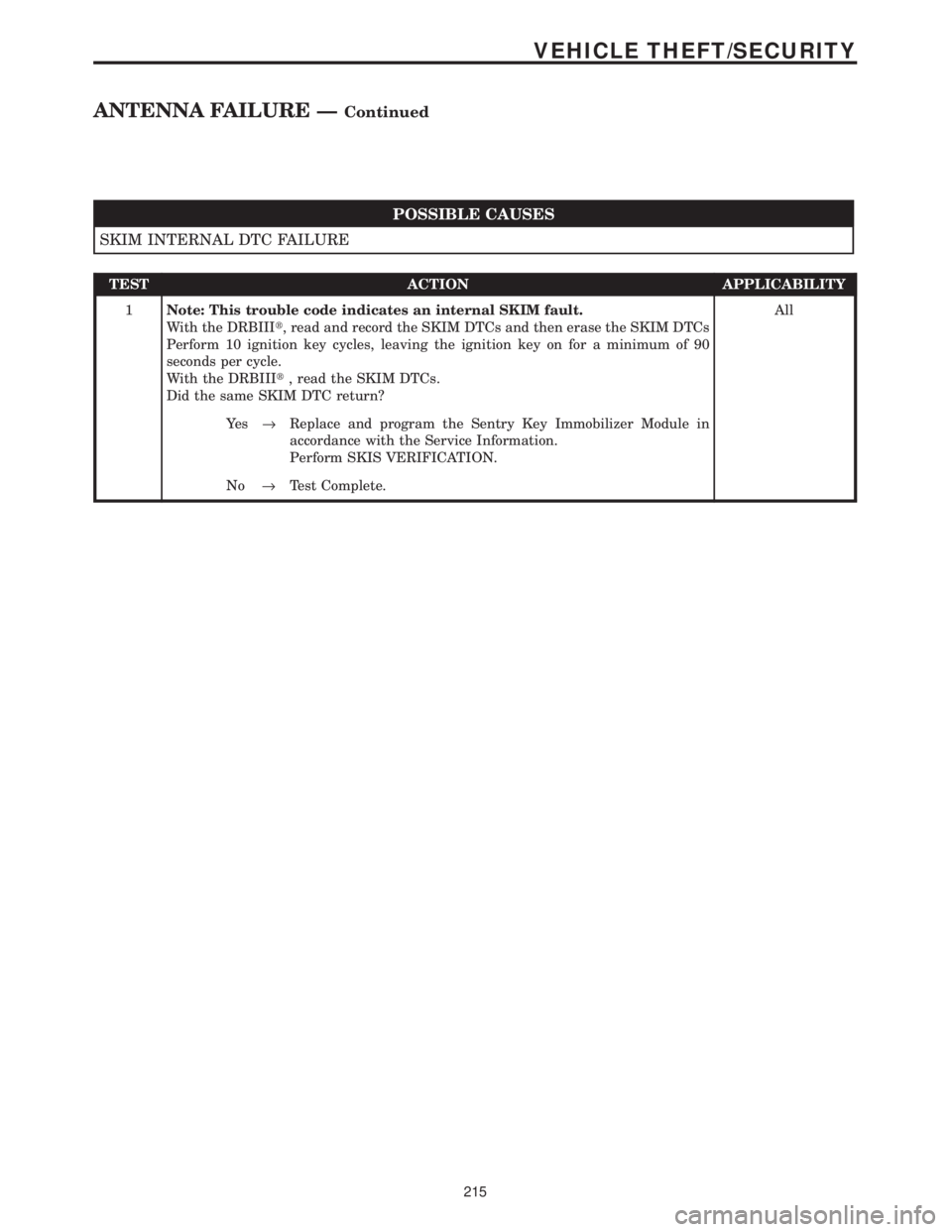
POSSIBLE CAUSES
SKIM INTERNAL DTC FAILURE
TEST ACTION APPLICABILITY
1Note: This trouble code indicates an internal SKIM fault.
With the DRBIIIt, read and record the SKIM DTCs and then erase the SKIM DTCs
Perform 10 ignition key cycles, leaving the ignition key on for a minimum of 90
seconds per cycle.
With the DRBIIIt, read the SKIM DTCs.
Did the same SKIM DTC return?All
Ye s®Replace and program the Sentry Key Immobilizer Module in
accordance with the Service Information.
Perform SKIS VERIFICATION.
No®Test Complete.
215
VEHICLE THEFT/SECURITY
ANTENNA FAILURE ÐContinued
Page 1436 of 4284
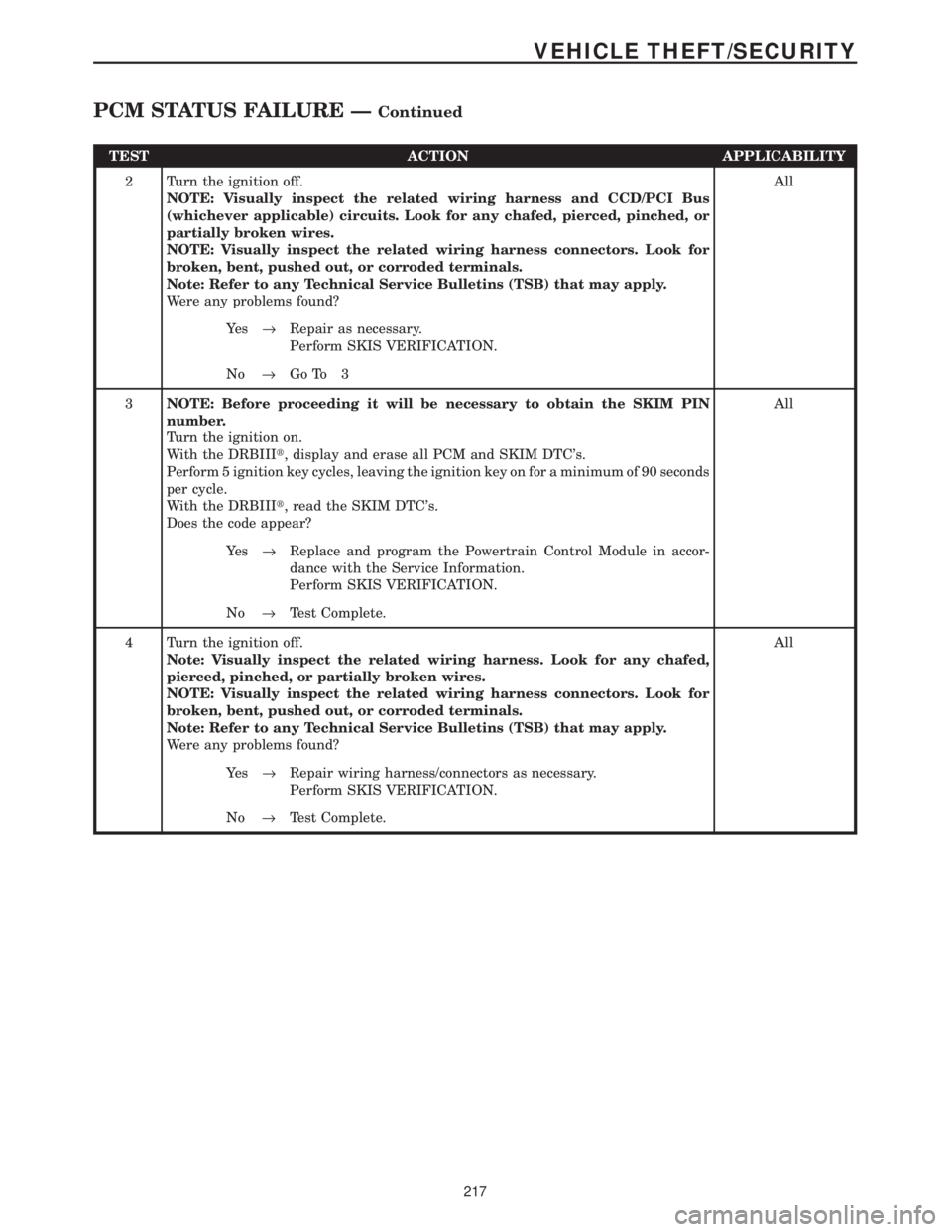
TEST ACTION APPLICABILITY
2 Turn the ignition off.
NOTE: Visually inspect the related wiring harness and CCD/PCI Bus
(whichever applicable) circuits. Look for any chafed, pierced, pinched, or
partially broken wires.
NOTE: Visually inspect the related wiring harness connectors. Look for
broken, bent, pushed out, or corroded terminals.
Note: Refer to any Technical Service Bulletins (TSB) that may apply.
Were any problems found?All
Ye s®Repair as necessary.
Perform SKIS VERIFICATION.
No®Go To 3
3NOTE: Before proceeding it will be necessary to obtain the SKIM PIN
number.
Turn the ignition on.
With the DRBIIIt, display and erase all PCM and SKIM DTC's.
Perform 5 ignition key cycles, leaving the ignition key on for a minimum of 90 seconds
per cycle.
With the DRBIIIt, read the SKIM DTC's.
Does the code appear?All
Ye s®Replace and program the Powertrain Control Module in accor-
dance with the Service Information.
Perform SKIS VERIFICATION.
No®Test Complete.
4 Turn the ignition off.
Note: Visually inspect the related wiring harness. Look for any chafed,
pierced, pinched, or partially broken wires.
NOTE: Visually inspect the related wiring harness connectors. Look for
broken, bent, pushed out, or corroded terminals.
Note: Refer to any Technical Service Bulletins (TSB) that may apply.
Were any problems found?All
Ye s®Repair wiring harness/connectors as necessary.
Perform SKIS VERIFICATION.
No®Test Complete.
217
VEHICLE THEFT/SECURITY
PCM STATUS FAILURE ÐContinued