2001 CHRYSLER VOYAGER change time
[x] Cancel search: change timePage 151 of 4284
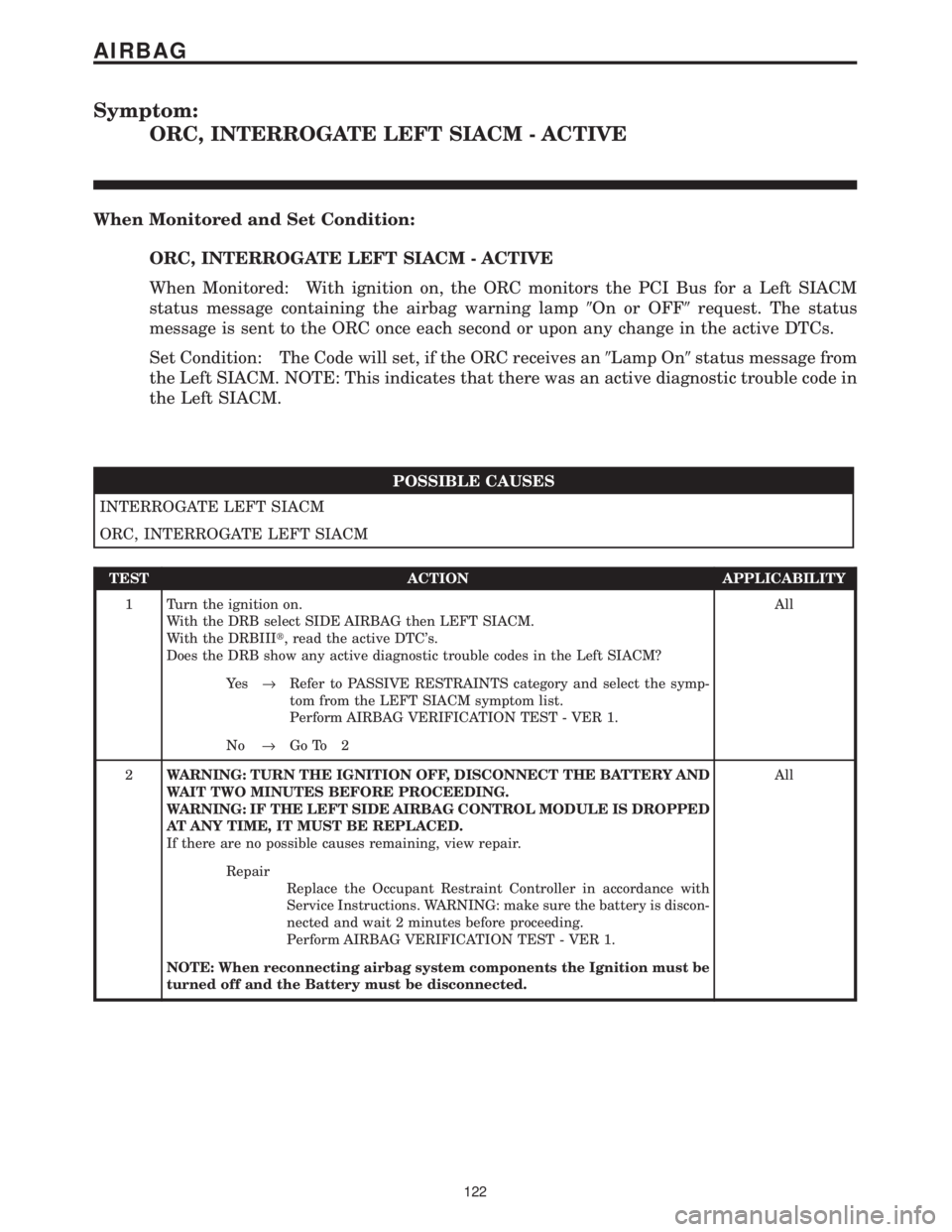
Symptom:
ORC, INTERROGATE LEFT SIACM - ACTIVE
When Monitored and Set Condition:
ORC, INTERROGATE LEFT SIACM - ACTIVE
When Monitored: With ignition on, the ORC monitors the PCI Bus for a Left SIACM
status message containing the airbag warning lamp9On or OFF9request. The status
message is sent to the ORC once each second or upon any change in the active DTCs.
Set Condition: The Code will set, if the ORC receives an9Lamp On9status message from
the Left SIACM. NOTE: This indicates that there was an active diagnostic trouble code in
the Left SIACM.
POSSIBLE CAUSES
INTERROGATE LEFT SIACM
ORC, INTERROGATE LEFT SIACM
TEST ACTION APPLICABILITY
1 Turn the ignition on.
With the DRB select SIDE AIRBAG then LEFT SIACM.
With the DRBIIIt, read the active DTC's.
Does the DRB show any active diagnostic trouble codes in the Left SIACM?All
Ye s®Refer to PASSIVE RESTRAINTS category and select the symp-
tom from the LEFT SIACM symptom list.
Perform AIRBAG VERIFICATION TEST - VER 1.
No®Go To 2
2WARNING: TURN THE IGNITION OFF, DISCONNECT THE BATTERY AND
WAIT TWO MINUTES BEFORE PROCEEDING.
WARNING: IF THE LEFT SIDE AIRBAG CONTROL MODULE IS DROPPED
AT ANY TIME, IT MUST BE REPLACED.
If there are no possible causes remaining, view repair.All
Repair
Replace the Occupant Restraint Controller in accordance with
Service Instructions. WARNING: make sure the battery is discon-
nected and wait 2 minutes before proceeding.
Perform AIRBAG VERIFICATION TEST - VER 1.
NOTE: When reconnecting airbag system components the Ignition must be
turned off and the Battery must be disconnected.
122
AIRBAG
Page 152 of 4284
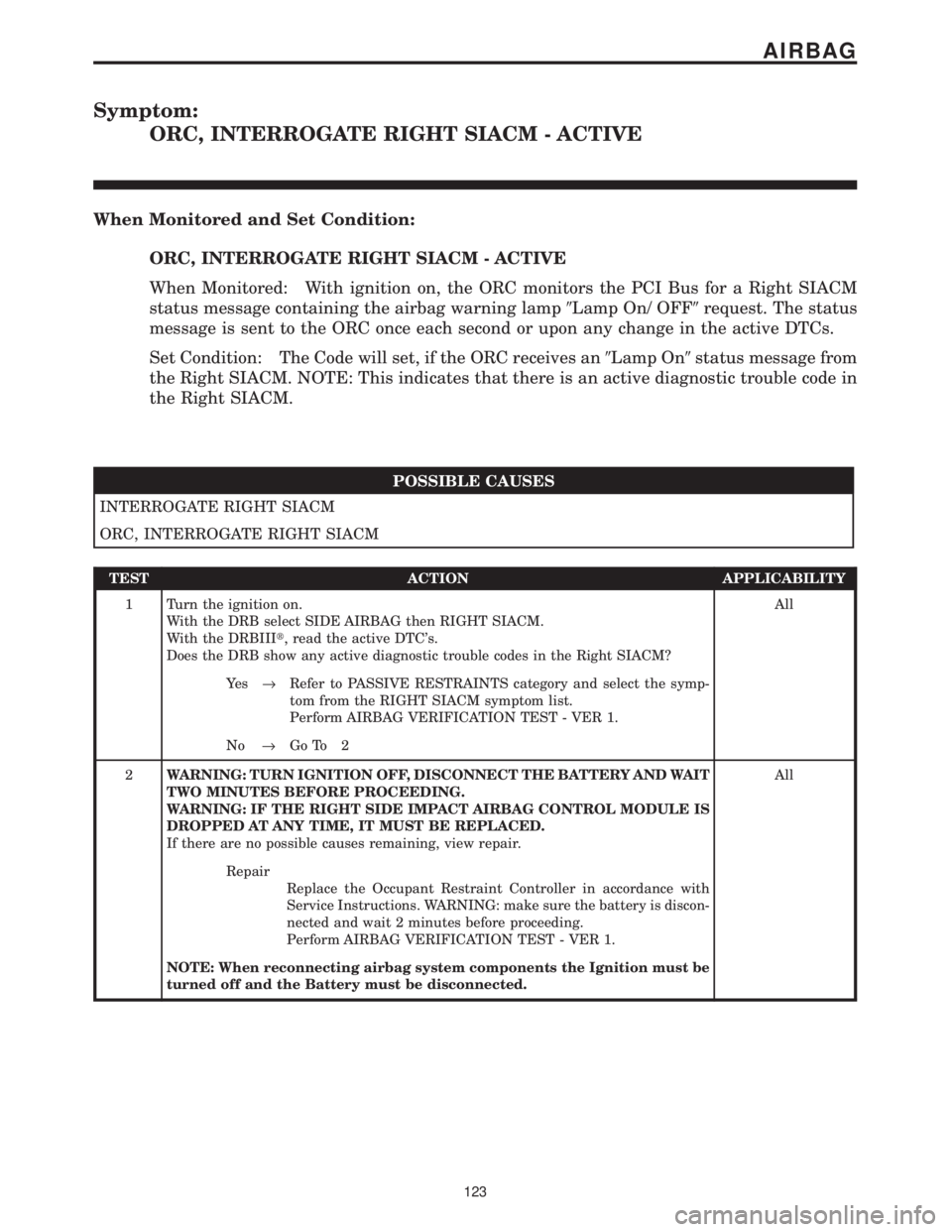
Symptom:
ORC, INTERROGATE RIGHT SIACM - ACTIVE
When Monitored and Set Condition:
ORC, INTERROGATE RIGHT SIACM - ACTIVE
When Monitored: With ignition on, the ORC monitors the PCI Bus for a Right SIACM
status message containing the airbag warning lamp9Lamp On/ OFF9request. The status
message is sent to the ORC once each second or upon any change in the active DTCs.
Set Condition: The Code will set, if the ORC receives an9Lamp On9status message from
the Right SIACM. NOTE: This indicates that there is an active diagnostic trouble code in
the Right SIACM.
POSSIBLE CAUSES
INTERROGATE RIGHT SIACM
ORC, INTERROGATE RIGHT SIACM
TEST ACTION APPLICABILITY
1 Turn the ignition on.
With the DRB select SIDE AIRBAG then RIGHT SIACM.
With the DRBIIIt, read the active DTC's.
Does the DRB show any active diagnostic trouble codes in the Right SIACM?All
Ye s®Refer to PASSIVE RESTRAINTS category and select the symp-
tom from the RIGHT SIACM symptom list.
Perform AIRBAG VERIFICATION TEST - VER 1.
No®Go To 2
2WARNING: TURN IGNITION OFF, DISCONNECT THE BATTERY AND WAIT
TWO MINUTES BEFORE PROCEEDING.
WARNING: IF THE RIGHT SIDE IMPACT AIRBAG CONTROL MODULE IS
DROPPED AT ANY TIME, IT MUST BE REPLACED.
If there are no possible causes remaining, view repair.All
Repair
Replace the Occupant Restraint Controller in accordance with
Service Instructions. WARNING: make sure the battery is discon-
nected and wait 2 minutes before proceeding.
Perform AIRBAG VERIFICATION TEST - VER 1.
NOTE: When reconnecting airbag system components the Ignition must be
turned off and the Battery must be disconnected.
123
AIRBAG
Page 155 of 4284

Symptom:
ORC, NO CLUSTER MESSAGE - ACTIVE
When Monitored and Set Condition:
ORC, NO CLUSTER MESSAGE - ACTIVE
When Monitored: With the ignition in the On position, the ORC monitors the PCI Bus for
a message from the MIC containing the airbag warning lamp status. The MIC transmits
the message one time at ignition on, lamp state change, or in response to the ORC lamp
message.
Set Condition: If the MIC message is not received for 10 consecutive seconds, the code
will set.
POSSIBLE CAUSES
MIC, COMMUNICATION FAILURE
NO CLUSTER MESSAGES
ORC, NO CLUSTER MESSAGES
TEST ACTION APPLICABILITY
1 Turn the ignition on.
With the DRBIIIt, ensure PCI Bus communications with the Instrument Cluster.
Is the Instrument Cluster communicating on the PCI Bus?All
Ye s®Go To 2
No®Refer to category COMMUNICATION CATEGORY and select the
related symptom INSTRUMENT CLUSTER BUS +/- SIGNAL
OPEN.
Perform AIRBAG VERIFICATION TEST - VER 1.
2 With the DRB select PASSIVE RESTRAINTS, AIRBAG, MONITOR DISPLAY and
WARNING LAMP STATUS.
Cycle the ignition key and observe the LAMP ON BY MIC monitor after the 6 to 8
seconds bulb check.
Does the DRB show LAMP ON BY MIC: ON or OFF?All
YES
Go To 3
NO
Replace Instrument Cluster circuit board.
Perform BODY VERIFICATION TEST - VER 1.
126
AIRBAG
Page 200 of 4284

Symptom List:
ORC, WARNING INDICATOR CIRCUIT OPEN - ACTIVE
ORC, WARNING INDICATOR CIRCUIT SHORT - ACTIVE
Test Note: All symptoms listed above are diagnosed using the same tests.
The title for the tests will be ORC, WARNING INDICATOR
CIRCUIT OPEN - ACTIVE.
When Monitored and Set Condition:
ORC, WARNING INDICATOR CIRCUIT OPEN - ACTIVE
When Monitored: When the ignition is On, the ORC monitors the PCI Bus for a message
from the MIC containing the airbag warning lamp status Ok or Open. The MIC transmit
the message one time at ignition on, upon lamp state change,or in response to the ORC
lamp message.
Set Condition: The code is set if the lamp state is open for 2 consecutive messages or 2
seconds.
ORC, WARNING INDICATOR CIRCUIT SHORT - ACTIVE
When Monitored: When the ignition is On, the ORC monitors the PCI Bus for a message
from the MIC containing the airbag warning lamp status Ok or Shorted. The MIC transmit
the message one time at ignition on and upon lamp state change.
Set Condition: If the lamp state is Shorted for 2 consecutive messages the code will be set.
POSSIBLE CAUSES
MIC, COMMUNICATION FAILURE
WARNING INDICATOR
ORC, WARNING INDICATOR
TEST ACTION APPLICABILITY
1 Turn the ignition on.
With the DRBIIIt, ensure PCI Bus communications with the Instrument Cluster.
Is the Instrument Cluster communicating on the PCI Bus?All
Ye s®Go To 2
No®Refer to category COMMUNICATION CATEGORY and select the
related symptom INSTRUMENT CLUSTER BUS +/- SIGNAL
OPEN.
Perform BODY VERIFICATION TEST - VER 1.
171
AIRBAG
Page 602 of 4284

TEST ACTION APPLICABILITY
3 Turn the ignition on.
Disconnect the Fuel Tank Module harness connector.
Measure the resistance of the Ground circuits in the Fuel Tank Module harness
connector.
Is the resistance below 5.0 ohms for both measurements?All
Ye s®Go To 4
No®Repair the Ground circuit for an open.
Perform BODY VERIFICATION TEST - VER 1.
4 Turn the ignition off.
Disconnect the Fuel Tank Module harness connector.
Turn the ignition on.
With the DRBIIItin Body Computer then Sensors, monitor the Fuel Sensor.
Using a jumper wire, jumper the Fuel Level Sensor Signal circuit to the ground
circuit in the Fuel Tank Module harness connector.
Does the DRB display below 0.5 volt?All
Ye s®Replace the Fuel Level Sending Unit.
Perform BODY VERIFICATION TEST - VER 1.
No®Go To 5
5 Turn the ignition off.
Disconnect the Fuel Tank Module harness connector.
Disconnect the BCM C3 harness connector.
Measure the resistance of the Fuel Level Sensor Signal circuit between the Fuel Tank
Module harness connector and the BCM harness connector.
Is the resistance below 5.0 ohms?All
Ye s®Go To 6
No®Repair the Fuel Level Sensor Signal for an open.
Perform BODY VERIFICATION TEST - VER 1.
6 If there are no possible causes remaining, view repair. All
Repair
Replace the Body Control Module.
Perform BODY VERIFICATION TEST - VER 1.
7WARNING: WHEN THE ENGINE IS OPERATING, DO NOT STAND IN A
DIRECT LINE WITH THE FAN. DO NOT PUT YOUR HANDS NEAR THE
PULLEYS, BELTS OR FAN. DO NOT WEAR LOOSE CLOTHING.
NOTE: The conditions that set the DTC are not present at this time. The
following list may help in identifying the intermittent condition.
With the engine running at normal operating temperature, monitor the DRB
parameters related to the DTC while wiggling the wiring harness. Look for param-
eter values to change and/or a DTC to set.
Refer to any Technical Service Bulletins (TSB) that may apply.
Visually inspect the related wiring harness. Look for any chafed, pierced, pinched, or
partially broken wires.
Visually inspect the related wiring harness connectors. Look for broken, bent, pushed
out, or corroded terminals.
Were any of the above conditions present?All
Ye s®Repair as necessary
Perform BODY VERIFICATION TEST - VER 1.
No®Test Complete.
573
INSTRUMENT CLUSTER
FUEL LEVEL SENDING UNIT INPUT OPEN ÐContinued
Page 604 of 4284

TEST ACTION APPLICABILITY
4 If there are no possible causes remaining, view repair. All
Repair
Replace the Body Control Module.
Perform BODY VERIFICATION TEST - VER 1.
5WARNING: WHEN THE ENGINE IS OPERATING, DO NOT STAND IN A
DIRECT LINE WITH THE FAN. DO NOT PUT YOUR HANDS NEAR THE
PULLEYS, BELTS OR FAN. DO NOT WEAR LOOSE CLOTHING.
NOTE: The conditions that set the DTC are not present at this time. The
following list may help in identifying the intermittent condition.
With the engine running at normal operating temperature, monitor the DRB
parameters related to the DTC while wiggling the wiring harness. Look for param-
eter values to change and/or a DTC to set.
Refer to any Technical Service Bulletins (TSB) that may apply.
Visually inspect the related wiring harness. Look for any chafed, pierced, pinched, or
partially broken wires.
Visually inspect the related wiring harness connectors. Look for broken, bent, pushed
out, or corroded terminals.
Were any of the above conditions present?All
Ye s®Repair as necessary
Perform BODY VERIFICATION TEST - VER 1.
No®Test Complete.
575
INSTRUMENT CLUSTER
FUEL LEVEL SENDING UNIT INPUT SHORT ÐContinued
Page 606 of 4284

TEST ACTION APPLICABILITY
3 Turn the ignition off.
Disconnect the Instrument Cluster harness connector.
Disconnect the BCM C4 harness connector.
Measure the resistance of the Instrument Cluster Wake Up Sense circuit between the
BCM C4 harness connector and the MIC harness connector.
Is the resistance below 5.0 ohms?All
Ye s®Go To 4
No®Repair the Instrument Cluster Wake Up Sense circuit for an
open.
Perform BODY VERIFICATION TEST - VER 1.
4 Turn the ignition off.
Disconnect the Instrument Cluster harness connector.
Disconnect the BCM C4 harness connector.
Measure the resistance of the Instrument Cluster Wake Up Sense circuit in the MIC
harness connector to ground.
Is the resistance below 5.0 ohms?All
Ye s®Repair the Instrument Cluster Wake Up Sense circuit for a
shorted to ground.
Perform BODY VERIFICATION TEST - VER 1.
No®Replace the Instrument Cluster.
Perform BODY VERIFICATION TEST - VER 1.
5WARNING: WHEN THE ENGINE IS OPERATING, DO NOT STAND IN A
DIRECT LINE WITH THE FAN. DO NOT PUT YOUR HANDS NEAR THE
PULLEYS, BELTS OR FAN. DO NOT WEAR LOOSE CLOTHING.
NOTE: The conditions that set the DTC are not present at this time. The
following list may help in identifying the intermittent condition.
With the engine running at normal operating temperature, monitor the DRB
parameters related to the DTC while wiggling the wiring harness. Look for param-
eter values to change and/or a DTC to set.
Refer to any Technical Service Bulletins (TSB) that may apply.
Visually inspect the related wiring harness. Look for any chafed, pierced, pinched, or
partially broken wires.
Visually inspect the related wiring harness connectors. Look for broken, bent, pushed
out, or corroded terminals.
Were any of the above conditions present?All
Ye s®Repair as necessary
Perform BODY VERIFICATION TEST - VER 1.
No®Test Complete.
577
INSTRUMENT CLUSTER
IOD WAKEUP CLUSTER OUTPUT OPEN ÐContinued
Page 608 of 4284

TEST ACTION APPLICABILITY
3 Turn the ignition off.
Disconnect the BCM C4 harness connector.
Disconnect the Instrument Cluster harness connector.
Turn the ignition on.
Using a 12-volt test light connected to ground, probe the Instrument Cluster Wake
Up Sense circuit.
Is the test light illuminated?All
Ye s®Repair the Instrument Cluster Wake Up Sense circuit for a short
to voltage.
Perform BODY VERIFICATION TEST - VER 1.
No®Replace the Instrument Cluster.
Perform BODY VERIFICATION TEST - VER 1.
4WARNING: WHEN THE ENGINE IS OPERATING, DO NOT STAND IN A
DIRECT LINE WITH THE FAN. DO NOT PUT YOUR HANDS NEAR THE
PULLEYS, BELTS OR FAN. DO NOT WEAR LOOSE CLOTHING.
NOTE: The conditions that set the DTC are not present at this time. The
following list may help in identifying the intermittent condition.
With the engine running at normal operating temperature, monitor the DRB
parameters related to the DTC while wiggling the wiring harness. Look for param-
eter values to change and/or a DTC to set.
Refer to any Technical Service Bulletins (TSB) that may apply.
Visually inspect the related wiring harness. Look for any chafed, pierced, pinched, or
partially broken wires.
Visually inspect the related wiring harness connectors. Look for broken, bent, pushed
out, or corroded terminals.
Were any of the above conditions present?All
Ye s®Repair as necessary
Perform BODY VERIFICATION TEST - VER 1.
No®Test Complete.
579
INSTRUMENT CLUSTER
IOD WAKEUP CLUSTER OUTPUT SHORT ÐContinued