2001 CHRYSLER VOYAGER change time
[x] Cancel search: change timePage 42 of 4284
3.7.6 EXTERIOR LIGHTING BATTERY
SAVER
The BCM monitors the status of, and controls, the
Park Lamps, Headlamps and Fog Lamp relays. If
any exterior lamps are left ON after the ignition is
turned OFF, the BCM will turn them OFF after 3
minutes.
3.7.7 AUTO HEADLAMPS
This feature is available on vehicles equipped
with both the Electrocromatic Mirror (ECM) and
the Compass/Mini-Trip Computer (CMTC). When
the BCM detects a day/night signal from the CMTC,
an ECM is present and Auto Headlamp mode is
selected.
3.8 FRONT CONTROL MODULE
The Front Control Module (FCM) is an electrical
control and interface center located in the engine
compartment. When it is mated to the Power Dis-
tribution Center (PDC), it is referred to as the
Intelligent Power Module (IPM). The IPM, with its
fuses and relays provides power and signal distri-
bution throughout most of the vehicle. The FCM
receives both hard wire and digital electronic inputs
from the vehicle electrical system through the PDC.
Based on these inputs and the ignition switch
position, it provides direct power feeds and relay
control to some of the vehicles' most critical electri-
cal systems.
The Front Control Module provides the following
features:
Controlled power feeds:
²Front airbag system
²Side airbag system
²Headlamp power
²EATX module power (4 speed only)
²Front washer motor
²Rear washer motor
²Brake shift interlock system
Relay controls:
²Fog lamp relay (when equipped)
²Park lamp relay
²Front wiper on relay
²Front wiper high/low relay
²Accessory relay
²Horn relay
²Front & rear blower relay
²Name brand speakers (NBS) relay
²Electronic back light (EBL) run only relay
²Cabin heater relayElectrical inputs:
²Headlamp battery supplies1&2
²Module battery supply
²Power ground
²Ignition switch RUN or START position status
²Ignition switch START only status
²PCI Bus
²Stop lamp switch
²Horn switch
²Back-up switch
²Wiper park switch
²Washer fluid level switch
²Brake fluid level switch
²Ambient temperature sensor
²Right park lamp outage
²Left park lamp outage
²Battery IOD
²Battery (+) connection detection
²Flash reprogramming voltage
3.8.1 CONTROLLED POWER FEEDS
Front airbag system
The FCM provides power to the Occupant Re-
straint Control (ORC) system through two ªfuse-
lessº circuits (ORC RUN/START, and ORC RUN
only). These circuits are electronically controlled
and continuously monitored for malfunctions.
Power is supplied while the ignition switch is in the
RUN and START positions on pin 48 of the FCM
connector, and in the RUN only position on pin 29.
Side airbag system
The FCM provides power to the Side Impact
Airbag Control Module (SIACM) system through
one ªfuselessº circuit. This circuit is electronically
controlled and continuously monitored for malfunc-
tions. Power is supplied in the ignition RUN and
START positions on pin 28 of the FCM connector.
Headlamp power
The headlamp switch is a direct input to the
BCM. The BCM sends a PCI Bus message to the
FCM informing it of a headlamp switch status
change. The FCM then turns on power to the
headlamps through four ªfuselessº circuits. These
circuits are electronically controlled and continu-
ously monitored for malfunctions. Power is supplied
to each filament in a separate circuit (RH low on pin
6, RH high on pin 4, LH low on pin 3 and LH high
on pin 5). For vehicles equipped with Daytime
Running Lamps (DRL), the FCM electronically
steps down the headlamp voltage to provide the
desired illumination.
13
GENERAL INFORMATION
Page 52 of 4284
contains a potentiometer to monitor the seat posi-
tion. To monitor the position of the motor, the
MSMM sends out a 5-volt reference on the sensor
supply circuit. The sensor is grounded back to the
module on a common ground circuit. Based on the
position of the sensor, the MSMM monitors the
voltage change through the sensor on a separate
signal circuit.
The MSMM stores the input value of each of the
four seat potentiometers in memory when the sys-
tem requests a set. The driver can initiate a mem-
ory recall, using either the door mounted memory
switch or the RKE transmitter (if the remote linked
to memory feature is enabled via the EVIC). When
initiated, the MSMM adjusts the four seat sensors
(by using the motors) to match the memorized seat
position data.
For safety, the memory seat recall is disabled by
the MSMM when the vehicle is out of park position
or if the speed is not zero. Any obstruction to seat
movement over a 2-second delay will cause the seat
to stop moving in which case a stalled motor would
be detected by the MSMM and the corresponding
seat output would be deactivated. However, if the
object obstructing the seat is removed, the seat will
function normally again.
3.13.2 MEMORY MIRRORS
Each outside mirror contains vertical and hori-
zontal bi-directional drive positioning motors and
position sensors. The MSMM provides a 5-volt
reference on the signal circuit to each position
sensor. The sensors share a common ground circuit.
The MSMM monitors the position of the mirror
motors by measuring the voltage on each signal
circuit. When a memory position is set, the MSMM
monitors and stores the position of the outside
mirrors. The MSMM adjusts the mirrors to the
appropriate positions when a memory recall mes-
sage is received from the RKE or is requested from
the memory set switch.
The power mirror switch during non-memory
operation operates both mirrors independently of
the MSMM.
3.14 OVERHEAD CONSOLE
3.14.1 COMPASS/MINI-TRIP COMPUTER
(CMTC)
The compass/mini-trip computer is located in the
overhead console. It displays to the driver the
direction the vehicle is traveling and the current
outside temperature, as well as the following trav-
eler navigational information: average fuel econ-
omy (AVG ECO), distance to empty (DTE), instan-
taneous fuel economy (ECO), elapsed time (ET),and trip odometer (ODO). The information needed
for the CMTC functions is received over the PCI bus
from other modules.
3.14.2 ELECTRONIC VEHICLE
INFORMATION CENTER (EVIC)
The Electronic Vehicle Information Center
(EVIC) includes all the same functions and is lo-
cated in the same area as the Compass/Mini-Trip
Computer, but it adds a number of warning mes-
sages. Also, the EVIC messages are spelled out on
the screen, for example, DISTANCE TO EMPTY,
where the Mini-Trip Computer displays only shows
DTE.
If the compass/mini-trip computer or EVIC has
been replaced, it may be necessary to reset the
calibration.
3.14.3 SETTING THE COMPASS
The compass/mini-trip computer and EVIC are
self-calibrated and requires no adjustment. The
word CAL will be displayed to indicate that the
compass is in the fast calibrating mode. CAL will
turn off after the vehicle has gone in three complete
circles without stopping, in an area free of magnetic
disturbance.
If the module displays the temperature while the
compass is blank or shows a false reading, the
vehicle must be demagnetized. See the service man-
ual for the proper procedure.
If the compass still goes blank after the vehicle is
demagnetized, the compass/mini-trip/EVIC module
must be replaced.
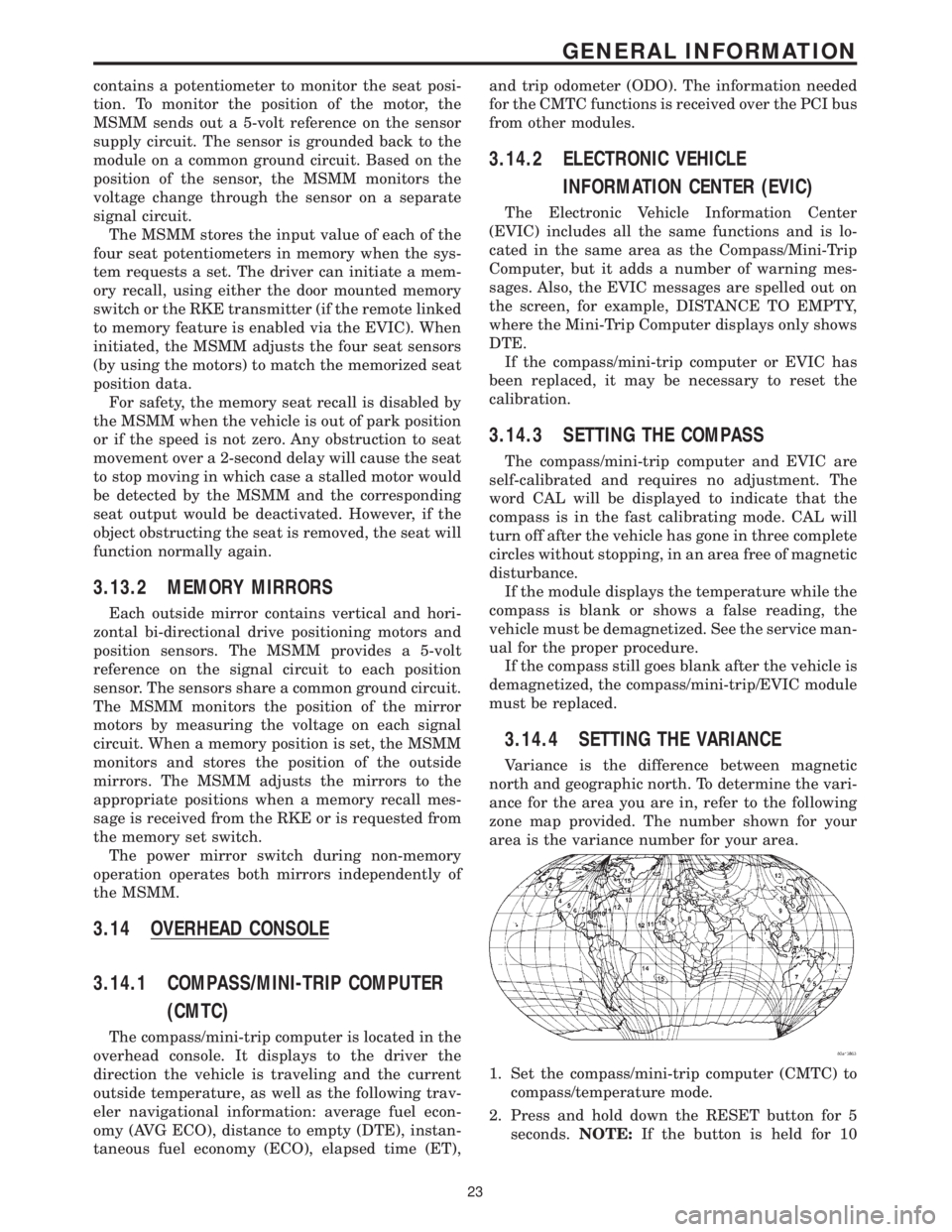
3.14.4 SETTING THE VARIANCE
Variance is the difference between magnetic
north and geographic north. To determine the vari-
ance for the area you are in, refer to the following
zone map provided. The number shown for your
area is the variance number for your area.
1. Set the compass/mini-trip computer (CMTC) to
compass/temperature mode.
2. Press and hold down the RESET button for 5
seconds.NOTE:If the button is held for 10
23
GENERAL INFORMATION
Page 56 of 4284

NOTE: A POWERTRAIN CONTROL MODULE
FROM A VEHICLE EQUIPPED WITH A
VEHICLE THEFT SECURITY SYSTEM
CANNOT BE USED IN A VEHICLE THAT IS
NOT EQUIPPED WITH A VEHICLE THEFT
SECURITY SYSTEM IF THE VTSS INDICATOR
LAMP COMES ON AFTER IGNITION ON AND
STAYS ON, THE PCI BUS COMMUNICATION
WITH THE POWERTRAIN CONTROL
MODULE HAS POSSIBLY BEEN LOST.
3.20.2 THATCHAM ALARM SYSTEM
The Thatcham Alarm Module monitors the vehi-
cle doors, liftgate, hood and the interior of the
vehicle for unauthorized operation. The vehicle
doors, liftgate, and hood use ajar switches as inputs
to the BCM to indicate their current status. The
interior of the vehicle is secured by the use of
Intrusion Sensors. The Intrusion Sensors are used
as inputs to the RKE/Thatcham Alarm Module to
report any motion in the interior of the vehicle. The
alarm activates by sounding the siren, flashing the
hazard lamps, and the VTSS Indicator Lamp.
Arming
Before arming, all doors, liftgate, and the hood
must be completely closed. The system can then be
armed by following a normal exit sequence, of
opening the door and then locking the doors with
the door lock switch and then closing the door. The
system can also be armed by opening the door,
closing the door and then locking the doors with the
RKE transmitter.
Disarming
To disarm the alarm system, the RKE transmit-
ter is used. The RKE transmitter will unlock the
vehicle doors and disarm the alarm system. The
RKE transmitter can also be used to halt the alarm
once it has been activated.
3.21 WIPER SYSTEM
3.21.1 FRONT WIPER
The front wiper/washer system consists of the
following features: lo-hi-speed, mist wipers, inter-
mittent wipers and wipe after wash. The front
wiper system is only active when the ignition switch
is in the RUN/ACC position. The vehicle operator
selects the front wiper function using the front
wiper switch (a resistive multiplexed stalk switch)
which is integral to the Multi-Function Switch. The
front wiper switch is hardwired to the Body Control
Module (BCM). Upon receiving a wiper switch sig-
nal, the BCM sends a PCI Bus message to the Front
Control Module (FCM). The FCM controls the ON/OFF relay, the HIGH/LOW relay and the front and
rear washer pump motors.
The Wiper system utilizes the BCM to control the
on/off and hi/low relays for the low and hi speed
wiper functions, intermittent wiper delay as the
switch position changes, pulse wipe, wipe after
wash mode and wiper motor functions. The BCM
uses the vehicle speed input to double the usual
delay time below 10 MPH (6 KPH).
3.21.2 SPEED SENSITIVE INTERMITTENT
WIPE MODE
There are 5 individual delay time settings with a
minimum delay of 1.7 seconds to a maximum of 18.4
seconds. When the vehicle speed is under 10 MPH
(6 KPM), the delay time is doubled, providing a
delay range of 3.4 seconds to 36.8 seconds.
3.21.3 PULSE WIPE
When the wiper is in the off position and the
driver presses the wash button for more than .062
seconds, but less than .5 seconds, 2 wipe cycles in
low speed mode will be provided.
3.21.4 PARK AFTER IGNITION OFF
Because the wiper relays are powered from the
battery, the BCM can run the wipers to park after
the ignition is turned off.
3.21.5 WIPE AFTER WASH
When the driver presses the wash button for over
.5 seconds and releases it, the wiper will continue to
run for 2 additional wipe cycles.
3.21.6 REAR WIPER
The rear wiper/washer system consists of the
following features: mist wipers, intermittent wipers
and wipe after wash. The rear wiper system is only
active when the ignition switch is in the RUN/ACC
position. The vehicle operator selects the rear wiper
function using one of the three buttons on the dash
mounted rear wiper switch. The rear wiper switch
is hardwired to the Body Control Module (BCM).
Upon receiving a wiper switch signal, the BCM
provides 12 volts to the rear wiper motor. Rear
washer occurs when the BCM receives a rear
washer switch ON input. The BCM sends a PCI Bus
message to the FCM requesting rear washer on.
The FCM activates the rear washer by providing a
ground for the rear washer motor.
3.21.7 SPEED SENSITIVE INTERMITTENT
WIPE MODE
The delay setting of the rear wiper system is
based solely on the vehicle speed. The delay time is
27
GENERAL INFORMATION
Page 57 of 4284
defined as the amount of time from the start of a
wipe to the beginning of the next wipe. The rear
wiper system delay time is based on the following:
7.75 - (MPH x .05) = Seconds delay
Examples:
At zero (0) MPH the delay is 7.75 seconds.
At 100 MPH the delay is 2.75 seconds.
3.21.8 WIPE AFTER WASH
When the driver presses the wash button for over
1.5 seconds and releases it, the wiper will continue
to run for 2 additional wipe cycles.
3.22 USING THE DRBIIIT
Refer to the DRBIIItuser guide for instructions
and assistance with reading trouble codes, erasing
trouble codes, and other DRBIIItfunctions.
3.22.1 DRBIIITERROR MESSAGES
Under normal operation, the DRBIIItwill dis-
play one of only two error messages: user-requested
WARM Boot or User-Requested COLD Boot. If the
DRBIIItshould display any other error message,
record the entire display and call the STAR Center.
This is a sample of such an error message display:
ver:2.14
date: 26 Jul93
file: key_iff.cc
date: Jul26 1993
line: 548
err: 0xi
User-Requested COLD Boot
Press MORE to switch between this display
and the application screen.
Press F4 when done noting information.
3.22.2 DRBIIITDOES NOT POWER UP
(BLANK SCREEN)
If the LED's do not light or no sound is emitted at
start up, check for loose cable connections or a bad
cable. Check the vehicle battery voltage (data link
connector cavity 16). A minimum of 11 volts is
required to adequately power the DRBIIIt. Check
for proper grounds at DLC cavities 4 and 5.
If all connections are proper between the
DRBIIItand the vehicle or other devices, and the
vehicle battery is fully charged, an inoperative
DRBIIItmay be the result or a faulty cable or
vehicle wiring.
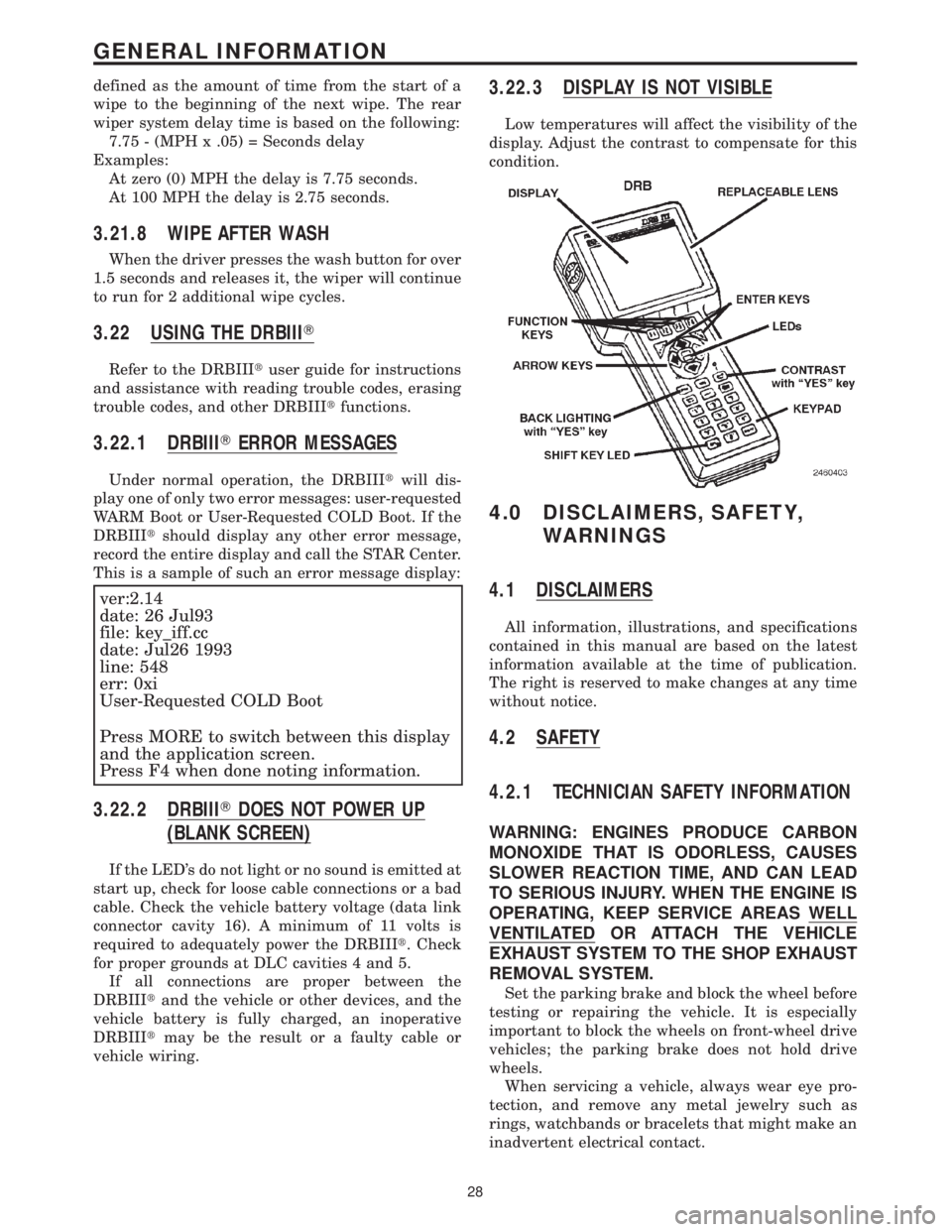
3.22.3 DISPLAY IS NOT VISIBLE
Low temperatures will affect the visibility of the
display. Adjust the contrast to compensate for this
condition.
4.0 DISCLAIMERS, SAFETY,
WARNINGS
4.1 DISCLAIMERS
All information, illustrations, and specifications
contained in this manual are based on the latest
information available at the time of publication.
The right is reserved to make changes at any time
without notice.
4.2 SAFETY
4.2.1 TECHNICIAN SAFETY INFORMATION
WARNING: ENGINES PRODUCE CARBON
MONOXIDE THAT IS ODORLESS, CAUSES
SLOWER REACTION TIME, AND CAN LEAD
TO SERIOUS INJURY. WHEN THE ENGINE IS
OPERATING, KEEP SERVICE AREAS WELL
VENTILATED OR ATTACH THE VEHICLE
EXHAUST SYSTEM TO THE SHOP EXHAUST
REMOVAL SYSTEM.
Set the parking brake and block the wheel before
testing or repairing the vehicle. It is especially
important to block the wheels on front-wheel drive
vehicles; the parking brake does not hold drive
wheels.
When servicing a vehicle, always wear eye pro-
tection, and remove any metal jewelry such as
rings, watchbands or bracelets that might make an
inadvertent electrical contact.
28
GENERAL INFORMATION
Page 105 of 4284

When Monitored and Set Condition:
ORC, CALIBRATION MISMATCH - STORED
When Monitored: With ignition on, the ORC monitors the PCI Bus for the VIN message
containing the body style. The PCM transmits the 17- character VIN message every 14
seconds. Note: The VIN message should match the vehicle VIN plate.
Set Condition: If the Body style stored in ORC does not exactly match the vehicle body
style indicated by the PCM, then the fault shall be set.
ORC, CLUSTER MESSAGE MISMATCH - STORED
When Monitored: After the MIC bulb test is completed, the ORC compares the Lamp
Request by ORC (On or Off) and the Lamp on by MIC (On or Off) PCI Bus messages. Each
message is transmitted one time per second or when a change in the lamp state occur.
Set Condition: If the Lamp Request by ORC (On or Off) and the Lamp on by MIC (On or
Off) messages do not match, the code will set.
ORC, DRIVER SBS OPEN - STORED
When Monitored: The ORC monitors the Seat Belt Switch circuit for an open condition.
Set Condition: The code will set if the ORC does not detect the correct circuit voltage.
ORC, DRIVER SBS SHORT TO BATTERY - STORED
When Monitored: The ORC monitors the Seat Belt Switch circuit for an short to battery.
Set Condition: The code will set if the ORC detects high circuit voltage.
ORC, DRIVER SBS SHORT TO GROUND - STORED
When Monitored: The ORC monitors the Seat Belt Switch circuit for a shorted together
or shorted to ground condition.
Set Condition: The code will set if the ORC detects low circuit voltage.
ORC, DRIVER SBT CIRCUIT OPEN - STORED
When Monitored: When the ignition is On, the ORC monitors the resistance of the Driver
Seat Belt Tensioner circuits.
Set Condition: The ORC has detected an open circuit or high resistance on the Driver
Seat Belt Tensioner circuits.
ORC, DRIVER SBT CIRCUIT SHORT - STORED
When Monitored: When the ignition is on, the ORC monitors the resistance of the Driver
Seat Belt Tensioner circuits.
Set Condition: The ORC has detected low resistance in the Driver Seat Belt Tensioner
circuits.
76
AIRBAG
ORC, CALIBRATION MISMATCH - STORED ÐContinued
Page 107 of 4284

ORC, DRIVER SQUIB 2 SHORT TO BATTERY - STORED
When Monitored: When the ignition is on, the ORC monitors the voltage of the Driver
Squib 2 circuits.
Set Condition: The ORC has detected high voltage on the Driver Squib 2 circuits.
ORC, DRIVER SQUIB 2 SHORT TO GROUND - STORED
When Monitored: When the ignition is on, the ORC monitors the resistance of the Driver
Squib 2 circuits.
Set Condition: The ORC has detected a short to ground in the Driver Squib 2 circuits.
ORC, LOSS OF IGNITION RUN ONLY - STORED
When Monitored: With the ignition in the run position the ORC monitors the ORC Run
Only Driver circuit for proper system voltage.
Set Condition: If the voltage on the ORC Run Only Driver circuit drops below 4.5 volts,
the code will set.
ORC, LOSS OF IGNITION RUN-START - STORED
When Monitored: With the ignition in the run or start position the ORC monitors the
ORC Run-Start Driver circuit for proper system voltage.
Set Condition: If the voltage on the ORC Run-Start Driver circuit drops below 4.5 volts,
the code will set.
ORC, NO CLUSTER MESSAGE - STORED
When Monitored: With the ignition in the ON position, the ORC monitors the PCI Bus for
a message from the MIC containing the airbag warning lamp status. The MIC transmits
the message one time at ignition on, lamp state change, or in response to the ORC lamp
message.
Set Condition: If the MIC message is not received for 10 consecutive seconds, the code
will set.
ORC, NO ODOMETER MESSAGE - STORED
When Monitored: With ignition on, the ORC monitors the PCI Bus for the Odometer
message from the Body Control Module. The BCM transmits the odometer message at 1
second intervals.
Set Condition: The code will set, if the ORC does not see the odometer message for 10
seconds.
ORC, PASSENGER SBS OPEN - STORED
When Monitored: The ORC monitors the Seat Belt Switch circuit for an open condition.
Set Condition: The code will set if the ORC does not detect the correct circuit voltage.
78
AIRBAG
ORC, CALIBRATION MISMATCH - STORED ÐContinued
Page 110 of 4284

ORC, WARNING INDICATOR CIRCUIT OPEN - STORED
When Monitored: When the ignition is On, the ORC monitors the PCI Bus for a message
from the MIC containing the airbag warning lamp status Ok or Open. The MIC transmits
the message one time at ignition on, upon lamp state change, or in response to the ORC
lamp message.
Set Condition: The code is set if the lamp state is open for 2 consecutive messages or 2
seconds.
ORC, WARNING INDICATOR CIRCUIT SHORT - STORED
When Monitored: When the ignition is On, the ORC monitors the PCI Bus for a message
from the MIC containing the airbag warning lamp status Ok or Shorted. The MIC
transmits the message one time at ignition on and upon lamp state change.
Set Condition: If the lamp state is Shorted for 2 consecutive messages the code will be set.
POSSIBLE CAUSES
CHECKING FOR ACTIVE ORC DTC'S
STORED CODE PRESENT
TEST ACTION APPLICABILITY
1 Turn ignition on.
NOTE: Ensure the battery is fully charged.
Active codes must be resolved before diagnosing stored codes.
With the DRBIIIt, record and erase all DTCs from all modules.
With the DRB III monitor active codes as you work through the system.
Wiggle the wiring harness and connectors of the Airbag System and rotate the
steering wheel from stop to stop.
NOTE: Check connectors - Clean and repair as necessary.
You have just attempted to simulate the condition that initially set the trouble code
message.
The following additional checks may assist you in identifying a possible intermittent
problem:
- Visually inspect related wire harness connectors. Look for broken, bent, pushed out,
spread, corroded, or contaminated terminals.
- Visually inspect related harnesses. Look for chafed, pierced, pinched or partially
broken wire.
- Refer to Wiring Diagrams and Technical Service Bulletins that may apply.
Did the DTC become active ?All
Ye s®Select appropriate symptom from Symptom List and continue
with diagnosis.
No®No problem found at this time. Erase codes in all modules before
returning vehicle to customer.
81
AIRBAG
ORC, CALIBRATION MISMATCH - STORED ÐContinued
Page 111 of 4284

Symptom:
ORC, CLUSTER MESSAGE MISMATCH - ACTIVE
When Monitored and Set Condition:
ORC, CLUSTER MESSAGE MISMATCH - ACTIVE
When Monitored: After the MIC bulb test is completed, the ORC compares the Lamp
Request by ORC, On or Off, and the Lamp on by MIC, On or Off, PCI Bus messages. Each
message is transmitted one time per second or when a change in the lamp state occur.
Set Condition: If the Lamp Request by ORC, On or Off, and the Lamp on by MIC, On or
Off, messages do not match, the code will set.
POSSIBLE CAUSES
MIC, COMMUNICATION FAILURE
MIC, CLUSTER MESSAGE MISMATCH
ORC, CLUSTER MESSAGE MISMATCH
TEST ACTION APPLICABILITY
1 Turn the ignition on.
With the DRBIIIt, ensure PCI Bus communications with the Instrument Cluster.
Is the Instrument Cluster communicating on the PCI Bus?All
Ye s®Go To 2
No®Refer to category COMMUNICATION CATEGORY and select the
related symptom INSTRUMENT CLUSTER BUS +/- SIGNAL
OPEN.
Perform AIRBAG VERIFICATION TEST - VER 1.
2 With the DRB select PASSIVE RESTRAINTS, AIRBAG, MONITOR DISPLAY and
WARNING LAMP STATUS.
Cycle the ignition key and observe the LAMP ON BY MIC and LAMP REQ BY ORC
monitors after the 6 to 8 second indicator test.
Does the LAMP ON BY MIC and LAMP REQ BY ORC monitors match?All
YES
Go To 3
NO
Replace Mechanical Instrument Cluster.
Perform BODY VERIFICATION TEST - VER 1.
82
AIRBAG