Page 2577 of 4770

± DIAGNOSTICSENGINE (5S±FE)
DI±157
392 Author�: Date�:
DTC P1133 A/F Sensor Circuit Response Malfunction
(Only for California Spec.)
CIRCUIT DESCRIPTION
Refer to DTC P0125 (Insufficient Coolant Temp. for Closed Loop Fuel Control (Only for California Spec.))
on page DI±61.
DTC No.DTC Detecting ConditionTrouble Area
P1133
After engine is warmed up, and during vehicle driving at en-
gine speed 1,600 rpm or more and vehicle speed 60 km/h (38
mph) or more, if response characteristic of A/F sensor be-
comes deteriorated
(2 trip detection logic)
�A/F sensor
INSPECTION PROCEDURE
HINT:
Read freeze frame data using TOYOTA hand±held tester or OBD II scan tool. Because freeze frame records
the engine conditions when the malfunction is detected, when troubleshooting it is useful for determining
whether the vehicle was running or stopped, the engine warmed up or not, the air±fuel ratio lean or rich, etc.
at the time of the, malfunction.
1 Are there any other codes (besides DTC P1133) being output?
YES Go to relevant DTC chart.
NO
DI01E±06
Page 2578 of 4770

DI±158
± DIAGNOSTICSENGINE (5S±FE)
393 Author�: Date�:
2 Connect OBD II scan tool or TOYOTA nand±held teter, and read value for voltage
output of A/F sensor.
PREPARATION:
(a) Connect the OBD II scan tool or TOYOTA hand±held tester to the DLC3.
(b) Warm up the A/F sensor with the engine at 2,500 rpm for approx. 90 sec.
CHECK:
Read voltage value of the A/F sensor on the screen of OBD II scan tool or TOYOTA hand±held tester when
you perform all the following conditions.
HINT:
The voltage of AF� terminal of ECM is 3.3 V fixed and AF� terminal is 3.0 V fixed. Therefore, it is impossible
to check the A/F sensor output voltage at the terminals (AF�/AF�) of ECM.
OK:
ConditionA/F Sensor Voltage Value
Engine idling
Engine racing�Not remains at 3.30 V (* 0.660 V)
�Not remains at38V(*0 76 V) or moreDriving at engine speed 1,500 rpm or more and vehicle
speed 40 km/h (25 mph) or more, and operate throttle valve
open and close�Not remains at 3.8 V (* 0.76 V) or more
�Not remains at 2.8 V (* 0.56 V) or less
*: When you use the OBD II scan tool (excluding TOYOTA hand±held tester)
HINT:
�During fuel enrichment, there is a case that the output voltage of the A/F sensor is below 2.8 V (* 0.56
V), it is normal.
�During fuel cut, there is a case that the output voltage of the A/F sensor is above 3.8 V (* 0.76 V), it
is normally.
�If output voltage of the A/F sensor remains at 3.30 V (* 0.660 V) even after performing all the above
conditions, A/F sensor circuit may be open.
�If output voltage of the A/F sensor remains at 3.8 V (* 0.76 V) or more, or 2.8 V (* 0.56 V) or less even
after performing all the above conditions, A/F sensor circuit may be short.
*: When you use the OBD II scan tool (excluding TOYOTA hand±held tester).
OK Go to step 9.
NG
3 Check for open and short in harness and connector between ECM and A/F sen-
sor (See page IN±31).
NG Repair or replace harness or connector.
OK
Page 2579 of 4770
± DIAGNOSTICSENGINE (5S±FE)
DI±159
394 Author�: Date�:
4 Check resistance of A/F sensor heater (See page SF±59).
NG Replace A/F sensor.
OK
5 Check air induction system (See page SF±1).
NG Repair or replace.
OK
6 Check EGR system (See page EC±12).
NG Repair EGR system.
OK
7 Check fuel pressure (See page SF±6).
NG Check and repair fuel pump, fuel pipe line and
filter (See page SF±1).
OK
Page 2580 of 4770
DI±160
± DIAGNOSTICSENGINE (5S±FE)
395 Author�: Date�:
8 Check injector injection (See page SF±23).
NG Replace injector.
OK
Replace A/F sensor.
9 Perform confirmation driving pattern (See page DI±152).
Go
10 Is there DTC P1133 being output again?
YES Check and replace ECM.
NO
11 Did vehicle runs out of fuel in the past?
NO Check for intermittent problems.
YES
DTC P1133 is caused by running out of fuel.
Page 2581 of 4770
A00430
HTAF (+) ON
± DIAGNOSTICSENGINE (5S±FE)
DI±161
396 Author�: Date�:
DTC P1135 A/F Sensor Heater Circuit Malfunction
(Only for California Spec.)
CIRCUIT DESCRIPTION
Refer to DTC P0125 (Insufficient Coolant Temp. for Closed Loop Fuel Control (Only for California Spec.))
on page DI±61.
DTC No.DTC Detecting ConditionTrouble Area
P1135
When heater operates, heater current exceeds 8 A
(2 trip detection logic)�Open or short in heater circuit of A/F sensor
A/F h tP1135Heater current of 0.25 A or less when heater operates
(2 trip detection logic)�A/F sensor heater
�ECM
WIRING DIAGRAM
Refer to DTC P0125 (Insufficient Coolant Temp. for Closed Loop Fuel Control (Only for California Spec.))
on page DI±61.
INSPECTION PROCEDURE
HINT:
Read freeze frame data using TOYOTA hand±held tester or OBD II scan tool. Because freeze frame records
the engine conditions when the malfunction is detected, when troubleshooting it is useful for determining
whether the vehicle was running or stopped, the engine warmed up or not, the air±fuel ratio lean or rich, etc.
at the time of the malfunction.
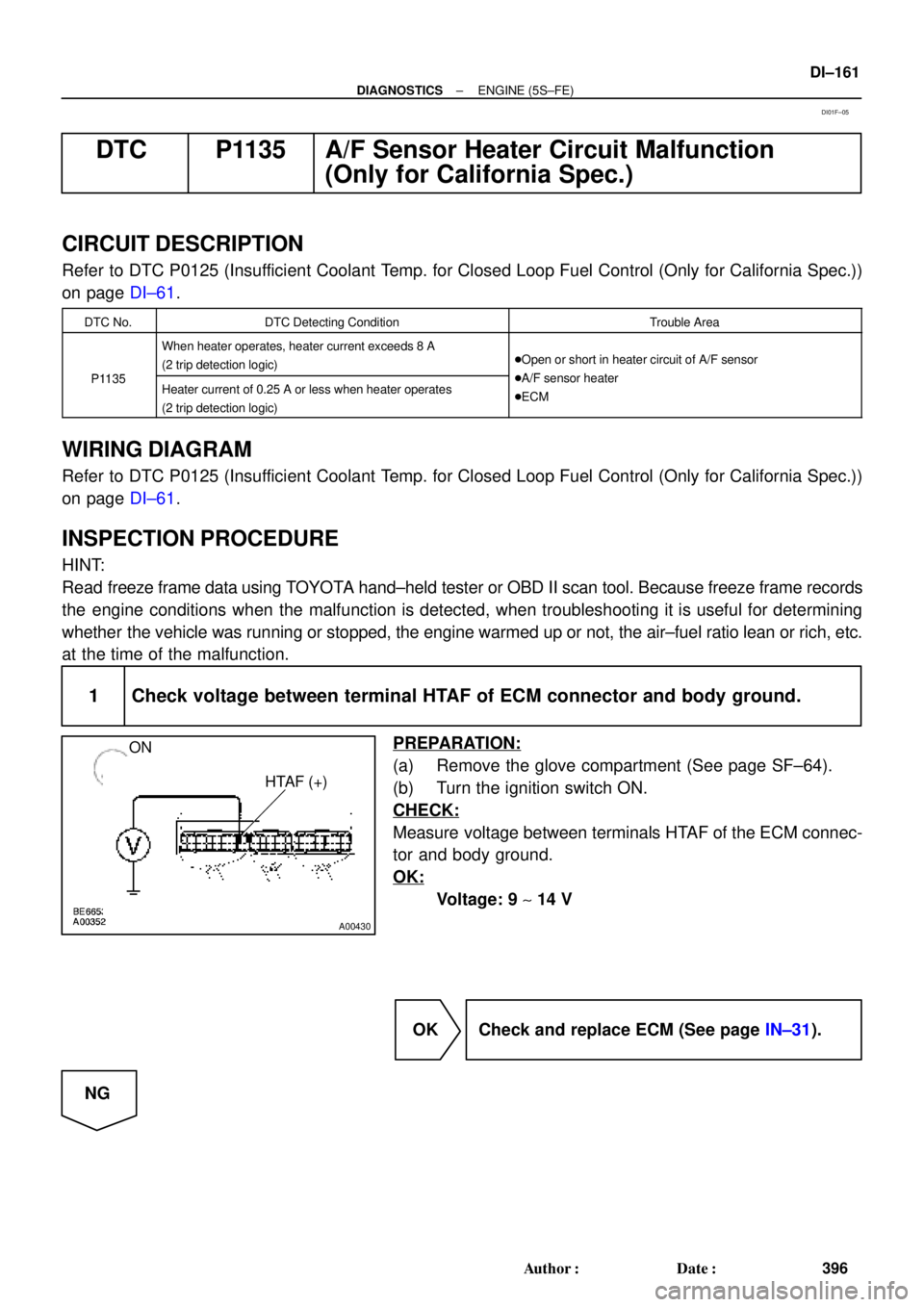
1 Check voltage between terminal HTAF of ECM connector and body ground.
PREPARATION:
(a) Remove the glove compartment (See page SF±64).
(b) Turn the ignition switch ON.
CHECK:
Measure voltage between terminals HTAF of the ECM connec-
tor and body ground.
OK:
Voltage: 9 ~ 14 V
OK Check and replace ECM (See page IN±31).
NG
DI01F±05
Page 2582 of 4770
DI±162
± DIAGNOSTICSENGINE (5S±FE)
397 Author�: Date�:
2 Check resistance of A/F sensor heater (See page SF±59).
NG Replace A/F sensor.
OK
Check and repair harness or connector between EFI main relay (Marking: EFI) and A/F sensor,
and A/F sensor and ECM (See page IN±31).
Page 2589 of 4770
± DIAGNOSTICSENGINE (5S±FE)
DI±169
404 Author�: Date�:
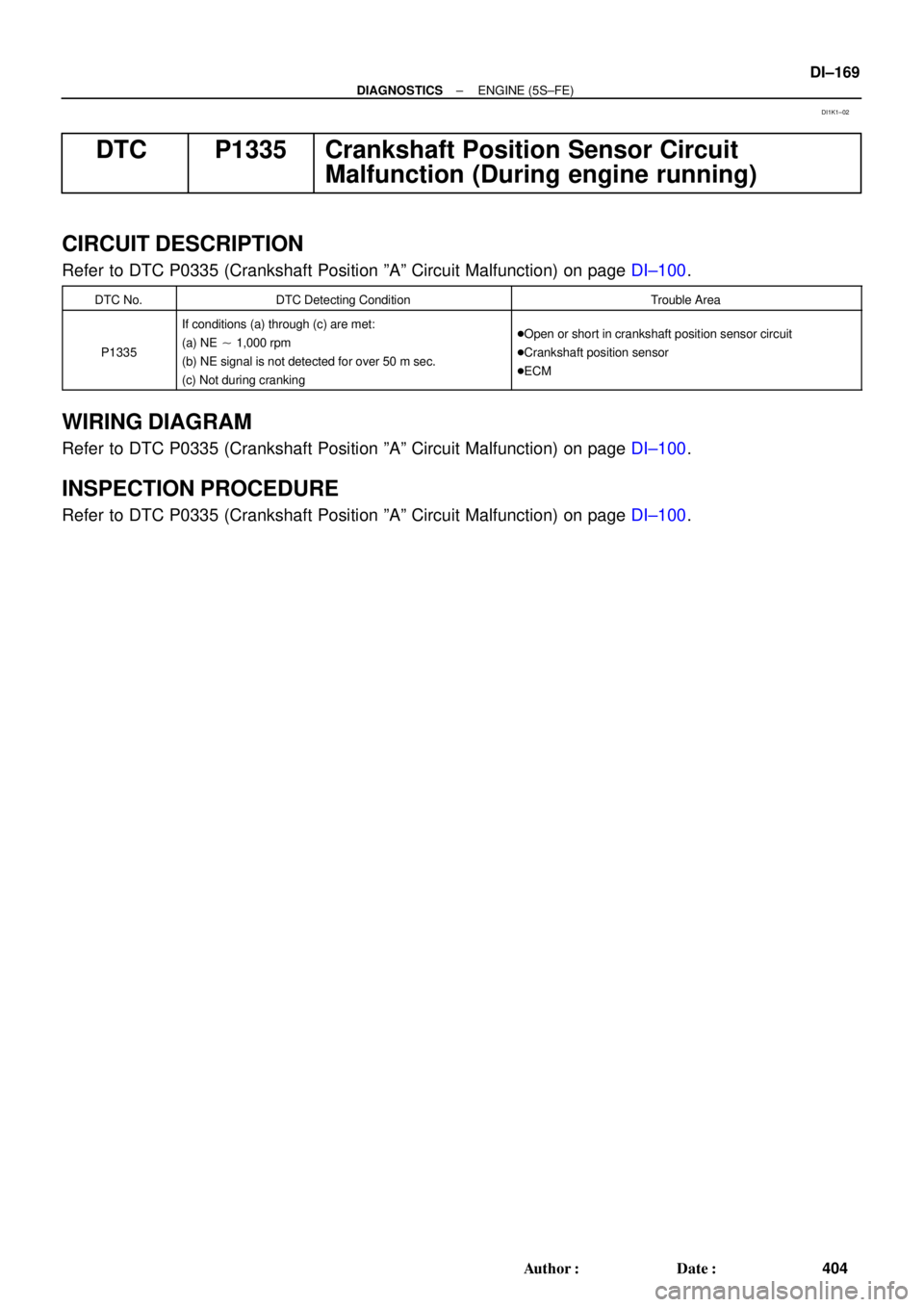
DTC P1335 Crankshaft Position Sensor Circuit
Malfunction (During engine running)
CIRCUIT DESCRIPTION
Refer to DTC P0335 (Crankshaft Position ºAº Circuit Malfunction) on page DI±100.
DTC No.DTC Detecting ConditionTrouble Area
P1335
If conditions (a) through (c) are met:
(a) NE � 1,000 rpm
(b) NE signal is not detected for over 50 m sec.
(c) Not during cranking�Open or short in crankshaft position sensor circuit
�Crankshaft position sensor
�ECM
WIRING DIAGRAM
Refer to DTC P0335 (Crankshaft Position ºAº Circuit Malfunction) on page DI±100.
INSPECTION PROCEDURE
Refer to DTC P0335 (Crankshaft Position ºAº Circuit Malfunction) on page DI±100.
DI1K1±02
Page 2590 of 4770
A03604
ECM
STP 4
E7
G±W G±WJ27 J28 1R 1R
1SJ27
J/C
AC Instrument Panel J/B
5
2 4
7
12
G±WLight
Failure
Sensor
Stop
Light
(LH) Stop
Light
(RH) G±R
2
52
5
W±B
W±B
BP High
Mount
Stop
Light
2
1R
A
A
J40
J/C
BL
1
W±B
Stop Light
Switch
2
BatteryW±B W
1C 7
STOP
41BInstrument
Panel J/B
B±R
B±R
F9 2 F9 1
ALT
F4MAIN
FL
FL Block
G±W
1
*1: w/o Immobiliser
*2: w/ Immobiliser(*1) (*2)
E79 DI±170
± DIAGNOSTICSENGINE (5S±FE)
405 Author�: Date�:
DTC P1520 Stop Light Switch Signal Malfunction (Only
for A/T)
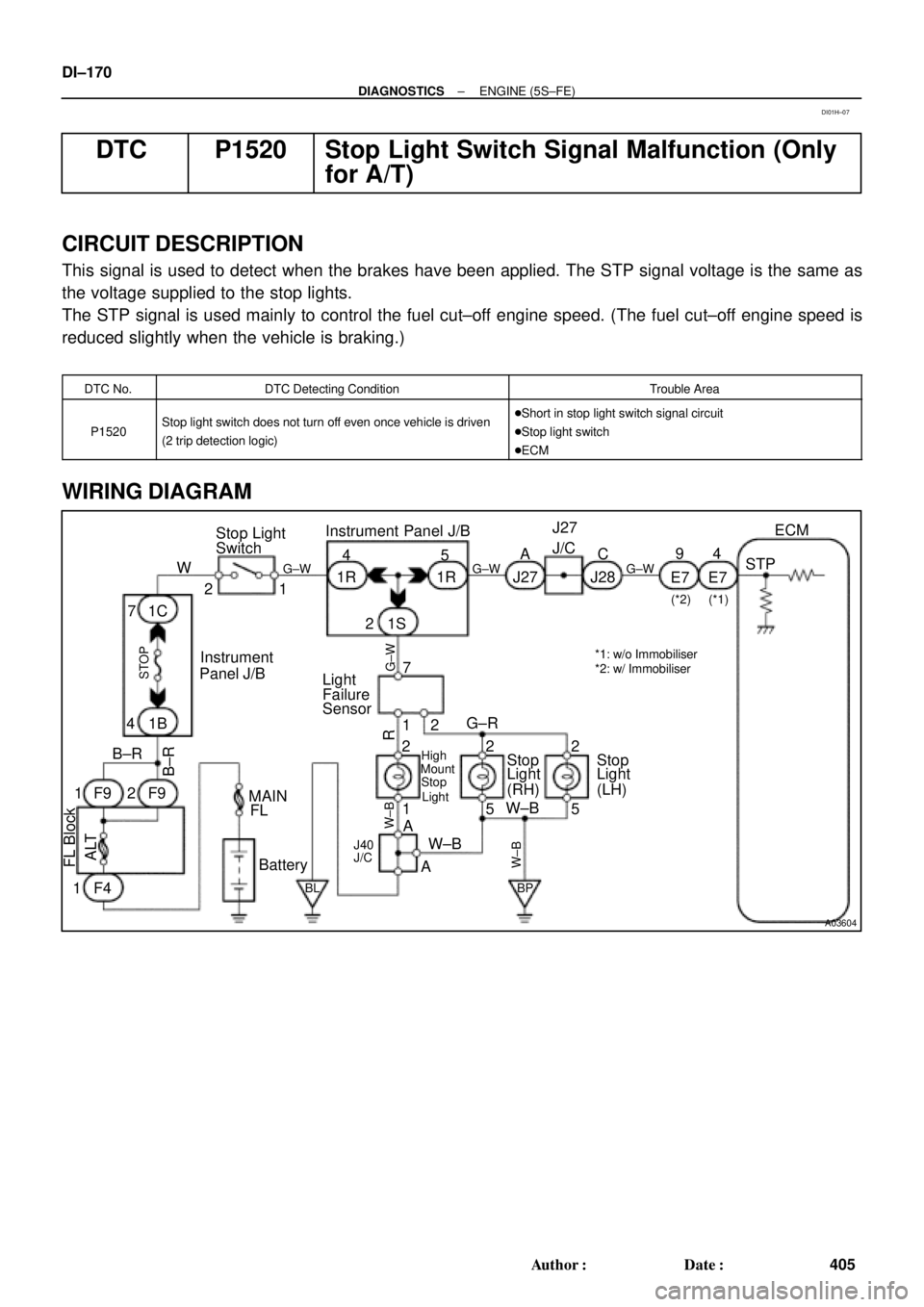
CIRCUIT DESCRIPTION
This signal is used to detect when the brakes have been applied. The STP signal voltage is the same as
the voltage supplied to the stop lights.
The STP signal is used mainly to control the fuel cut±off engine speed. (The fuel cut±off engine speed is
reduced slightly when the vehicle is braking.)
DTC No.DTC Detecting ConditionTrouble Area
P1520Stop light switch does not turn off even once vehicle is driven
(2 trip detection logic)�Short in stop light switch signal circuit
�Stop light switch
�ECM
WIRING DIAGRAM
DI01H±07