Page 2563 of 4770
± DIAGNOSTICSENGINE (5S±FE)
DI±143
378 Author�: Date�:
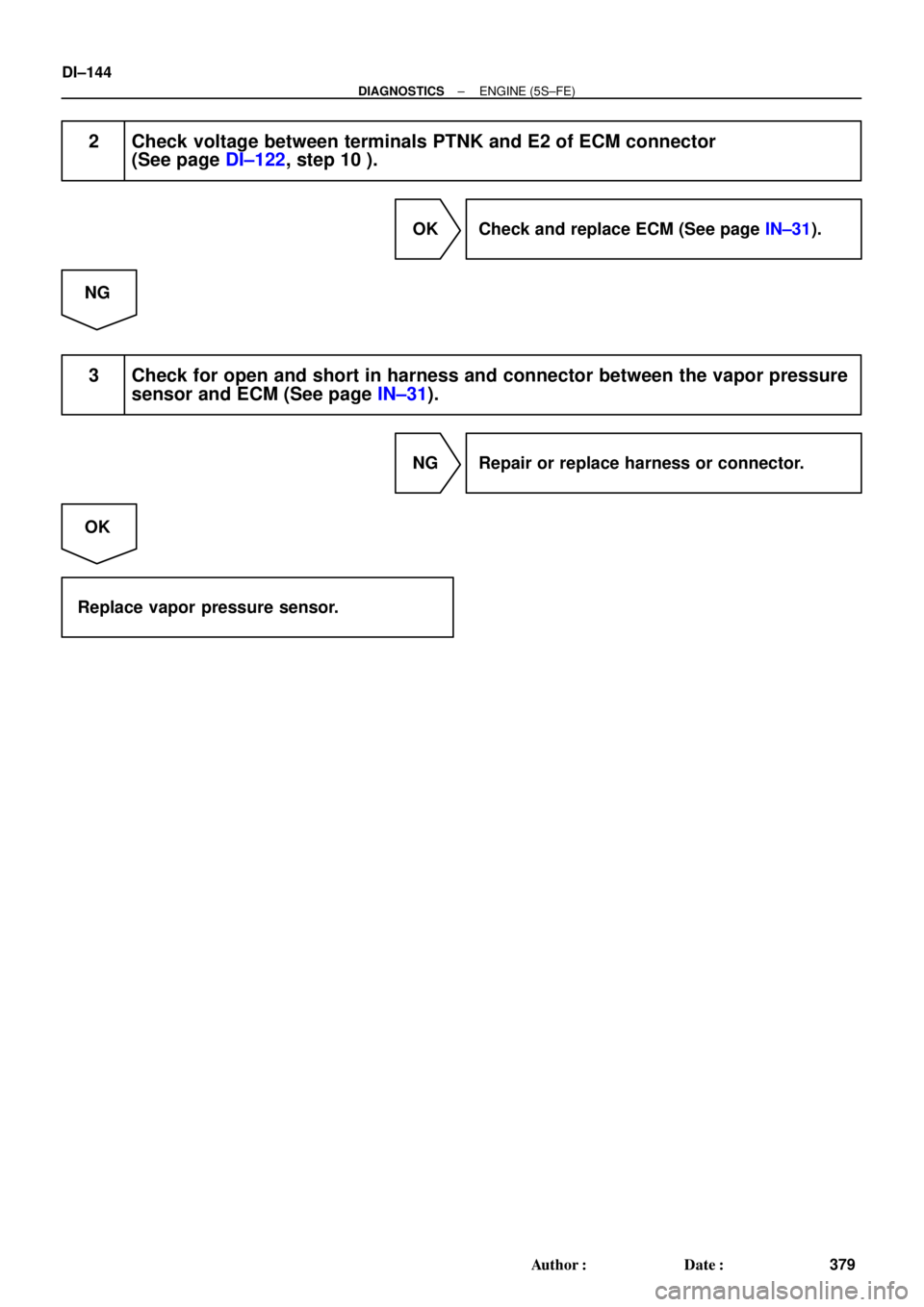
DTC No.DTC Detecting ConditionTrouble Area
P0450
10 seconds or more after engine starting codition (a) or (b)
continues for 7 seconds or more:
(2 trip detection logic)
(a) vapor pressure sensor value < ±4 kpa (±30 mmHg,
±1.0 in.Hg)
(b) Vapor pressure sensor value � 2.1 kpa (±15 mmHg,
0.4 in.Hg)
�Open or short in vapor pressure sensor circuit
�Vapor pressure sensor
�ECM
F l t k fill h k l k d d d
P0451
Vapor pressure sensor output extremely changes under condi-
tions of (a), (b) and (c):
(2 trip detection logic)
(a) Vehicle speed: 0 km/h (0 mph)
(b) Engine speed: idling
(c) VSV for vapor pressure sensor is ON�Fuel tank over fill check valve cracked or damaged.
WIRING DIAGRAM
Refer to DTC P0440 (Evaporative Emission Control System Malfunction) on page DI±122.
INSPECTION PROCEDURE
HINT:
�If DTC P0441 (Evaporative Emission Control System Incorrect Purge Flow), P0446 (Evaporative
Emission Control System Vent Control Malfunction), P0450 (Evaporative Emission Control System
Pressure Sensor Malfunction) or P0451 is output after DTC P0440 (Evaporative Emission Control Sys-
tem Malfunction), first troubleshoot DTC P0441, P0446, P0450 or P0451. If no malfunction is detected,
troubleshoot DTC P0440 next.
�Read freeze frame data using TOYOTA hand±held tester or OBD II scan tool. Because freeze frame
records the engine conditions when the malfunction is detected, when troubleshooting it is useful for
determining whether the vehicle was running or stopped, the engine warmed up or not, the air±fuel
ratio lean or rich, etc. at the time of the malfunction.
�When the ENGINE RUN TIME in the freeze frame data is less than 200 seconds, carefully check the
VSV for EVAP, charcoal canister and vapor pressure sensor.
1 Check voltage between terminals VC and E2 of ECM connector
(See page DI±122, step 9).
NG Check and replace ECM (See page IN±31).
OK
Page 2564 of 4770
DI±144
± DIAGNOSTICSENGINE (5S±FE)
379 Author�: Date�:
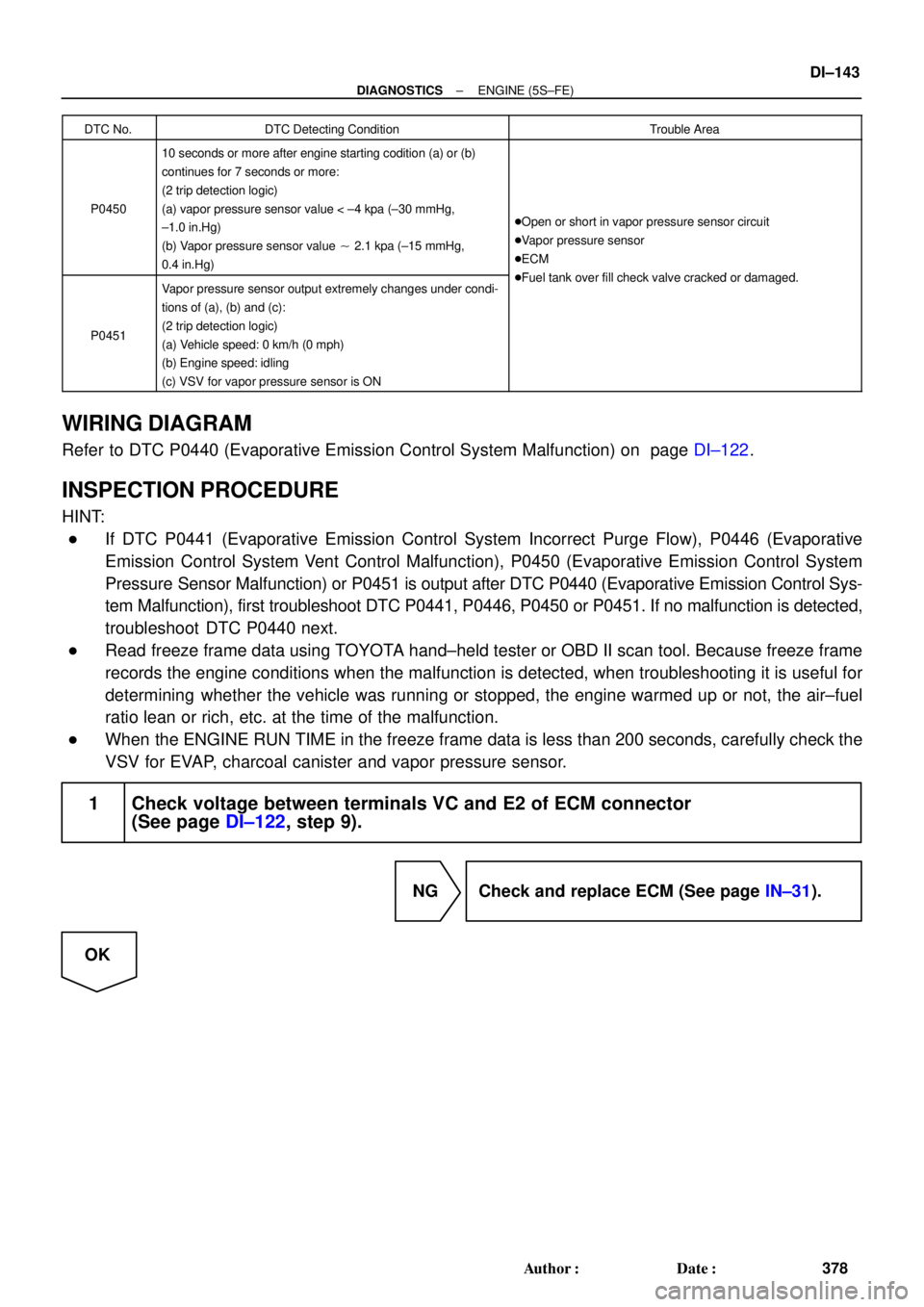
2 Check voltage between terminals PTNK and E2 of ECM connector
(See page DI±122, step 10 ).
OK Check and replace ECM (See page IN±31).
NG
3 Check for open and short in harness and connector between the vapor pressure
sensor and ECM (See page IN±31).
NG Repair or replace harness or connector.
OK
Replace vapor pressure sensor.
Page 2565 of 4770
A00414
No.1 Vehicle
Speed Sensor4±Pulse 4±Pulse
Combination Meter
ECM
Transaxle
No.1 Vehicle Speed Sensor
A03601
Combination Meter
14
V±WV±W
B J15
J/C
IG3
BV±W9
E7SPD5 V ECM
3
C9
*1: w/o Immobiliser
*2: w/ Immobiliser(*1) (*2)
E7 8
± DIAGNOSTICSENGINE (5S±FE)
DI±145
380 Author�: Date�:
DTC P0500 Vehicle Speed Sensor Malfunction
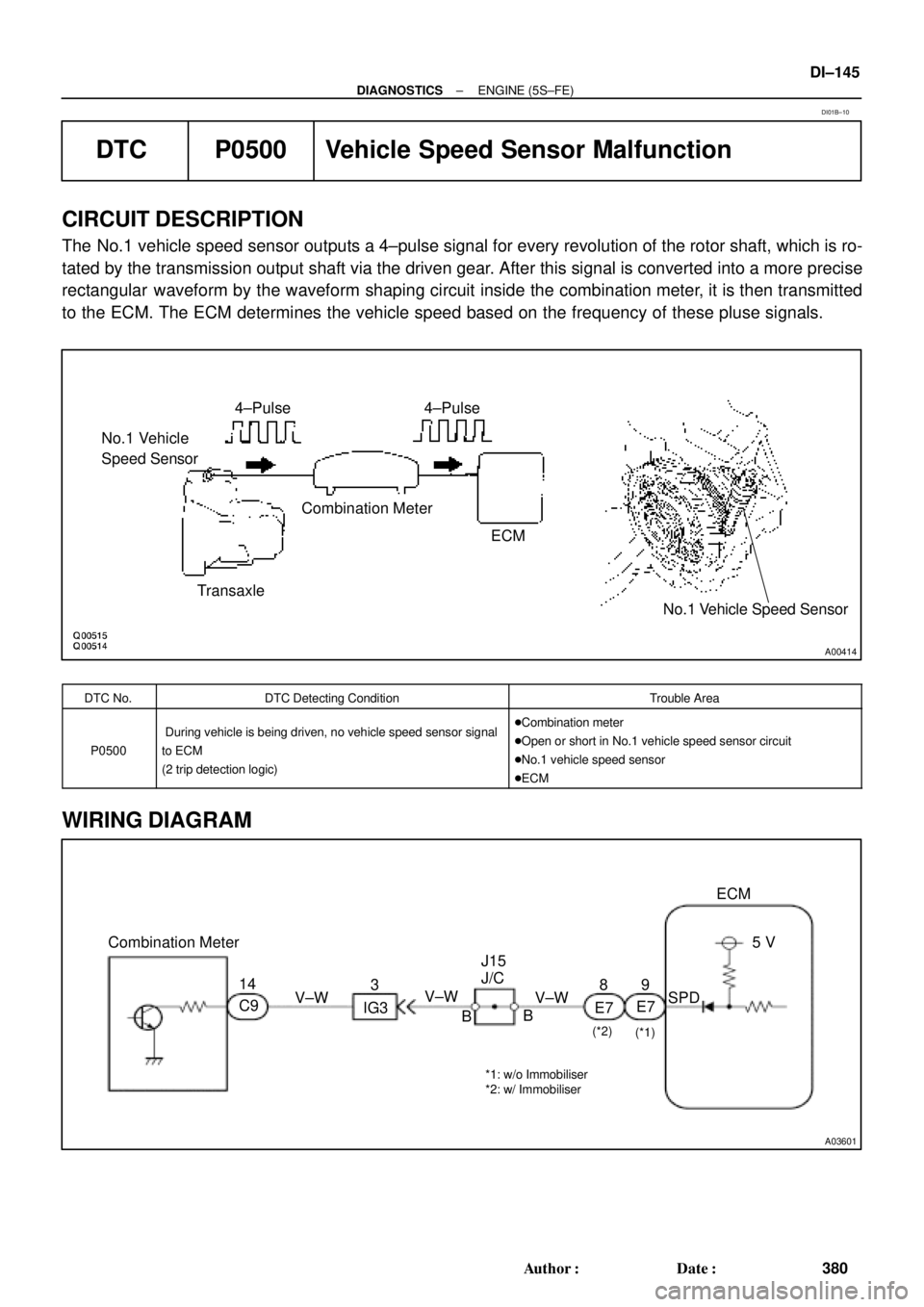
CIRCUIT DESCRIPTION
The No.1 vehicle speed sensor outputs a 4±pulse signal for every revolution of the rotor shaft, which is ro-
tated by the transmission output shaft via the driven gear. After this signal is converted into a more precise
rectangular waveform by the waveform shaping circuit inside the combination meter, it is then transmitted
to the ECM. The ECM determines the vehicle speed based on the frequency of these pluse signals.
DTC No.DTC Detecting ConditionTrouble Area
P0500
During vehicle is being driven, no vehicle speed sensor signal
to ECM
(2 trip detection logic)�Combination meter
�Open or short in No.1 vehicle speed sensor circuit
�No.1 vehicle speed sensor
�ECM
WIRING DIAGRAM
DI01B±10
Page 2566 of 4770
DI±146
± DIAGNOSTICSENGINE (5S±FE)
381 Author�: Date�:
INSPECTION PROCEDURE
HINT:
Read freeze frame data using TOYOTA hand±held tester or OBD II scan tool. Because freeze frame records
the engine conditions when the malfunction is detected, when troubleshooting it is useful for determining
whether the vehicle was running or stopped, the engine warmed up or not, the air±fuel ratio lean or rich, etc.
at the time of the malfunction.
1 Check operation of speedometer.
CHECK:
Drive the vehicle and check if the operation of the speedmeter in the combination meter is normal.
HINT:
The vehicle speed sensor is operating normally if the speedometer display is normal.
NG Check speedometer circuit. See combination
meter troubleshooting (See page BE±2).
OK
Page 2572 of 4770

DI±152
± DIAGNOSTICSENGINE (5S±FE)
387 Author�: Date�:
DTC P1130 A/F Sensor Circuit Range/Performance
Malfunction (Only for California Spec.)
CIRCUIT DESCRIPTION
Refer to DTC P0125 (Insufficient Coolant Temp. for Closed Loop Fuel Control (Only for California Spec.))
on page DI±61.
DTC No.DTC Detecting ConditionTrouble Area
Voltage output* of A/F sensor remains at 3.8 V or more, or 2.8
V or less, during engine running after engine is warmed up (2
trip detection logic)
*: Output value changes at the inside of ECM only
P1130Voltage output* of A/F sensor does not change from 3.30 V,
during engine running after engine is warmed up
(2 trip detection logic)
*: Output value changes at inside of ECM only�Open or short in A/F sensor circuit
�A/F sensor
�ECM
Open or short in A/F sensor circuit
(2 trip detection logic)
HINT:
�After confirming DTC P1130, use the OBD II scan tool or TOYOTA hand-held tester to confirm voltage
output of A/F sensor (AFS B1 S1 / O2S B1 S1) from the CURRENT DATA.
�The A/F sensor's output voltage and the short-term fuel trim value can be read using the OBD II scan
tool or TOYOTA hand-held tester.
�The ECM controls the voltage of AF� and AF� terminals of ECM to the fixed voltage. Therefore, it
is impossible to confirm the A/F sensor output voltage without OBD II scan tool or TOYOTA hand±held
tester.
�OBD II scan tool (excluding TOYOTA hand-held tester) displays the one fifth of the A/F sensor output
voltage which is displayed on the TOYOTA hand-held tester.
WIRING DIAGRAM
Refer to DTC P0125 (Insufficient Coolant Temp. for Closed Loop Fuel Control (Only for California Spec.))
on page DI±61.
DI01D±06
Page 2574 of 4770

DI±154
± DIAGNOSTICSENGINE (5S±FE)
389 Author�: Date�:
2 Connect OBD II scan tool or TOYOTA hand±held tester, and read value for volt-
age output of A/F sensor.
PREPARATION:
(a) Connect the OBD II scan tool or TOYOTA hand±held tester to the DLC3.
(b) Warm up the A/F sensor with the engine at 2,500 rpm for approx. 90 sec.
CHECK:
Read voltage value of the A/F sensor on the screen of OBD II scan tool or TOYOTA hand±held tester when
you perform all the following conditions.
HINT:
The voltage of AF� terminal of ECM is 3.3 V fixed and AF� terminal is 3.0 V fixed. Therefore, it is impossible
to check the A/F sensor output voltage at the terminals (AF�/AF�) of ECM.
OK:
ConditionA/F Sensor Voltage Value
Engine idling
Engine racing�Not remains at 3.30 V (* 0.660 V)
�Not remains at38V(*0 76 V) or moreDriving at engine speed 1,500 rpm or more and vehicle
speed 40 km/h (25 mph) or more, and operate throttle valve
open and close�Not remains at 3.8 V (* 0.76 V) or more
�Not remains at 2.8 V (* 0.56 V) or less
*: When you use the OBD II scan tool (excluding TOYOTA hand±held tester)
HINT:
�During fuel enrichment, there is a case that the output voltage of the A/F sensor is below 2.8 V (* 0.56
V), it is normal.
�During fuel cut, there is a case that the output voltage of the A/F sensor is above 3.8 V (* 0.76 V), it
is normally.
�If output voltage of the A/F sensor remains at 3.30 V (* 0.660 V) even after performing all the above
conditions, A/F sensor circuit may be open.
�If output voltage of the A/F sensor remains at 3.8 V (* 0.76 V) or more, or 2.8 V (* 0.56 V) or less even
after performing all the above conditions, A/F sensor circuit may be short.
*: When you use the OBD II scan tool (excluding TOYOTA hand±held tester).
OK Go to step 9.
NG
3 Check for open and short in harness and connector between ECM and A/F sen-
sor (See page IN±31).
NG Repair or replace harness or connector.
OK
Page 2575 of 4770
± DIAGNOSTICSENGINE (5S±FE)
DI±155
390 Author�: Date�:
4 Check resistance of A/F sensor heater (See page SF±59).
NG Replace A/F sensor.
OK
5 Check air induction system (See page SF±1).
NG Repair or replace.
OK
6 Check EGR system (See page EC±12).
NG Repair EGR system.
OK
7 Check fuel pressure (See page SF±6).
NG Check and repair fuel pump, fuel pipe line and
filter (See page SF±1).
OK
Page 2576 of 4770
DI±156
± DIAGNOSTICSENGINE (5S±FE)
391 Author�: Date�:
8 Check injector injection (See page SF±23).
NG Replace injector.
OK
Replace A/F sensor.
9 Perform confirmation driving pattern (See page DI±152).
Go
10 Is there DTC P1130 being output again?
YES Check and replace ECM.
NO
11 Did vehicle runs out of fuel in the past?
NO Check for intermittent problems.
YES
DTC P0125 is caused by running out of fuel.