Page 1 of 4770

W 1999 TOYOTA MOTOR CORPORATIONAll rights reserved. This book may not be repro-
duced or copied, in whole or in part, without the
written permission of Toyota Motor Corporation.
First Printing: Jul. 5, 1999 01-990705-00
1
FOREWORD
To assist you in your service activities, this manual explains the main characteristics of the 2000 model year
vehicles, in particular providing a technical explanation of the construction and operation of new mechanisms
and new technology used.
This manual consists of the following sections.
1. General 2000 Features ± Changed features common to all models are explained.
2.� 9. Each Model ± Changed features for each model are explained.
10. Appendix ± Major technical specifications of the vehicle.
CAUTIONS, NOTICE, REFERENCE and NOTE are used in the following ways:
CAUTION
A potentially hazardous situation which could result in injury to people may occur
if instructions on what to do or not do are ignored.
NOTICEDamage to the vehicle or components may occur if instructions on what to do or not
do are ignored.
REFERENCEExplains the theory behind mechanisms and techniques.
NOTENotes or comments not included under the above 3 titles.
All information contained herein is the most up-to-date at the time of publication. We reserve the right to make
changes without prior notice.
Page 27 of 4770
3
CAMRY ± NEW FEATURES
172CM13
Discharge
ValveFuel Pressure Sensor
Fuel Temp. SensorDelivery Pipe
CNG
Fuel Shutoff
Valve
Injector
167CN23
Rubber Sheet47
Delivery Pipe
�A delivery pipe with a wide passage that enables a large volume of gas to flow responsively has been
adopted to minimize the pressure loss.
�A fuel pressure sensor and a fuel temperature sensor that help correct the fuel injection volume are
mounted on the delivery pipe.
�Similar to the fuel shutoff valves for the fuel tank and the fuel pressure regulator, a fuel shutoff valve is
provided on the fuel inlet side of the delivery pipe to shut off the supply of fuel when the engine is stopped
or during abnormal conditions.
�To discharge the fuel out of the delivery pipe during service, a discharge valve is provided.
Injector
For the injection of fuel in the gaseous state, injectors that allow the flow of a large volume of fuel and pro-
vide improved sealing performance have been adopted.
Page 45 of 4770

W 2000 TOYOTA MOTOR CORPORATIONAll rights reserved. This book may not be repro-
duced or copied, in whole or in part, without the
written permission of Toyota Motor Corporation.
First Printing: Aug. 30, 2000 01-000830-00
FOREWORD
To assist you in your sales and service activities, this manual explains the main characteristics of the 2001 model
year vehicles, in particular providing a technical explanation of the construction and operation of new mecha-
nisms and new technology used.
CAUTION, NOTICE, REFERENCE and NOTE are used in the following ways:
CAUTION
A potentially hazardous situation which could result in injury to people may occur
if instructions on what to do or not do are ignored.
NOTICEDamage to the vehicle or components may occur if instructions on what to do or not
do are ignored.
REFERENCEExplains the theory behind mechanisms and techniques.
NOTENotes or comments not included under the above 3 titles.
All information contained herein is the most up-to-date at the time of publication. We reserve the right to make
changes without prior notice.
Page 54 of 4770
PREPARATION
SST (SPECIAL SERVICE TOOLS)
09222±30010 Connecting Rod Bushing Remover
& Replacer09201±70010 Valve Guide Bushing Remover & Replacer
(09213±00060) Bolt set (09213±00030) Handle (91651 ±60855) Bolt
(09213±00020) Body With Bolt 09213±80017 Crankshaft Pulley & Gear Puller Set09011±38121 12 mm Socket wrench for 12 Pointed
Head
09223±46011 Crankshaft Front Oil Seal
Replacer
09223±63010 Crankshaft Rear Oil Seal
ReplacerCylinder head bolt and connecting
rod bolt
09213±54015 Crankshaft Pulley Holding Tool09201±41020 Valve Stem Oil Seal Replacer
09202±70010 Valve Spring Compressor
Camshaft oil seal
± 5S±FE ENGINEENGINE MECHANICALEG1±4
Page 57 of 4770
SSM (SERVICE SPECIAL MATERIALS)
08833±00070 Adhesive 1311,
THREE BOND 1311 or equivalentCamshaft bearing cap
Cylinder head cover
Rear oil sear retainer 08826±00080 Seal packing or equivalent
Flywheel or drive plate bolt Valve seat cutter
Vernier calipers
± 5S±FE ENGINEENGINE MECHANICALEG1±7
Page 60 of 4770

3. Delco Battery:
CHECK HYDROMETER
Green Dot visible:
Battery is adequately charged
Dark (Green Dot not visible):
Battery must be charged
Clear or Light Yellow:
Replace battery
HINT: There is no need to add water during the entire
service life of the battery.
AIR FILTER INSPECTION
1. INSPECT AIR FILTER
Visually check that the element is not excessively
dirty, damaged or oily.
2. CLEAN AIR FILTER
Clean the element with compressed air.
First blow air from the inside thoroughly. Then blow
off the outside of the element.B. Except Maintenance Free Battery
Check the specific gravity of each cell.
Standard specific gravity:
55D23L battery for GNB Incorporated
1.25 ± 1.27 at 205C (685F)
55D23L battery for JOHNSON CONTROLS
1.26 ± 1.28 at 275C (815F)
80D26L battery for GNB Incorporated
1.27 ± 1.29 at 205C (685F)
80D26L battery for JOHNSON CONTROLS
1.28 ± 1.30 at 27�C (81�F)
If the gravity is less than specification, charge the
battery.
HINT: Check the indicator as shown in the illustration.
HIGH±TENSION CORDS INSPECTION
1. DISCONNECT HIGH±TENSION CORDS FROM
SPARK PLUGS
Disconnect the high ± tension cords at the rubber
boot. Do not pull on the high±tension cords.
NOTICE: Pulling on or bending the cords may damage the
conductor inside.
± 5S±FE ENGINEENGINE MECHANICALEG1±10
Page 100 of 4770
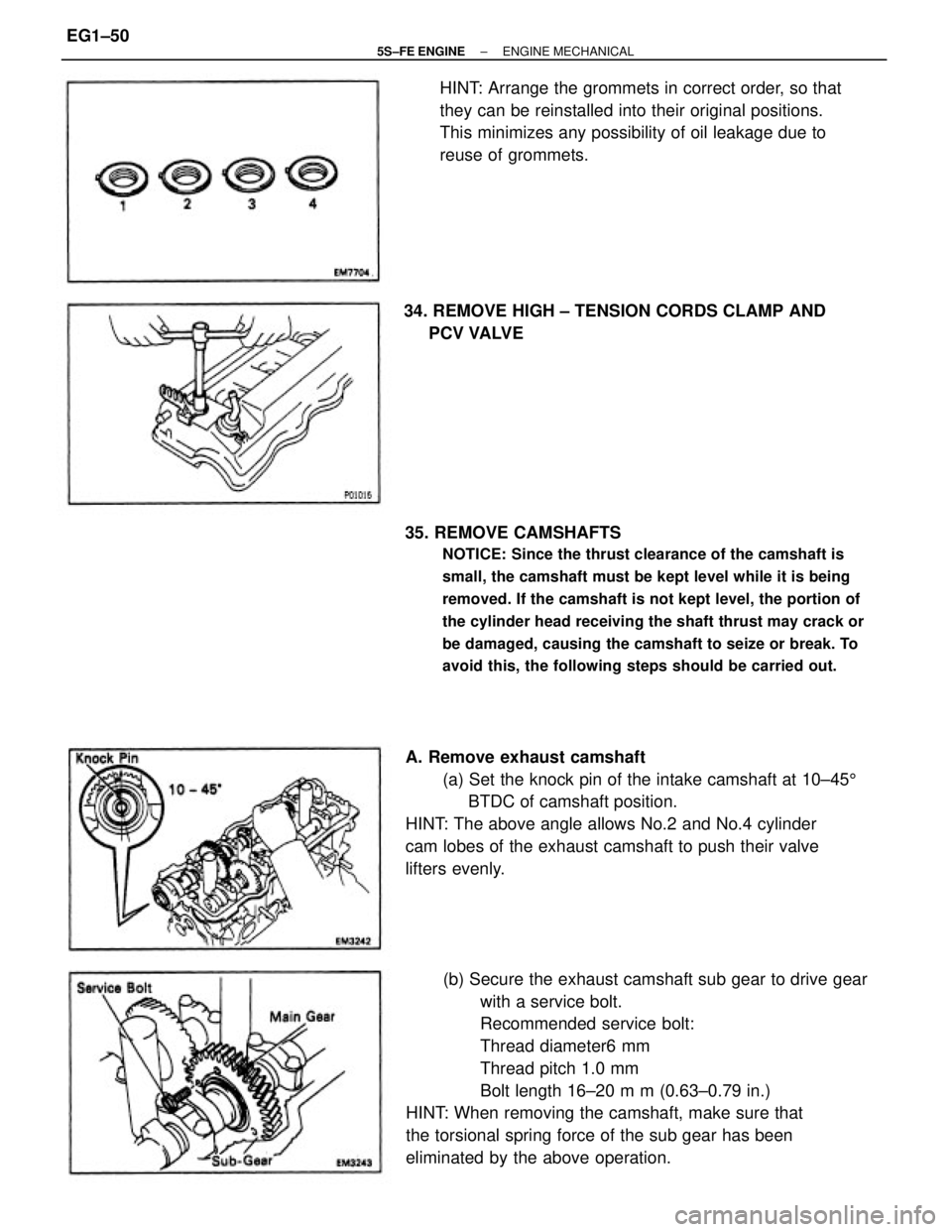
(b) Secure the exhaust camshaft sub gear to drive gear
with a service bolt.
Recommended service bolt:
Thread diameter6 mm
Thread pitch 1.0 mm
Bolt length 16±20 m m (0.63±0.79 in.)
HINT: When removing the camshaft, make sure that
the torsional spring force of the sub gear has been
eliminated by the above operation. 35. REMOVE CAMSHAFTS
NOTICE: Since the thrust clearance of the camshaft is
small, the camshaft must be kept level while it is being
removed. If the camshaft is not kept level, the portion of
the cylinder head receiving the shaft thrust may crack or
be damaged, causing the camshaft to seize or break. To
avoid this, the following steps should be carried out.
A. Remove exhaust camshaft
(a) Set the knock pin of the intake camshaft at 10±455
BTDC of camshaft position.
HINT: The above angle allows No.2 and No.4 cylinder
cam lobes of the exhaust camshaft to push their valve
lifters evenly.HINT: Arrange the grommets in correct order, so that
they can be reinstalled into their original positions.
This minimizes any possibility of oil leakage due to
reuse of grommets.
34. REMOVE HIGH ± TENSION CORDS CLAMP AND
PCV VALVE
± 5S±FE ENGINEENGINE MECHANICALEG1±50
Page 103 of 4770
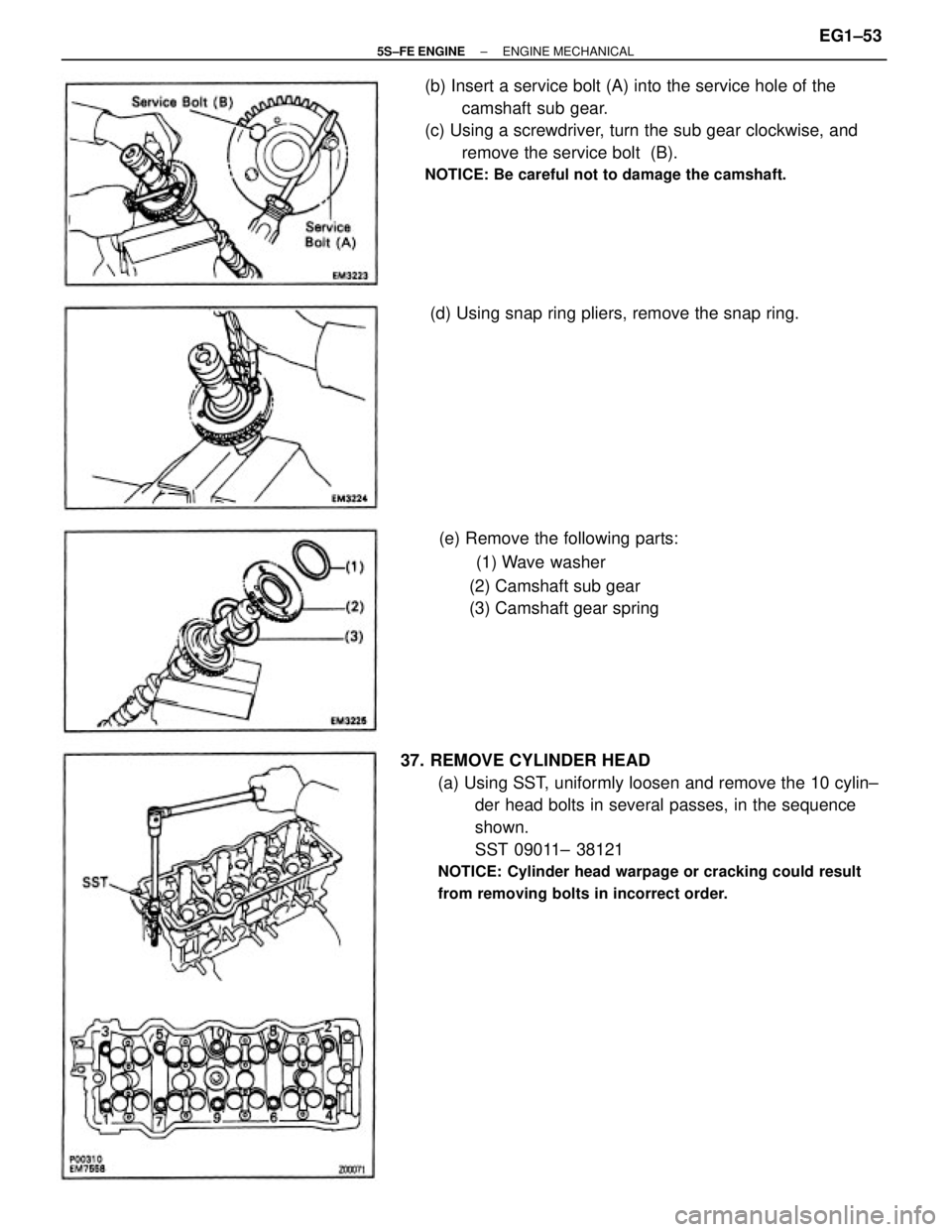
37. REMOVE CYLINDER HEAD
(a) Using SST, uniformly loosen and remove the 10 cylin±
der head bolts in several passes, in the sequence
shown.
SST 09011± 38121
NOTICE: Cylinder head warpage or cracking could result
from removing bolts in incorrect order.
(b) Insert a service bolt (A) into the service hole of the
camshaft sub gear.
(c) Using a screwdriver, turn the sub gear clockwise, and
remove the service bolt (B).
NOTICE: Be careful not to damage the camshaft.
(e) Remove the following parts:
(1) Wave washer
(2) Camshaft sub gear
(3) Camshaft gear spring (d) Using snap ring pliers, remove the snap ring.
± 5S±FE ENGINEENGINE MECHANICALEG1±53