Page 4565 of 4770
EVAP SYSTEM OPERATION INFORMATION ± EG005-01 April 27, 2001
Page 6 of 14
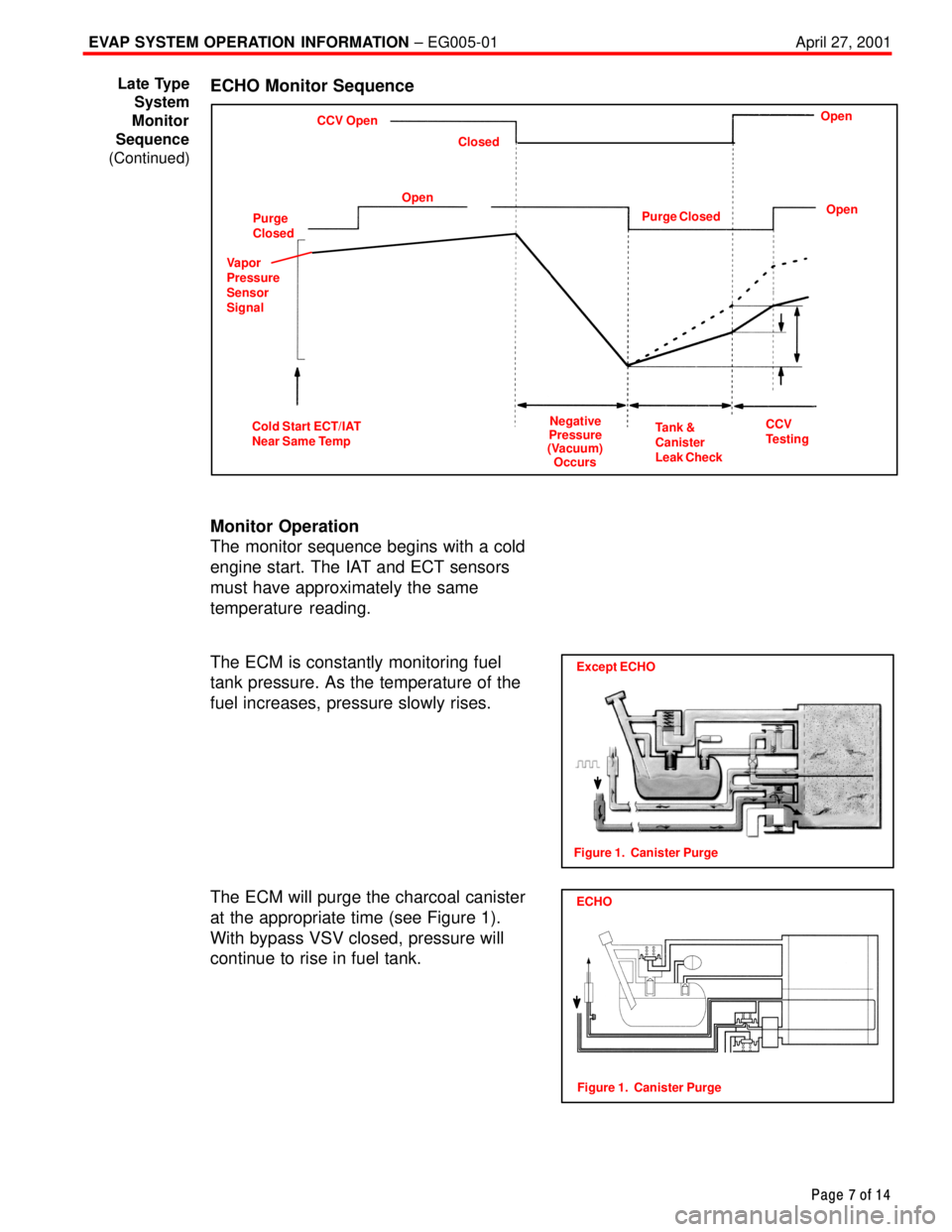
ECHO Late Type (Intrusive EVAP System)
The ECHO uses a Late Type EVAP System but is configured with some small
differences. For the ECHO, the Canister Closed Valve is located directly on the canister.
Additionally, the bypass VSV has been eliminated.
Onboard Recovery
Valve (Fill Check Valve)Vapor
Pressure
Sensor
Air Inlet ValveCanister
Canister Closed ValveAir Valve AssemblyAir Drain Valve Assembly
To
Manifold
Vacuum
Purge
Valve
Filtered
Air
Late Type (Intrusive) EVAP System Monitor Sequence
The monitoring sequence for leak detection is different from that of the Early Type EVAP
System. The Late Type applies a very small vacuum to the EVAP system. The ECM then
determines if there is a problem in the system based on the vapor pressure sensor
signal.
Monitor Sequence (Except ECHO)
CCV Open
Purge ClosedOpenClosed
Purge ClosedOpenOpen
Cold Start ECT/IAT
Near Same TempNegative
Pressure
(Vacuum)
OccursLeak Testing
Period OccursCCV
Op Open
Time in Minutes Bypass Closed
Closed
Bypass
VSV Op Vapor
Pressure
Sensor
Signal
P0441P0440
P0442P0446
Late Type
System
Description
(Continued)
Late Type
System
Monitor
Sequence
Page 4566 of 4770
EVAP SYSTEM OPERATION INFORMATION ± EG005-01 April 27, 2001
Page 7 of 14
ECHO Monitor Sequence
CCV Open
Purge
ClosedOpenClosed
Purge ClosedOpen Open
Cold Start ECT/IAT
Near Same TempNegative
Pressure
(Vacuum)
OccursTank &
Canister
Leak CheckCCV
Testing Vapor
Pressure
Sensor
Signal
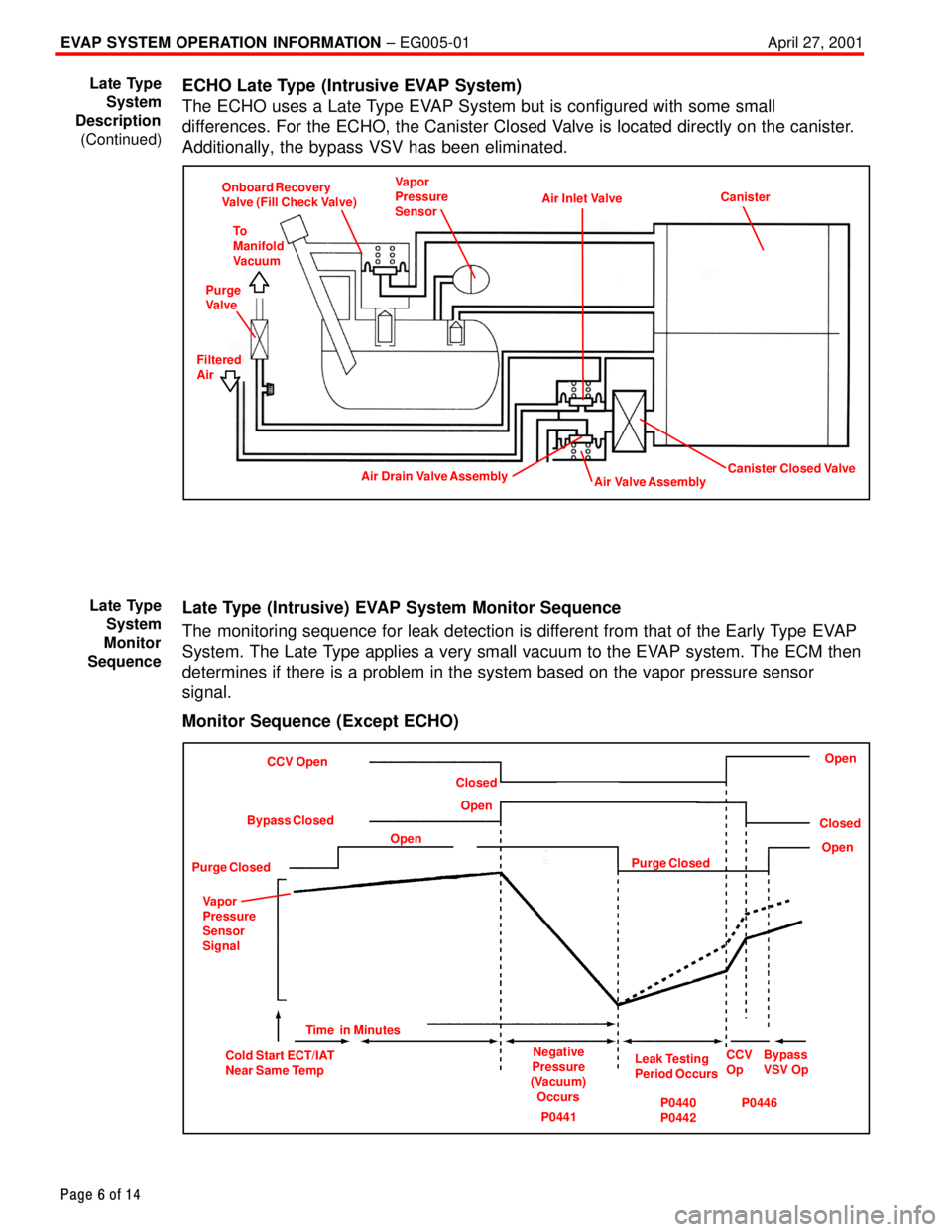
Monitor Operation
The monitor sequence begins with a cold
engine start. The IAT and ECT sensors
must have approximately the same
temperature reading.
The ECM is constantly monitoring fuel
tank pressure. As the temperature of the
fuel increases, pressure slowly rises.
The ECM will purge the charcoal canister
at the appropriate time (see Figure 1).
With bypass VSV closed, pressure will
continue to rise in fuel tank.
Late Type
System
Monitor
Sequence
(Continued)
Except ECHO
Figure 1. Canister Purge
ECHO
Figure 1. Canister Purge
Page 4569 of 4770
EVAP SYSTEM OPERATION INFORMATION ± EG005-01 April 27, 2001
Page 10 of 14
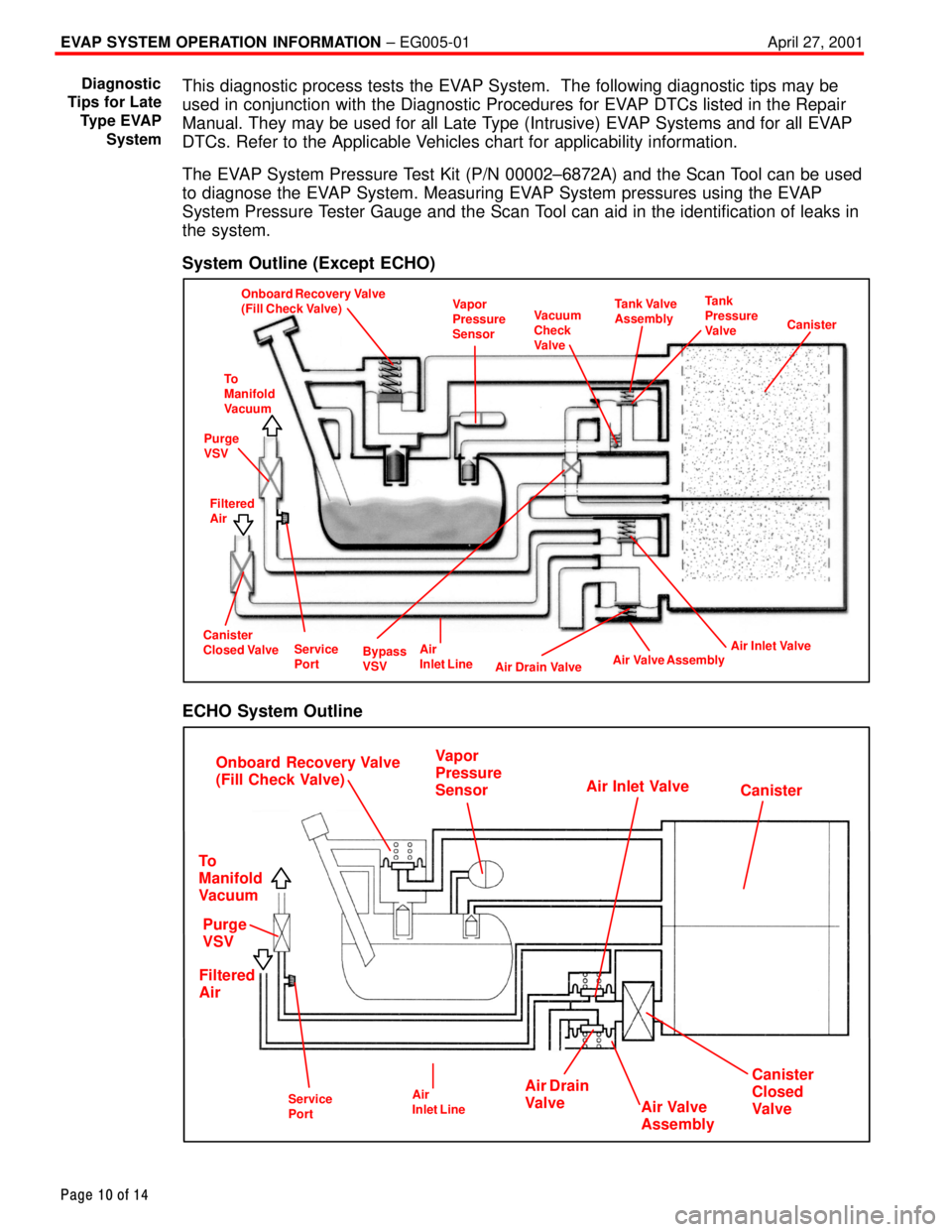
This diagnostic process tests the EVAP System. The following diagnostic tips may be
used in conjunction with the Diagnostic Procedures for EVAP DTCs listed in the Repair
Manual. They may be used for all Late Type (Intrusive) EVAP Systems and for all EVAP
DTCs. Refer to the Applicable Vehicles chart for applicability information.
The EVAP System Pressure Test Kit (P/N 00002±6872A) and the Scan Tool can be used
to diagnose the EVAP System. Measuring EVAP System pressures using the EVAP
System Pressure Tester Gauge and the Scan Tool can aid in the identification of leaks in
the system.
System Outline (Except ECHO)
Onboard Recovery Valve
(Fill Check Valve)Vapor
Pressure
SensorVacuum
Check
ValveTank Valve
AssemblyTank
Pressure
Valve
Canister
To
Manifold
Vacuum
Purge
VSV
Filtered
Air
Air Drain Valve
Air Valve AssemblyAir Inlet ValveCanister
Closed Valve
Bypass
VSVAir
Inlet LineService
Port
ECHO System Outline
Onboard Recovery Valve
(Fill Check Valve)
To
Manifold
Vacuum
Filtered
AirPurge
VSV
Air Drain
Valve
Air Valve
Assembly
Canister
Closed
Valve
Canister
Vapor
Pressure
Sensor
Air Inlet Valve
Air
Inlet LineService
Port
Diagnostic
Tips for Late
Type EVAP
System
Page 4570 of 4770
EVAP SYSTEM OPERATION INFORMATION ± EG005-01 April 27, 2001
Page 11 of 14
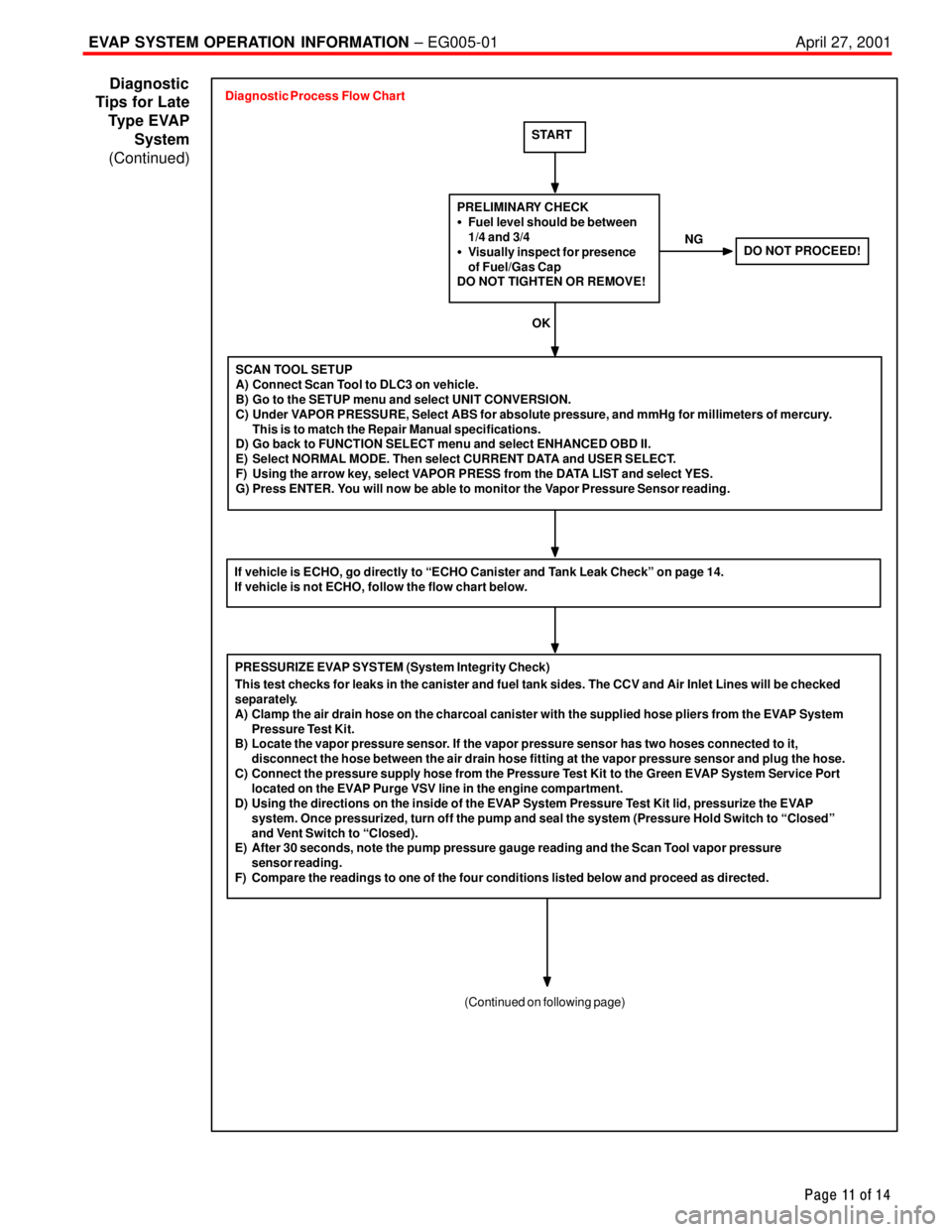
Diagnostic Process Flow Chart
(Continued on following page)
PRELIMINARY CHECK
Fuel level should be between
1/4 and 3/4
Visually inspect for presence
of Fuel/Gas Cap
DO NOT TIGHTEN OR REMOVE!
PRESSURIZE EVAP SYSTEM (System Integrity Check)
This test checks for leaks in the canister and fuel tank sides. The CCV and Air Inlet Lines will be checked
separately.
A) Clamp the air drain hose on the charcoal canister with the supplied hose pliers from the EVAP System
Pressure Test Kit.
B) Locate the vapor pressure sensor. If the vapor pressure sensor has two hoses connected to it,
disconnect the hose between the air drain hose fitting at the vapor pressure sensor and plug the hose.
C) Connect the pressure supply hose from the Pressure Test Kit to the Green EVAP System Service Port
located on the EVAP Purge VSV line in the engine compartment.
D) Using the directions on the inside of the EVAP System Pressure Test Kit lid, pressurize the EVAP
system. Once pressurized, turn off the pump and seal the system (Pressure Hold Switch to ªClosedº
and Vent Switch to ªClosed).
E) After 30 seconds, note the pump pressure gauge reading and the Scan Tool vapor pressure
sensor reading.
F) Compare the readings to one of the four conditions listed below and proceed as directed.
DO NOT PROCEED! NG
OK
SCAN TOOL SETUP
A) Connect Scan Tool to DLC3 on vehicle.
B) Go to the SETUP menu and select UNIT CONVERSION.
C) Under VAPOR PRESSURE, Select ABS for absolute pressure, and mmHg for millimeters of mercury.
This is to match the Repair Manual specifications.
D) Go back to FUNCTION SELECT menu and select ENHANCED OBD II.
E) Select NORMAL MODE. Then select CURRENT DATA and USER SELECT.
F) Using the arrow key, select VAPOR PRESS from the DATA LIST and select YES.
G) Press ENTER. You will now be able to monitor the Vapor Pressure Sensor reading.
START
If vehicle is ECHO, go directly to ªECHO Canister and Tank Leak Checkº on page 14.
If vehicle is not ECHO, follow the flow chart below.
Diagnostic
Tips for Late
Type EVAP
System
(Continued)
Page 4575 of 4770
Toyota Supports ASE CertificationPage 1 of 5
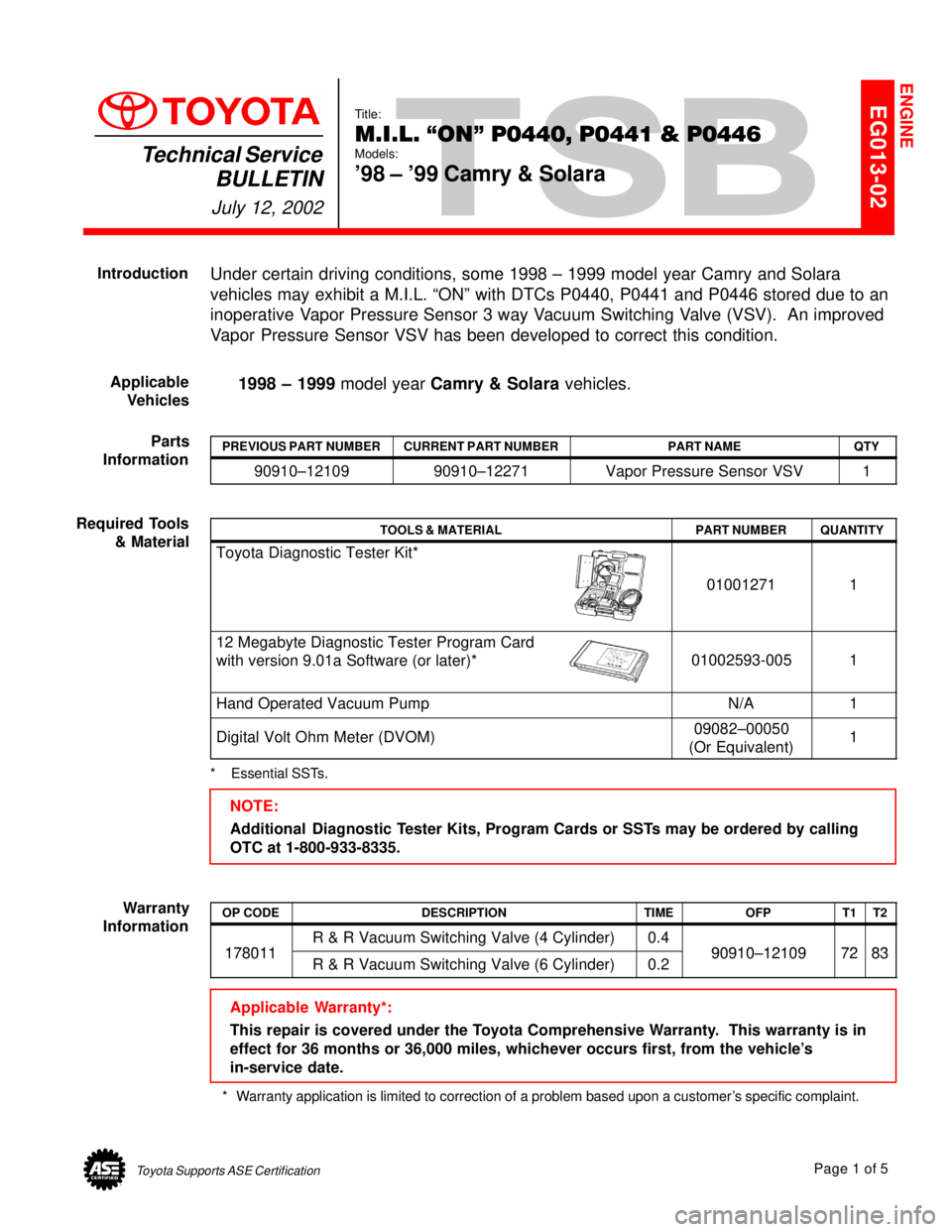
EG013-02Title:
M.I.L. ON" P0440, P0441 & P0446
Models:
'98 ± '99 Camry & Solara
Technical Service
BULLETIN
July 12, 2002
Under certain driving conditions, some 1998 ± 1999 model year Camry and Solara
vehicles may exhibit a M.I.L. ªONº with DTCs P0440, P0441 and P0446 stored due to an
inoperative Vapor Pressure Sensor 3 way Vacuum Switching Valve (VSV). An improved
Vapor Pressure Sensor VSV has been developed to correct this condition.
�1998 ± 1999 model year Camry & Solara vehicles.
PREVIOUS PART NUMBERCURRENT PART NUMBERPART NAMEQTY
90910±1210990910±12271Vapor Pressure Sensor VSV1
TOOLS & MATERIALPART NUMBERQUANTITY
Toyota Diagnostic Tester Kit*
010012711
12 Megabyte Diagnostic Tester Program Card
with version 9.01a Software (or later)*
01002593-0051
Hand Operated Vacuum PumpN/A1
Digital Volt Ohm Meter (DVOM)09082±00050
(Or Equivalent)1
* Essential SSTs.
NOTE:
Additional Diagnostic Tester Kits, Program Cards or SSTs may be ordered by calling
OTC at 1-800-933-8335.
OP CODEDESCRIPTIONTIMEOFPT1T2
178011
R & R Vacuum Switching Valve (4 Cylinder)0.4
90910 121097283178011R & R Vacuum Switching Valve (6 Cylinder)0.290910±121097283
Applicable Warranty*:
This repair is covered under the Toyota Comprehensive Warranty. This warranty is in
effect for 36 months or 36,000 miles, whichever occurs first, from the vehicle's
in-service date.
* Warranty application is limited to correction of a problem based upon a customer's specific complaint.
ENGINE
Introduction
Applicable
Vehicles
Parts
Information
Required Tools
& Material
Warranty
Information
Page 4576 of 4770
M.I.L. ªONº P0440, P0441 & P0446 ± EG013-02July 12, 2002
Page 2 of 5
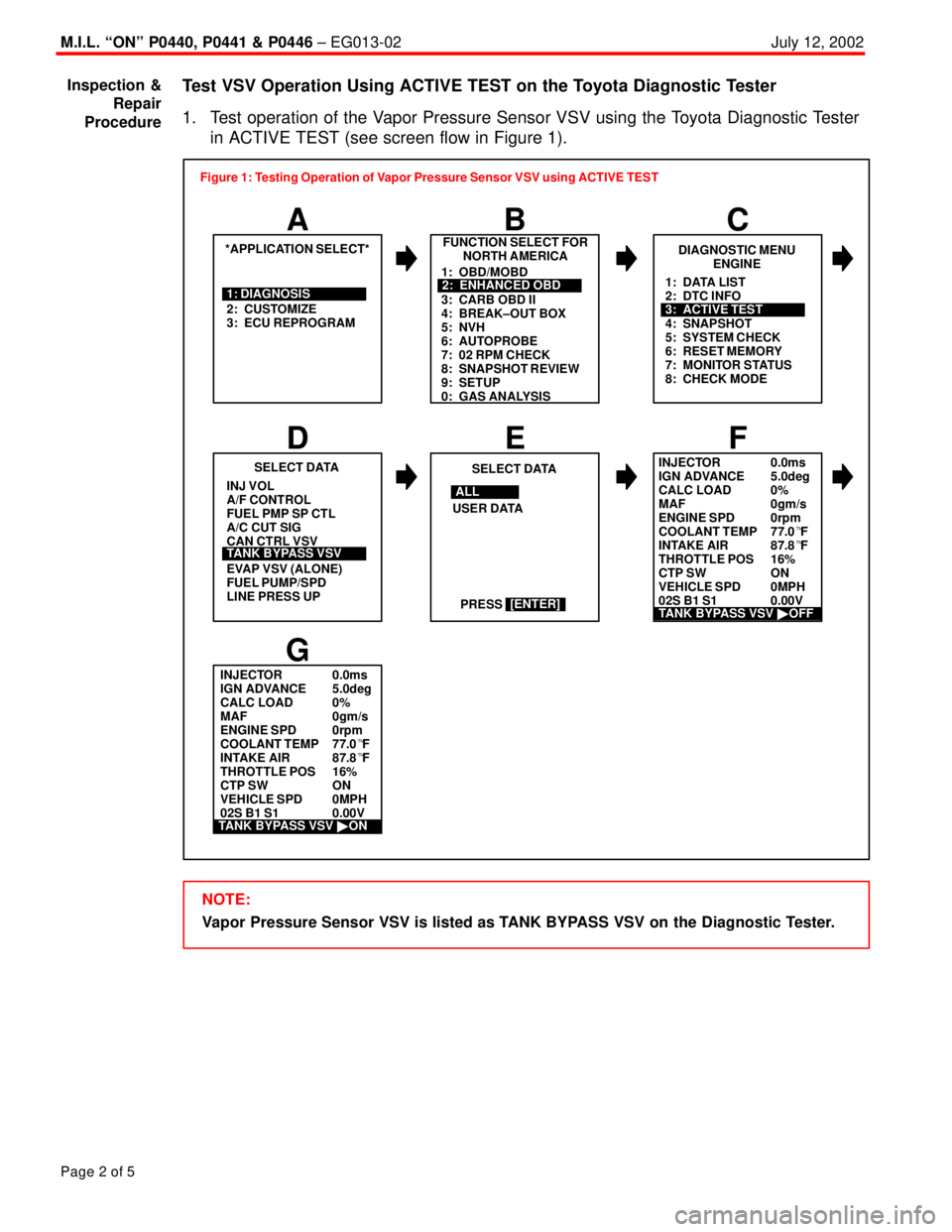
Test VSV Operation Using ACTIVE TEST on the Toyota Diagnostic Tester
1. Test operation of the Vapor Pressure Sensor VSV using the Toyota Diagnostic Tester
in ACTIVE TEST (see screen flow in Figure 1).
INJECTOR 0.0ms
IGN ADVANCE 5.0deg
CALC LOAD 0%
MAF 0gm/s
ENGINE SPD 0rpm
COOLANT TEMP 77.0�F
INTAKE AIR 87.8�F
THROTTLE POS 16%
CTP SW ON
VEHICLE SPD 0MPH
02S B1 S1 0.00V
2: CUSTOMIZE
3: ECU REPROGRAMFUNCTION SELECT FOR
NORTH AMERICA
B
*APPLICATION SELECT*
A
1: DIAGNOSISDIAGNOSTIC MENU
ENGINE
C
PRESS INJ VOL
A/F CONTROL
FUEL PMP SP CTL
A/C CUT SIG
CAN CTRL VSV
EVAP VSV (ALONE)
FUEL PUMP/SPD
LINE PRESS UPSELECT DATA
E
SELECT DATA
D
TANK BYPASS VSVUSER DATA
[ENTER]
F
G
TANK BYPASS VSV OFF
1: OBD/MOBD
3: CARB OBD II
4: BREAK±OUT BOX
5: NVH
6: AUTOPROBE
7: 02 RPM CHECK
8: SNAPSHOT REVIEW
9: SETUP
0: GAS ANALYSIS2: ENHANCED OBD1: DATA LIST
2: DTC INFO
4: SNAPSHOT
5: SYSTEM CHECK
6: RESET MEMORY
7: MONITOR STATUS
8: CHECK MODE
3: ACTIVE TEST
ALL
INJECTOR 0.0ms
IGN ADVANCE 5.0deg
CALC LOAD 0%
MAF 0gm/s
ENGINE SPD 0rpm
COOLANT TEMP 77.0�F
INTAKE AIR 87.8�F
THROTTLE POS 16%
CTP SW ON
VEHICLE SPD 0MPH
02S B1 S1 0.00V Figure 1: Testing Operation of Vapor Pressure Sensor VSV using ACTIVE TEST
TANK BYPASS VSV ON
NOTE:
Vapor Pressure Sensor VSV is listed as TANK BYPASS VSV on the Diagnostic Tester. Inspection &
Repair
Procedure
Page 4577 of 4770
M.I.L. ªONº P0440, P0441 & P0446 ± EG013-02July 12, 2002
Page 3 of 5
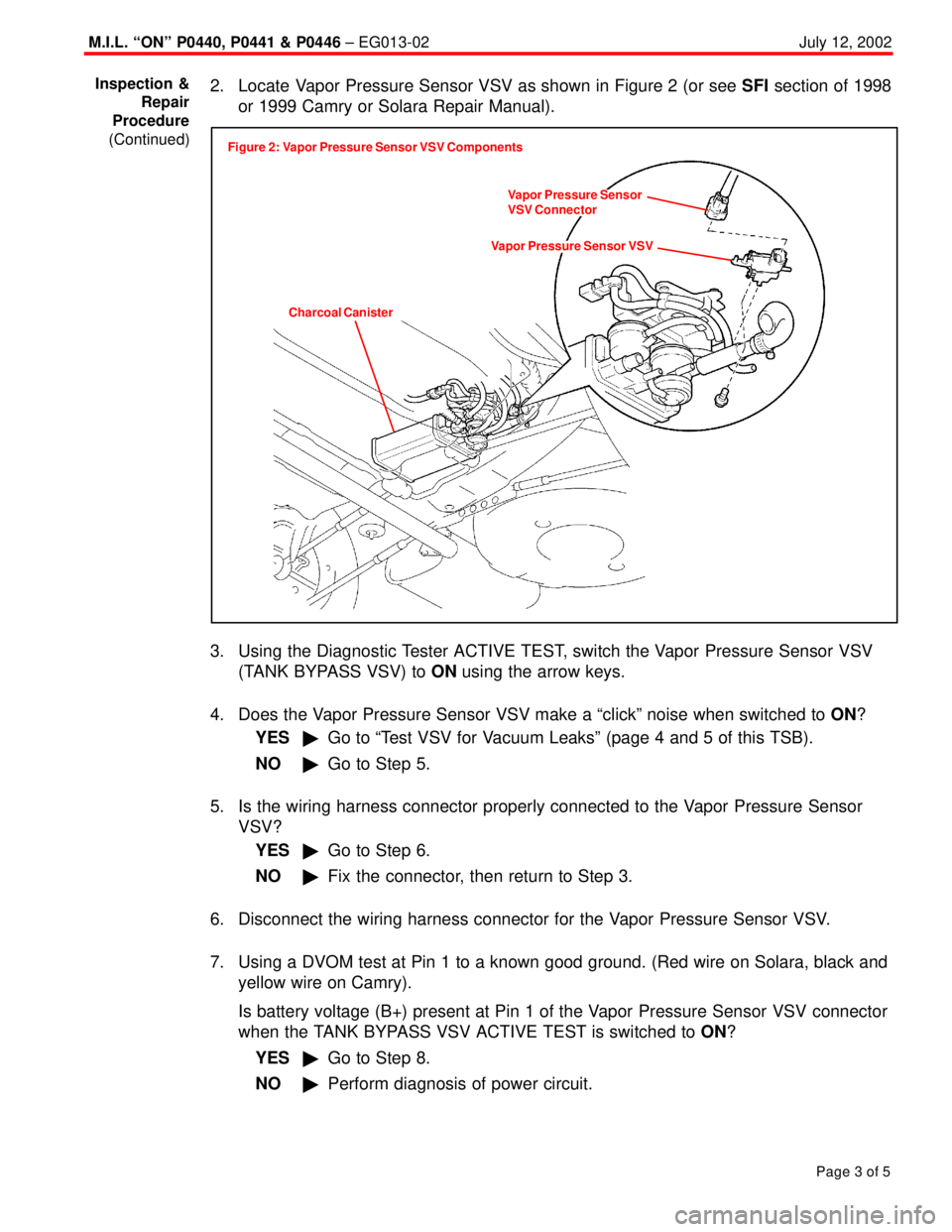
2. Locate Vapor Pressure Sensor VSV as shown in Figure 2 (or see SFI section of 1998
or 1999 Camry or Solara Repair Manual).
Charcoal Canister
Vapor Pressure Sensor
VSV Connector
Vapor Pressure Sensor VSV
Figure 2: Vapor Pressure Sensor VSV Components
3. Using the Diagnostic Tester ACTIVE TEST, switch the Vapor Pressure Sensor VSV
(TANK BYPASS VSV) to ON using the arrow keys.
4. Does the Vapor Pressure Sensor VSV make a ªclickº noise when switched to ON?
YESGo to ªTest VSV for Vacuum Leaksº (page 4 and 5 of this TSB).
NOGo to Step 5.
5. Is the wiring harness connector properly connected to the Vapor Pressure Sensor
VSV?
YESGo to Step 6.
NOFix the connector, then return to Step 3.
6. Disconnect the wiring harness connector for the Vapor Pressure Sensor VSV.
7. Using a DVOM test at Pin 1 to a known good ground. (Red wire on Solara, black and
yellow wire on Camry).
Is battery voltage (B+) present at Pin 1 of the Vapor Pressure Sensor VSV connector
when the TANK BYPASS VSV ACTIVE TEST is switched to ON?
YESGo to Step 8.
NOPerform diagnosis of power circuit.
Inspection &
Repair
Procedure
(Continued)
Page 4578 of 4770
M.I.L. ªONº P0440, P0441 & P0446 ± EG013-02July 12, 2002
Page 4 of 5
8. Using a DVOM test at Pin 2 to a known good ground. The ECM provides ground
when the VSV is switched ON. (White and red wire on Solara, violet wire on Camry).
Is there continuity to ground at Pin 2 of the Vapor Pressure Sensor VSV connector
when the TANK BYPASS VSV ACTIVE TEST is switched to ON?
YESReplace the Vapor Pressure Sensor VSV.
NOPerform diagnosis of ground circuit.
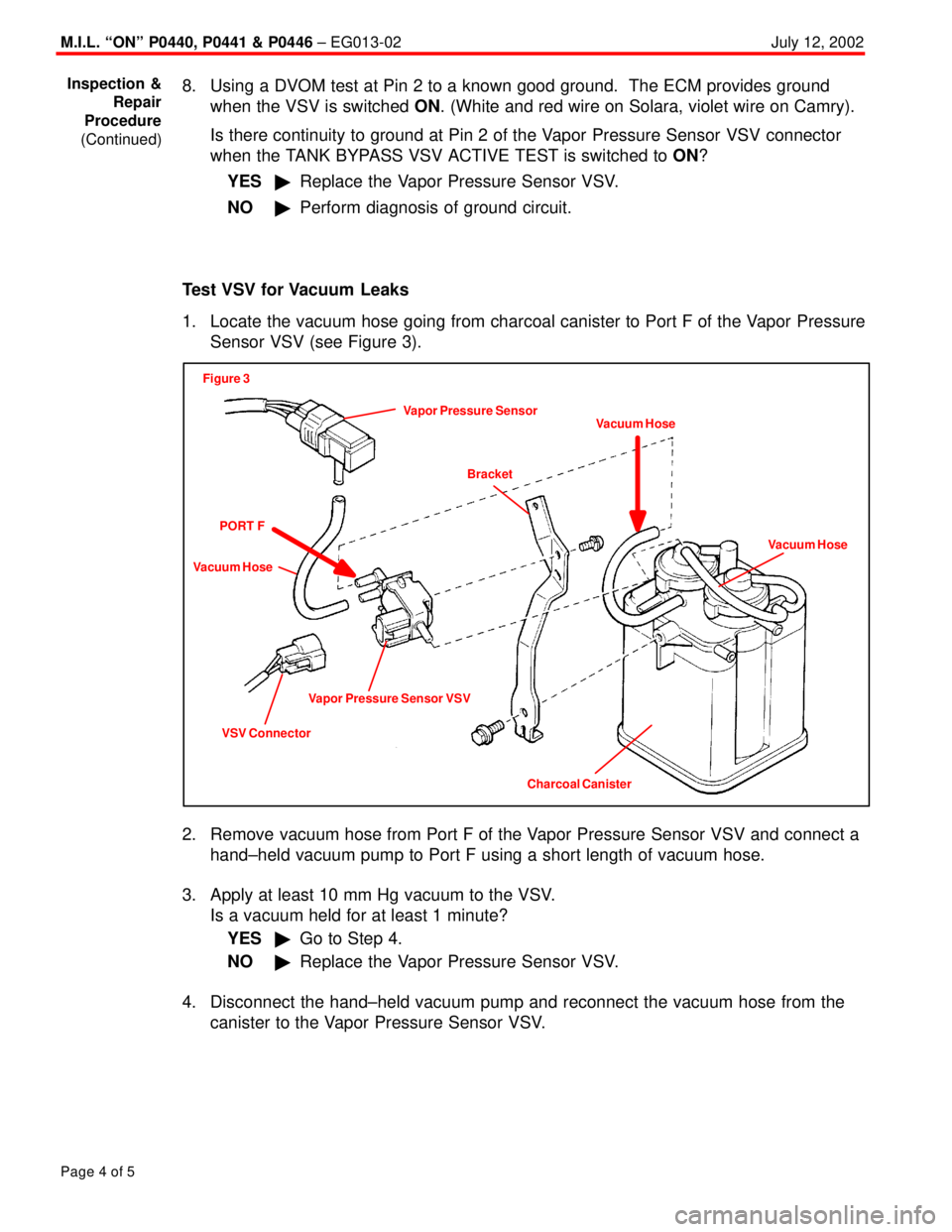
Test VSV for Vacuum Leaks
1. Locate the vacuum hose going from charcoal canister to Port F of the Vapor Pressure
Sensor VSV (see Figure 3).
Vapor Pressure Sensor
Figure 3
Bracket
Vacuum HoseVacuum Hose
Vapor Pressure Sensor VSV
VSV ConnectorVacuum Hose
PORT F
Charcoal Canister
2. Remove vacuum hose from Port F of the Vapor Pressure Sensor VSV and connect a
hand±held vacuum pump to Port F using a short length of vacuum hose.
3. Apply at least 10 mm Hg vacuum to the VSV.
Is a vacuum held for at least 1 minute?
YESGo to Step 4.
NOReplace the Vapor Pressure Sensor VSV.
4. Disconnect the hand±held vacuum pump and reconnect the vacuum hose from the
canister to the Vapor Pressure Sensor VSV.
Inspection &
Repair
Procedure
(Continued)