Page 59 of 4770

2. Except Delco Battery:
CHECK BATTERY VOLTAGE AND SPECIFIC
GRAVITY
A. Maintenance Free Battery
Measure the battery voltage between the terminals
negative (±) and positive (+) of the battery.
Standard voltage:
12.7 ± 12.9 V at 205C (685F)
HINT:
wBefore measuring the voltage, turn the ignition
switch to LOCK and turn off the electrical sys±
tems (headlight, blower motor, rear defogger etc.)
for 60 seconds to remove the surface charge.
wIf the vehicle has been running, wait 5 minutes or
more after the vehicle stops before measuring
the battery voltage.
If the voltage is less than specification, charge the
battery.
HINT: Check the indicator as shown in the illustration. 1. Except Delco Battery:
CHECK BATTERY ELECTROLYTE LEVEL
Check the electrolyte quantity of each cell.
A. Maintenance Free Battery
If under the lower level, replace the battery (or add
distilled water if possible). Check the charging system.
B. Except Maintenance Free Battery
If under the ªLOWERº or ªMINº line, add distilled
water.
BATTERY INSPECTION
± 5S±FE ENGINEENGINE MECHANICALEG1±9
Page 60 of 4770

3. Delco Battery:
CHECK HYDROMETER
Green Dot visible:
Battery is adequately charged
Dark (Green Dot not visible):
Battery must be charged
Clear or Light Yellow:
Replace battery
HINT: There is no need to add water during the entire
service life of the battery.
AIR FILTER INSPECTION
1. INSPECT AIR FILTER
Visually check that the element is not excessively
dirty, damaged or oily.
2. CLEAN AIR FILTER
Clean the element with compressed air.
First blow air from the inside thoroughly. Then blow
off the outside of the element.B. Except Maintenance Free Battery
Check the specific gravity of each cell.
Standard specific gravity:
55D23L battery for GNB Incorporated
1.25 ± 1.27 at 205C (685F)
55D23L battery for JOHNSON CONTROLS
1.26 ± 1.28 at 275C (815F)
80D26L battery for GNB Incorporated
1.27 ± 1.29 at 205C (685F)
80D26L battery for JOHNSON CONTROLS
1.28 ± 1.30 at 27�C (81�F)
If the gravity is less than specification, charge the
battery.
HINT: Check the indicator as shown in the illustration.
HIGH±TENSION CORDS INSPECTION
1. DISCONNECT HIGH±TENSION CORDS FROM
SPARK PLUGS
Disconnect the high ± tension cords at the rubber
boot. Do not pull on the high±tension cords.
NOTICE: Pulling on or bending the cords may damage the
conductor inside.
± 5S±FE ENGINEENGINE MECHANICALEG1±10
Page 222 of 4770
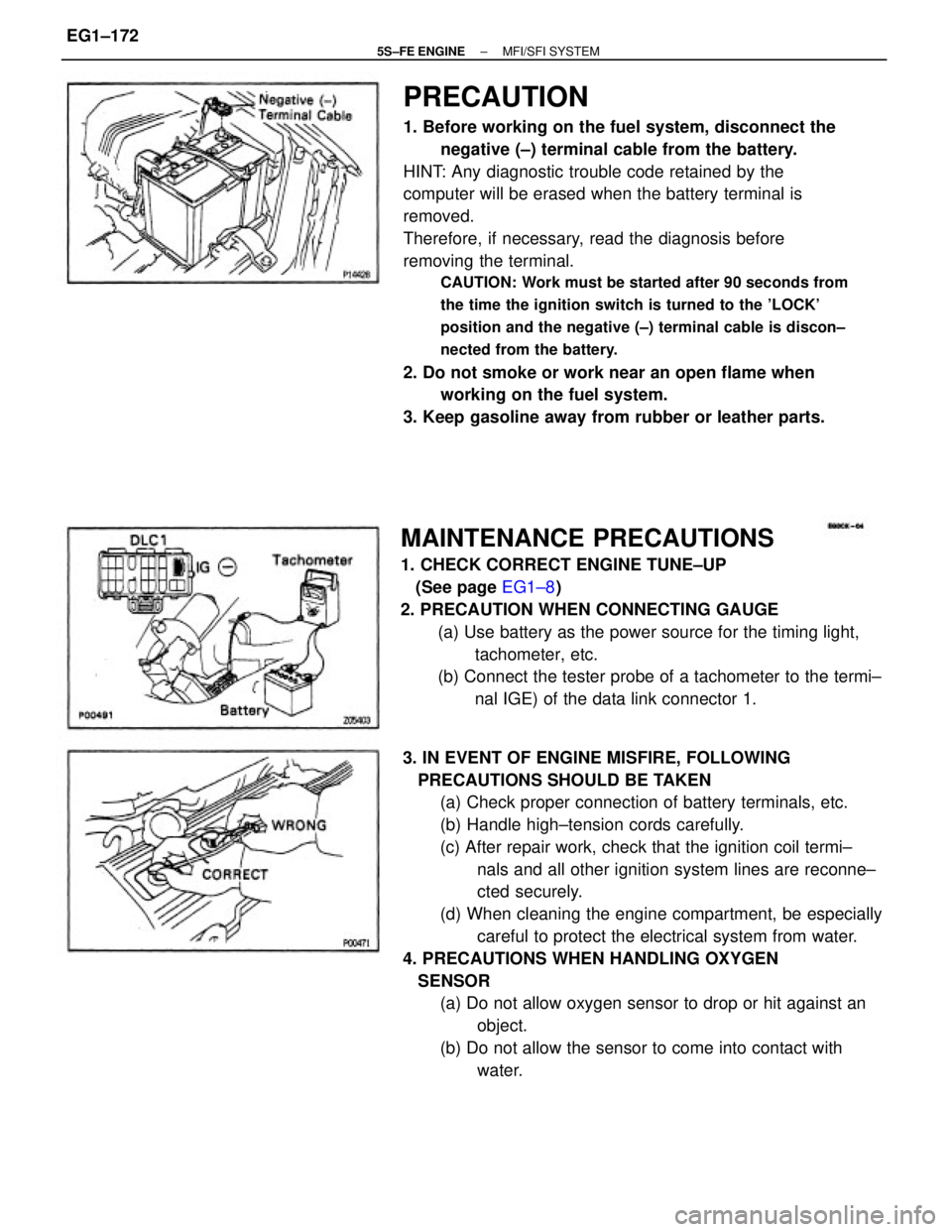
PRECAUTION
1. Before working on the fuel system, disconnect the
negative (±) terminal cable from the battery.
HINT: Any diagnostic trouble code retained by the
computer will be erased when the battery terminal is
removed.
Therefore, if necessary, read the diagnosis before
removing the terminal.
CAUTION: Work must be started after 90 seconds from
the time the ignition switch is turned to the 'LOCK'
position and the negative (±) terminal cable is discon±
nected from the battery.
2. Do not smoke or work near an open flame when
working on the fuel system.
3. Keep gasoline away from rubber or leather parts.
3. IN EVENT OF ENGINE MISFIRE, FOLLOWING
PRECAUTIONS SHOULD BE TAKEN
(a) Check proper connection of battery terminals, etc.
(b) Handle high±tension cords carefully.
(c) After repair work, check that the ignition coil termi±
nals and all other ignition system lines are reconne±
cted securely.
(d) When cleaning the engine compartment, be especially
careful to protect the electrical system from water.
4. PRECAUTIONS WHEN HANDLING OXYGEN
SENSOR
(a) Do not allow oxygen sensor to drop or hit against an
object.
(b) Do not allow the sensor to come into contact with
water.
MAINTENANCE PRECAUTIONS
1. CHECK CORRECT ENGINE TUNE±UP
(See page EG1±8)
2. PRECAUTION WHEN CONNECTING GAUGE
(a) Use battery as the power source for the timing light,
tachometer, etc.
(b) Connect the tester probe of a tachometer to the termi±
nal IGE) of the data link connector 1.
± 5S±FE ENGINEMFI/SFI SYSTEMEG1±172
Page 226 of 4770
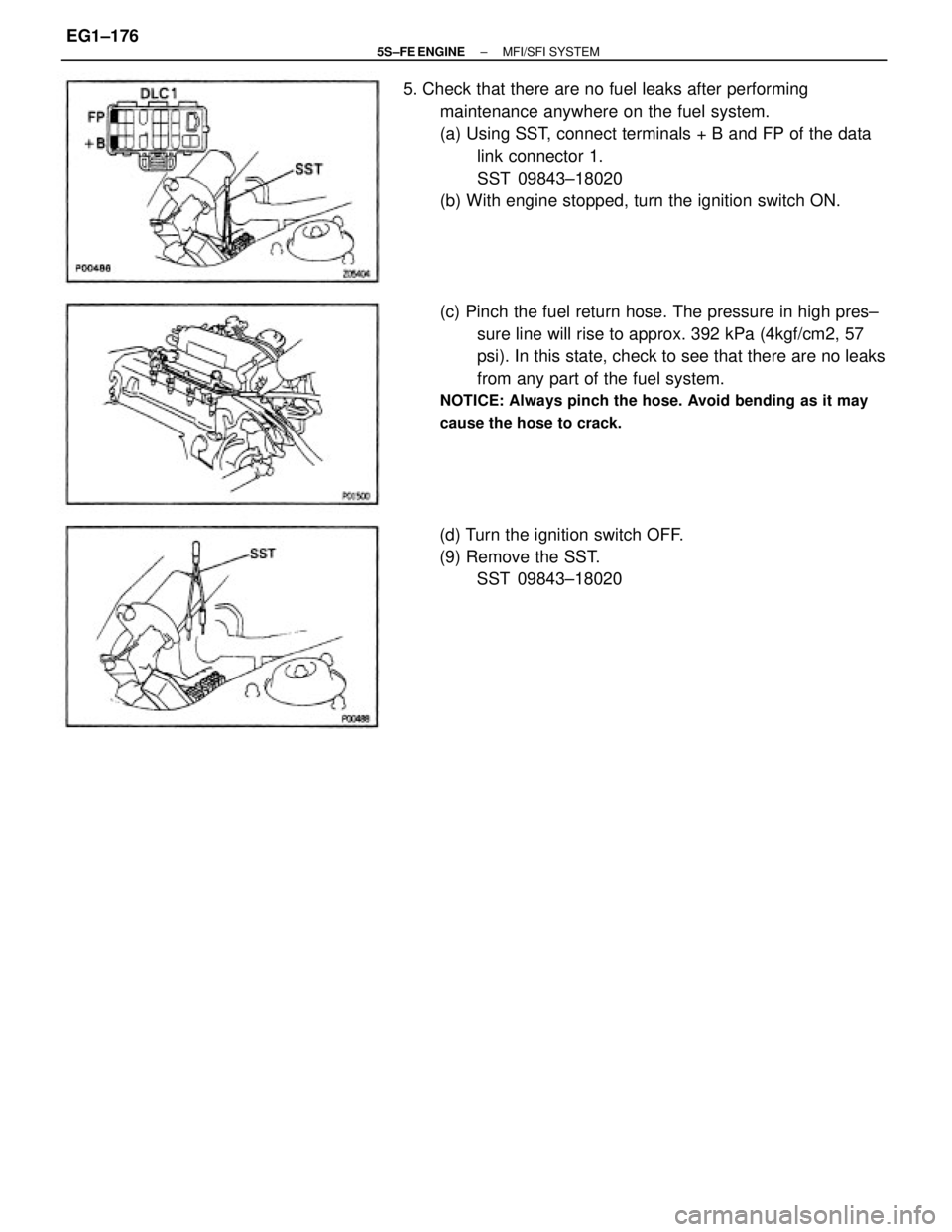
5. Check that there are no fuel leaks after performing
maintenance anywhere on the fuel system.
(a) Using SST, connect terminals + B and FP of the data
link connector 1.
SST 09843±18020
(b) With engine stopped, turn the ignition switch ON.
(c) Pinch the fuel return hose. The pressure in high pres±
sure line will rise to approx. 392 kPa (4kgf/cm2, 57
psi). In this state, check to see that there are no leaks
from any part of the fuel system.
NOTICE: Always pinch the hose. Avoid bending as it may
cause the hose to crack.
(d) Turn the ignition switch OFF.
(9) Remove the SST.
SST 09843±18020
± 5S±FE ENGINEMFI/SFI SYSTEMEG1±176
Page 923 of 4770
'99camry U
209
Part 7
DO±IT±YOURSELF
MAINTENANCEÐ
Chapter 7±1
Introduction
�Engine compartment overview
�Fuse locations
�Do±it±yourself service
precautions
�P ar t s and tools
Page 927 of 4770
'99camry U
213
If you perform maintenance by yourself,
be sure to follow the correct procedure
given in this part.
You should be aware that improper or in-
complete servicing may result in operating
problems.
Performing do±it±yourself maintenance
during the warranty period may affect your
warranty coverage. Read the separate
Toyota Warranty statement for details and
suggestions.
This part gives instructions only for those
items that are relatively easy for an owner
to perform. As explained in Part 6, there
are still a number of items that must be
done by a qualified technician with special
tools.
For information on tools and parts for do±
it±yourself maintenance, see ºParts and
toolsº.
Utmost care should be taken when work-
ing on your vehicle to prevent accidental
injury. Here are a few precautions that
you should be especially careful to ob-
serve:CAUTION
�When the engine is running, keep
hands, clothing, and tools away
from the moving fan and engine
drive belts. (Removing rings,
watches, and ties is advisable.)
�Right after driving, the engine
compartmentÐthe engine, radiator,
exhaust manifold and spark plug
boots, etc.Ðwill be hot. So be care-
ful not to touch them. Oil, fluids
and spark plugs may also be hot.
�If the engine is hot, do not remove
the radiator cap or loosen the drain
plugs to prevent burning yourself.
�Do not smoke, cause sparks or al-
low open flames around fuel or the
battery. Their fumes are flammable.
�Be extremely cautious when work-
ing on the battery. It contains poi-
sonous and corrosive sulfuric acid.
�Do not get under your vehicle with
just the body jack supporting it. Al-
ways use automotive jack stands or
other solid supports.
Do±it±yourself service
precautions
Page 931 of 4770
'99camry U
217
Part 7
DO±IT±YOURSELF
MAINTENANCEÐ
Chapter 7±2
Engine and Chassis
�Checking the engine oil level
�Checking the engine coolant
level
�Checking brake fluid
�Checking power steering fluid
�Checking tire pressure
�Checking and replacing tires
�Rotating tires
�Installing snow tires and chains
�Replacing wheels
�Aluminum wheel precautions
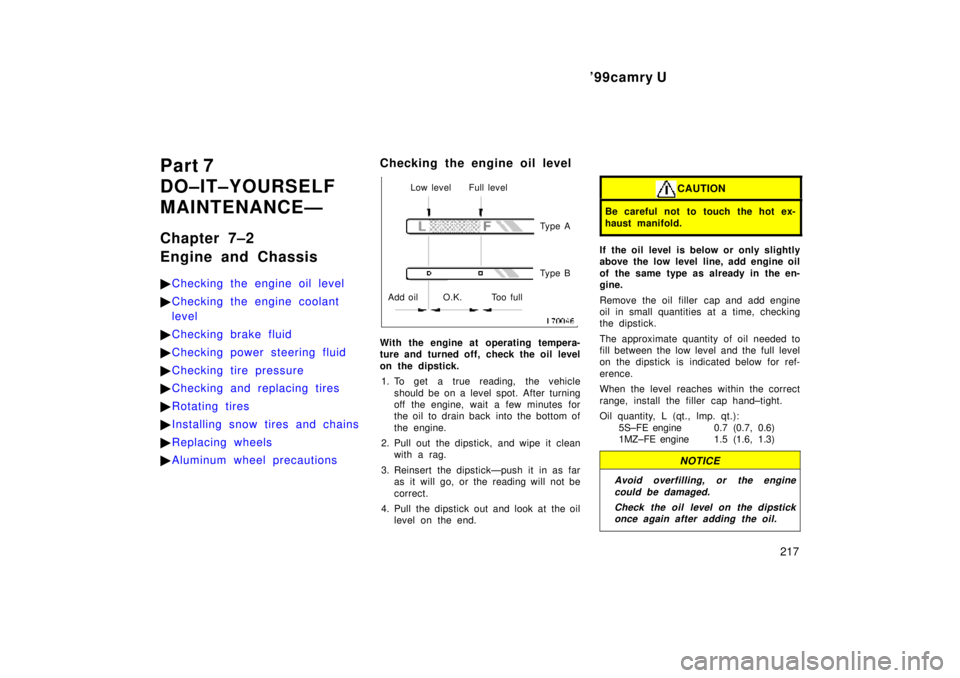
Checking the engine oil level
Low level Full level
Add oil O.K. Too fullTy p e A
Ty p e B
With the engine at operating tempera-
ture and turned off, check the oil level
on the dipstick.
1. To get a true reading, the vehicle
should be on a level spot. After turning
off the engine, wait a few minutes for
the oil to drain back into the bottom of
the engine.
2. Pull out the dipstick, and wipe it clean
with a rag.
3. Reinsert the dipstickÐpush it in as far
as it will go, or the reading will not be
correct.
4. Pull the dipstick out and look at the oil
level on the end.
CAUTION
Be careful not to touch the hot ex-
haust manifold.
If the oil level is below or only slightly
above the low level line, add engine oil
of the same type as already in the en-
gine.
Remove the oil filler cap and add engine
oil in small quantities at a time, checking
the dipstick.
The approximate quantity of oil needed to
fill between the low level and the full level
on the dipstick is indicated below for ref-
erence.
When the level reaches within the correct
range, install the filler cap hand±tight.
Oil quantity, L (qt., lmp. qt.):
5S±FE engine 0.7 (0.7, 0.6)
1MZ±FE engine 1.5 (1.6, 1.3)
NOTICE
�Avoid overfilling, or the engine
could be damaged.
�Check the oil level on the dipstick
once again after adding the oil.
Page 941 of 4770

'99camry U
227
Part 7
DO±IT±YOURSELF
MAINTENANCEÐ
Chapter 7±3
Electrical components
�Checking battery condition
�Battery recharging precautions
�Checking and replacing fuses
�Adding washer fluid
�Replacing light bulbs
CAUTION
BATTERY PRECAUTIONS
The battery produces flammable and
explosive hydrogen gas.
�Do not cause a spark from the bat-
tery with tools.
�Do not smoke or light a match near
the battery.
The electrolyte contains poisonous
and corrosive sulfuric acid.
�Avoid contact with eyes, skin or
clothes.
�Never ingest electrolyte.
�Wear protective safety glasses when
working near the battery.
�Keep children away from the bat-
tery.
EMERGENCY MEASURES
�If electrolyte gets in your eyes,
flush your eyes with clean water
immediately and get immediate
medical attention. If possible, con-
tinue to apply water with a sponge
or cloth while en route to the medi-
cal office.
�If electrolyte gets on your skin,
thoroughly wash the contact area. If
you feel pain or burning, get medi-
cal attention immediately.
�If electrolyte gets on your clothes,
there is a possibility of its soaking
through to your skin, so immediate-
ly take off the exposed clothing and
follow the procedure above, if nec-
essary.
�If you happen to swallow electro-
lyte, drink a large quantity of water
or milk. Follow with milk of magne-
sia, beaten raw egg or vegetable
oil. Then go immediately for emer-
gency help.
Checking battery conditionÐ
ÐPrecautions