Page 4554 of 4770
READINESS MONITOR DRIVE PATTERNS ± EG003-02 RevisedMarch 29, 2002
Page 23 of 23
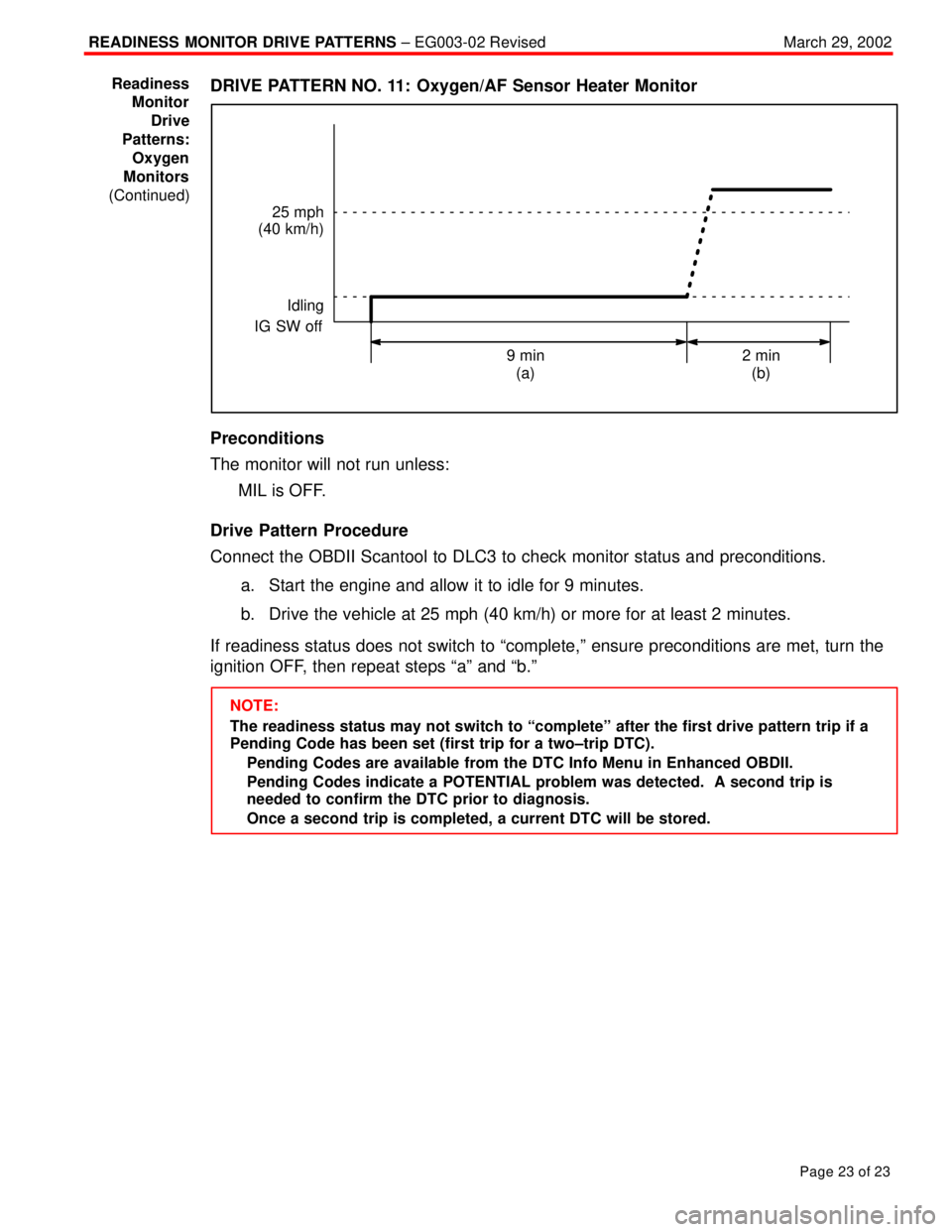
DRIVE PATTERN NO. 11: Oxygen/AF Sensor Heater Monitor
Idling
IG SW off
2 min
(b) 9 min
(a) 25 mph
(40 km/h)
Preconditions
The monitor will not run unless:
�MIL is OFF.
Drive Pattern Procedure
Connect the OBDII Scantool to DLC3 to check monitor status and preconditions.
a. Start the engine and allow it to idle for 9 minutes.
b. Drive the vehicle at 25 mph (40 km/h) or more for at least 2 minutes.
If readiness status does not switch to ªcomplete,º ensure preconditions are met, turn the
ignition OFF, then repeat steps ªaº and ªb.º
NOTE:
The readiness status may not switch to ªcompleteº after the first drive pattern trip if a
Pending Code has been set (first trip for a two±trip DTC).
�Pending Codes are available from the DTC Info Menu in Enhanced OBDII.
�Pending Codes indicate a POTENTIAL problem was detected. A second trip is
needed to confirm the DTC prior to diagnosis.
�Once a second trip is completed, a current DTC will be stored. Readiness
Monitor
Drive
Patterns:
Oxygen
Monitors
(Continued)
Page 4555 of 4770

Toyota Supports ASE CertificationPage 1 of 1
EG003-03Title:
SULFUR ODOR FROM EXHAUST
Models:
All Models
Technical Service
BULLETIN
February 24, 2003
Some owners of Toyota vehicles may experience a sulfur±like or ªrotten eggº odor from
the exhaust system. Sulfur is a natural component of crude oil from which gasoline is
refined and the amount of sulfur can be decreased through the refining process. The
amount of sulfur in fuel sold in California is regulated, however gasoline sold in other
states can have substantially higher sulfur content. Sulfur content also varies
considerably between gasoline brands and locations.
All Models.
A sulfur odor emitted from the vehicle's tailpipe does not necessarily indicate that there is
an issue with the engine's running condition, but is most likely directly related to the fuel.
If the vehicle is exhibiting an excessive sulfur odor, the following checks should be
performed:
If the MIL light is ON, check for DTCs and repair as necessary.
If no trouble is found after performing the above check, recommend the customer try a
different source of fuel.
Replacement of oxygen sensors, air/fuel ratio sensors or catalytic converters will not
reduce the odor and will therefore not
be considered warrantable.
OP CODEDESCRIPTIONTIMEOFPT1T2
N/ANot Applicable to Warranty±±±±
ENGINE
Introduction
Applicable
Vehicles
Repair
Procedure
Warranty
Information
Page 4558 of 4770

Toyota Supports ASE CertificationPage 1 of 2
EG004-01Title:
M.I.L. ON" P1133
Models:
'97±'99 Camry and '99 Solara
Technical Service
BULLETIN
April 20, 2001
Under certain driving conditions, some 1997 ± 1999 5S±FE California emission
specification Camrys and 1999 5S±FE California emission specification Solaras may
exhibit a M.I.L. ªONº with DTC P1133 (Air Fuel Ratio Sensor Slow Response
Malfunction). An improved Air Fuel Ratio (A/F) Sensor was developed to correct this
condition (See TSB EG006±99).
In some rare cases, P1133 may still set after the improved A/F sensor is installed. The
Engine Control Module (ECM) logic has been modified to correct this condition.
1997 ± 1999 model year Camrys with 5S±FE California emission specification.
1999 model year Solaras with 5S±FE California emission specification.
PREVIOUS PART NUMBERCURRENT PART NUMBERPART NAME
89661±3T45189661±3T452ECM, 1999 AT
89661±0668189661±06682
,
ECM, 1999 MT
89661±3T27189661±3T272
,
ECM, 1998 ATNon Immobilizer89661±0650189661±06502
,
ECM, 1998 MTNon±Immobilizer
89661±3T04189661±3T042
,
ECM, 1997 AT
89661±0637189661±06372ECM, 1997 MT
89661±3T47189661±3T472ECM, 1999 ATImmobilizer89661±3T29189661±3T292ECM, 1998 ATImmobilizer
OP CODEDESCRIPTIONTIMEOPNT1T2
895011
Varied Work Code ªNº.R & R ECM For DOHC0.4See Previous PN
Above9999
Applicable Warranty*:
This repair is covered under the Toyota Federal Emissions Warranty. This warranty is
in effect for 96 months or 80,000 miles, whichever occurs first, from the vehicle's
in-service date.
* Warranty application is limited to correction of a problem based upon a customer's specific complaint.
ENGINE
Introduction
Applicable
Vehicles
Parts
Information
Warranty
Information
Page 4559 of 4770
M.I.L. ªONº P1133 ± EG004-01 April 20, 2001
Page 2 of 2
1. Should a M.I.L. ªONº condition with P1133 be encountered, perform diagnostic
procedures as described in the Repair Manual.
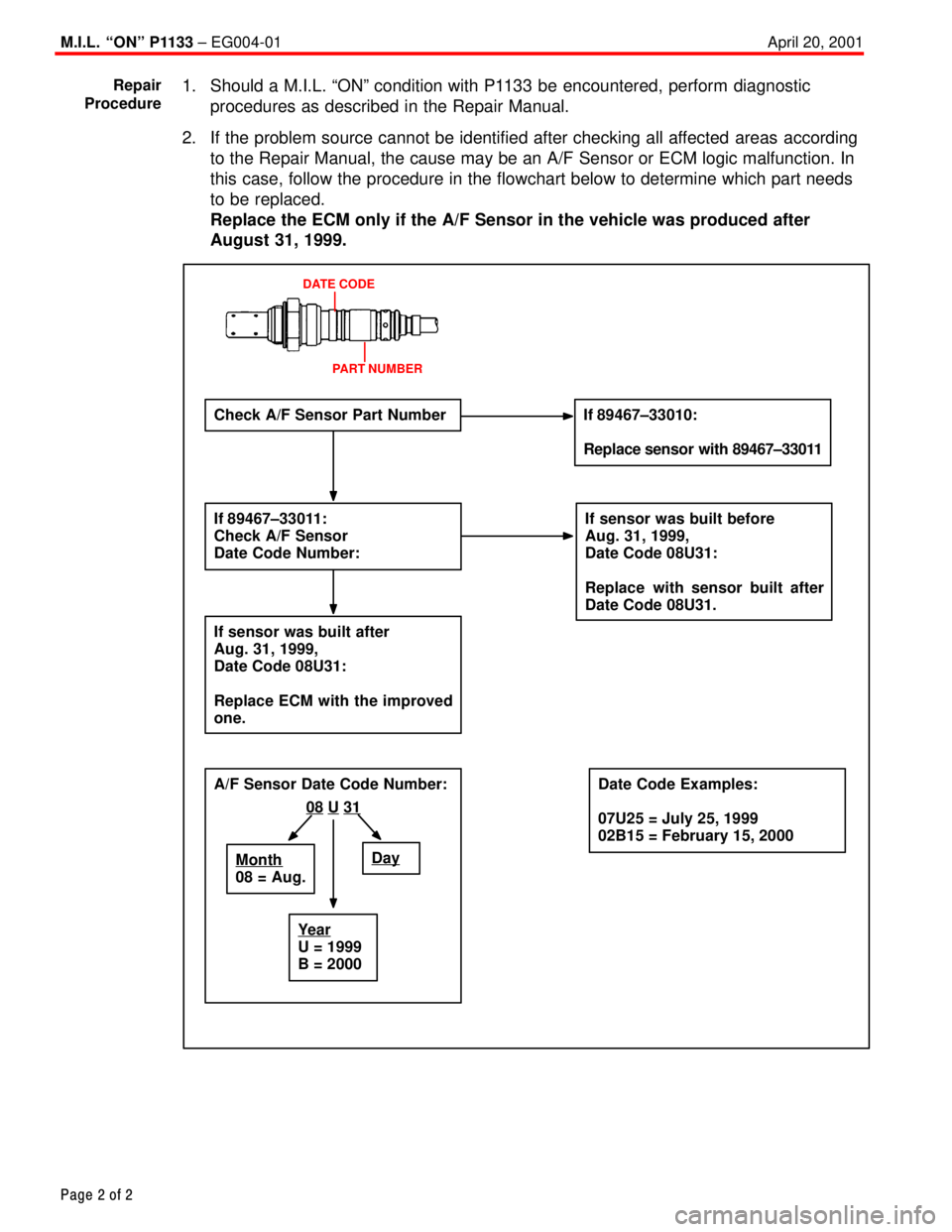
2. If the problem source cannot be identified after checking all affected areas according
to the Repair Manual, the cause may be an A/F Sensor or ECM logic malfunction. In
this case, follow the procedure in the flowchart below to determine which part needs
to be replaced.
Replace the ECM only if the A/F Sensor in the vehicle was produced after
August 31, 1999.
A/F Sensor Date Code Number:
08
U 31
Check A/F Sensor Part Number
If 89467±33011:
Check A/F Sensor
Date Code Number:
If sensor was built after
Aug. 31, 1999,
Date Code 08U31:
Replace ECM with the improved
one.
If 89467±33010:
Replace sensor with 89467±33011
If sensor was built before
Aug. 31, 1999,
Date Code 08U31:
Replace with sensor built after
Date Code 08U31.
Date Code Examples:
07U25 = July 25, 1999
02B15 = February 15, 2000
DATE CODE
PART NUMBER
Month
08 = Aug.
Day
Year
U = 1999
B = 2000
Repair
Procedure
Page 4561 of 4770
EVAP SYSTEM OPERATION INFORMATION ± EG005-01 April 27, 2001
Page 2 of 14
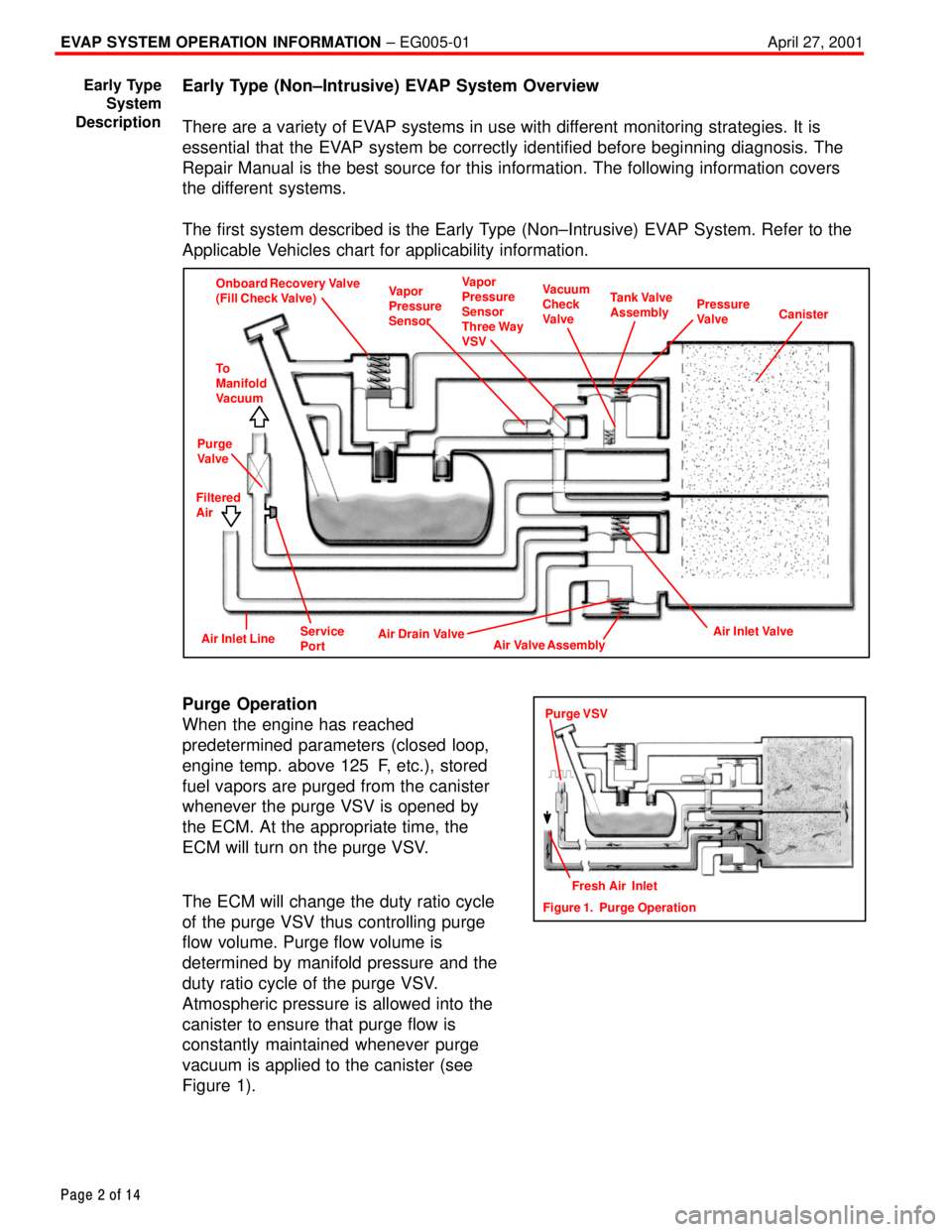
Early Type (Non±Intrusive) EVAP System Overview
There are a variety of EVAP systems in use with different monitoring strategies. It is
essential that the EVAP system be correctly identified before beginning diagnosis. The
Repair Manual is the best source for this information. The following information covers
the different systems.
The first system described is the Early Type (Non±Intrusive) EVAP System. Refer to the
Applicable Vehicles chart for applicability information.
Onboard Recovery Valve
(Fill Check Valve)Vapor
Pressure
SensorVapor
Pressure
Sensor
Three Way
VSVVacuum
Check
ValveTank Valve
AssemblyPressure
ValveCanister
To
Manifold
Vacuum
Purge
Valve
Filtered
Air
Air Drain Valve
Air Valve AssemblyAir Inlet ValveAir Inlet LineService
Port
Purge Operation
When the engine has reached
predetermined parameters (closed loop,
engine temp. above 125�F, etc.), stored
fuel vapors are purged from the canister
whenever the purge VSV is opened by
the ECM. At the appropriate time, the
ECM will turn on the purge VSV.
The ECM will change the duty ratio cycle
of the purge VSV thus controlling purge
flow volume. Purge flow volume is
determined by manifold pressure and the
duty ratio cycle of the purge VSV.
Atmospheric pressure is allowed into the
canister to ensure that purge flow is
constantly maintained whenever purge
vacuum is applied to the canister (see
Figure 1).
Early Type
System
Description
Figure 1. Purge OperationFresh Air Inlet
Purge VSV
Page 4562 of 4770
EVAP SYSTEM OPERATION INFORMATION ± EG005-01 April 27, 2001
Page 3 of 14
ORVR Operation
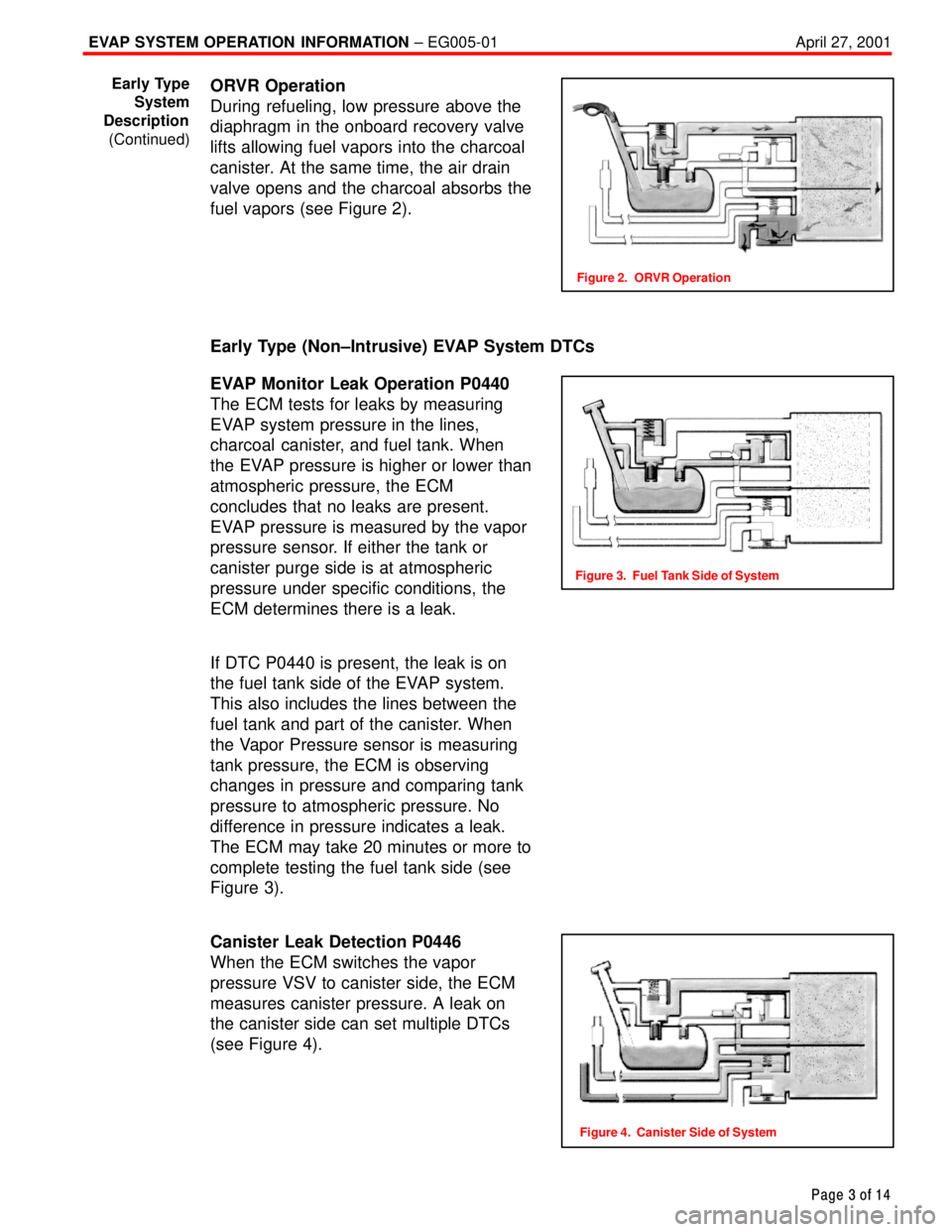
During refueling, low pressure above the
diaphragm in the onboard recovery valve
lifts allowing fuel vapors into the charcoal
canister. At the same time, the air drain
valve opens and the charcoal absorbs the
fuel vapors (see Figure 2).
Early Type (Non±Intrusive) EVAP System DTCs
EVAP Monitor Leak Operation P0440
The ECM tests for leaks by measuring
EVAP system pressure in the lines,
charcoal canister, and fuel tank. When
the EVAP pressure is higher or lower than
atmospheric pressure, the ECM
concludes that no leaks are present.
EVAP pressure is measured by the vapor
pressure sensor. If either the tank or
canister purge side is at atmospheric
pressure under specific conditions, the
ECM determines there is a leak.
If DTC P0440 is present, the leak is on
the fuel tank side of the EVAP system.
This also includes the lines between the
fuel tank and part of the canister. When
the Vapor Pressure sensor is measuring
tank pressure, the ECM is observing
changes in pressure and comparing tank
pressure to atmospheric pressure. No
difference in pressure indicates a leak.
The ECM may take 20 minutes or more to
complete testing the fuel tank side (see
Figure 3).
Canister Leak Detection P0446
When the ECM switches the vapor
pressure VSV to canister side, the ECM
measures canister pressure. A leak on
the canister side can set multiple DTCs
(see Figure 4).Early Type
System
Description
(Continued)
Figure 2. ORVR Operation
Figure 3. Fuel Tank Side of System
Figure 4. Canister Side of System
Page 4563 of 4770
EVAP SYSTEM OPERATION INFORMATION ± EG005-01 April 27, 2001
Page 4 of 14
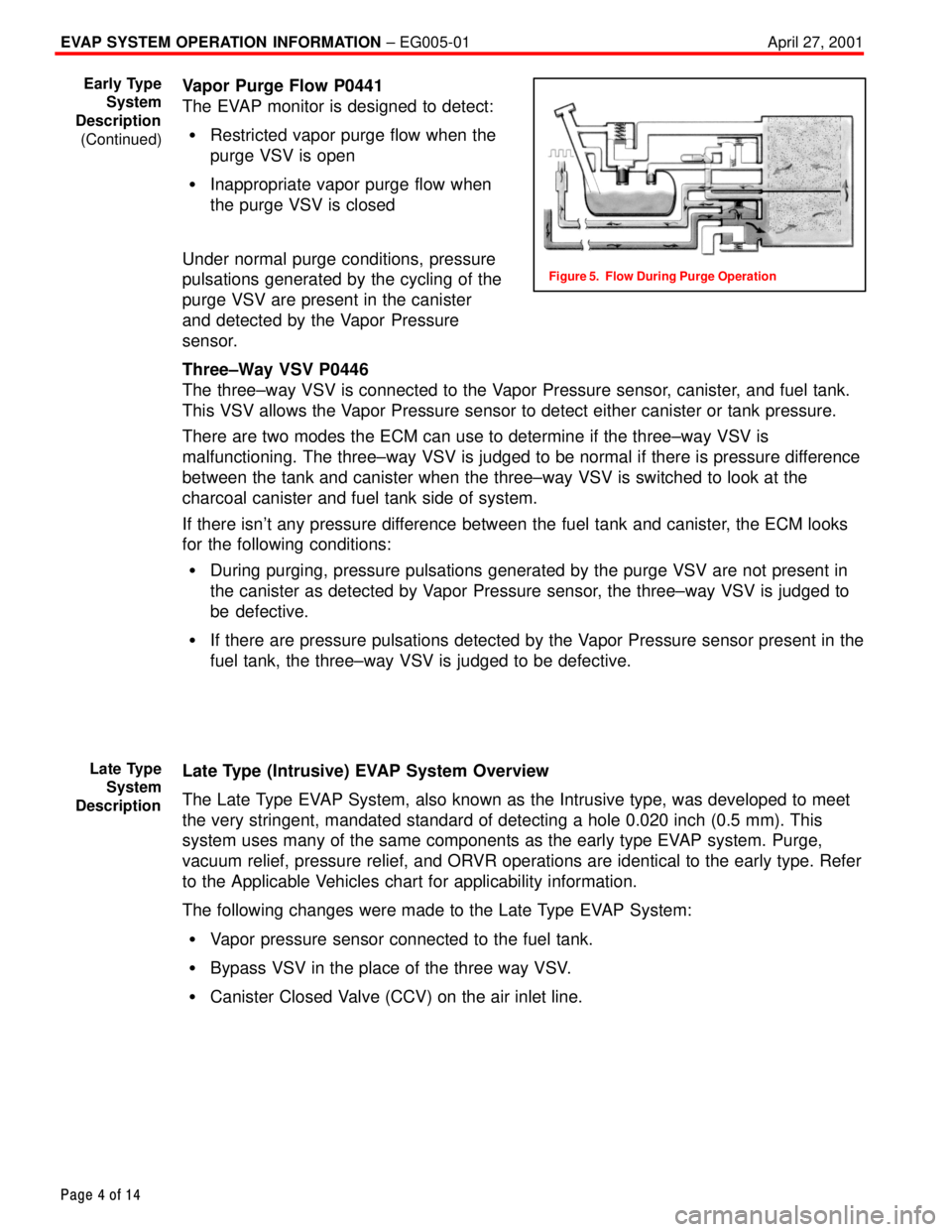
Vapor Purge Flow P0441
The EVAP monitor is designed to detect:
Restricted vapor purge flow when the
purge VSV is open
Inappropriate vapor purge flow when
the purge VSV is closed
Under normal purge conditions, pressure
pulsations generated by the cycling of the
purge VSV are present in the canister
and detected by the Vapor Pressure
sensor.
Three±Way VSV P0446
The three±way VSV is connected to the Vapor Pressure sensor, canister, and fuel tank.
This VSV allows the Vapor Pressure sensor to detect either canister or tank pressure.
There are two modes the ECM can use to determine if the three±way VSV is
malfunctioning. The three±way VSV is judged to be normal if there is pressure difference
between the tank and canister when the three±way VSV is switched to look at the
charcoal canister and fuel tank side of system.
If there isn't any pressure difference between the fuel tank and canister, the ECM looks
for the following conditions:
During purging, pressure pulsations generated by the purge VSV are not present in
the canister as detected by Vapor Pressure sensor, the three±way VSV is judged to
be defective.
If there are pressure pulsations detected by the Vapor Pressure sensor present in the
fuel tank, the three±way VSV is judged to be defective.
Late Type (Intrusive) EVAP System Overview
The Late Type EVAP System, also known as the Intrusive type, was developed to meet
the very stringent, mandated standard of detecting a hole 0.020 inch (0.5 mm). This
system uses many of the same components as the early type EVAP system. Purge,
vacuum relief, pressure relief, and ORVR operations are identical to the early type. Refer
to the Applicable Vehicles chart for applicability information.
The following changes were made to the Late Type EVAP System:
Vapor pressure sensor connected to the fuel tank.
Bypass VSV in the place of the three way VSV.
Canister Closed Valve (CCV) on the air inlet line.Early Type
System
Description
(Continued)
Figure 5. Flow During Purge Operation
Late Type
System
Description
Page 4564 of 4770
EVAP SYSTEM OPERATION INFORMATION ± EG005-01 April 27, 2001
Page 5 of 14
Late Type (Intrusive EVAP System) (Except ECHO)
Onboard Recovery Valve
(Fill Check Valve)Vapor
Pressure
SensorVacuum
Check
ValveTank Valve
AssemblyTank
Pressure
Valve
Canister
To
Manifold
Vacuum
Purge
VSV
Filtered
Air
Air Drain Valve
Air Valve AssemblyAir Inlet ValveCanister
Closed Valve
Bypass
VSVAir
Inlet LineService
Port
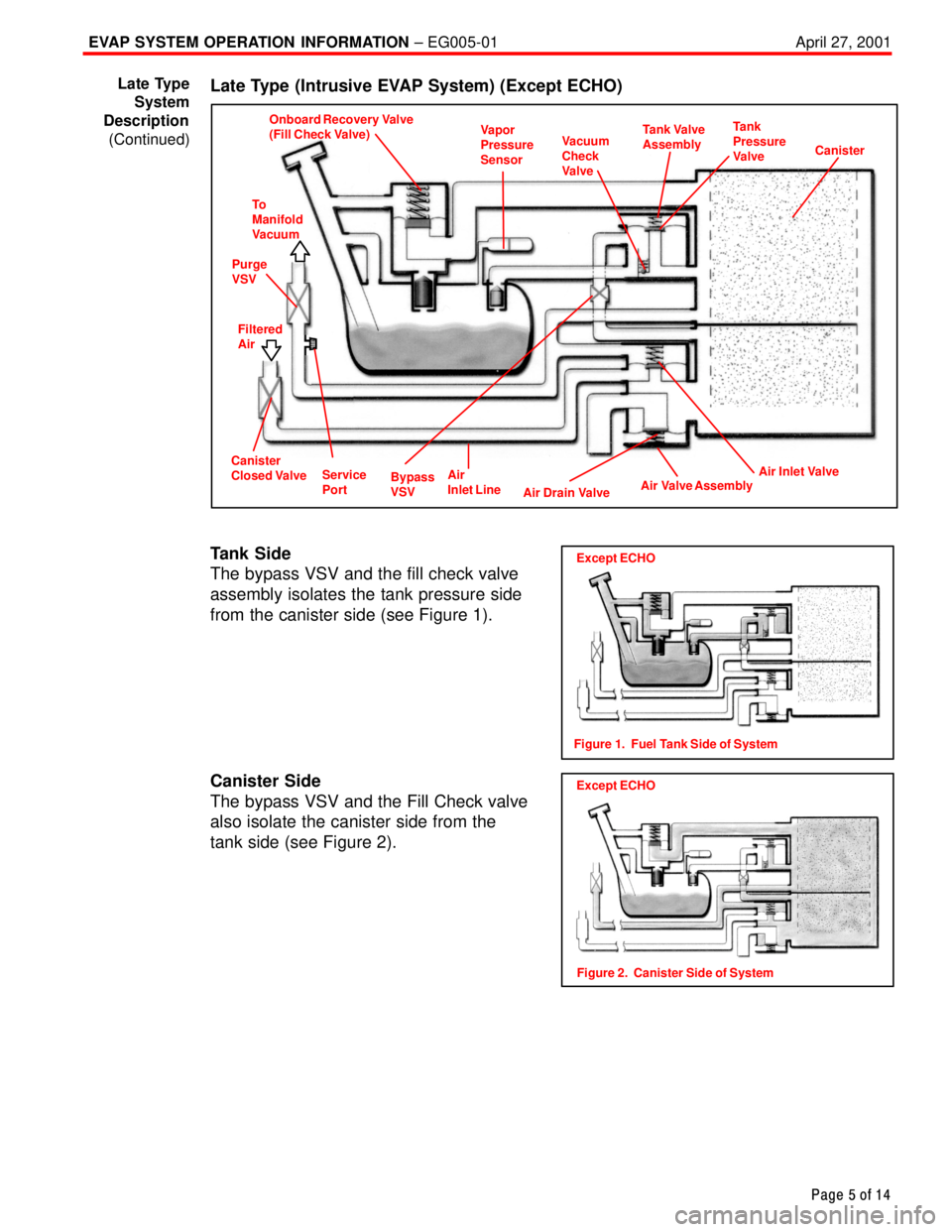
Tank Side
The bypass VSV and the fill check valve
assembly isolates the tank pressure side
from the canister side (see Figure 1).
Canister Side
The bypass VSV and the Fill Check valve
also isolate the canister side from the
tank side (see Figure 2).
Late Type
System
Description
(Continued)
Except ECHO
Figure 1. Fuel Tank Side of System
Except ECHO
Figure 2. Canister Side of System