2000 DODGE NEON tow
[x] Cancel search: towPage 23 of 1285
BALL JOINT
The lower control arm connects to the steering
knuckle through a ball joint mounted at the outboard
end of the arm (Fig. 1). The ball joint is pressed into
the lower control arm and has a non-tapered stud
with a notch for steering knuckle pinch bolt clear-
ance. The ball joint stud is clamped and locked to the
steering knuckle lower leg using a pinch bolt.
The ball joint is lubricated for life during the man-
ufacturing process. Once lubricated for life, the
grease fitting head is snapped off by the manufac-
turer. This is done to eliminate the possibility of
lubrication later in the ball joints life thus damaging
the non-vented ball joint seal boot.
The ball joint used on this vehicle is replaceable
and, if found defective, can be serviced as a separate
component of the lower control arm.
STABILIZER BAR (FRONT)
The stabilizer bar helps control vehicle body roll.
Jounce and rebound movements affecting one wheel
are partially transmitted to the opposite wheel of the
vehicle to stabilize body roll.
The stabilizer bar interconnects both front lower
control arms of the vehicle and is attached to the
front suspension crossmember (Fig. 1).
Attachment of the stabilizer bar to the front sus-
pension crossmember is through 2 rubber-isolator
cushion and retainers (Fig. 1). The stabilizer bar
attachment to the lower control arm is done by uti-
lizing an isolated stabilizer bar link at each arm. All
components of the stabilizer bar are serviceable.
DIAGNOSIS AND TESTING
STRUT ASSEMBLY (FRONT)
Inspect the strut assembly for the following condi-
tions (Fig. 3):
²Inspect for a damaged or broken coil spring.
²Inspect for a torn or damaged strut assembly
dust shield.²Lift the dust shield and inspect the strut assem-
bly for evidence of fluid running from the upper end
of the strut fluid reservoir. (Actual leakage will be a
stream of fluid running down the side and dripping
off lower end of unit.) A slight amount of seepage
between the strut shaft and strut shaft seal is not
unusual and does not affect performance of the strut
assembly.
²Lift the dust shield and inspect the jounce
bumper for signs of damage or deterioration.
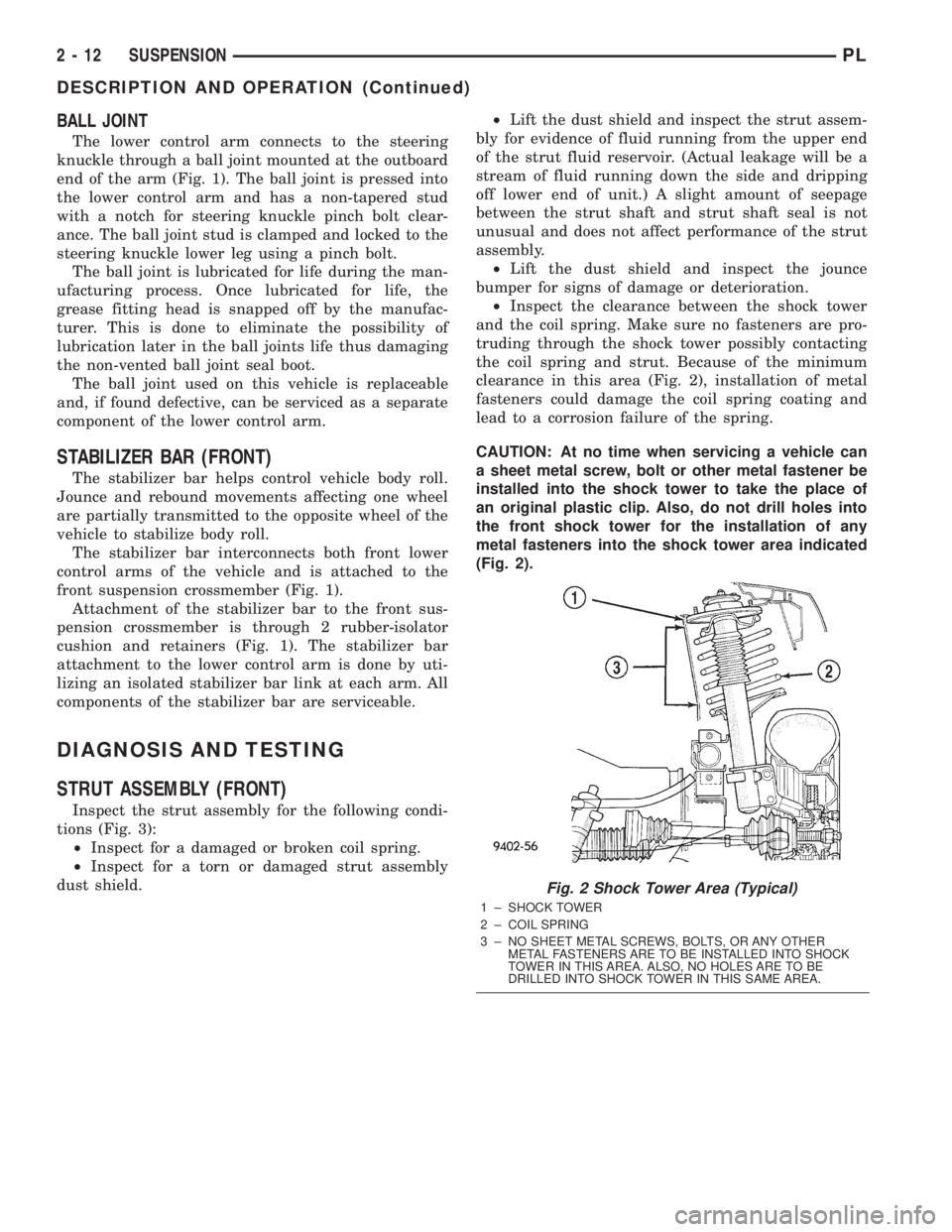
²Inspect the clearance between the shock tower
and the coil spring. Make sure no fasteners are pro-
truding through the shock tower possibly contacting
the coil spring and strut. Because of the minimum
clearance in this area (Fig. 2), installation of metal
fasteners could damage the coil spring coating and
lead to a corrosion failure of the spring.
CAUTION: At no time when servicing a vehicle can
a sheet metal screw, bolt or other metal fastener be
installed into the shock tower to take the place of
an original plastic clip. Also, do not drill holes into
the front shock tower for the installation of any
metal fasteners into the shock tower area indicated
(Fig. 2).
Fig. 2 Shock Tower Area (Typical)
1 ± SHOCK TOWER
2 ± COIL SPRING
3 ± NO SHEET METAL SCREWS, BOLTS, OR ANY OTHER
METAL FASTENERS ARE TO BE INSTALLED INTO SHOCK
TOWER IN THIS AREA. ALSO, NO HOLES ARE TO BE
DRILLED INTO SHOCK TOWER IN THIS SAME AREA.
2 - 12 SUSPENSIONPL
DESCRIPTION AND OPERATION (Continued)
Page 25 of 1285
CAUTION: No attempt should be made to service
the headless grease fitting on the ball joint. It has
been purposely snapped off by the manufacturer to
avoid over-greasing.
STABILIZER BAR (FRONT)
Inspect for broken, cracked or distorted stabilizer
bar cushions and retainers. Inspect for worn or dam-
aged stabilizer bar links (Fig. 1).
SERVICE PROCEDURES
LUBRICATION
There are no serviceable lubrication points on the
front suspension. The front lower ball joints have
grease fittings which have had the head snapped off
by the manufacturer after they have been filled. This
has been done to eliminate the possibility of damag-
ing the non-vented seals. Grease will not leak from
the broken grease fittings. The ball joints are sealed
for life and require no maintenance.
CAUTION: No attempt should be made to replace
the ball joint grease fitting with a new fitting, then
filling the ball joint with grease. Damage to the
grease seal can result.
REMOVAL AND INSTALLATION
SERVICE WARNINGS AND CAUTIONS
WARNING: DO NOT REMOVE THE STRUT SHAFT
NUT WHILE STRUT ASSEMBLY IS INSTALLED IN
VEHICLE, OR BEFORE THE COIL SPRING IS COM-
PRESSED WITH A COMPRESSION TOOL. THE
SPRING IS HELD UNDER HIGH PRESSURE.
CAUTION: Only frame contact hoisting equipment
can be used on this vehicle. All vehicles have a
fully independent rear suspension. The vehicles
cannot be hoisted using equipment designed to lift
a vehicle by the rear axle. If this type of hoisting
equipment is used, damage to rear suspension
components will occur.
CAUTION: At no time when servicing a vehicle can
a sheet metal screw, bolt, or other metal fastener be
installed in the shock tower to take the place of an
original plastic clip. It may come into contact with
the strut or coil spring.CAUTION: Wheel bearing damage will result if after
loosening the hub nut, the vehicle is rolled on the
ground or the weight of the vehicle is allowed to be
supported by the tires for a length of time.
STRUT ASSEMBLY (FRONT)
NOTE: Before proceeding with this procedure,
review SERVICE WARNINGS AND CAUTIONS at the
beginning of REMOVAL AND INSTALLATION in this
section.
REMOVAL
(1) Raise the vehicle. Refer to HOISTING in the
LUBRICATION AND MAINTENANCE group for the
proper lifting procedure.
(2) Remove tire and wheel assembly from location
on front of vehicle requiring strut removal.
(3) If both strut assemblies are to be removed,
mark the strut assemblies right or left according to
which side of the vehicle they were removed from.
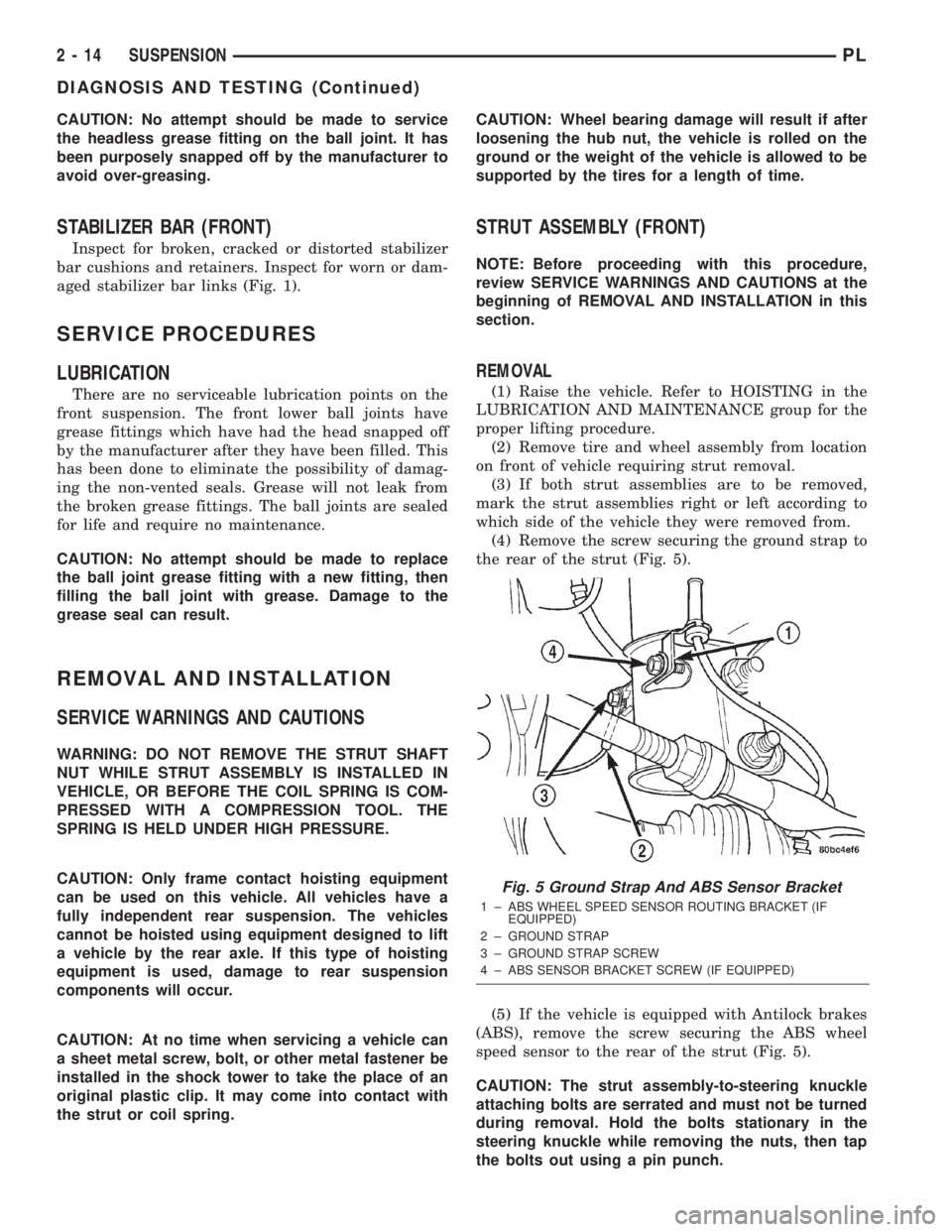
(4) Remove the screw securing the ground strap to
the rear of the strut (Fig. 5).
(5) If the vehicle is equipped with Antilock brakes
(ABS), remove the screw securing the ABS wheel
speed sensor to the rear of the strut (Fig. 5).
CAUTION: The strut assembly-to-steering knuckle
attaching bolts are serrated and must not be turned
during removal. Hold the bolts stationary in the
steering knuckle while removing the nuts, then tap
the bolts out using a pin punch.
Fig. 5 Ground Strap And ABS Sensor Bracket
1 ± ABS WHEEL SPEED SENSOR ROUTING BRACKET (IF
EQUIPPED)
2 ± GROUND STRAP
3 ± GROUND STRAP SCREW
4 ± ABS SENSOR BRACKET SCREW (IF EQUIPPED)
2 - 14 SUSPENSIONPL
DIAGNOSIS AND TESTING (Continued)
Page 26 of 1285
(6) Remove the two bolts attaching the strut to the
steering knuckle (Fig. 1).
(7) Lower the vehicle just enough to open the
hood, but without letting the tires touch the floor.
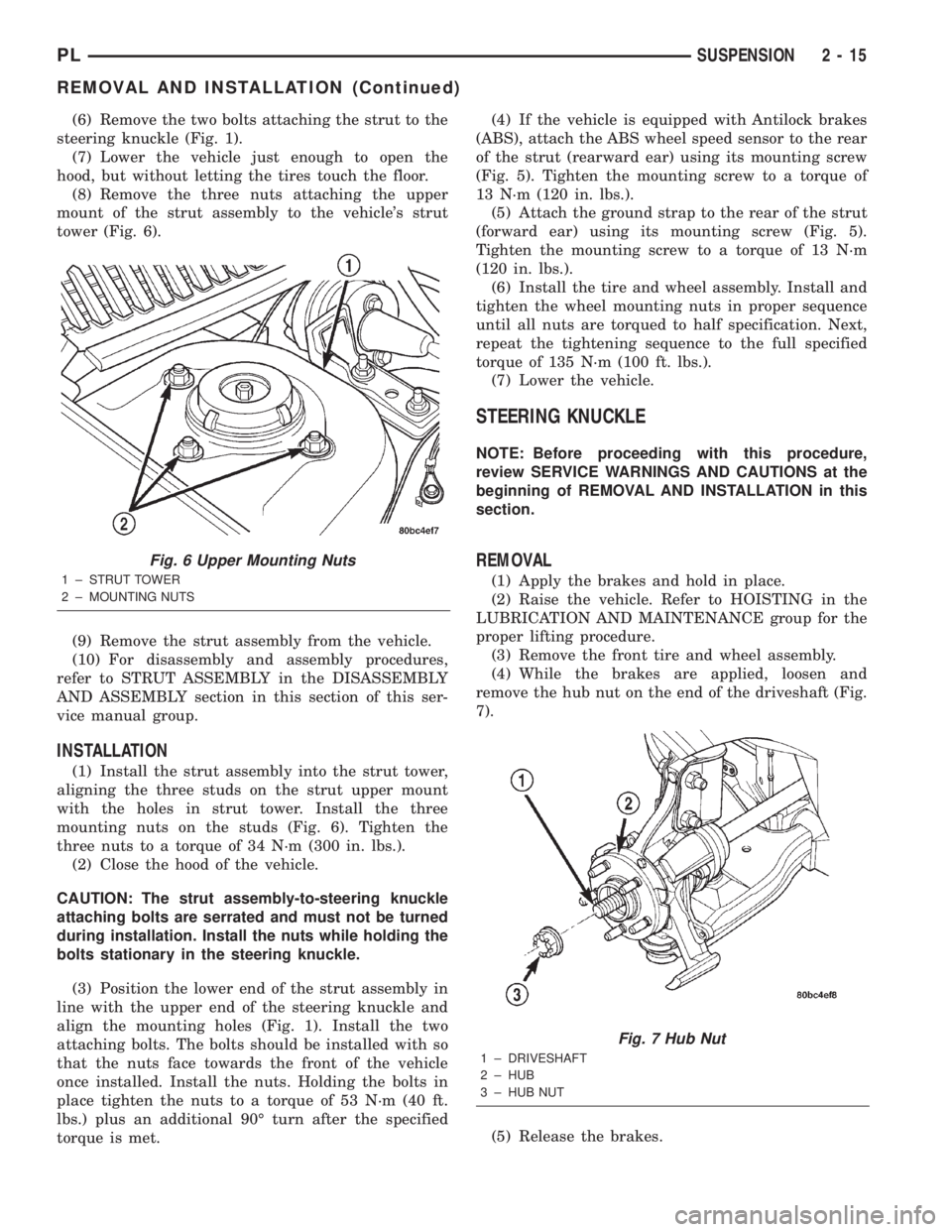
(8) Remove the three nuts attaching the upper
mount of the strut assembly to the vehicle's strut
tower (Fig. 6).
(9) Remove the strut assembly from the vehicle.
(10) For disassembly and assembly procedures,
refer to STRUT ASSEMBLY in the DISASSEMBLY
AND ASSEMBLY section in this section of this ser-
vice manual group.
INSTALLATION
(1) Install the strut assembly into the strut tower,
aligning the three studs on the strut upper mount
with the holes in strut tower. Install the three
mounting nuts on the studs (Fig. 6). Tighten the
three nuts to a torque of 34 N´m (300 in. lbs.).
(2) Close the hood of the vehicle.
CAUTION: The strut assembly-to-steering knuckle
attaching bolts are serrated and must not be turned
during installation. Install the nuts while holding the
bolts stationary in the steering knuckle.
(3) Position the lower end of the strut assembly in
line with the upper end of the steering knuckle and
align the mounting holes (Fig. 1). Install the two
attaching bolts. The bolts should be installed with so
that the nuts face towards the front of the vehicle
once installed. Install the nuts. Holding the bolts in
place tighten the nuts to a torque of 53 N´m (40 ft.
lbs.) plus an additional 90É turn after the specified
torque is met.(4) If the vehicle is equipped with Antilock brakes
(ABS), attach the ABS wheel speed sensor to the rear
of the strut (rearward ear) using its mounting screw
(Fig. 5). Tighten the mounting screw to a torque of
13 N´m (120 in. lbs.).
(5) Attach the ground strap to the rear of the strut
(forward ear) using its mounting screw (Fig. 5).
Tighten the mounting screw to a torque of 13 N´m
(120 in. lbs.).
(6) Install the tire and wheel assembly. Install and
tighten the wheel mounting nuts in proper sequence
until all nuts are torqued to half specification. Next,
repeat the tightening sequence to the full specified
torque of 135 N´m (100 ft. lbs.).
(7) Lower the vehicle.
STEERING KNUCKLE
NOTE: Before proceeding with this procedure,
review SERVICE WARNINGS AND CAUTIONS at the
beginning of REMOVAL AND INSTALLATION in this
section.
REMOVAL
(1) Apply the brakes and hold in place.
(2) Raise the vehicle. Refer to HOISTING in the
LUBRICATION AND MAINTENANCE group for the
proper lifting procedure.
(3) Remove the front tire and wheel assembly.
(4) While the brakes are applied, loosen and
remove the hub nut on the end of the driveshaft (Fig.
7).
(5) Release the brakes.
Fig. 6 Upper Mounting Nuts
1 ± STRUT TOWER
2 ± MOUNTING NUTS
Fig. 7 Hub Nut
1 ± DRIVESHAFT
2 ± HUB
3 ± HUB NUT
PLSUSPENSION 2 - 15
REMOVAL AND INSTALLATION (Continued)
Page 28 of 1285
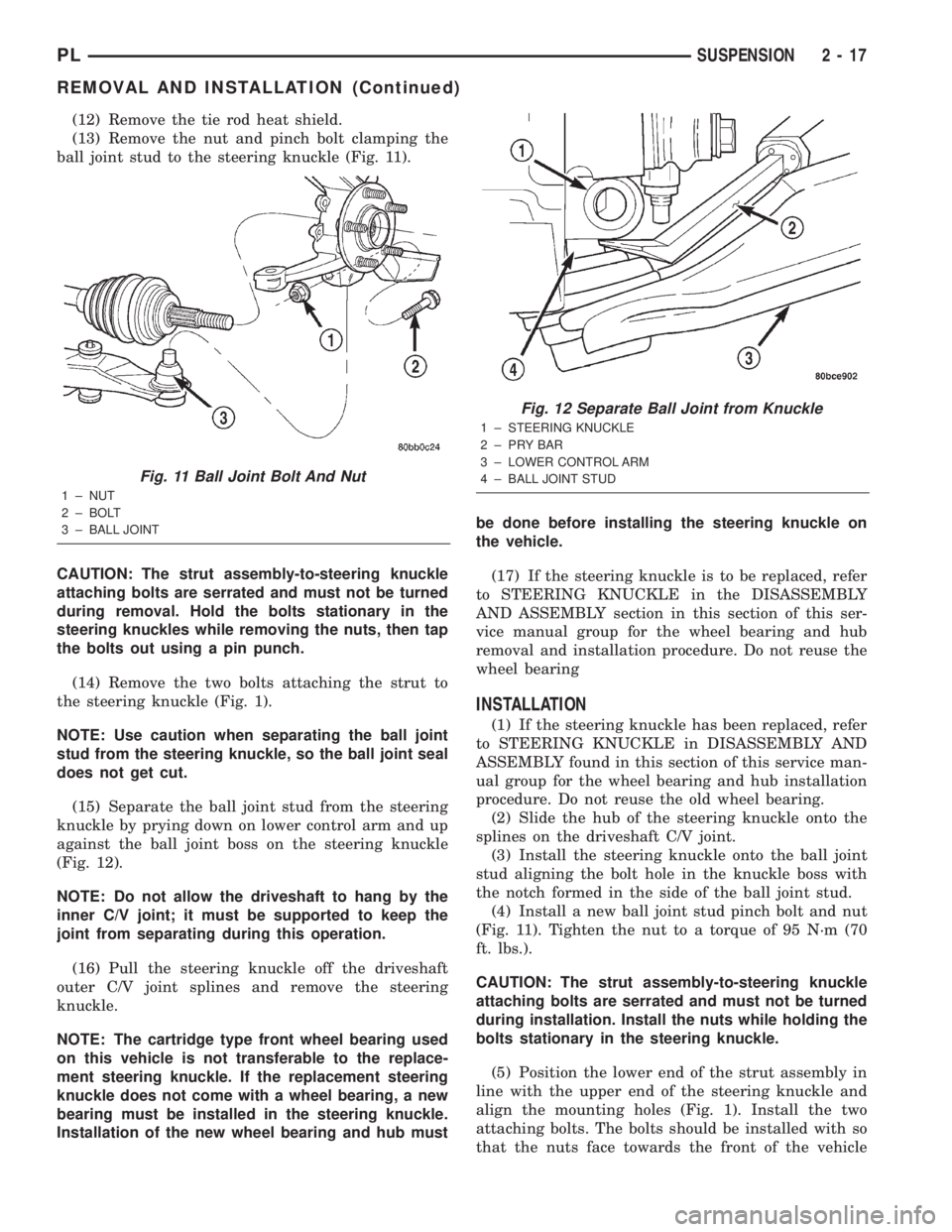
(12) Remove the tie rod heat shield.
(13) Remove the nut and pinch bolt clamping the
ball joint stud to the steering knuckle (Fig. 11).
CAUTION: The strut assembly-to-steering knuckle
attaching bolts are serrated and must not be turned
during removal. Hold the bolts stationary in the
steering knuckles while removing the nuts, then tap
the bolts out using a pin punch.
(14) Remove the two bolts attaching the strut to
the steering knuckle (Fig. 1).
NOTE: Use caution when separating the ball joint
stud from the steering knuckle, so the ball joint seal
does not get cut.
(15) Separate the ball joint stud from the steering
knuckle by prying down on lower control arm and up
against the ball joint boss on the steering knuckle
(Fig. 12).
NOTE: Do not allow the driveshaft to hang by the
inner C/V joint; it must be supported to keep the
joint from separating during this operation.
(16) Pull the steering knuckle off the driveshaft
outer C/V joint splines and remove the steering
knuckle.
NOTE: The cartridge type front wheel bearing used
on this vehicle is not transferable to the replace-
ment steering knuckle. If the replacement steering
knuckle does not come with a wheel bearing, a new
bearing must be installed in the steering knuckle.
Installation of the new wheel bearing and hub mustbe done before installing the steering knuckle on
the vehicle.
(17) If the steering knuckle is to be replaced, refer
to STEERING KNUCKLE in the DISASSEMBLY
AND ASSEMBLY section in this section of this ser-
vice manual group for the wheel bearing and hub
removal and installation procedure. Do not reuse the
wheel bearing
INSTALLATION
(1) If the steering knuckle has been replaced, refer
to STEERING KNUCKLE in DISASSEMBLY AND
ASSEMBLY found in this section of this service man-
ual group for the wheel bearing and hub installation
procedure. Do not reuse the old wheel bearing.
(2) Slide the hub of the steering knuckle onto the
splines on the driveshaft C/V joint.
(3) Install the steering knuckle onto the ball joint
stud aligning the bolt hole in the knuckle boss with
the notch formed in the side of the ball joint stud.
(4) Install a new ball joint stud pinch bolt and nut
(Fig. 11). Tighten the nut to a torque of 95 N´m (70
ft. lbs.).
CAUTION: The strut assembly-to-steering knuckle
attaching bolts are serrated and must not be turned
during installation. Install the nuts while holding the
bolts stationary in the steering knuckle.
(5) Position the lower end of the strut assembly in
line with the upper end of the steering knuckle and
align the mounting holes (Fig. 1). Install the two
attaching bolts. The bolts should be installed with so
that the nuts face towards the front of the vehicle
Fig. 11 Ball Joint Bolt And Nut
1 ± NUT
2 ± BOLT
3 ± BALL JOINT
Fig. 12 Separate Ball Joint from Knuckle
1 ± STEERING KNUCKLE
2±PRYBAR
3 ± LOWER CONTROL ARM
4 ± BALL JOINT STUD
PLSUSPENSION 2 - 17
REMOVAL AND INSTALLATION (Continued)
Page 31 of 1285
with the notch formed in the side of the ball joint
stud.
(4) If the right lower control arm has been ser-
viced, install the engine torque strut (Fig. 16). Follow
the procedure described in the ENGINE service man-
ual group to properly align and tighten the torque
strut.
(5) Install a new ball joint stud pinch bolt and nut
(Fig. 15). Tighten the nut to a torque of 95 N´m (70
ft. lbs.).
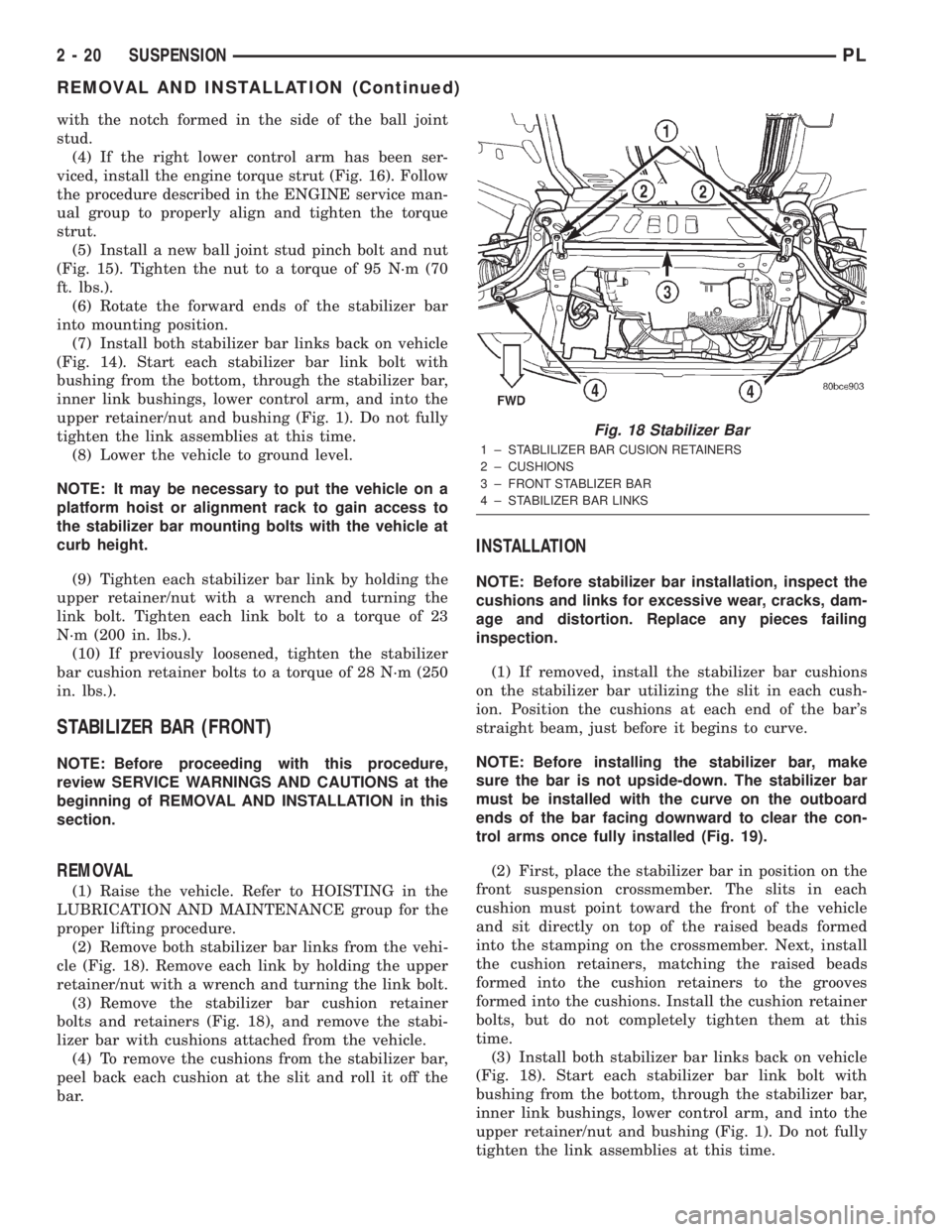
(6) Rotate the forward ends of the stabilizer bar
into mounting position.
(7) Install both stabilizer bar links back on vehicle
(Fig. 14). Start each stabilizer bar link bolt with
bushing from the bottom, through the stabilizer bar,
inner link bushings, lower control arm, and into the
upper retainer/nut and bushing (Fig. 1). Do not fully
tighten the link assemblies at this time.
(8) Lower the vehicle to ground level.
NOTE: It may be necessary to put the vehicle on a
platform hoist or alignment rack to gain access to
the stabilizer bar mounting bolts with the vehicle at
curb height.
(9) Tighten each stabilizer bar link by holding the
upper retainer/nut with a wrench and turning the
link bolt. Tighten each link bolt to a torque of 23
N´m (200 in. lbs.).
(10) If previously loosened, tighten the stabilizer
bar cushion retainer bolts to a torque of 28 N´m (250
in. lbs.).
STABILIZER BAR (FRONT)
NOTE: Before proceeding with this procedure,
review SERVICE WARNINGS AND CAUTIONS at the
beginning of REMOVAL AND INSTALLATION in this
section.
REMOVAL
(1) Raise the vehicle. Refer to HOISTING in the
LUBRICATION AND MAINTENANCE group for the
proper lifting procedure.
(2) Remove both stabilizer bar links from the vehi-
cle (Fig. 18). Remove each link by holding the upper
retainer/nut with a wrench and turning the link bolt.
(3) Remove the stabilizer bar cushion retainer
bolts and retainers (Fig. 18), and remove the stabi-
lizer bar with cushions attached from the vehicle.
(4) To remove the cushions from the stabilizer bar,
peel back each cushion at the slit and roll it off the
bar.
INSTALLATION
NOTE: Before stabilizer bar installation, inspect the
cushions and links for excessive wear, cracks, dam-
age and distortion. Replace any pieces failing
inspection.
(1) If removed, install the stabilizer bar cushions
on the stabilizer bar utilizing the slit in each cush-
ion. Position the cushions at each end of the bar's
straight beam, just before it begins to curve.
NOTE: Before installing the stabilizer bar, make
sure the bar is not upside-down. The stabilizer bar
must be installed with the curve on the outboard
ends of the bar facing downward to clear the con-
trol arms once fully installed (Fig. 19).
(2) First, place the stabilizer bar in position on the
front suspension crossmember. The slits in each
cushion must point toward the front of the vehicle
and sit directly on top of the raised beads formed
into the stamping on the crossmember. Next, install
the cushion retainers, matching the raised beads
formed into the cushion retainers to the grooves
formed into the cushions. Install the cushion retainer
bolts, but do not completely tighten them at this
time.
(3) Install both stabilizer bar links back on vehicle
(Fig. 18). Start each stabilizer bar link bolt with
bushing from the bottom, through the stabilizer bar,
inner link bushings, lower control arm, and into the
upper retainer/nut and bushing (Fig. 1). Do not fully
tighten the link assemblies at this time.
Fig. 18 Stabilizer Bar
1 ± STABLILIZER BAR CUSION RETAINERS
2 ± CUSHIONS
3 ± FRONT STABLIZER BAR
4 ± STABILIZER BAR LINKS
2 - 20 SUSPENSIONPL
REMOVAL AND INSTALLATION (Continued)
Page 35 of 1285
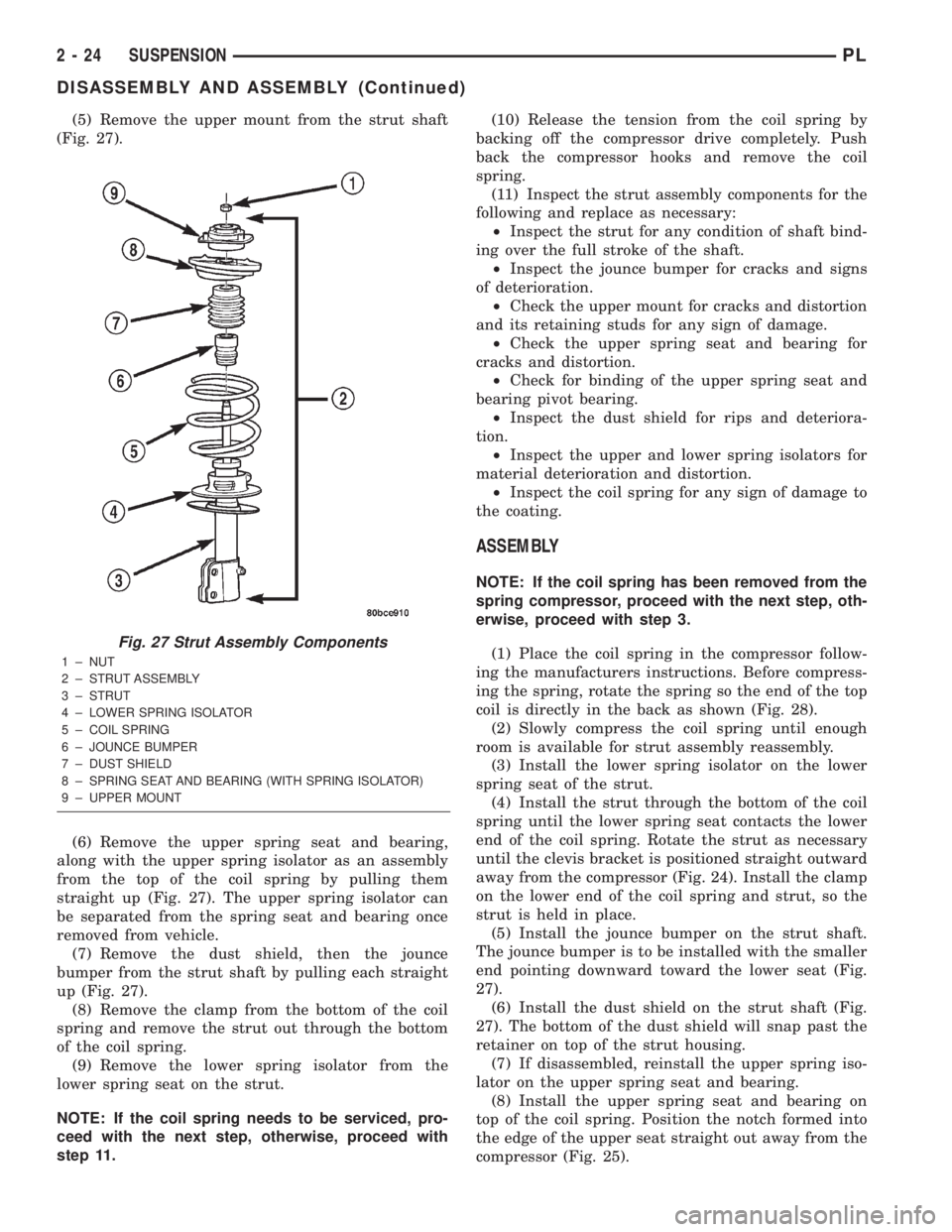
(5) Remove the upper mount from the strut shaft
(Fig. 27).
(6) Remove the upper spring seat and bearing,
along with the upper spring isolator as an assembly
from the top of the coil spring by pulling them
straight up (Fig. 27). The upper spring isolator can
be separated from the spring seat and bearing once
removed from vehicle.
(7) Remove the dust shield, then the jounce
bumper from the strut shaft by pulling each straight
up (Fig. 27).
(8) Remove the clamp from the bottom of the coil
spring and remove the strut out through the bottom
of the coil spring.
(9) Remove the lower spring isolator from the
lower spring seat on the strut.
NOTE: If the coil spring needs to be serviced, pro-
ceed with the next step, otherwise, proceed with
step 11.(10) Release the tension from the coil spring by
backing off the compressor drive completely. Push
back the compressor hooks and remove the coil
spring.
(11) Inspect the strut assembly components for the
following and replace as necessary:
²Inspect the strut for any condition of shaft bind-
ing over the full stroke of the shaft.
²Inspect the jounce bumper for cracks and signs
of deterioration.
²Check the upper mount for cracks and distortion
and its retaining studs for any sign of damage.
²Check the upper spring seat and bearing for
cracks and distortion.
²Check for binding of the upper spring seat and
bearing pivot bearing.
²Inspect the dust shield for rips and deteriora-
tion.
²Inspect the upper and lower spring isolators for
material deterioration and distortion.
²Inspect the coil spring for any sign of damage to
the coating.
ASSEMBLY
NOTE: If the coil spring has been removed from the
spring compressor, proceed with the next step, oth-
erwise, proceed with step 3.
(1) Place the coil spring in the compressor follow-
ing the manufacturers instructions. Before compress-
ing the spring, rotate the spring so the end of the top
coil is directly in the back as shown (Fig. 28).
(2) Slowly compress the coil spring until enough
room is available for strut assembly reassembly.
(3) Install the lower spring isolator on the lower
spring seat of the strut.
(4) Install the strut through the bottom of the coil
spring until the lower spring seat contacts the lower
end of the coil spring. Rotate the strut as necessary
until the clevis bracket is positioned straight outward
away from the compressor (Fig. 24). Install the clamp
on the lower end of the coil spring and strut, so the
strut is held in place.
(5) Install the jounce bumper on the strut shaft.
The jounce bumper is to be installed with the smaller
end pointing downward toward the lower seat (Fig.
27).
(6) Install the dust shield on the strut shaft (Fig.
27). The bottom of the dust shield will snap past the
retainer on top of the strut housing.
(7) If disassembled, reinstall the upper spring iso-
lator on the upper spring seat and bearing.
(8) Install the upper spring seat and bearing on
top of the coil spring. Position the notch formed into
the edge of the upper seat straight out away from the
compressor (Fig. 25).
Fig. 27 Strut Assembly Components
1 ± NUT
2 ± STRUT ASSEMBLY
3 ± STRUT
4 ± LOWER SPRING ISOLATOR
5 ± COIL SPRING
6 ± JOUNCE BUMPER
7 ± DUST SHIELD
8 ± SPRING SEAT AND BEARING (WITH SPRING ISOLATOR)
9 ± UPPER MOUNT
2 - 24 SUSPENSIONPL
DISASSEMBLY AND ASSEMBLY (Continued)
Page 39 of 1285
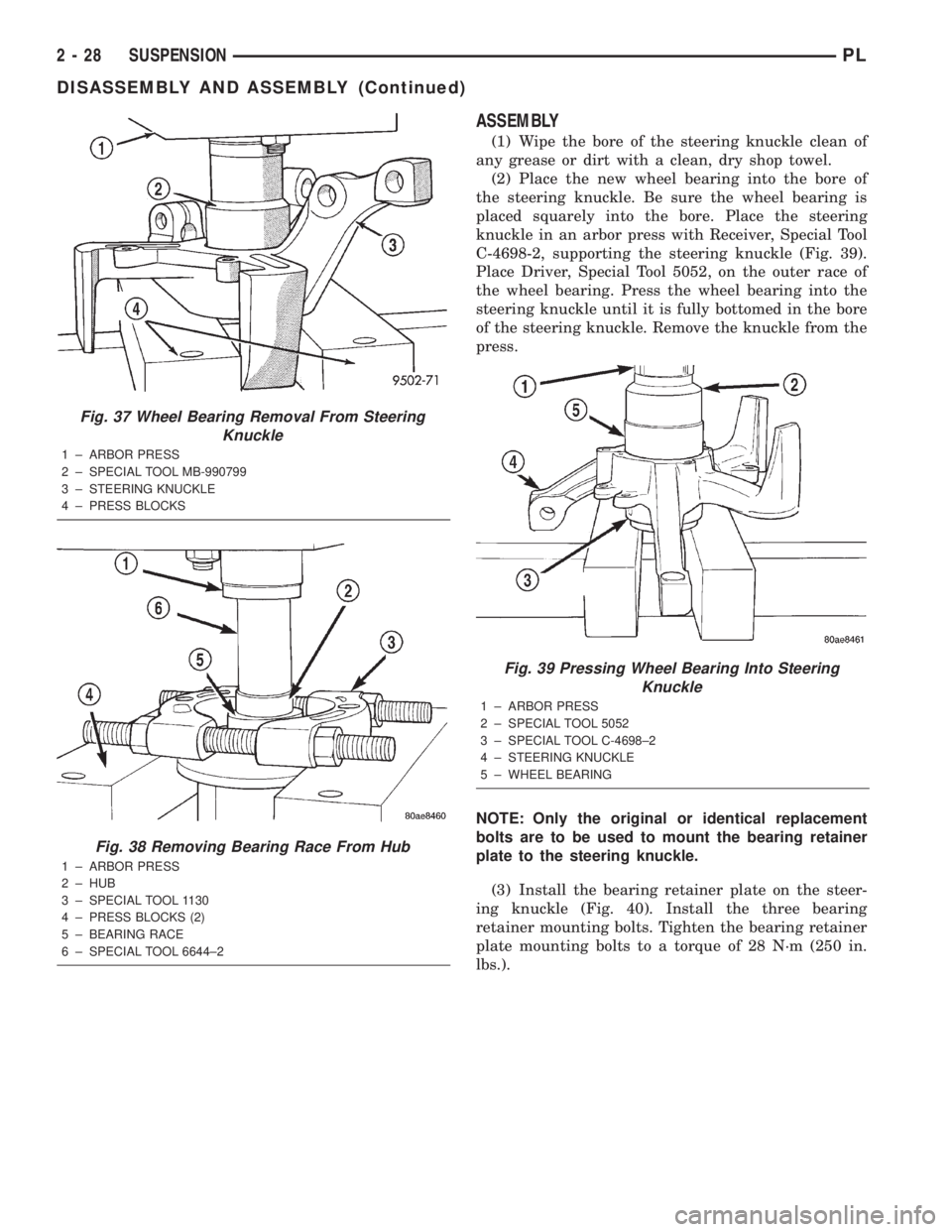
ASSEMBLY
(1) Wipe the bore of the steering knuckle clean of
any grease or dirt with a clean, dry shop towel.
(2) Place the new wheel bearing into the bore of
the steering knuckle. Be sure the wheel bearing is
placed squarely into the bore. Place the steering
knuckle in an arbor press with Receiver, Special Tool
C-4698-2, supporting the steering knuckle (Fig. 39).
Place Driver, Special Tool 5052, on the outer race of
the wheel bearing. Press the wheel bearing into the
steering knuckle until it is fully bottomed in the bore
of the steering knuckle. Remove the knuckle from the
press.
NOTE: Only the original or identical replacement
bolts are to be used to mount the bearing retainer
plate to the steering knuckle.
(3) Install the bearing retainer plate on the steer-
ing knuckle (Fig. 40). Install the three bearing
retainer mounting bolts. Tighten the bearing retainer
plate mounting bolts to a torque of 28 N´m (250 in.
lbs.).
Fig. 37 Wheel Bearing Removal From Steering
Knuckle
1 ± ARBOR PRESS
2 ± SPECIAL TOOL MB-990799
3 ± STEERING KNUCKLE
4 ± PRESS BLOCKS
Fig. 38 Removing Bearing Race From Hub
1 ± ARBOR PRESS
2 ± HUB
3 ± SPECIAL TOOL 1130
4 ± PRESS BLOCKS (2)
5 ± BEARING RACE
6 ± SPECIAL TOOL 6644±2
Fig. 39 Pressing Wheel Bearing Into Steering
Knuckle
1 ± ARBOR PRESS
2 ± SPECIAL TOOL 5052
3 ± SPECIAL TOOL C-4698±2
4 ± STEERING KNUCKLE
5 ± WHEEL BEARING
2 - 28 SUSPENSIONPL
DISASSEMBLY AND ASSEMBLY (Continued)
Page 44 of 1285
SPECIFICATIONS
FRONT SUSPENSION FASTENER TORQUE
SPECIFICATIONS
DESCRIPTION TORQUE
STRUT ASSEMBLY:
Tower Nuts............. 34N´m(300 in. lbs.)
Steering Knuckle Nuts.............. 54N´m
(40 ft. lbs.) + 90É Turn
Strut Shaft Nut........... 75N´m(55ft.lbs.)
STEERING KNUCKLE:
Ball Joint Stud Pinch Bolt Nut........ 95N´m
(70 ft. lbs.)
Disc Brake Caliper Guide Bolts........ 22N´m
(192 in. lbs.)
WHEEL BEARING AND HUB:
Bearing Retainer Plate Bolts.......... 28N´m
(250 in. lbs.)
Driveshaft Hub Nut...... 244N´m(180 ft. lbs.)
Wheel Mounting Nuts...........109-150 N´m
(80-110 ft. lbs.)
STEERING GEAR:
Crossmember Bolts........ 68N´m(50ft.lbs.)
Tie Rod Adjusting Jam Nut . . 75 N´m (55 ft. lbs.)
Tie Rod End Steering Knuckle Nut..... 54N´m
(40 ft. lbs.)
LOWER CONTROL ARM:
Front Pivot Bolt......... 163N´m(120 ft. lbs.)
Rear Pivot Bolt......... 203N´m(150 ft. lbs.)
STABILIZER BAR:
Cushion Retainer Bolts.... 28N´m(250 in. lbs.)
Link Nut............... 23N´m(200 in. lbs.)
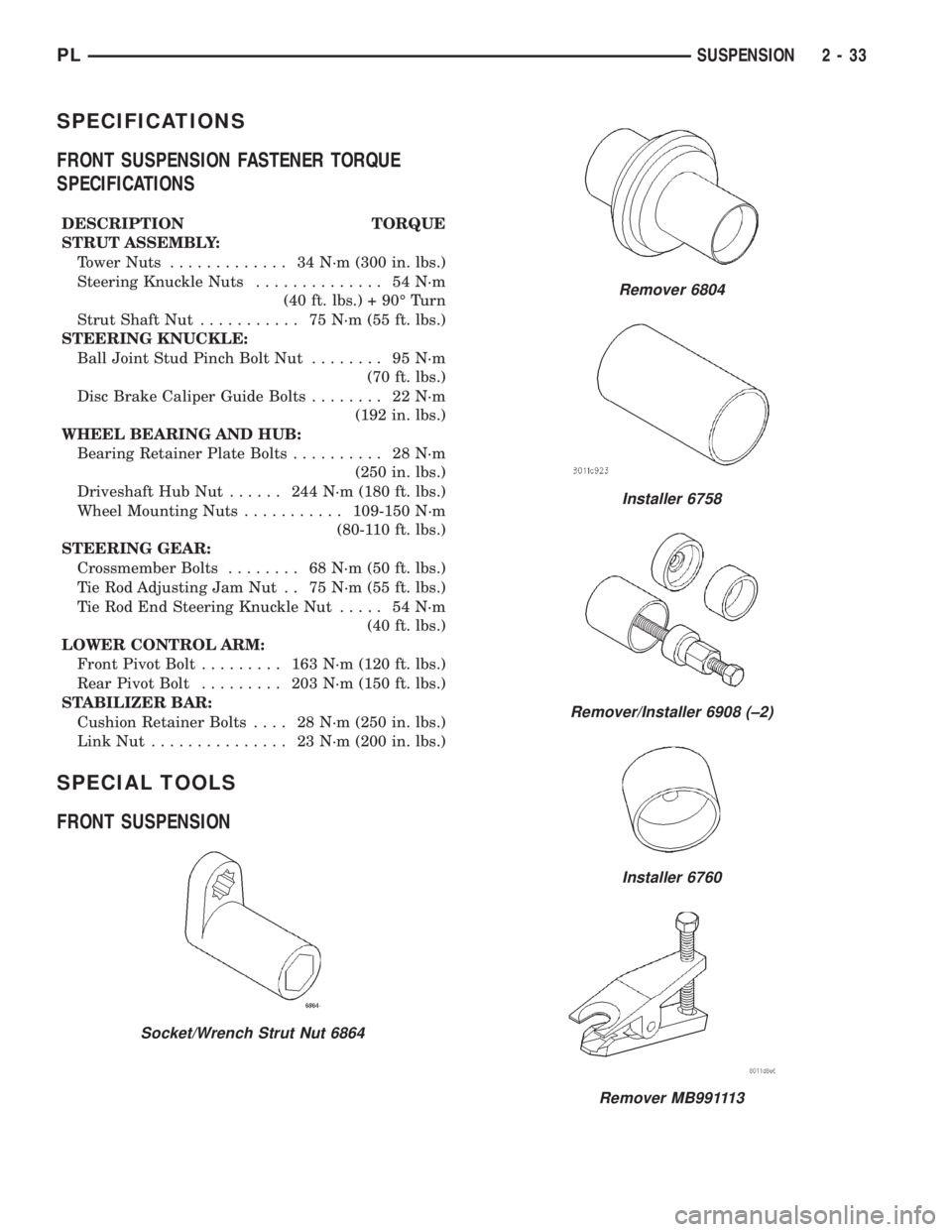
SPECIAL TOOLS
FRONT SUSPENSION
Socket/Wrench Strut Nut 6864
Remover 6804
Installer 6758
Remover/Installer 6908 (±2)
Installer 6760
Remover MB991113
PLSUSPENSION 2 - 33