2000 AUDI ALLROAD ESP
[x] Cancel search: ESPPage 206 of 306
Electronic
Stability Program (ESP)
The Electronic Stability Program helps to
control the vehicle in critical maneuvers like
curves.
When the vehicle starts up and accelerates,
the wheels are prevented from spinning by
adjusting the engine power to conform to all
road conditions. This improves vehicle sta
bil ity.
The system operates across the entire
speed range in combination with the ABS
syst em. If the Anti-Lock Brake System
(ABS) malfunctions, the ESP will also shut
down.
When you turn on the engine, the ESP will
automatically be activated and will perform
a self-test. The
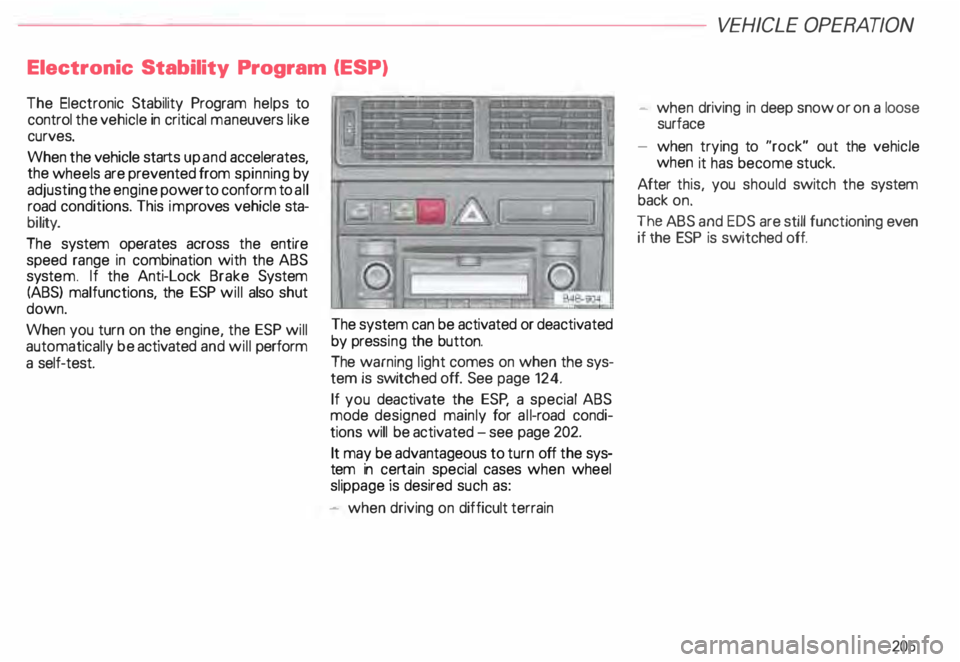
system can be activated or deactivated
by press ing the button.
The warning light comes on when the sys
tem is switch ed off. See page 124.
If you deactivate the ESP, a special ABS
mode designed mainly for all-road condi
tions will be activated - see page 202.
It may be advantageous to turn off the sys
tem in certain special cases when wheel
slippage is desired such as:
- when driving on difficult terrain VE
HICL E OPER ATION
- when driving in deep snow or on a loose
surface
- when trying to "rock" out the vehicle
when it has become stuck.
After this, you should switch the system
back on.
The ABS and EDS are still functioning even
if the ESP is switched off.
205
Page 207 of 306

VEHICLE
OPER ATION----------------------
Operation
The Anti-Lock Brake System (ABS) and the
Electronic Differential Lock (EDU are inte
grat _ed in the Electronic Stability Progr am. In
a _ddrtron to the data provided by these func
tions, the ESP control unit requires addition
al measurement data provided by hig h-per
forman ?e sensors. The rotat ional speed of
the veh1cle about its vertical axis, vehicle lat
eral acceleration, brake pressure and the
steering angle are measured.
The direction in which the driverwishes to
travel is determined with the aid of the
stee �ing angle and the vehicle speed and is
contmually compared with the actual be
havior of the vehicle.
If the data do not match - for example when
a vehrcle is beginning to spin out of control
- the ESP applies the brakes to the appropri
ate wheels for the given situation and, if
necessar y, changes the vehicle traction
forces so as to reduce the slipping of individ
ual wheels (ASR anti-slip regulation).
206 The
vehicle is then stabilized by the forces
a ?tin � on the wheel during braking. If the ve
hicle IS overstee ring (rear tends to skid out
of the turn), the brakes are mainly applied on
the wheel that is on the outside ofthe curve.
In the case of a vehicle that is und ersteering
(tendency to slide out of the curve). the
brakes are applied at the rear wheel that is
on the inside of the curve. An audible signal
�rll accompany the brake application func
tion.
All �SP senso rs a�e monitored continuously
wh1le the vehicle IS being driven. However,
when the vehicle is driven at low speed on
ex tremely rugged terrain, it is not always
possrble to monrtor the ESP sensors contin
uously. Thus, in rare and exceptional cases
the ESP itself can deactivate (ESP and ABS
ind icator lights will be lit continuously).
In this case. the ride level adjustment sys
tem lowers the vehicle to the normal level
If this happens, you may need to select th�
ride level again (see page 153).
Operation of the ESP and ABS is restored
whenever you restart the engine. m
WAR NING
! he Electronic Stability Program
•• nevertheless subject to the laws
of physics. It is particularly impor
tant to pay attention to this fact on
wet and slippery roads.
It is therefore important that you
always adapt your driving to the
condition of the road and traffic
conditions. Do not allow the in
creased safety provided by the
Electro nic Stability Program sys
tem to lull you into accepting addi
tional safety risks.
Page 211 of 306
VEHICLE OPER
ATION-----------------------
Driving Instructions
To obtain the best possible handling of ve
hicle and trailer , please note the following:
• A "balanced" rig is easier to operate and
control. This means that the tow vehicle
should be loaded to the extent possible and
permissible while keeping the trailer as light
as possible under the circumstances.
Whenever possible, transfer some cargo to
the luggage compartment of the tow ve
hicle while observing tongue load require
ments and vehicle loading considerations.
• The higher the speed, the more difficult
it becomes for the driver to control the rig.
Do not drive at the maximum per
missible speed. Reduce your speed even
more under unfavorable load, weather or
wind conditions - particularly when going
dow nhill.
210 Be
especially careful when passing other
vehicles.
Reduce vehicle speed immediately if the
trailer shows the slightest sign of swaying.
Do not try to stop the sway ing by accel erat
ing.
Observe speed limits. In some areas
speeds for vehicles towing trailers are low
er than for regular vehicles.
• Always apply brakes early.
When driving downhill, shift into lower gear
to use the engine braking effect to slow
down the vehicle. Use of the brakes alone
can cause them to overheat and fail. •
The coolant temperatura gauge
must be observed carefully. H the
needle nears the upper end of the
scale, reduce speed immediately
and/or switch off the air condi
tioner.
If the coolant temperature warning
light in the instrument cluster starts
flashing in red, pull off the road,
stop and let the engine idle for about
2 minutes to prevent a heat build-up.
Page 215 of 306

VEHICL E CA
RE----------------------------------------------------
Notes
• Do not wash the vehicle in direct sun
light.
• If the vehicle is rinsed with a hose, do not
direct the water into the lock cylinders -
otherwise they may freeze up in the winter.
�W ARNING
• Do not wash, wax or dry the ve
hicle with the engine running.
• Do not clean the underside of
chassis, fenders, wheel covers,
etc. without protecting your
hands and arms. You may cut your
self on sharp-edged metal parts.
• Moisture and ice on brakes may
affect braking efficiency. Test the
brakes carefully after each vehicle
wash.
214 Washing
your vehicle with a power
washer
If you use a power washer, please note the
following:
• Always follow the operating instructions
for the power washer -especially for pres
sure and spraying distance.
• Make sure that the jet on the spray hose
produces a "fan shape" spray. Do not use
a jet which sprays the water out in a direct
stream or one that has a rota ting jet.
• Water temperature should not exceed
140 °F (60 °C).
�W ARNING
Never wash tires with a jet that
sprays the water out in a direct
stream. This could invisibly dam
age and weaken the tires, even if
they are sprayed from a relatively
long distance for a vary short
amount of time. Damaged and
weakened tires can fail and cause
accidents and personal injury. Headli
ghts
Do not clean your headlights with a dry
towel or sponge. They must be cleaned
with a moistened towel.
Never use a sponge designed for removing
dried-on insects, a kitchen scrubber or any
other similar product since the lens surface
can be damaged by scrat ching and scour
ing.
When using high-pressure washing equip
ment or steam-cl eaning units, never spray
the vehicle with the nozzle close the vehicle
surface and never aim the spray at the same
point for a relatively long period of time.
Polishing Please refer to the imp ortant information on
page 212.
Polish your vehicle only if the paint has lost
its shine and the gloss cannot be brought
back with wax. If the polish used doesn't
contain preservative compounds, the paint
must be waxed afterwards.
Do not treat matte- pain�ed and plas
tic parts with polish or wax.
Page 219 of 306
VE
HICL E CA
RE-------------------------
Dust and small particles of dirt lodging in the
pores, grain and seams can have an abra
sive effect and damage the surface and the
seams. If the vehicle is left standing for a
long time in the sun, cover the upholstery or
use the sun blinds to protect the leather
from direct sunlight and prevent fading or
discoloration.
Depending on the amount of use, clean it
occasionally according to the following
instructions. Never use solvents, wax
polish, shoe cream, spot removers
or similar materials.
For normal cleaning of leather -covered
steering wheels, leather seat upholstery,
etc., slightly moisten a cotton or woollen
cloth with water and wipe over the areas af
fected.
218 More
stubborn dirt can be removed using a
mild soap solution (pure liquid soap: two
tablespoons dissolved in 1 quart of water).
It is very important not to let the wa
ter soak through the leather or pene
trate into the seams. Then wipe off with
a soft, dry cloth.
In addition to this regular cleaning, it is
worth while treating the leather with a suit
able leather -care product. This should be
done about twice a year for uphol stery in
normal use. Apply these products very spar
ingly and follow the manufacturer's direc
tions.
Safety belts
Keep belts clean! Dirty belts may
not retract properly.
For cleaning, use a mild soap and water
solution. Let belts dry thoroughly and away
from direct sunlight.
Do not allow inertia reel safety belts to re
tract before they are completely dry. �W
ARNING
• Any thing that might damage
your safety balta could mean that
you and your passengers would
not be adequately protected in an
accident.
• Do not use chemical cleaning
agents, bleach or dyes. They have
corrosive properties which weak
en the webbing.
• When cleaning your safety
belts, inspect them for damage. If
you discover damage. see your
Audi Dealer.
• Safety belt performance de
pends on correct installation.
Never remove belts from the ve
hicle to clean them.
Page 227 of 306
VEHICLE
CARE-------------------------
Use of gasoline containing alcohol
or MTBE (methyl tertiary butyl
ether)
You may use unleaded gasoline blended
with alcohol or MTBE (commonly referred
to as oxygenates) if the blended mixture
meets the following criteria:
Blend of gasoline methanol (wood
alcohol or methyl alcohol)
Anti-knock index must be 87 AKI or
hig her.
Blend must contain no more than 3%
methanol.
- Blend must contain more than 2% CO
solvents.
226 Note
Methanol
fuels which do not meet
these requirements may cause cor
rosion and damage to plastic and
rubber components in the fuel sys-
tem. ·
Blend of gasoline and ethanol (grain
alcohol or ethyl alcohol)
Ant i-knock , index must be 87 AKI or
high er.
Blend must not contain more than 1 0%
ethanol.
Blend of gasoline and MTBE
- Anti-knock index must be 87 AKI or
hig her.
Blend must contain not more than 15%
MTBE. Notes
• Do not use fuels that fail to meet
the specified criteria in this chapter.
• If you are unable to dete rmine
whether or not a particular fuel
blend meets the specifications, ask
your service station or its fuel sup
plier.
• Do not use fuel for which the con
tents cannot be identified.
• Fuel system damage and perfor
mance problems resulting from the
use of fuels different from those
specified are not the responsibility
of Audi and are not covered under
the New Vehicle or the Emission
Control System Warranties.
• If you experience a loss of fuel
economy or drivea bility and perfor
mance problems due to the use of
one of these fuel blends, we recom
mend that you switch to unblended
fuel.
Page 250 of 306

-------------------------VEHICLE
CARE
Spark plugs
Spark plugs are replaced during the Audi
scheduled Maintenance Service.
If you have to replace the spark plugs be
tween the Audi Maintenance services, be
sure to note the following:
• Engine, spark plugs and the ignition sys
tem are matched to each other. To avoid
faulty operation or engine damage, use only
Original Audi spark plugs. It is especially im
portant to note the number of electrodes on
the spark plug and the heat value.
• Since spark plug specifications may
change for technical reasons during a model
year, we recommend that you obtain your
spark plugs from an authorized Audi Dealer,
who has the latest information.
Always heed all WARNINGS
on page 232. Belts
Ribbed V-Belt
The radiator fan, hydraulic pump (power
steering), alternator and air conditioner
compressor are driven by one V-belt.
The installed V-belt conforms to the highest
quality requirements. The V-belt adjusts its
own tension.
Replacing of the V-belt should be
performed by your authorized Audi
Dealer or a qualified workshop.
When replacing a belt, it is not sufficient to
use just any belt of the same size. For safe
and reliable operation, use only Genuine
Audi V-belts specially designed for your ve
hicle. The correct belts can be obta ined at
your authorized Audi Dealer. �W
ARNING
To prevent serious personal inju
ries stay well clear of the V-belt,
The radiator fan and the V-belt
driven accessories when the en
gine is running. The V-belt will be
inspected and replaced by your au
thorized Audi Dealer during a
scheduled Maintenance Service.
Timing belt
• Yo ur engine is equipped with a long last
ing toothed belt. The belt will be in
spected and replaced during a scheduled
Maintenance Service.
Always heed all WA RNINGS
on page 232.
249
Page 267 of 306

DO-IT-YOURSELF
SERVICE----------------------
Spare wheel
Yo ur vehicle is equip ped with a spare wheel
(deflated full size spare tire) and an accom
panying compressor.
The deflated full size spare tire and com
pressor are located beneath the floor of the
luggage compartment. The spare wheel is
held down by a knurled bolt.
On vehicle' s equipped with a childr en's
bench seat, the seat must be folded back to
allow the spare wheel to be removed -see
page 94.
"Changine a wheel" and "Inflating the de
flated full size spare tire" -see page 267.
266 The
following points must be ob
served when the deflated full size
spare tire is used:
• The deflated full size spare tire is
only designed for brief, temporary
use. Therefore, replace it with a nor
mal wheel as soon as poss ible.
• Never drive at speeds over 50 mph
(80 km/h). Avoid jackrabbit starts, hard bra
king and aggressive turns!
• Do not take the vehicle to automatic car
washes when the deflated full size spare
tire is installed.
• The deflated full size spare tire was de
veloped especially for your vehicle model. It
must not be used on other models. Simi
larly, do not use spare wheels from other ve
hicle models on your car. •
For engineering reasons, snow chains
must not be used on the deflated full size
spare tire.
If the vehicle must be driven with snow
chains, and one of its rear tires is flat, you
will first need to install the collapsible rear ti
re on the front axle. This is because for engi
neering reaons snow chains can only be in
stalled on special winter tires*1) and only
on rear wheels.
After you've installed the spare tire on the
front axle, install the snow chain on the
wheel you've removed from the front axle.
and then install this wheel on the rear axle
in place of the wheel whose tire is flat. As
soon as possible, correct the tire pressure
to the proper setting.
• Never install normal or winter tires on the
deflated full size spare tire rim.
• Never drive the vehicle with more than
one deflated full size spare tire installed.
11 Not available at the time of printing.