2000 AUDI ALLROAD power
[x] Cancel search: powerPage 124 of 306
---------------------CONTROLS AND
EQUIPMENT
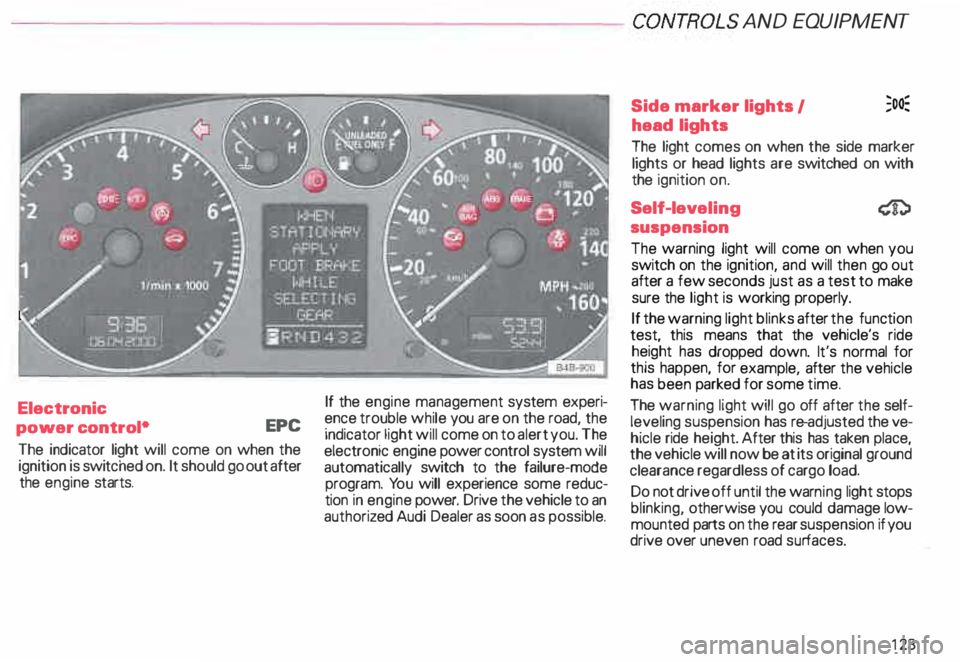
Electronic
power control• EPC
The indicator light will come on when the
ignition is switc hed on. It should go out after
the engine starts. If
the engine management system experi
ence trouble while you are on the road, the
indicator light will come on to alert you. The
electronic engine power control system will
automatically switch to the failure-mode
program. You will experience some reduc
tion in engine power. Drive the vehicle to an
authoriz ed Audi Dealer as soon as possible. Side
marker lights I ;o�
head lights
The light comes on when the side marker
lights or head lights are switched on with
the ignition on.
Self-lev eling
suspension
The warning light will come on when you
switch on the ignition, and will then go out
after a few seconds just as a test to make
sure the light is working properly.
If the warning light blinks after the function
test, this means that the vehicle's ride
height has dropped down. It's normal for
this happen, for example, after the vehicle
has been parked for some time.
The warning light will go off after the self
leveling suspension has re-adjusted the ve
hicle ride height. After this has taken place,
the vehicle will now be at its original ground
clearance regardless of cargo load.
Do not drive off until the warn ing light stops
blinking, otherwise you could damage low
mounted parts on the rear suspension if you
drive over uneven road surfaces.
123
Page 128 of 306
f4
WARNING continued
• If the brake warning light does
not go out with the engine running
and the parking brake released, or
lights up while you ere driving, the
fluid level in the brake fluid reser
voir is too low.
• If you believe that it Is safe to do
so, proceed immediately at low
speed to the nearest authorized
Audi Dealer or qualified workshop
and have the brake system in
spected.
• Please be very careful and be
sure to remember that after sev
eral brake applications, you will
need greater pressure on the brake
pedal to stop your vehicle. Conse
quently, you must allow for in
creased braking distances. Trying
to brake as quickly as usual could
lead to an accident.
For details see "Brakes.. on page
201. Generator
This
light comes on when the ignition is
turned on and goes out after the engine is
started. If the light does not go out after
star ting and rewing up the engine momen
tarily or lights up while driving, there may be
a malfunc tion in the electrical system, or the
V- belt driving the gener ator may be broken. A If the warning light comes on
V while driving, stop the vehicle
and turn oft the engine. Inspect the
belts.
If the V-belt is not torn, you can still continue
driving to the nearestAudi Dealer. However,
since the battery is no longer being charged,
switch off all unne cessary electrical equip
ment.
If the V- belt is tom, the power steering and
the radiator fan will also not work.
Obtain expert assistance.
g Always heed all WA RNINGS
r!!l on page 232, chapter "En
gine compartment '". CONT
ROLS AND EQ UIPMENT
Safety belts
Yo ur vehicle has a warning light to remind
you to wear your safety belt and to make
sure that others do too.
After switching on the ignition, the warning
light in the instrument cluster will come on
for about 6 seconds along with a war ning
tone. As soon as you fasten your safety belt,
the warning tone will stop.
The warning light, however, will be on for
the entire 6 seconds.
Fasten your safety belt now and ma
ke sure that your passengers also
properly put on their safety belts.
Please be sure to read the chapter
"Safety belts" page 14.
127
Page 129 of 306
CONT
ROLS AND EQ
UIPMEN T---------------------
On Board Diagnostic system
The Malfunction Indicator Lamp (MIL)-see
page 125- is part of the On Board Diagnos
tic system (OBD).
The lamp comes on when the ignition is
swi tched on and will go out after the engine
is started and the idle has stabilized. This is
to assure you that the Malfunction Indicator
Lamp is working properly.
If the lamp does not go out after the engine
is started, or if it comes on while you're
driving, there is a malfunction in the engine
system. If the lamp starts blinking, the cata
lytic converter could be damaged.
Continue driving with reduced power
and have the cause corrected right away by
an authorized Audi Dealer or a qualified
workshop.
12 8 If the lamp comes
on, the Electr onic speed
li miter can also be out of operation. See
next page.
The On Board Diagnostics in your vehicle
monitors the various components of your
emission control system. Each controlled
component in your engine system has been
coded. In case of a malfunction the respec
tive component in question will be identi
fied and the fault stored in the form of a
code in the control module's memory.
On Board Diagnostic
System (OBD)
The stored data can only be displayed with
special testing equipment (generic scan
tool for OBDl to assure an accurate diagno
sis.
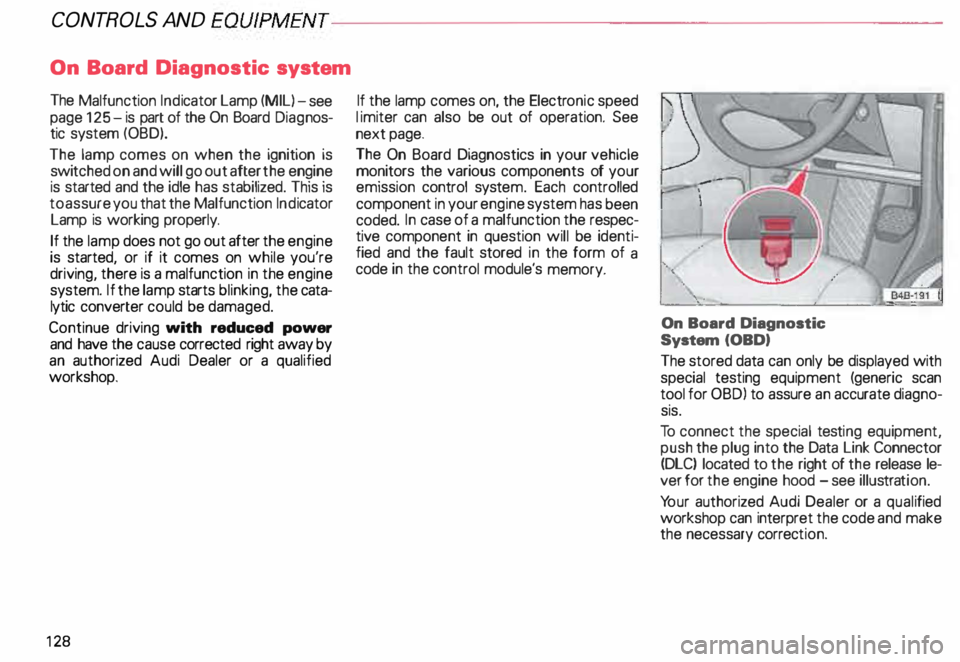
To connect the special testing equipment,
push the plug into the Data Link Connector
(DLC) located to the right of the release le
ver for the engine hood -see illus tration.
Yo ur authorized Audi Dealer or a quali fied
workshop can interpret the code and make
the necessary correction.
Page 130 of 306

Electronic
speed limiter
Yo ur Audi may be factory equipped with
tires which are rated for a maximum speed
of 130 mph (21 0 km/h). This is less than the
maximum speed of your vehicle. To reduce
the risk of sudden tire failure and loss of
control should the vehicle be operated at ex
cessive speeds, your Audi also has an elec
tronic speed limiterwhi ch prevents your ve
hicle from going faster than the tire speed
rating. See page 257.
If the vehicle approaches the tire speed rat
ing, the engine control unit will shut off the
fuel injectors and you will notice an instant
Joss of engine power and drop in road
speed. The engine performance will return
to normal as soon as the speed has dropped
below approximately 125 mph (200 km/h).
If the vehicle road speed signal to
the engine control unit should fail,
the Malfunction Indicator Lamp will
come on.
If this occurs, see your authorized Audi
Dealer and have the cause located and cor
rected. �W
ARNING
Always observe the posted speed
limits and adjust your speed to suit
preva iling road, traffic and
weather conditions. Never drive
your vehicle faster than the maxi
mum speed rating of the tires
installed. CONT
ROLS AND EQUIPMENT
129
Page 143 of 306

CONT
ROLS AND EQUIPMENT---------------------
�W ARNING
• The engine compartment of any
motor vehicle is a potentially haz
ardous area. Before you check any
thing in the engine compartment,
stop the engine and let it cool
down. Always exercise extreme
caution when working under the
engine hood. Heed all of the
WA RNINGS on page 232.
• To reduce the risk of being
burned, never open the hood if you
see or hear steam or coolant es
caping from the engine compart
ment. Wait until no steam or cool
ant can be seen or heard before
carefully opening the hood.
• Never touch the radiator fan.
The auxiliary fan is temperature
controlled and can switch on sud
denly.
14 2 �
WARNING continued
• Reduce the risk of scalding from
hot coolant by following these
steps:
If the coolant reservoir cap must
be removed. wait until the en
gine has cooled down.
- Protect face, hands. and arms
from escaping fluid and steam
by cov ering the cap with a large.
thick rag.
Tu rn the cap slowly and very
carefully in a counter-clockwise
direction while applying light.
downward pressure on the top
of the cap.
- To help avoid being burned. do
not spill antifreeze or coolant on
the exhaust system or hot en
gine parts. Under some condi·
tions. the ethylene glycol in en·
gine coolant can catch fire. •
If a visual check shows the coolant level
and the V-belt normal, and the warning light
still does not go out, do not continue
driving. See your authorized Audi Dealer.
• If the coolant level and the V-belt are nor
mal, the malfunc tion may be in the auxiliary
radiator fan. You can continue driving to the
nearest authorized Audi Dealer. The wind
from the moving vehicle and the main radia
tor fan driven by the V-belt will be enough to
keep the angine cool. However, avoid idling
for a long time or driving very slowly.
If the V-belt is torn, the main radiator fan, the
power steering and the gener ator will also
not work.
Obtain expert assistance.
Refer to "Coolant temperature gauge" on
page 118 for detai ls.
Page 149 of 306
CONTROLS ANDEO�PMENT-----------------------------------------
Switches
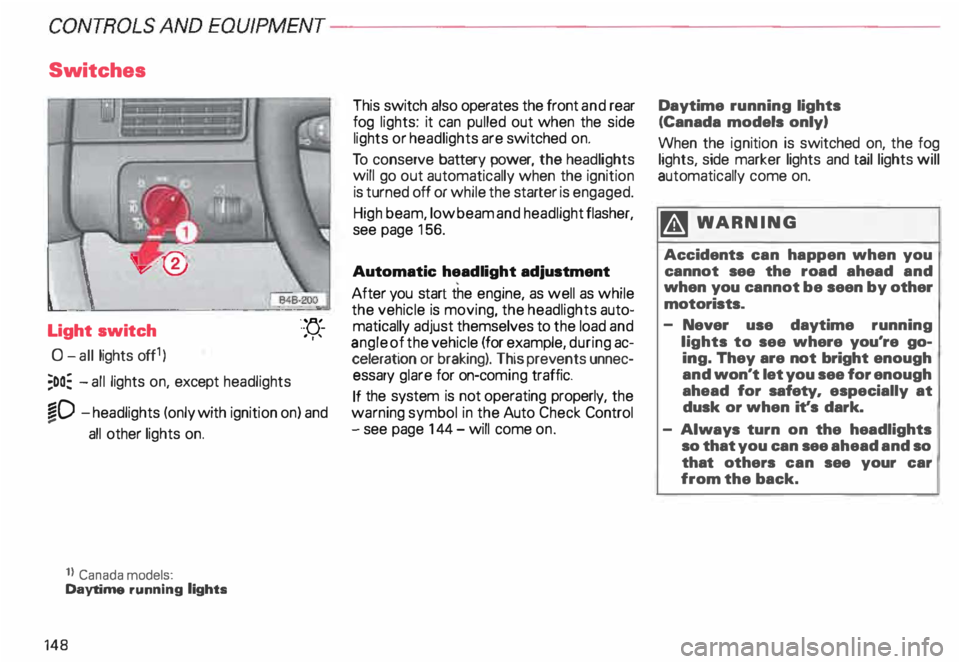
Light switch
0- all lights off1)
;oo: -all lights on, except headlights "-
YJ.-
. ''
�D -headlights (only with ignition on) and
...
all other lights on.
1} Canada models:
Daytime running lights
148 This
switch also operates the front and rear
fog lights: it can pulled out when the side
lights or headlights are switched on.
To conserve battery power, the headlights
will go out automatically when the ignition
is turned off or while the starter is engaged.
High beam, low beam and headlight flasher,
see page 156.
Automatic headlight adjustment
After you start the engine, as well as while
the vehicle is moving, the headlights auto
matically adjust themselves to the load and
angle of the vehicle (for example, during ac
celeration or braking). This prevents unnec
essary glare for on-com ing traffic.
If the system is not operating properly, the
warning symbol in the Auto Check Control
- see page 144- will come on. Daytime
running lights
(Canada models only)
When the ignition is switched on, the fog
lights, side marker lights and taillights will
automatically come on.
�W ARNING
Accidents can happen when you
cannot see the road ahead and
when you cannot be seen by other
motorists.
- Never use daytime running
lights to see where you're go
ing. They are not bright enough
and won't let you see for enough
ahead for safety, especially at
dusk or when it's dark.
- Always turn on the headlights
so that you can see ahead and so
that others can see your car
from the back.
Page 167 of 306
CONT
ROLS AND EQUIPMENT
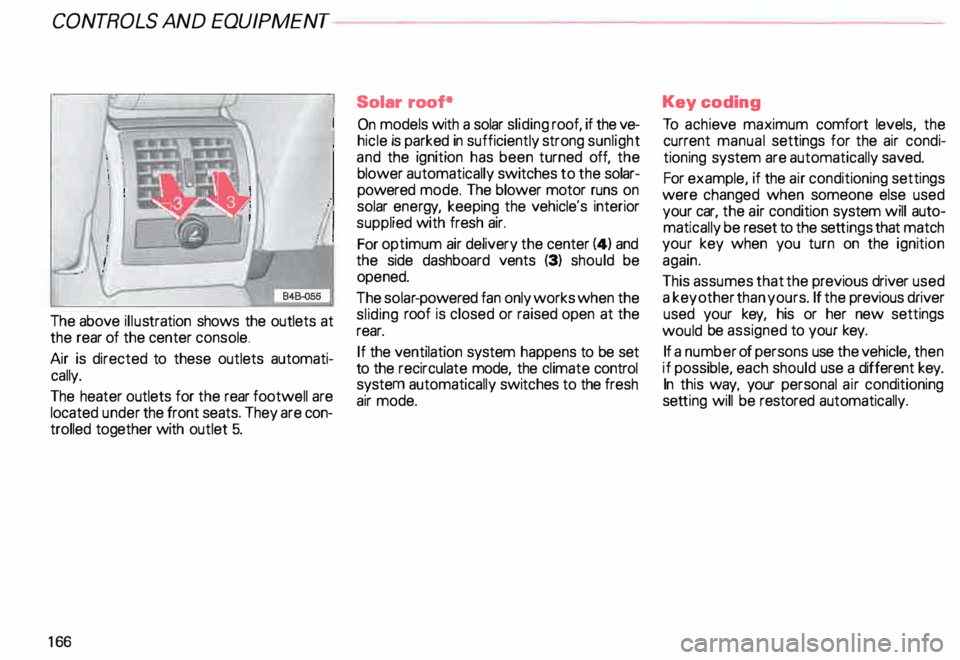
The above illustration shows the outlets at
the rear of the center console.
Air is directed to these outlets automati
cally.
The heater outlets for the rear footwall are
located under the front seats. They are con
trolled together with outlet 5.
16 6 Solar
roof*
On models with a solar sliding roof, if the ve
hicle is parked in sufficiently strong sunlight
and the ignition has been turned off, the
blower automatically switches to the solar
powered mode. The blower motor runs on
solar energy, keeping the vehicle's interior
supplied with fresh air.
For optimum air delivery the center (4) and
the side dashboard vents (3) should be
opened.
The solar -powered fan only works when the
sliding roof is closed or raised open at the
rear.
If the ventilation system happens to be set
to the recirculate mode, the climate control
system automatically switches to the fresh
air mode. Key
coding
To achie ve maximum comfort levels, the
current manual settings for the air condi
tioning system are automatically saved.
For example, if the air conditioning settings
were changed when someone else used
your car, the air condition system will auto
matically be reset to the settings that match
your key when you turn on the ignition
again.
This assumes that the previous driver used
a key other than yours. If the previous driver
used your key, his or her new settings
would be assigned to your key.
If a number of persons use the vehicle, then
if possible, each should use a different key.
In this way, your personal air conditioning
set ting will be restored automatically.
Page 168 of 306

---------------------CONTROLS AND
EQUIPMENT
General notes
• Vehicle heating is depend upon tne tem
perature of the engine coolant -therefore,
your vehicle interior will warm uponly when
the engine has reached its operating tem
perature.
When the ambient temperature is too low,
the fan only switches to high speed modes
when the coolant has reached a sufficiently
high temperature, or when the ® button
has been depressed.
• Keeping the air intake slots in front of the
windshield free from ice, snow and debris
helps to make sure that the climate control
system will work properly.
• When the air conditioner compressor is
on it reduces both the temperature and the
humid ity of the air inside the vehicle. This
prevents the windows from fogging up.
• The air conditioner works best with the
windows and power roof* closed. •
If the inside temperature is very high af
ter the vehicle has been parked in the sun,
open windows and allow the hot air to es
cape before switching on the air condi
tioner.
• The dust and pollen filter will prevent
dust and pollen etc. in the outside air from
entering the car. Switch to air recirculation
to prevent unpleasant fumes from entering
the vehicle.
If water drips under the
vehicle ...
At high outside temperatures and humidity,
condensation may drip from the evaporator.
This is normal and does not indicate a leak.
If the airflow is not cool ...
• At low ambient temperatures the air con
ditioner compressor switches off automati
cally. The compressor cannot be switc hed
on again in this case, even by pressing the
AUTO button. •
The air conditioner may switch itself off
temporarily to ensure sufficient engine
cooling when the engine is running at full
load.
The air conditioner will also be switched off
temporarily in the kick-down function. See
page 109.
• Check the air conditioning fuse on the
fuse p imel -see page 27 4. Have it replaced,
if necessary.
• If you suspect that the air conditioner is
damaged, for instance after an accident,
switch to the ECON and have the system
examined immediately for leaks or other
damage.
167