2000 AUDI ALLROAD power
[x] Cancel search: powerPage 169 of 306

CONTROLS AND
EQUIPMENT--------------------
Maintenance
• For maximum efficiency of the air condi
tioner the dust and pollen filter elements
must 'be replaced at the intervals indicated
in the Maintenance Schedule.
• The condenser must be checked regu
larly to make sure it is clean. If it becomes
obstructed by dirt or insects, spray 1t clear
with water.
• Repairs to the Audi air condition
ing system require specialized
knowledge and special tools.
If the system is not functioning
properly, contact your Audi Dealer.
16 8 Power roof*
The roof will slide open or tilt up at the rear
as required. When the ignition is on it can be
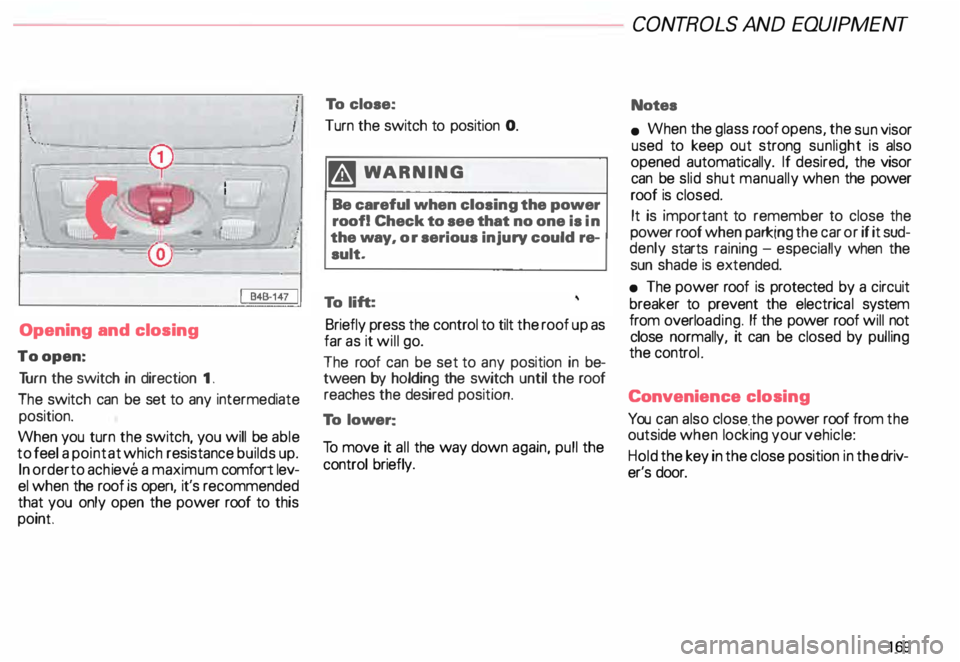
opened and closed by turning the rota�
control next to the interior light. The roof 1s
tilted open or closed by pressing or pulling
the control -see illustration.
When turning the ignition off, however, the
sunr oof can still be operated as long as the
driver's and front passenger's door are
closed. When either door is opened, sliding
roof operation will be deactivated .
Always close the roof completely if you are
going to park your vehicle and leave. �W
ARNING
Be careful when closing the power
roof 1 tilt roof. Not paying atten
tion could cause you or others to
be caught and injured as the roof
closes. To help avoid injuries
caused by closing the roof, always
take your key whenever you leave
your vehicle.
Page 170 of 306
;
\ I
\. ,. _
---________.)
---------� =::�1
Opening and closing
To open: Tu rn the switch in direction 1.
The switch can be set to any intermediate
position.
When you turn the switch, you will be able
to feel a point at which resistance builds up.
In order to achieve a maximum comfort lev
el when the roof is operi, it's recommended
that you only open the power roof to this
point To
close:
Turn the switch to position 0.
�W ARNING
Be careful when closing the power
roof! Check to see that no one is in
the way, or serious injury could re
sult.
To lift:
Briefly press the control to tilt the roof up as
far as it will go.
The roof can be set to any position in be
tween by holding the switch until the roof
reaches the desired position.
To lower:
To move it all the way down again, pull the
control briefly. CONT
ROLS AND EQUIPMENT
Notes
• When the glass roof opens, the sun visor
used to keep out strong sunlight is also
opened automatically. If desired, the visor
can be slid shut manually when the power
roof is closed.
It is important to remember to close the
power roof when parking the car or if it sud
denly starts raining -especially when the
sun shade is extended.
• The power roof is protected by a circuit
breaker to prevent the electrica l system
from overlo ading. If the power roof will not
close normally, it can be closed by pulling
the controL
Conv enience closing
You can also close . the power roof from the
outside when locking your vehicle:
Hold the key in the close position in the driv
er's door.
169
Page 171 of 306
CONT
ROLS AND
EQUIPMENT---------------------
.·
Emergency closing
If you cannot close the roof with the electric
switch, you can still close the roof manually
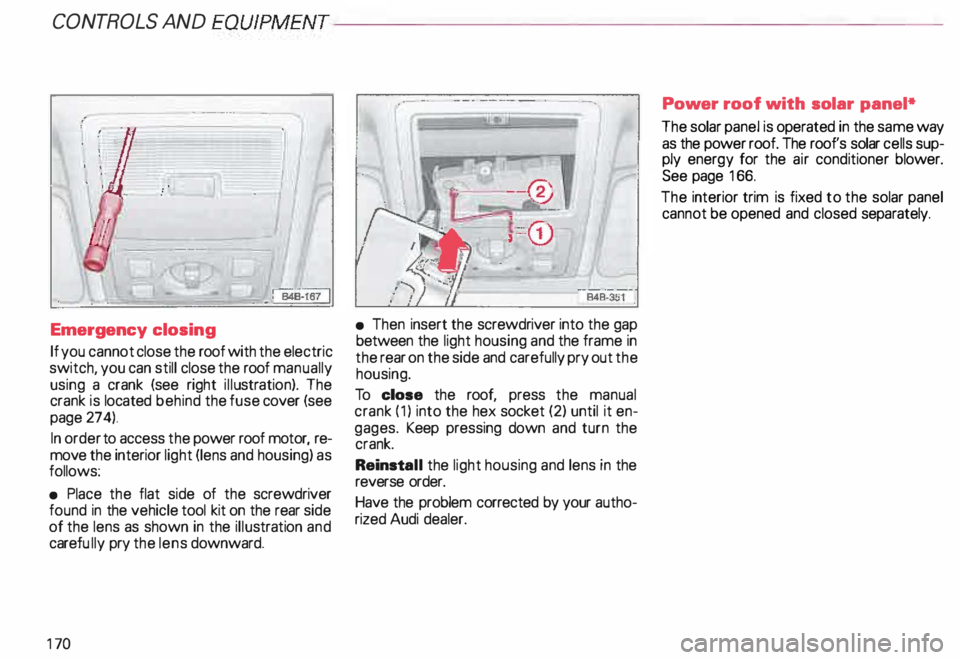
using a crank (see right illustr ation). The
crank is located behind the fuse cover (see
page 274).
In order to access the power roof motor, re
move the interior light (lens and housing) as
follows:
• Place the flat side of the screwdriver
found in the vehicle tool kit on the rear side
of the lens as shown in the illustration and
carefu lly pry the lens downward.
17 0 •
Then insert the screwdriver into the gap
between the light housing and the frame in
the rear on the side and carefully pry out the
housing.
To close the roof, press the manual
crank (1) into the hex socket (2) until it en
gages. Keep pressing down and turn the
crank.
Reinst all the light housing and lens in the
reverse order.
Have the problem corrected by your autho
rized Audi dealer. Power
roof with solar panel*
The solar panel is operated in the same way
as the power roof. The roof's solar cells sup
ply energy for the air conditioner blower.
See page 166.
The interior trim is fixed to the solar panel
cannot be opened and closed separately.
Page 182 of 306
---------------------CONTROLS
AND EQUIPMENT
Cigar ette lighter I Socket
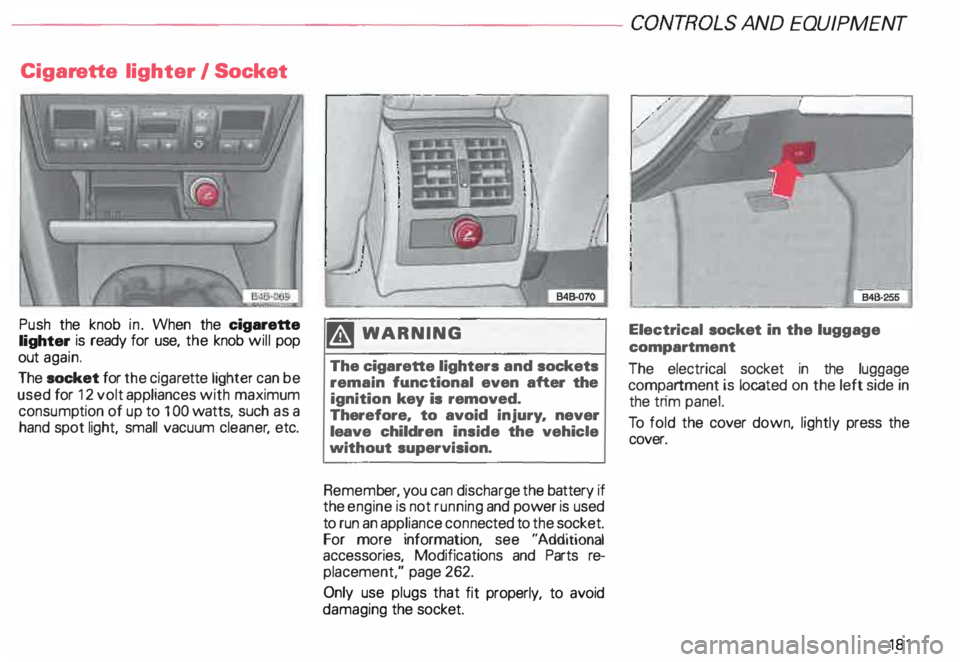
Push the knob in. When the cigarette
lighter is ready for use, the knob will pop
out again.
The socket for the ciga rette lighter can be
used for 12 volt appliances with maximum
consump tion of up to 1 00 watts, such as a
hand spot light, small vacuum cleaner, etc. �W
ARNING
The cigarette lighters and sockets
remain functional even after the
ignition key is removed.
Therefore. to avoid injury. never
leave children inside the vehicle
without supervision.
Remem ber, you can discharge the battery if
the engine is not running and power is used
to run an appliance connected to the socket.
For more information, see "Additional
accessories, Modifications and Parts re
placement," page 262.
Only use plugs that fit properly, to avoid
damaging the socket. Electrical
socket in the luggage
compartment
The electrical socket in the luggage
compartment is located on the left side in
the trim panel.
To fold the cover down, lightly press the
cover.
181
Page 194 of 306

The
first 1,000 miles (1 500 km)
and afterwards
Break-in period
During the first few hours of driving, the en
gine's internal friction is higher than later
when all the moving parts have been broken
in. How well this break-in process is done
depends to a considerable extent on the
way the vehicle is driven during the first
1, 000 miles (1 500 kilometres").
For the first 600 miles
(1 000 kilometres):
As a rule of thumb:
• Do not use full throttle.
• Do not drive faster than 3/4 of top
speed shown on the speedometer.
• Avoid high engine speeds.
• If possible, avoid towing a trailer. �
WARNING
• New tires tend to be slippery
and must also be "broken-ln." Be
sure to remember this during the
first 300 miles (500 kilometres).
Brake gently. Avoid following
closely behind other vehicles or
other situations that might require
sudden, hard braking.
• New brake pads don't have the
best stopp ing power and must be
.. brok en-in" during the initial 100
to 150 miles (150 to 200 kilo
metres) of normal city driving. You
can compensate for this by press
ing the brake pedal more firmly.
This also applies later when new
pads are installed.
From 600 to 1,000 miles
(1 000 to 1 500 kilometres):
Speeds can gradually be increased to maxi
mum permissible road or engine speed. VE
HICL E OPER ATION
During and after break-in
period
• Do not rev the engine up to high speeds
when it is cold. This applies whether the
transmission is in N (Neutral) or in gear. dib Do not drive with unnece ssarily C!1'5 high engine speeds -upshifting
early saves fuel, reduces noise and
protects the environmeht -see also
page 195.
After the break-in period
Do not exceed maximum engine
speed under any circumstances. Up
shift into the next higher gear before reach
ing the red area at the end of the tachome
ter scale -see page 117.
Excessive engine speeds are automatically
reduced.
193
Page 205 of 306

VE
HICL E OPERA TION-----------------------
'4 WARN ING continued
• Before descending a steep
grade, reduce speed and shift
transmission into a lower gear or
lower driving position. Do not ride
the brakes or hold the pedal down
too long or too often. This could
cause the brakes to get hot and di
minish braking efficiency.
• If you damage the front spoiler,
or if you install a different spoiler,
be sure the air flow to the front
brakes is not obstructed. Other
wise the brake system could over
heat reducing the effective ness of
the entire brake system.
• Failure of one brake circuit will
impair the braking capability re
sulting in an increased stopping
distance.
Avoid driving the vehicle and have
it towed to the nearest Audi Dealer
or qualified workshop.
204 Electronic differential lock
(EDL)
The EDL operates in conjunction with the
ABS. The EDL acts automatically, i.e. with
out the driver's intervention.
With the aid of the ABS sensors, this sy
stem monitors the speed of the driven
wheels up to about 50 mph, 80 km/h .
Within the speed range at which this sy
stem operates, if the wheels spin (e.g. on
slippery surfaces) they are braked in a con
trolled manner , and more of the engine's
power is directed to whiche ver wheels
achieve greater traction.
Please note:
• When driving off, always be sure to keep
road conditions in mind as you accelerate.
If a drive wheel spins because it's on a slip
perier surface, gradually increase the pres
sure on the accelerator pedal until the car
starts to move. •
When accelerating on slippery surfaces,
such as on ice or snow, always be careful
when depressing the accelerator pedal.
Even with the EDL working, the drive
wheels can spin and reduce your ability to
control your car.
• To prevent the disc brake of the braked
wheel from overheating, if subjected to ex
cessive loads the EDL cuts out temporarily.
The vehicle remains operational and be
haves in the same way as a vehicle without
EDL
If a fault occurs in the ABS the EDL is also
not functioning. This is ind icated by the ABS
warning light-see page 125.
ftl WARNING
The increased safety afforded by
EDL does not mean that you can
take safety risks. Always adapt
your driving style to the road con
ditions and traffic situation.
Page 206 of 306
Electronic
Stability Program (ESP)
The Electronic Stability Program helps to
control the vehicle in critical maneuvers like
curves.
When the vehicle starts up and accelerates,
the wheels are prevented from spinning by
adjusting the engine power to conform to all
road conditions. This improves vehicle sta
bil ity.
The system operates across the entire
speed range in combination with the ABS
syst em. If the Anti-Lock Brake System
(ABS) malfunctions, the ESP will also shut
down.
When you turn on the engine, the ESP will
automatically be activated and will perform
a self-test. The
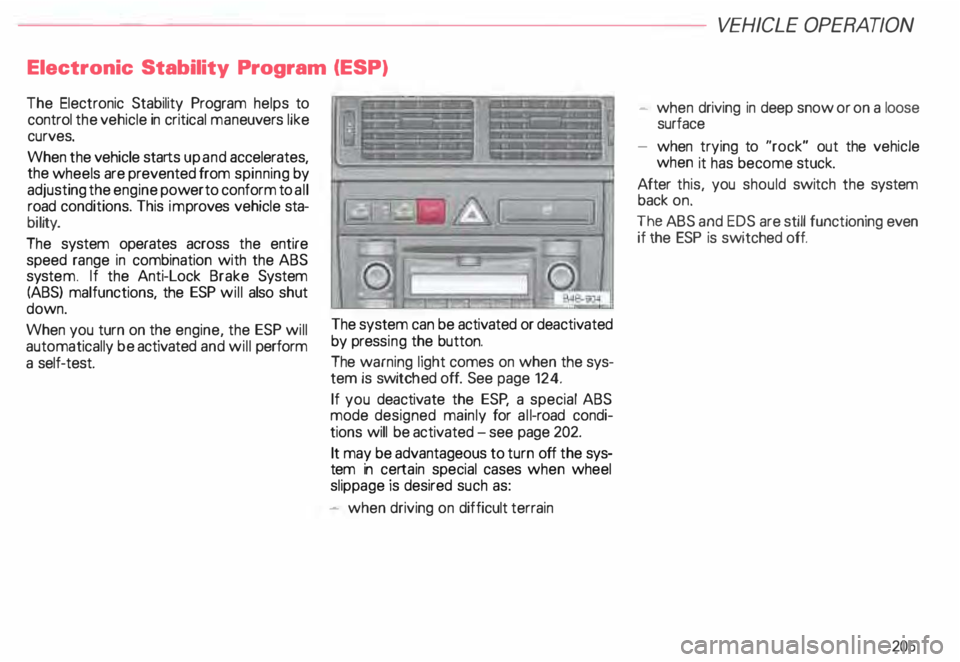
system can be activated or deactivated
by press ing the button.
The warning light comes on when the sys
tem is switch ed off. See page 124.
If you deactivate the ESP, a special ABS
mode designed mainly for all-road condi
tions will be activated - see page 202.
It may be advantageous to turn off the sys
tem in certain special cases when wheel
slippage is desired such as:
- when driving on difficult terrain VE
HICL E OPER ATION
- when driving in deep snow or on a loose
surface
- when trying to "rock" out the vehicle
when it has become stuck.
After this, you should switch the system
back on.
The ABS and EDS are still functioning even
if the ESP is switched off.
205
Page 208 of 306

Driving
with your quattro ®
The All Wheel Drive system has no operat
ing controls that require attention.
The engine power is distributed automati
cally to all four wheels for optimum effi
ciency in all situations and road conditions.
The All Wheel Drive concept is perfectly
matched to the engine power of your
Audi all road. This combination gives the ve
hicle excep tional handling and performance
capabilities, both on normal roads and in ex
treme conditions of ice and snow.
However, it is vital to observe the following
safety notes:
�W ARNIN G
Always adjust your driving to road
and traffic conditions. Do not let
the extra safety afforded by All
Wheel Drive tempt you into taking
extra risks.
Although the All Wheel Drive is
very effective, always remember
that braking capacity is limited by
tire traction. You should therefore
not drive at excessive speeds on
icy or slippery road surfaces. ftl
WARNING continued
On wet road surfaces, be careful
not to drive too fast because the
front wheels could begin to slide
on top of the water (hydroplaning).
If this should occur, you will have
no warning from a sudden in
crease in engine speed as with a
front-wheel drive vehicle. Always
drive at speeds which are suitable
to the road conditions.
Replacing wheels I tires
All four wheels must always have the same
rol ling radius. Different tires on the front and
rear wheels may impair vehicle control and
will damage the All Wheel Drive because of
the constantly different wheel speeds. The
proper function of the system is not af
fected by unevenly worn tires.
For more information, see page 255. VEH
ICLE OPER ATION
Using winter tires
When driving in the winter, your vehicle
with All Wheel Drive has an advantage,
even with regular tires.
You should promptly install wheels
equipped with winter or all-season tires to
better handling and braking characteristics.
See also "Winter tires", page 260.
207