2000 AUDI ALLROAD sunroof
[x] Cancel search: sunroofPage 61 of 306

CONTROLS AND
EQUIPMENT--------------------
Remember- the panic function can be seen
and heard by other motorists and I or per
sons near you.
Use the panic function only if you
are In an emergency situation.
�W ARNING
Do not leave children unattended
in the vehicle especially with ac
cess to the remote control. There
mote control could be used to lock
the doors delaying access to the
children in an emergency.
Resetting the remote control
If your vehicle will not lock using the remote
control . it could be that the code for the con
trol unit and key needs to be reset. This can
occur if you frequently use the remote c �m
trol while standing outside of the effective
range.
60 Resetting
procedure
1 - To synchronize, press button A or but
ton Con the remote control one time.
2 - Then, within one minute, lock or un
lock the driver's door with the master
key.
The system is now functional.
Operating locks using the key
• To lock and unlock the vehicle from
the outside, turn the key in the lock of the
driver's door or the rear lid.
Yo u can also lock and unlock the vehicle by
turning the key in the re ar lid lock. See
page 63.
• Turn the key one time only to unlock
(A) either the driver's door or respectively
the rear lid.
• Turn the key two times to unlock all ve
hicle doors and the rear lid. Convenience
close I open feature
You can also close any open windows and
1 or the power roof* when you lock your car
with the key.
Insert the key into the lock of the driver's
door, turn it to the lock position (B) and hold
until the wind ows and sunroof are com
pletely closed. The automatic close function
will stop immediately if the key is released.
Always make sure the windows are
not obstructed.
To open all window s: insert your key into the
lock of the dr iver's door, turn it to the open
position (A) and then hold it in this position.
Page 214 of 306
Washing
The best protection against environmental
influences is frequent washing and waxing.
How often this is required depends on how
much the vehicle is used, where it is parked
(garage, in the open under trees, etc.), the
seasonal and weather conditions as well as
env ironmental influences. The longer bird
droppings, insects, tree resin, road and in
dustrial grime, tar, soot, road salt and other
materials remain on the vehicle paint, the
more lasting their destructive effect will be.
High temperatures, as from strong sunlight,
intensify the corrosive effect.
Under certain circumstances, weekly
washing may be necessary. Under other
conditions. a monthly washing and waxing
may be adequate.
After the winter, the underside of the ve
hicle should be thoroughly washed. Automatic
car wash
The vehicle paint is so durable that the ve
hicle can normally be washed without prob
lems in an automatic car wash. However,
the effect on the paint depends to a large
extent on the design of the facil ity, the filter
ing of the wash water, the type of wash and
care material, etc. If the paint has a dull ap
pearance after going through the car wash
or is scratched, bring this to the atte ntion of
the operator immediately. If necessary use
a different car wash.
Notes
• Before going through a car wash, be sure
to take the usual precautions such as clos
ing the windows and sunroof*.
• You don't have to remove the factory
installed radio antenna. However, if your ve
hicle is equipped with the Navigation Sys
tem*, then you must remove the antenna.
• If you have installed additional accesso
ries on the vehicle -such as spoilers, roof
rack, etc. -it is best to ask the car wash op
erator if these should be remov ed. VE
HICLE CARE
Washing the vehicle by hand
� In the intsi'Sst of the environ
� msnt, the vehicle should only be
washed in special wash bays.
First soften the dirt with plenty of water and
rinse off as well as possible.
Then clean the vehicle with a soft sponge,
glove or brush starting on the roof and work
ing down using only slight pressure. Special
car wash soap should only be used for very
persistent dirt.
Rinse the sponge or glove thoroughly and
oft en.
Clean wheels .and sill panels last, using a dif
ferent sponge if pos sible.
After washing the vehicle, rinse thoroughly
with water and wipe it off.
213
Page 275 of 306
DO-IT-YOURSELF
SERVICE----------------------
Fuses
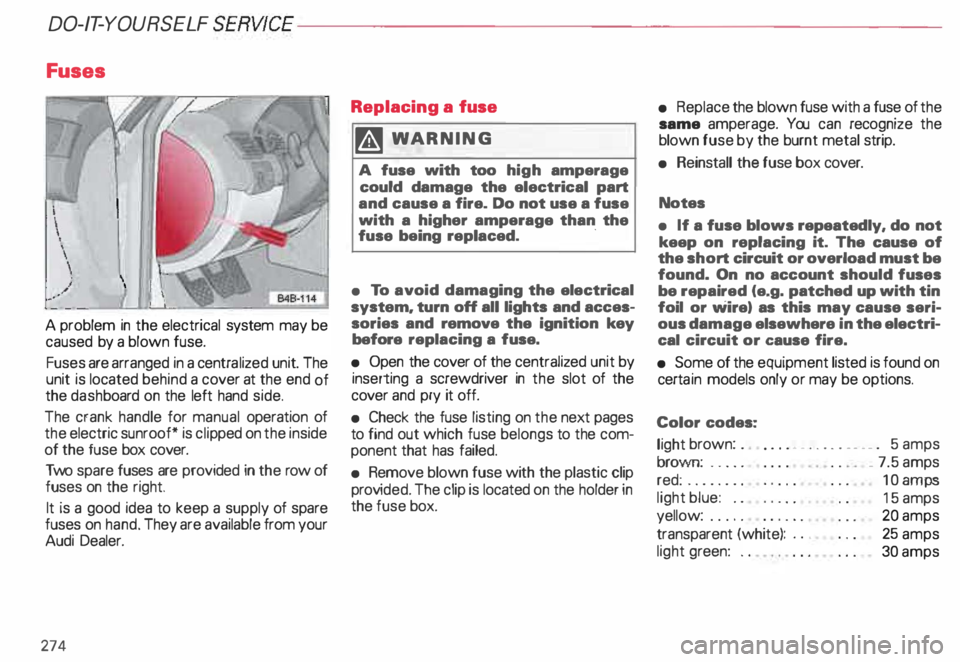
A problem in the electrical system may be
caused by a blown fuse.
Fuses are arranged in a centra lized unit. The
unit is located behind a cover at the end of
the dash board on the left hand side.
The crank handle for manual operation of
the electric sunroof* is cli pped on the inside
of the fuse box cover.
Two spare fuses are provided in the row of
fuses on the right.
It is a good idea to keep a supply of spare
fuses on hand. They are available from your
Audi Dealer.
274 Replacing
a fuse
� WARNING
A fuse with too high amperage
could damage the electrical part
and cause a fire. Do not use a fuse
with a higher amperage than the
fuse being replaced. ·
• To avoid damaging the electrical
system. turn off all lights and acces
sories and remove the ignition key
before replacing a fuse.
• Open the cover of the centralized unit by
inserting a screwdriver in the slot of the
cover and pry it off.
• Check the fuse listing on the next pages
to find out which fuse belongs to the com
ponent that has failed.
• Remove blown fuse with the plastic clip
prov ided. The clip is located on the holder in
the fuse box. •
Replace the blown fuse with a fuse of the
same amperage. You can recognize the
blown fuse by the burnt metal strip.
• Reinstall the fuse box cover.
Notes
• If a fuse blows repeatedly. do not
keep on replacing it. The cause of
the short circuit or overload must be
found. On no account should fuses
be repaired (e.g. patched up with tin
foil or wire) as this may cause seri
ous damage elsewhere in the electri
cal circuit or cause fire.
• Some of the equipment listed is found on
certa in models only or may be options.
Color codes:
light brown: . .
... • _ .. .. . __ . _ . 5 amps
brown: .... .
red: ....... .
light blue: ..
yellow: .....
transparent (white): ..•
light green: .. _
7.5 amps
10 amps
15 amps
20 amps
25 amps
30 amps