1999 SUBARU LEGACY diff
[x] Cancel search: diffPage 824 of 1456
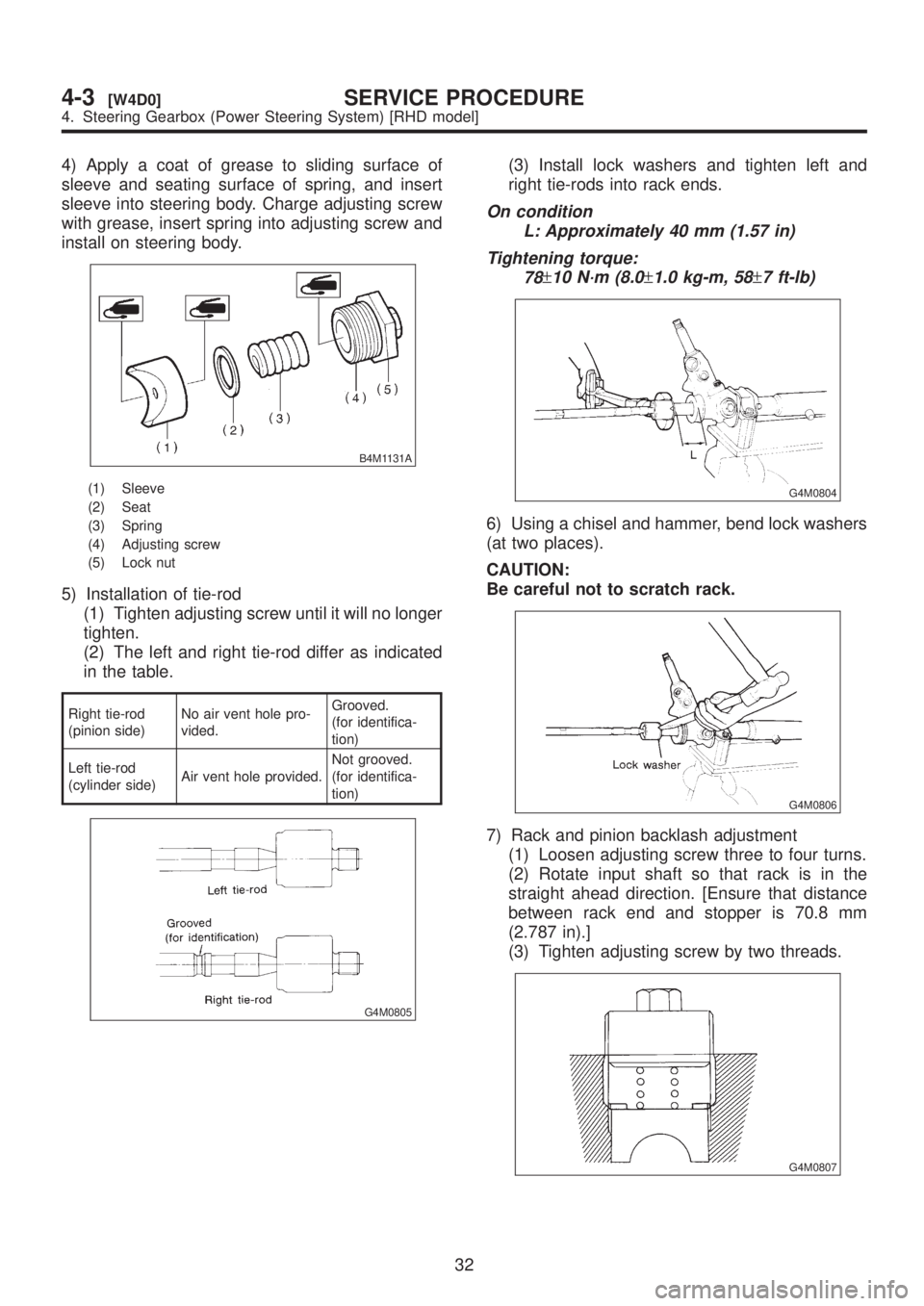
4) Apply a coat of grease to sliding surface of
sleeve and seating surface of spring, and insert
sleeve into steering body. Charge adjusting screw
with grease, insert spring into adjusting screw and
install on steering body.
B4M1131A
(1) Sleeve
(2) Seat
(3) Spring
(4) Adjusting screw
(5) Lock nut
5) Installation of tie-rod
(1) Tighten adjusting screw until it will no longer
tighten.
(2) The left and right tie-rod differ as indicated
in the table.
Right tie-rod
(pinion side)No air vent hole pro-
vided.Grooved.
(for identifica-
tion)
Left tie-rod
(cylinder side)Air vent hole provided.Not grooved.
(for identifica-
tion)
G4M0805
(3) Install lock washers and tighten left and
right tie-rods into rack ends.
On condition
L: Approximately 40 mm (1.57 in)
Tightening torque:
78
±10 N´m (8.0±1.0 kg-m, 58±7 ft-lb)
G4M0804
6) Using a chisel and hammer, bend lock washers
(at two places).
CAUTION:
Be careful not to scratch rack.
G4M0806
7) Rack and pinion backlash adjustment
(1) Loosen adjusting screw three to four turns.
(2) Rotate input shaft so that rack is in the
straight ahead direction. [Ensure that distance
between rack end and stopper is 70.8 mm
(2.787 in).]
(3) Tighten adjusting screw by two threads.
G4M0807
32
4-3[W4D0]SERVICE PROCEDURE
4. Steering Gearbox (Power Steering System) [RHD model]
Page 837 of 1456
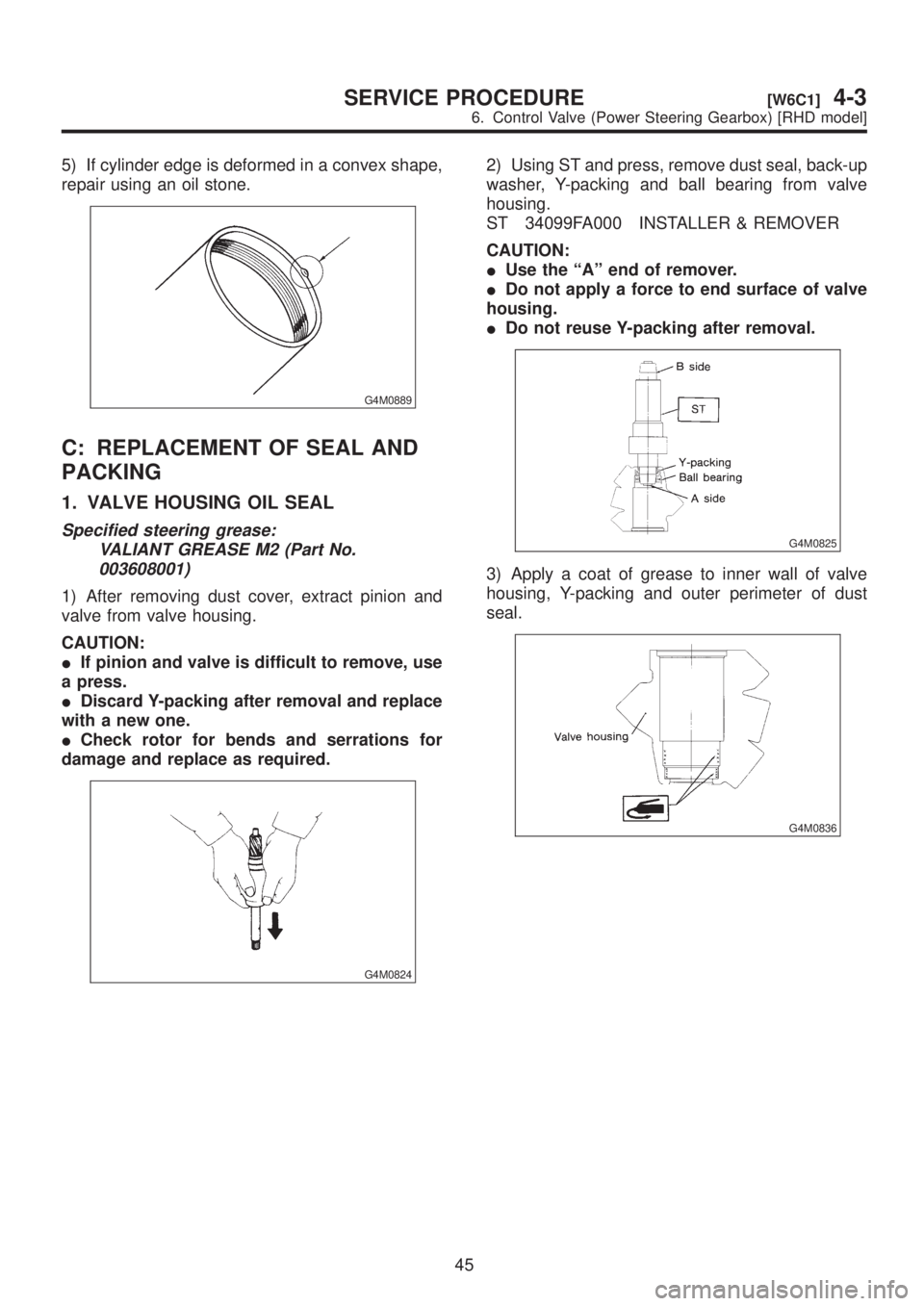
5) If cylinder edge is deformed in a convex shape,
repair using an oil stone.
G4M0889
C: REPLACEMENT OF SEAL AND
PACKING
1. VALVE HOUSING OIL SEAL
Specified steering grease:
VALIANT GREASE M2 (Part No.
003608001)
1) After removing dust cover, extract pinion and
valve from valve housing.
CAUTION:
IIf pinion and valve is difficult to remove, use
a press.
IDiscard Y-packing after removal and replace
with a new one.
ICheck rotor for bends and serrations for
damage and replace as required.
G4M0824
2) Using ST and press, remove dust seal, back-up
washer, Y-packing and ball bearing from valve
housing.
ST 34099FA000 INSTALLER & REMOVER
CAUTION:
IUse the ªAº end of remover.
IDo not apply a force to end surface of valve
housing.
IDo not reuse Y-packing after removal.
G4M0825
3) Apply a coat of grease to inner wall of valve
housing, Y-packing and outer perimeter of dust
seal.
G4M0836
45
[W6C1]4-3SERVICE PROCEDURE
6. Control Valve (Power Steering Gearbox) [RHD model]
Page 853 of 1456
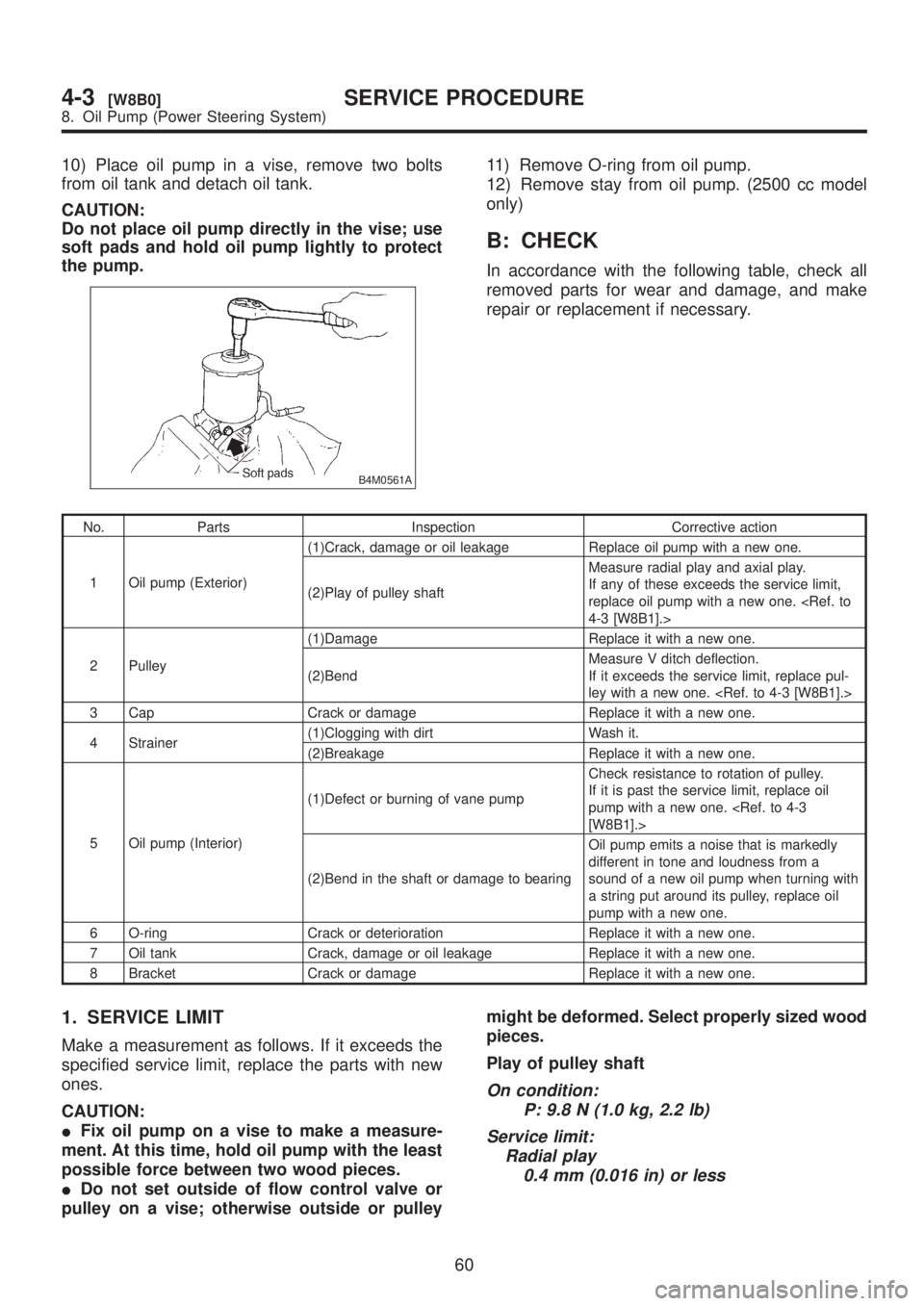
10) Place oil pump in a vise, remove two bolts
from oil tank and detach oil tank.
CAUTION:
Do not place oil pump directly in the vise; use
soft pads and hold oil pump lightly to protect
the pump.
B4M0561A
11) Remove O-ring from oil pump.
12) Remove stay from oil pump. (2500 cc model
only)
B: CHECK
In accordance with the following table, check all
removed parts for wear and damage, and make
repair or replacement if necessary.
No. Parts Inspection Corrective action
1 Oil pump (Exterior)(1)Crack, damage or oil leakage Replace oil pump with a new one.
(2)Play of pulley shaftMeasure radial play and axial play.
If any of these exceeds the service limit,
replace oil pump with a new one.
2 Pulley(1)Damage Replace it with a new one.
(2)BendMeasure V ditch deflection.
If it exceeds the service limit, replace pul-
ley with a new one.
3 Cap Crack or damage Replace it with a new one.
4 Strainer(1)Clogging with dirt Wash it.
(2)Breakage Replace it with a new one.
5 Oil pump (Interior)(1)Defect or burning of vane pumpCheck resistance to rotation of pulley.
If it is past the service limit, replace oil
pump with a new one.
(2)Bend in the shaft or damage to bearingOil pump emits a noise that is markedly
different in tone and loudness from a
sound of a new oil pump when turning with
a string put around its pulley, replace oil
pump with a new one.
6 O-ring Crack or deterioration Replace it with a new one.
7 Oil tank Crack, damage or oil leakage Replace it with a new one.
8 Bracket Crack or damage Replace it with a new one.
1. SERVICE LIMIT
Make a measurement as follows. If it exceeds the
specified service limit, replace the parts with new
ones.
CAUTION:
IFix oil pump on a vise to make a measure-
ment. At this time, hold oil pump with the least
possible force between two wood pieces.
IDo not set outside of flow control valve or
pulley on a vise; otherwise outside or pulleymight be deformed. Select properly sized wood
pieces.
Play of pulley shaft
On condition:
P: 9.8 N (1.0 kg, 2.2 lb)
Service limit:
Radial play
0.4 mm (0.016 in) or less
60
4-3[W8B0]SERVICE PROCEDURE
8. Oil Pump (Power Steering System)
Page 863 of 1456
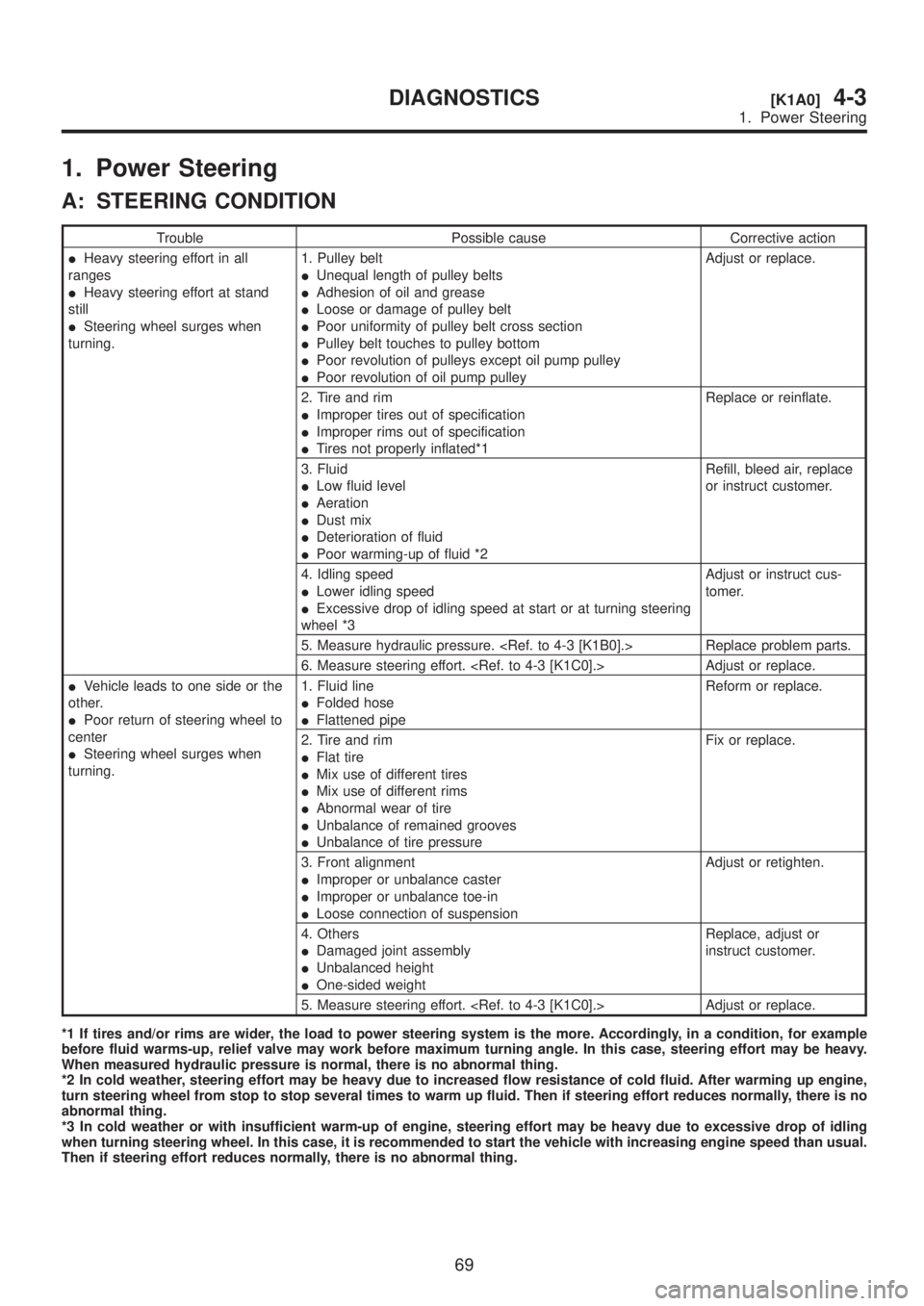
1. Power Steering
A: STEERING CONDITION
Trouble Possible cause Corrective action
IHeavy steering effort in all
ranges
IHeavy steering effort at stand
still
ISteering wheel surges when
turning.1. Pulley belt
IUnequal length of pulley belts
IAdhesion of oil and grease
ILoose or damage of pulley belt
IPoor uniformity of pulley belt cross section
IPulley belt touches to pulley bottom
IPoor revolution of pulleys except oil pump pulley
IPoor revolution of oil pump pulleyAdjust or replace.
2. Tire and rim
IImproper tires out of specification
IImproper rims out of specification
ITires not properly inflated*1Replace or reinflate.
3. Fluid
ILow fluid level
IAeration
IDust mix
IDeterioration of fluid
IPoor warming-up of fluid *2Refill, bleed air, replace
or instruct customer.
4. Idling speed
ILower idling speed
IExcessive drop of idling speed at start or at turning steering
wheel *3Adjust or instruct cus-
tomer.
5. Measure hydraulic pressure.
6. Measure steering effort.
IVehicle leads to one side or the
other.
IPoor return of steering wheel to
center
ISteering wheel surges when
turning.1. Fluid line
IFolded hose
IFlattened pipeReform or replace.
2. Tire and rim
IFlat tire
IMix use of different tires
IMix use of different rims
IAbnormal wear of tire
IUnbalance of remained grooves
IUnbalance of tire pressureFix or replace.
3. Front alignment
IImproper or unbalance caster
IImproper or unbalance toe-in
ILoose connection of suspensionAdjust or retighten.
4. Others
IDamaged joint assembly
IUnbalanced height
IOne-sided weightReplace, adjust or
instruct customer.
5. Measure steering effort.
*1 If tires and/or rims are wider, the load to power steering system is the more. Accordingly, in a condition, for example
before fluid warms-up, relief valve may work before maximum turning angle. In this case, steering effort may be heavy.
When measured hydraulic pressure is normal, there is no abnormal thing.
*2 In cold weather, steering effort may be heavy due to increased flow resistance of cold fluid. After warming up engine,
turn steering wheel from stop to stop several times to warm up fluid. Then if steering effort reduces normally, there is no
abnormal thing.
*3 In cold weather or with insufficient warm-up of engine, steering effort may be heavy due to excessive drop of idling
when turning steering wheel. In this case, it is recommended to start the vehicle with increasing engine speed than usual.
Then if steering effort reduces normally, there is no abnormal thing.
69
[K1A0]4-3DIAGNOSTICS
1. Power Steering
Page 876 of 1456
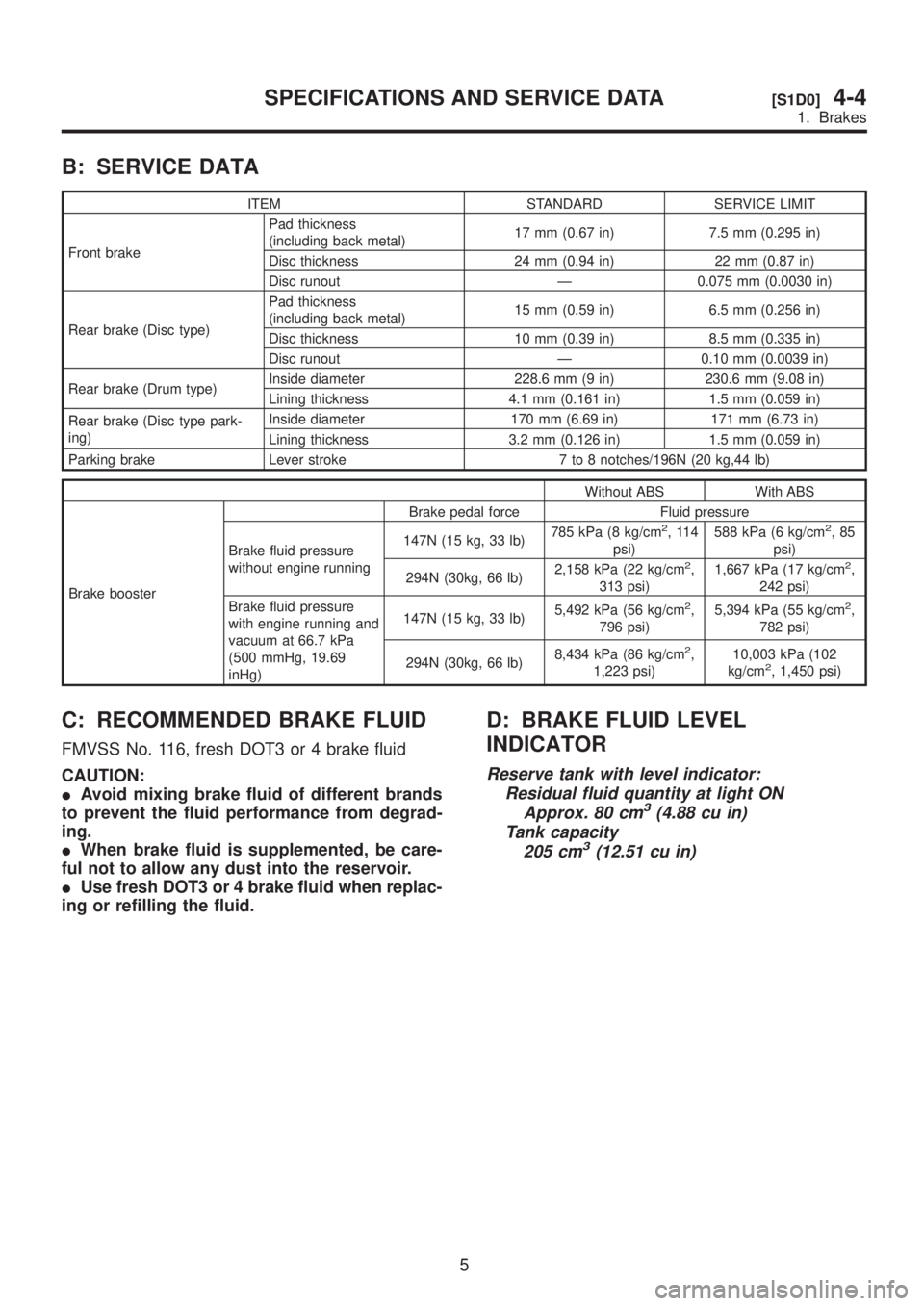
B: SERVICE DATA
ITEM STANDARD SERVICE LIMIT
Front brakePad thickness
(including back metal)17 mm (0.67 in) 7.5 mm (0.295 in)
Disc thickness 24 mm (0.94 in) 22 mm (0.87 in)
Disc runout Ð 0.075 mm (0.0030 in)
Rear brake (Disc type)Pad thickness
(including back metal)15 mm (0.59 in) 6.5 mm (0.256 in)
Disc thickness 10 mm (0.39 in) 8.5 mm (0.335 in)
Disc runout Ð 0.10 mm (0.0039 in)
Rear brake (Drum type)Inside diameter 228.6 mm (9 in) 230.6 mm (9.08 in)
Lining thickness 4.1 mm (0.161 in) 1.5 mm (0.059 in)
Rear brake (Disc type park-
ing)Inside diameter 170 mm (6.69 in) 171 mm (6.73 in)
Lining thickness 3.2 mm (0.126 in) 1.5 mm (0.059 in)
Parking brake Lever stroke 7 to 8 notches/196N (20 kg,44 lb)
Without ABS With ABS
Brake boosterBrake pedal force Fluid pressure
Brake fluid pressure
without engine running147N (15 kg, 33 lb)785 kPa (8 kg/cm
2,114
psi)588 kPa (6 kg/cm2,85
psi)
294N (30kg, 66 lb)2,158 kPa (22 kg/cm
2,
313 psi)1,667 kPa (17 kg/cm2,
242 psi)
Brake fluid pressure
with engine running and
vacuum at 66.7 kPa
(500 mmHg, 19.69
inHg)147N (15 kg, 33 lb)5,492 kPa (56 kg/cm
2,
796 psi)5,394 kPa (55 kg/cm2,
782 psi)
294N (30kg, 66 lb)8,434 kPa (86 kg/cm
2,
1,223 psi)10,003 kPa (102
kg/cm2, 1,450 psi)
C: RECOMMENDED BRAKE FLUID
FMVSS No. 116, fresh DOT3 or 4 brake fluid
CAUTION:
IAvoid mixing brake fluid of different brands
to prevent the fluid performance from degrad-
ing.
IWhen brake fluid is supplemented, be care-
ful not to allow any dust into the reservoir.
IUse fresh DOT3 or 4 brake fluid when replac-
ing or refilling the fluid.
D: BRAKE FLUID LEVEL
INDICATOR
Reserve tank with level indicator:
Residual fluid quantity at light ON
Approx. 80 cm
3(4.88 cu in)
Tank capacity
205 cm
3(12.51 cu in)
5
[S1D0]4-4SPECIFICATIONS AND SERVICE DATA
1. Brakes
Page 889 of 1456

1. Front Disc Brake
A: ON-CAR SERVICE
1. PAD
1) Remove lock pin.
2) Raise caliper body.
3) Remove pad.
B4M1167
4) Check pad thickness A.
B4M1168A
Pad thickness
(including back metal)
mm (in)Standard value 17 (0.67)
Wear limit 7.5 (0.295)
CAUTION:
IAlways replace the pads for both the left and
right wheels at the same time. Also replace pad
clips if they are twisted or worn.
IA wear indicator is provided on the inner
disc brake pad. If the pad wears down to such
an extent that the end of the wear indicator
contacts the disc rotor, a squeaking sound is
produced as the wheel rotates. If this sound is
heard, replace the pad.
IReplace pad if there is oil or grease on it.5) Apply thin coat of PBC GREASE (Part No.
003607000) to the frictional portion between pad
and pad clip.
B4M1169A
6) Install pads on support.
7) Install caliper body on support.
NOTE:
If it is difficult to push piston during pad
replacement, loosen air bleeder to facilitate work.
2. DISC ROTOR
1) Install disc rotor by tightening the five wheel
nuts.
2) Set a dial gauge on the disc rotor. Turn disc
rotor to check runout.
G4M0364
NOTE:
Make sure that dial gauge is set 5 mm (0.20 in)
inward of rotor outer perimeter.
Disc rotor runout limit:
0.075 mm (0.0030 in)
18
4-4[W1A1]SERVICE PROCEDURE
1. Front Disc Brake
Page 898 of 1456
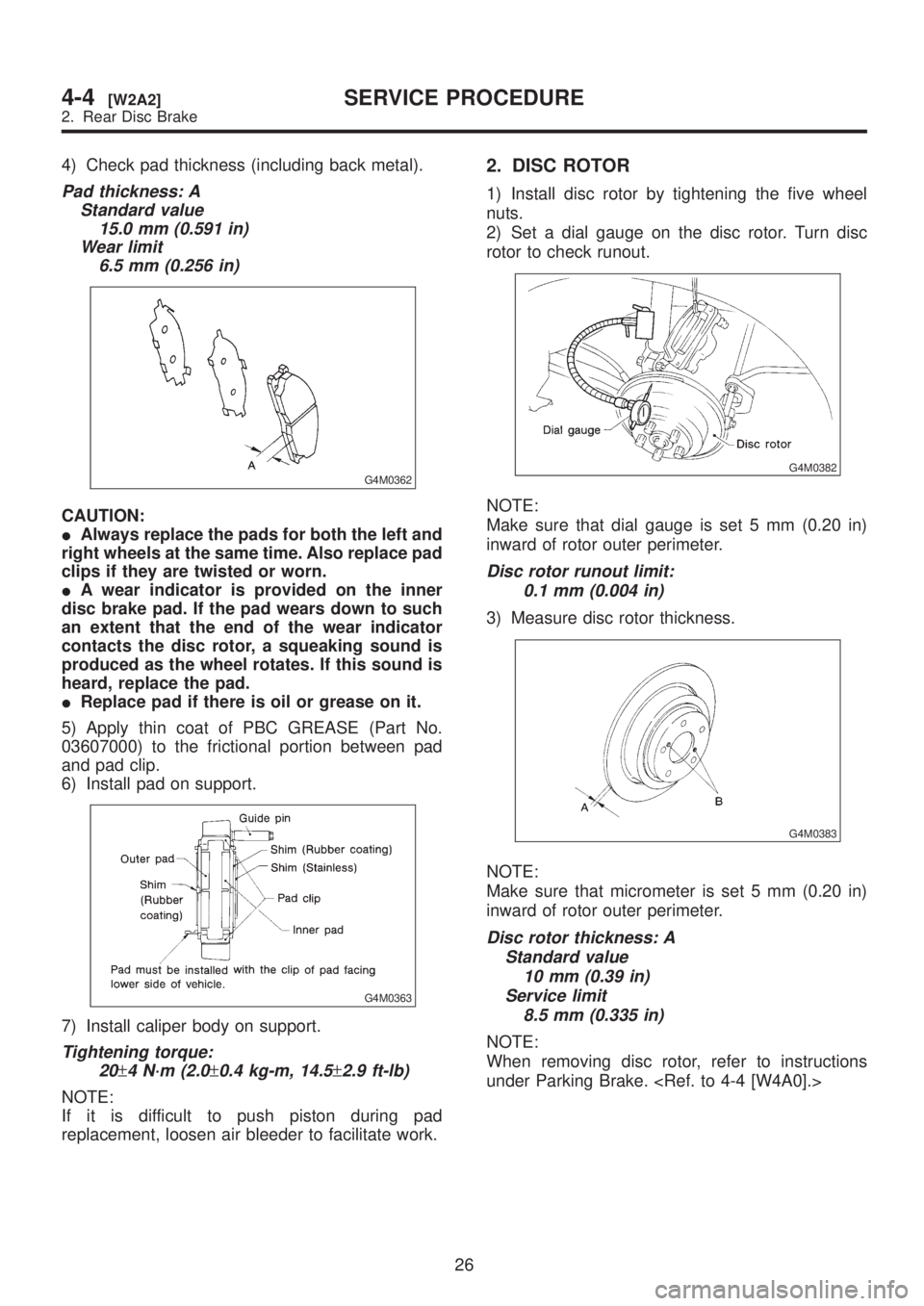
4) Check pad thickness (including back metal).
Pad thickness: A
Standard value
15.0 mm (0.591 in)
Wear limit
6.5 mm (0.256 in)
G4M0362
CAUTION:
IAlways replace the pads for both the left and
right wheels at the same time. Also replace pad
clips if they are twisted or worn.
IA wear indicator is provided on the inner
disc brake pad. If the pad wears down to such
an extent that the end of the wear indicator
contacts the disc rotor, a squeaking sound is
produced as the wheel rotates. If this sound is
heard, replace the pad.
IReplace pad if there is oil or grease on it.
5) Apply thin coat of PBC GREASE (Part No.
03607000) to the frictional portion between pad
and pad clip.
6) Install pad on support.
G4M0363
7) Install caliper body on support.
Tightening torque:
20
±4 N´m (2.0±0.4 kg-m, 14.5±2.9 ft-lb)
NOTE:
If it is difficult to push piston during pad
replacement, loosen air bleeder to facilitate work.
2. DISC ROTOR
1) Install disc rotor by tightening the five wheel
nuts.
2) Set a dial gauge on the disc rotor. Turn disc
rotor to check runout.
G4M0382
NOTE:
Make sure that dial gauge is set 5 mm (0.20 in)
inward of rotor outer perimeter.
Disc rotor runout limit:
0.1 mm (0.004 in)
3) Measure disc rotor thickness.
G4M0383
NOTE:
Make sure that micrometer is set 5 mm (0.20 in)
inward of rotor outer perimeter.
Disc rotor thickness: A
Standard value
10 mm (0.39 in)
Service limit
8.5 mm (0.335 in)
NOTE:
When removing disc rotor, refer to instructions
under Parking Brake.
26
4-4[W2A2]SERVICE PROCEDURE
2. Rear Disc Brake
Page 903 of 1456
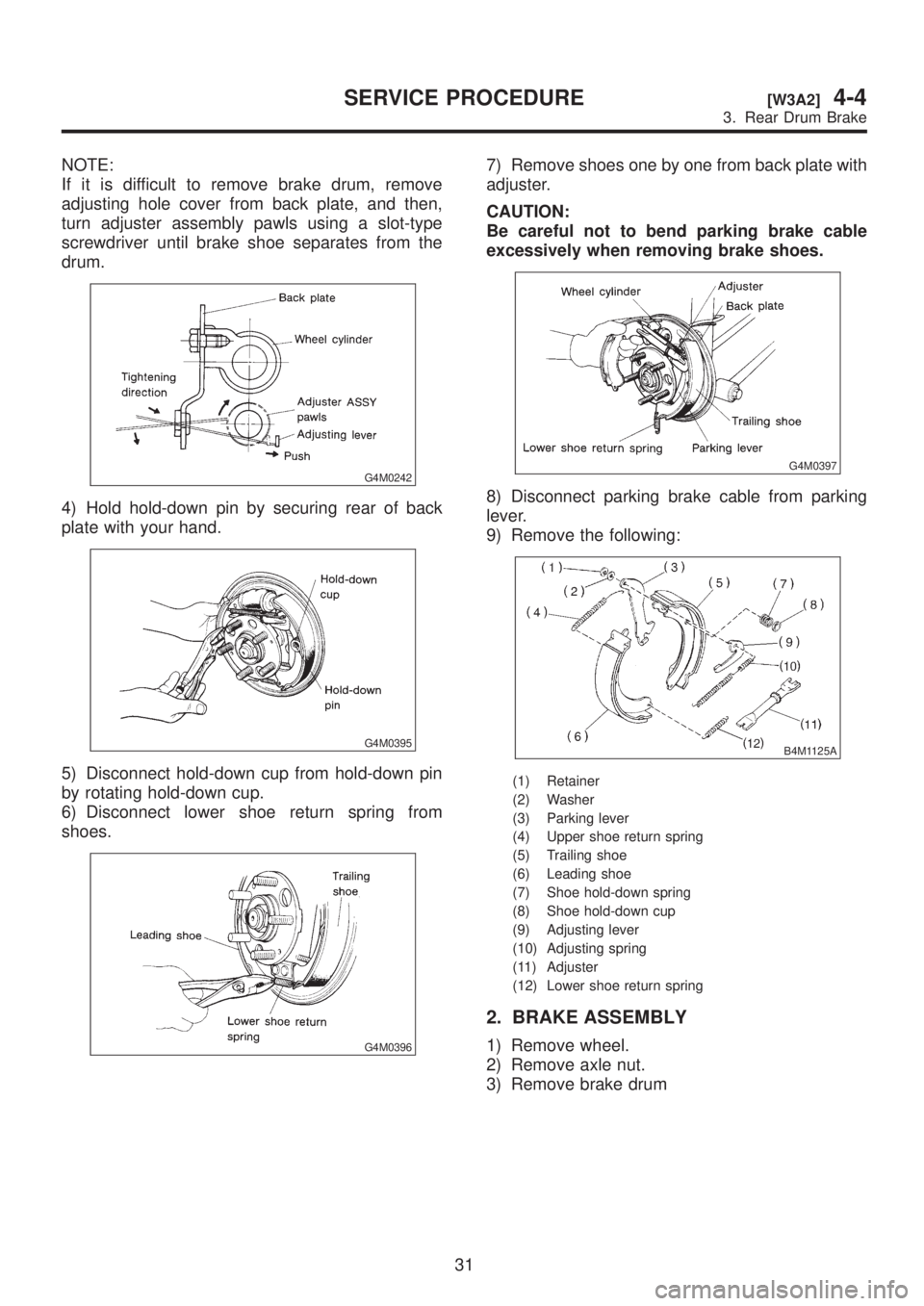
NOTE:
If it is difficult to remove brake drum, remove
adjusting hole cover from back plate, and then,
turn adjuster assembly pawls using a slot-type
screwdriver until brake shoe separates from the
drum.
G4M0242
4) Hold hold-down pin by securing rear of back
plate with your hand.
G4M0395
5) Disconnect hold-down cup from hold-down pin
by rotating hold-down cup.
6) Disconnect lower shoe return spring from
shoes.
G4M0396
7) Remove shoes one by one from back plate with
adjuster.
CAUTION:
Be careful not to bend parking brake cable
excessively when removing brake shoes.
G4M0397
8) Disconnect parking brake cable from parking
lever.
9) Remove the following:
B4M1125A
(1) Retainer
(2) Washer
(3) Parking lever
(4) Upper shoe return spring
(5) Trailing shoe
(6) Leading shoe
(7) Shoe hold-down spring
(8) Shoe hold-down cup
(9) Adjusting lever
(10) Adjusting spring
(11) Adjuster
(12) Lower shoe return spring
2. BRAKE ASSEMBLY
1) Remove wheel.
2) Remove axle nut.
3) Remove brake drum
31
[W3A2]4-4SERVICE PROCEDURE
3. Rear Drum Brake