1999 SUBARU LEGACY diff
[x] Cancel search: diffPage 697 of 1456

Adjusting direction of drive pinion
Adjusting direction of crown gear
TOOTH CONTACT PATTERN
Condition Contact pattern Adjustment
Correct tooth contact
Tooth contact pattern slightly shifted
towards toe under no load rotation.
(When loaded, contact pattern
moves toward heel.)
G3M0098A
Ð
Face contact
Backlash is too large.This may cause noise and chipping at
tooth ends.
G3M0098B
Increase thickness of drive pinion height
adjusting washer in order to bring drive
pinion closer to crown gear center.
G3M0098F
Flank contact
Backlash is too small.This may cause noise and stepped wear
on surfaces.
G3M0098C
Reduce thickness of drive pinion height
adjusting washer in order to move drive
pinion away from crown gear.
G3M0098G
Toe contact Contact area is small.
This may cause chipping at toe ends.
G3M0098D
Adjust as for flank contact.
G3M0098G
Heel contact Contact area is small.
This may cause chipping at heel ends.
G3M0098E
Adjust as for face contact
G3M0098F
F: INSTALLATION
To install, reverse the removal sequence.
1) Install the air breather cap tapping with a plas-
tic hammer.CAUTION:
Be sure to install new air breather cap.
2) Position front member on body by passing it
under parking brake cable and securing to rear
differential.
47
[W2F0]3-4SERVICE PROCEDURE
2. Rear Differential
Page 698 of 1456
NOTE:
When installing rear differential front member, do
not confuse the installation sequence of the upper
and lower stoppers.
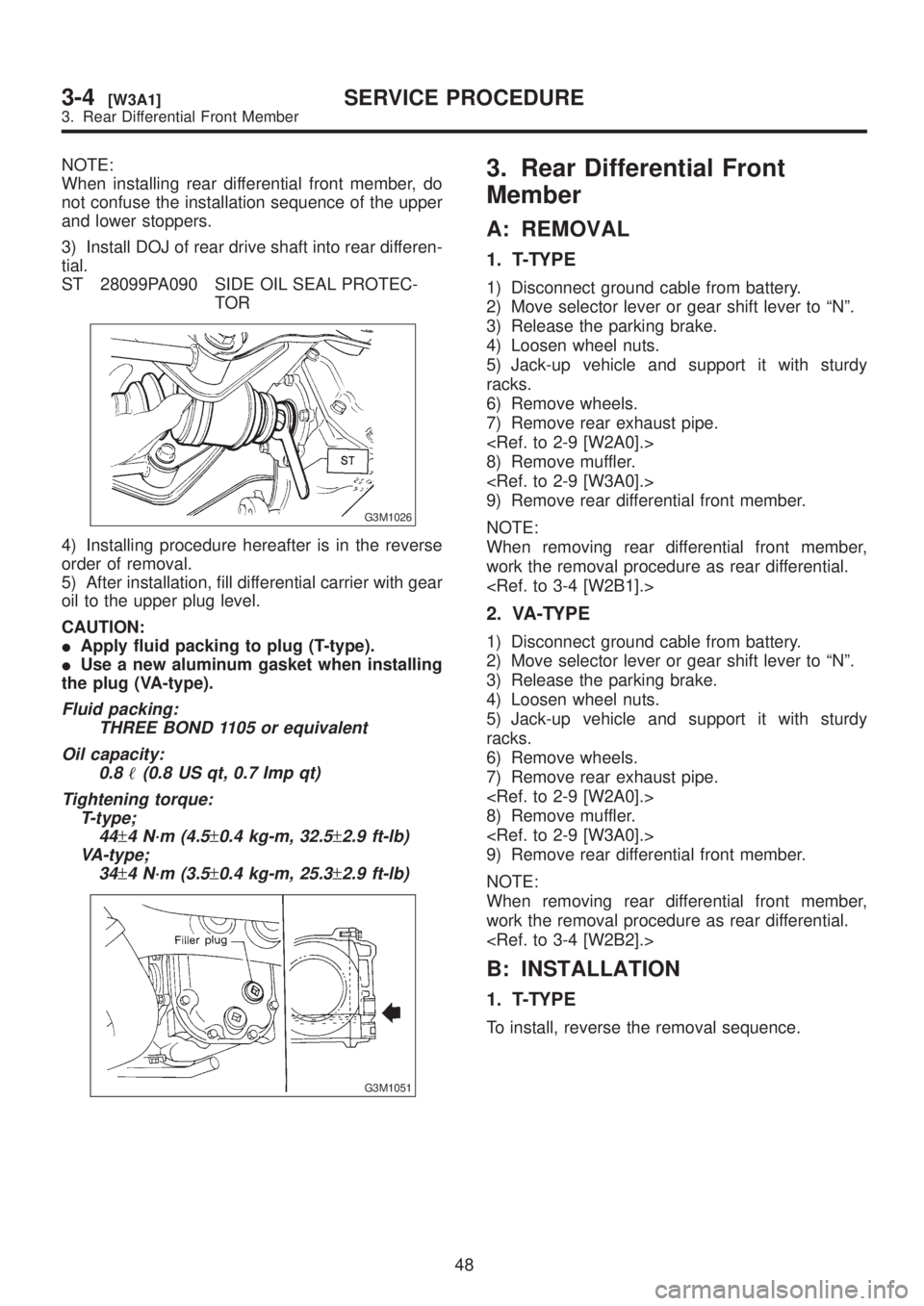
3) Install DOJ of rear drive shaft into rear differen-
tial.
ST 28099PA090 SIDE OIL SEAL PROTEC-
TOR
G3M1026
4) Installing procedure hereafter is in the reverse
order of removal.
5) After installation, fill differential carrier with gear
oil to the upper plug level.
CAUTION:
IApply fluid packing to plug (T-type).
IUse a new aluminum gasket when installing
the plug (VA-type).
Fluid packing:
THREE BOND 1105 or equivalent
Oil capacity:
0.8
(0.8 US qt, 0.7 Imp qt)
Tightening torque:
T-type;
44
±4 N´m (4.5±0.4 kg-m, 32.5±2.9 ft-lb)
VA-type;
34
±4 N´m (3.5±0.4 kg-m, 25.3±2.9 ft-lb)
G3M1051
3. Rear Differential Front
Member
A: REMOVAL
1. T-TYPE
1) Disconnect ground cable from battery.
2) Move selector lever or gear shift lever to ªNº.
3) Release the parking brake.
4) Loosen wheel nuts.
5) Jack-up vehicle and support it with sturdy
racks.
6) Remove wheels.
7) Remove rear exhaust pipe.
8) Remove muffler.
9) Remove rear differential front member.
NOTE:
When removing rear differential front member,
work the removal procedure as rear differential.
2. VA-TYPE
1) Disconnect ground cable from battery.
2) Move selector lever or gear shift lever to ªNº.
3) Release the parking brake.
4) Loosen wheel nuts.
5) Jack-up vehicle and support it with sturdy
racks.
6) Remove wheels.
7) Remove rear exhaust pipe.
8) Remove muffler.
9) Remove rear differential front member.
NOTE:
When removing rear differential front member,
work the removal procedure as rear differential.
B: INSTALLATION
1. T-TYPE
To install, reverse the removal sequence.
48
3-4[W3A1]SERVICE PROCEDURE
3. Rear Differential Front Member
Page 699 of 1456
NOTE:
When installing rear differential front member, do
not confuse the installation sequence of the upper
and lower stoppers.
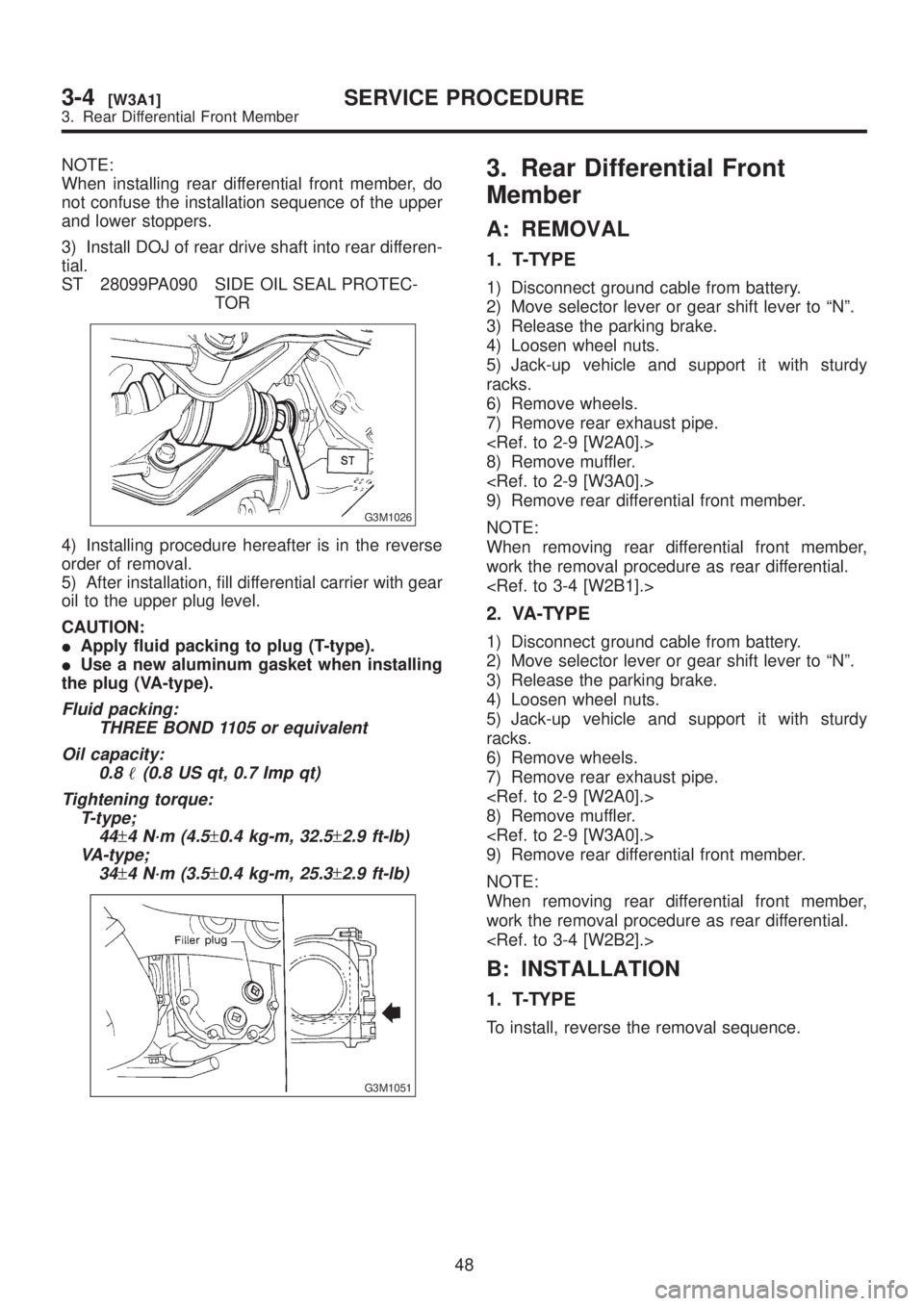
3) Install DOJ of rear drive shaft into rear differen-
tial.
ST 28099PA090 SIDE OIL SEAL PROTEC-
TOR
G3M1026
4) Installing procedure hereafter is in the reverse
order of removal.
5) After installation, fill differential carrier with gear
oil to the upper plug level.
CAUTION:
IApply fluid packing to plug (T-type).
IUse a new aluminum gasket when installing
the plug (VA-type).
Fluid packing:
THREE BOND 1105 or equivalent
Oil capacity:
0.8
(0.8 US qt, 0.7 Imp qt)
Tightening torque:
T-type;
44
±4 N´m (4.5±0.4 kg-m, 32.5±2.9 ft-lb)
VA-type;
34
±4 N´m (3.5±0.4 kg-m, 25.3±2.9 ft-lb)
G3M1051
3. Rear Differential Front
Member
A: REMOVAL
1. T-TYPE
1) Disconnect ground cable from battery.
2) Move selector lever or gear shift lever to ªNº.
3) Release the parking brake.
4) Loosen wheel nuts.
5) Jack-up vehicle and support it with sturdy
racks.
6) Remove wheels.
7) Remove rear exhaust pipe.
8) Remove muffler.
9) Remove rear differential front member.
NOTE:
When removing rear differential front member,
work the removal procedure as rear differential.
2. VA-TYPE
1) Disconnect ground cable from battery.
2) Move selector lever or gear shift lever to ªNº.
3) Release the parking brake.
4) Loosen wheel nuts.
5) Jack-up vehicle and support it with sturdy
racks.
6) Remove wheels.
7) Remove rear exhaust pipe.
8) Remove muffler.
9) Remove rear differential front member.
NOTE:
When removing rear differential front member,
work the removal procedure as rear differential.
B: INSTALLATION
1. T-TYPE
To install, reverse the removal sequence.
48
3-4[W3A1]SERVICE PROCEDURE
3. Rear Differential Front Member
Page 700 of 1456
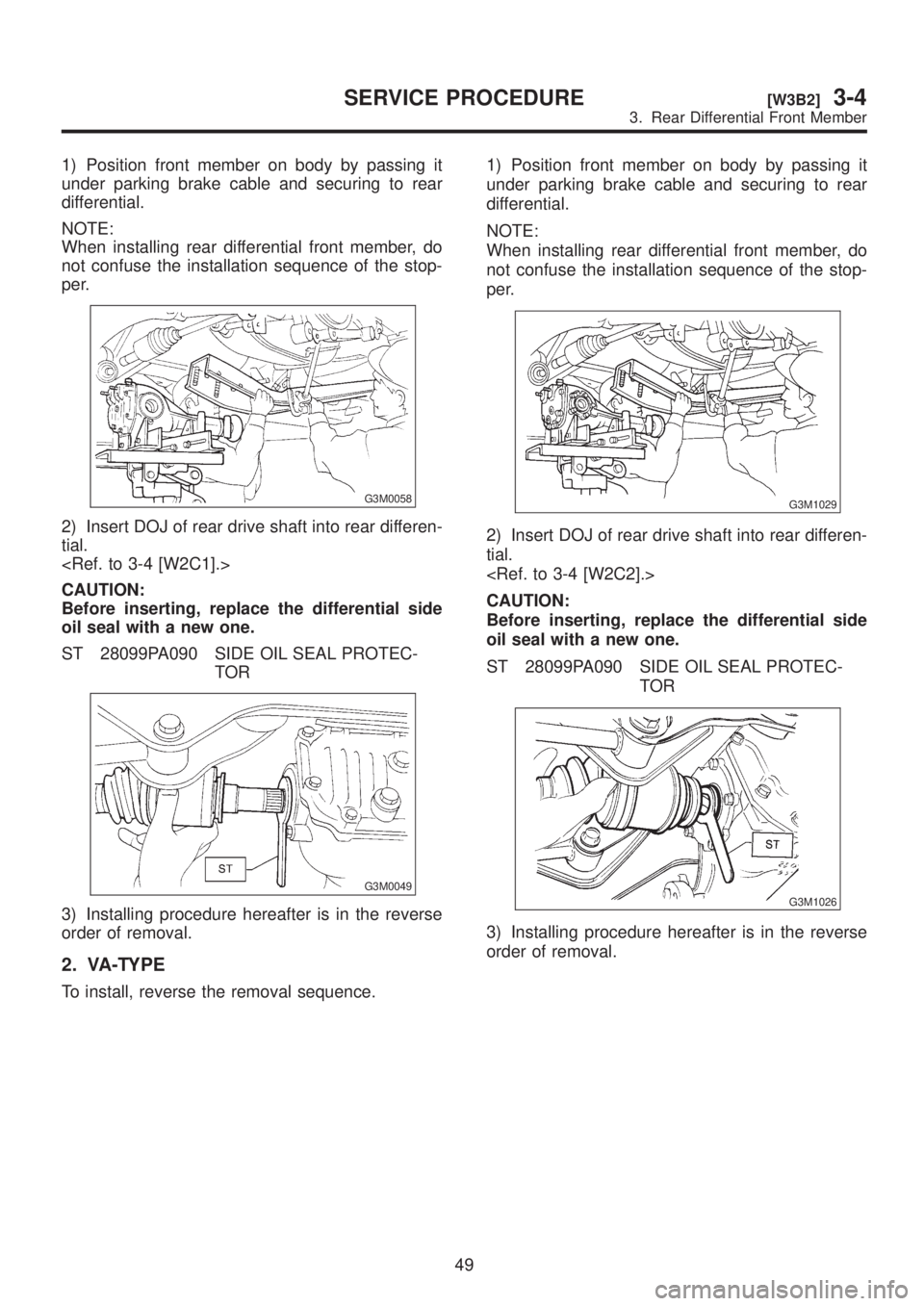
1) Position front member on body by passing it
under parking brake cable and securing to rear
differential.
NOTE:
When installing rear differential front member, do
not confuse the installation sequence of the stop-
per.
G3M0058
2) Insert DOJ of rear drive shaft into rear differen-
tial.
CAUTION:
Before inserting, replace the differential side
oil seal with a new one.
ST 28099PA090 SIDE OIL SEAL PROTEC-
TOR
G3M0049
3) Installing procedure hereafter is in the reverse
order of removal.
2. VA-TYPE
To install, reverse the removal sequence.1) Position front member on body by passing it
under parking brake cable and securing to rear
differential.
NOTE:
When installing rear differential front member, do
not confuse the installation sequence of the stop-
per.
G3M1029
2) Insert DOJ of rear drive shaft into rear differen-
tial.
CAUTION:
Before inserting, replace the differential side
oil seal with a new one.
ST 28099PA090 SIDE OIL SEAL PROTEC-
TOR
G3M1026
3) Installing procedure hereafter is in the reverse
order of removal.
49
[W3B2]3-4SERVICE PROCEDURE
3. Rear Differential Front Member
Page 703 of 1456

2. Rear Differential
Symptom Possible cause Remedy
1. Oil leakage(1) Worn, scratched, or incorrectly seated front or
side oil seal. Scored, battered, or excessively worn
sliding surface of companion flange.Repair or replace.
(2) Clogged or damaged air breather. Clean, repair or replace.
(3) Loose bolts on differential spindle or side
retainer, or incorrectly fitted O-ring.Tighten bolts to specified torque.
Replace O-ring.
(4) Loose rear cover attaching bolts or damaged
gasket.Tighten bolts to specified torque.
Replace gasket and apply liquid
packing.
(5) Loose oil filler or drain plug. Retighten and apply liquid packing.
(6) Wear, damage or incorrectly fitting for spindle,
side retainer and oil seal.Repair or replace.
2. Seizure
NOTE:
Seized or damaged parts should
be replaced, and also other parts
should be thoroughly checked for
any defect and should be repaired
or replaced as required.(1) Insufficient backlash for hypoid gear. Readjust or replace.
(2) Excessive preload for side, rear, or front bearing. Readjust or replace.
(3) Insufficient or improper oil used. Replace seized part and fill with
specified oil to specified level.
3. Damage
NOTE:
Damaged parts should be
replaced, and also other parts
should be thoroughly checked for
any defect and should be repaired
or replaced as required.(1) Improper backlash for hypoid gear. Replace.
(2) Insufficient or excessive preload for side, rear, or
front bearing.Readjust or replace.
(3) Excessive backlash for differential gear. Replace gear or thrust washer.
(4) Loose bolts and nuts such as crown gear bolt. Retighten.
(5) Damage due to overloading. Replace.
4. Noises when starting or shift-
ing gears
NOTE:
Noises may be caused by differen-
tial assembly, universal joint, wheel
bearing, etc. Find out what is actu-
ally making noise before disassem-
bly.(1) Excessive backlash for hypoid gear. Readjust.
(2) Excessive backlash for differential gear. Replace gear or thrust washer.
(3) Insufficient preload for front or rear bearing. Readjust.
(4) Loose drive pinion nut. Tighten to specified torque.
(5) Loose bolts and nuts such as side bearing
retainer attaching bolt.Tighten to specified torque.
5. Noises when cornering(1) Damaged differential gear. Replace.
(2) Excessive wear or damage of thrust washer. Replace.
(3) Broken pinion mate shaft. Replace.
(4) Seized or damaged side bearing. Replace.
6. Gear noises
NOTE:
Since noises from engine, muffler,
transmission, propeller shaft, wheel
bearings, tires, and body are
sometimes mistaken for noises
from differential assembly, be care-
ful in checking them. Inspection
methods to locate noises include
coasting, accelerating, cruising,
and jacking-up all four wheels.
Perform these inspections accord-
ing to condition of trouble. When
listening to noises, shift gears into
four wheel drive and fourth speed
position, trying to pick up only dif-
ferential noise.(1) Improper tooth contact of hypoid gear. Readjust or replace hypoid gear
set.
(2) Improper backlash for hypoid gear. Readjust.
(3) Scored or chipped teeth of hypoid gear. Replace hypoid gear set.
(4) Seized hypoid gear. Replace hypoid gear set.
(5) Improper preload for front or rear bearings. Readjust.
(6) Seized, scored, or chipped front or rear bearing. Replace.
(7) Seized, scored, or chipped side bearing. Replace.
(8) Vibrating differential carrier. Replace.
52
3-4[K200]DIAGNOSTICS
2. Rear Differential
Page 731 of 1456
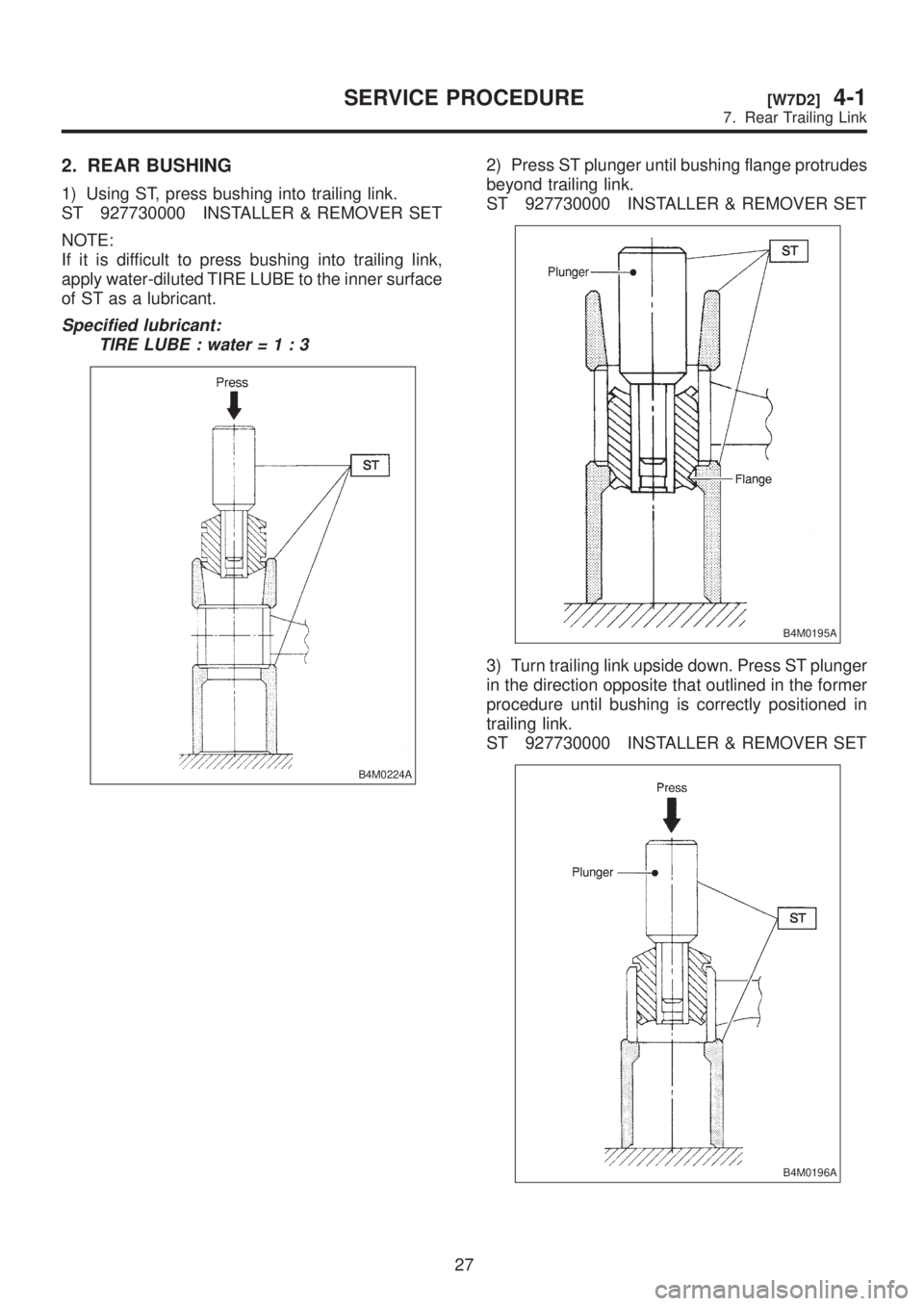
2. REAR BUSHING
1) Using ST, press bushing into trailing link.
ST 927730000 INSTALLER & REMOVER SET
NOTE:
If it is difficult to press bushing into trailing link,
apply water-diluted TIRE LUBE to the inner surface
of ST as a lubricant.
Specified lubricant:
TIRE LUBE : water=1:3
B4M0224A
2) Press ST plunger until bushing flange protrudes
beyond trailing link.
ST 927730000 INSTALLER & REMOVER SET
B4M0195A
3) Turn trailing link upside down. Press ST plunger
in the direction opposite that outlined in the former
procedure until bushing is correctly positioned in
trailing link.
ST 927730000 INSTALLER & REMOVER SET
B4M0196A
27
[W7D2]4-1SERVICE PROCEDURE
7. Rear Trailing Link
Page 734 of 1456
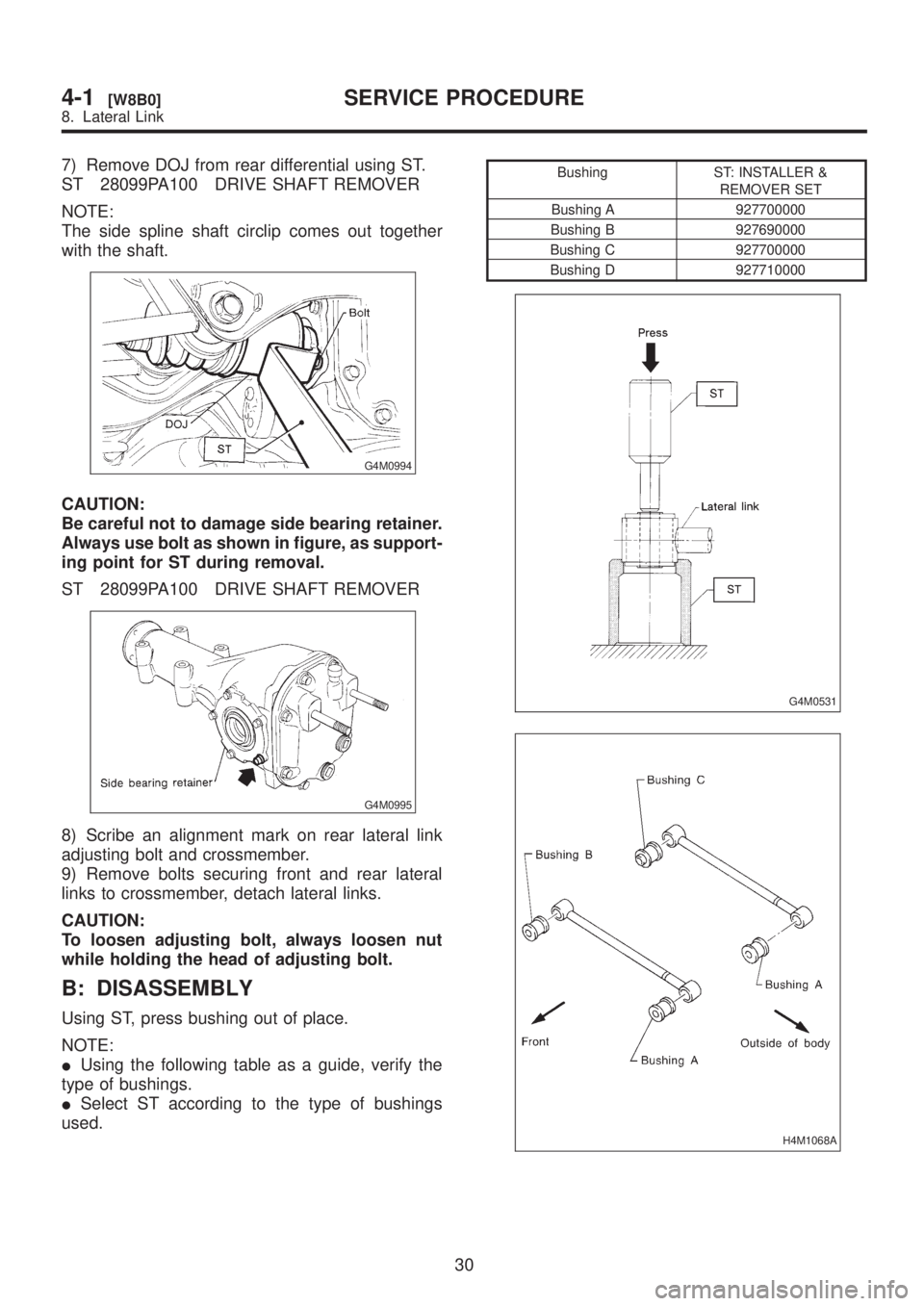
7) Remove DOJ from rear differential using ST.
ST 28099PA100 DRIVE SHAFT REMOVER
NOTE:
The side spline shaft circlip comes out together
with the shaft.
G4M0994
CAUTION:
Be careful not to damage side bearing retainer.
Always use bolt as shown in figure, as support-
ing point for ST during removal.
ST 28099PA100 DRIVE SHAFT REMOVER
G4M0995
8) Scribe an alignment mark on rear lateral link
adjusting bolt and crossmember.
9) Remove bolts securing front and rear lateral
links to crossmember, detach lateral links.
CAUTION:
To loosen adjusting bolt, always loosen nut
while holding the head of adjusting bolt.
B: DISASSEMBLY
Using ST, press bushing out of place.
NOTE:
IUsing the following table as a guide, verify the
type of bushings.
ISelect ST according to the type of bushings
used.
Bushing ST: INSTALLER &
REMOVER SET
Bushing A 927700000
Bushing B 927690000
Bushing C 927700000
Bushing D 927710000
G4M0531
H4M1068A
30
4-1[W8B0]SERVICE PROCEDURE
8. Lateral Link
Page 735 of 1456
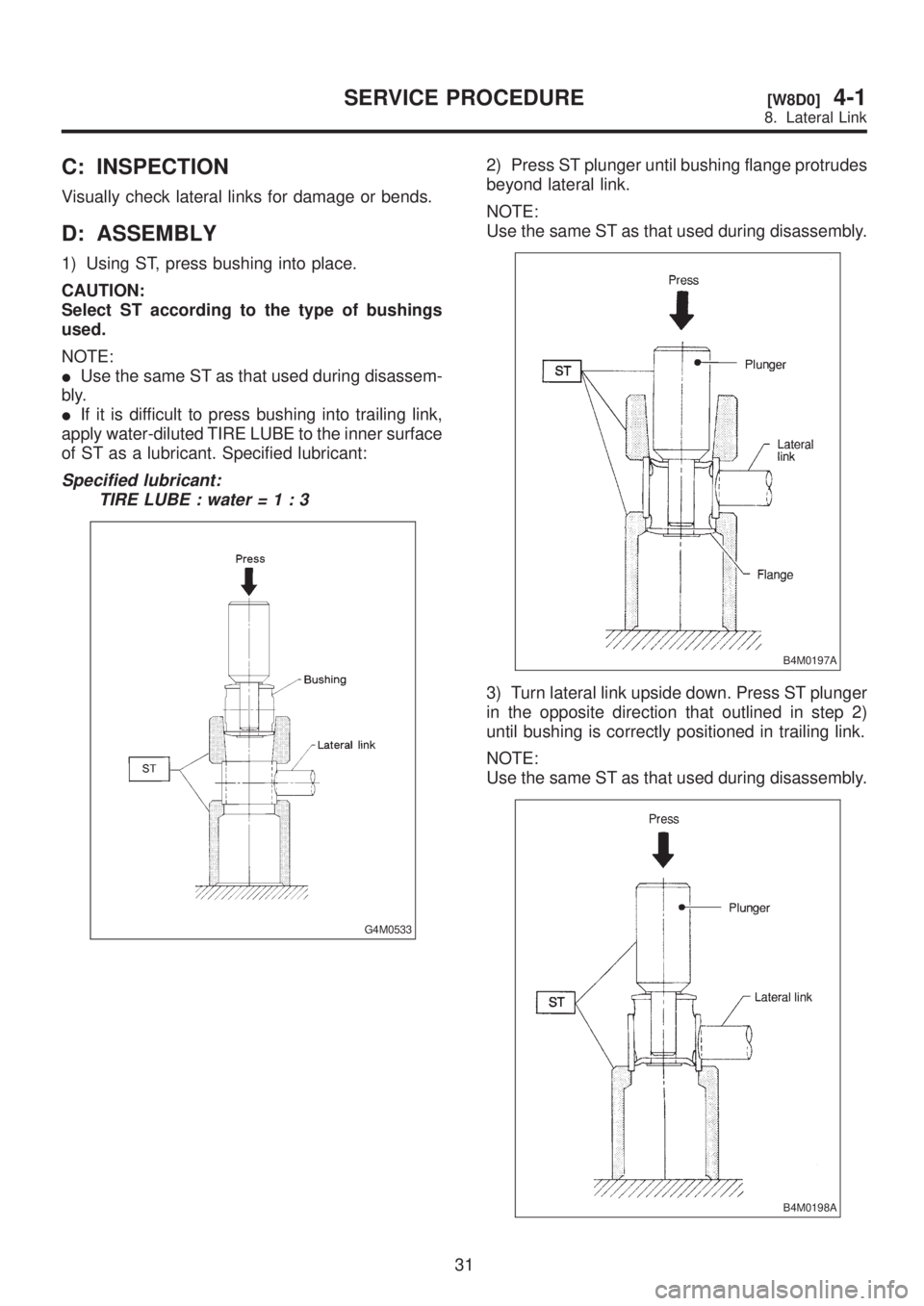
C: INSPECTION
Visually check lateral links for damage or bends.
D: ASSEMBLY
1) Using ST, press bushing into place.
CAUTION:
Select ST according to the type of bushings
used.
NOTE:
IUse the same ST as that used during disassem-
bly.
IIf it is difficult to press bushing into trailing link,
apply water-diluted TIRE LUBE to the inner surface
of ST as a lubricant. Specified lubricant:
Specified lubricant:
TIRE LUBE : water=1:3
G4M0533
2) Press ST plunger until bushing flange protrudes
beyond lateral link.
NOTE:
Use the same ST as that used during disassembly.
B4M0197A
3) Turn lateral link upside down. Press ST plunger
in the opposite direction that outlined in step 2)
until bushing is correctly positioned in trailing link.
NOTE:
Use the same ST as that used during disassembly.
B4M0198A
31
[W8D0]4-1SERVICE PROCEDURE
8. Lateral Link