1999 SUBARU LEGACY diff
[x] Cancel search: diffPage 905 of 1456
D: ASSEMBLY
1. WHEEL CYLINDER
1) Clean all parts in brake fluid. Check and replace
faulty parts.
ICup and boot for damage or fatigue
ICylinder, piston and spring or damage or rust
formation
2) Assembly is the reverse order of disassembly.
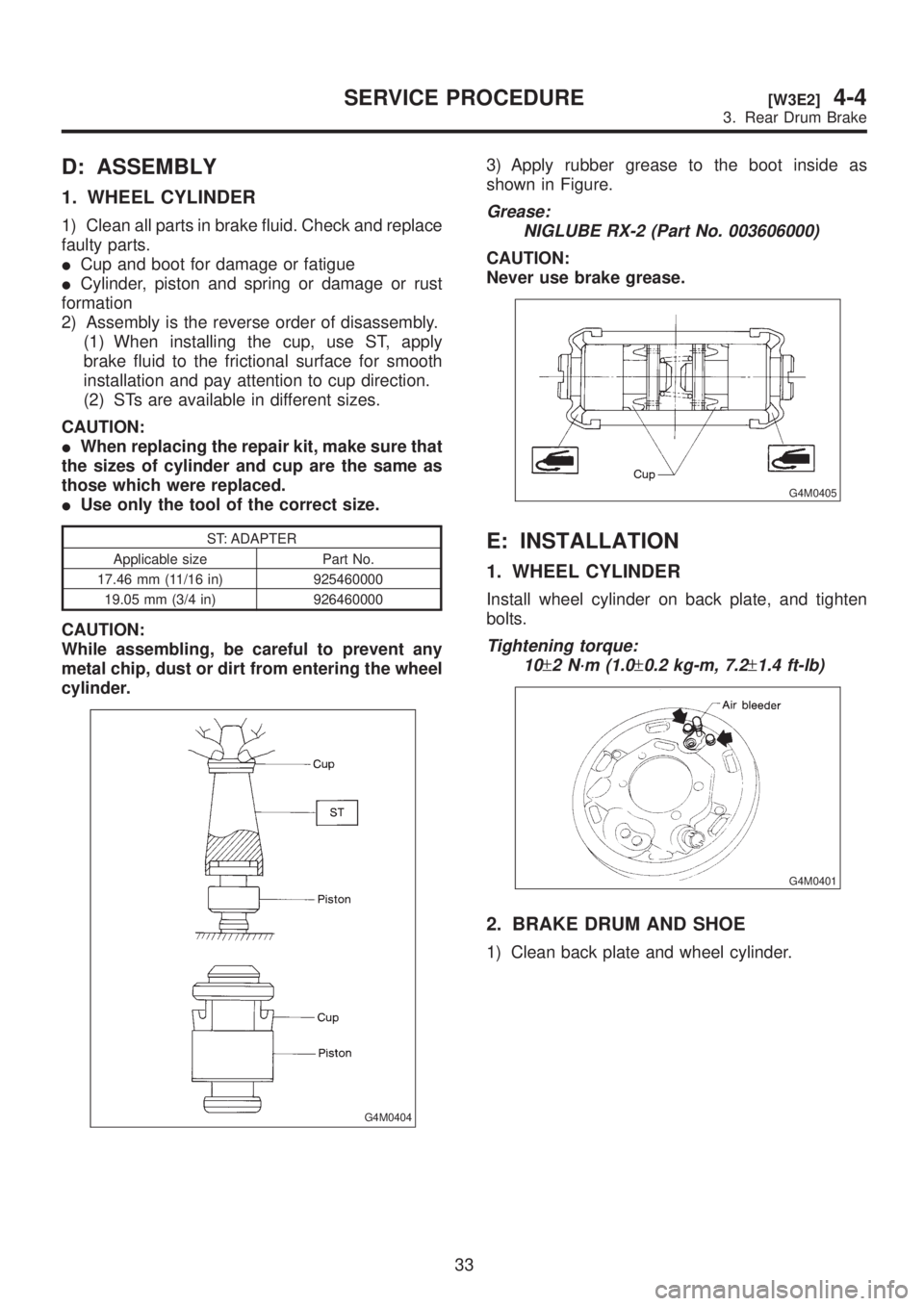
(1) When installing the cup, use ST, apply
brake fluid to the frictional surface for smooth
installation and pay attention to cup direction.
(2) STs are available in different sizes.
CAUTION:
IWhen replacing the repair kit, make sure that
the sizes of cylinder and cup are the same as
those which were replaced.
IUse only the tool of the correct size.
ST: ADAPTER
Applicable size Part No.
17.46 mm (11/16 in) 925460000
19.05 mm (3/4 in) 926460000
CAUTION:
While assembling, be careful to prevent any
metal chip, dust or dirt from entering the wheel
cylinder.
G4M0404
3) Apply rubber grease to the boot inside as
shown in Figure.
Grease:
NIGLUBE RX-2 (Part No. 003606000)
CAUTION:
Never use brake grease.
G4M0405
E: INSTALLATION
1. WHEEL CYLINDER
Install wheel cylinder on back plate, and tighten
bolts.
Tightening torque:
10
±2 N´m (1.0±0.2 kg-m, 7.2±1.4 ft-lb)
G4M0401
2. BRAKE DRUM AND SHOE
1) Clean back plate and wheel cylinder.
33
[W3E2]4-4SERVICE PROCEDURE
3. Rear Drum Brake
Page 924 of 1456
11. Air Bleeding
A: GENERAL RULES FOR
EFFECTIVE BLEEDING
1) Start with the brakes (wheels) connecting to the
secondary chamber of the master cylinder.
2) The time interval between two brake pedal
operations (from the time when the pedal is
released to the time when it is depressed another
time) shall be approximately 3 seconds.
3) The air bleeder on each brake shall be released
for 1 to 2 seconds.
B: BLEEDING PROCEDURE
CAUTION:
IThe FMVSS No. 116, fresh DOT3 or 4 brake
fluid must be used.
ICover bleeder with waste cloth, when loos-
ening it, to prevent brake fluid from being
splashed over surrounding parts.
IAvoid mixing different brands of brake fluid
to prevent degrading the quality of the fluid.
IBe careful not to allow dirt or dust to get into
the reservoir tank.
NOTE:
IDuring bleeding operation, keep the brake
reserve tank filled with brake fluid to eliminate entry
of air.
IBrake pedal operating must be very slow.
IFor convenience and safety, it is advisable to
have two men working.
1) Make sure that there is no leak from joints and
connections of the brake system.2) Fit one end of vinyl tube into the air bleeder and
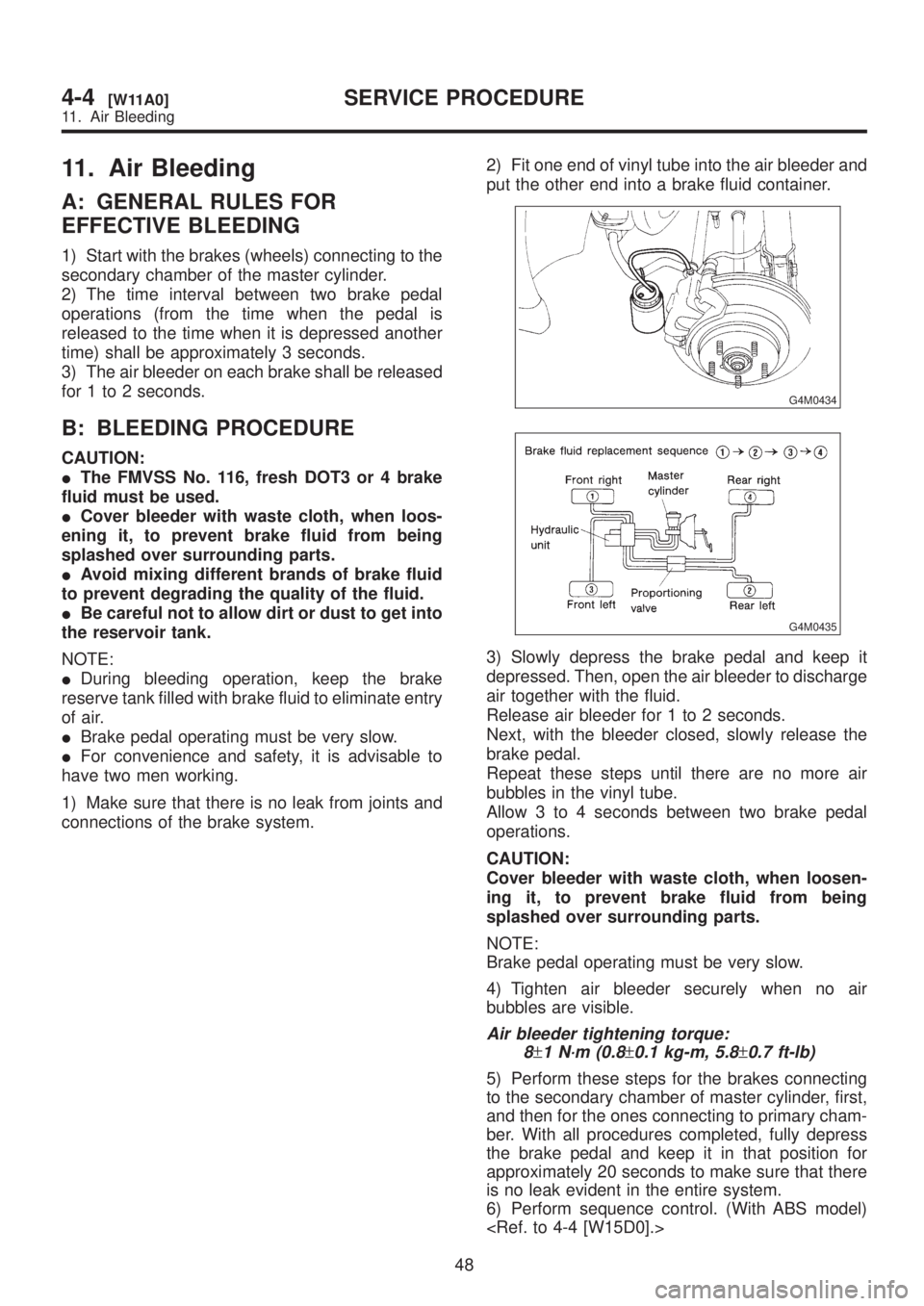
put the other end into a brake fluid container.
G4M0434
G4M0435
3) Slowly depress the brake pedal and keep it
depressed. Then, open the air bleeder to discharge
air together with the fluid.
Release air bleeder for 1 to 2 seconds.
Next, with the bleeder closed, slowly release the
brake pedal.
Repeat these steps until there are no more air
bubbles in the vinyl tube.
Allow 3 to 4 seconds between two brake pedal
operations.
CAUTION:
Cover bleeder with waste cloth, when loosen-
ing it, to prevent brake fluid from being
splashed over surrounding parts.
NOTE:
Brake pedal operating must be very slow.
4) Tighten air bleeder securely when no air
bubbles are visible.
Air bleeder tightening torque:
8
±1 N´m (0.8±0.1 kg-m, 5.8±0.7 ft-lb)
5) Perform these steps for the brakes connecting
to the secondary chamber of master cylinder, first,
and then for the ones connecting to primary cham-
ber. With all procedures completed, fully depress
the brake pedal and keep it in that position for
approximately 20 seconds to make sure that there
is no leak evident in the entire system.
6) Perform sequence control. (With ABS model)
48
4-4[W11A0]SERVICE PROCEDURE
11. Air Bleeding
Page 925 of 1456
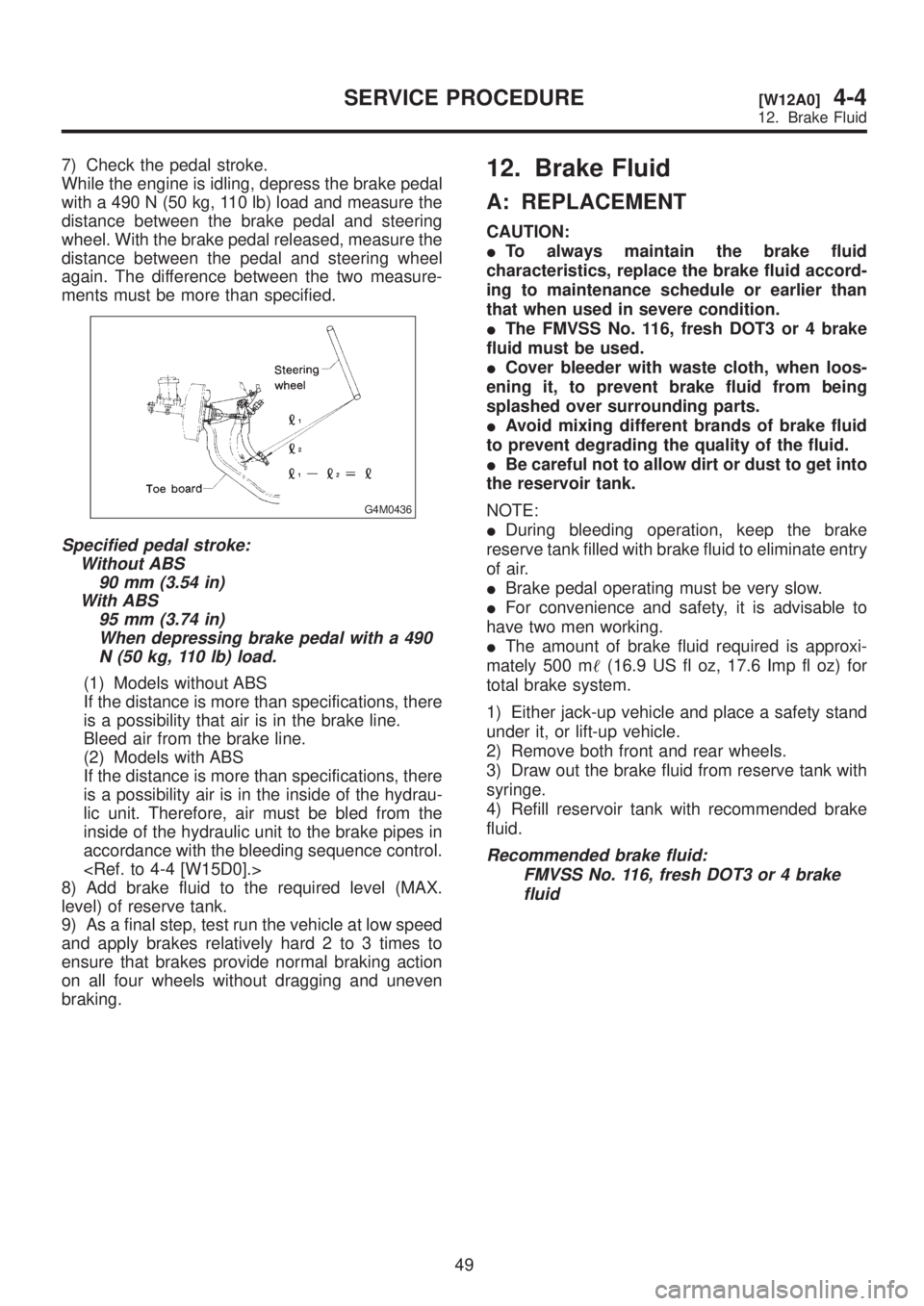
7) Check the pedal stroke.
While the engine is idling, depress the brake pedal
with a 490 N (50 kg, 110 lb) load and measure the
distance between the brake pedal and steering
wheel. With the brake pedal released, measure the
distance between the pedal and steering wheel
again. The difference between the two measure-
ments must be more than specified.
G4M0436
Specified pedal stroke:
Without ABS
90 mm (3.54 in)
With ABS
95 mm (3.74 in)
When depressing brake pedal with a 490
N (50 kg, 110 lb) load.
(1) Models without ABS
If the distance is more than specifications, there
is a possibility that air is in the brake line.
Bleed air from the brake line.
(2) Models with ABS
If the distance is more than specifications, there
is a possibility air is in the inside of the hydrau-
lic unit. Therefore, air must be bled from the
inside of the hydraulic unit to the brake pipes in
accordance with the bleeding sequence control.
8) Add brake fluid to the required level (MAX.
level) of reserve tank.
9) As a final step, test run the vehicle at low speed
and apply brakes relatively hard 2 to 3 times to
ensure that brakes provide normal braking action
on all four wheels without dragging and uneven
braking.
12. Brake Fluid
A: REPLACEMENT
CAUTION:
ITo always maintain the brake fluid
characteristics, replace the brake fluid accord-
ing to maintenance schedule or earlier than
that when used in severe condition.
IThe FMVSS No. 116, fresh DOT3 or 4 brake
fluid must be used.
ICover bleeder with waste cloth, when loos-
ening it, to prevent brake fluid from being
splashed over surrounding parts.
IAvoid mixing different brands of brake fluid
to prevent degrading the quality of the fluid.
IBe careful not to allow dirt or dust to get into
the reservoir tank.
NOTE:
IDuring bleeding operation, keep the brake
reserve tank filled with brake fluid to eliminate entry
of air.
IBrake pedal operating must be very slow.
IFor convenience and safety, it is advisable to
have two men working.
IThe amount of brake fluid required is approxi-
mately 500 m(16.9 US fl oz, 17.6 Imp fl oz) for
total brake system.
1) Either jack-up vehicle and place a safety stand
under it, or lift-up vehicle.
2) Remove both front and rear wheels.
3) Draw out the brake fluid from reserve tank with
syringe.
4) Refill reservoir tank with recommended brake
fluid.
Recommended brake fluid:
FMVSS No. 116, fresh DOT3 or 4 brake
fluid
49
[W12A0]4-4SERVICE PROCEDURE
12. Brake Fluid
Page 926 of 1456
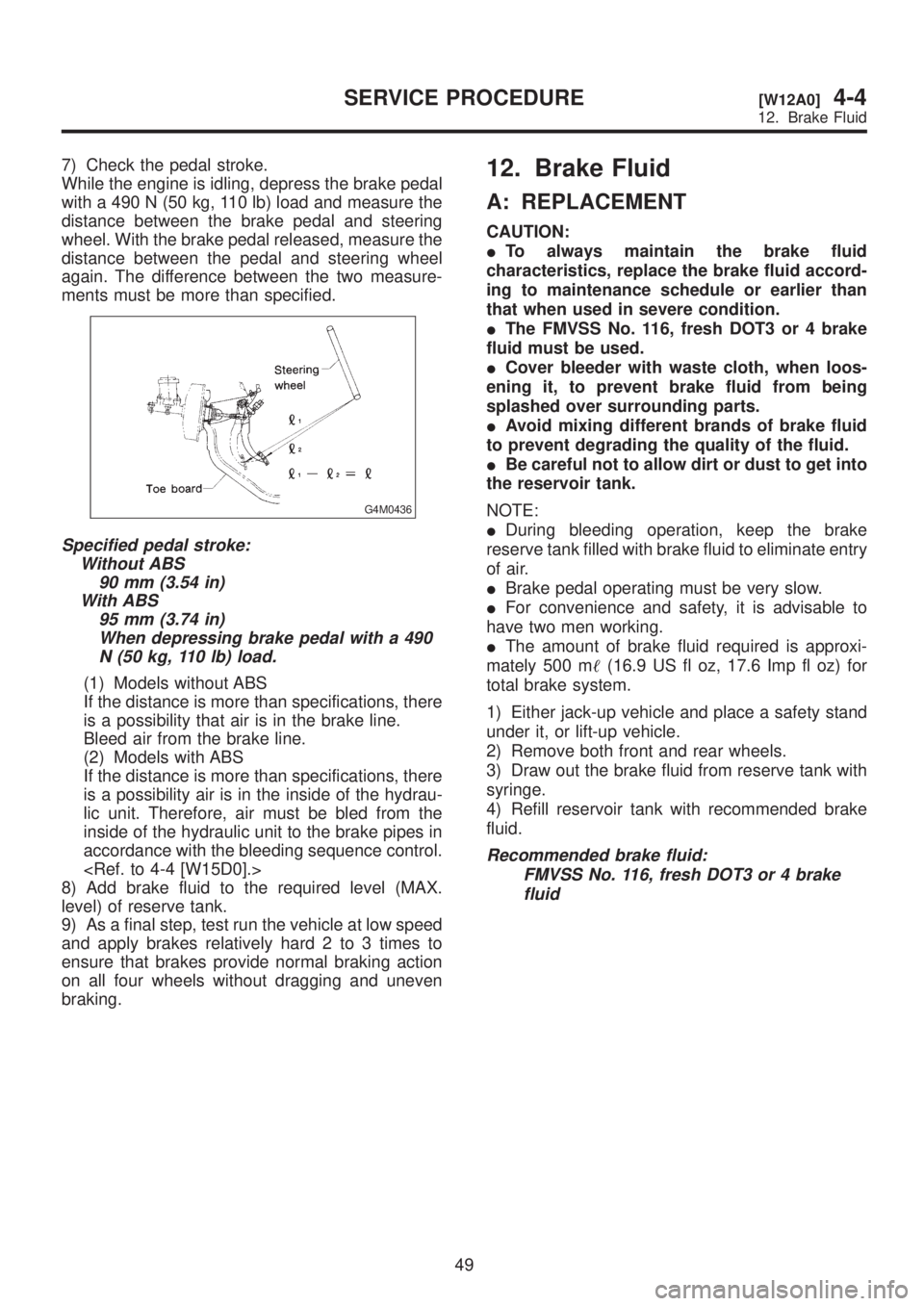
7) Check the pedal stroke.
While the engine is idling, depress the brake pedal
with a 490 N (50 kg, 110 lb) load and measure the
distance between the brake pedal and steering
wheel. With the brake pedal released, measure the
distance between the pedal and steering wheel
again. The difference between the two measure-
ments must be more than specified.
G4M0436
Specified pedal stroke:
Without ABS
90 mm (3.54 in)
With ABS
95 mm (3.74 in)
When depressing brake pedal with a 490
N (50 kg, 110 lb) load.
(1) Models without ABS
If the distance is more than specifications, there
is a possibility that air is in the brake line.
Bleed air from the brake line.
(2) Models with ABS
If the distance is more than specifications, there
is a possibility air is in the inside of the hydrau-
lic unit. Therefore, air must be bled from the
inside of the hydraulic unit to the brake pipes in
accordance with the bleeding sequence control.
8) Add brake fluid to the required level (MAX.
level) of reserve tank.
9) As a final step, test run the vehicle at low speed
and apply brakes relatively hard 2 to 3 times to
ensure that brakes provide normal braking action
on all four wheels without dragging and uneven
braking.
12. Brake Fluid
A: REPLACEMENT
CAUTION:
ITo always maintain the brake fluid
characteristics, replace the brake fluid accord-
ing to maintenance schedule or earlier than
that when used in severe condition.
IThe FMVSS No. 116, fresh DOT3 or 4 brake
fluid must be used.
ICover bleeder with waste cloth, when loos-
ening it, to prevent brake fluid from being
splashed over surrounding parts.
IAvoid mixing different brands of brake fluid
to prevent degrading the quality of the fluid.
IBe careful not to allow dirt or dust to get into
the reservoir tank.
NOTE:
IDuring bleeding operation, keep the brake
reserve tank filled with brake fluid to eliminate entry
of air.
IBrake pedal operating must be very slow.
IFor convenience and safety, it is advisable to
have two men working.
IThe amount of brake fluid required is approxi-
mately 500 m(16.9 US fl oz, 17.6 Imp fl oz) for
total brake system.
1) Either jack-up vehicle and place a safety stand
under it, or lift-up vehicle.
2) Remove both front and rear wheels.
3) Draw out the brake fluid from reserve tank with
syringe.
4) Refill reservoir tank with recommended brake
fluid.
Recommended brake fluid:
FMVSS No. 116, fresh DOT3 or 4 brake
fluid
49
[W12A0]4-4SERVICE PROCEDURE
12. Brake Fluid
Page 931 of 1456

4) Install front ABS sensor on strut and wheel
apron bracket.
Tightening torque:
32
±10 N´m (3.3±1.0 kg-m, 24±7 ft-lb)
B4M1181A
5) Place a thickness gauge between ABS sensor's
pole piece and tone wheel's tooth face. After stan-
dard clearance is obtained over the entire
perimeter, tighten ABS sensor on housing to speci-
fied torque.
ABS sensor standard clearance:
0.9 Ð 1.4 mm (0.035 Ð 0.055 in)
Tightening torque:
32
±10 N´m (3.3±1.0 kg-m, 24±7 ft-lb)
CAUTION:
Check the marks on the harness to make sure
that no distortion exists. (RH: white, LH: yel-
low)
NOTE:
If the clearance is outside specifications, readjust.
2. REAR ABS SENSOR
1) Install rear tone wheel on hub, then rear hous-
ing on hub.
2) Temporarily install rear ABS sensor on back
plate.
CAUTION:
Be careful not to strike ABS sensor's pole
piece and tone wheel's teeth against adjacent
metal parts during installation.
B4M1182A
3) Install rear drive shaft to rear housing and rear
differential spindle.
Tightening torque:
32
±10 N´m (3.3±1.0 kg-m, 24±7 ft-lb)
G4M0453
5) Place a thickness gauge between ABS sensor's
pole piece and tone wheel's tooth face. After stan-
dard clearance is obtained over the entire
perimeter, tighten ABS sensor on back plate to
specified torque.
ABS sensor standard clearance:
0.7 Ð 1.2 mm (0.028 Ð 0.047 in)
Tightening torque:
32
±10 N´m (3.3±1.0 kg-m, 24±7 ft-lb)
CAUTION:
Check the marks on the harness to make sure
that no distortion exists. (RH: white, LH: yel-
low)
NOTE:
If the clearance is outside specifications, readjust.
54
4-4[W14C2]SERVICE PROCEDURE
14. ABS Sensor
Page 962 of 1456
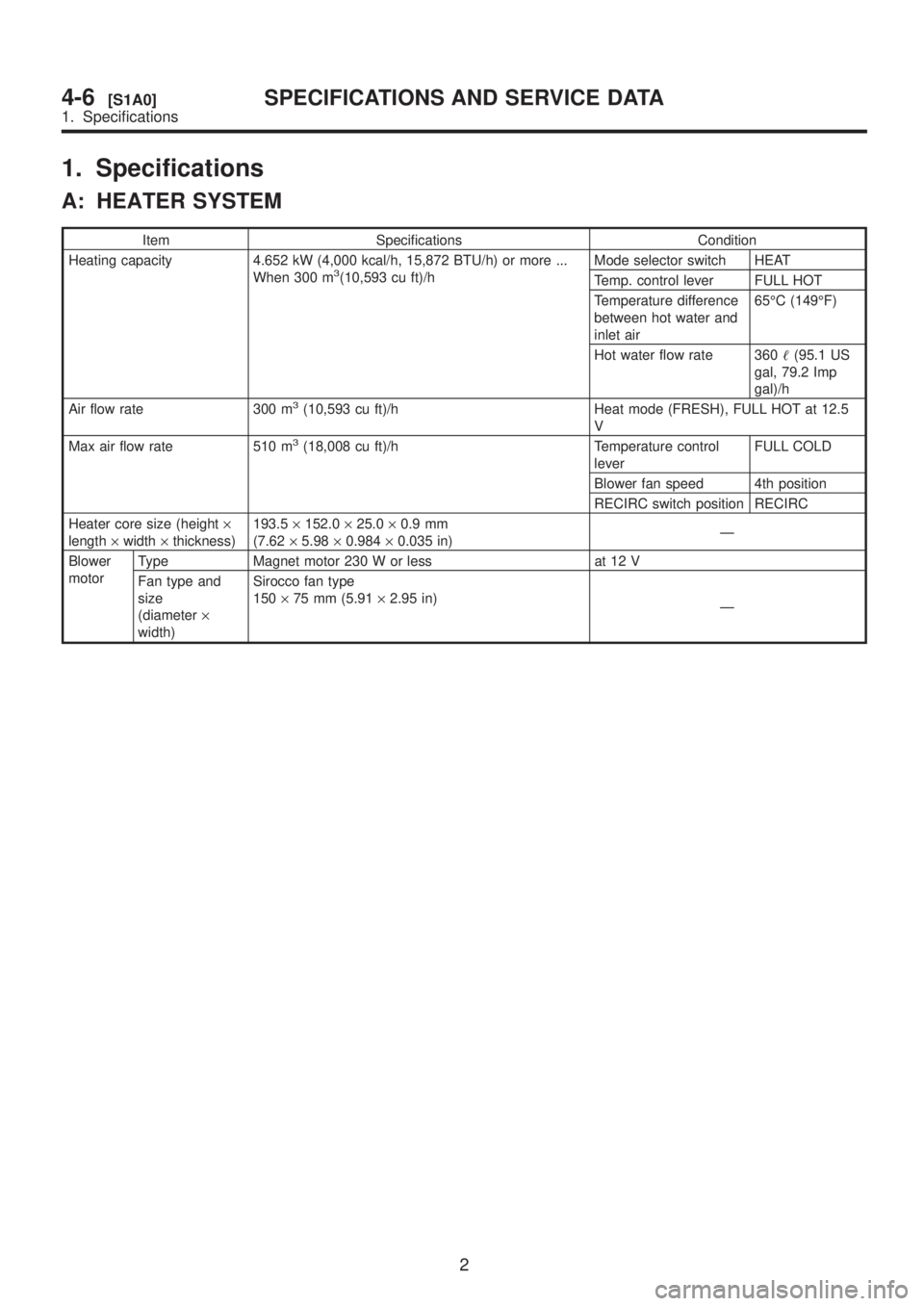
1. Specifications
A: HEATER SYSTEM
Item Specifications Condition
Heating capacity 4.652 kW (4,000 kcal/h, 15,872 BTU/h) or more ...
When 300 m
3(10,593 cu ft)/hMode selector switch HEAT
Temp. control lever FULL HOT
Temperature difference
between hot water and
inlet air65ÉC (149ÉF)
Hot water flow rate 360(95.1 US
gal, 79.2 Imp
gal)/h
Air flow rate 300 m
3(10,593 cu ft)/h Heat mode (FRESH), FULL HOT at 12.5
V
Max air flow rate 510 m
3(18,008 cu ft)/h Temperature control
leverFULL COLD
Blower fan speed 4th position
RECIRC switch position RECIRC
Heater core size (height´
length´width´thickness)193.5´152.0´25.0´0.9 mm
(7.62´5.98´0.984´0.035 in)Ð
Blower
motorType Magnet motor 230 W or less at 12 V
Fan type and
size
(diameter´
width)Sirocco fan type
150´75 mm (5.91´2.95 in)
Ð
2
4-6[S1A0]SPECIFICATIONS AND SERVICE DATA
1. Specifications
Page 984 of 1456
3. Tools and Equipment
The following section provides information about
the tools and equipment that will be necessary to
properly service the A/C system.
Since equipment may vary slightly depending on
the manufacturer, it is important to always read and
follow the manufacturer's instructions.
CAUTION:
When working on vehicles with the HFC-134a
system, only use HFC-134a specified tools and
parts. Do not mix with CFC-12 tools and parts.
If HFC-134a and CFC-12 refrigerant or com-pressor oil is mixed, poor lubrication will result
and the compressor itself may be destroyed. In
order to help prevent mixing HFC-134a and
CFC-12 parts and liquid, the tool and screw
type and the type of service valves used are
different. The gas leak detectors for the HFC-
134a and CFC-12 systems must also not be
interchanged.
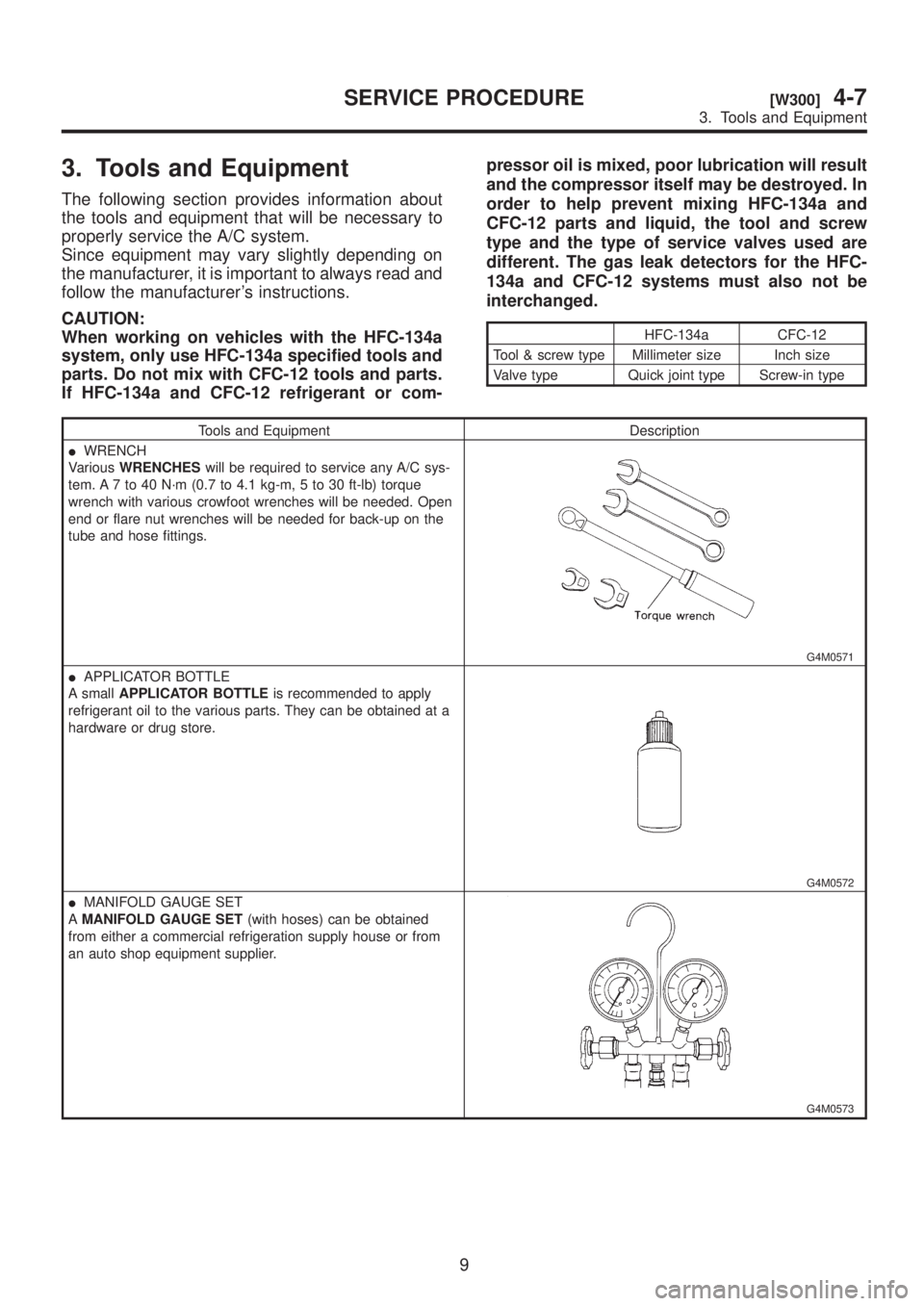
HFC-134a CFC-12
Tool & screw type Millimeter size Inch size
Valve type Quick joint type Screw-in type
Tools and Equipment Description
IWRENCH
VariousWRENCHESwill be required to service any A/C sys-
tem. A 7 to 40 N´m (0.7 to 4.1 kg-m, 5 to 30 ft-lb) torque
wrench with various crowfoot wrenches will be needed. Open
end or flare nut wrenches will be needed for back-up on the
tube and hose fittings.
G4M0571
IAPPLICATOR BOTTLE
A smallAPPLICATOR BOTTLEis recommended to apply
refrigerant oil to the various parts. They can be obtained at a
hardware or drug store.
G4M0572
IMANIFOLD GAUGE SET
AMANIFOLD GAUGE SET(with hoses) can be obtained
from either a commercial refrigeration supply house or from
an auto shop equipment supplier.
G4M0573
9
[W300]4-7SERVICE PROCEDURE
3. Tools and Equipment
Page 1088 of 1456
![SUBARU LEGACY 1999 Service Repair Manual 4) Tilt up assembly:
(1) Remove sunroof flame. <Ref. to 5-1
[W16A2].>
(2) Remove tilt up assembly.
B5M0485A
(3) Installation is in the reverse order of
removal.
B: ADJUSTMENT
1. SEDAN AND WAGON REAR (](/manual-img/17/57435/w960_57435-1087.png "SUBARU LEGACY 1999 Service Repair Manual 4) Tilt up assembly:
(1) Remove sunroof flame. <Ref. to 5-1
[W16A2].>
(2) Remove tilt up assembly.
B5M0485A
(3) Installation is in the reverse order of
removal.
B: ADJUSTMENT
1. SEDAN AND WAGON REAR (")
4) Tilt up assembly:
(1) Remove sunroof flame.
(2) Remove tilt up assembly.
B5M0485A
(3) Installation is in the reverse order of
removal.
B: ADJUSTMENT
1. SEDAN AND WAGON REAR (EXCEPT
OUTBACK)
1) Alignment of height between glass lid assembly
and roof panel:
(1) Remove guide rail cover.
(2) Loosen nuts and adjust height by adding
(Max: two pieces) and extracting (Max: one
piece) shim(s) (Standard: one piece) between
glass lid assembly and lid bracket.
Difference in height between glass lid assem-
bly and roof panel:
0
±0.5 mm (0±0.020 in)
B5M0314B
B5M0315B
2) Alignment of glass lid assembly with roof panel:
(1) Remove guide rail cover.
(2) Loosen nuts and move glass lid assembly
to either side to adjust front, rear, right, and left
side partitions.
Partition clearance:
7.0
±0.5 mm (0.276±0.020 in)
B5M0316A
3) Checking for movement of glass lid assembly
itself:
(1) Before installing sunroof motor, check glass
lid assembly for movement.
(2) Place a cloth on glass lid assembly and sun
shade, and attach a spring scale to glass lid
assembly edge using the cloth.
B5M0317
(3) Pull spring scale to measure force required
to move glass lid assembly.
Force required to move glass lid assembly
and sun shade trim:
Less than 196 N (20 kg, 44 lb)
Considerable effort is required to start glass lid
assembly moving, so take scale reading while
glass lid assembly is moving smoothly.
(4) If force required exceeds specifications,
check the following points:
IGlass lid assembly, sun shade and deflector and
guide rail assembly for improper installation
ICable for seizure
60
5-1[W16B1]SERVICE PROCEDURE
16. Sunroof