Page 261 of 436
Engine Fan Noise
Your vehicle has a clutched engine cooling fan. When
the clutch is engaged, the fan spi.ns faster to provide
more air
to cool the engine. In most everyday driving
conditions, the fan is spinning slower and the clutch is
not fully engaged. This improves
fuel economy and
reduces fan noise. Under heavy vehicle loading, trailer towing and/or high outside temperatures, the fan speed
increases as the clutch more fully engages.
So you may
hear an increase in fan noise. This
is normal and should
not be mistaken as the transmission slipping or making
extra shifts. It is merely the cooling system functioning
properly. The fan will slow down when additional
cooling is not required and the clutch disengages.
You may also hear this
fan noise when you start the engine.
It will
go away as the fan clutch partially disengages.
If a Tire Goes Flat
It’s unusual for a tire to “blow out” while you’re driving,
especially
if you maintain your tires properly. If air goes
out
of a tire, it’s much more likely to leak out slowly.
But if you should ever have
a “blowout,” here are a
few tips about what to expect and what to do:
If a front tire fails, the flat tire will create a drag that
pulls the vehicle toward that side. Take your foot off the
accelerator pedal and grip the steering wheel firmly.
Steer to maintain lane position, and then gently brake to
a stop well out of the traffic lane.
A rear blowout, particularly on a curve, acts much like a
skid and may require the same correction you’d use in
a skid. In any rear blowout, remove your foot from
the accelerator pedal. Get the vehicle under control by
steering the way you want the vehicle to go. It may be
very bumpy and noisy, but
you can still steer. Gently
brake
to a stop -- well off the road if possible.
If a tire goes flat, the next part shows how to
use your
jacking equipment
to change a flat tire safely.
ProCarManuals.com
Page 262 of 436
Changing a Flat Tire
If a tire goes flat, avoid further tire and wheel damage
by driving slowly to a level place. Turn on your hazard
warning flashers.
I A CAUTION:
Changing a tire can cause an injury. The vehicle
can slip
off the jack and roll over you or other
people. You and they could be badly injured.
Find a level place
to change your tire. To help
prevent the vehicle from moving:
1. Set the parking brake firmly.
2. Put an automatic transmission shift
lever in
PARK (P) or shift a manual
transmission to
FIRST (1) or
REVERSE (R).
3. If you have a four-wheel-drive vehicle,
be
sure the transfer case is in a drive
gear
-- not in NEUTRAL (N).
4. Turn off the engine.
CAUTION: (Continued)
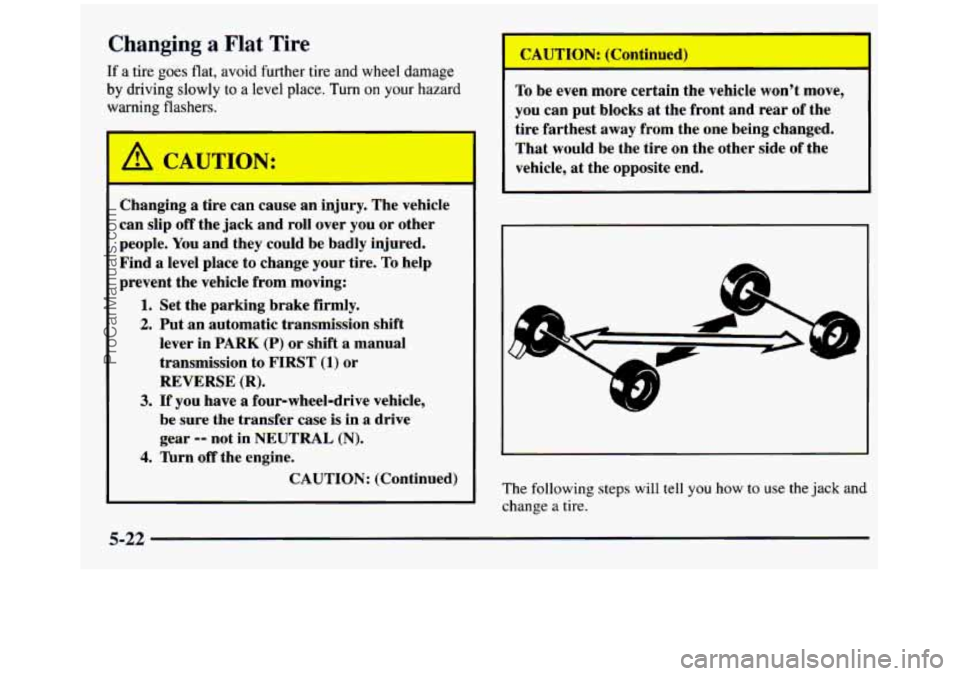
To be even more certain the vehicle won’t move,
you can put blocks at the front and rear of the
tire farthest away from the one being changed.
That would be the tire on the other side
of the
vehicle, at the opposite end.
The following steps will tell
you how to use the jack and
change
a tire.
5-22
ProCarManuals.com
Page 271 of 436
NOTICE:
Improperly tightened wheel nuts can lead to
brake pulsation and rotor damage.
To avoid
expensive brake repairs, evenly tighten the wheel
nuts in the proper sequence and
to the proper
torque specification.
9. Put the wheel trim back on. For vehicles with plastic
wheel nut caps, tighten the caps until they are finger
tight, then tighten them an additional one-half
TI
with the ratchet and wheel wrench.
Storing a Flat or Spare Tire and Tools
'A
Storing a jack, a tire or other equipment in the
passenger compartment
of the vehicle could
cause injury. In
a sudden stop or collision, loose
equipment could strike someone. Store all these
in the proper place.
Store the flat tire where the spare tire was stored.
5-31
ProCarManuals.com
Page 277 of 436
Section 6 Service and Appearance Care
Here you will find information about the care of your vehicle. This section begins with service and fuel information,
and then it shows how
to check important fluid and lubricant levels. There is also technical information about your
vehicle, and a part devoted to its appearance care.
6-2
6-
3
6-4
6-5
6-8
6- 14
6- 15
6- 19
6-2 1
6-25
6-26
6-26 6-27
6-29
6-32
6-32 Service
Fuel (Gasoline Engine)
Fuels
in Foreign Countries - - Gasoline
Engines
Filling Your Tank
Checking Things Under the Hood
Noise Control System
Engine Oil (Gasoline Engine)
Air Cleaner Filter (Gasoline Engines)
Automatic Transmission Fluid
Manual Transmission Fluid
Hydraulic Clutch
Rear Axle
Four-wheel Drive
Engine Coolant Radiator Pressure Cap (Gasoline Engine)
Thermostat 6-33
6-33 6-35
6-39
6-39
6-49 6-50
6-59
6-60
6-64
6-68
6-69
6-70 6-75
6-76
6-78 Power Steering Fluid
Windshield Washer Fluid
Brakes
Battery
Bulb Replacement
Windshield Wiper Blade
R
Tires
Appearance Care .eplacement
Cleaning the Inside
of Your Vehicle
Cleaning
the Outside of Your Vehicle
Appearance Care Materials
Chart
Vehicle Identification Number (VIN)
Electrical System Replacement Bulbs
Capacities and Specifications
Air Conditioning Specifications
ProCarManuals.com
Page 284 of 436
Checking Things Under the Hood
I A CAUTION:
If your vehicle has air conditioning, the auxiliary
engine fan under the hood can
start up and
injure you even when the engine
is not running.
Keep hands, clothing and tools away from any
underhood electric
fan.
t -4
Things that burn can get on hot engine parts and
start a fire. These include liquids like gasoline or
diesel fuel, oil, coolant, brake fluid, windshield
washer and other fluids, and plastic or rubber. You or others could be burned. Be careful
not to drop or spill things that will burn onto
a hot engine.
ProCarManuals.com
Page 287 of 436
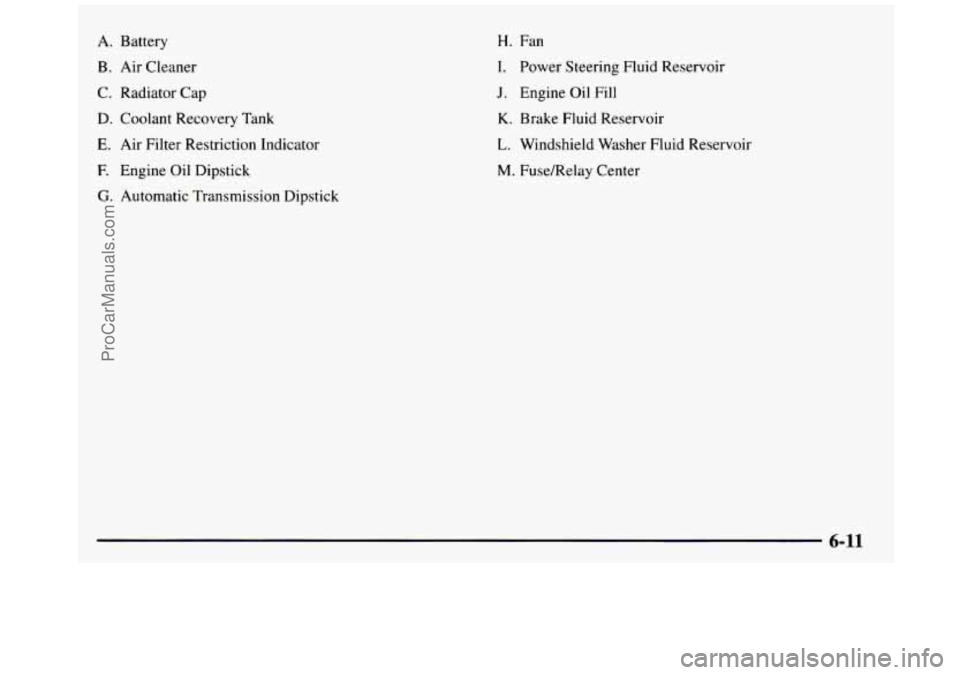
A. Battery
B. Air Cleaner
C. Radiator Cap
D. Coolant Recovery Tank
E. Air Filter Restriction Indicator
F. Engine Oil Dipstick
G. Automatic Transmission Dipstick
H. Fan
I. Power Steering Fluid Reservoir
J. Engine Oil Fill
K. Brake Fluid Reservoir
L. Windshield Washer Fluid Reservoir
M. Fuse/Relay Center
6-11
ProCarManuals.com
Page 289 of 436
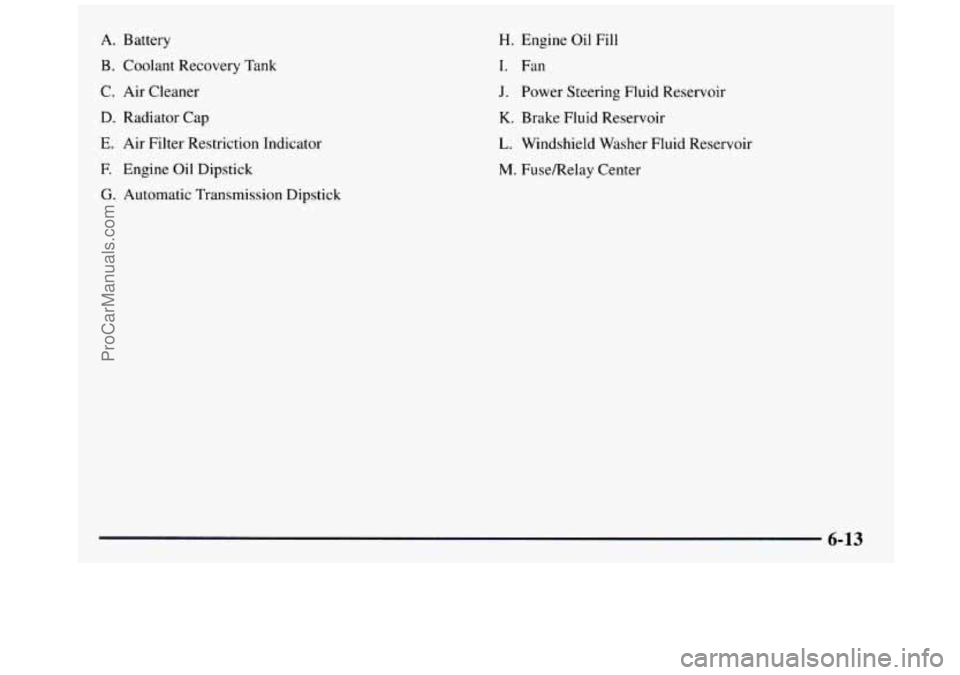
A. Battery
B. Coolant Recovery Tank
C. Air Cleaner
D. Radiator Cap
E. Air Filter Restriction Indicator
E Engine Oil Dipstick
G. Automatic Transmission Dipstick
H. Engine Oil Fill
I. Fan
J. Power Steering Fluid Reservoir
K. Brake Fluid Reservoir
L. Windshield Washer Fluid Reservoir
M. FuseRelay Center
6-13
ProCarManuals.com
Page 299 of 436
Checking the Fluid Hot or Cold
Park your vehicle on a level place. Keep the
engine running.
With the parking brake applied, place the shift lever
in PARK
(P).
0 With your foot on the brake pedal, move the shift
lever through each gear range, pausing
for about
three seconds in each range. Then, position the shift
lever in PARK (P). Then, without shutting
off the engine, follow these steps:
0 Let the
engine run at idle for three minutes or more.
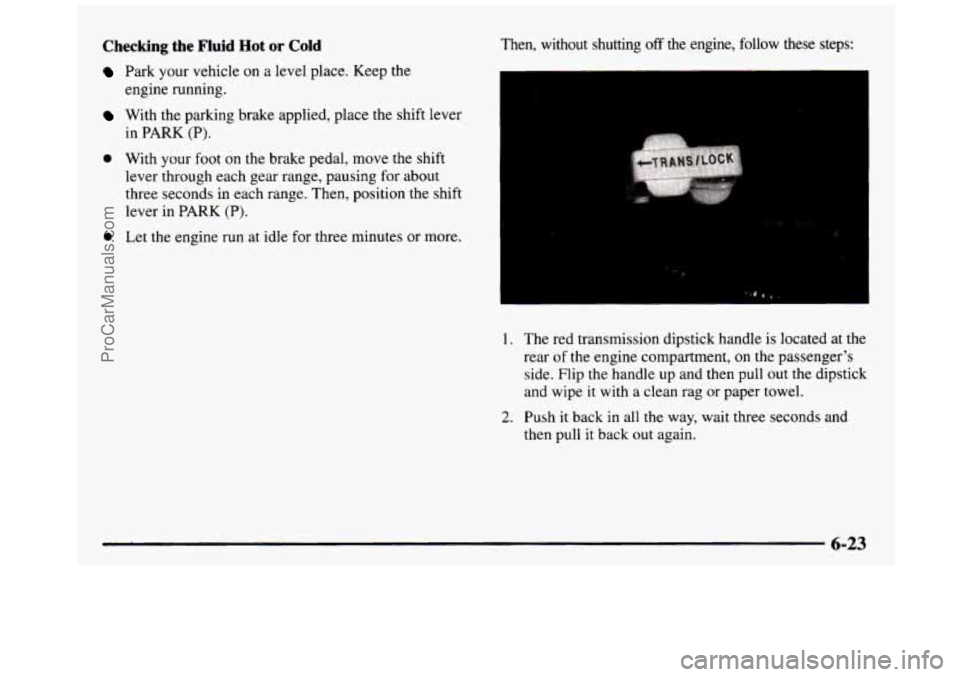
1. The red transmission dipstick handle is located at the
rear
of the engine compartment, on the passenger's
side. Flip the handle
up and then pull out the dipstick
and wipe
it with a clean rag or paper towel.
2. Push it back in all the way, wait three seconds and
then
pull it back out again.
ProCarManuals.com