1997 GMC SIERRA tires
[x] Cancel search: tiresPage 98 of 436
$-Wheel High (4H): This setting engages your front
axle
to help drive your vehicle. Use 4H when you need
extra traction, such as on wet or icy roads, or in most
off-road situations.
Neutral (N): Shift to this setting only when your vehicle
needs to be towed or when using a power take-off.
4-Wheel Low (4L): This setting also engages your front
axle to give you extra power and also gives you a higher
driveline ratio. It should
be used only for off-road driving.
You can shift from 2-WHEEL HIGH (2H) to 4-WHEEL
HIGH (4H) or from 4-WHEEL HIGH
(4H) to
2-WHEEL HIGH (2H) while the vehicle is moving.
Your front axle will engage faster if
you take your foot
off of the accelerator for a few seconds after you shift.
In extremely cold weather, it may be necessary
to stop
or slow the vehicle
to shift into 4-WHEEL HIGH (4H). To
shift into or out of 4-WHEEL LOW (4L) or
NEUTRAL
(N):
1. Slow the vehicle to a roll, about 1 to 3 mph (2 to
5 kmh) and shift an automatic transmission into
NEUTRAL (N), or with a manual transmission,
press the clutch pedal.
2. Shift the transfer case shift lever in one continuous motion.
Don’t pause in NEUTRAL
(N) as you shift the transfer
case into 4-WHEEL LOW (4L), or your gears
could clash.
Remember that driving in 4-WHEEL HIGH (4H) or
4-WHEEL LOW (4L) may reduce fuel economy.
Also,
driving in four-wheel drive on dry pavement could
cause your tires to wear faster and make your transfer
case harder to shift and run noisier.
When your headlamps or parking lamps are on,
rotate the thumb wheel next to the headlamp switch
up to brighten or down
to dim your transfer case
indicator light.
2-24
ProCarManuals.com
Page 184 of 436
Control of a Vehicle Braking
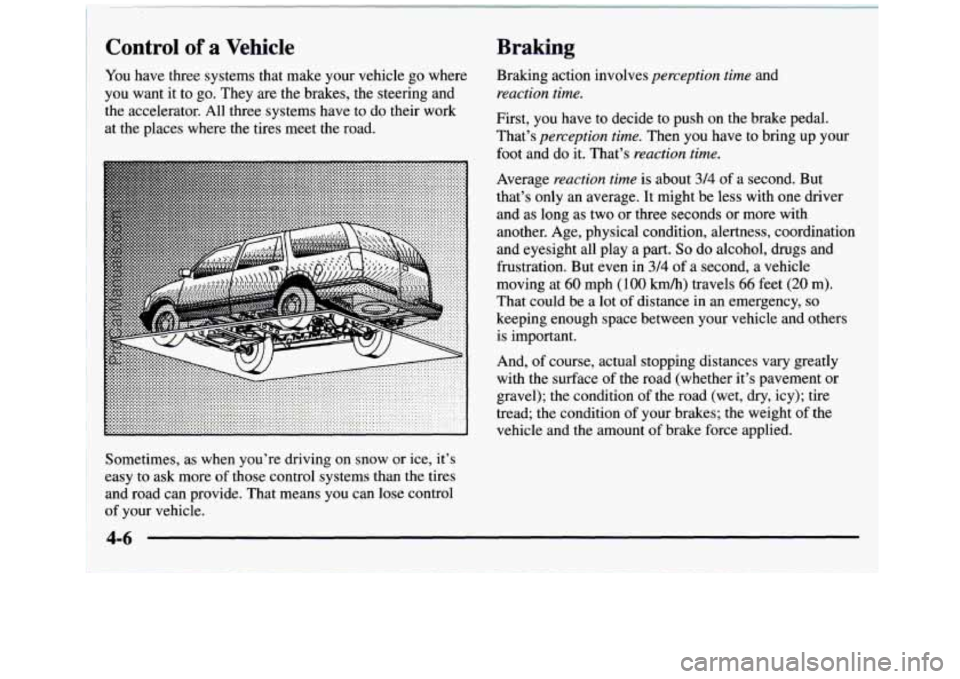
You have three systems that make your vehicle go where
you want it
to go. They are the brakes, the steering and
the accelerator. All three systems have to do their work
at the places where the tires meet the road. Braking action involves
perception
time and
reaction time.
First, you have to decide to push on the brake pedal.
That’s
perception time. Then you have to bring up your
foot and do it. That’s
reaction time.
Average reaction time is about 314 of a second. But
that’s only an average. It might be less with one driver
and as long as two or three seconds or more with
another. Age, physical condition, alertness, coordination
and eyesight all play a
part. So do alcohol, drugs and
frustration. But even in
3/4 of a second, a vehicle
moving at
60 mph (100 km/h) travels 66 feet (20 m).
That could be a lot
of distance in an emergency, so
keeping enough space between your vehicle and others
is important.
And, of course, actual stopping distances vary greatly
with the surface of the road (whether it’s pavement or
gravel); the condition
of the road (wet, dry, icy); tire
tread; the condition of your brakes; the weight of the
vehicle and the amount
of brake force applied.
Sometimes, as when you’re driving on snow or ice, it’s
easy to ask more
of those control systems than the tires
and road can provide. That means you can lose control
of your vehicle.
4-6
ProCarManuals.com
Page 187 of 436
Remember: Anti-lock doesn’t change the time you need
to get your foot up to the brake pedal or always decrease
stopping distance. If you get too close to the vehicle in
front of you, you won’t have time to apply your brakes
if that vehicle suddenly slows or stops. Always leave
enough room up ahead
to stop, even though you have
anti-lock brakes.
Using Anti-Lock
Don’t pump the brakes. Just hold the brake pedal down
and let anti-lock work for you. You may feel the brakes
vibrate, or you may notice some noise, but this is normal.
On vehicles
with four-wheel drive, your anti-lock brakes
work at all times
-- whether you are in two-wheel drive
or four-wheel drive.
Braking in Emergencies
With anti-lock, you can steer and brake at the same
time. In many emergencies, steering can help you more
than even the very best braking.
Steering
Power Steering
If you lose power steering assist because the engine
stops or the system is not functioning, you can steer but
it will take much more effort.
Variable Effort Steering
This system varies the amount of steering effort
proportionate
to your vehicle speed. Steering is easier
at lower speeds for maneuvering and parking ease. As
your vehicle speed increases, the steering effort also
increases.
At highway speeds, the amount of steering
effort is increased for vehicle control and stability.
Steering Tips
Driving on Curves
It’s important to take curves at a reasonable speed.
A lot of the “driver lost control” accidents mentioned on
the news happen on curves. Here’s
why:
Experienced driver or beginner, each of us is subject to
the same laws of physics when driving on curves. The
traction of the tires against the road surface makes
it
possible for the vehicle to change its path when you turn
the front wheels. If there’s no traction, inertia will keep
the vehicle going in the same direction.
If you’ve ever
tried to steer a vehicle on wet ice, you’ll understand this.
The traction you can get
in a curve depends on the
condition of your tires and the road surface, the angle
at
which the curve is banked, and your speed. While you’re
in a curve, speed is the one factor you can control.
ProCarManuals.com
Page 188 of 436
Suppose you’re steering through a sharp,curve. Then you
suddenly accelerate.
Both control systems -- steering and
acceleration
-- have to do their work where the tires meet
the road. Adding the sudden acceleration can demand too
much
of those places. You can lose control.
What should you do if this ever happens? Ease up on the
accelerator pedal, steer the vehicle
the way you want it
to go, and slow down.
Speed limit signs near curves
warn that you should
adjust your speed. Of course,
the posted speeds are
based on good weather and road conditions. Under less
favorable conditions you’ll want to go slower.
If you need to reduce your speed as you approach a
curve, do
it before you enter the curve, while your front
wheels are straight ahead.
Try to adjust your speed so you can “drive” through the
curve. Maintain a reasonable, steady speed. Wait to
accelerate until you are out
of the curve, and then
accelerate gently into the straightaway.
Steering in Emergencies
There are times when steering can be more effective
than braking. For example, you come over a hill
and
find a truck stopped in your lane, or a car suddenly pulls
out from nowhere, or a child darts out from between
parked cars and stops right in front of you. You can
avoid these problems by braking
-- if you can stop
in time. But sometimes you can’t; there isn’t room.
That’s the time for evasive action -- steering around
the problem.
Your vehicle can perform very well in emergencies like
these. First apply your brakes. (See “Braking
in
Emergencies” earlier in this section.) It is better to
remove as much speed as you can from a possible
collision. Then steer around the problem, to the left or
right depending on the space available.
4-10
ProCarManuals.com
Page 191 of 436
If other cars are lined up to pass a slow vehicle, wait
your turn. But take care that someone
isn’t trying to
pass you as
you pull out to pass the slow vehicle.
Remember to glance over your shoulder and check
the blind spot.
Check your mirrors, glance over your shoulder and
start your left lane change signal before moving out
of the right lane to pass. When you are far enough
ahead of the passed vehicle to see its front
in your
inside mirror, activate your right lane change signal
and move back into the right lane. (Remember that
if
your right outside mirror is convex, the vehicle you
just passed may seem to be farther away from you
than
it really is.)
on two-lane roads. Reconsider before passing the
next vehicle.
Don’t overtake a slowly moving vehicle too rapidly.
Even though the brake lamps are not flashing,
it may
be slowing down or starting to turn.
following driver to get ahead of you. Perhaps you
can ease a little to the right.
0 Try not to pass more than one vehicle at a time
If you’re being passed, make it easy for the
Loss of Control
Let’s review what driving experts say about what
happens when
the three control systems (brakes, steering
and acceleration) don’t have enough friction where the
tires meet the road to do what the driver has asked.
In
any emergency, don’t give up. Keep trying to steer and
constantly seek
an escape route or area of less danger.
Skidding
In a skid, a driver can lose control of the vehicle.
Defensive drivers avoid most skids by taking reasonable
care suited to existing conditions, and by not
“overdriving” those conditions. But skids are always
possible.
The three types of skids correspond to your vehicle’s
three control systems. In
the braking skid, your wheels
aren’t rolling. In
the steering or cornering skid, too
much speed or steering
in a curve causes tires to slip and
lose cornering force. And
in the acceleration skid, too
much throttle causes the driving wheels to spin.
A cornering skid and an acceleration skid are best
handled by easing your foot off the accelerator pedal.
4-13
. ..
ProCarManuals.com
Page 192 of 436
If your vehicle starts to slide, ease your foot off the
accelerator pedal and quickly steer the way
you want the
vehicle to go. If you start steering quickly enough, your
vehicle may straighten out. Always be ready for
a
second skid if it occurs.
Of course, traction is reduced when water, snow, ice,
gravel or other material is on the road. For safety, you’ll
want to slow down and adjust your driving to these
conditions.
It is important to slow down on slippery
surfaces because stopping distance will be longer and
vehicle control more limited.
While driving on a surface with reduced traction, try
your best to avoid sudden steering, acceleration or
braking (including engine braking by shifting to a lower
gear). Any sudden changes could cause the tires to slide.
You may not realize the surface is slippery until your
vehicle is skidding.
Learn to recognize warning
clues
-- such as enough water, ice or packed snow on
the road to make a “mirrored surface”
-- and slow
down when you have any doubt.
Remember: Any anti-lock brake system (ABS) helps
avoid only the braking skid.
Driving Guidelines
Off-Road Driving with Your
Four-Wheel-Drive Vehicle
This off-road guide is for vehicles that have
four-wheel drive.
Also, see “Anti-Lock Brakes” in the Index.
If your vehicle doesn’t have four-wheel drive, you
shouldn’t drive off-road unless you’re
on a level,
solid surface.
Off-road dnving can be great fun. But
it does have
some definite hazards. The greatest of these is the
terrain itself.
“Off-roading” means you’ve left the great North
American road system behind. Traffic lanes aren’t
marked. Curves aren’t banked. There are no road signs.
Surfaces can be slippery, rough, uphill
or downhill. In
short, you’ve gone right back to nature.
Off-road driving involves some new skills. And that’s
why it’s very important that you read this guide. You’ll \
find many driving tips and suggestions. These will help
make your off-road driving safer and more enjoyable.
4-14
1
ProCarManuals.com
Page 193 of 436
Before You Go Off-Roading
There are some things to do before you go out. For
example, be sure to have all necessary maintenance
and service work done. Check to make sure all
underbody shields
(if so equipped) are properly
attached. Be sure you
read all the information about
your four-wheel-drive vehicle in this manual.
Is there
enough fuel?
Is the spare tire fully inflated? Are the
fluid levels up where they should be? What are the local
laws that apply to off-roading where you’ll be driving?
If you don’t know, you should check
with law
enforcement people
in the area. Will you be on
someone’s private land?
If so, be sure to get the
necessary permission.
Loading Your Vehicle for Off-Road Driving
There are some important things to remember about
how to load your vehicle.
The heaviest things should be on the load floor and
forward
of your rear axle. Put heavier items as far
forward as you can.
Be sure the load is secured properly, so driving on
the off-road terrain doesn’t toss things around.
Cargo on the load floor piled higher than
the seatbacks can be thrown forward
during a sudden stop. You or your
passengers could be injured. Keep cargo
below the top of the seatbacks.
Unsecured cargo on the load floor can be
tossed about when driving over rough
terrain. You or your passengers can
be struck
by flying objects. Secure the
cargo properly.
Heavy loads on the roof raise the vehicle’s
center of gravity, making it more likely to
roll over. You can be seriously or fatally
injured
if the vehicle rolls over. Put heavy
loads inside the cargo area, not on the roof.
Keep cargo in the cargo area as far forward
and low
as possible.
You’ll find other important information
in this manual.
See “Vehicle Loading,” “Luggage Carrier” and “Tires”
in the Index.
ProCarManuals.com
Page 201 of 436
Am I likely to stall when going downhill?
A: It’s much more likely to happen going uphill. But if
it happens going downhill, here’s what to do.
Stop your vehicle by applying the regular brakes.
Apply the parking brake.
Shift to PARK (P) (or to NEUTRAL (N) with the manual
transmission) and, while still braking, restart
the engine.
Shift back to a low gear, release the parking brake,
and drive straight down.
e If the engine won’t start, get out and get help.
Driving Across an Incline
Sooner or later, an off-road trail will probably go across
the incline of a hill. If this happens, you have to decide
whether to try to drive across the incl.ine. Here are some
things to consider:
A hill that can be driven straight up or down may
be too steep to drive across. When you go straight
up or down
a hill, the length of the wheel base (the
distance from the front wheels to the rear wheels)
reduces
the likelihood the vehicle will tumble end
over end. But when you drive across an incline, the
much more narrow track width (the distance between
the left and right wheels) may not prevent the vehicle
from tilting and rolling over. Also, driving across
an
e
e
incline puts more weight on the downhill wheels.
This could cause a downhill slide or
a rollover.
Surface conditions can be a problem
when you drive
across
a hill. Loose gravel, muddy spots, or even wet
grass can cause your tires
to slip sideways, downhill.
If the vehicle slips sideways, it can hit something
that will trip it (a rock, a rut, etc.) and roll over.
Hidden obstacles can make the steepness of
the
incline even worse. If you drive across a rock with
the uphill wheels, or if the downhill wheels drop into
a
rut or depression, your vehicle can tilt even more.
For reasons like these, you need to decide carefully
whether
to try to drive across an incline. Just because the
trail
goes across the incline doesn’t mean you have to
drive it. The last vehicle to
try it might have rolled over.
Driving across an incline that’s too steep will
make your vehicle roll over.
You could be
seriously injured or killed.
If you have any doubt
about the steepness
of the incline, don’t drive
across it. Find another route instead.
ProCarManuals.com