1997 GMC SIERRA tires
[x] Cancel search: tiresPage 331 of 436
Dual Tire Operation Buying New Tires
To find
out what kind and size of tires you need, look
at the CertificationEire label. When the vehicle is new, or whenever a wheel, wheel bolt
or wheel
nut is replaced, check the wheel nut torque after
100,
1,OOO and 6,000 miles (160, 1 600 and 10 OOO km)
of driving. For proper torque, see “Wheel Nut Torque” in
the Index.
The outer tire on a dual wheel setup generally wears faster
than
the inner tire. Your tires will wear more evenly and
last longer if you rotate the tires periodically.
If you’re
going to be doing a lot of driving on high-crown roads,
you can reduce tire wear by adding 5 psi (35 kPa) to the
tire pressure in the outer tires.
Be sure to return to the
recommended pressures when no longer driving under
those conditions. See “Changing a Flat Tire”
in the
Index for more information.
If you operate your vehicle with a tire that is badly
underinflated, the
tire can overheat. An overheated
tire
can lose air suddenly or catch fire. You or others
could be injured. Be sure all tires (including the
spare,
if any) are properly inflated.
The tires installed on your vehicle when it was new had
a Tire Performance Criteria Specification
(TPC Spec)
number on each
tire’s sidewall. When you get new tires,
get ones with that same TPC Spec number. That way
your vehicle will continue to have tires that are designed
to give proper endurance, handling, speed rating,
traction, ride and other things during normal service
on your vehicle.
If your tires have an all-season tread
design, the TPC number will be followed by an
“MS”
(for mud and snow).
If you ever replace your tires with those not having a
TPC Spec number, make sure they are the same size,
load range, speed rating and construction type (bias,
bias-belted or radial) as your original tires.
ProCarManuals.com
Page 332 of 436
L
Mixing tires could cause you to lose control while
driving.
If you mix tires of different sizes or types
(radial and bias-belted tires), the vehicle may not
handle properly, and
you could have a crash.
Using tires
of different sizes may also cause
damage to your vehicle. Be sure to use the same
size and type tires on all wheels.
Uniform Tire Quality Grading
The following information relates to the system
developed
by the United States National Highway
Traffic Safety Administration, which grades tires by
treadwear, traction and temperature performance. (This
applies only
to vehicles sold in the United States.) The
grades are molded
on the sidewalls of most passenger
car tires. The Uniform Tire Quality Grading system
does not apply to deep tread, winter-type snow tires,
space-saver or temporary use spare tires, tires with
nominal rim diameters
of 10 to 12 inches (25 to 30 cm),
or to some limited-production tires. While
the tires available on General Motors passenger
cars and light trucks may
vary with respect to these
grades, they must also conform to Federal safety
requirements and additional General Motors Tire
Performance Criteria (TPC) standards.
Treadwear
The treadwear grade is a comparative rating based on
the wear rate
of the tire when tested under controlled
conditions
on a specified government test course. For
example, a tire graded
150 would wear one and a half
( 1 1/2) times as well on the government course as a tire
graded
100. The relative performance of tires depends
upon the actual conditions of their use, however, and
may depart significantly from the norm due
to variations
in driving habits, service practices and differences in
road characteristics and climate.
Traction -- A, B, C
The traction grades, from highest to lowest, are A, B, and
C, and they represent the tire’s ability to stop on wet
pavement as measured under controlled conditions on
specified government test surfaces
of asphalt and concrete.
A tire marked C may have poor traction performance.
Warning: The traction grade assigned to this tire is based
on braking (straightahead) traction tests and does not
include cornering (turning) traction.
ProCarManuals.com
Page 333 of 436
Temperature -- A, B, C
The temperature grades are A (the highest), B, and C,
representing the tire's resistance to the generation of
heat and its ability to dissipate heat when tested under
controlled conditions on a specified indoor laboratory
test wheel. Sustained high temperature can cause the
material of the tire to degenerate and reduce tire life, and
excessive temperature can lead to sudden tire failure.
The grade
C corresponds to a level of performance
which all passenger car tires must meet under the
Federal Motor Vehicle Safety Standard
No. 109. Grades
B and A represent higher levels of performance on the
laboratory test wheel than the minimum required by law.
Warning: The temperature grade for this tire
is
established for a tire that is properly inflated and not
overloaded. Excessive speed, underinflation,
or
excessive loading, either separately or in combination,
can cause heat buildup and possible tire failure.
Wheel Alignment and Tire Balance
The wheels on your vehicle were aligned and balanced
carefully at the factory to give you the longest tire life
and best overall performance. Scheduled
wheel alignment and wheel balancing are not
needed. However, if
you notice unusual tire wear or
your vehicle pulling one way or the other, the alignment
may need to be reset. If you notice your vehicle
vibrating
when driving on a smooth road, your wheels
may need to be rebalanced.
Wheel Replacement
Replace any wheel that is bent, cracked, or badly rusted
or corroded. If wheel nuts keep coming loose, the wheel,
wheel bolts and wheel nuts should be replaced. If the
wheel leaks air, replace
it (except some aluminum
wheels, which can sometimes be repaired). See your
GM dealer if any of these conditions exist.
Your dealer will know the kind of wheel
you need.
Each new wheel should have the same load-carrying
capacity, diameter, width, offset and be mounted
the
same way as the one it replaces.
If you need to replace any of your wheels, wheel bolts
or wheel nuts, replace them only
with new GM original
equipment parts. This way, you
will be sure to have the
right wheel, wheel bolts
and wheel nuts for your vehicle.
ProCarManuals.com
Page 334 of 436
I a CAUTION:
Using the wrong replacement wheels, wheel bolts
or wheel nuts on your vehicle can be dangerous.
It could affect the braking and handling of your
vehicle, make your tires lose air and make you
lose control.
You could have a collision in which
you or others could be injured. Always use the
correct wheel, wheel bolts and wheel nuts
for replacement.
I NOTICE:
The wrong wheel can also cause problems with
bearing life, brake cooling, speedometer or
odometer calibration, headlamp aim, bumper
height, vehicle ground clearance and tire or tire
chain clearance
to the body and chassis.
Whenever a wheel, wheel bolt or wheel
nut is replaced
on a dual wheel setup, check the wheel
nut torque after
100, 1,000 and 6,000 miles ( 160, 1 600 and 10 000 km)
of driving. For proper torque, see “Wheel Nut Torque’’
in the Index. See
“Changing a
Flat Tire” in the Index for
more information.
Used Replacement Wheels
~
Putting a used wheel on your vehicle is dangerous.
You can’t know how it’s been used or how far it’s
been driven. It could fail suddenly and
cause an
new
GM original equipment wheel.
~ accident. If you have to replace a wheel, use a
Tire Chains
I NOTICE:
If your vehicle has dual wheels or P26975R16 size
tires, don’t use tire chains. They can damage
your
vehicle because there’s not enough clearance.
NOTICE: (Continued)
6-58
ProCarManuals.com
Page 335 of 436
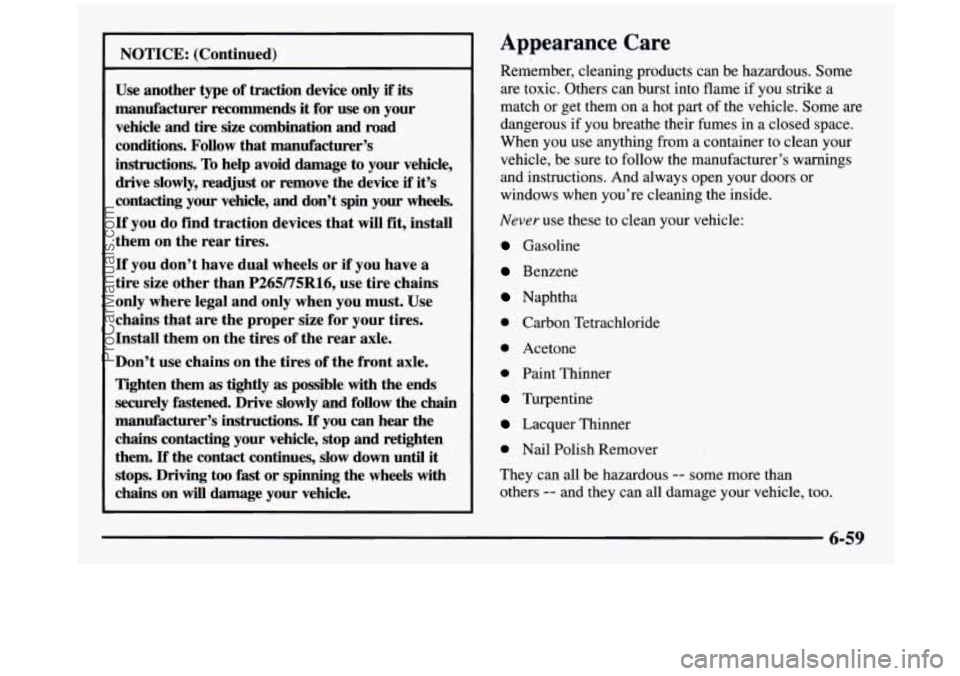
NOTICE: (Continued)
Use another type of traction device only if its
manufacturer recommends it for
use on your
vehicle and
tire size combination and road
conditions. Follow that manufacturer’s
instructions. To help avoid damage to your vehicle,
drive slowly, readjust or remove the device
if it’s
contacting
your vehicle, and don’t spin your wheels.
If you do find traction devices that will fit, install
them on the rear tires.
If you don’t have dual wheels or if you have a
tire size other than
P265175R16, use tire chains
only where legal and only when you must. Use
chains that are the proper size for your tires.
Install them on the tires of the rear axle.
Don’t use chains on the tires of the front axle.
Tighten them
as tightly as possible with the ends
securely fastened. Drive slowly and follow the chain
manufacturer’s instructions.
If you can hear the
chains contacting your vehicle, stop and retighten
them.
If the contact continues, slow down until it
stops. Driving too
fast or spinning the wheels with
chains on
will damage your vehicle.
Appearance Care
Remember, cleaning products can be hazardous. Some
are toxic. Others can burst into flame if you strike a
match or get them on a hot part of the vehicle. Some are
dangerous if you breathe their fumes in a closed space.
When you
use anything from a container to clean your
vehicle, be sure
to follow the manufacturer’s warnings
and instructions. And always open your doors or
windows when you’re cleaning the inside.
Never use these to clean your vehicle:
Gasoline
Benzene
Naphtha
0 Carbon Tetrachloride
0 Acetone
0 Paint Thinner
Turpentine
Lacquer Thinner
0 Nail Polish Remover
They can all be hazardous
-- some more than
others
-- and they can all damage your vehicle, too.
6-59
ProCarManuals.com
Page 342 of 436
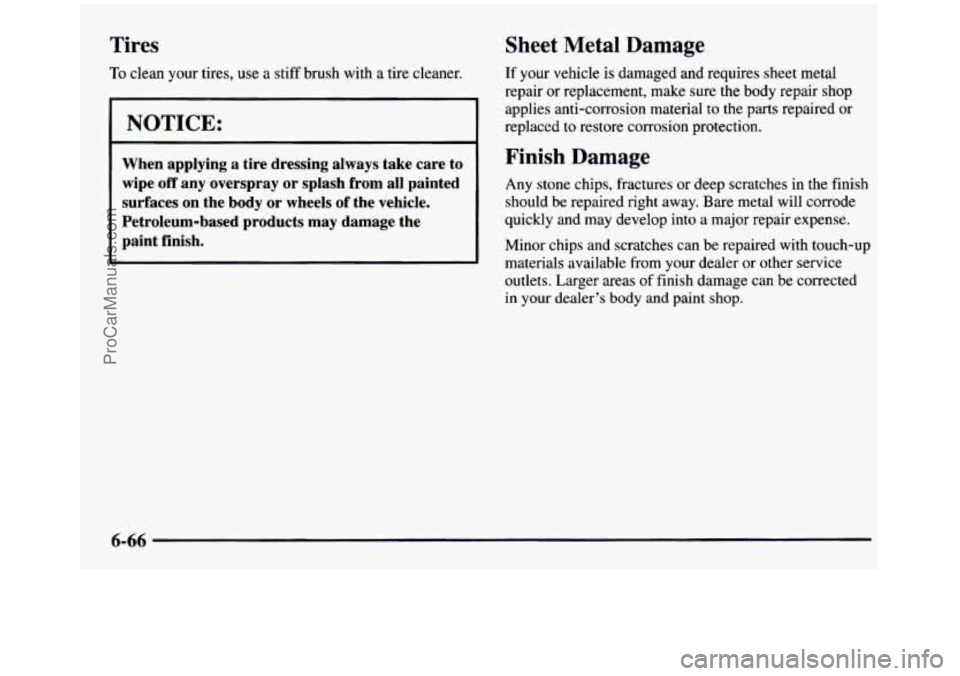
Tires
To clean your tires, use a stiff brush with a tire cleaner.
NOTICE: ~~ -
When applying a tire dressing always take care to
wipe
off any overspray or splash from all painted
surfaces on the body or wheels
of the vehicle.
Petroleum-based products may damage the
paint finish.
Sheet Metal Damage
If your vehicle is damaged and requires sheet metal
repair or replacement, make sure the body repair shop
applies anti-corrosion material
to the parts repaired or
replaced to restore corrosion protection.
Finish Damage
Any stone chips, fractures or deep scratches in the finish
should be repaired right away. Bare metal will corrode
quickly and may develop into a major repair expense.
Minor chips and scratches can be repaired with touch-up
materials available from your dealer or other service
outlets. Larger areas
of finish damage can be corrected
in your dealer’s body and paint shop.
6-66
ProCarManuals.com
Page 352 of 436
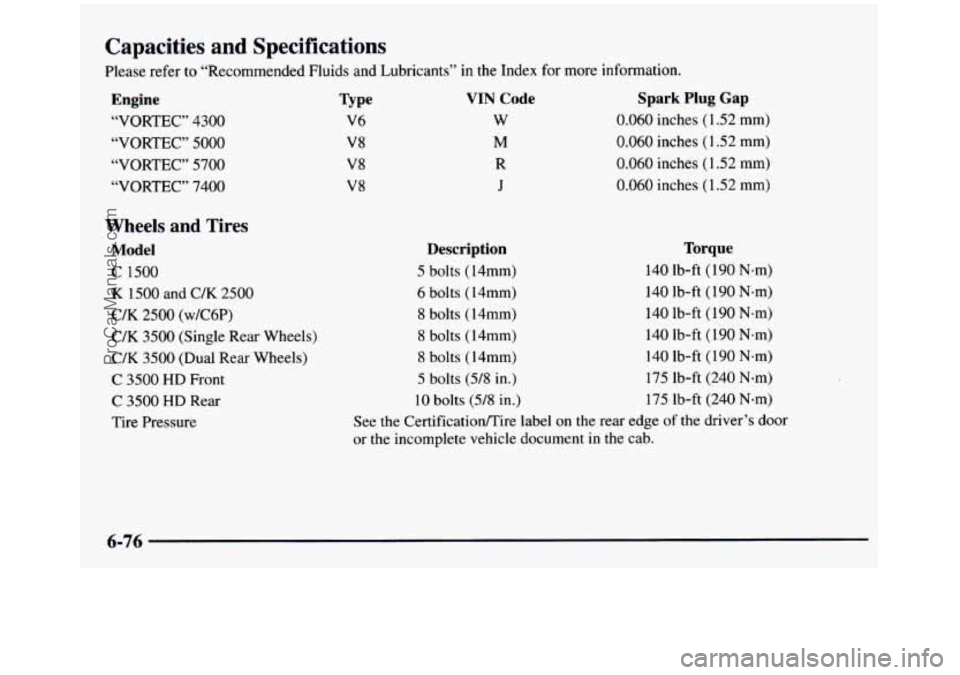
Capacities and Specifications
Please refer to “Recommended Fluids and Lubricants” in the Index for more information.
Engine Type VIN Code Spark Plug Gap
“VORTEC”
4300 V6 W 0.060 inches (1.52 mm)
“VORTEC” 5000 V8 M 0.060 inches (1.52 mm)
“VORTEC”
5700 V8 R 0.060 inches (1.52 mm)
“VORTEC” 7400
V8 J 0.060 inches (1.52 mm)
Wheels and Tires
Model
C 1500
K 1500 and C/K 2500
C/K 2500 (w/C6P)
C/K
3500 (Single Rear Wheels)
C/K 3500 (Dual Rear Wheels)
C 3500 HD Front
C 3500 HD Rear
Tire Pressure
Description Torque
5 bolts (14mm) 140 lb-ft (190 N-m)
6 bolts (14mm) 140 lb-ft ( 190 Nam)
8 bolts (14mm)
140 lb-ft ( 190 N-m)
8 bolts (14mm) 140 lb-ft ( 190 N-m)
8 bolts (14mm) 140 lb-ft ( 190 N-m)
5 bolts (5/8 in.) 175 lb-ft (240 N-m)
10 bolts (5/8 in.) 175
lb-ft (240 N-m)
See the CertificatiodTire label on the rear edge of the driver’s door
or the incomplete vehicle document
in the cab.
6-76
ProCarManuals.com
Page 363 of 436
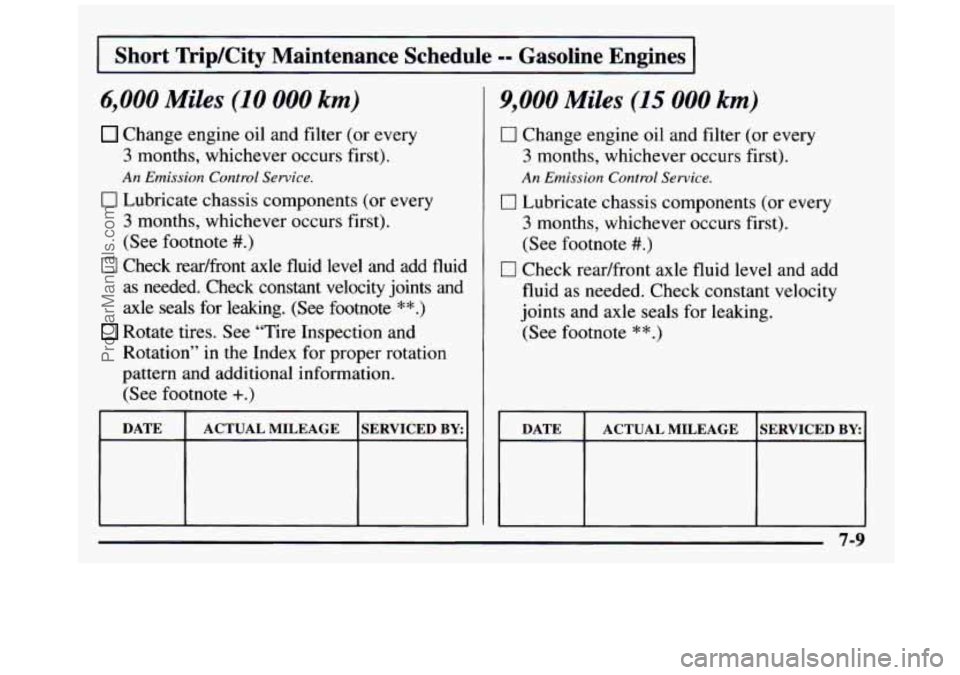
1 Short Trip/City Maintenance Schedule =- Gasoline Engines I
6,000 Miles (10 000 km)
Change engine oil and filter (or every
3 months, whichever occurs first).
An Emission Control Service.
0 Lubricate chassis components (or every
3 months, whichever occurs first).
(See footnote
#.)
0 Check readfront axle fluid level and add fluid
as needed. Check constant velocity joints and
axle seals for leaking. (See footnote
**.)
Rotate tires. See “Tire Inspection and
Rotation” in the Index for proper rotation
pattern and additional information.
(See footnote
+.)
9,000 Miles (15 000 km)
0 Change engine oil and filter (or every
3 months, whichever occurs first).
An Emission Control Service.
0 Lubricate chassis components (or every
3 months, whichever occurs first).
(See footnote
#.)
0 Check readfront axle fluid level and add
fluid as needed. Check constant velocity
joints and axle seals for leaking.
(See footnote
**.)
DATE SERVICED BY: ACTUAL MILEAGE
7-9
ProCarManuals.com