1997 GMC SIERRA load capacity
[x] Cancel search: load capacityPage 146 of 436
Anti-Lock Brake System Warning Light
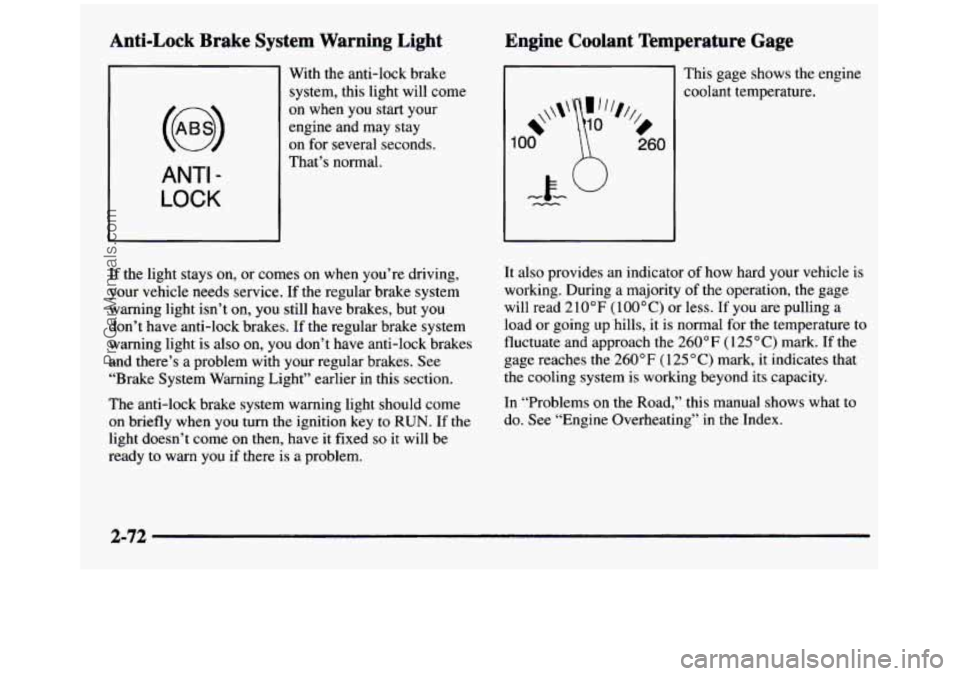
ANTI -
LOCK
With the anti-lock brake
system, this light will come
on when you start your
engine and may stay
on for several seconds.
That’s normal.
If the light stays on, or comes
on when you’re driving,
your vehicle needs service. If
the regular brake system
warning light isn’t on, you still have brakes, but you
don’t have anti-lock brakes. If the regular brake system
warning light is
also on, you don’t have anti-lock brakes
and there’s a problem with your regular brakes. See
“Brake System Warning Light” earlier in this section.
The anti-lock brake system warning light should come
on briefly when you
turn the ignition key to RUN. If the
light doesn’t come on then, have it fixed
so it will be
ready to warn you
if there is a problem.
Engine Coolant Temperature Gage
Ill This gage shows the engine
1
*\\I‘
00
%,
0
260
coolant temperature.
It also provides an indicator
of how hard your vehicle is
working. During a majority of the operation, the gage
will read 210°F
(lOO°C) or less. If you are pulling a
load or going up hills, it is normal for
the temperature to
fluctuate and approach the
260°F (125°C) mark. If the
gage reaches the 260°F ( 125 “C) mark, it indicates that
the cooling system is working beyond its capacity.
In “Problems on the Road,” this manual shows what to
do. See “Engine Overheating” in the Index.
2-72
ProCarManuals.com
Page 219 of 436
Loading Your Vehicle
I-
GAWR FRT
RIM COLD TIRE PRESSURE
-!=2 - I
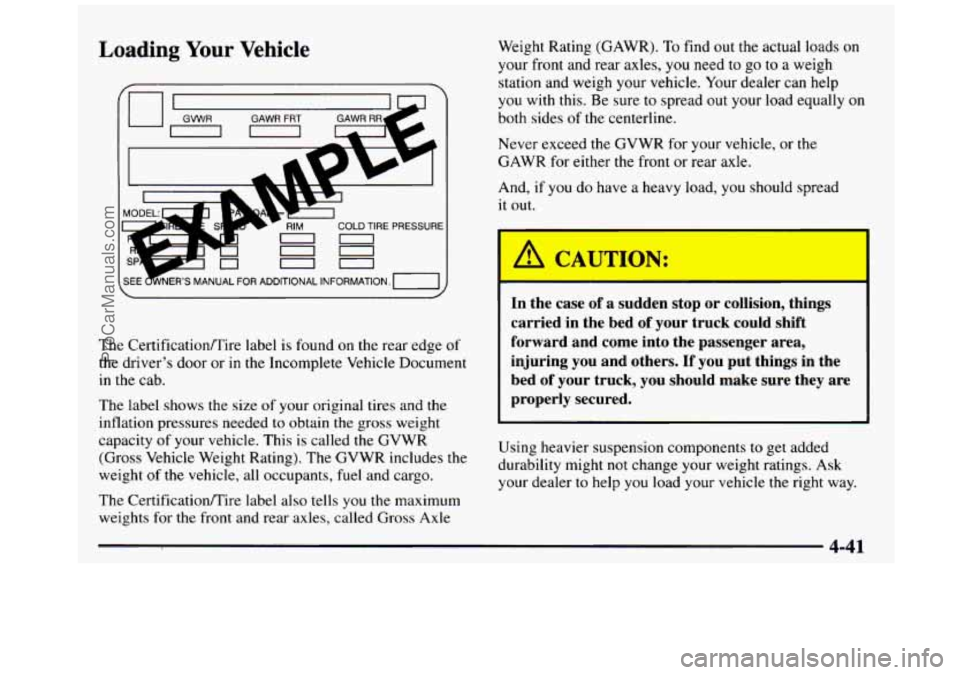
The Certificationrnire label is found on the rear edge of
the driver’s door or in the Incomplete Vehicle Document
in the cab.
The label shows the size of
your original tires and the
inflation pressures needed to obtain the gross weight
capacity
of your vehicle. This is called the GVWR
(Gross Vehicle Weight Rating). The GVWR includes the
weight
of the vehicle, all occupants, fuel and cargo.
The Certificationmire label also tells you the maximum
weights for the front and rear axles, called Gross Axle Weight Rating (GAWR). To find out the actual loads on
your front and rear axles, you need
to go to a weigh
station
and weigh your vehicle. Your dealer can help
you
with this. Be sure to spread out your load equally on
both sides of the centerline.
Never exceed the
GVWR for your vehicle, or the
GAWR for
either the front or rear axle.
And, if you do have a heavy load, you should spread
it out.
/;1 CAUTION:
In the case of a den stop or collision, things
carried in the bed of your truck could shift
forward and come into the passenger area,
injuring you and others. If you put things in the
bed
of your truck, you should make sure they are
properly secured.
Using heavier suspension components to get added
durability might not change your weight ratings. Ask
your dealer to help you load
your vehicle the right way.
4-41
ProCarManuals.com
Page 224 of 436
NOTICE:
Pulling a trailer improperly can damage your
vehicle and result in costly repairs not covered
by
your warranty. To pull a trailer correctly, follow
the advice in this part, and see your
GM dealer
for important information about towing a trailer with
your vehicle.
Every vehicle is ready for some trailer towing. If yours
was built with trailering options, as many are, it’s ready
for heavier trailers. But trailering is different than just
driving your vehicle by itself. Trailering means changes
in handling, durability and fuel economy. Successful,
safe trailering takes correct equipment, and it has
to be
used properly.
That’s the reason for this part. In it are many
time-tested, important trailering tips and safety rules.
Many
of these are important for your safety and that of
your passengers.
So please read this section carefully
before
you pull a trailer.
If You Do Decide To Pull A Trailer
If you do, here are some important points:
0
0
0
0
There are many different laws, including speed limit
restrictions, having
to do with trailering. Make sure
your
rig will be legal, not only where you live but
also where you’ll be driving.
A good source for this
information can be state
or provincial police.
Consider using
a sway control if your trailer will
weigh less than the capacity stamped on your step
bumper.
You should always use a sway control if
your trailer will weigh more than the capacity
stamped on your step bumper. You can ask
a hitch
dealer about sway controls.
Don’t tow a trailer at all during the first
500 miles
(800 km) your new vehicle is driven. Your engine,
axle or other parts could be damaged.
Then, during the first
500 miles (800 km) that you
tow a trailer, don’t drive over 50 mph (80 kmh) and
don’t make starts at full throttle. This helps your
engine and other parts of your vehicle wear in at the
heavier loads.
4-46
ProCarManuals.com
Page 230 of 436
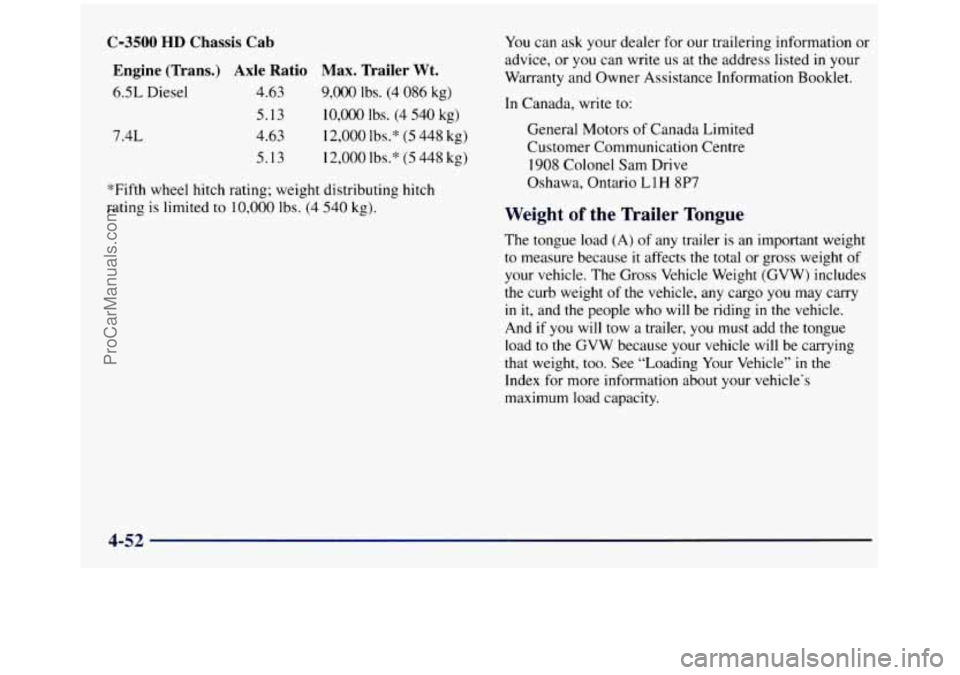
C-3500 HD Chassis Cab
Engine (Trans.) Axle Ratio
Max. Trailer
Wt.
6.5L Diesel 4.63 9,000 lbs. (4 086 kg)
5.13 10,000 lbs. (4 540 kg)
4.63 12,000 lbs.*
(5 448 kg)
5.13
12,000 lbs.* (5 448 kg)
7.4L
*Fifth wheel hitch rating; weight distributing hitch
rating is limited to
10,000 lbs. (4 540 kg). You
can ask your dealer for our trailering information or
advice, or you can write us at the address listed in your
Warranty and Owner Assistance Information Booklet.
In Canada, write to:
General Motors of Canada Limited
Customer Communication Centre 1908 Colonel Sam Drive
Oshawa, Ontario L1H 8P7
Weight of the Trailer Tongue
The tongue load (A) of any trailer is an important weight
to measure because it affects
the total or gross weight of
your vehicle. The Gross Vehicle Weight (GVW) includes
the curb weight
of the vehicle, any cargo you may carry
in it, and the people who will be riding in the vehicle.
And
if you will tow a trailer, you must add the tongue
load to the GVW because your vehicle will be carrying
that weight, too.
See “Loading Your Vehicle” in the
Index for more information about your vehicle‘s
maximum load capacity.
4-52
ProCarManuals.com
Page 231 of 436
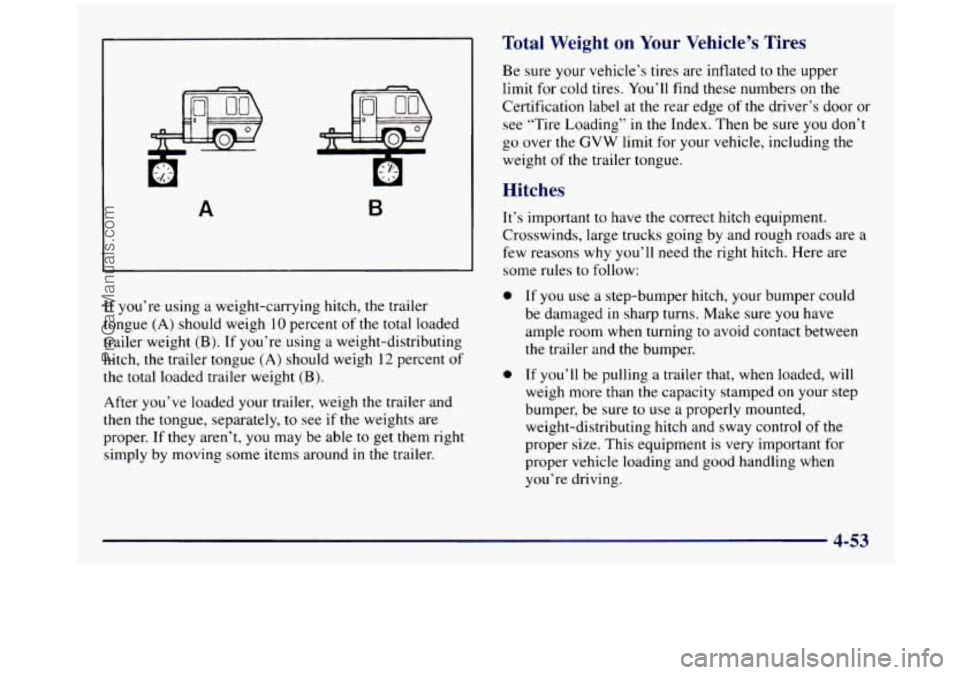
A B
If you’re using a weight-carrying hitch, the trailer
tongue
(A) should weigh 10 percent of the total loaded
trailer weight
(B). If you’re using a weight-distributing
hitch, the trailer tongue
(A) should weigh 12 percent of
the total loaded trailer weight (B).
After you’ve loaded your trailer, weigh the trailer and
then
the tongue, separately, to see if the weights are
proper. If they aren’t,
you may be able to get them right
simply by moving some items around
in the trailer.
Total Weight on Your Vehicle’s Tires
Be sure your vehicle’s tires are inflated to the upper
limit for cold tires. You’ll find these numbers on the
Certification label at the rear edge
of the driver’s door or
see “Tire Loading”
in the Index. Then be sure you don’t
go over the GVW limit for your vehicle, including the
weight of the trailer tongue.
Hitches
It’s important to have the correct hitch equipment.
Crosswinds, large trucks going by and rough roads are a
few reasons why
you’ll need the right hitch. Here are
some rules to follow:
0 If you use a step-bumper hitch, your bumper could
be damaged in sharp turns. Make sure
you have
ample room when turning
to avoid contact between
the trailer and the bumper.
0 If you’ll be pulling a trailer that, when loaded, will
weigh more than
the capacity stamped on your step
bumper, be sure
to use a properly mounted,
weight-distributing hitch and sway control of the
proper size. This equipment
is very important for
proper vehicle loading and good handling when
you’re driving.
4-53
ProCarManuals.com
Page 303 of 436
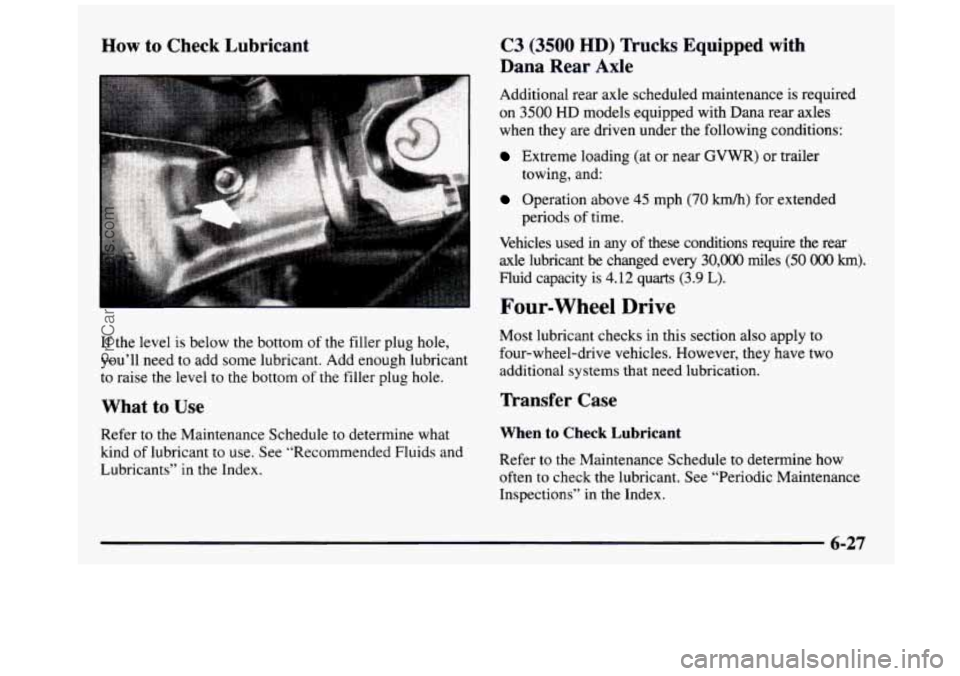
How to Check Lubricant
If the level is below the bottom of the filler plug hole,
you’ll need to add
some lubricant. Add enough lubricant
to raise the level
to the bottom of the filler plug hole.
What to Use
Refer to the Maintenance Schedule to determine what
kind
of lubricant to use. See “Recommended Fluids and
Lubricants”
in the Index.
C3 (3500 HD) Trucks Equipped with
Dana Rear Axle
Additional rear axle scheduled maintenance is required
on
3500 HD models equipped with Dana rear axles
when they are driven under the following conditions:
Extreme loading (at or near GVWR) or trailer
Operation above 45 mph (70 km/h) for extended
towing, and:
periods of time.
Vehicles used in any
of these conditions require the rear
axle lubricant be changed every
30,000 miles (50 OOO km).
Fluid capacity is 4.12 quarts (3.9 L).
Four-wheel Drive
Most lubricant checks in this section also apply to
four-wheel-drive vehicles. However, they have two
additional systems that need lubrication.
Transfer Case
When to Check Lubricant
Refer to the Maintenance Schedule to determine how
often to check the lubricant. See “Periodic Maintenance
Inspections” in the Index.
ProCarManuals.com
Page 333 of 436
Temperature -- A, B, C
The temperature grades are A (the highest), B, and C,
representing the tire's resistance to the generation of
heat and its ability to dissipate heat when tested under
controlled conditions on a specified indoor laboratory
test wheel. Sustained high temperature can cause the
material of the tire to degenerate and reduce tire life, and
excessive temperature can lead to sudden tire failure.
The grade
C corresponds to a level of performance
which all passenger car tires must meet under the
Federal Motor Vehicle Safety Standard
No. 109. Grades
B and A represent higher levels of performance on the
laboratory test wheel than the minimum required by law.
Warning: The temperature grade for this tire
is
established for a tire that is properly inflated and not
overloaded. Excessive speed, underinflation,
or
excessive loading, either separately or in combination,
can cause heat buildup and possible tire failure.
Wheel Alignment and Tire Balance
The wheels on your vehicle were aligned and balanced
carefully at the factory to give you the longest tire life
and best overall performance. Scheduled
wheel alignment and wheel balancing are not
needed. However, if
you notice unusual tire wear or
your vehicle pulling one way or the other, the alignment
may need to be reset. If you notice your vehicle
vibrating
when driving on a smooth road, your wheels
may need to be rebalanced.
Wheel Replacement
Replace any wheel that is bent, cracked, or badly rusted
or corroded. If wheel nuts keep coming loose, the wheel,
wheel bolts and wheel nuts should be replaced. If the
wheel leaks air, replace
it (except some aluminum
wheels, which can sometimes be repaired). See your
GM dealer if any of these conditions exist.
Your dealer will know the kind of wheel
you need.
Each new wheel should have the same load-carrying
capacity, diameter, width, offset and be mounted
the
same way as the one it replaces.
If you need to replace any of your wheels, wheel bolts
or wheel nuts, replace them only
with new GM original
equipment parts. This way, you
will be sure to have the
right wheel, wheel bolts
and wheel nuts for your vehicle.
ProCarManuals.com