Page 29 of 436
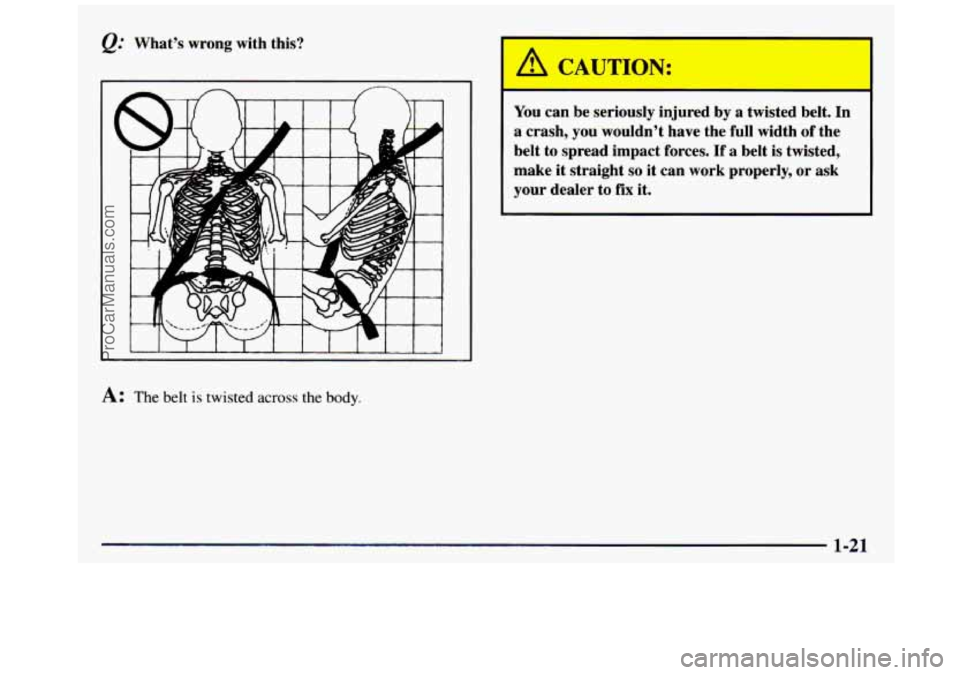
@ What’s wrong with this?
A: The belt is twisted across the body.
You can be seriously injured by a twisted belt. In
a crash, you wouldn’t have the full width
of the
belt to spread impact forces. If
a belt is twisted,
make it straight
so it can work properly, or ask
your dealer
to fix it.
ProCarManuals.com
Page 201 of 436
Am I likely to stall when going downhill?
A: It’s much more likely to happen going uphill. But if
it happens going downhill, here’s what to do.
Stop your vehicle by applying the regular brakes.
Apply the parking brake.
Shift to PARK (P) (or to NEUTRAL (N) with the manual
transmission) and, while still braking, restart
the engine.
Shift back to a low gear, release the parking brake,
and drive straight down.
e If the engine won’t start, get out and get help.
Driving Across an Incline
Sooner or later, an off-road trail will probably go across
the incline of a hill. If this happens, you have to decide
whether to try to drive across the incl.ine. Here are some
things to consider:
A hill that can be driven straight up or down may
be too steep to drive across. When you go straight
up or down
a hill, the length of the wheel base (the
distance from the front wheels to the rear wheels)
reduces
the likelihood the vehicle will tumble end
over end. But when you drive across an incline, the
much more narrow track width (the distance between
the left and right wheels) may not prevent the vehicle
from tilting and rolling over. Also, driving across
an
e
e
incline puts more weight on the downhill wheels.
This could cause a downhill slide or
a rollover.
Surface conditions can be a problem
when you drive
across
a hill. Loose gravel, muddy spots, or even wet
grass can cause your tires
to slip sideways, downhill.
If the vehicle slips sideways, it can hit something
that will trip it (a rock, a rut, etc.) and roll over.
Hidden obstacles can make the steepness of
the
incline even worse. If you drive across a rock with
the uphill wheels, or if the downhill wheels drop into
a
rut or depression, your vehicle can tilt even more.
For reasons like these, you need to decide carefully
whether
to try to drive across an incline. Just because the
trail
goes across the incline doesn’t mean you have to
drive it. The last vehicle to
try it might have rolled over.
Driving across an incline that’s too steep will
make your vehicle roll over.
You could be
seriously injured or killed.
If you have any doubt
about the steepness
of the incline, don’t drive
across it. Find another route instead.
ProCarManuals.com
Page 333 of 436
Temperature -- A, B, C
The temperature grades are A (the highest), B, and C,
representing the tire's resistance to the generation of
heat and its ability to dissipate heat when tested under
controlled conditions on a specified indoor laboratory
test wheel. Sustained high temperature can cause the
material of the tire to degenerate and reduce tire life, and
excessive temperature can lead to sudden tire failure.
The grade
C corresponds to a level of performance
which all passenger car tires must meet under the
Federal Motor Vehicle Safety Standard
No. 109. Grades
B and A represent higher levels of performance on the
laboratory test wheel than the minimum required by law.
Warning: The temperature grade for this tire
is
established for a tire that is properly inflated and not
overloaded. Excessive speed, underinflation,
or
excessive loading, either separately or in combination,
can cause heat buildup and possible tire failure.
Wheel Alignment and Tire Balance
The wheels on your vehicle were aligned and balanced
carefully at the factory to give you the longest tire life
and best overall performance. Scheduled
wheel alignment and wheel balancing are not
needed. However, if
you notice unusual tire wear or
your vehicle pulling one way or the other, the alignment
may need to be reset. If you notice your vehicle
vibrating
when driving on a smooth road, your wheels
may need to be rebalanced.
Wheel Replacement
Replace any wheel that is bent, cracked, or badly rusted
or corroded. If wheel nuts keep coming loose, the wheel,
wheel bolts and wheel nuts should be replaced. If the
wheel leaks air, replace
it (except some aluminum
wheels, which can sometimes be repaired). See your
GM dealer if any of these conditions exist.
Your dealer will know the kind of wheel
you need.
Each new wheel should have the same load-carrying
capacity, diameter, width, offset and be mounted
the
same way as the one it replaces.
If you need to replace any of your wheels, wheel bolts
or wheel nuts, replace them only
with new GM original
equipment parts. This way, you
will be sure to have the
right wheel, wheel bolts
and wheel nuts for your vehicle.
ProCarManuals.com