Page 173 of 236
1. Make sure the vehicle is on level
ground. If the engine is warm, turn
the engine off and wait a few
minutes for the oil to drain into
the oil pan.
2. Set the parking brake and
ensure the gearshift is securely
latched in P (Park).
3. Open the hood. Protect yourself
from engine heat.
4. Locate and carefully remove the
engine oil dipstick.
5. Wipe the dipstick clean. Insert
the dipstick fully, then remove it
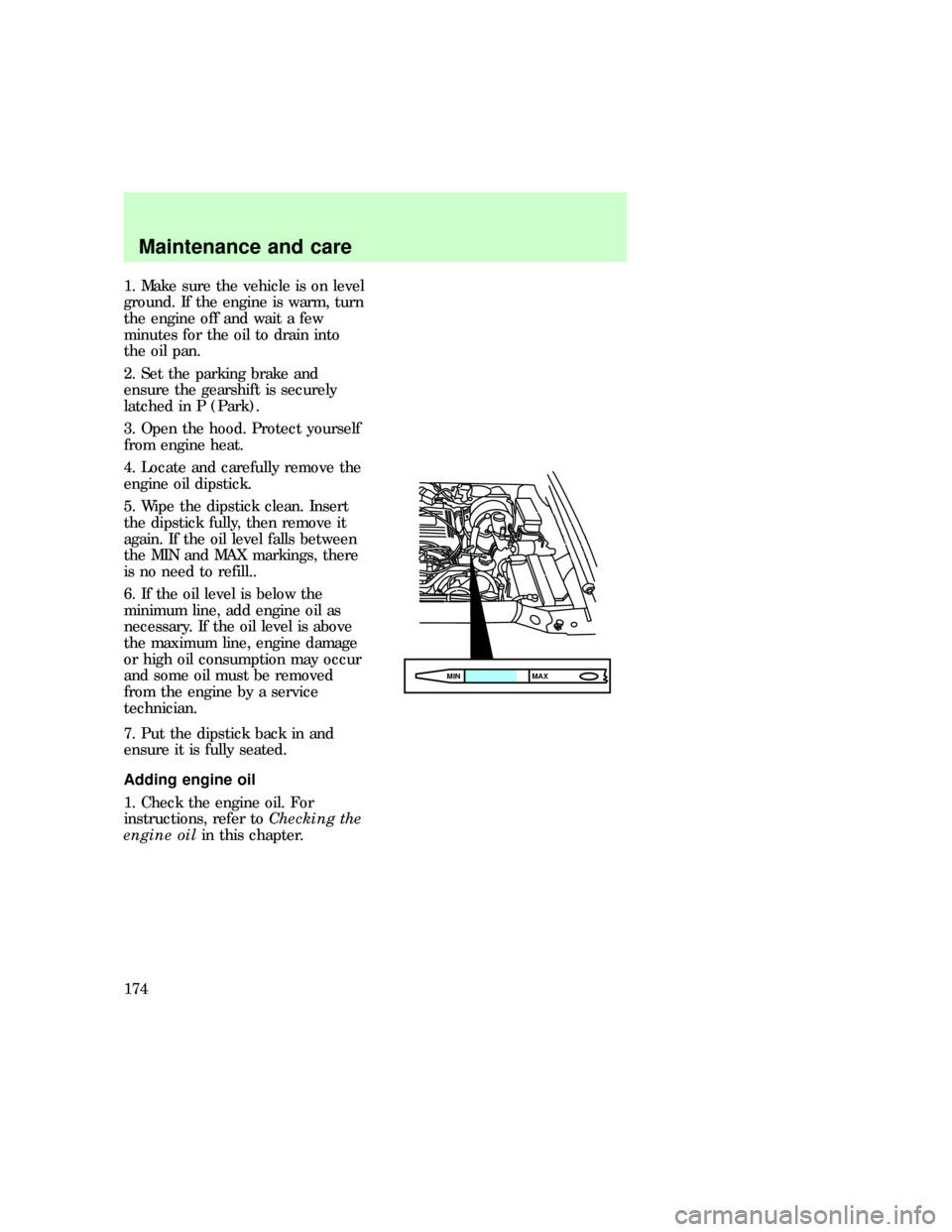
again. If the oil level falls between
the MIN and MAX markings, there
is no need to refill..
6. If the oil level is below the
minimum line, add engine oil as
necessary. If the oil level is above
the maximum line, engine damage
or high oil consumption may occur
and some oil must be removed
from the engine by a service
technician.
7. Put the dipstick back in and
ensure it is fully seated.
Adding engine oil
1. Check the engine oil. For
instructions, refer toChecking the
engine oilin this chapter.
MAX MIN
com_adding_engine_oil.01
Maintenance and care
174
Page 176 of 236
CHECKING AND ADDING
BRAKE FLUID
Brake fluid should be checked and
refilled as needed at least once
each year:
²Clean the reservoir cap before
removal to prevent dirt or water
from entering the reservoir.
²Visually inspect the fluid level.
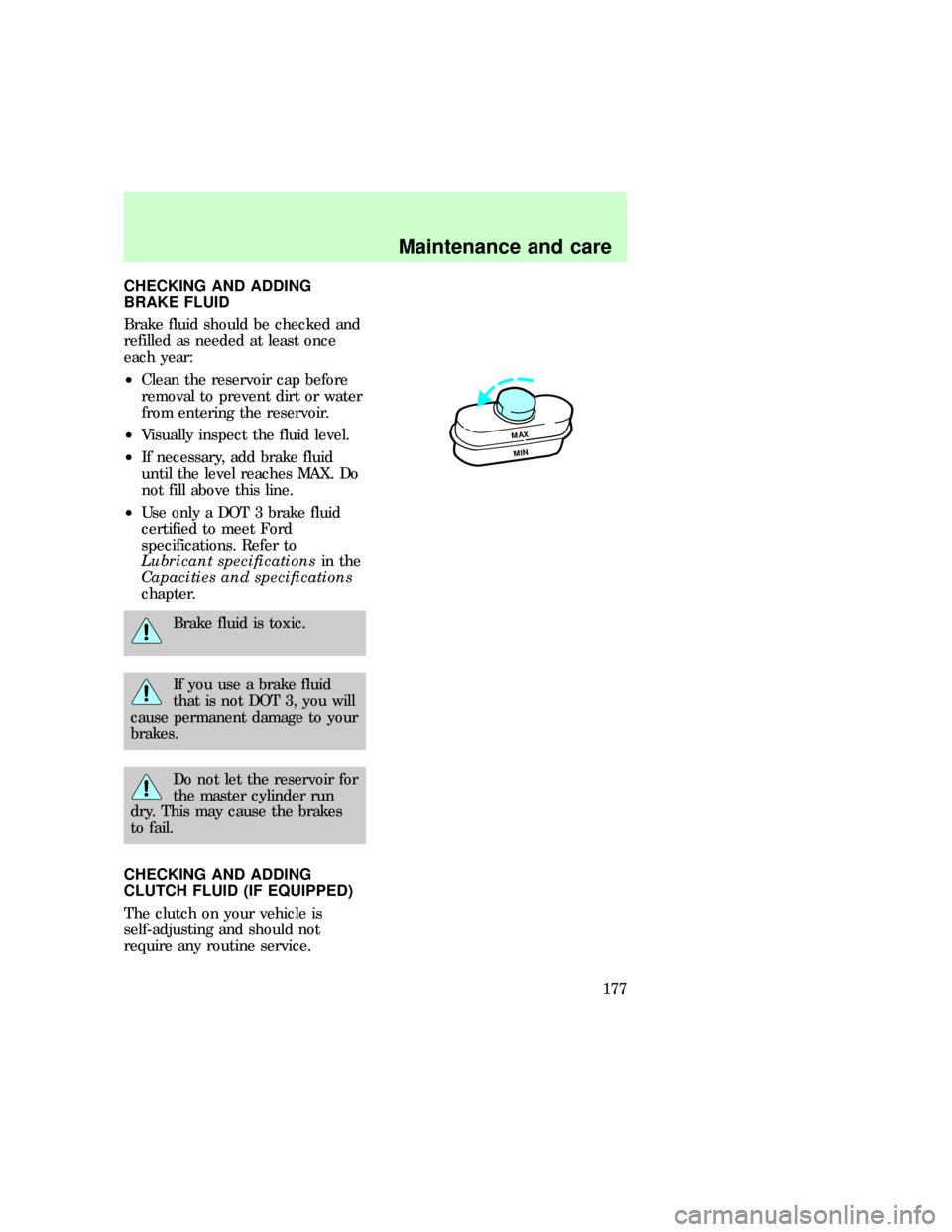
²If necessary, add brake fluid
until the level reaches MAX. Do
not fill above this line.
²Use only a DOT 3 brake fluid
certified to meet Ford
specifications. Refer to
Lubricant specificationsin the
Capacities and specifications
chapter.
Brake fluid is toxic.
If you use a brake fluid
that is not DOT 3, you will
cause permanent damage to your
brakes.
Do not let the reservoir for
the master cylinder run
dry. This may cause the brakes
to fail.
CHECKING AND ADDING
CLUTCH FLUID (IF EQUIPPED)
The clutch on your vehicle is
self-adjusting and should not
require any routine service.
MAX
MIN
uno_checking_adding_clutch
Maintenance and care
177
Page 177 of 236
During normal operation, the fluid
level in the clutch fluid reservoir
will slowly rise. If the fluid level
drops, maintain the fluid level at
the reservoir indicator.
Use only DOT 3 brake fluid
designed to meet Ford
specifications. Refer to the
Capacities and specifications
chapter.
1. Clean the reservoir cap before
removal to prevent contaminants
from entering the reservoir.
2. Remove the cap.
3. Add fluid until the level reaches
the FULL line.
CHECKING AND ADDING
WASHER FLUID
Important information about
washer fluid
In freezing weather (temperatures
below 0ÉC [32ÉF]), washer fluid
containing a small amount of
antifreeze is to be used. State or
local regulations on volatile organic
compounds may restrict the use of
methanol, a common antifreeze
additive. Use a non-methanol
antifreeze in freezing weather only
if the fluid does not damage the
paint finish, wiper blades or
washer system.
Windshield washer fluid
contains methanol which is
poisonous.
uno_washer_fluid_title
uno_what_you_should_know
uno_reservoir_washer_fluid
Maintenance and care
178
Page 200 of 236
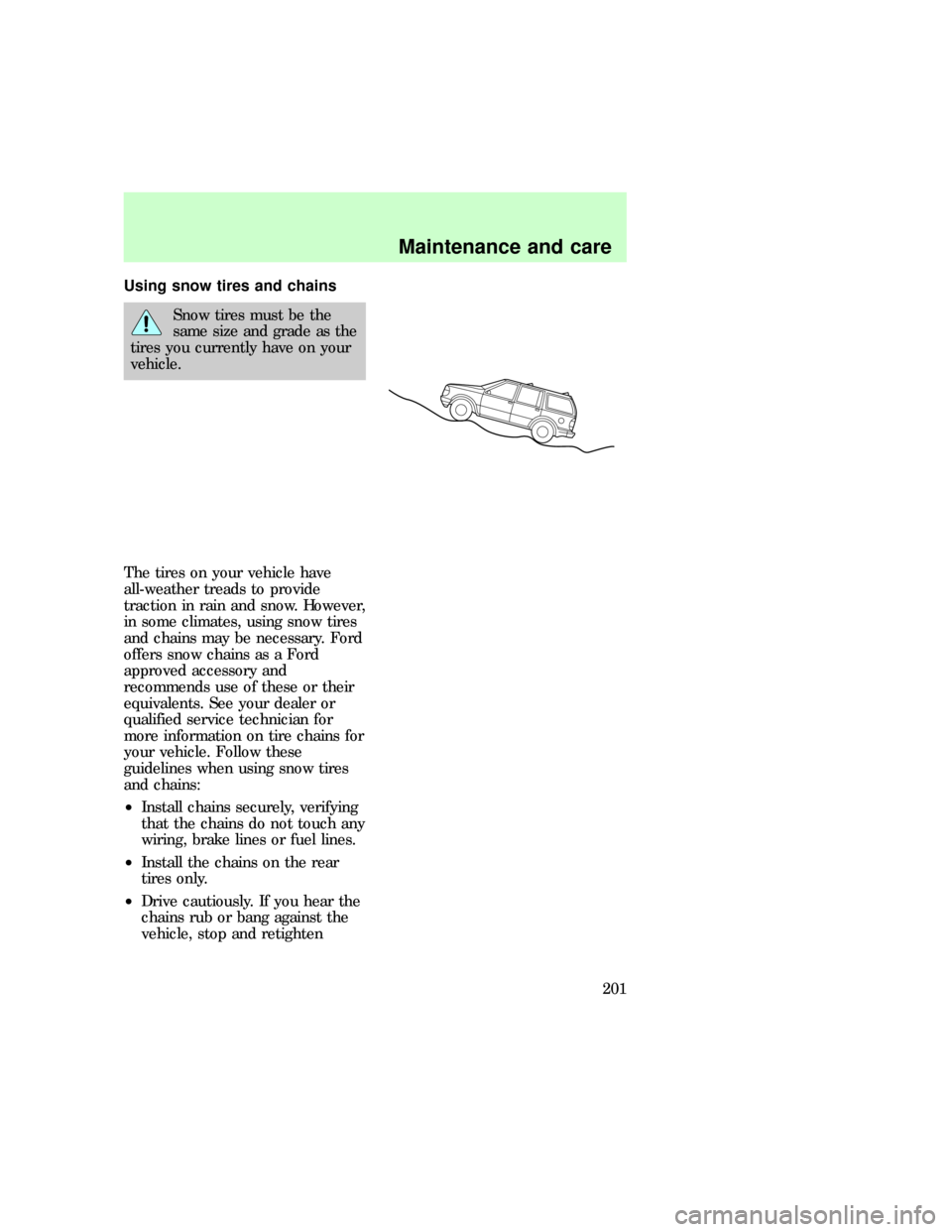
Using snow tires and chains
Snow tires must be the
same size and grade as the
tires you currently have on your
vehicle.
The tires on your vehicle have
all-weather treads to provide
traction in rain and snow. However,
in some climates, using snow tires
and chains may be necessary. Ford
offers snow chains as a Ford
approved accessory and
recommends use of these or their
equivalents. See your dealer or
qualified service technician for
more information on tire chains for
your vehicle. Follow these
guidelines when using snow tires
and chains:
²Install chains securely, verifying
that the chains do not touch any
wiring, brake lines or fuel lines.
²Install the chains on the rear
tires only.
²Drive cautiously. If you hear the
chains rub or bang against the
vehicle, stop and retighten
Maintenance and care
201
Page 209 of 236
REPLACING VEHICLE BULBS
Replacing the exterior bulbs
Check the operation of the
following exterior lamps
frequently:
²headlamps
²foglamps (if equipped)
²high-mount brakelamp
²license plate lamp
²tail lamps
²back-up lamps
Do not remove lamp bulbs unless
they will be replaced immediately
with new ones. If a bulb is
removed for an extended period of
time, contaminants may enter the
lamp-housings and affect lamp
performance.
Handle a halogen
headlamp bulb carefully
and keep out of children's reach.
Grasp the bulb only by its plastic
base and do not touch the glass.
The oil from your hand could
cause the bulb to break the next
time the headlamps are
operated.
uno_exterior_bulbs
uno_headlamps
Maintenance and care
210
Page 211 of 236
4. Lock the bulb assembly into
place by turning it clockwise until
it stops.
Highmount brakelamp
The highmount brakelamp is
located just above the rear liftgate
window. For bulb replacement, see
a dealer or qualified service
technician.
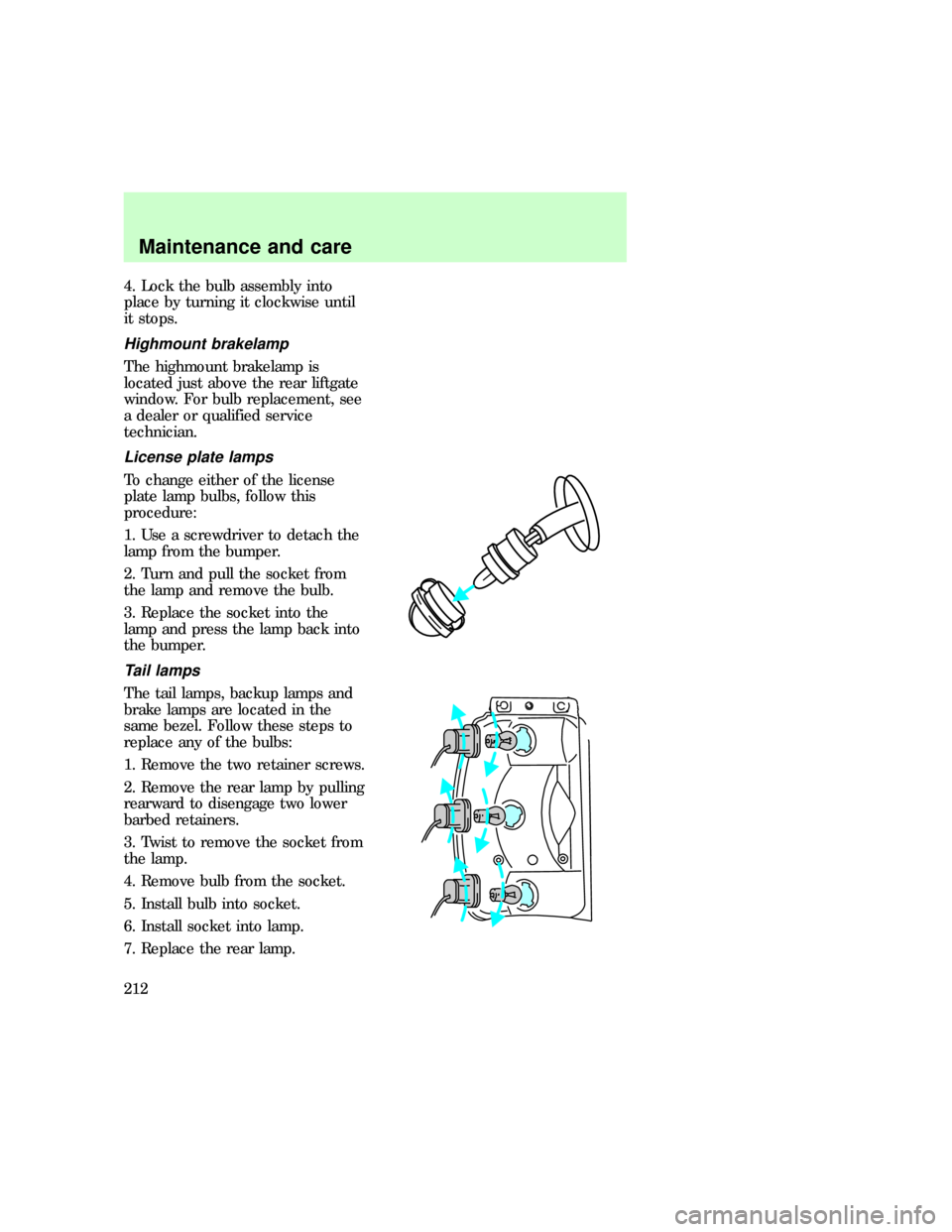
License plate lamps
To change either of the license
plate lamp bulbs, follow this
procedure:
1. Use a screwdriver to detach the
lamp from the bumper.
2. Turn and pull the socket from
the lamp and remove the bulb.
3. Replace the socket into the
lamp and press the lamp back into
the bumper.
Tail lamps
The tail lamps, backup lamps and
brake lamps are located in the
same bezel. Follow these steps to
replace any of the bulbs:
1. Remove the two retainer screws.
2. Remove the rear lamp by pulling
rearward to disengage two lower
barbed retainers.
3. Twist to remove the socket from
the lamp.
4. Remove bulb from the socket.
5. Install bulb into socket.
6. Install socket into lamp.
7. Replace the rear lamp.
uno_highmount
uno_license_plate
uno_tail_lamps
uno_interior_bulbs
Maintenance and care
212
Page 214 of 236
CLEANING AND CARING FOR
YOUR VEHICLE
Refer to the ªCustomer Assistance
Guideº for a list of Ford-approved
cleaners, polishes and waxes.
Washing your vehicle
Wash your vehicle regularly with
cold or lukewarm water. Never use
strong detergents or soap. If your
vehicle is particularly dirty, use a
quality car wash detergent. Always
use a clean sponge, washing glove
or similar device and plenty of
water for best results. To avoid
spots, avoid washing when the
hood is still warm, immediately
after or during exposure to strong
sunlight.
During winter months, it is
especially important to wash the
vehicle on a regular basis. Large
quantities of dirt and road salt are
difficult to remove, and they also
cause damage to the vehicle.
Remove any exterior accessories,
such as antennas, before entering
a car wash.
²After washing, apply the brakes
several times to dry them.
Waxing your vehicle
The best way to determine when
the paintwork needs waxing is by
noting when water stops beading
on the surface. This could be every
three or four months, depending
on operating conditions.
Use only carnauba or
synthetic-based waxes. Remove
com_washing_vehicle.01
com_waxing_vehicle.01
Maintenance and care
215
Page 222 of 236
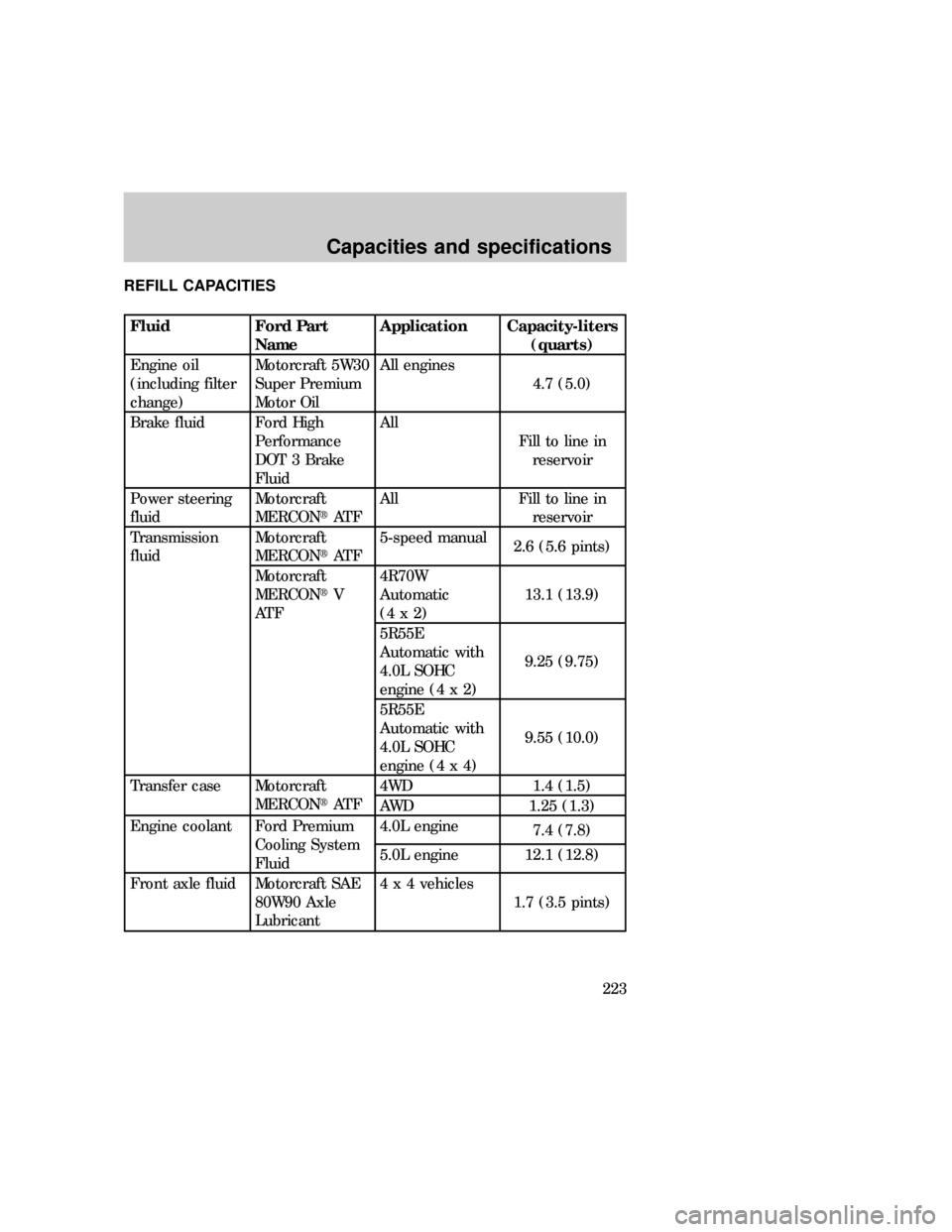
REFILL CAPACITIES
Fluid Ford Part
NameApplication Capacity-liters
(quarts)
Engine oil
(including filter
change)Motorcraft 5W30
Super Premium
Motor OilAll engines
4.7 (5.0)
Brake fluid Ford High
Performance
DOT 3 Brake
FluidAll
Fill to line in
reservoir
Power steering
fluidMotorcraft
MERCONtAT FAll Fill to line in
reservoir
Transmission
fluidMotorcraft
MERCONtAT F5-speed manual
2.6 (5.6 pints)
Motorcraft
MERCONtV
AT F4R70W
Automatic
(4x2)13.1 (13.9)
5R55E
Automatic with
4.0L SOHC
engine (4 x 2)9.25 (9.75)
5R55E
Automatic with
4.0L SOHC
engine (4 x 4)9.55 (10.0)
Transfer case Motorcraft
MERCONtAT F4WD 1.4 (1.5)
AWD 1.25 (1.3)
Engine coolant Ford Premium
Cooling System
Fluid4.0L engine
7.4 (7.8)
5.0L engine 12.1 (12.8)
Front axle fluid Motorcraft SAE
80W90 Axle
Lubricant4 x 4 vehicles
1.7 (3.5 pints)
com_explorer-refills
Capacities and specifications
223