Page 157 of 236
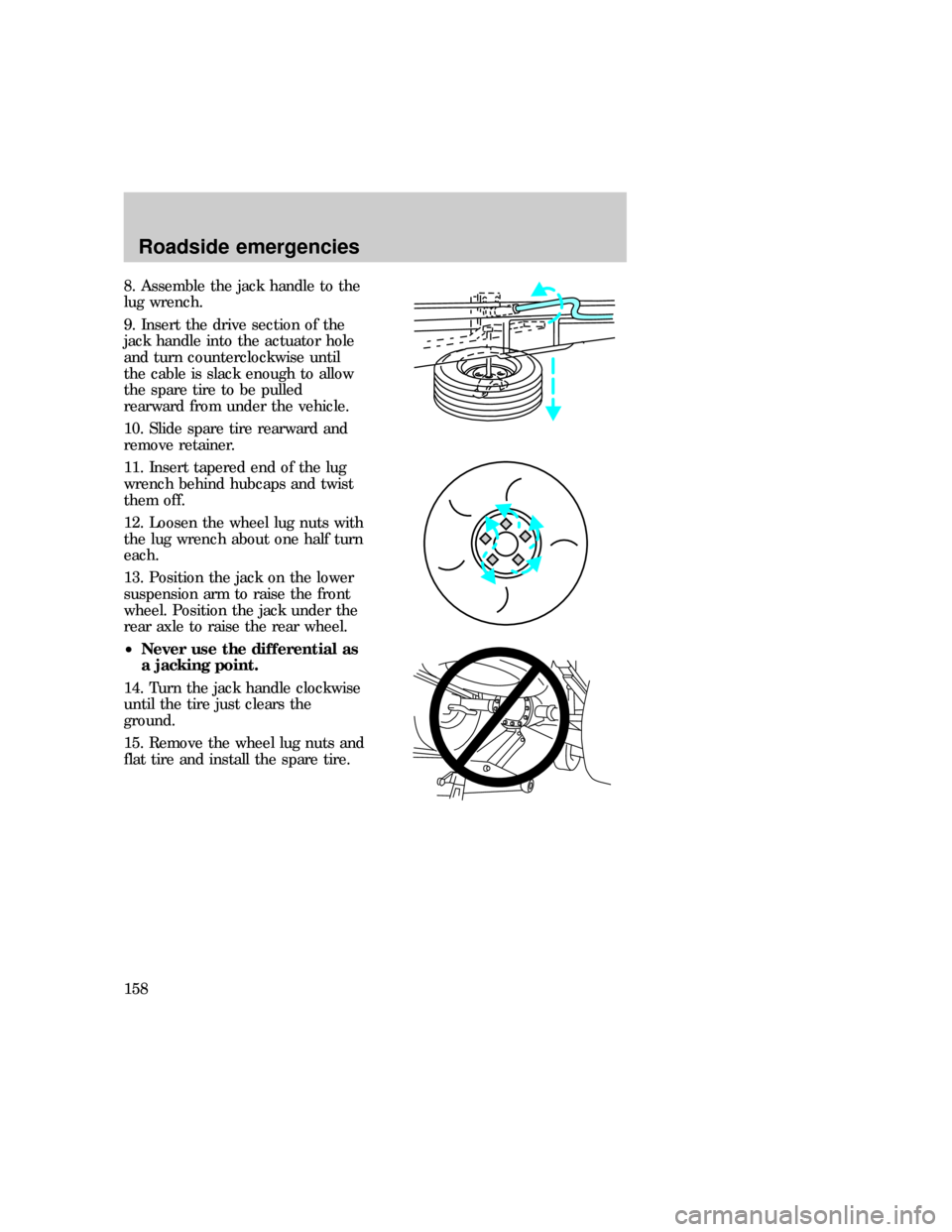
8. Assemble the jack handle to the
lug wrench.
9. Insert the drive section of the
jack handle into the actuator hole
and turn counterclockwise until
the cable is slack enough to allow
the spare tire to be pulled
rearward from under the vehicle.
10. Slide spare tire rearward and
remove retainer.
11. Insert tapered end of the lug
wrench behind hubcaps and twist
them off.
12. Loosen the wheel lug nuts with
the lug wrench about one half turn
each.
13. Position the jack on the lower
suspension arm to raise the front
wheel. Position the jack under the
rear axle to raise the rear wheel.
²Never use the differential as
a jacking point.
14. Turn the jack handle clockwise
until the tire just clears the
ground.
15. Remove the wheel lug nuts and
flat tire and install the spare tire.
Roadside emergencies
158
Page 158 of 236
16. Install the lug nuts and tighten
until snug.
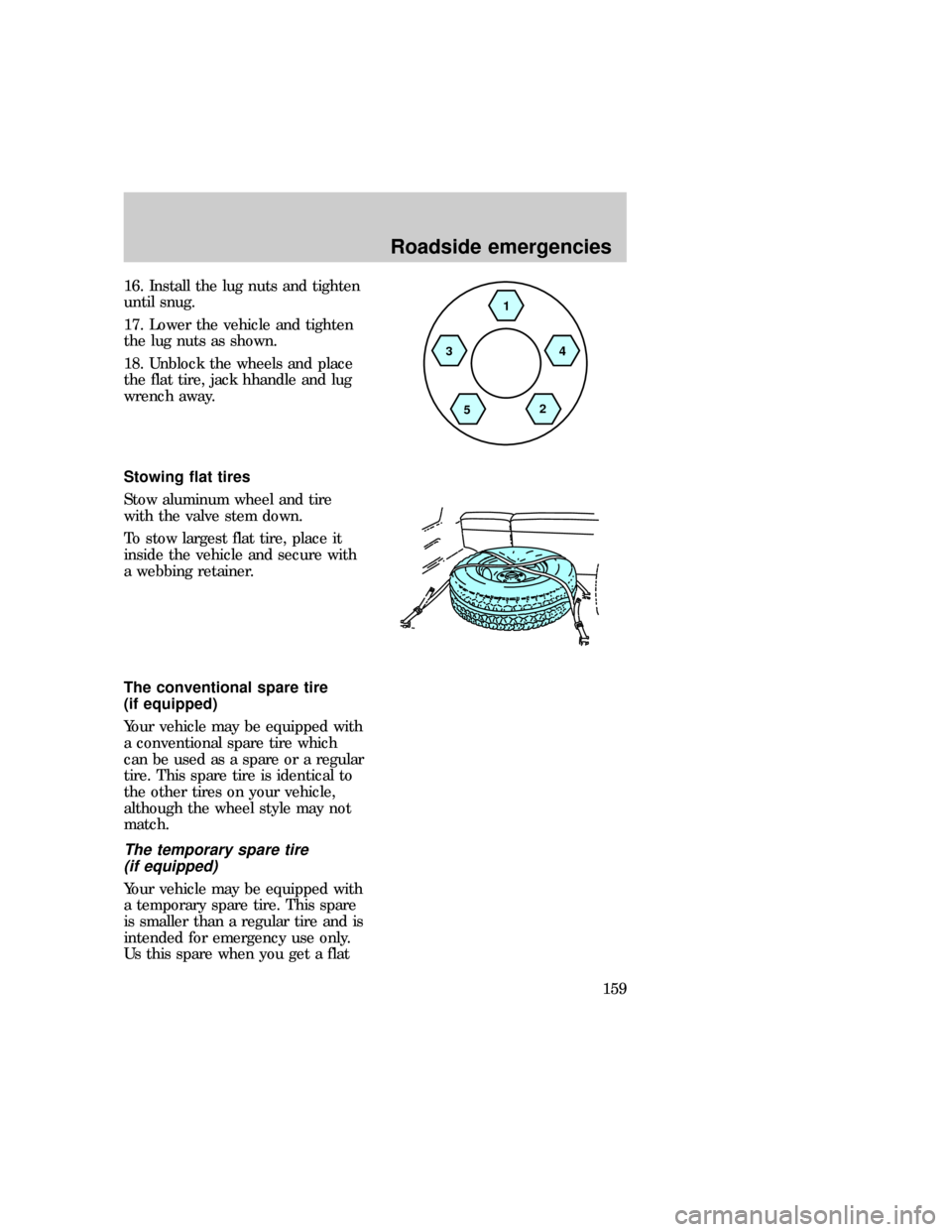
17. Lower the vehicle and tighten
the lug nuts as shown.
18. Unblock the wheels and place
the flat tire, jack hhandle and lug
wrench away.
Stowing flat tires
Stow aluminum wheel and tire
with the valve stem down.
To stow largest flat tire, place it
inside the vehicle and secure with
a webbing retainer.
The conventional spare tire
(if equipped)
Your vehicle may be equipped with
a conventional spare tire which
can be used as a spare or a regular
tire. This spare tire is identical to
the other tires on your vehicle,
although the wheel style may not
match.
The temporary spare tire
(if equipped)
Your vehicle may be equipped with
a temporary spare tire. This spare
is smaller than a regular tire and is
intended for emergency use only.
Us this spare when you get a flat
1
4
2
5 3
uno_stowing_flat_tires
uno_conventional_spare
uno_temporary_spare
Roadside emergencies
159
Page 196 of 236
Warning: The traction grade
assigned to this tire is based on
braking (straightahead) traction
tests and does not include
cornering (turning) traction.
Temperature A B C
The temperature grades are A (the
highest), B, and C, representing
the tire's resistance to the
generation of heat and its ability to
dissipate heat when tested under
controlled conditions on a
specified indoor laboratory test
wheel. Sustained high temperature
can cause the material of the tire
to degenerate and reduce tire life,
and excessive temperature can
lead to sudden tire failure. The
grade C corresponds to a level of
performance which all passenger
car tires must meet under the
Federal Motor Vehicle Safety
Standard No. 109. Grades B and A
represent higher levels of
performance on the laboratory test
wheel than the minimum required
by law.
The temperature grade for
this tire is established for a
tire that is properly inflated and
not overloaded. Excessive speed,
underinflation, or excessive
loading, either separately or in
combination, can cause heat
buildup and possible tire failure.
Checking the tire pressure
Check the tire pressure
periodically and inflate tires as
com_temperature_abc.01
uno_pressure_tires
Maintenance and care
197
Page 197 of 236
necessary. To check the tire
pressure, insert the tire pressure
gauge into the valve stem.
The cold pressure amount is listed
on the Safety Compliance
Certification label.
Improperly inflated tires
can affect vehicle handling
and can fail suddenly, possibly
resulting in loss of vehicle
control.
Rotating tires
Rotate your tires at regular
intervals for even wear. Rotation
intervals are listed in the ªService
Guideº.
²Four tire rotation
uno_rotating_tires
Maintenance and care
198