Page 6 of 2543
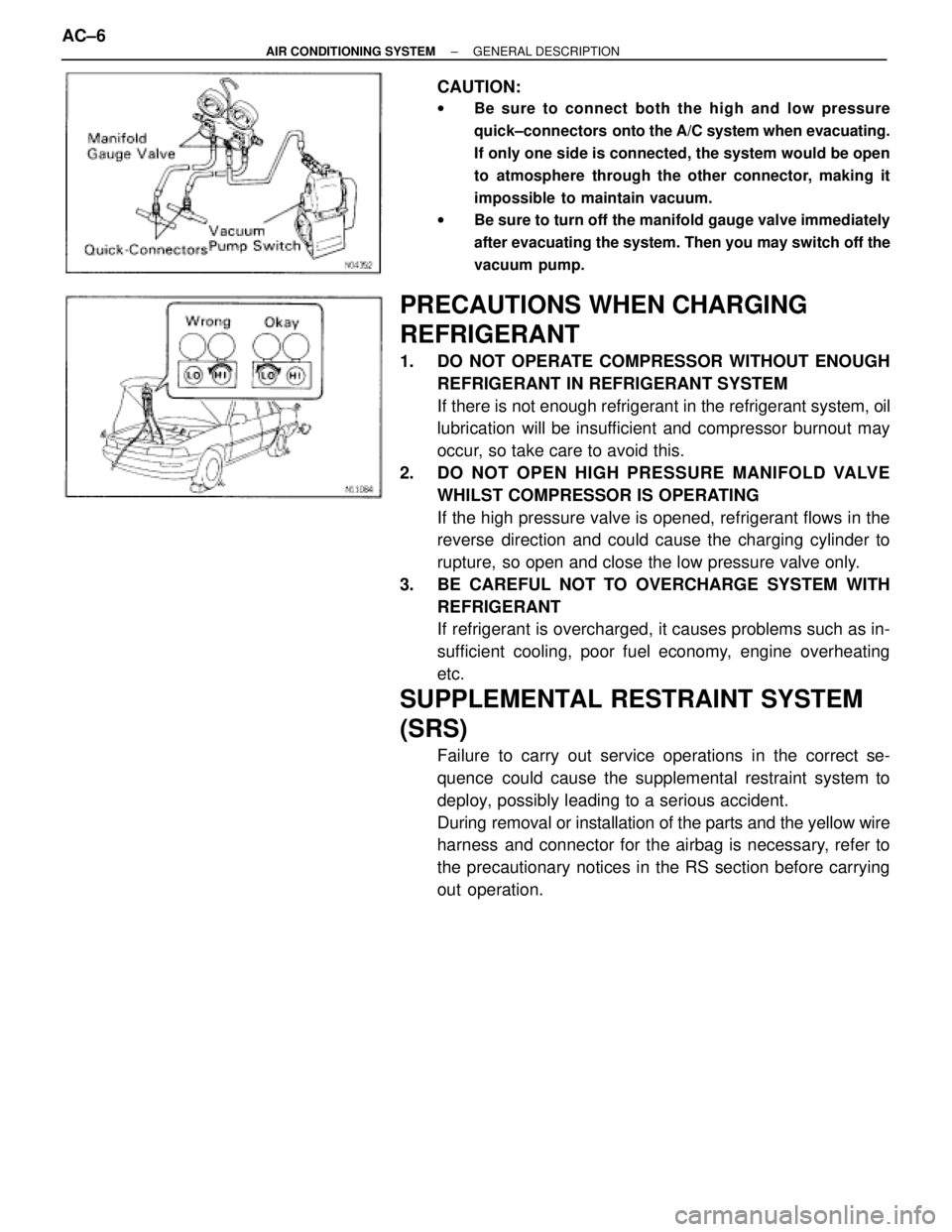
CAUTION:
wBe sure to connect both the high and low pressure
quick±connectors onto the A/C system when evacuating.
If only one side is connected, the system would be open
to atmosphere through the other connector, making it
impossible to maintain vacuum.
wBe sure to turn off the manifold gauge valve immediately
after evacuating the system. Then you may switch off the
vacuum pump.
PRECAUTIONS WHEN CHARGING
REFRIGERANT
1. DO NOT OPERATE COMPRESSOR WITHOUT ENOUGH
REFRIGERANT IN REFRIGERANT SYSTEM
If there is not enough refrigerant in the refrigerant system, oil
lubrication will be insufficient and compressor burnout may
occur, so take care to avoid this.
2. DO NOT OPEN HIGH PRESSURE MANIFOLD VALVE
WHILST COMPRESSOR IS OPERATING
If the high pressure valve is opened, refrigerant flows in the
reverse direction and could cause the charging cylinder to
rupture, so open and close the low pressure valve only.
3. BE CAREFUL NOT TO OVERCHARGE SYSTEM WITH
REFRIGERANT
If refrigerant is overcharged, it causes problems such as in-
sufficient cooling, poor fuel economy, engine overheating
etc.
SUPPLEMENTAL RESTRAINT SYSTEM
(SRS)
Failure to carry out service operations in the correct se-
quence could cause the supplemental restraint system to
deploy, possibly leading to a serious accident.
During removal or installation of the parts and the yellow wire
harness and connector for the airbag is necessary, refer to
the precautionary notices in the RS section before carrying
out operation. AC±6
± AIR CONDITIONING SYSTEMGENERAL DESCRIPTION
Page 1092 of 2543
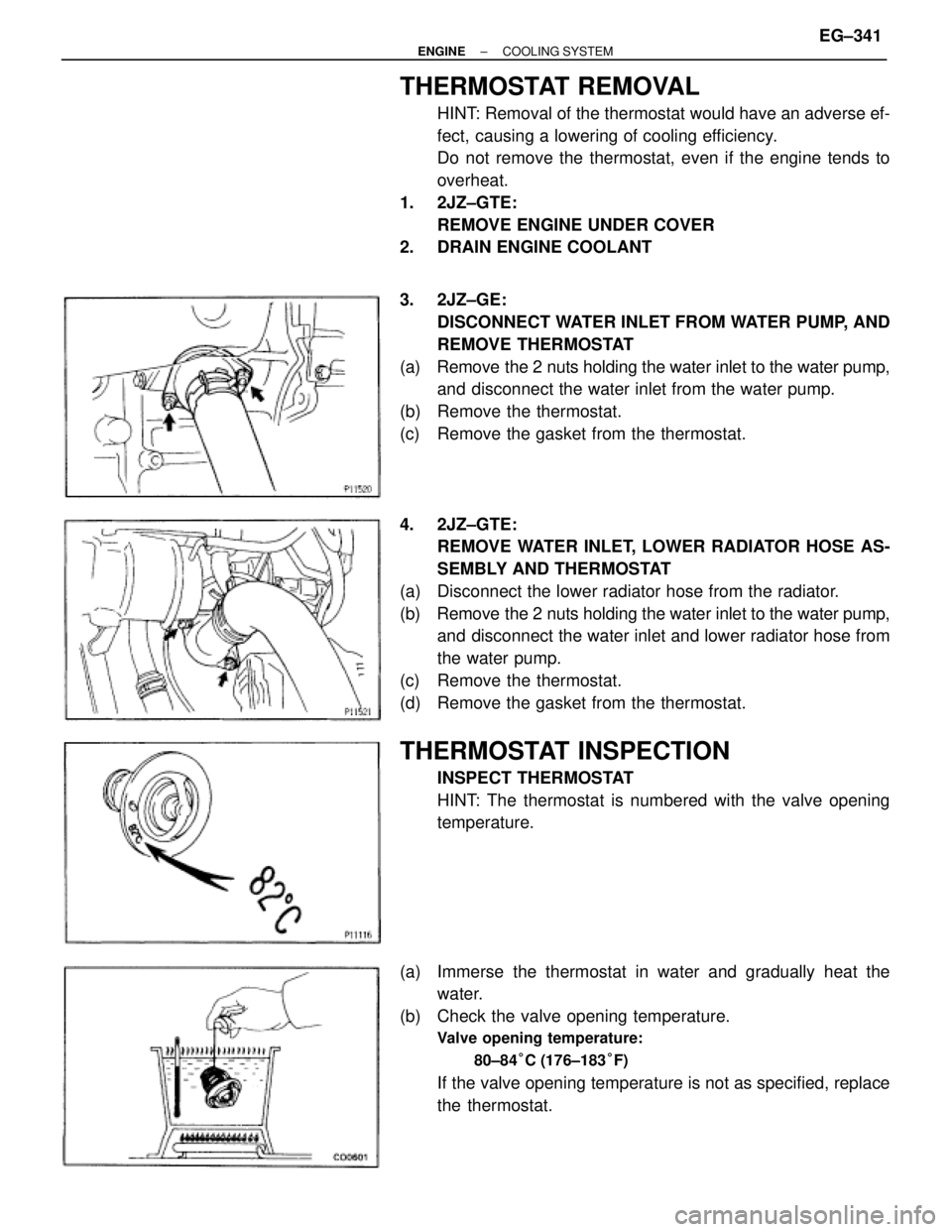
THERMOSTAT REMOVAL
HINT: Removal of the thermostat would have an adverse ef-
fect, causing a lowering of cooling efficiency.
Do not remove the thermostat, even if the engine tends to
overheat.
1. 2JZ±GTE:
REMOVE ENGINE UNDER COVER
2. DRAIN ENGINE COOLANT
3. 2JZ±GE:
DISCONNECT WATER INLET FROM WATER PUMP, AND
REMOVE THERMOSTAT
(a) Remove the 2 nuts holding the water inlet to the water pump,
and disconnect the water inlet from the water pump.
(b) Remove the thermostat.
(c) Remove the gasket from the thermostat.
4. 2JZ±GTE:
REMOVE WATER INLET, LOWER RADIATOR HOSE AS-
SEMBLY AND THERMOSTAT
(a) Disconnect the lower radiator hose from the radiator.
(b) Remove the 2 nuts holding the water inlet to the water pump,
and disconnect the water inlet and lower radiator hose from
the water pump.
(c) Remove the thermostat.
(d) Remove the gasket from the thermostat.
THERMOSTAT INSPECTION
INSPECT THERMOSTAT
HINT: The thermostat is numbered with the valve opening
temperature.
(a) Immerse the thermostat in water and gradually heat the
water.
(b) Check the valve opening temperature.
Valve opening temperature:
80±84°C (176±183°F)
If the valve opening temperature is not as specified, replace
the thermostat.
± ENGINECOOLING SYSTEMEG±341
Page 1182 of 2543

Wire Harness and Connector
The SRS wire harness is integrated with the cowl wire har-
ness assembly and floor wire harness assembly. The wires
for the SRS wire harness are encased in a yellow corrugated
tube. All the connectors for the system are also a standard
yellow color. If the SRS wire harness becomes disconnected
or the connector becomes broken due to an accident, etc.,
repair or replace it as shown on page RS±36.
FOR VEHICLES EQUIPPED WITH A CATALYTIC CONVERTER
CAUTION: If large amounts of unburned gasoline flow into the converter, it may overheat and create a fire
hazard. To prevent this, observe the following precautions and explain them to your customer.
1. Use only unleaded gasoline.
2. Avoid prolonged idling.
Avoid running the engine at idle speed for more than 20 minutes.
3. Avoid spark jump test.
(a) Perform spark jump test only when absolutely necessary. Perform this test as rapidly as possible.
(b) While testing, never race the engine.
4. Avoid prolonged engine compression measurement.
Engine compression tests must be done as rapidly as possible.
5. Do not run engine when fuel tank is nearly empty.
This may cause the engine to misfire and create an extra load on the converter.
6. Avoid coasting with ignition turned off and prolonged braking.
7. Do not dispose of used catalyst along with parts contaminated with gasoline or oil.
± INTRODUCTIONPRECAUTIONIN±15