Page 388 of 2248
4. CHECK FOR THE AWD FUNCTION
If“tight-corner braking”occurs when the steering wheel is
fully turned at low speed:
1) Determine the applicable trouble code and check the
corresponding duty solenoid C (transfer) for improper
operation.
2) If the solenoid is operating properly, check transfer
clutch pressure.
3) If oil pressure is normal but“tight-corner braking”
occurs:
Check the transfer control valve for sticking, and the trans-
fer clutch facing for wear.
44
3-2SERVICE PROCEDURE
3. Performance Test
Page 400 of 2248
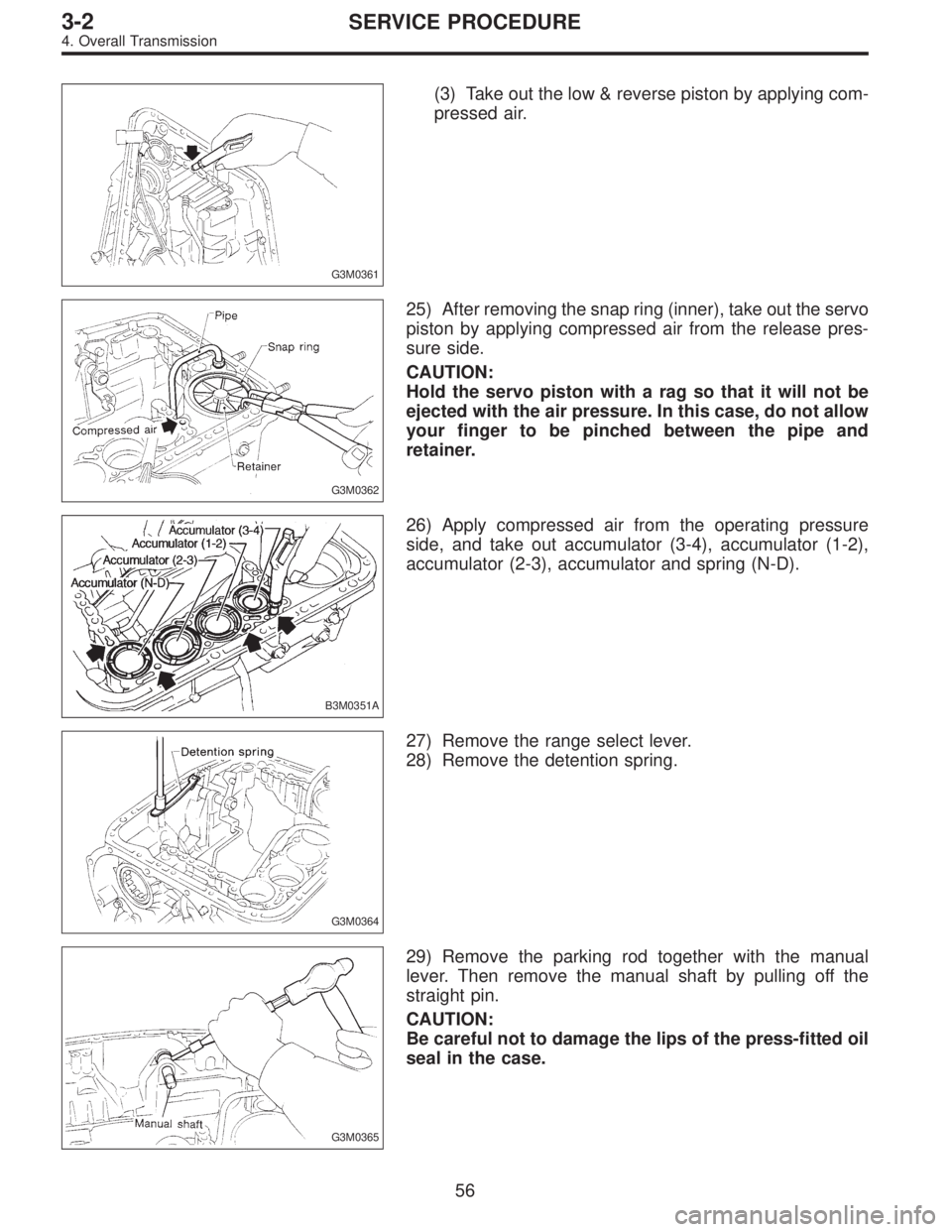
G3M0361
(3) Take out the low & reverse piston by applying com-
pressed air.
G3M0362
25) After removing the snap ring (inner), take out the servo
piston by applying compressed air from the release pres-
sure side.
CAUTION:
Hold the servo piston with a rag so that it will not be
ejected with the air pressure. In this case, do not allow
your finger to be pinched between the pipe and
retainer.
B3M0351A
26) Apply compressed air from the operating pressure
side, and take out accumulator (3-4), accumulator (1-2),
accumulator (2-3), accumulator and spring (N-D).
G3M0364
27) Remove the range select lever.
28) Remove the detention spring.
G3M0365
29) Remove the parking rod together with the manual
lever. Then remove the manual shaft by pulling off the
straight pin.
CAUTION:
Be careful not to damage the lips of the press-fitted oil
seal in the case.
56
3-2SERVICE PROCEDURE
4. Overall Transmission
Page 563 of 2248
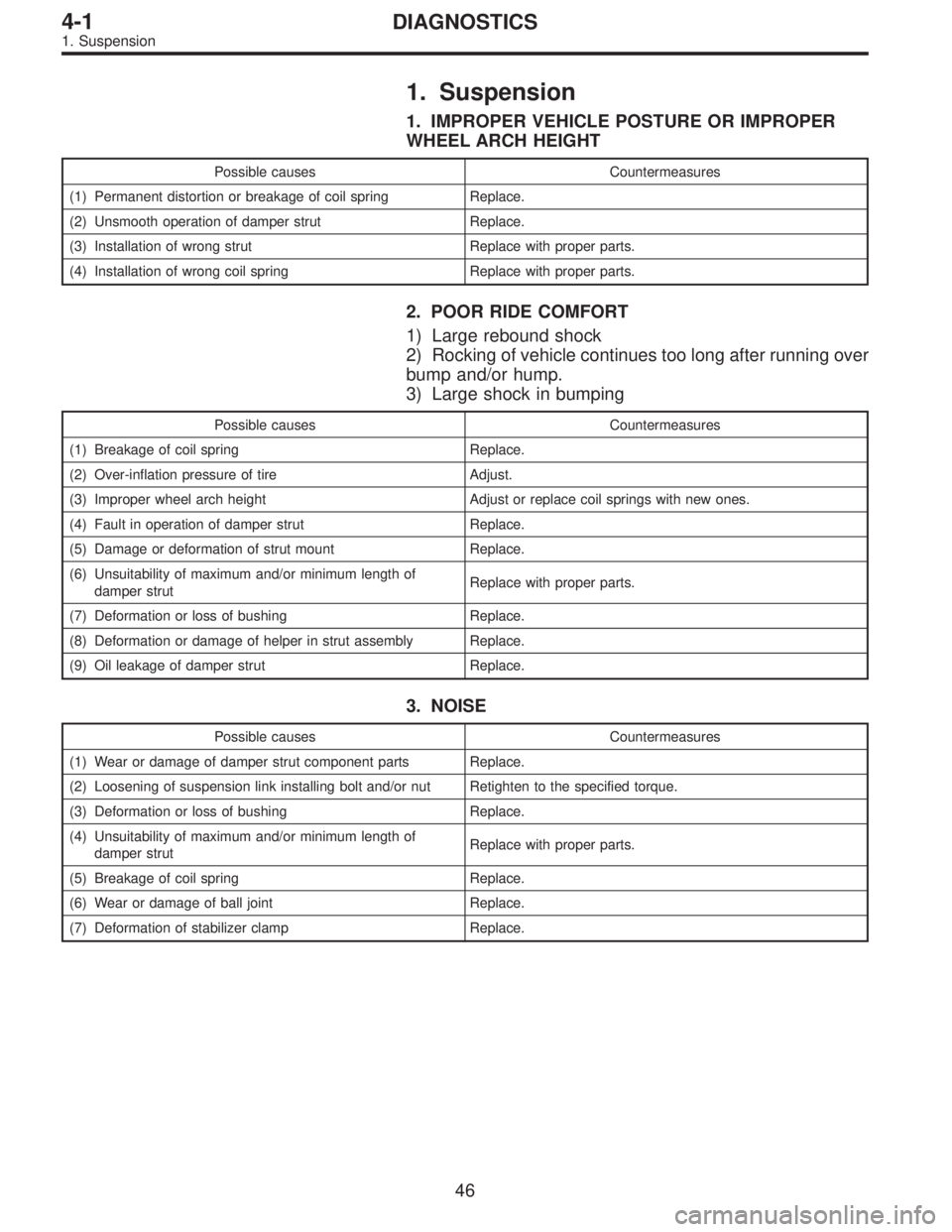
1. Suspension
1. IMPROPER VEHICLE POSTURE OR IMPROPER
WHEEL ARCH HEIGHT
Possible causes Countermeasures
(1) Permanent distortion or breakage of coil spring Replace.
(2) Unsmooth operation of damper strut Replace.
(3) Installation of wrong strut Replace with proper parts.
(4) Installation of wrong coil spring Replace with proper parts.
2. POOR RIDE COMFORT
1) Large rebound shock
2) Rocking of vehicle continues too long after running over
bump and/or hump.
3) Large shock in bumping
Possible causes Countermeasures
(1) Breakage of coil spring Replace.
(2) Over-inflation pressure of tire Adjust.
(3) Improper wheel arch height Adjust or replace coil springs with new ones.
(4) Fault in operation of damper strut Replace.
(5) Damage or deformation of strut mount Replace.
(6) Unsuitability of maximum and/or minimum length of
damper strutReplace with proper parts.
(7) Deformation or loss of bushing Replace.
(8) Deformation or damage of helper in strut assembly Replace.
(9) Oil leakage of damper strut Replace.
3. NOISE
Possible causes Countermeasures
(1) Wear or damage of damper strut component parts Replace.
(2) Loosening of suspension link installing bolt and/or nut Retighten to the specified torque.
(3) Deformation or loss of bushing Replace.
(4) Unsuitability of maximum and/or minimum length of
damper strutReplace with proper parts.
(5) Breakage of coil spring Replace.
(6) Wear or damage of ball joint Replace.
(7) Deformation of stabilizer clamp Replace.
46
4-1DIAGNOSTICS
1. Suspension
Page 617 of 2248
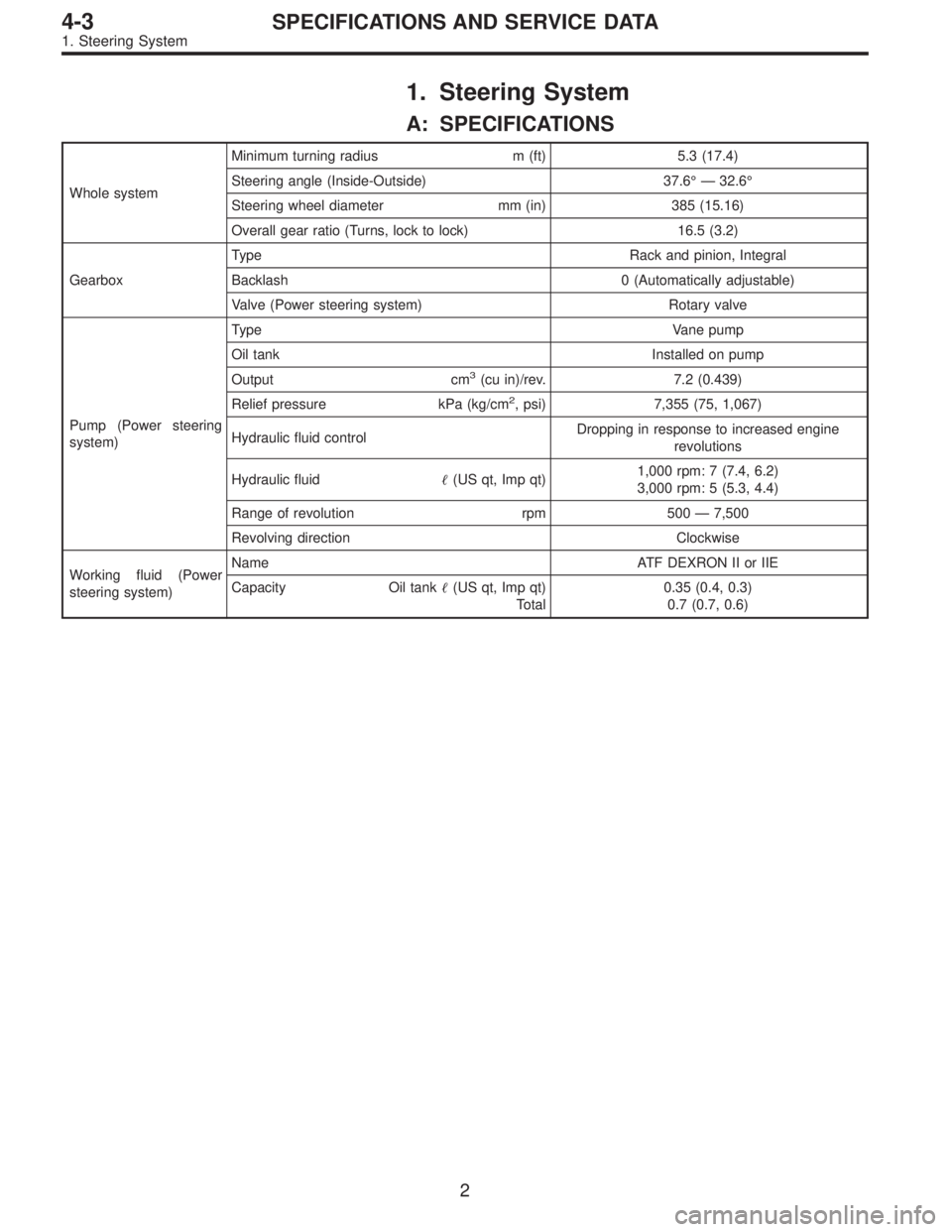
1. Steering System
A: SPECIFICATIONS
Whole systemMinimum turning radius m (ft) 5.3 (17.4)
Steering angle (Inside-Outside) 37.6°—32.6°
Steering wheel diameter mm (in) 385 (15.16)
Overall gear ratio (Turns, lock to lock) 16.5 (3.2)
GearboxType Rack and pinion, Integral
Backlash 0 (Automatically adjustable)
Valve (Power steering system) Rotary valve
Pump (Power steering
system)Type Vane pump
Oil tank Installed on pump
Output cm
3(cu in)/rev. 7.2 (0.439)
Relief pressure kPa (kg/cm
2, psi) 7,355 (75, 1,067)
Hydraulic fluid controlDropping in response to increased engine
revolutions
Hydraulic fluid�(US qt, Imp qt)1,000 rpm: 7 (7.4, 6.2)
3,000 rpm: 5 (5.3, 4.4)
Range of revolution rpm 500—7,500
Revolving direction Clockwise
Working fluid (Power
steering system)Name ATF DEXRON II or IIE
Capacity Oil tank�(US qt, Imp qt)
Total0.35 (0.4, 0.3)
0.7 (0.7, 0.6)
2
4-3SPECIFICATIONS AND SERVICE DATA
1. Steering System
Page 618 of 2248
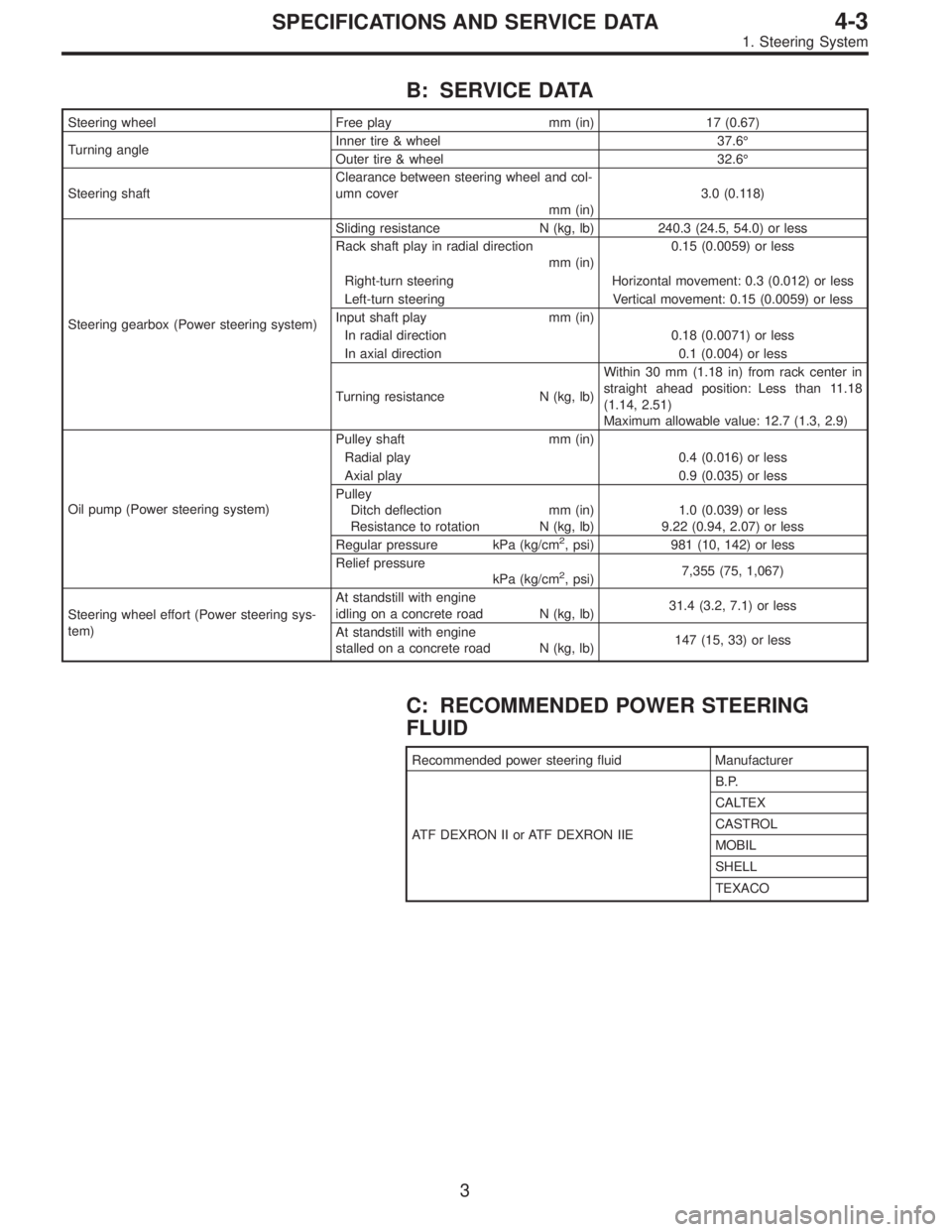
B: SERVICE DATA
Steering wheel Free play mm (in) 17 (0.67)
Turning angleInner tire & wheel 37.6°
Outer tire & wheel 32.6°
Steering shaftClearance between steering wheel and col-
umn cover
mm (in)3.0 (0.118)
Steering gearbox (Power steering system)Sliding resistance N (kg, lb) 240.3 (24.5, 54.0) or less
Rack shaft play in radial direction
mm (in)0.15 (0.0059) or less
Right-turn steering Horizontal movement: 0.3 (0.012) or less
Left-turn steering Vertical movement: 0.15 (0.0059) or less
Input shaft play mm (in)
In radial direction 0.18 (0.0071) or less
In axial direction 0.1 (0.004) or less
Turning resistance N (kg, lb)Within 30 mm (1.18 in) from rack center in
straight ahead position: Less than 11.18
(1.14, 2.51)
Maximum allowable value: 12.7 (1.3, 2.9)
Oil pump (Power steering system)Pulley shaft mm (in)
Radial play 0.4 (0.016) or less
Axial play 0.9 (0.035) or less
Pulley
Ditch deflection mm (in)
Resistance to rotation N (kg, lb)1.0 (0.039) or less
9.22 (0.94, 2.07) or less
Regular pressure kPa (kg/cm
2, psi) 981 (10, 142) or less
Relief pressure
kPa (kg/cm
2, psi)7,355 (75, 1,067)
Steering wheel effort (Power steering sys-
tem)At standstill with engine
idling on a concrete road N (kg, lb)31.4 (3.2, 7.1) or less
At standstill with engine
stalled on a concrete road N (kg, lb)147 (15, 33) or less
C: RECOMMENDED POWER STEERING
FLUID
Recommended power steering fluid Manufacturer
ATF DEXRON II or ATF DEXRON IIEB.P.
CALTEX
CASTROL
MOBIL
SHELL
TEXACO
3
4-3SPECIFICATIONS AND SERVICE DATA
1. Steering System
Page 693 of 2248
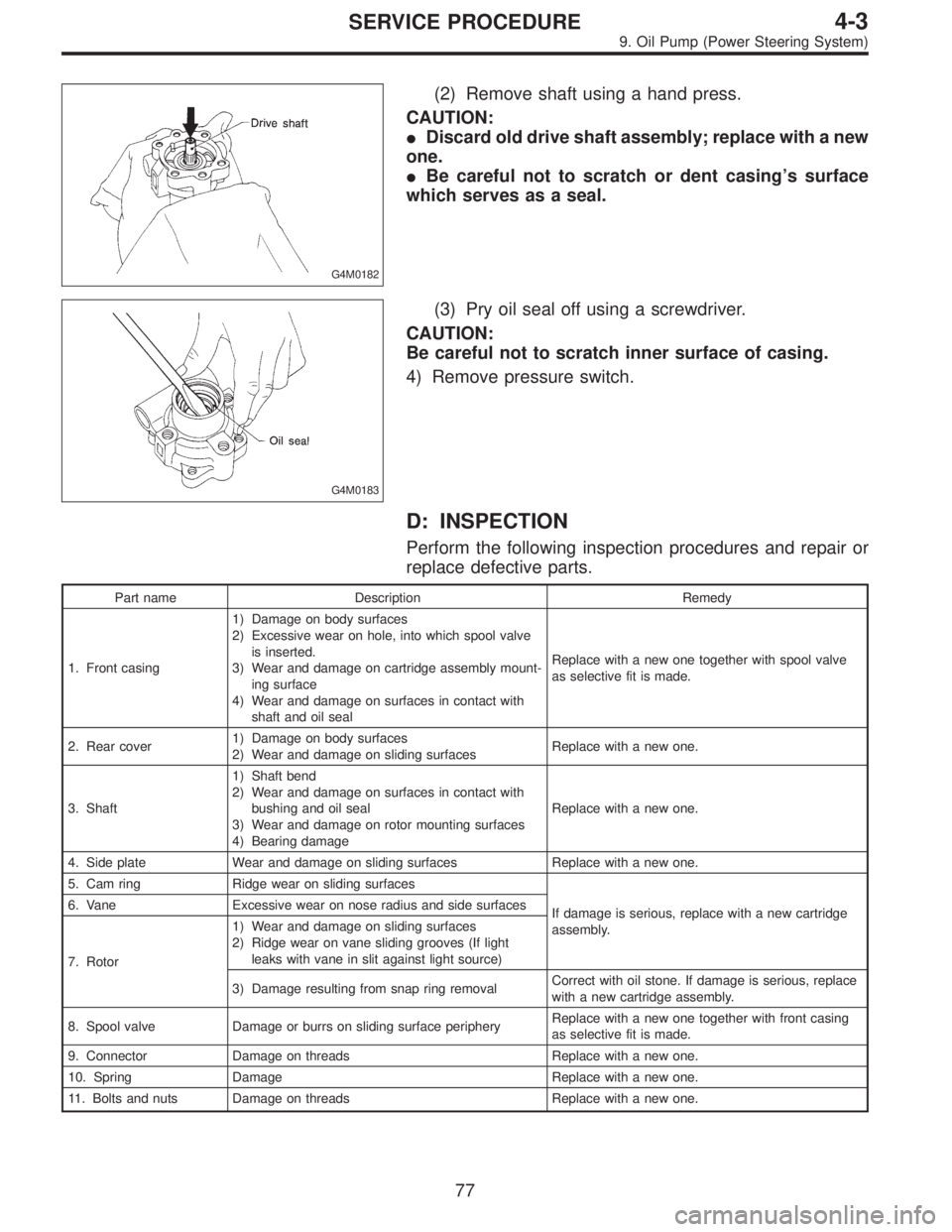
G4M0182
(2) Remove shaft using a hand press.
CAUTION:
�Discard old drive shaft assembly; replace with a new
one.
�Be careful not to scratch or dent casing’s surface
which serves as a seal.
G4M0183
(3) Pry oil seal off using a screwdriver.
CAUTION:
Be careful not to scratch inner surface of casing.
4) Remove pressure switch.
D: INSPECTION
Perform the following inspection procedures and repair or
replace defective parts.
Part name Description Remedy
1. Front casing1) Damage on body surfaces
2) Excessive wear on hole, into which spool valve
is inserted.
3) Wear and damage on cartridge assembly mount-
ing surface
4) Wear and damage on surfaces in contact with
shaft and oil sealReplace with a new one together with spool valve
as selective fit is made.
2. Rear cover1) Damage on body surfaces
2) Wear and damage on sliding surfacesReplace with a new one.
3. Shaft1) Shaft bend
2) Wear and damage on surfaces in contact with
bushing and oil seal
3) Wear and damage on rotor mounting surfaces
4) Bearing damageReplace with a new one.
4. Side plate Wear and damage on sliding surfaces Replace with a new one.
5. Cam ring Ridge wear on sliding surfaces
If damage is serious, replace with a new cartridge
assembly. 6. Vane Excessive wear on nose radius and side surfaces
7. Rotor1) Wear and damage on sliding surfaces
2) Ridge wear on vane sliding grooves (If light
leaks with vane in slit against light source)
3) Damage resulting from snap ring removalCorrect with oil stone. If damage is serious, replace
with a new cartridge assembly.
8. Spool valve Damage or burrs on sliding surface peripheryReplace with a new one together with front casing
as selective fit is made.
9. Connector Damage on threads Replace with a new one.
10. Spring Damage Replace with a new one.
11. Bolts and nuts Damage on threads Replace with a new one.
77
4-3SERVICE PROCEDURE
9. Oil Pump (Power Steering System)
Page 696 of 2248
6) Check
(1) When reassembly procedures have been
completed, turn shaft by hand to ensure it turns
smoothly. If it binds or other unusual conditions are
evident, disassemble again and check for foreign mat-
ter trapped on sliding surfaces and improper installa-
tion. Eliminate the cause of trouble.
(2) Check followings by referring to“CHECK”article.
�Excessive play in pulley shaft
�Ditch deflection of pulley
�Resistance to rotation of pulley
�Measurement of generated oil pressure
F: INSTALLATION
1) Install bracket on engine.
Tightening torque:
22±2 N⋅m (2.2±0.2 kg-m, 15.9±1.4 ft-lb)
2) Install oil pump on oil tank as follows outside the
vehicle:
NOTE:
Prior to installation, make sure that all oil is removed from
oil pump, oil tank and pipe.
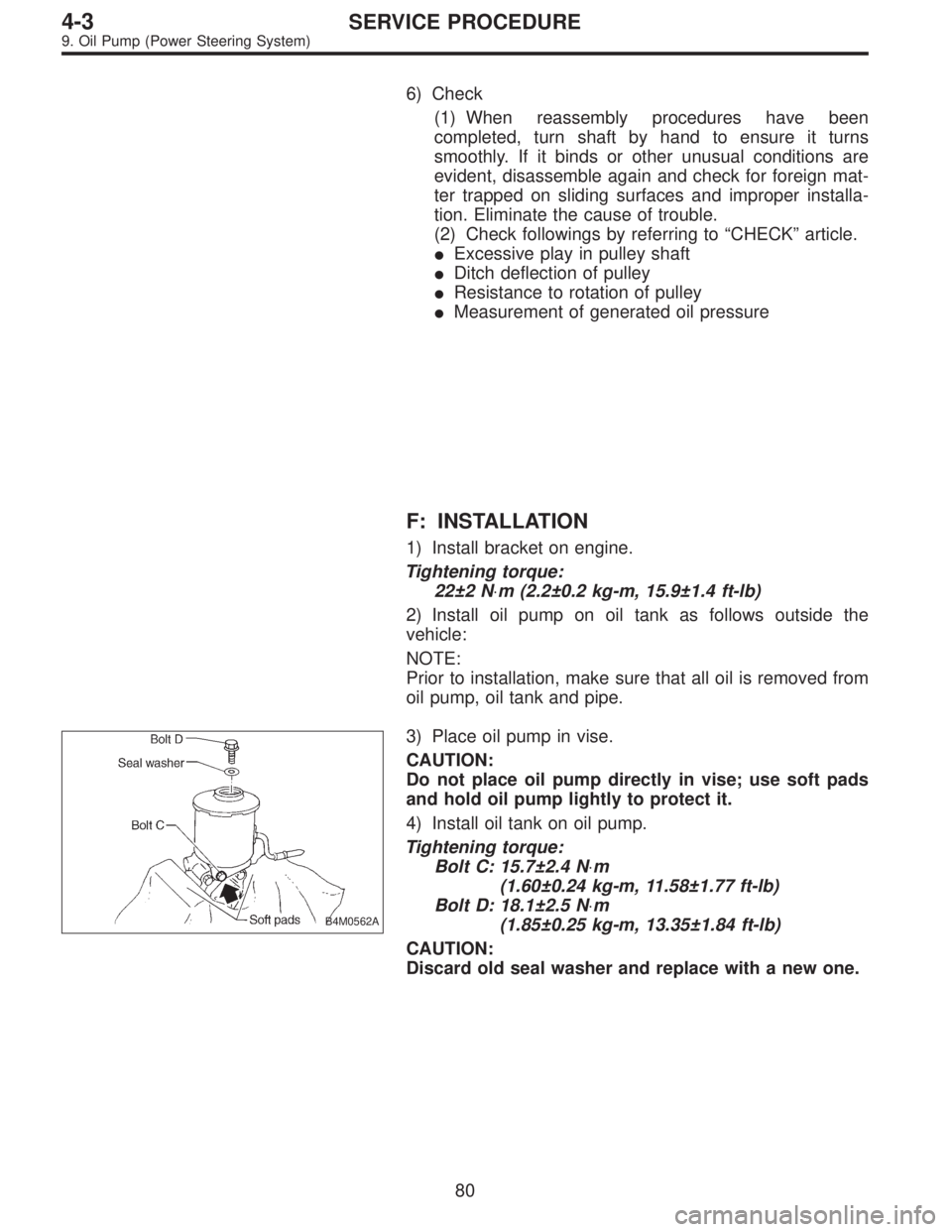
B4M0562A
3) Place oil pump in vise.
CAUTION:
Do not place oil pump directly in vise; use soft pads
and hold oil pump lightly to protect it.
4) Install oil tank on oil pump.
Tightening torque:
Bolt C: 15.7±2.4 N⋅m
(1.60±0.24 kg-m, 11.58±1.77 ft-lb)
Bolt D: 18.1±2.5 N⋅m
(1.85±0.25 kg-m, 13.35±1.84 ft-lb)
CAUTION:
Discard old seal washer and replace with a new one.
80
4-3SERVICE PROCEDURE
9. Oil Pump (Power Steering System)
Page 700 of 2248
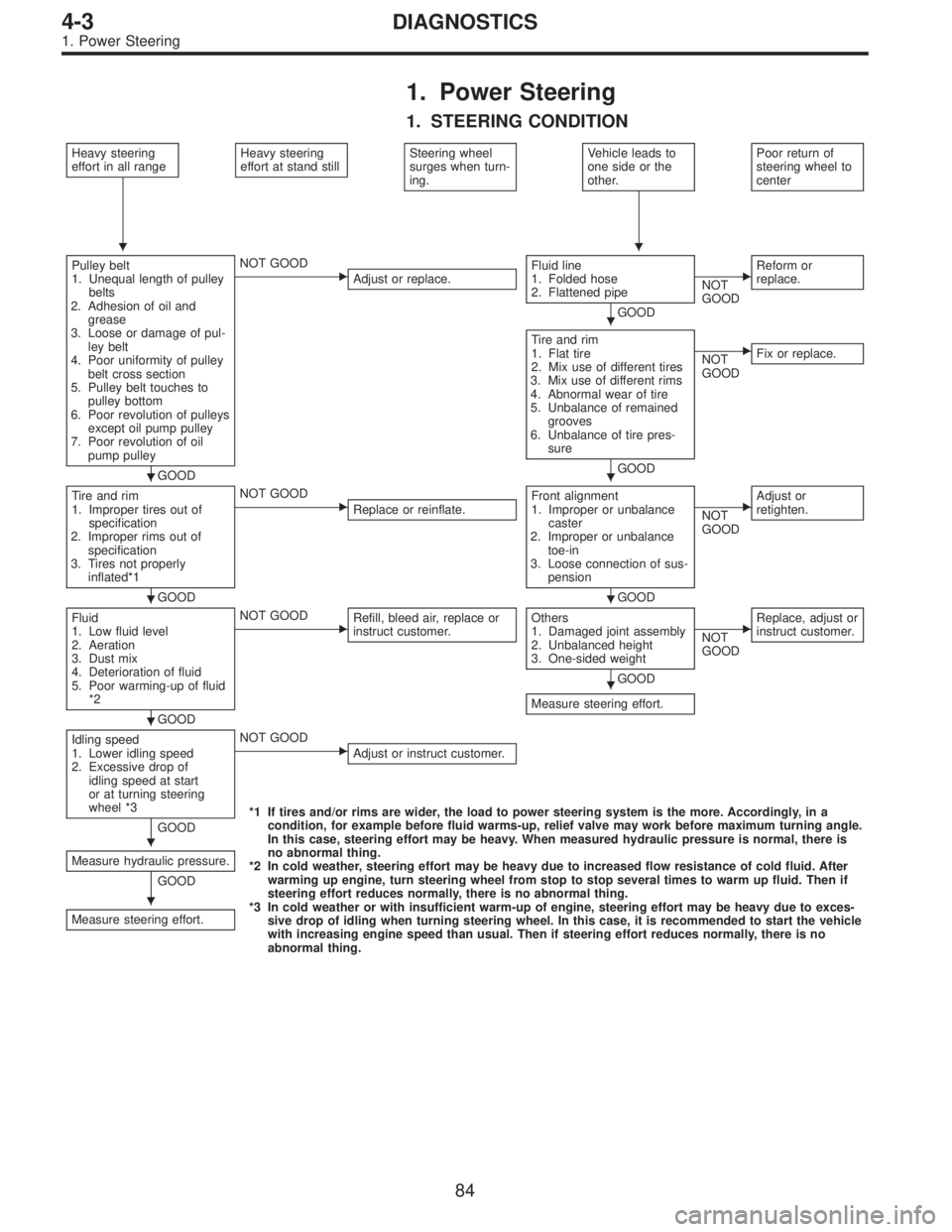
1. Power Steering
1. STEERING CONDITION
Heavy steering
effort in all rangeHeavy steering
effort at stand stillSteering wheel
surges when turn-
ing.Vehicle leads to
one side or the
other.Poor return of
steering wheel to
center
Pulley belt
1. Unequal length of pulley
belts
2. Adhesion of oil and
grease
3. Loose or damage of pul-
ley belt
4. Poor uniformity of pulley
belt cross section
5. Pulley belt touches to
pulley bottom
6. Poor revolution of pulleys
except oil pump pulley
7. Poor revolution of oil
pump pulley
GOOD
�NOT GOOD
Adjust or replace.Fluid line
1. Folded hose
2. Flattened pipe
GOOD
�NOT
GOODReform or
replace.
Tire and rim
1. Flat tire
2. Mix use of different tires
3. Mix use of different rims
4. Abnormal wear of tire
5. Unbalance of remained
grooves
6. Unbalance of tire pres-
sure
GOOD
�NOT
GOODFix or replace.
Tire and rim
1. Improper tires out of
specification
2. Improper rims out of
specification
3. Tires not properly
inflated*1
GOOD
�NOT GOOD
Replace or reinflate.Front alignment
1. Improper or unbalance
caster
2. Improper or unbalance
toe-in
3. Loose connection of sus-
pension
GOOD
�NOT
GOODAdjust or
retighten.
Fluid
1. Low fluid level
2. Aeration
3. Dust mix
4. Deterioration of fluid
5. Poor warming-up of fluid
*2
GOOD
�NOT GOOD
Refill, bleed air, replace or
instruct customer.Others
1. Damaged joint assembly
2. Unbalanced height
3. One-sided weight
GOOD
Measure steering effort.
�NOT
GOODReplace, adjust or
instruct customer.
Idling speed
1. Lower idling speed
2. Excessive drop of
idling speed at start
or at turning steering
wheel *3
GOOD
�NOT GOOD
Adjust or instruct customer.
*1 If tires and/or rims are wider, the load to power steering system is the more. Accordingly, in a
condition, for example before fluid warms-up, relief valve may work before maximum turning angle.
In this case, steering effort may be heavy. When measured hydraulic pressure is normal, there is
no abnormal thing.
*2 In cold weather, steering effort may be heavy due to increased flow resistance of cold fluid. After
warming up engine, turn steering wheel from stop to stop several times to warm up fluid. Then if
steering effort reduces normally, there is no abnormal thing.
*3 In cold weather or with insufficient warm-up of engine, steering effort may be heavy due to exces-
sive drop of idling when turning steering wheel. In this case, it is recommended to start the vehicle
with increasing engine speed than usual. Then if steering effort reduces normally, there is no
abnormal thing. Measure hydraulic pressure.
GOOD
Measure steering effort.
��
�
��
��
�
�
�
�
84
4-3DIAGNOSTICS
1. Power Steering