Page 700 of 2248
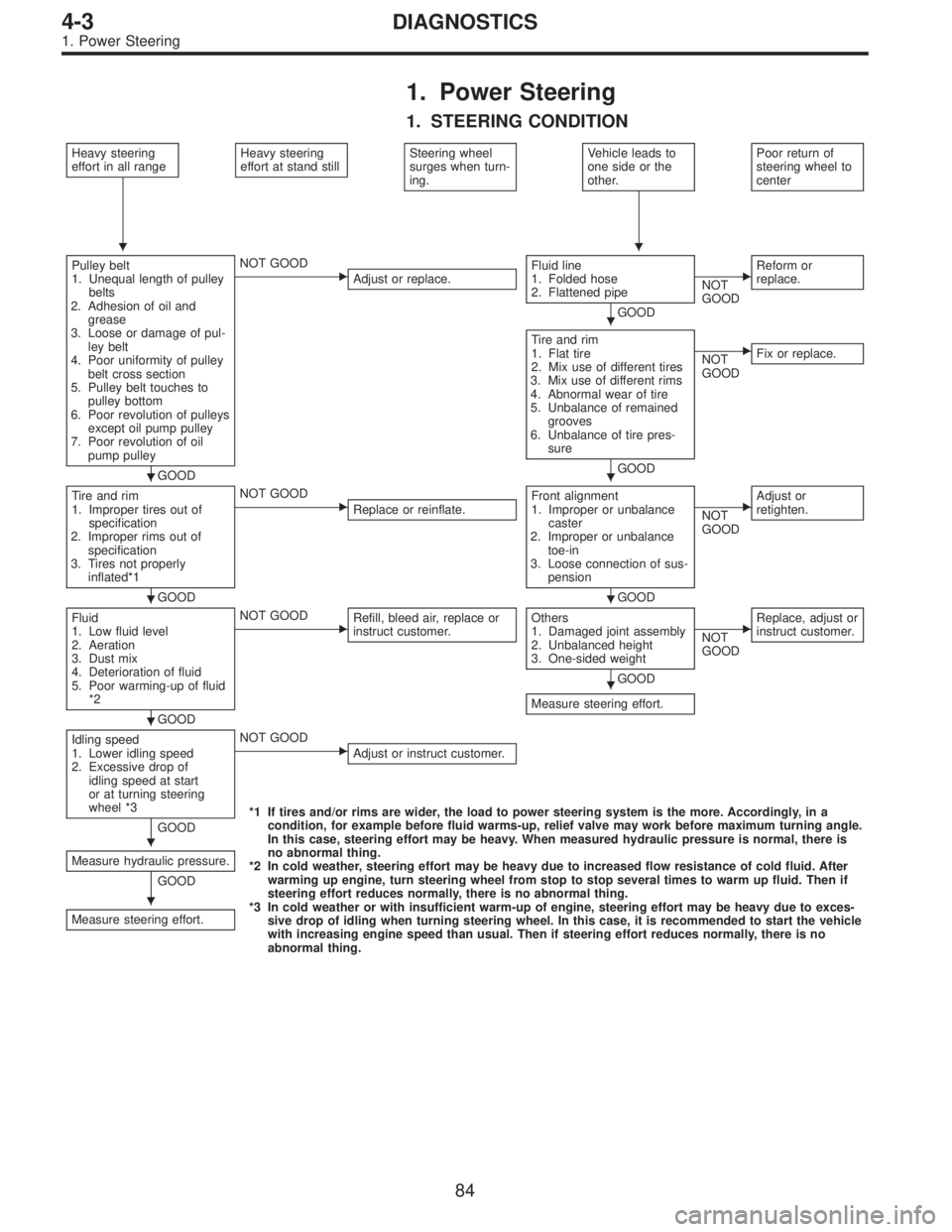
1. Power Steering
1. STEERING CONDITION
Heavy steering
effort in all rangeHeavy steering
effort at stand stillSteering wheel
surges when turn-
ing.Vehicle leads to
one side or the
other.Poor return of
steering wheel to
center
Pulley belt
1. Unequal length of pulley
belts
2. Adhesion of oil and
grease
3. Loose or damage of pul-
ley belt
4. Poor uniformity of pulley
belt cross section
5. Pulley belt touches to
pulley bottom
6. Poor revolution of pulleys
except oil pump pulley
7. Poor revolution of oil
pump pulley
GOOD
�NOT GOOD
Adjust or replace.Fluid line
1. Folded hose
2. Flattened pipe
GOOD
�NOT
GOODReform or
replace.
Tire and rim
1. Flat tire
2. Mix use of different tires
3. Mix use of different rims
4. Abnormal wear of tire
5. Unbalance of remained
grooves
6. Unbalance of tire pres-
sure
GOOD
�NOT
GOODFix or replace.
Tire and rim
1. Improper tires out of
specification
2. Improper rims out of
specification
3. Tires not properly
inflated*1
GOOD
�NOT GOOD
Replace or reinflate.Front alignment
1. Improper or unbalance
caster
2. Improper or unbalance
toe-in
3. Loose connection of sus-
pension
GOOD
�NOT
GOODAdjust or
retighten.
Fluid
1. Low fluid level
2. Aeration
3. Dust mix
4. Deterioration of fluid
5. Poor warming-up of fluid
*2
GOOD
�NOT GOOD
Refill, bleed air, replace or
instruct customer.Others
1. Damaged joint assembly
2. Unbalanced height
3. One-sided weight
GOOD
Measure steering effort.
�NOT
GOODReplace, adjust or
instruct customer.
Idling speed
1. Lower idling speed
2. Excessive drop of
idling speed at start
or at turning steering
wheel *3
GOOD
�NOT GOOD
Adjust or instruct customer.
*1 If tires and/or rims are wider, the load to power steering system is the more. Accordingly, in a
condition, for example before fluid warms-up, relief valve may work before maximum turning angle.
In this case, steering effort may be heavy. When measured hydraulic pressure is normal, there is
no abnormal thing.
*2 In cold weather, steering effort may be heavy due to increased flow resistance of cold fluid. After
warming up engine, turn steering wheel from stop to stop several times to warm up fluid. Then if
steering effort reduces normally, there is no abnormal thing.
*3 In cold weather or with insufficient warm-up of engine, steering effort may be heavy due to exces-
sive drop of idling when turning steering wheel. In this case, it is recommended to start the vehicle
with increasing engine speed than usual. Then if steering effort reduces normally, there is no
abnormal thing. Measure hydraulic pressure.
GOOD
Measure steering effort.
��
�
��
��
�
�
�
�
84
4-3DIAGNOSTICS
1. Power Steering
Page 821 of 2248
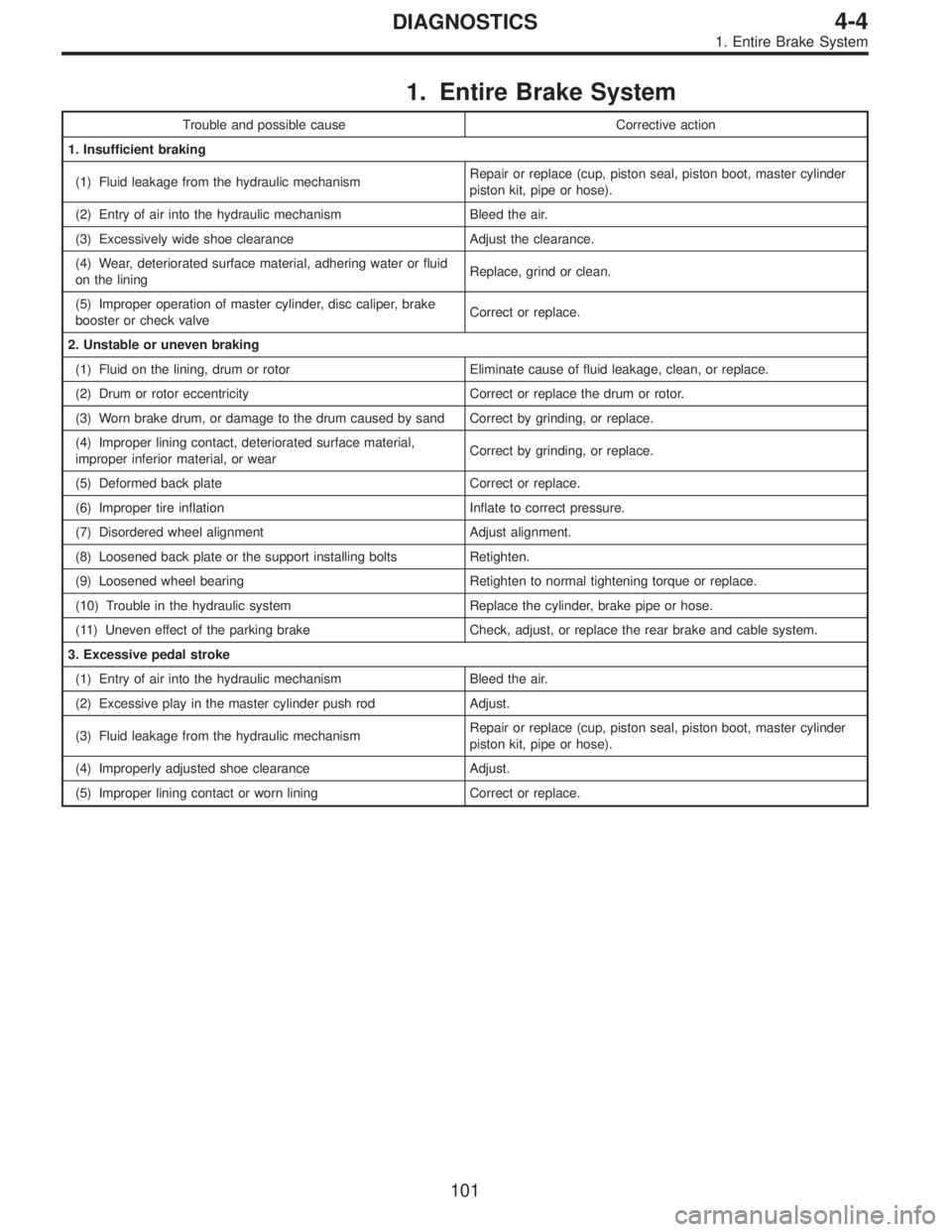
1. Entire Brake System
Trouble and possible cause Corrective action
1. Insufficient braking
(1) Fluid leakage from the hydraulic mechanismRepair or replace (cup, piston seal, piston boot, master cylinder
piston kit, pipe or hose).
(2) Entry of air into the hydraulic mechanism Bleed the air.
(3) Excessively wide shoe clearance Adjust the clearance.
(4) Wear, deteriorated surface material, adhering water or fluid
on the liningReplace, grind or clean.
(5) Improper operation of master cylinder, disc caliper, brake
booster or check valveCorrect or replace.
2. Unstable or uneven braking
(1) Fluid on the lining, drum or rotor Eliminate cause of fluid leakage, clean, or replace.
(2) Drum or rotor eccentricity Correct or replace the drum or rotor.
(3) Worn brake drum, or damage to the drum caused by sand Correct by grinding, or replace.
(4) Improper lining contact, deteriorated surface material,
improper inferior material, or wearCorrect by grinding, or replace.
(5) Deformed back plate Correct or replace.
(6) Improper tire inflation Inflate to correct pressure.
(7) Disordered wheel alignment Adjust alignment.
(8) Loosened back plate or the support installing bolts Retighten.
(9) Loosened wheel bearing Retighten to normal tightening torque or replace.
(10) Trouble in the hydraulic system Replace the cylinder, brake pipe or hose.
(11) Uneven effect of the parking brake Check, adjust, or replace the rear brake and cable system.
3. Excessive pedal stroke
(1) Entry of air into the hydraulic mechanism Bleed the air.
(2) Excessive play in the master cylinder push rod Adjust.
(3) Fluid leakage from the hydraulic mechanismRepair or replace (cup, piston seal, piston boot, master cylinder
piston kit, pipe or hose).
(4) Improperly adjusted shoe clearance Adjust.
(5) Improper lining contact or worn lining Correct or replace.
101
4-4DIAGNOSTICS
1. Entire Brake System
Page 917 of 2248
1. Supplemental Restraint System
“Airbag”
Airbag system wiring harness is routed on and along body
panels.
CAUTION:
�All Airbag system wiring harness and connectors
are colored yellow. Do not use electrical test equip-
ment on these circuits.
�Be careful not to damage Airbag system wiring har-
ness when repairing the body panel.
2. Body Datum Points
Various master repair locations are established as datum
points used during body repairs. In addition, guide holes,
locators and indents are provided to facilitate panel
replacement and achieve alignment accuracy.
NOTE:
Left and right datum points are all symmetrical to each
other.
2
5-1SERVICE DATA
1. Supplemental Restraint System“Airbag”- 2. Body Datum Points
Page 918 of 2248
1. Supplemental Restraint System
“Airbag”
Airbag system wiring harness is routed on and along body
panels.
CAUTION:
�All Airbag system wiring harness and connectors
are colored yellow. Do not use electrical test equip-
ment on these circuits.
�Be careful not to damage Airbag system wiring har-
ness when repairing the body panel.
2. Body Datum Points
Various master repair locations are established as datum
points used during body repairs. In addition, guide holes,
locators and indents are provided to facilitate panel
replacement and achieve alignment accuracy.
NOTE:
Left and right datum points are all symmetrical to each
other.
2
5-1SERVICE DATA
1. Supplemental Restraint System“Airbag”- 2. Body Datum Points
Page 951 of 2248
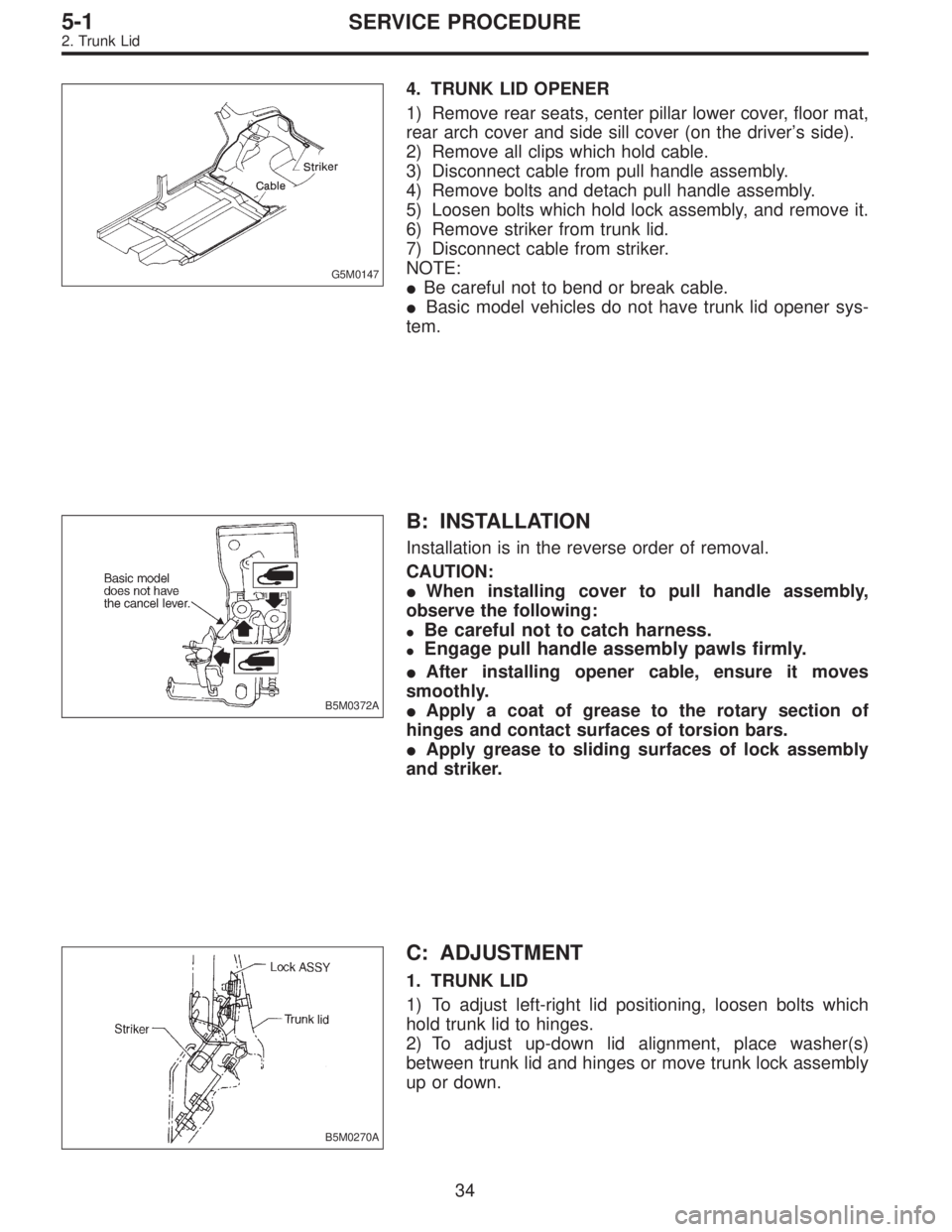
G5M0147
4. TRUNK LID OPENER
1) Remove rear seats, center pillar lower cover, floor mat,
rear arch cover and side sill cover (on the driver’s side).
2) Remove all clips which hold cable.
3) Disconnect cable from pull handle assembly.
4) Remove bolts and detach pull handle assembly.
5) Loosen bolts which hold lock assembly, and remove it.
6) Remove striker from trunk lid.
7) Disconnect cable from striker.
NOTE:
�Be careful not to bend or break cable.
�Basic model vehicles do not have trunk lid opener sys-
tem.
B5M0372A
B: INSTALLATION
Installation is in the reverse order of removal.
CAUTION:
�When installing cover to pull handle assembly,
observe the following:
�Be careful not to catch harness.
�Engage pull handle assembly pawls firmly.
�After installing opener cable, ensure it moves
smoothly.
�Apply a coat of grease to the rotary section of
hinges and contact surfaces of torsion bars.
�Apply grease to sliding surfaces of lock assembly
and striker.
B5M0270A
C: ADJUSTMENT
1. TRUNK LID
1) To adjust left-right lid positioning, loosen bolts which
hold trunk lid to hinges.
2) To adjust up-down lid alignment, place washer(s)
between trunk lid and hinges or move trunk lock assembly
up or down.
34
5-1SERVICE PROCEDURE
2. Trunk Lid
Page 963 of 2248
G5M0175
B: INSTALLATION
1) Installation is in the reverse order of removal.
2) Check for alignment of front fender with hood and front
door with front fender at all points. Adjust, if necessary.
B5M0287A
9. Mud Guard and Rear Arch
Protector
A: REMOVAL
SUPPLEMENTAL RESTRAINT SYSTEM“AIRBAG”
Airbag system wiring harness is routed near the mud
guard.
CAUTION:
�All Airbag system wiring harness and connectors
are colored yellow. Do not use electrical test equip-
ment on these circuits.
�Be careful not to damage Airbag system wiring har-
ness when servicing the mud guard.
B5M0288
1. MUD GUARD
1) Jack-up vehicle to remove tire.
2) Remove screws and clips. Move mud guard toward the
center of the body and remove mud guard.
46
5-1SERVICE PROCEDURE
8. Front Fender - 9. Mud Guard and Rear Arch Protector
Page 964 of 2248
G5M0175
B: INSTALLATION
1) Installation is in the reverse order of removal.
2) Check for alignment of front fender with hood and front
door with front fender at all points. Adjust, if necessary.
B5M0287A
9. Mud Guard and Rear Arch
Protector
A: REMOVAL
SUPPLEMENTAL RESTRAINT SYSTEM“AIRBAG”
Airbag system wiring harness is routed near the mud
guard.
CAUTION:
�All Airbag system wiring harness and connectors
are colored yellow. Do not use electrical test equip-
ment on these circuits.
�Be careful not to damage Airbag system wiring har-
ness when servicing the mud guard.
B5M0288
1. MUD GUARD
1) Jack-up vehicle to remove tire.
2) Remove screws and clips. Move mud guard toward the
center of the body and remove mud guard.
46
5-1SERVICE PROCEDURE
8. Front Fender - 9. Mud Guard and Rear Arch Protector
Page 974 of 2248
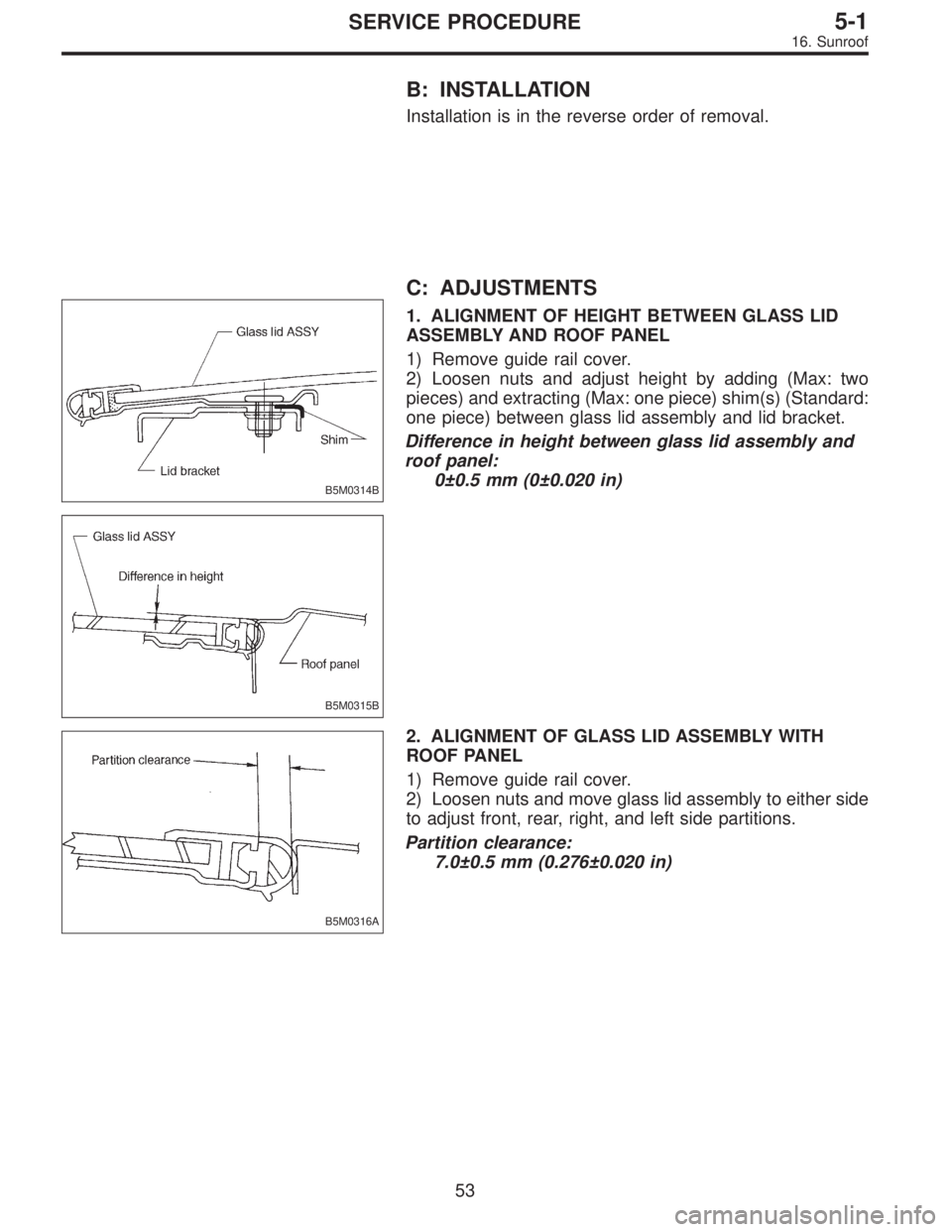
B: INSTALLATION
Installation is in the reverse order of removal.
B5M0314B
B5M0315B
C: ADJUSTMENTS
1. ALIGNMENT OF HEIGHT BETWEEN GLASS LID
ASSEMBLY AND ROOF PANEL
1) Remove guide rail cover.
2) Loosen nuts and adjust height by adding (Max: two
pieces) and extracting (Max: one piece) shim(s) (Standard:
one piece) between glass lid assembly and lid bracket.
Difference in height between glass lid assembly and
roof panel:
0±0.5 mm (0±0.020 in)
B5M0316A
2. ALIGNMENT OF GLASS LID ASSEMBLY WITH
ROOF PANEL
1) Remove guide rail cover.
2) Loosen nuts and move glass lid assembly to either side
to adjust front, rear, right, and left side partitions.
Partition clearance:
7.0±0.5 mm (0.276±0.020 in)
53
5-1SERVICE PROCEDURE
16. Sunroof