Page 93 of 2248
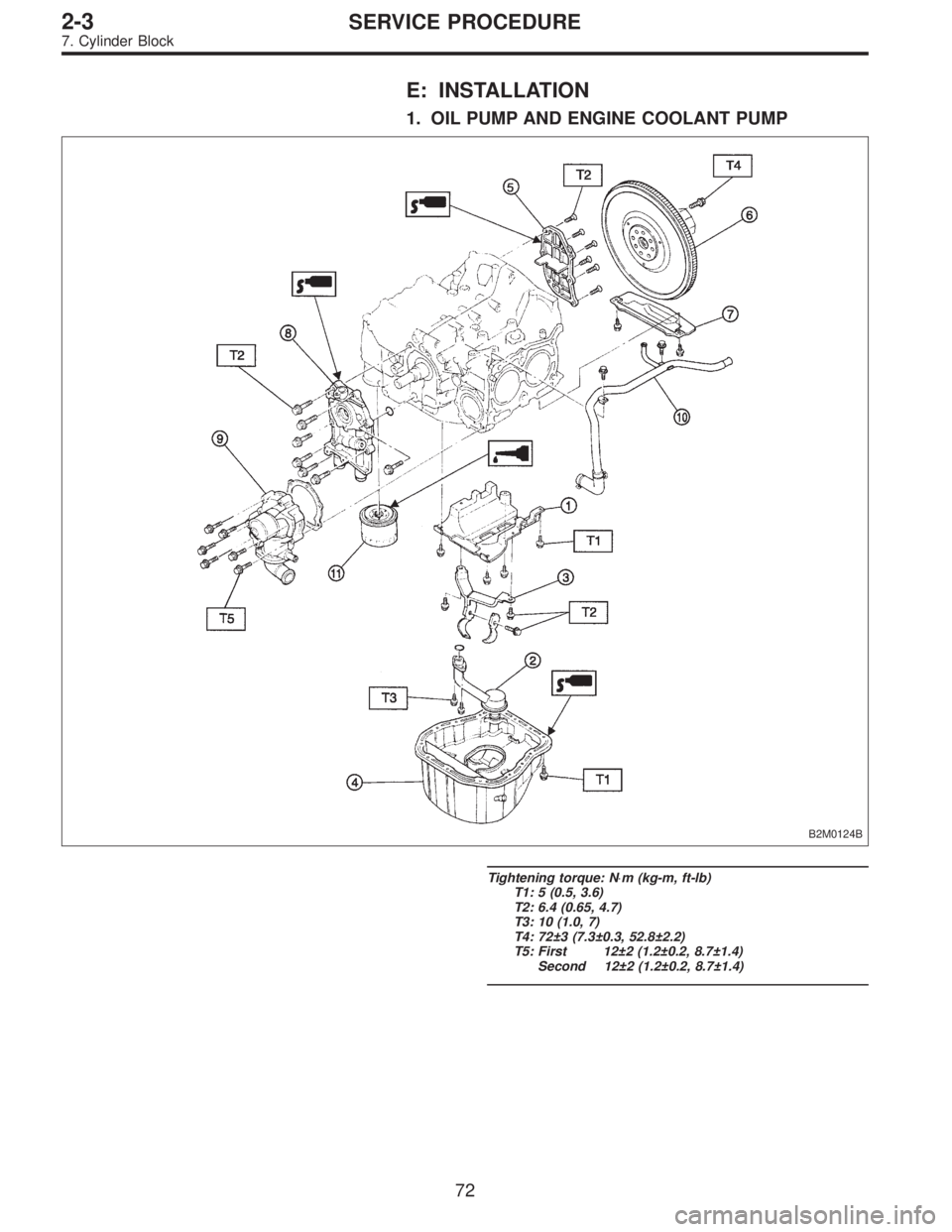
E: INSTALLATION
1. OIL PUMP AND ENGINE COOLANT PUMP
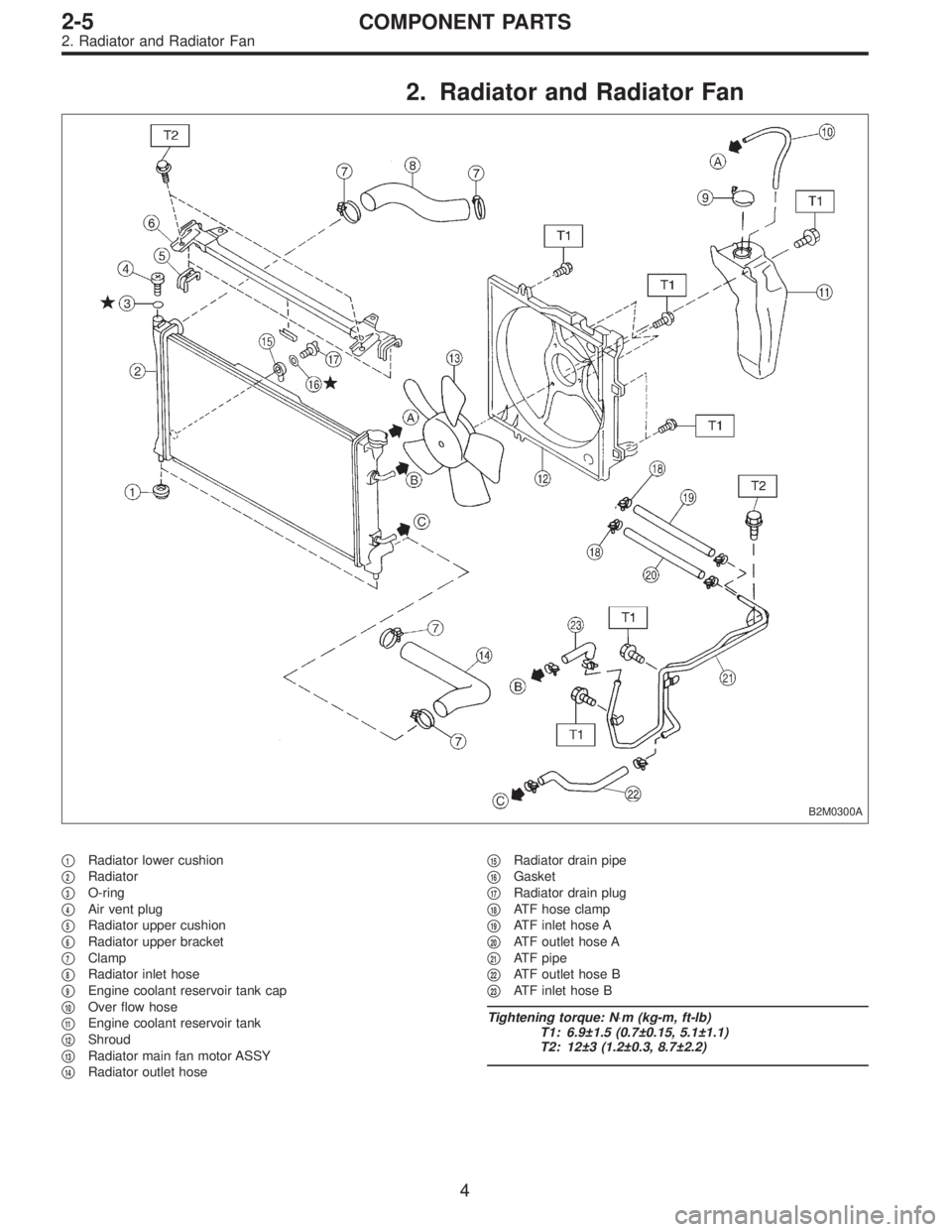
B2M0124B
Tightening torque: N⋅m (kg-m, ft-lb)
T1: 5 (0.5, 3.6)
T2: 6.4 (0.65, 4.7)
T3: 10 (1.0, 7)
T4: 72±3 (7.3±0.3, 52.8±2.2)
T5: First 12±2 (1.2±0.2, 8.7±1.4)
Second 12±2 (1.2±0.2, 8.7±1.4)
72
2-3SERVICE PROCEDURE
7. Cylinder Block
Page 95 of 2248
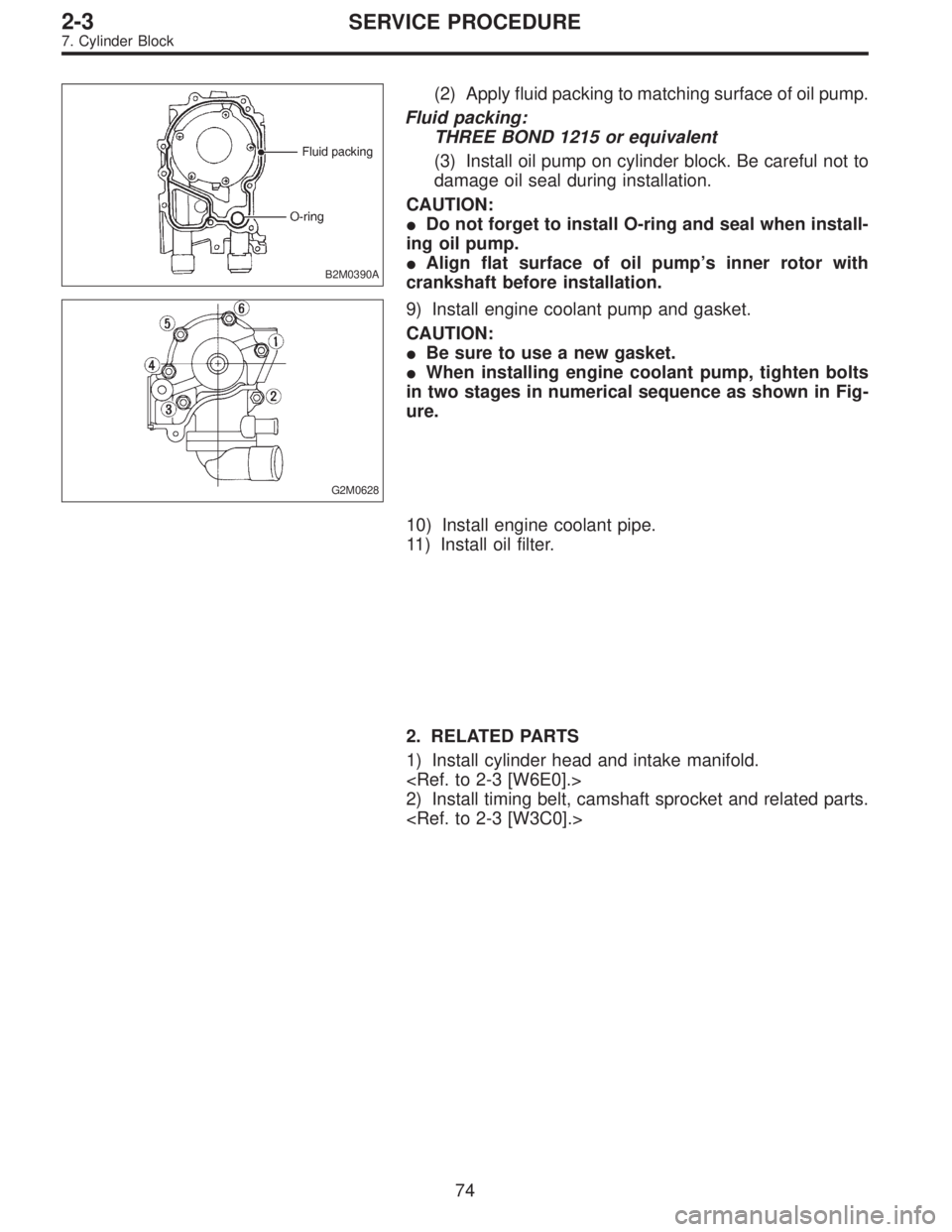
B2M0390A
(2) Apply fluid packing to matching surface of oil pump.
Fluid packing:
THREE BOND 1215 or equivalent
(3) Install oil pump on cylinder block. Be careful not to
damage oil seal during installation.
CAUTION:
�Do not forget to install O-ring and seal when install-
ing oil pump.
�Align flat surface of oil pump’s inner rotor with
crankshaft before installation.
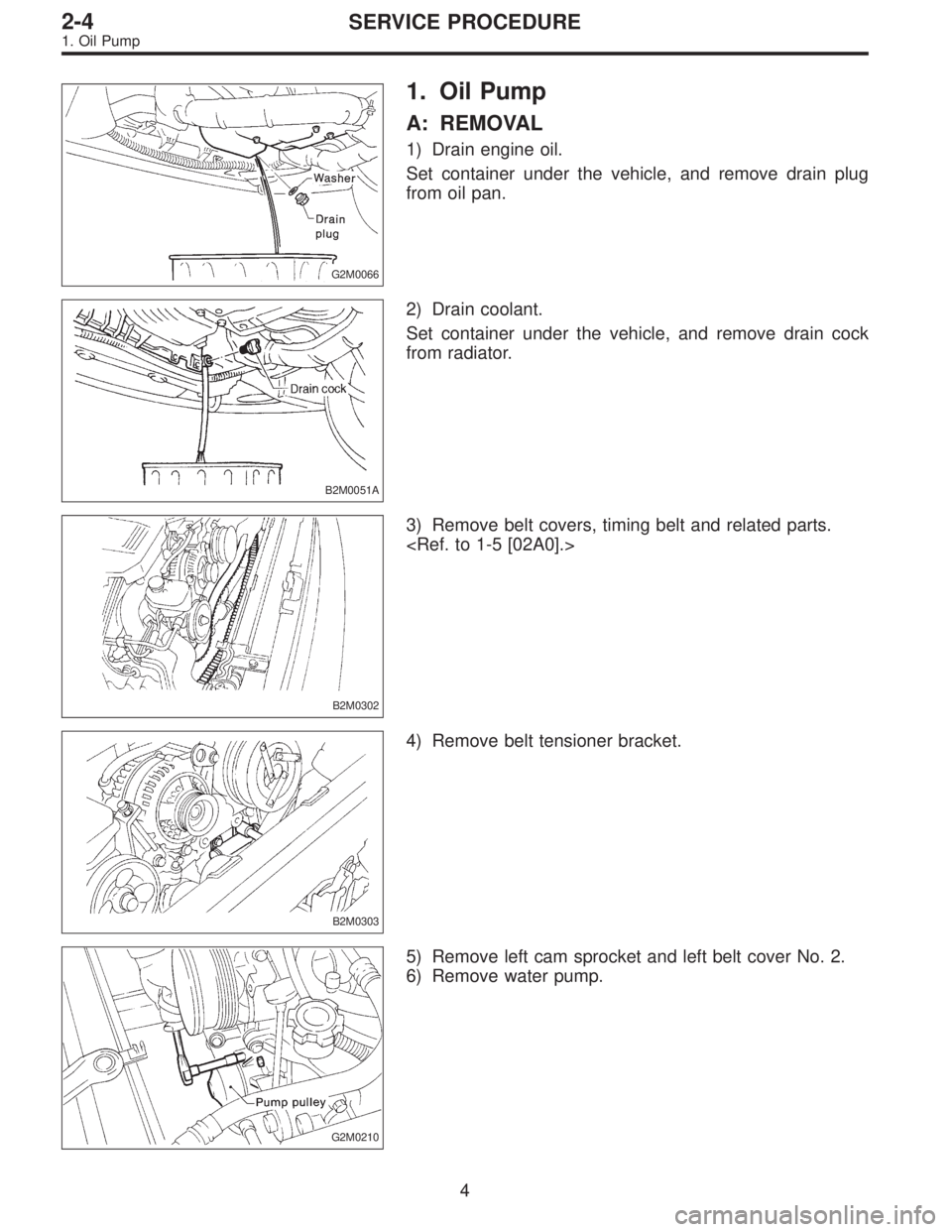
G2M0628
9) Install engine coolant pump and gasket.
CAUTION:
�Be sure to use a new gasket.
�When installing engine coolant pump, tighten bolts
in two stages in numerical sequence as shown in Fig-
ure.
10) Install engine coolant pipe.
11) Install oil filter.
2. RELATED PARTS
1) Install cylinder head and intake manifold.
2) Install timing belt, camshaft sprocket and related parts.
74
2-3SERVICE PROCEDURE
7. Cylinder Block
Page 99 of 2248
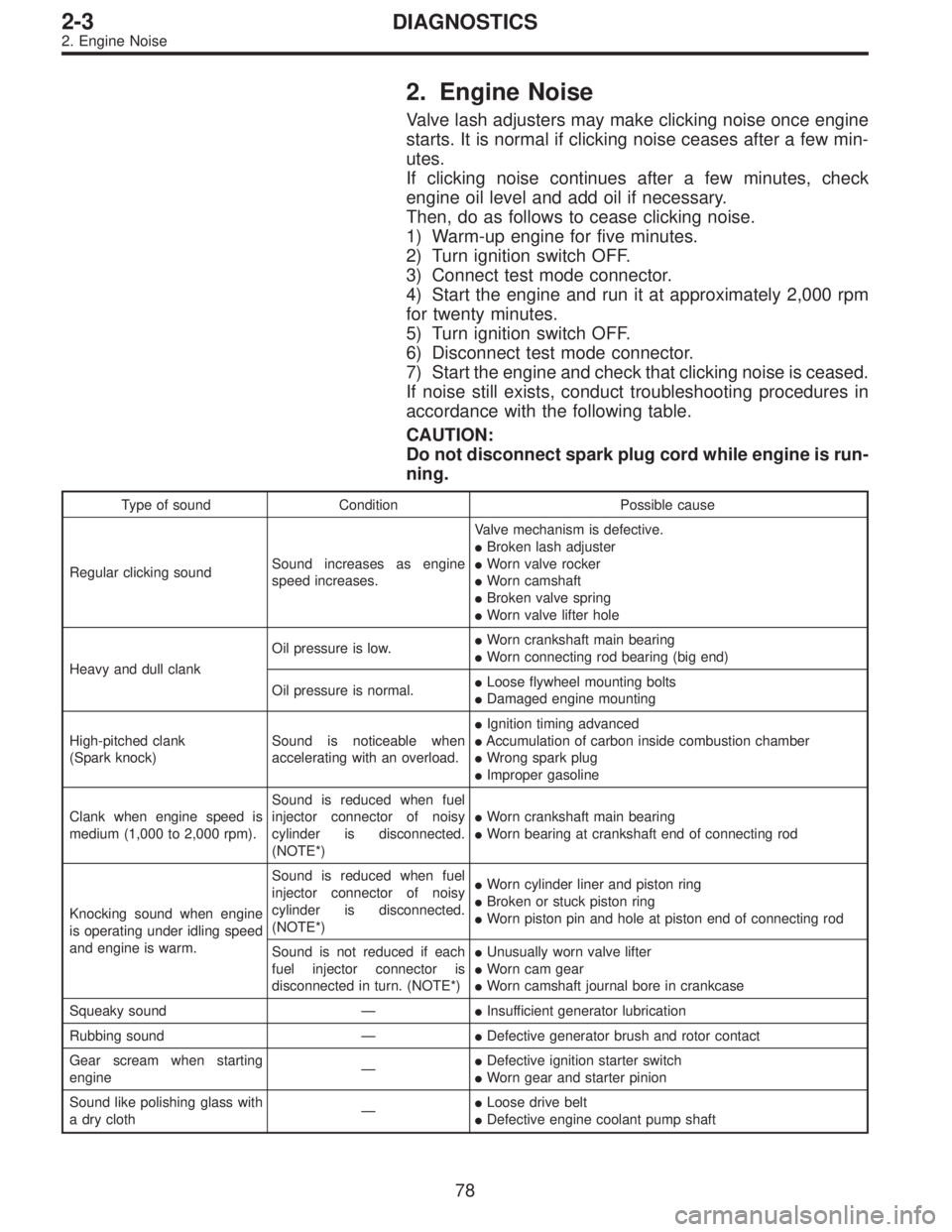
2. Engine Noise
Valve lash adjusters may make clicking noise once engine
starts. It is normal if clicking noise ceases after a few min-
utes.
If clicking noise continues after a few minutes, check
engine oil level and add oil if necessary.
Then, do as follows to cease clicking noise.
1) Warm-up engine for five minutes.
2) Turn ignition switch OFF.
3) Connect test mode connector.
4) Start the engine and run it at approximately 2,000 rpm
for twenty minutes.
5) Turn ignition switch OFF.
6) Disconnect test mode connector.
7) Start the engine and check that clicking noise is ceased.
If noise still exists, conduct troubleshooting procedures in
accordance with the following table.
CAUTION:
Do not disconnect spark plug cord while engine is run-
ning.
Type of sound Condition Possible cause
Regular clicking soundSound increases as engine
speed increases.Valve mechanism is defective.
�Broken lash adjuster
�Worn valve rocker
�Worn camshaft
�Broken valve spring
�Worn valve lifter hole
Heavy and dull clankOil pressure is low.�Worn crankshaft main bearing
�Worn connecting rod bearing (big end)
Oil pressure is normal.�Loose flywheel mounting bolts
�Damaged engine mounting
High-pitched clank
(Spark knock)Sound is noticeable when
accelerating with an overload.�Ignition timing advanced
�Accumulation of carbon inside combustion chamber
�Wrong spark plug
�Improper gasoline
Clank when engine speed is
medium (1,000 to 2,000 rpm).Sound is reduced when fuel
injector connector of noisy
cylinder is disconnected.
(NOTE*)�Worn crankshaft main bearing
�Worn bearing at crankshaft end of connecting rod
Knocking sound when engine
is operating under idling speed
and engine is warm.Sound is reduced when fuel
injector connector of noisy
cylinder is disconnected.
(NOTE*)�Worn cylinder liner and piston ring
�Broken or stuck piston ring
�Worn piston pin and hole at piston end of connecting rod
Sound is not reduced if each
fuel injector connector is
disconnected in turn. (NOTE*)�Unusually worn valve lifter
�Worn cam gear
�Worn camshaft journal bore in crankcase
Squeaky sound—�Insufficient generator lubrication
Rubbing sound—�Defective generator brush and rotor contact
Gear scream when starting
engine—�Defective ignition starter switch
�Worn gear and starter pinion
Sound like polishing glass with
a dry cloth—�Loose drive belt
�Defective engine coolant pump shaft
78
2-3DIAGNOSTICS
2. Engine Noise
Page 103 of 2248
G2M0066
1. Oil Pump
A: REMOVAL
1) Drain engine oil.
Set container under the vehicle, and remove drain plug
from oil pan.
B2M0051A
2) Drain coolant.
Set container under the vehicle, and remove drain cock
from radiator.
B2M0302
3) Remove belt covers, timing belt and related parts.
B2M0303
4) Remove belt tensioner bracket.
G2M0210
5) Remove left cam sprocket and left belt cover No. 2.
6) Remove water pump.
4
2-4SERVICE PROCEDURE
1. Oil Pump
Page 117 of 2248
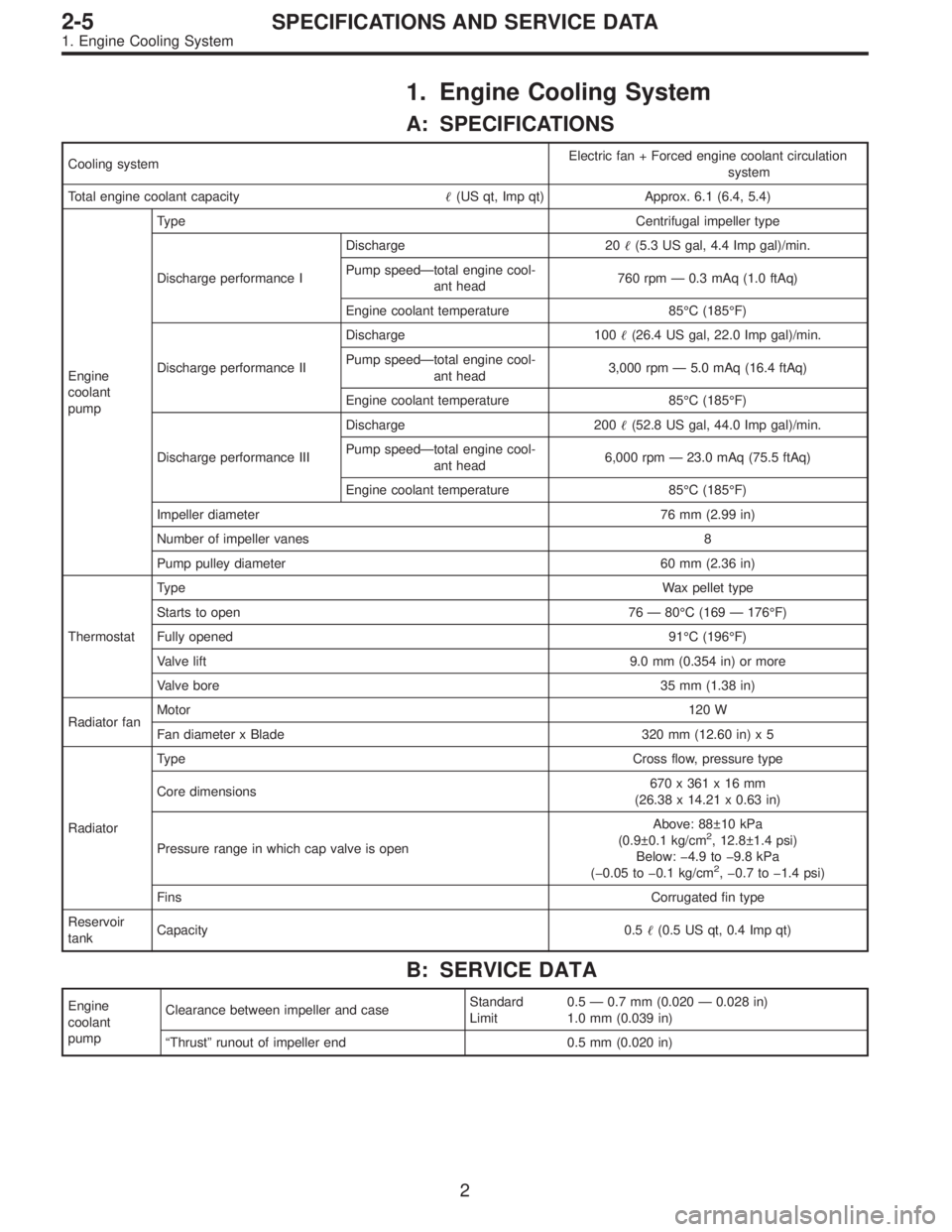
1. Engine Cooling System
A: SPECIFICATIONS
Cooling systemElectric fan + Forced engine coolant circulation
system
Total engine coolant capacity�(US qt, Imp qt) Approx. 6.1 (6.4, 5.4)
Engine
coolant
pumpTypeCentrifugal impeller type
Discharge performance IDischarge 20�(5.3 US gal, 4.4 Imp gal)/min.
Pump speed—total engine cool-
ant head760 rpm — 0.3 mAq (1.0 ftAq)
Engine coolant temperature 85°C (185°F)
Discharge performance IIDischarge 100�(26.4 US gal, 22.0 Imp gal)/min.
Pump speed—total engine cool-
ant head3,000 rpm — 5.0 mAq (16.4 ftAq)
Engine coolant temperature 85°C (185°F)
Discharge performance IIIDischarge 200�(52.8 US gal, 44.0 Imp gal)/min.
Pump speed—total engine cool-
ant head6,000 rpm — 23.0 mAq (75.5 ftAq)
Engine coolant temperature 85°C (185°F)
Impeller diameter 76 mm (2.99 in)
Number of impeller vanes 8
Pump pulley diameter 60 mm (2.36 in)
ThermostatTypeWax pellet type
Starts to open 76 — 80°C (169 — 176°F)
Fully opened91°C (196°F)
Valve lift9.0 mm (0.354 in) or more
Valve bore35 mm (1.38 in)
Radiator fanMotor120 W
Fan diameter x Blade 320 mm (12.60 in) x 5
RadiatorTypeCross flow, pressure type
Core dimensions670x361x16mm
(26.38 x 14.21 x 0.63 in)
Pressure range in which cap valve is openAbove: 88±10 kPa
(0.9±0.1 kg/cm
2, 12.8±1.4 psi)
Below: 4.9 to 9.8 kPa
(0.05 to 0.1 kg/cm
2, 0.7 to 1.4 psi)
FinsCorrugated fin type
Reservoir
tankCapacity 0.5�(0.5 US qt, 0.4 Imp qt)
B: SERVICE DATA
Engine
coolant
pumpClearance between impeller and caseStandard
Limit0.5 — 0.7 mm (0.020 — 0.028 in)
1.0 mm (0.039 in)
“Thrust” runout of impeller end 0.5 mm (0.020 in)
2
2-5SPECIFICATIONS AND SERVICE DATA
1. Engine Cooling System
Page 118 of 2248
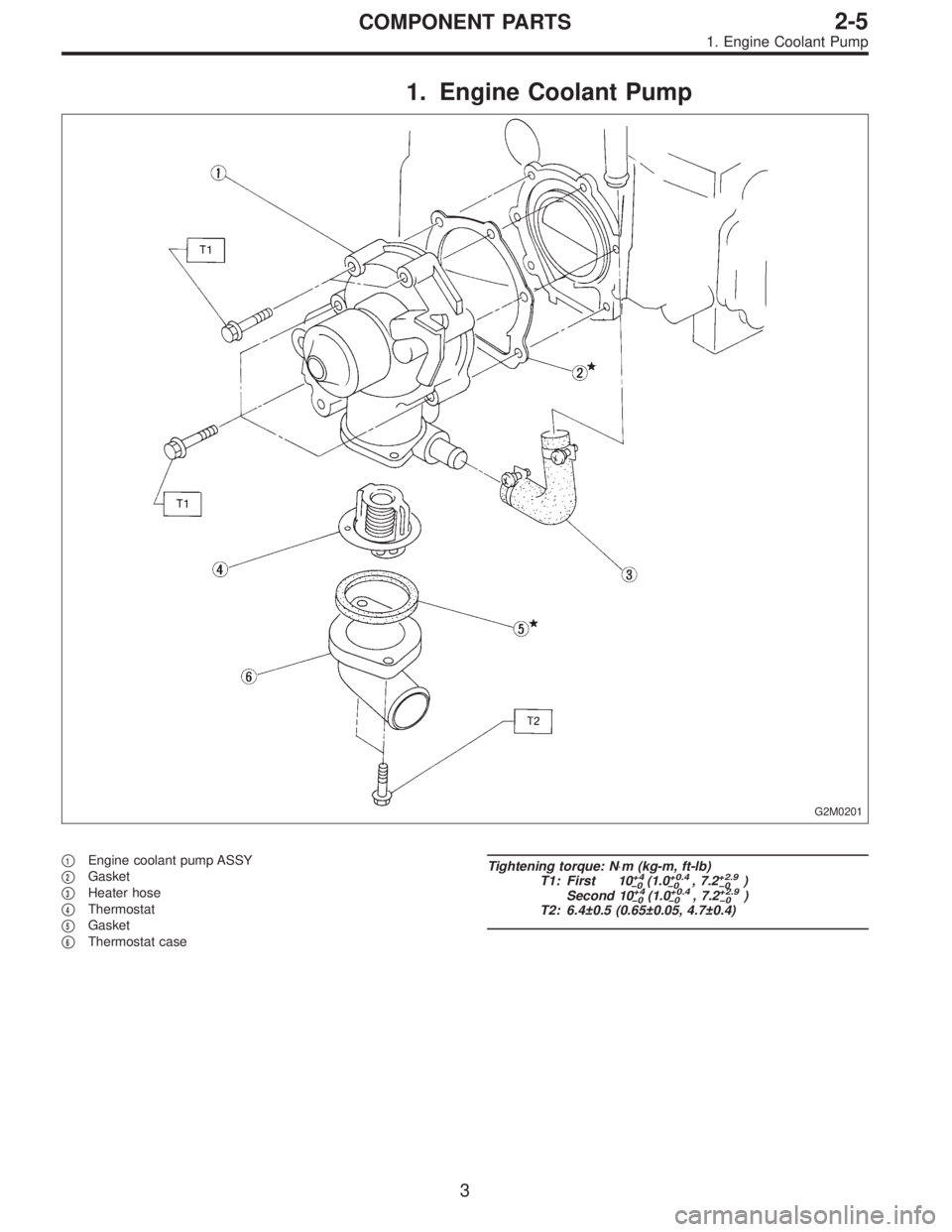
1. Engine Coolant Pump
G2M0201
�1Engine coolant pump ASSY
�
2Gasket
�
3Heater hose
�
4Thermostat
�
5Gasket
�
6Thermostat case
Tightening torque: N⋅m (kg-m, ft-lb)
T1: First 10+4
0(1.0+0.4
0, 7.2+2.9
0)
Second 10+4
0(1.0+0.4
0, 7.2+2.9
0)
T2: 6.4±0.5 (0.65±0.05, 4.7±0.4)
3
2-5COMPONENT PARTS
1. Engine Coolant Pump
Page 119 of 2248
2. Radiator and Radiator Fan
B2M0300A
�1Radiator lower cushion
�
2Radiator
�
3O-ring
�
4Air vent plug
�
5Radiator upper cushion
�
6Radiator upper bracket
�
7Clamp
�
8Radiator inlet hose
�
9Engine coolant reservoir tank cap
�
10Over flow hose
�
11Engine coolant reservoir tank
�
12Shroud
�
13Radiator main fan motor ASSY
�
14Radiator outlet hose�
15Radiator drain pipe
�
16Gasket
�
17Radiator drain plug
�
18ATF hose clamp
�
19ATF inlet hose A
�
20ATF outlet hose A
�
21ATF pipe
�
22ATF outlet hose B
�
23ATF inlet hose B
Tightening torque: N⋅m (kg-m, ft-lb)
T1: 6.9±1.5 (0.7±0.15, 5.1±1.1)
T2: 12±3 (1.2±0.3, 8.7±2.2)
4
2-5COMPONENT PARTS
2. Radiator and Radiator Fan
Page 120 of 2248
3. Engine Coolant Pipe
G2M0203
�1Engine coolant temperature sensor
�
2Engine coolant temperature gauge
�
3Engine coolant pipe
�
4O-ring
�
5By-pass hose
Tightening torque: N⋅m (kg-m, ft-lb)
T: 6.4±0.5 (0.65±0.05, 4.7±0.4)
5
2-5COMPONENT PARTS
3. Engine Coolant Pipe