Page 207 of 340
Downloaded from www.Manualslib.com manuals search engine That’s normal, and you don’t have to buy a higher
octane fuel
to get rid of pinging. It’s the heavy, constant
knock that means you have
a problem.
What about gasoline with blending materials that
contain oxygen (oxygenates), such as MTBE or alcohol?
MTBE is “methyl tertiary-butyl ether.” Fuel that is no
more than
15% MTBE is fine for your vehicle.
Ethanol is ethyl or grain alcohol. Properly-blended fuel
that is
no more than 10% ethanol is fine for your
vehicle.
Methanol is methyl or wood alcohol.
NOTICE:
Fuel that is more than 5% methanol is bad for
your vehicle. Don’t use it. It can corrode metal
parts in your fuel system and also damage plastic
and rubber parts. That damage wouldn’t be covered under your warranty. And even at
5% or
less, there must be “cosolvents” and corrosion preventers in this fuel to help avoid these
problems.
Gasolines for Cleaner Air
Your use of gasoline with deposit control additives will
help prevent deposits from forming in your engine and
fuel system. That helps keep your engine in tune and
your emission control system working properly. It’s
good for your vehicle, and
you’ll be doing your part for
cleaner air.
Many gasolines are now blended with oxygenates.
General Motors recommends that
you use gasolines with
these blending materials, such as MTBE and ethanol. By
doing
so, you can help clean the air, especially in those
parts of the country that have high carbon monoxide
levels.
In addition, some gasoline suppliers are now producing
reformulated gasolines. These gasolines are specially
designed
to reduce vehicle emissions. General Motors
recommends
that you use reformulated gasoline. By
doing
so, you can help clean the air, especially in those
parts
of the country that have high ozone levels.
You should ask your service station operators if their
gasolines contain deposit control additives and
oxygenates, and if they have been reformulated
to
reduce vehicle emissions.
6-3
Page 218 of 340
Downloaded from www.Manualslib.com manuals search engine Engine Oil Additives Engine Coolant Heater
Don’t add anything to your
oil. Your Chevrolet dealer is
ready
to advise if you think something should be added.
When to Change Engine Oil
See if any one of these is true for you:
0 Most trips are less than 5 to 10 miles (8 to 16 km).
This is particularly important when outside
temperatures are below freezing.
driving in stop and go traffic).
0 Most trips are through dusty areas.
0 Most trips include extensive idling (such as frequent
0 You frequently tow a trailer or use a carrier on top of
your vehicle.
If any
one of these is true for your vehicle, then you
need to change your oil and filter every
3,000 miles
(5 000 km) or 3 months -- whichever comes first.
If none of them is true, change the oil and filter every
7,500 miles (12 500 km) or 12 months -- whichever
comes first. An
engine coolant heater can be a big help
if you have
to park outside
in very cold weather, 0°F (- 18 “C) or
colder.
If your vehicle has this option, see “Engine
Coolant Heater” in the Index.
What to Do with Used Oil
Did you know that used engine oil contains certain
elements that may be unhealthy for your skin and could
even cause cancer? Don’t let used oil stay
on your skin
for very long. Clean your skin and nails with soap and
water, or a good hand cleaner. Wash or properly throw
away clothing or rags containing used engine oil. (See
the manufacturer’s warnings about the use and disposal
of oil products.)
Used oil can be a real threat to the environment.
If you
change your own oil, be sure
to drain all free-flowing oil
from the filter before disposal. Don’t ever dispose of oil
by putting it in the trash, pouring it
on the ground, into
sewers, or into streams or bodies of water. Instead,
recycle
it by taking it to a place that collects used oil. If
you have a problem properly disposing
of your used oil,
ask your dealer, a service station or a local recycling
center for help.
6-14
Page 219 of 340
Downloaded from www.Manualslib.com manuals search engine Air Cleaner
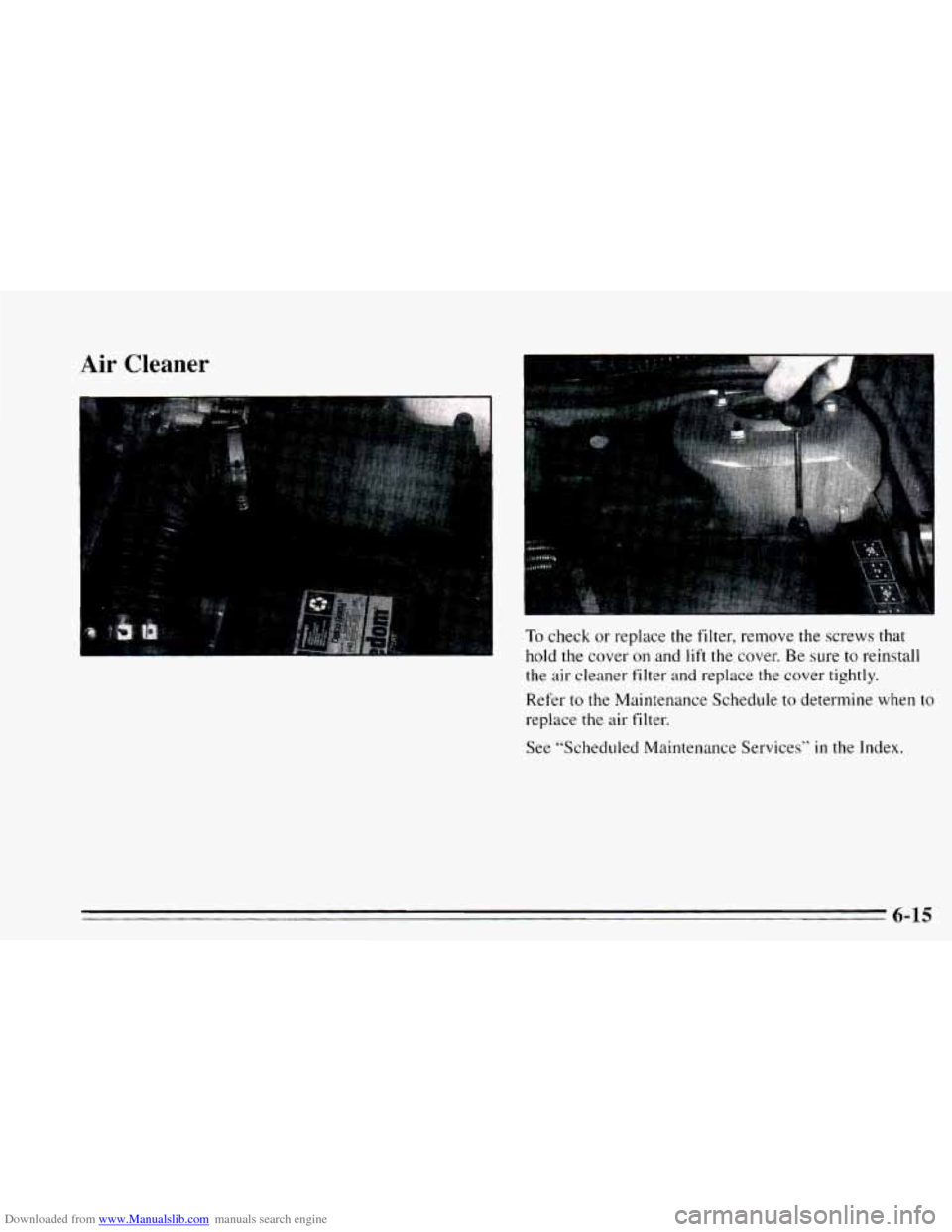
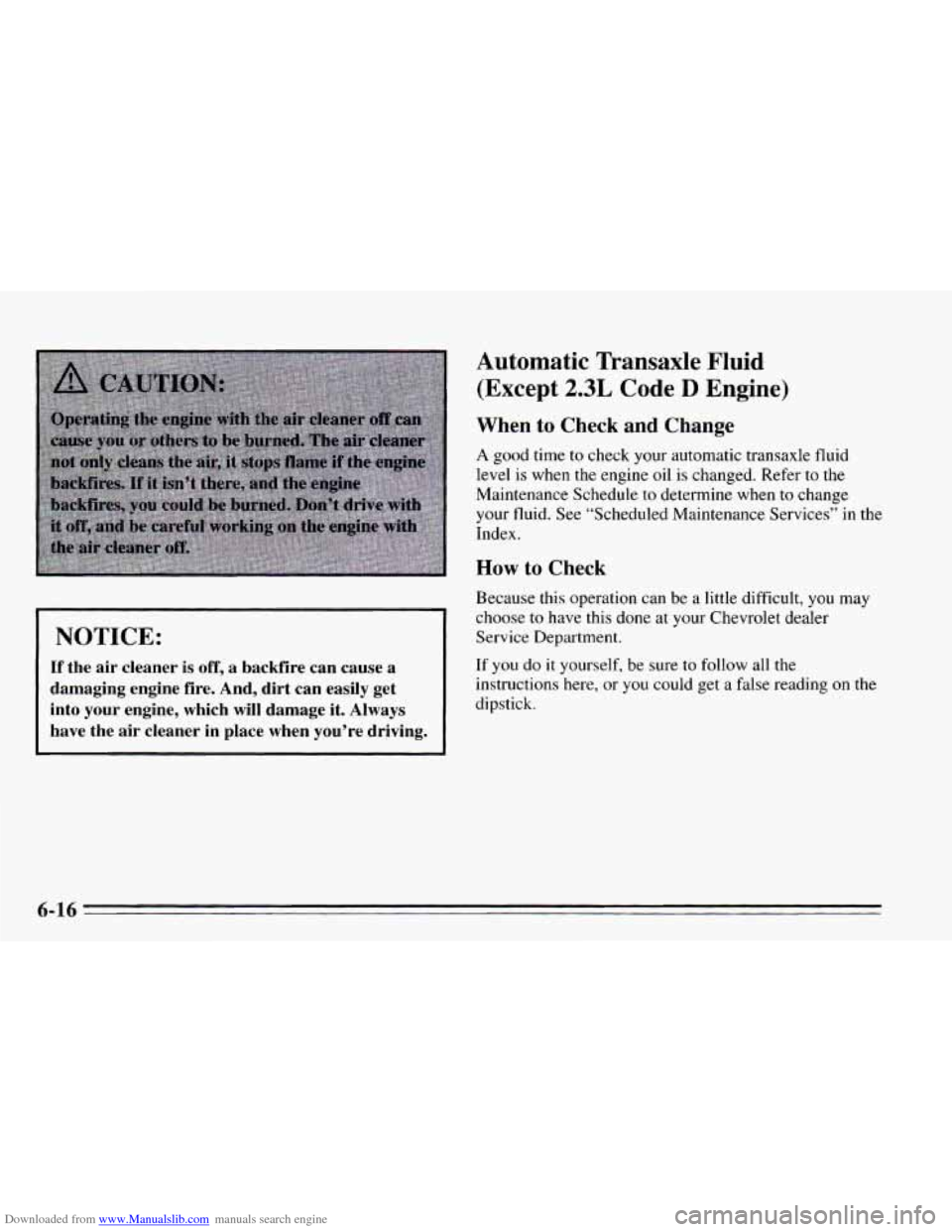
To check or replace the filter, remove the screws that
hold the cover on and lift the cover. Be sure to reinstall
the air cleaner filter and replace
the cover tightly.
Refer
to the Maintenance Schedule to determine when to
replace the air filter.
See “Scheduled Maintenance Services”
in the Index.
6-15
Page 220 of 340
Downloaded from www.Manualslib.com manuals search engine I NOTICE:
If the air cleaner is off, a backfire can cause a
damaging engine fire. And, dirt can easily get
into your engine, which
will damage it. Always
have the air cleaner in place when you’re driving.
Automatic Transaxle Fluid
(Except
2.3L Code D Engine)
When to Check and Change
A good time to check your automatic transaxle fluid
level is when the engine oil is changed. Refer to
the
Maintenance Schedule to determine when to change
your fluid. See “Scheduled Maintenance Services” in the
Index.
How to Check
Because this operation can be a little difficult, you may
choose
to have this done at your Chevrolet dealer
Service Department.
If
you do it yourself, be sure to follow all the
instructions here, or
you could get a false reading on the
dipstick.
6-16
Page 223 of 340
Downloaded from www.Manualslib.com manuals search engine Automatic Transaxle Fluid
(2.3L Code D Engine Only)
If you have the optional 2.3L Code D engine (see
“Engine Identification” in the Index) and an automatic
transaxle, it is not necessary to check the transaxle fluid
level.
A transaxle fluid leak is the only reason for fluid
loss. If a leak occurs, take the vehicle to your Chevrolet
dealer Service Department and have
it repaired as soon
as possible. You may also have your fluid level checked
by your dealer or service center when
you have your oil
changed.
Manual Transaxle Fluid
When to Check
A good time to have it checked is when the engine oil is
changed. However, the fluid in your manual transaxle
doesn’t require changing.
How to Check
Because this operation can be a little difficult, you may
choose
to have this done at your Chevrolet dealer
Service Department.
If you do it yourself, be sure to follow all the
instructions here, or
you could get a false reading on the
dipstick.
NOTICE:
Too much or too little fluid can damage your
transaxle.
Too much can mean that some of the
fluid could come out and fall on hot engine parts
or exhaust system parts, starting a fire. Be sure to
get an accurate reading if you check your
transaxle fluid.
Check the fluid level only when your engine is off, the
vehicle is parked on a level place and
the transaxle is
cool enough for
you to rest your fingers on the transaxle
case.
6-19
Page 225 of 340
Downloaded from www.Manualslib.com manuals search engine When to Check and What to Use
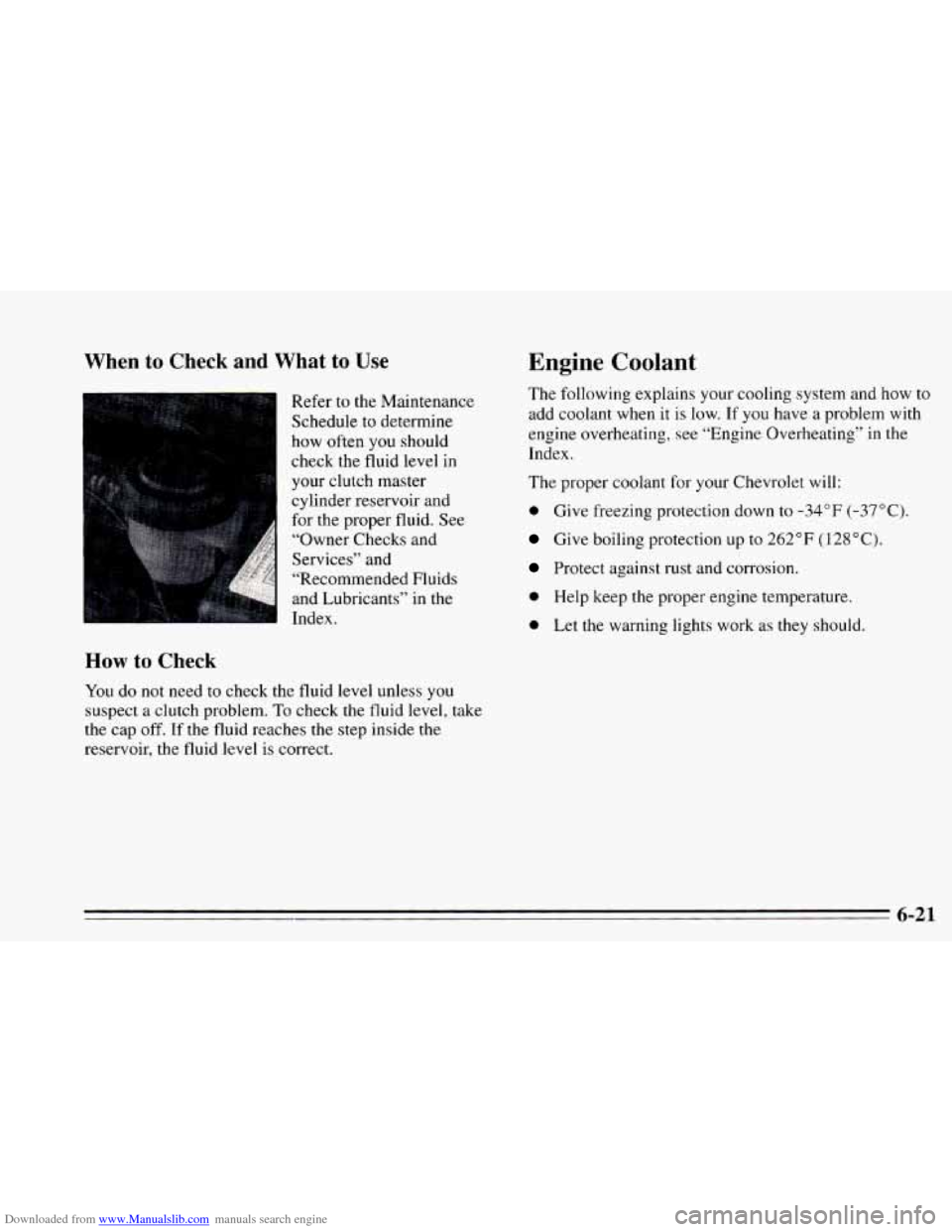
Refer to the Maintenance
Schedule to determine
how often you should
check the fluid level in
your clutch master
cylinder reservoir and
for the proper fluid. See
“Owner Checks and
Services” and
“Recommended Fluids
and Lubricants” in the
Index.
How to Check
You do not need to check the fluid level unless you
suspect a clutch problem. To check the fluid level, take
the cap
off. If the fluid reaches the step inside the
reservoir, the fluid level
is correct.
Engine Coolant
The following explains your cooling system and how to
add coolant when it is low.
If you have a problem with
engine overheating, see “Engine Overheating” in the
Index.
The proper
coolant for your Chevrolet will:
0 Give freezing protection down to -34°F (-37°C).
Give boiling protection up to 262°F (128°C).
Protect against rust and corrosion.
0 Help keep the proper engine temperature.
0 Let the warning lights work as they should.
6-21
Page 239 of 340
Downloaded from www.Manualslib.com manuals search engine Tire Inspection and Rotation
Tires should be inspected every 6,000 to 8,000 miles
(10 000 to 13 000 km) for any signs of unusual wear. If
unusual wear is present, rotate your tires as soon
as
possible and check wheel alignment. Also check for
damaged tires or wheels. See “When It’s Time for New
Tires” and “Wheel Replacement” later in this section for
more information.
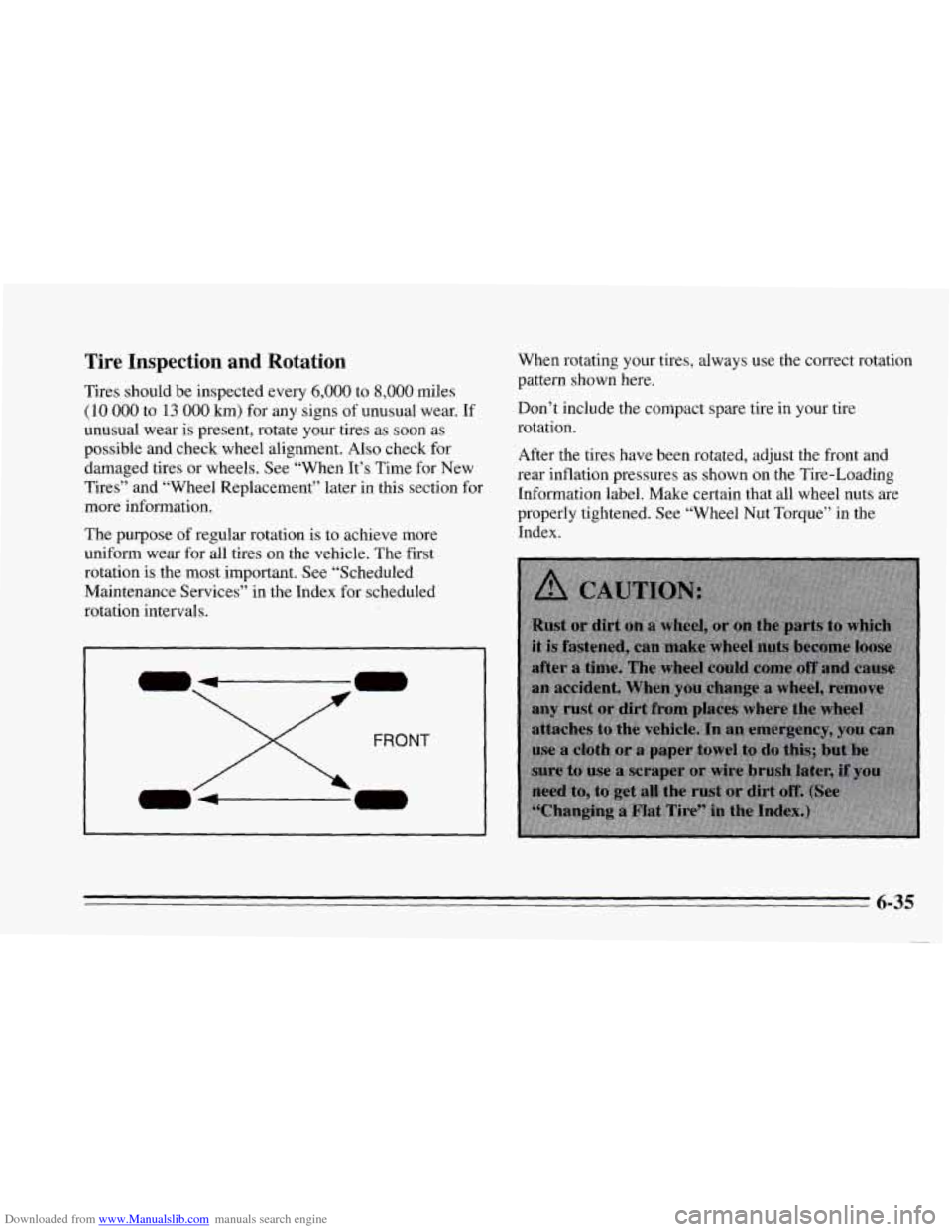
The purpose of regular rotation is to achieve more
uniform wear for all tires on the vehicle. The first
rotation is the most important. See “Scheduled
Maintenance Services” in the Index for scheduled
rotation intervals. When
rotating your tires, always use the correct rotation
pattern shown here.
Don’t include the compact spare tire in your tire
rotation.
After the tires have been rotated, adjust the front and
rear inflation pressures as shown on the Tire-Loading
Information label. Make certain that all wheel nuts are
properly tightened. See “Wheel Nut Torque” in the
Index.
FRONT
6-35
Page 241 of 340
Downloaded from www.Manualslib.com manuals search engine Buying New Tires
To find out what kind and size of tires you need, look at
the Tire-Loading Information label.
The tires installed on your vehicle when it was new had
a Tire Performance Criteria Specification (TPC Spec)
number on each tire’s sidewall. When you get new tires,
get ones with that same
TPC Spec number. That way,
your vehicle will continue to have tires that are designed
to give proper endurance, handling, speed rating,
traction, ride and other things during normal service on
your vehicle. If your tires have an all-season tread
design, the TPC number will be followed by an
“MS”
(for mud and snow).
If you ever replace your tires with those not having a
TPC Spec number, make sure they are the same size,
load range, speed rating and construction type (bias,
bias-belted
or radial) as your original tires.
6-37