1995 CHEVROLET CAVALIER service
[x] Cancel search: servicePage 119 of 340
Downloaded from www.Manualslib.com manuals search engine Anti-Lock Brake System Warning Light
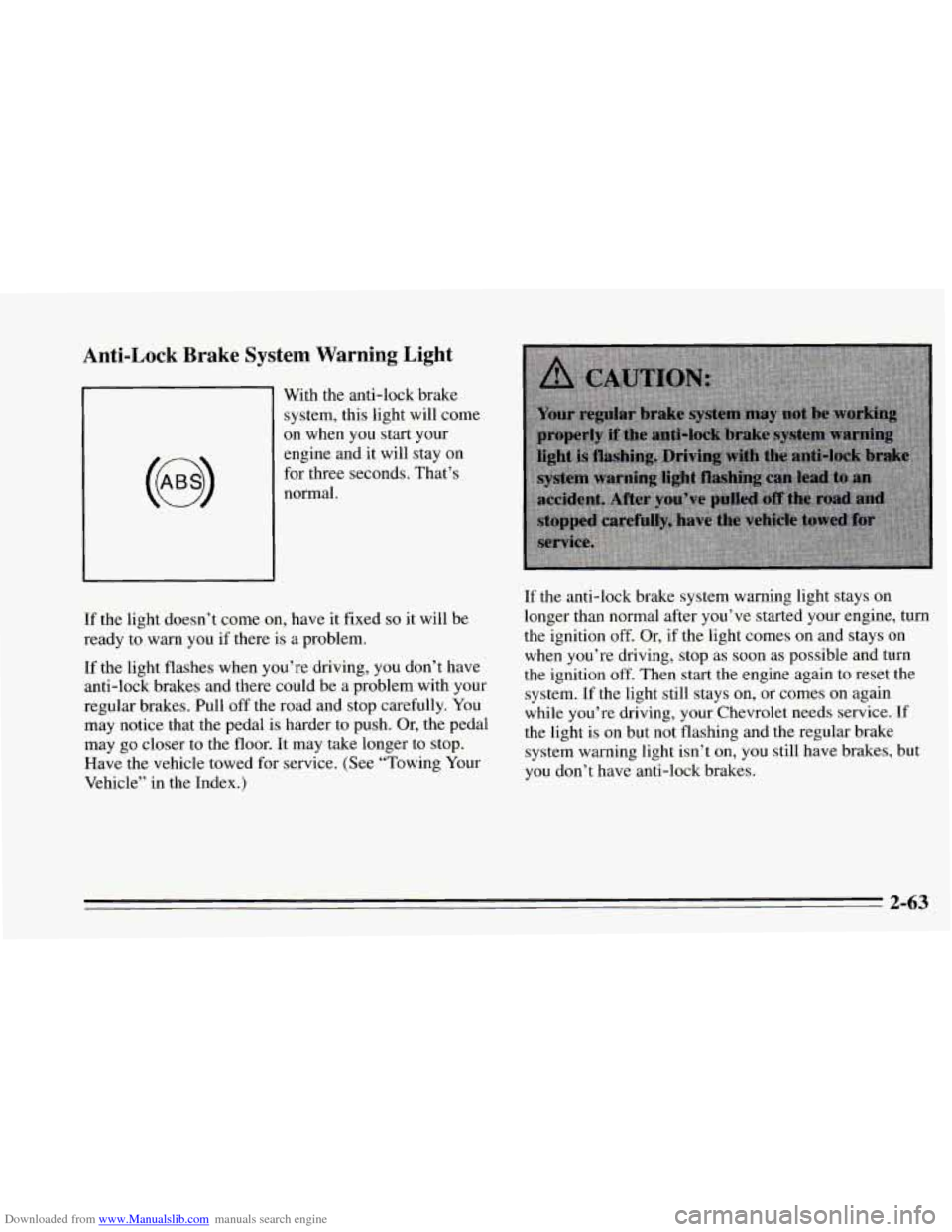
1 With the anti-lock brake
’ system, this light will come
on when you start your
engine and it will stay on
for three seconds. That’s
normal.
If the light doesn’t come on, have it fixed
so it will be
ready to warn you if there is a problem.
If the light flashes when you’re driving,
you don’t have
anti-lock brakes and there could be a problem with your
regular brakes. Pull off the road and stop carefully. You
may notice that the pedal is harder to push. Or, the pedal
may
go closer to the floor. It may take longer to stop.
Have the vehicle towed for service. (See “Towing Your
Vehicle” in the Index.) If
the anti-lock brake system warning light stays on
longer than normal after you’ve started your engine, turn
the ignition off. Or, if the light comes on and stays on
when you’re driving, stop as soon as possible and turn
the ignition
off. Then start the engine again to reset the
system. If the light still stays on, or comes
on again
while you’re driving, your Chevrolet needs service.
If
the light is on but not flashing and the regular brake
system warning light isn’t on,
you still have brakes, but
you don’t have anti-lock brakes.
2-63
Page 120 of 340
Downloaded from www.Manualslib.com manuals search engine Engine Coolant Temperature Gage
100 \‘+’” 260
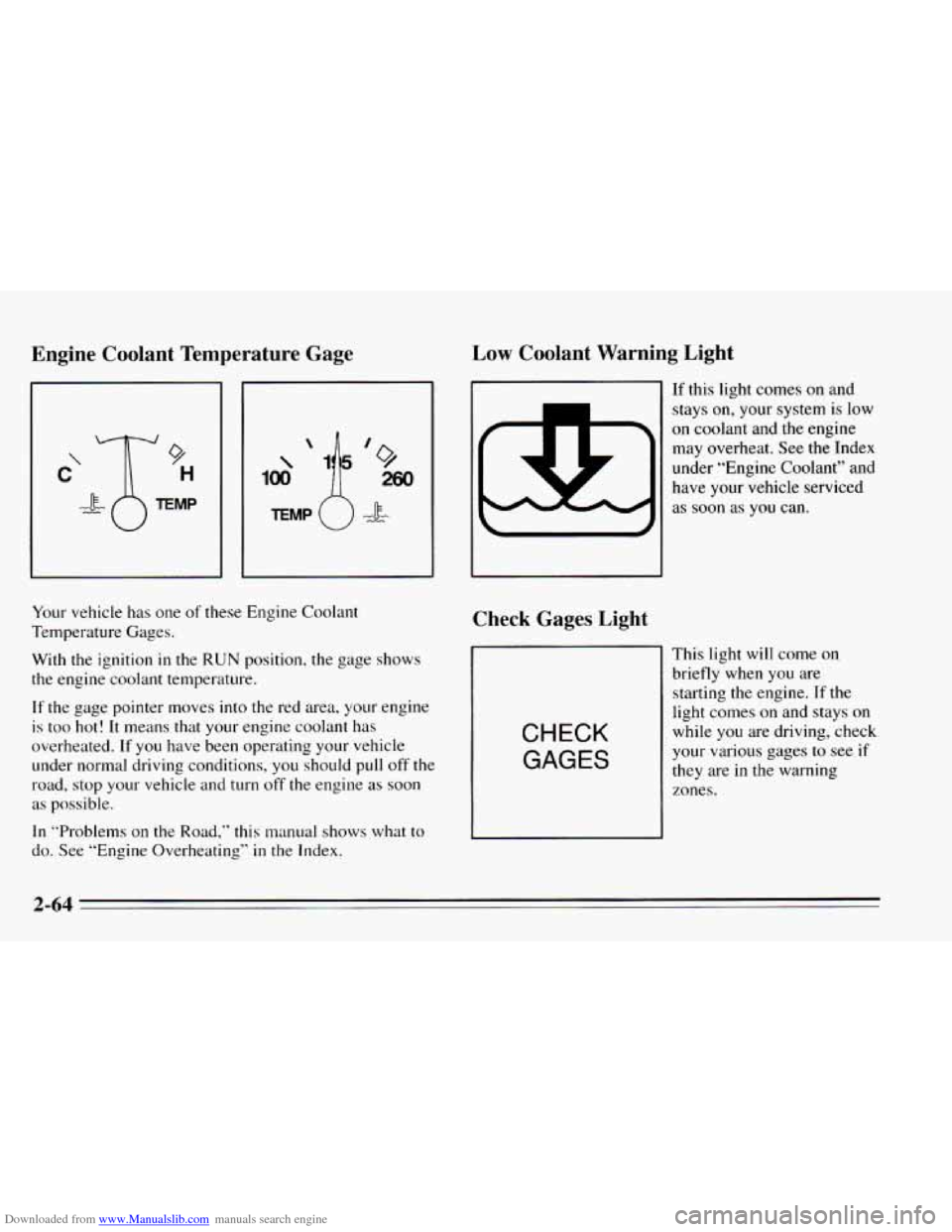
Your vehicle has one of these Engine Coolant
Temperature Gages.
With the ignition
in the RUN position, the gage shows
the engine coolant temperature.
If the gage pointer tnoves into the red area, your engine
is too
hot! It means that your engine coolant has
overheated.
If you have been operating your vehicle
under normal driving conditions, you should pull
off’ the
road, stop your vehicle and turn
off’ the engine as soon
as possible.
In “Problems on the Road,“ this manual shows what to
do. See “Engine Overheating”
in the Index.
Low Coolant Warning Light
Check Gages Light
CHECK
GAGES
If this light comes on and
stays on, your system is low
on coolant and the engine
may overheat. See the Index
under “Engine Coolant” and
have your vehicle serviced
as soon as you can.
This light will come on
briefly when
you are
starting the engine.
If the
light comes on and stays
on
while you are driving, check
your various gages
to see if
they are in the warning
I
zones.
2-64
Page 123 of 340
Downloaded from www.Manualslib.com manuals search engine Fuel Gage
/
/
F
UNLEADED
FUEL ONLY El9
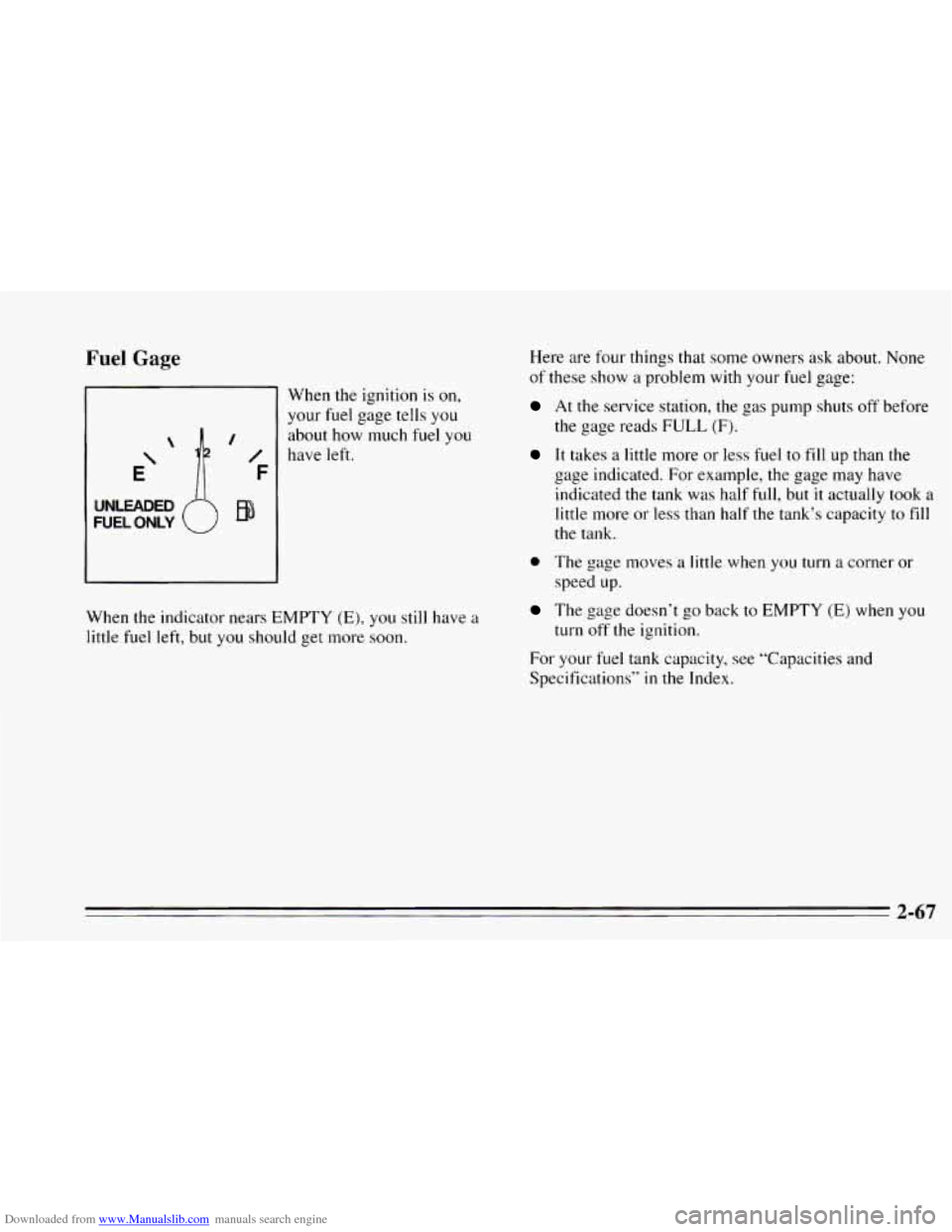
When the ignition is on,
your fuel gage tells you
about how much
fuel you
have left.
When the indicator nears EMPTY
(E), you still have a
little fuel left, but you should get more soon.
Here are four things that some owners ask about. None
of these show a problem with your fuel gage:
At the service station, the gas pump shuts off before
the gage reads
FULL (F).
It takes a little more or less fuel to fill up than the
gage indicated. For example, the gage may have
indicated the tank was half
full, but it actually took a
little more or less than half the tank’s capacity to fill
the tank.
0 The gage moves a little when you turn a corner or
The gage doesn’t go back to EMPTY (E) when you
speed up.
turn off the ignition.
For your
fuel tank capacity, see “Capacities and
Specifications”
in the Index.
2-67
Page 124 of 340
Downloaded from www.Manualslib.com manuals search engine i Shift Light (Manual Transaxle)
SHIFT
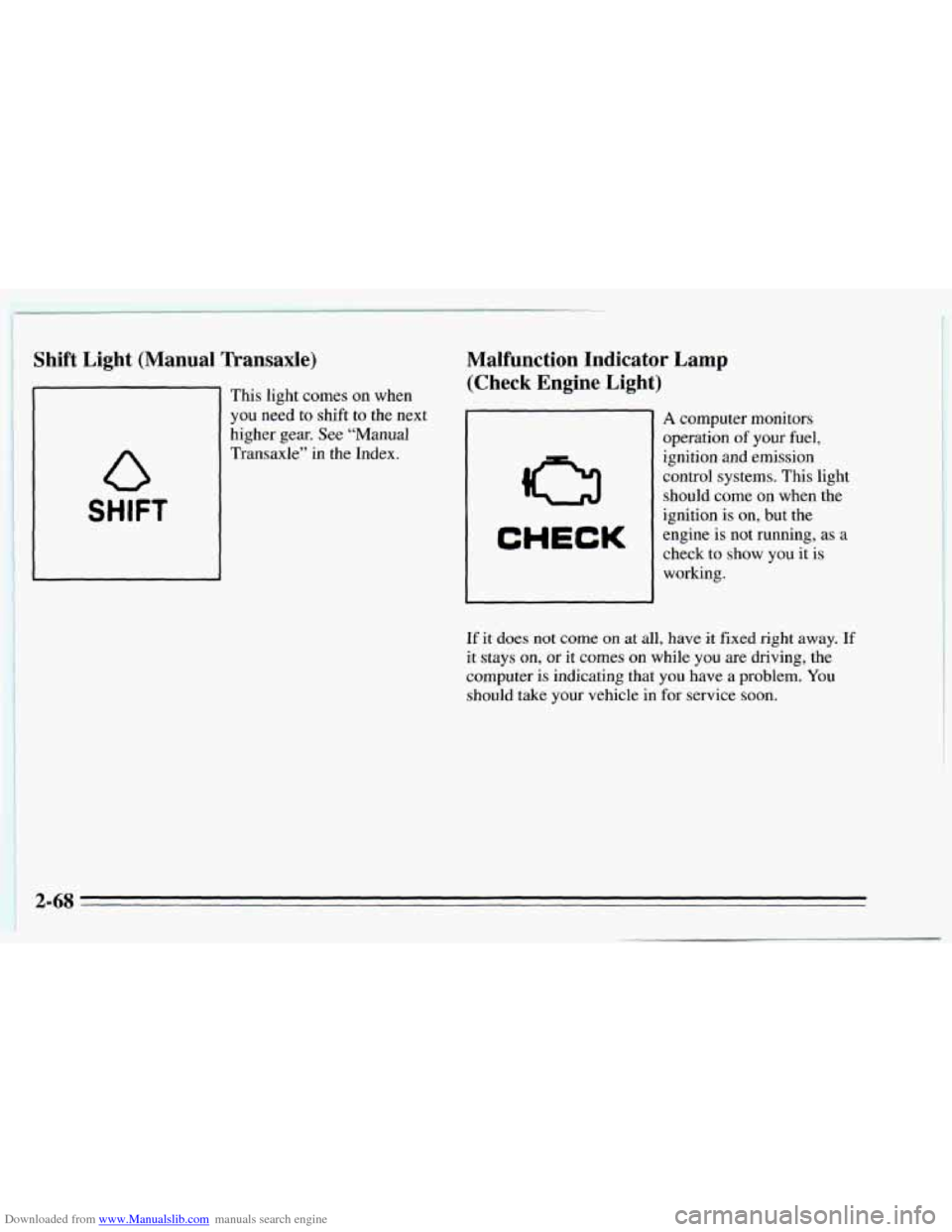
This light comes on when
you need to shift
to the next
higher gear. See “Manual
Transaxle” in the Index.
Malfunction Indicator Lamp
(Check Engine Light)
r A computer monitors
operation
of your fuel,
ignition and emission
control systems. This light
should come
on when the
ignition
is on, but the
engine is not running,
as a
check to show
you it is
working.
If it does not come on at all, have it fixed right away. If
it stays on, or it comes on while you are driving, the
computer is indicating that you have a problem. You
should take your vehicle in for service soon.
Page 125 of 340
Downloaded from www.Manualslib.com manuals search engine NOTICE:
If you keep driving your vehicle with this light
on, after a while the emission controls won’t
work as well, your fuel economy won’t
be as good
and your engine may not run as smoothly. This
could lead to costly repairs not covered by your
warranty.
If Your Vehicle
Is Equipped with OBD I1
(2.3L Code D Engine Only)
Certain vehicles are equipped with a new emission
diagnostic system. You can tell whether your vehicle has
this system by reading your tune-up label located under
the hood. If the label says
“OBD 11” on it. the following
instructions apply.
Your Chevrolet
is equipped with an onboard computer
which monitors operation
of the emission control
system. This system
is called OBD I1 (On-Board
Diagnostics
-- Second Generation) and is intended to
assure that emissions are at acceptable levels for the life
of the vehicle, helping to produce a cleaner
environment. The
CHECK ENGINE light comes on to
indicate when service is require.d. Malfunctions often
will be indicated by the system before any problem is apparent,
which may prevent more serious damage
tc,
your vehicle. This system is also designed to assist your
service technician
in correctly diagnosing any
malfunction.
The
CHECK ENGINE light should come on, as a check
to show
you it is working, when the ignition is on and
the engine is
not running. This light will also come on
during a malfunction in one of two ways:
Light On Steady: This indicates a system
malfunction has been detected. Drive the vehicle
to
the dealer for service at your first opportunity.
Light Flashing: This indicates a misfire has been
detected which may damage the emission control
system. The damage may be reduced by Iowering the
vehicle speed, reducing the amount
of cargo being
hauled or trailered, avoiding hard acceleration,
or by
avoiding steep uphill grades.
If these actions are
effective,
the light will stop flashing and remain on
steady. Drive the vehicle to a dealer for service. If
the light continues to flash, stop the vehicle. Wait for
a steady light to come on, then drive the vehicle to
a
dealer for service.
2-69
Page 139 of 340
Downloaded from www.Manualslib.com manuals search engine Care of Your Cassette Tape Player
A tape player that is not cleaned regularly is subject to
reduced sound quality, ruined cassettes, or a damaged
mechanism. Tape cassettes that are
not properly stored
in their plastic cases away from contaminants, direct
sunlight, and extreme heat may not operate properly and
could cause premature failure of
the tape player.
Your tape player should be cleaned after
50 hours of use.
If you notice a reduction in sound quality, try a known
good cassette
to see if the tape or the tape player is at
fault. If this other cassette has no improvement in sound
quality, clean
the tape player. Cleaning
may be done with
a scrubbing action,
non-abrasive cleaning cassette. This system uses a
cleaning cassette with pads which scrub the tape head as
the hubs of the cleaner cassette turn.
A scrubbing action
cleaning cassette is available through your Chevrolet dealership.
You may also choose a non-scrubbing action, wet-type
cleaner which uses
a cassette with a fabric belt to clean
the tape head. It may not clean as thoroughly as the
scrubbing type cleaner.
Cassettes are subject to wear and
the sound quality may
degrade over time. Always verify that
the cassette tape
is
in good condition before you have your tape player
serviced.
3-13
Page 159 of 340
Downloaded from www.Manualslib.com manuals search engine Once you are moving on the freeway, make certain you
allow a reasonable following distance. Expect to move
slightly slower at night.
When you want to leave the freeway, move
to the proper
lane well
in advance. If you miss your exit do not, under
any circumstances, stop and back
up. Drive on to the
next exit.
The exit ramp can be curved, sometimes quite sharply.
The exit speed is usually posted.
Reduce your speed according
to your speedometer, not
to your sense of motion. After driving for any distance
at higher speeds, you may tend to think
you are going
slower than
you actually are.
Before Leaving on a Long Trip
Make sure you’re ready. Try to be well rested. If you
must start when you’re
not fresh -- such as after a day’s
work
-- don’t plan to make too many miles that first part
of the journey. Wear comfortable clothing and shoes
you
can easily drive in.
Is your vehicle ready for a long trip? If you keep it
serviced and maintained, it’s ready
to go. If it needs
service, have
it done before starting out. Of course,
you’ll find experienced and able service experts in Chevrolet dealers
all across North America. They’ll be
ready and willing to help
if you need it.
Here are some things you can check before a trip:
0
Windshield Washer Fluid: Is the reservoir full? Are
all windows clean inside and outside?
Wiper Blades: Are they in good shape?
Fuel, Engine Oil, Other Fluids: Have you checked
all levels?
Lanzps: Are they all working‘? Are the lenses clean?
Tires: They are vitally important to a safe,
trouble-free trip.
Is the tread good enough for
long-distance driving? Are the tires all inflated to the
recommended pressure?
Weather Forecasts: What’s the weather outlook
along your route? Should you delay your trip a short
time
to avoid a major storm system?
Maps: Do you have up-to-date maps?
4-19
Page 160 of 340
Downloaded from www.Manualslib.com manuals search engine Highway Hypnosis
Is there actually such a condition as “highway
hypnosis”? Or
is it just plain falling asleep at the wheel?
Call it highway hypnosis, lack
of awareness, or
whatever.
There is something about an easy stretch of road
with
the same scenery, along with the hum of the tires on the
road, the drone of
the engine, and the rush of the wind
against
the vehicle that can make you sleepy. Don’t let it
happen to you! If it does, your vehicle can leave the
road
in less thnn n second, and you could crash and be
inj wed.
What can you
do about highway hypnosis? First, be
aware that it can happen.
Then here are some tips:
Make sure your vehicle is well ventilated, with a
comfortably cool interior.
Keep your eyes moving. Scan the road ahead and to
the sides. Check your rearview mirrors and
your
instruments frequently.
If you get sleepy, pull off the road into a rest, service,
or parking area and take a nap, get some exercise,
or
both. For safety, treat drowsiness on the highway as
an emergency.
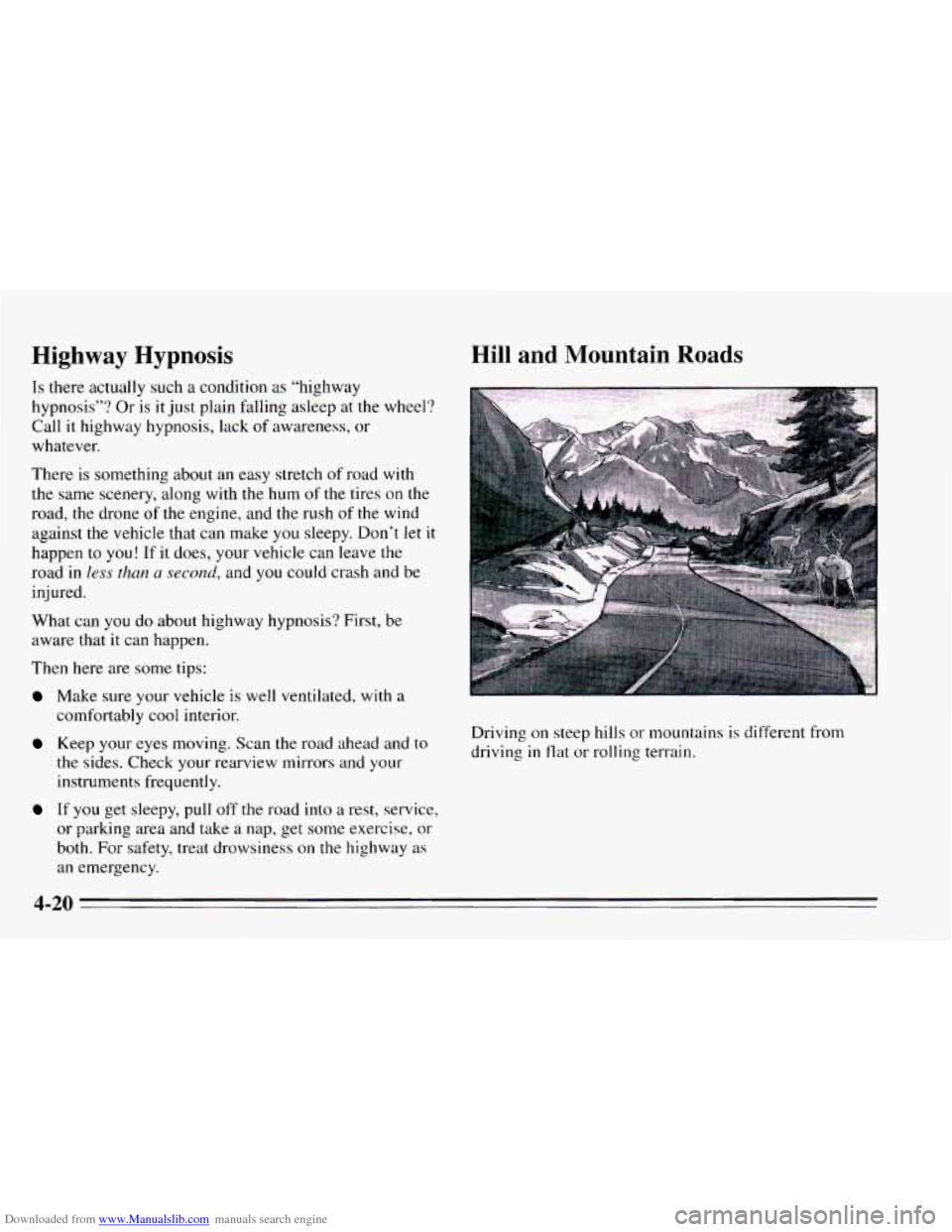
Hill and Mountain Roads
Driving on steep hills or mountains is different from
driving
in flat or rolling terrain.
4-20