1995 CHEVROLET CAVALIER trailer
[x] Cancel search: trailerPage 63 of 340
Downloaded from www.Manualslib.com manuals search engine Passlock (Option)
Your vehicle may be equipped with the Passlock
theft-deterrent system.
To find out if your vehicle has
Passlock, turn the ignition key to RUN position.
If the
THEFT SYSTEM light comes on, then your vehicle is
equipped with Passlock. Passlock
is a passive
theft-deterrent system. The system is armed once the
key is removed from the ignition. Passlock enables fuel
if the ignition lock cylinder is turned with a valid key. If
a correct key is not used, fuel is disabled.
During normal operation, the
THEFT SYSTEM light will
go
off after the engine is started. In the unlikely event that
the engine stalls and the
THEFI’ SYSTEM light flashes,
wait until the light stops flashing before
trying to restart
the engine. Remember to release the key from.the START
position
as soon as the engine starts. If after several tries
the vehicle still does not start, the vehicle may need
service. At
this the, you may also want to check the fuses
(see “Fuses and Circuit Breakers” in the Index).
See your
Chevrolet dealer for service.
If the THEFT SYSTEM light comes on while the engine
is running, a problem has been detected and
the system
may need service. See your Chevrolet dealer for service.
In an emergency, call the Chevrolet Roadside Assistance
Program at 1-800-CHEV USA (1-800-243-8872).
New Vehicle “Break-In”
Your modern Chevrolet doesn’t need an
elaborate “break-in.” But it will perform better
in the long run if you follow these guidelines:
e
e
0
Don’t drive at any one speed -- fast or
slow
-- for the first 500 miles (804 h).
Don’t make full-throttle starts.
Avoid making hard stops for the
first
200 miles (322 km) or so. During this time
your new brake linings aren’t yet broken
in. Hard stops with new linings can mean
premature wear and earlier replacement.
Follow this “breaking-in” guideline every
time you get new brake linings.
Don’t tow a trailer during “break-in.” See
“Towing a Trailer’’ in the Index for more
information.
2-7
Page 73 of 340
Downloaded from www.Manualslib.com manuals search engine NOTICE:
If your front wheels can’t rotate, don’t try to
drive. This might happen if you were stuck in
very deep sand or mud or were up against a solid
object.
You could damage your transaxle. Also, if
you stop when going uphill, don’t hold your
vehicle there with only the accelerator pedal. This
could overheat and damage the transaxle. Use
your brakes or shift into
PARK (P) to hold your
vehicle in position on
a hill.
Forward Gears (Four Speed)
AUTOMATIC OVERDRIVE (D): This position is for
normal driving with
the four speed automatic transaxle.
If
you need more power for passing, and you’re:
0 Going less than about 35 mph (56 km/h), push your
accelerator pedal about halfway down.
0 Going about 35 mph (56 kmh), push your
accelerator all
the way down.
THIRD (3): This position is also used for normal
driving, however,
it offers more power and lower fuel
economy than AUTOMATIC OVERDRIVE (D). Here
are some times you might choose THIRD
(3) instead of
AUTOMATIC OVERDRIVE (D):
0 When driving on hilly, winding roads.
0 When towing a trailer, so there is less shifting
between gears.
0 When going down a steep hill.
SECOND (2): This position gives you more power out
lower fuel economy. You can use SECOND
(2) on hills.
It can help control your speed as you
go down steep
mountain roads, but then
you would also want to use
your brakes off and on.
NOTICE:
Don’t drive in SECOND (2) for more than
5 miles (8 km), or at speeds over 55 mph
(88 km/h), or you can damage your transaxle.
Use AUTOMATIC OVERDRIVE
(D), THIRD (3)
or DRIVE (D) as much as possible. Don’t shift into
SECOND
(2) unless you are going slower than 65
mph (105 km/h), or you can damage your engine.
2-17
Page 78 of 340
Downloaded from www.Manualslib.com manuals search engine To set the parking brake, hold the brake pedal down and
pull up on the parking brake lever. If the ignition
is on,
the brake system warning light will come on.
To release the parking brake, hold the brake pedal down.
Pull the parking brake lever up until you can press the
release button.
Hold the release button in as you move
the brake lever all the way down.
I NOTICE:
Driving with the parking brake on can cause
your rear brakes to overheat. You may have to
replace them, and you could also damage other
parts
of your vehicle.
If you are towing a trailer and are parking on any hill,
see “Towing a Trailer’’ in the Index. That section shows
what to
do first to keep the trailer from moving.
Shifting Pnto PARK (P) (Automatic
Transaxle Models Only)
1. Hold the brake pedal down and set the parking
brake.
2-22
Page 82 of 340
Downloaded from www.Manualslib.com manuals search engine Running Your Engine While You’re
Parked (Automatic Transaxle)
It’s better not to park with the engine running. But if you
ever have to, here are some things to know.
Follow the proper steps to be sure your vehicle won’t
move. See “Shifting Into
PARK (P)” in the Index.
If you are parking on a hill and if you’re pulling a
trailer, also see “Towing a Trailer”
in the Index.
Windows
On a vehicle with manual windows, use the window
crank
to open and close each window.
2-26
Page 125 of 340
Downloaded from www.Manualslib.com manuals search engine NOTICE:
If you keep driving your vehicle with this light
on, after a while the emission controls won’t
work as well, your fuel economy won’t
be as good
and your engine may not run as smoothly. This
could lead to costly repairs not covered by your
warranty.
If Your Vehicle
Is Equipped with OBD I1
(2.3L Code D Engine Only)
Certain vehicles are equipped with a new emission
diagnostic system. You can tell whether your vehicle has
this system by reading your tune-up label located under
the hood. If the label says
“OBD 11” on it. the following
instructions apply.
Your Chevrolet
is equipped with an onboard computer
which monitors operation
of the emission control
system. This system
is called OBD I1 (On-Board
Diagnostics
-- Second Generation) and is intended to
assure that emissions are at acceptable levels for the life
of the vehicle, helping to produce a cleaner
environment. The
CHECK ENGINE light comes on to
indicate when service is require.d. Malfunctions often
will be indicated by the system before any problem is apparent,
which may prevent more serious damage
tc,
your vehicle. This system is also designed to assist your
service technician
in correctly diagnosing any
malfunction.
The
CHECK ENGINE light should come on, as a check
to show
you it is working, when the ignition is on and
the engine is
not running. This light will also come on
during a malfunction in one of two ways:
Light On Steady: This indicates a system
malfunction has been detected. Drive the vehicle
to
the dealer for service at your first opportunity.
Light Flashing: This indicates a misfire has been
detected which may damage the emission control
system. The damage may be reduced by Iowering the
vehicle speed, reducing the amount
of cargo being
hauled or trailered, avoiding hard acceleration,
or by
avoiding steep uphill grades.
If these actions are
effective,
the light will stop flashing and remain on
steady. Drive the vehicle to a dealer for service. If
the light continues to flash, stop the vehicle. Wait for
a steady light to come on, then drive the vehicle to
a
dealer for service.
2-69
Page 170 of 340
Downloaded from www.Manualslib.com manuals search engine I
Towing a Trailer ( Models with 2.3L
Engine and Four Speed Automatic
Transaxle
)
4-30
Page 171 of 340
Downloaded from www.Manualslib.com manuals search engine NOTICE:
Pulling a trailer improperly can damage your
vehicle and result in costly repairs not covered
by
your warranty. To pull a trailer correctly, follow
the advice in this part, and see your Chevrolet
dealer for important information about towing a
trailer with your vehicle.
Do not tow a trailer if your vehicle is equipped with a
2.2L (Code 4) engine. You also cannot tow a trailer if
your vehicle is equipped with a manual or a three speed
automatic transaxle.
Your vehicle can tow a trailer
if it is equipped with a
2.3L (Code D) engine, a four speed automatic transaxle
and proper trailer towing equipment. To identify what
the vehicle trailering capacity
is for your vehicle, you
should read the information in “Weight of the Trailer”
that appears later in this section. But trailering is
different than
just driving your vehicle by itself.
Trailering means changes
in handling, durability, and
fuel economy. Successful, safe trailering takes correct
equipment, and
it has to be used properly.
That’s the reason for this
part. In it are many
time-tested, important trailering
tips and safety rules. Many
of these are important
for your safety and that of
your passengers. So please read this section carefully
before you pull a trailer.
Load-pulling components such as the engine, transaxle,
wheel assemblies, and tires are forced to work harder
against the drag
of the added weight. The engine is
required
to operate at relatively higher speeds and under
greater loads, generating extra heat. What’s more, the
trailer adds considerably
to wind resistance, increasing
the pulling requirements.
If You Do Decide To Pull A Trailer
If you do, here are some important points.
0 There are many different laws, including speed limit
restrictions, having to do with trailering. Make sure
your rig will be legal,
not only where you live but
also where you’ll be driving.
A good source for this
information can be state or provincial police.
0 Consider using a sway control.
You can ask a hitch dealer about sway controls.
Don’t tow a trailer at all during the first 1,000 miles
(I 600 km) your new vehicle is driven. Your engine,
axle or other parts could be damaged.
4-3 1
Page 172 of 340
Downloaded from www.Manualslib.com manuals search engine 0 Then, during the first 500 miles (800 km) that you
tow a trailer, don’t drive over
50 mph (80 km/h) and
don’t make starts at full throttle. This helps your
engine and other parts
of your vehicle wear in at the
heavier loads.
0 Obey speed limit restrictions when towing a trailer.
Don’t drive faster than the maximum posted speed
for trailers (or no more than
55 mph (90 kdh)) to
save wear on your vehicle’s parts.
Three important considerations have to do with weight:
~ Weight of the Trailer
I Your vehicle can tow normally up to 1,000 pounds (450kg).
1 It depends on how you plan to use your rig. For
’ example, speed, altitude, road grades, outside
temperature and how much your vehicle is used
to pull a
trailer
are all important. And, it can also depend on any
special equipment that you have on your vehicle.
You can ask your dealer for our trailering information or
advice, or you can write
us at Chevrolet Motor Division,
Customer Assistance Center,
P.O. Box 7047, Troy, MI
’ In Canada, write to General Motors of Canada Limited,
Customer Assistance Center,
1908 Colonel Sam Drive,
Oshawa, Ontario L1H 8P7.
’ 48007-7047
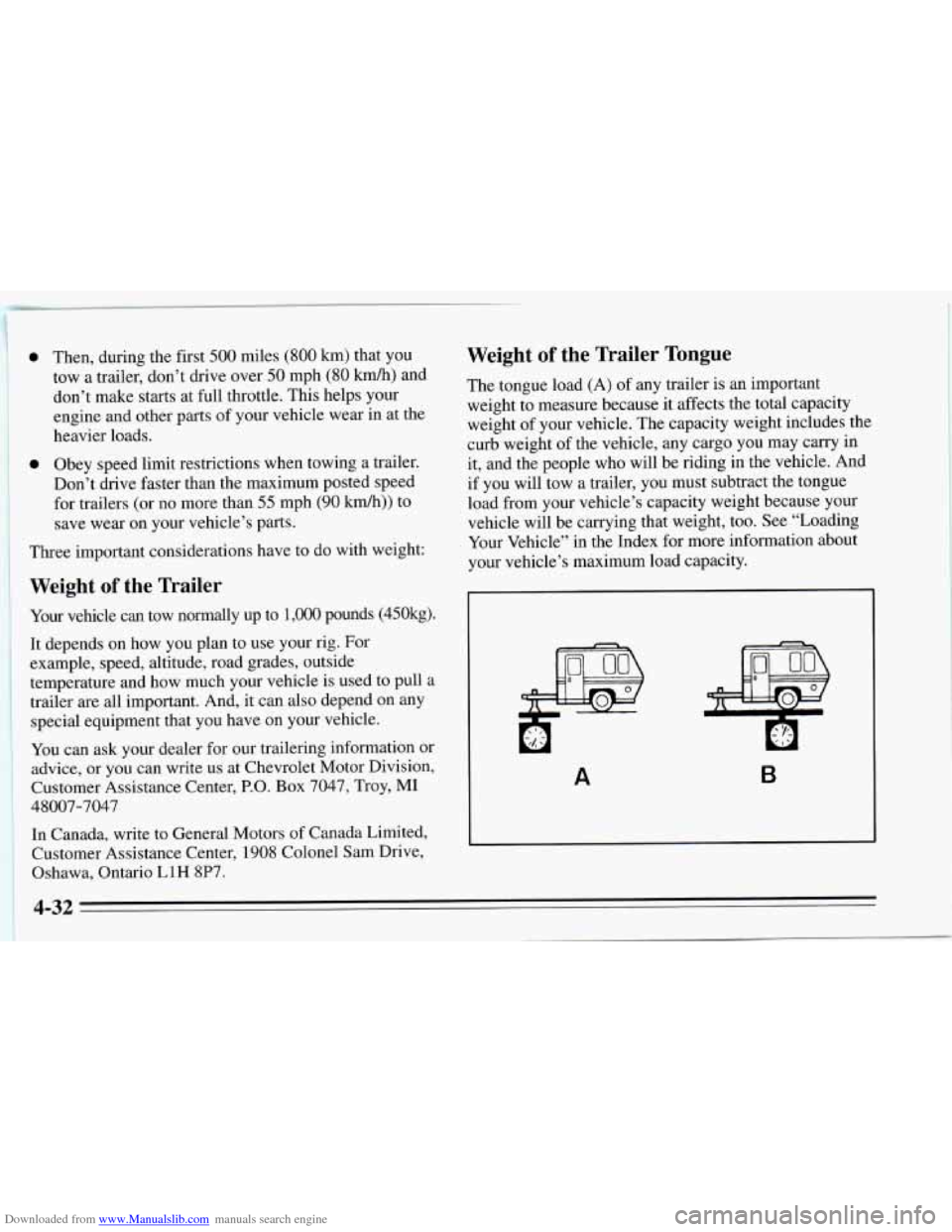
Weight of the Trailer Tongue
The tongue load (A) of any trailer is an important
weight to measure because it affects the total capacity
weight of your vehicle. The capacity weight includes the
curb weight
of the vehicle, any cargo you may carry in
it, and the people who will be riding in the vehicle. And
if you will tow a trailer, you must subtract the tongue
load from your vehicle’s capacity weight because your
vehicle will be carrying that weight, too. See “Loading
Your Vehicle” in the Index for more information about
your vehicle’s maximum load capacity.
A B