1994 CHEVROLET BLAZER light
[x] Cancel search: lightPage 206 of 348
Downloaded from www.Manualslib.com manuals search engine 2.
3.
Get the vehicles close enough so the jumper cables can reach, but be
sure the vehicles
aren’t touching each other. If they are, it could cause
ground connection you don’t want. You wouldn’t be able to start you1
vehicle, and the bad grounding could damage the electrical systems.
You could be injured if the vehicles roll. Set
the parking brake firmly
on each vehicle. Put an automatic transmission in “P’ (Park) or a
a
manual transmission in “N” (Neutral). If you have a four-wheel-drive
vehicle with
a manual transfer case shift lever, be sure the transfer case
is not in “N” (Neutral).
Turn
off the ignition on both vehicles. Turn off all lights that aren’t
needed, and radios. This will avoid sparks and help save both batteries.
And it could save your radio!
~~~
NOTICE:
~~
If you leave your radio on, it could be badly damaged. The
repairs wouldn’t be covered by your warranty.
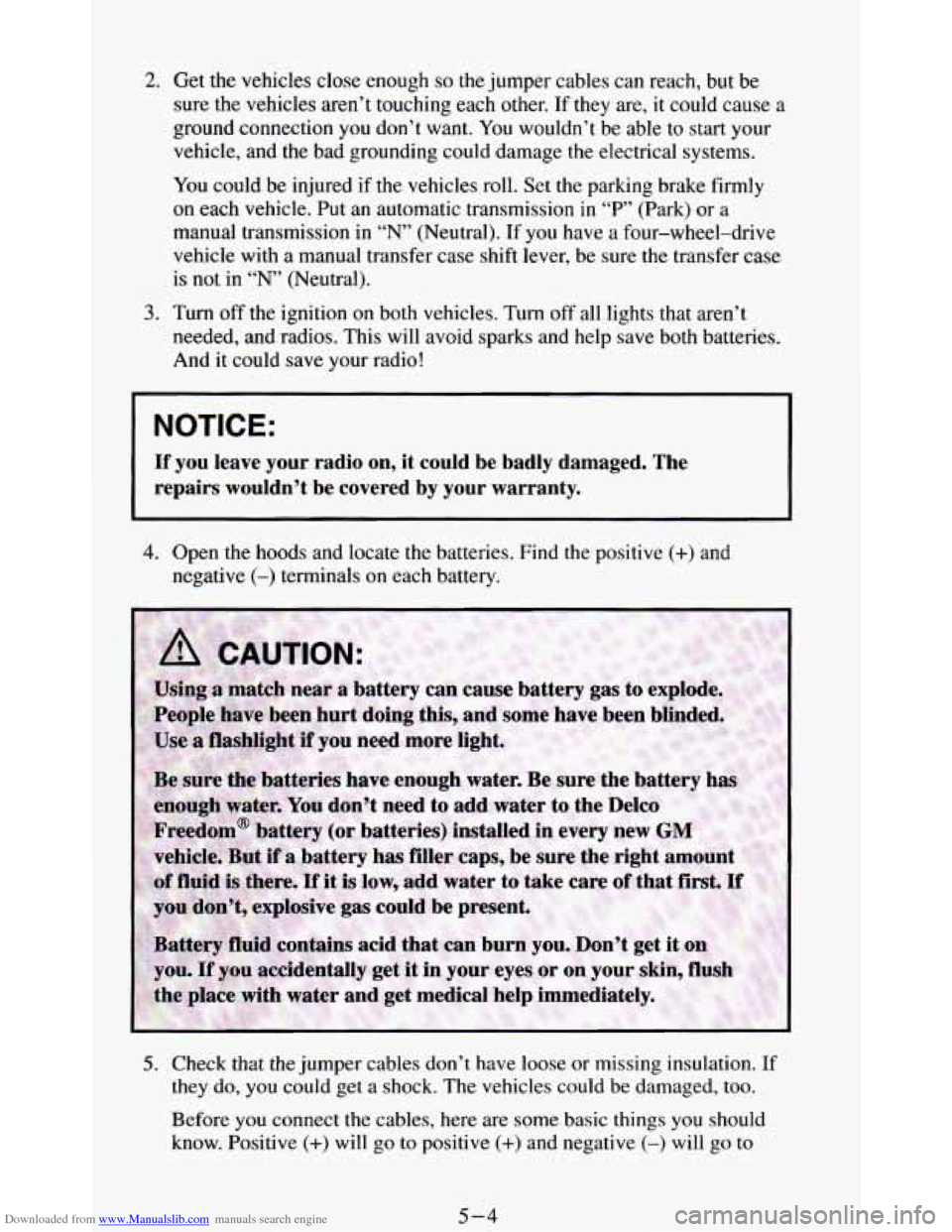
4. Open the hoods and locate the batteries. Find the positive (+) and
negative (-) terminals on each battery.
5. Check that the jumper cables don’t have loose or missing insulation. If
they do, you could get a shock. The vehicles could be damaged, too.
Before you connect the cables, here are some basic things you should
know. Positive
(+) will go to positive (+) and negative (-) will go to
5-4
Page 235 of 348
Downloaded from www.Manualslib.com manuals search engine Rocking your vehicle to get it out:
First, turn your steering wheel left and right. That will clear the area around
your front wheels. Then shift back and forth between “R” (Reverse) and
a
forward gear (or with a manual transmission, between First or Second gear
and Reverse), spinning the wheels
as little as possible. Release the
accelerator pedal while
you shift, and press lightly on the accelerator pedal
when the transmission
is in gear. If that doesn’t get you out after a few tries,
you may need to be towed out. Or,
you can use your recovery hooks, if your
vehicle has them.
If you do need to be towed out, see “Towing Your
Vehicle”
in the Index.
Using the Recovery Hooks
I
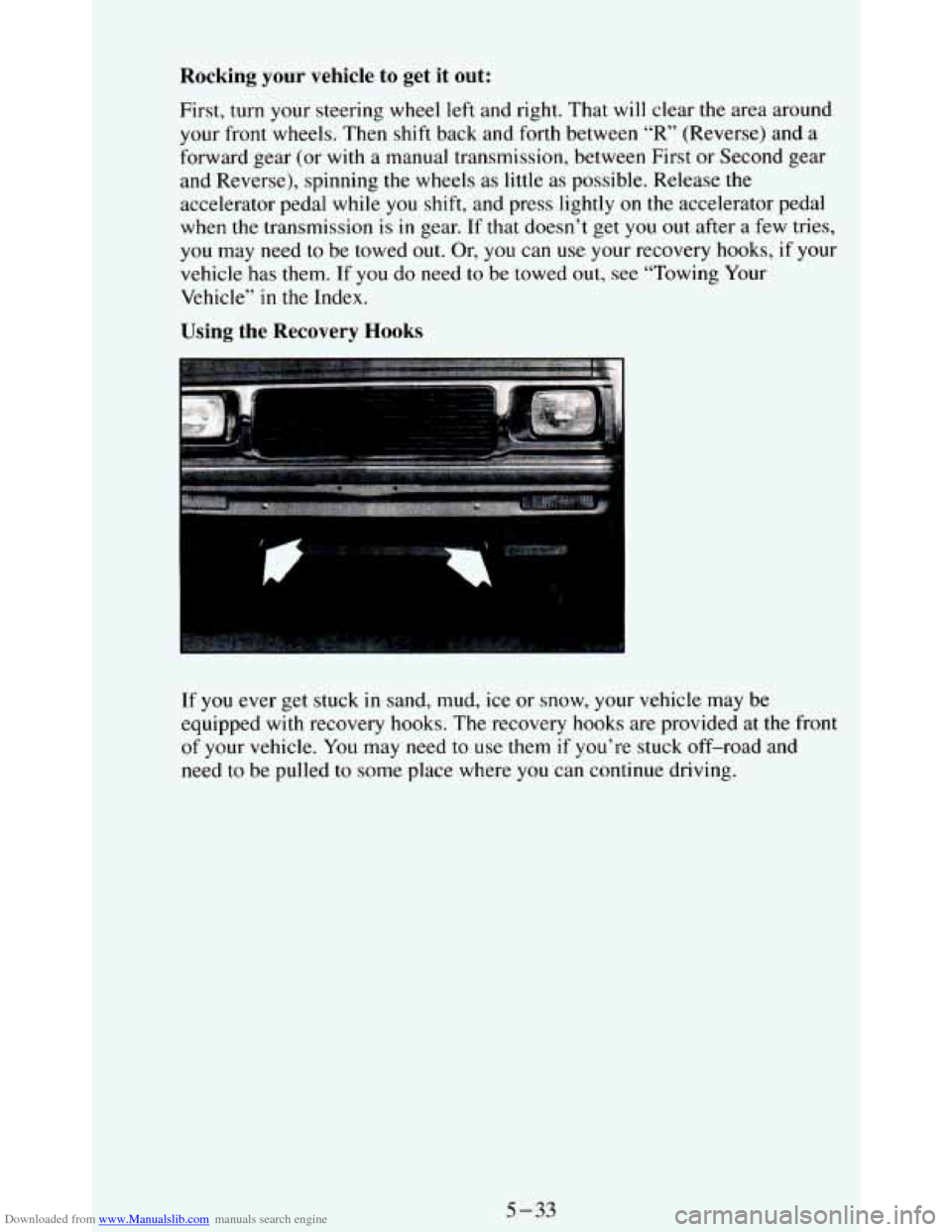
If you ever get stuck in sand, mud, ice or snow, your vehicle may be
equipped with recovery hooks.
The recovery hooks are provided at the front
of your vehicle. You may need to use them if you’re stuck off-road and
need to be pulled to some place where you can continue driving.
5-33
Page 239 of 348
Downloaded from www.Manualslib.com manuals search engine Fuel
The 8th digit of your Vehicle Identification Number (VIN) shows the code
letter for your engine. You will find the VIN at the top left of your
instrument panel. (See “Vehicle Identification Number”
in the Index.)
Use regular unleaded gasoline rated at
87 octane or higher. With the 4.3L
(Code W) engine, use premium unleaded gasoline rated at 91 octane or
higher for high power performance, when towing a trailer or with a high
payload requirement. But when operating with a light load as a normal
condition, you may use middle grade or regular unleaded gasolines.
The gasoline you use should meet specifications ASTM D48 14 in the
U.S.
and CGSB 3.5-92 in Canada. These fuels should have the proper additives,
so you should not have to add anything to the fuel.
In the U.S. and Canada, it’s easy to be sure you get the right kind of
gasoline (unleaded). You’ll see “UNLEADED” right on the pump. And only
unleaded nozzles will fit into your vehicle’s filler neck.
Be sure the posted octane is at least 9
1 for premium, 89 for middle grade
and
87 for regular. If the octane is less than 87, you may get a heavy
knocking noise when you drive. If it’s bad enough, it can damage your
engine.
If you’re using fuel rated at
91 octane or higher and you still hear heavy
knocking, your engine needs service. But don’t worry if you hear a little
pinging noise when you’re accelerating
or driving up a hill. That’s normal,
and you don’t have
to buy a higher octane fuel to get rid of it. It’s the heavy,
constant knock that means
you have a problem.
What about gasoline with blending materials that contain oxygen
(oxygenates), such as MTBE or alcohol?
MTBE is “methyl tertiary-butyl ether.” Fuel that is no more than 15%
MTBE is fine for your vehicle.
Ethanol is ethyl or grain alcohol. Properly-blended fuel that is no more than
10% ethanol is fine for your vehicle.
Methanol is methyl or wood alcohol.
NOTICE:
Fuel that is more than 5% methanol is bad for your vehicle.
Don’t use it. It can corrode metal parts in your fuel syst\
em and
also damage plastic and rubber parts. That damage wouldn’t be
covered under your warranty. And even at
5% or less, there
must be “cosolvents” and corrosion preventers in this fuel\
to
help avoid these problems.
6-3
Page 243 of 348
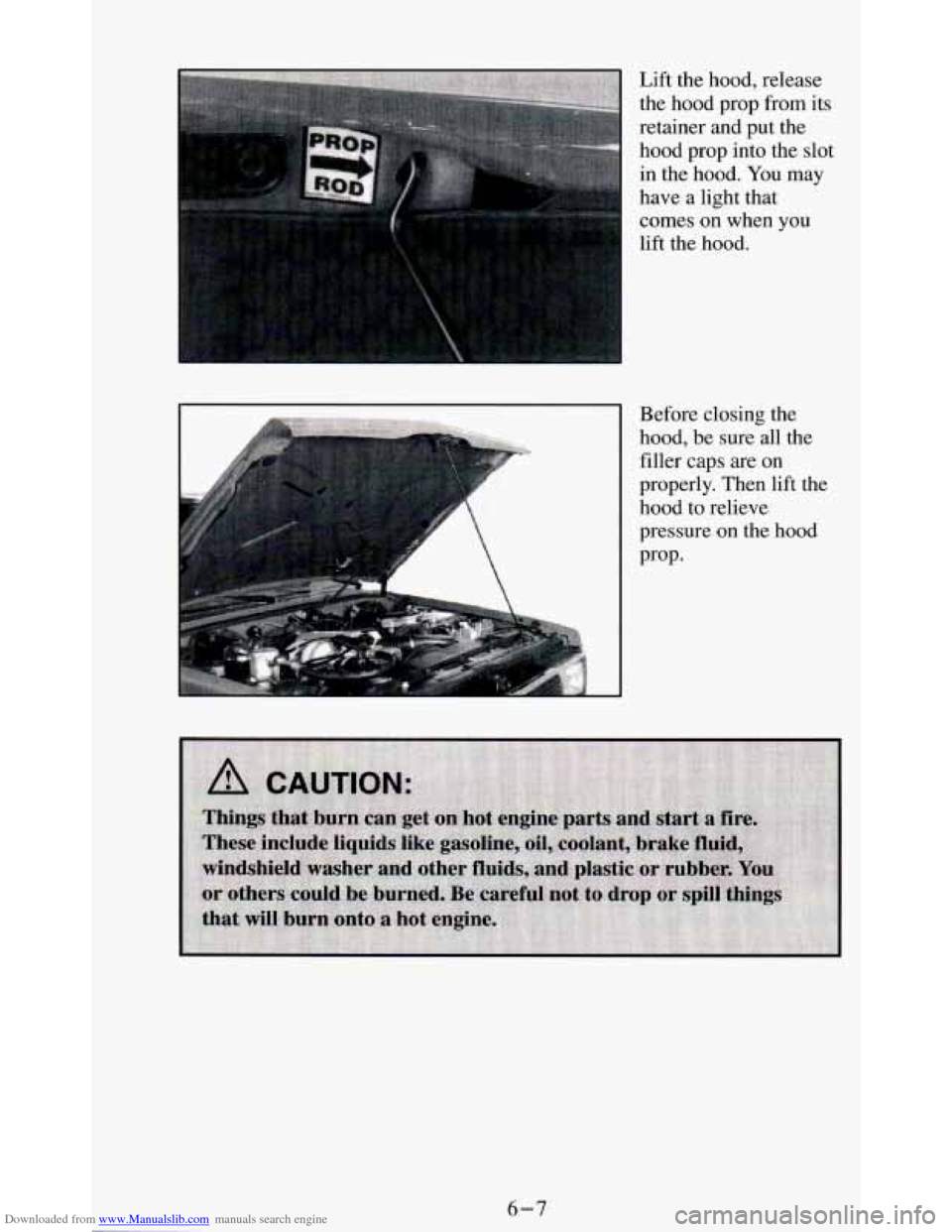
Downloaded from www.Manualslib.com manuals search engine Lift the hood, release
the hood prop from its
retainer and put the
hood prop into the slot
in the hood. You may
have a light that
comes on when you
lift the hood.
Before closing the
hood, be sure all the
filler caps are on
properly. Then lift the
hood to relieve
pressure on the hood
Prop.
6-7
Page 249 of 348
Downloaded from www.Manualslib.com manuals search engine When to Change Engine Oil
See if any one of these is true for you:
Most trips are less than 4 miles (6 km).
It’s below freezing outside and most trips are less than 10 miles (I 6 km).
0 The engine is at low speed most of the time (as in door-to-door
delivery, or
in stop-and-go traffic).
You tow a trailer often.
0 Most trips are through dusty places.
0 The vehicle is frequently operated off-road.
If any one of these is true for your vehicle, then you need to change your oil
andfilter every 3,000 miles (5 000 km) or 3 months - whichever comes
first.
If none
of them is true, change the oil every 7,500 miles (12 500 km) or
12 months - whichever comes first. Change the filter at the first oil change
and at every other oil change after that.
Four-wheel Drive Remote Oil Filter
If your vehicle has four-wheel drive, you will have a remote oil filter
located under the hood. It is mounted to the front left inner fender, behind
the headlights.
Engine Coolant Heater (Engine Block Heater)
An engine coolant heater can be a big help if you have to park outside in
very cold weather, 0°F (-18°C) or colder. If your vehicle has this option,
see “Engine Coolant Heater
” in the Index.
What to Do with Used Oil
Did you know that used engine oil contains certain elements that may be
unhealthy for your skin and could even cause cancer? Don’t let used oil stay
on your skin for very long. Clean your skin
and nails with soap and water,
or
a good hand cleaner. Wash or properly throw away clothing or rags
containing used engine oil. (See
the manufacturer’s warnings about the use
and disposal of oil products.)
Used oil can be
a real threat to the environment. If you change your own oil,
be sure to drain all free-flowing oil from
the filter before disposal. Don’t
ever dispose of oil
by putting it in the trash, pouring it on the ground, into
sewers, or into streams or bodies of water. Instead, recycle
it by taking it to
a place that collects used oil. If you have a problem properly disposing of
your used oil, ask your dealer,
a service station or a local recycling center
for help.
6-13
Page 256 of 348
Downloaded from www.Manualslib.com manuals search engine Hydraulic Clutch
The hydraulic clutch in your vehicle is self-adjusting. A slight amount of
play (114 inch to 1/2 inch) in the pedal is normal.
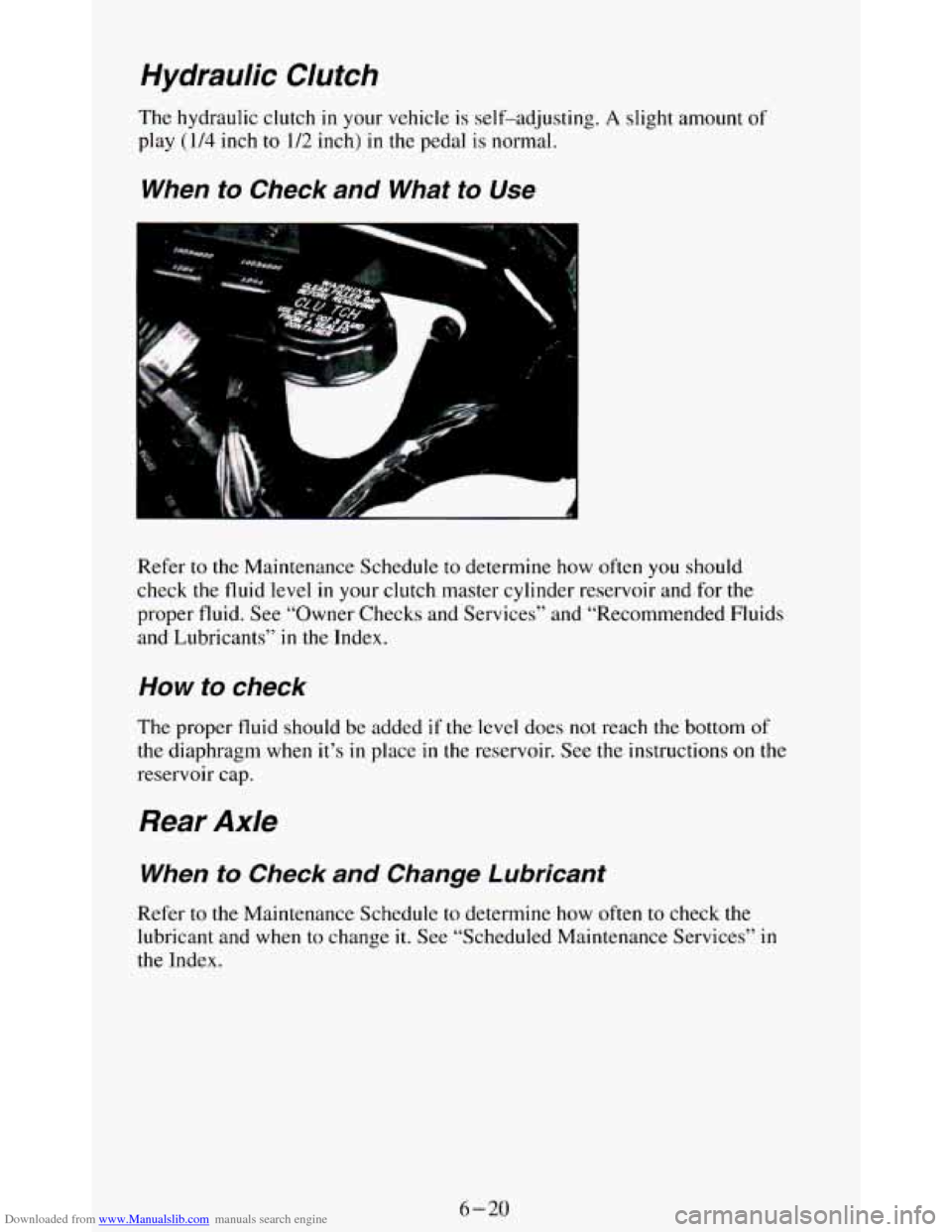
When to Check and What to Use
A
Refer to the Maintenance Schedule to determine how often you should
check
the fluid level in your clutch master cylinder reservoir and for the
proper fluid. See “Owner Checks and Services” and “Recommended Fluids
and Lubricants”
in the Index.
How to check
The proper fluid should be added if the level does not reach the bottom of
the diaphragm when it’s
in place in the reservoir. See the instructions on the
reservoir cap.
Rear Axle
When to Check and Change Lubricant
Refer to the Maintenance Schedule to determine how often to check the
lubricant and when to change
it. See “Scheduled Maintenance Services” in
the Index.
6-20
Page 259 of 348
Downloaded from www.Manualslib.com manuals search engine If the differential is cold, add enough lubricant to raise the level to 1/2 inch
(12 mm) below the filler plug hole.
What to use
Refer to the Maintenance Schedule to determine what kind of lubricant to
use.
See “Recommended Fluids and Lubricants” in the Index.
Engine Coolanr
The following explains your cooling system and how to add coolant when it
is
low. If you have a problem with engine overheating, see “Engine
Overheating” in the Index.
The proper coolant for your vehicle will:
0 Give freezing protection down to -20 “F (-29”C), or -34°F (-37°C) in
Give boiling protection up to 258°F (125°C).
Canada
and for
vehicles with the cold climate option.
0 Protect against rust and corrosion.
Help keep the proper engine temperature.
0 Let the warning lights and gages work as they should.
What to Use
Use a mixture of one-half clean water (preferably distilled) and one-half
antifreeze that meets “GM Specification 6038-M,” which won’t damage
aluminum parts.
You can use a recycled coolant conforming to “GM
Specification 6038-M,” with a complete coolant flush and refill. If you use
this mixture, you don’t need to add anything else.
6-23
Page 266 of 348
Downloaded from www.Manualslib.com manuals search engine I NOTICE:
I
Continuing to drive with worn-out brake pads could result in
costly brake repair.
Some driving conditions or climates may cause a brake squeal when the
brakes are first applied or lightly applied. This does
not mean something is
wrong with your brakes.
Your rear drum brakes don’t have wear indicators, but if
you ever hear a
rear brake rubbing noise, have the rear brake linings inspected.
Also, the
rear brake drums should be removed and inspected each time the tires are
removed for rotation or changing. When
you have the front brakes replaced,
have the rear brakes inspected, too.
Brake linings should always be replaced
as complete axle sets.
Brake Pedal Travel
See your dealer if the brake pedal does not return to normal height, or if
there
is a rapid increase in pedal travel. This could be a sign of brake
trouble.
Brake Adjustment
Every time you make a brake stop, your disc brakes adjust for wear.
If your brake pedal goes down farther than normal, your rear drum brakes
may need adjustment. Adjust them by backing up and firmly applying the
brakes a few times.
Replacing Brake System Parts
The braking system on a modern vehicle is complex. Its many parts have to
be of top quality and work well together if the vehicle is
to have really good
braking. Vehicles we design and
test have top-quality GM brake parts in
them, as your vehicle does when it is new. When you replace parts of your
braking system
- for example, when your brake linings wear down and
6-30