Page 268 of 348
Downloaded from www.Manualslib.com manuals search engine ulb Replacement
Before you replace any bulbs, be sure that all the lights are off and the
engine isn't running.
Halogen Bulbs
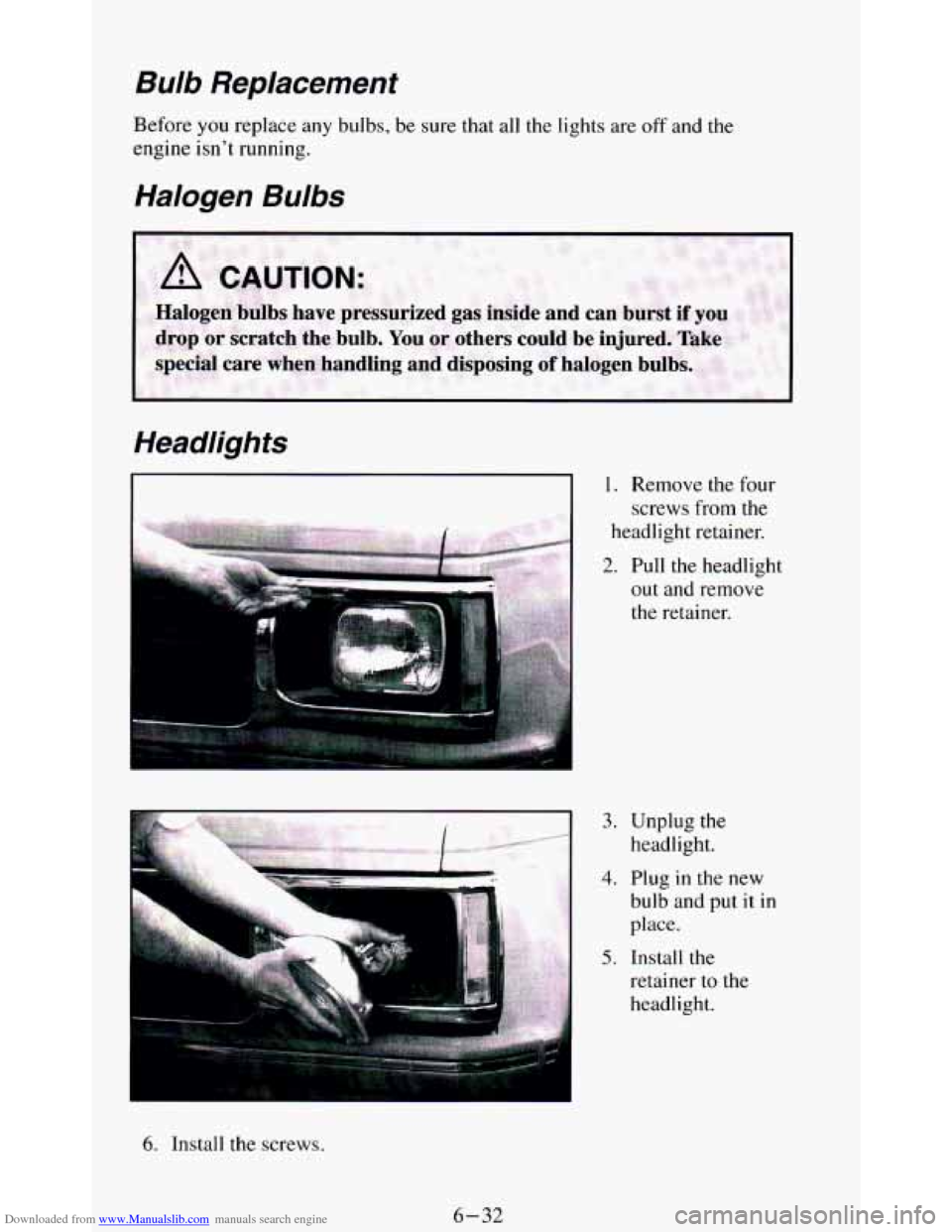
Headlights
1. Remove the four
screws from
the
headlight retainer.
2. Pull the headlight
out and remove
the retainer.
:::
c
3.
4.
5.
Unplug the
headlight.
Plug
in the new
bulb and put it
in
place.
Install the
retainer to the
headlight.
6. Install the screws.
6-32
Page 269 of 348
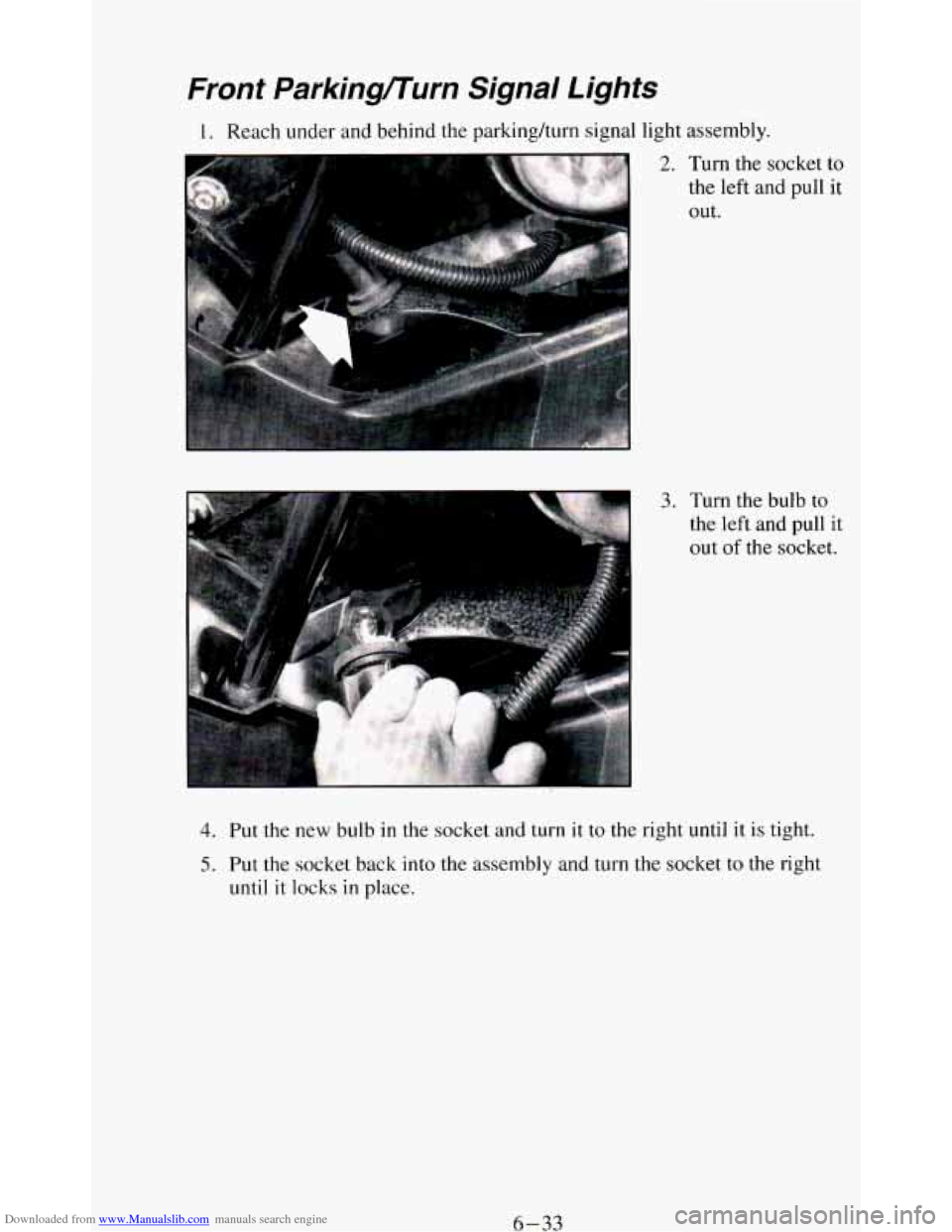
Downloaded from www.Manualslib.com manuals search engine Front ParkingKurn Signal Lights
1. Reach under and behind the parkingkurn signal light assembly.
3. Turn the bulb to
the left and pull it
out
of the socket.
2. Turn the socket to
the left and pull it
out.
4. Put the new bulb in the socket and turn it to the right until it is tight.
5. Put the socket back into the assembly and turn the socket to the right
until it locks in place.
6-33
Page 270 of 348
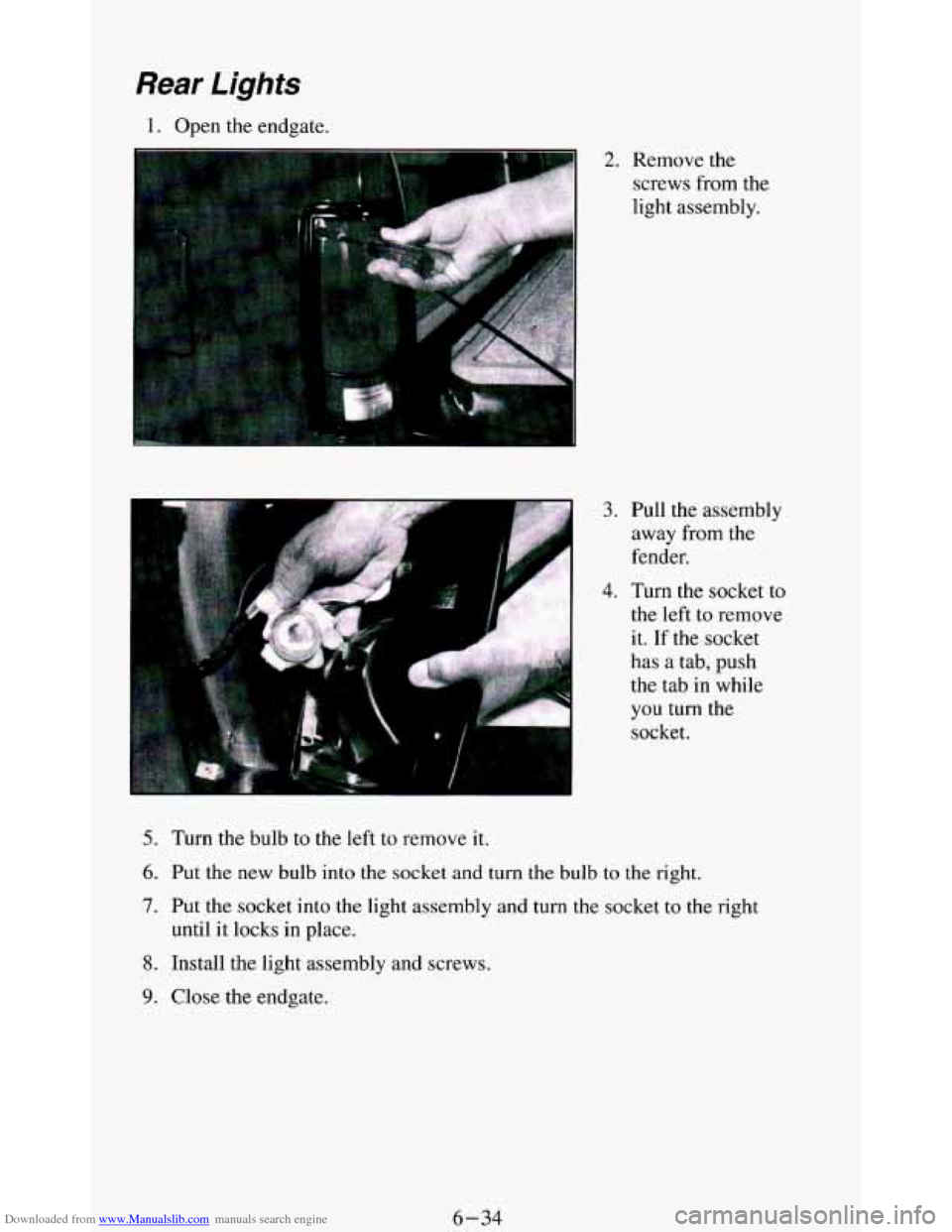
Downloaded from www.Manualslib.com manuals search engine Rear Lights
1. Open the endgate.
- 3. Pull the assembly
away from the
fender.
4. Turn tne socket to
the
left to remove
it. If the socket
has a tab, push
the tab in while
you turn the socket.
5. Turn the bulb to the left to remove it.
6. Put the new bulb into the socket and turn the bulb to the right.
7. Put the socket into the light assembly and turn the socket to the right
8. Install the light assembly and screws.
9. Close the endgate.
until
it locks in place.
6-34
Page 271 of 348
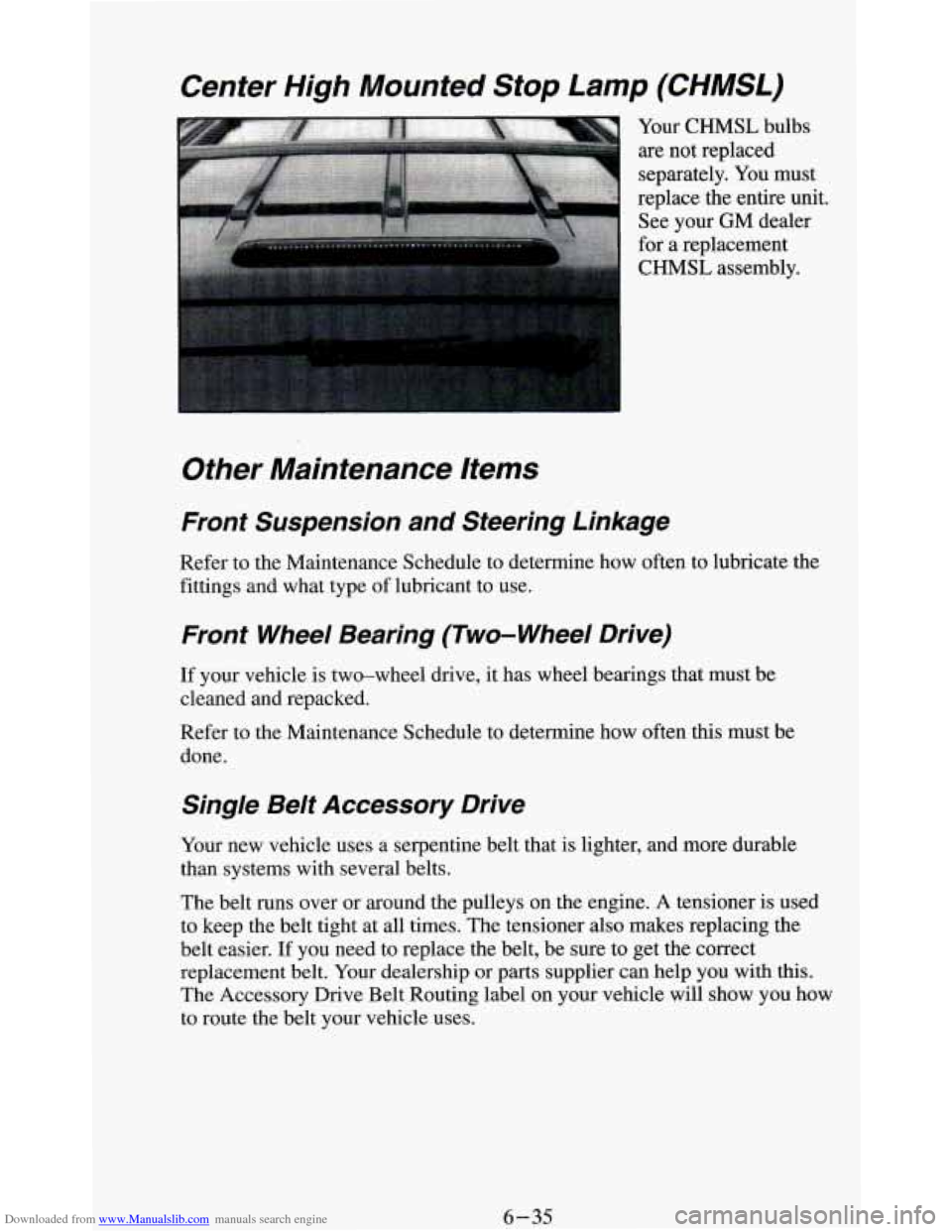
Downloaded from www.Manualslib.com manuals search engine Other Maintenance Items
Front Suspension and Steering Linkage
Refer to the Maintenance Schedule to determine how often to lubricate the
fittings and what type of lubricant to use.
Front Wheel Bearing (Two- Wheel Drive)
If your vehicle is two-wheel drive, it has wheel bearings that must be
cleaned and repacked.
Refer to the Maintenance Schedule to determine how often this must be
done.
Single Belt Accessory Drive
Your new vehicle uses a serpentine belt that is lighter, and more durable
than systems with several belts.
The belt runs over or around the pulleys on the engine. A tensioner is used
to keep the belt tight at all times. 'The tensioner also makes replacing the
belt easier. If you need to replace the belt, be sure to get the correct
replacement belt. Your dealership or parts supplier can help you with this.
The Accessory Drive Belt Routing label on your vehicle will show you how
to route the belt your vehicle uses.
6-35
Page 273 of 348
Downloaded from www.Manualslib.com manuals search engine Propeller Shaft Slip Splines/Universal Joints
Refer to the Maintenance Schedule to determine how often the slip and
universal joints must be lubricated and what type of lubricant to use.
Body
Normal use of your vehicle will cause metal to metal wear at some points on
the cab and body if they are not lubricated.
For exposed surfaces, such as door checks, door lock bolts, lock s\
triker plates,
dovetail bumper wedges, etc., a
thin film of engine oil should be applied.
Where oil holes are provided
in the body or cab, a dripless oil can be used.
The seat adjusters and seat track should be lubricated with chassis grease.
Door weatherstrips and rubber hood bumpers should be wiped clean with a
wet cloth and lightly coated with a rubber lubricant.
Never use too much of any lubricant and be sure to wipe up any extra
lubricant when
you are finished.
Window regulators and controls are inside the doors. They are lubricated
with a long lasting grease.
If lubrication is required your dealer should
perform this service.
Refer to the Maintenance Schedule to determine how often to lubricate
these items and what type of lubricant to use.
Lock Cylinders
To be sure your locks operate properly, they must be lubricated.
Refer to the Maintenance Schedule to determine how often
to lubricate them
and what type of lubricant to
use.
You should not use penetrating oils because they could wash out the factory
installed lubricant and cause
the lock to bind. De-icers which contain
alcohol could also wash away the lubricant,
so be sure to lubricate the lock
after using a de-icer of this type.
Endgate Handle
The endgate handle pivot points on your vehicle should be lubricated to
keep the handle working smoothly.
Refer to the Maintenance Schedule
to determine how often to lubricate them
and what type of lubricant to use.
6-37
Page 274 of 348
Downloaded from www.Manualslib.com manuals search engine Exhaust System
‘To help prevent damage to your exhaust system, do not continue to drive
your vehicle
if you notice:
Engine misfiring
Loss of performance
0 Other unusual operating conditions
Have your engine and exhaust system serviced regularly.
Three- Way Catalytic Converter
Your vehicle’s three-way catalytic converter is designed to reduce the
pollutants
in your vehicle’s exhaust. Use only unleaded fuel in your vehicle.
If you use leaded fuel, you could damage your three-way catalytic converter
and other engine components.
Engine Control Module System
This system has an oxygen (02) sensor that helps keep your engine’s
air-fuel mixture at a proper level. Use only unleaded fuel
in your vehicle. If
you use leaded fuel, you could damage your oxygen (02) sensor and affect
your vehicle’s emissions.
Malfunction Indicator Lamp (SERVICE ENGINE SOON )
This light on your instrument panel lets you know when your emission
system needs service. The light
will come on briefly when you start your
engine to let you know that the system is working.
If it does not come on
when you start your engine, or
if it comes on and stays on while you’re
driving, your system may need service. Your vehicle should still be
driveable, but you should have your system serviced right away.
6-38
Page 284 of 348
Downloaded from www.Manualslib.com manuals search engine If you need to replace any of your wheels, wheel bolts, or wheel nuts,
replace them only with parts. This way, you will be sure to have the right
wheel, wheel bolts, and wheel nuts for your
GM model.
NOTICE:
The wrong wheel can also cause problems with bearing life,
bumper height, vehicle ground clearance, and tire or tire chain\
clearance to the body and chassis. brake cooling, speedometer/odometer calibration, headlight aim,
Used Replacement Wheels
6-48
Page 287 of 348
Downloaded from www.Manualslib.com manuals search engine Using Foam-Type Cleaner on Fabric
Vacuum and brush the area to remove any loose dirt.
Always clean a whole trim panel or section. Mask surrounding trim
along stitch or welt lines.
Mix Multi-Purpose Powdered Cleaner following the directions on the
container label.
Use suds only and apply with a clean sponge.
Don’t saturate the material.
Don’t rub it roughly.
As soon as you’ve cleaned the section, use a sponge to remove the
suds.
0 Rinse the section with a clean, wet sponge.
0 Wipe off what’s left with a slightly damp paper towel or cloth.
0 Then dry it immediately with a blow dryer or a heat lamp.
NOTICE:
Be careful with a hair dryer or heat lamp. You could scorch the
fabric.
0 Wipe with a clean cloth.
Using Solvent-Type Cleaner on Fabric
First, see if you have to use solvent-type cleaner at all. Some spots and
stains will
clean off better with just water and mild soap.
If you need to use a solvent:
Gently scrape excess soil from the trim material with a clean, dull knife
or scraper. Use very little cleaner, light pressure and clean cloths
(preferably cheesecloth). Cleaning should start at the outside of the
stain, “feathering” toward the center. Keep changing to a clean section
of the cloth.
When you clean a stain from fabric, immediately dry the area with an
air hose, hair dryer, or heat lamp
to help prevent a cleaning ring. (See
the previous NOTICE.)
6-51