1994 CHEVROLET BLAZER maintenance
[x] Cancel search: maintenancePage 3 of 348
Downloaded from www.Manualslib.com manuals search engine INTRODUCTION
1994 Chevrolet S-10 Blazer Owner's Manual
Welcome
This manual was prepared to acquaint you with the operation and
maintenance of your
1994 Chevrolet S-10 Blazer and to provide important
safety information. There is also a Chevrolet Truck Warranty and Owner
Assistance Information booklet. In some vehicles, there can be information
manuals from other manufacturers like body builders or special equipment
companies. We urge you to review
all these publications carefully. This will
help you enjoy safe and trouble-free operation of your vehicle.
When it comes to service, keep in mind that your Chevrolet dealer knows
your vehicle best and is interested
in your complete satisfaction. Your dealer
invites you to return for all of your service needs both during and after the
warranty period.
Remember, if you have a concern and need help handling it to your
satisfaction, see the procedure in the Chevrolet Truck Warranty and Owner
Assistance Information booklet.
Thanks for choosing a Chevrolet product. We value you as a member
of the
Chevrolet family. We want to assure you of our continuing interest in your
pleasure and satisfaction with your vehicle.
Chevrolet Motor Division
General Motors Corporation
30007 Van Dyke Ave.
Warren, Michigan
@Copyright
1993 General Motors Corporation, Chevrolet Motor Division
All Rights Reserved
Second Edition
1
Printed in U.S.A.
Page 6 of 348
Downloaded from www.Manualslib.com manuals search engine Table of Contents
Introduction - How to Use this Manual
This section tells you how to use your manual and includes safety
and vehicle damage warnings and symbols.
Section 1 - Seats and Safety Restraints
This section tells you how to use your seats and safety restraints
properly.
Section 2 - Features & Controls
This section explains how to start and operate your vehicle.
Section 3 - Comfort Controls & Audio Systems
This section tells you how to adjust the ventilation and comfort
controls and how
to operate your audio system.
Section 4 - Your Driving and the Road
Here you’ll find helpful information and tips about the road and \
how
to drive under different conditions.
Section 5 - Problems on the Road
This section tells you what to do if you have a problem while
driving, such as a flat tire or engine overheating.
Section 6 - Service & Appearance Care
Here the manual tells you how to keep your vehicle running
properly and looking good.
Section 7- Scheduled Maintenance Services
This section tells you when to perform vehicle maintenance and
what fluids and lubricants
to use.
Section 8 - Customer Assistance Information
This section tells you how to contact your GM division for
assistance and how
to get service publications. It also gives you
information
on “Reporting Safety Defects” on page 8-4.
Index
Here’s an alphabetical listing of almost every subject in this
manual. You can use
it to quickly find something you want to read.
1v
Page 7 of 348
Downloaded from www.Manualslib.com manuals search engine How to Use This Manual
Many people read their owner’s manual from beginning to end when they
first receive their new vehicle. This
will help you learn about the features
and controls for your vehicle.
In this manual, you’ll find that pictures and
words work together to explain things quickly.
INDEX: A good place to look for what you need is the Index in back of the
manual.
It’s an alphabetical list of all that’s in the manual, and the page
number where you’ll find
it.
SECTIONS 1-6: Each section of this manual begins with a brief list of its
contents,
so you can often find at a glance if a section contains the
information you want.
SECTION 7: This section of the manual covers the maintenance required
for your vehicle.
SECTION 8, CUSTOMER ASSISTANCE: This section includes
important information about reporting safety defects and gives you details
about the “Roadside Assistance” program. You
will also find customer
satisfaction phone numbers (including customer satisfaction numbers for
the
hearing and speech impaired) as well as the mediatiodarbitration procedure.
We’ve
also included ordering information for service publications in this
section.
Page 171 of 348
Downloaded from www.Manualslib.com manuals search engine Off-Road Driving with Your Four-wheel Drive Vehicle
This off-road guide is for vehicles that have four-wheel drive.
Also, see “Anti-lock Brakes”
in the Index.
If your vehicle doesn’t have four-wheel drive,
you shouldn’t drive off-road
unless you’re on a level, solid surface.
Off-road driving can be great
fun. But it does have some definite hazards.
The greatest
of these is the terrain itself.
“Off-roading” means you’ve left the great North American road system
behind. Traffic lanes aren’t marked. Curves aren’t banked. There are no
road signs. Surfaces can be slippery, rough, uphill or downhill. In short,
you’ve gone right back to nature.
Off-road driving involves some new skills. And that’s
why it’s very
important that you read this guide. You’ll find many driving tips and
suggestions. These
will help make your off-road driving safer and more
enjoyable.
Before You Go Off-Roading
There are some things to do before you go out. For example, be sure to have
all necessary maintenance and service work done. Be sure you read all the
information about your four-wheel drive vehicle
in this manual. Is there
enough fuel? Is the spare tire
fully inflated? Are the fluid levels up where
they should be? What are the local
laws that apply to off-roading where
you’ll be driving? If you don’t know, you should check with law
enforcement people
in the area. Will you be on someone’s private land? If
so, be sure to get the necessary permission.
Loading Your Vehicle for Off-Road Driving
There are some important things to remember about how to load your
vehicle.
The heaviest things should be on the load floor and forward of your
rear axle. Put heavier items as far forward as you can.
Be sure the load is secured properly, so driving on the off-road terrain
doesn’t toss things around.
4-13
Page 182 of 348
Downloaded from www.Manualslib.com manuals search engine After Off-Road Driving
Remove any brush or debris that has collected on the underbody, chassis or
under the hood. These accumulations can be a fire hazard.
After operation in mud or sand, have the brake linings cleaned and checked.
These substances can cause glazing and uneven braking. Check
the body
structure, steering, suspension, wheels, tires, and exhaust system for
damage. Also, check the
fuel lines and cooling system for any leakage.
Your vehicle will require more frequent service due
to off-road use. Refer
to the Maintenance Schedule for additional information.
Driving at Night
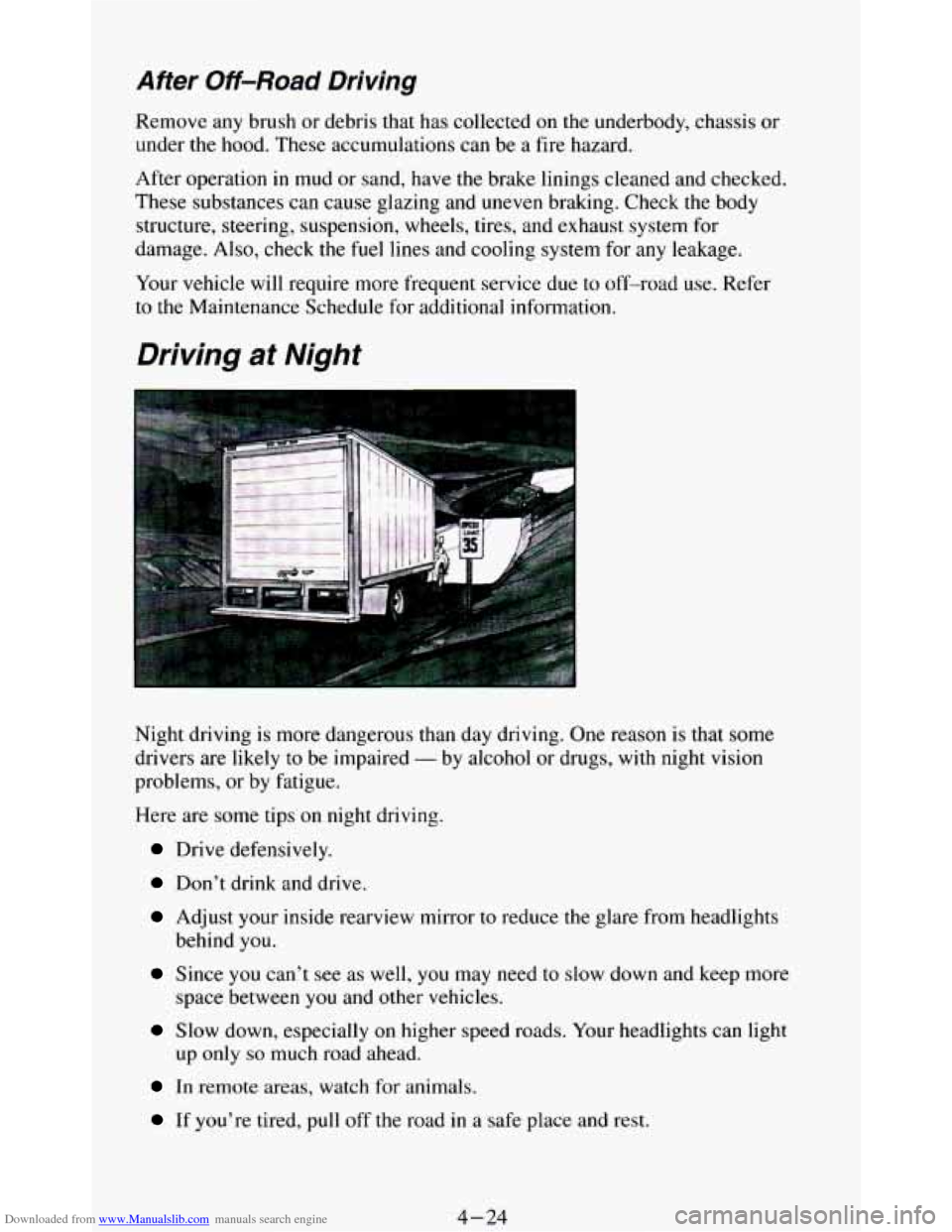
Night driving is more dangerous than day driving. One reason is that some
drivers are likely
to be impaired - by alcohol or drugs, with night vision
problems, or by fatigue.
Here are some tips
on night driving.
Drive defensively.
Don’t drink and drive.
Adjust your inside rearview mirror to reduce the glare from headlights
behind you.
space between
you and other vehicles.
up
only so much road ahead.
Since you can’t see as well, you may need to slow down and keep more
Slow down, especially on higher speed roads. Your headlights can light
In remote areas, watch for animals.
If you’re tired, pull off the road in a safe place and rest.
4-24
Page 202 of 348
Downloaded from www.Manualslib.com manuals search engine Maintenance When Trailer Towing
Your vehicle will need service more often when you’re pulling a trailer. See
the Maintenance Schedule for more on this. Things that are especially
important in trailer operation are automatic transmission fluid (don’t
overfill), engine oil, axle lubricant, belt, cooling system, and brake
adjustment. Each of these is covered
in this manual, and the Index will help
you find them quickly. If you’re trailering,
it’s a good idea to review these
sections before you start your trip.
Check periodically to see that
all hitch nuts and bolts are tight.
Trailer Light Wiring
See “Trailer Wiring Harness” in the Index.
Power Winches
If you wish to use a power winch on your vehicle, only use it when your
vehicle
is stationary or anchored.
! NOTICE:
~ When operating a power winch on your vehicle always leave the \
l transmission in the neutral position. Do not leave an automatic
transmission in
P (Park) or a manual transmission in gear or the
transmission may be damaged.
Use the regular brakes, set the parking brake or block the wheels to keep
your vehicle from rolling.
4-44
Page 237 of 348
Downloaded from www.Manualslib.com manuals search engine Service & Appearance Care
Section
Here you will find information about the care of your vehicle . This part
begins with service and fuel information. and then
it shows how to check
important fluid and lubricant levels
. There is also technical information
about your vehicle. and a section devoted to
its appearance care .
Service ................................................... 6-2
Fuel
..................................................... 6-3
Checking Things Under the Hood
.............................. 6-6
Engineoil
.............................................. 6-8
Aircleaner
............................................ 6-14
Automatic Transmission Fluid
............................. 6-15
Manual Transmission Fluid
............................... 6-18
Hydraulic Clutch ........................................ 6-20
RearAxle
............................................. 6-20
Transfer Case
.......................................... 6-21
FrontAxle
............................................. 6-22
Enginecoolant
......................................... 6-23
Power Steering Fluid
.................................... 6-26
Windshield Washer Fluid
................................. 6-28
Brake Master Cylinder
................................... 6-29
Replacing Brake System Parts
................................ 6-30
Battery
.................................................. 6-31
Vehiclestorage
......................................... 6-31
Bulb Replacement
......................................... 6-32
Other Maintenance Items
.................................... 6-35
Loading Your Vehicle
...................................... 6-39
Tires .................................................... 6-42
Appearance Care
.......................................... 6-49
Vehicle Identification Number (VIN)
.......................... 6-58
Service Parts Identification Label
............................. 6-60
Fuses and Circuit Breakers
.................................. 6-60
Capacities and Specifications Charts
........................... 6-62
6-1
Page 238 of 348
Downloaded from www.Manualslib.com manuals search engine Service
Your GM dealer knows your vehicle best and wants you to be happy with it.
We hope you’ll go to your dealer for all your service needs. You’ll get
genuine
GM parts and GM-trained and supported service people.
We hope you’ll want
to keep your GM vehicle all GM. Genuine GM parts
have
one of these marks:
Dohg Your Own Service Work
If you want to do some of your own service work, you’ll want to get the
proper GM Service Manual. It tells
you much more about how to service
your vehicle than this manual can.
To order the proper service manual, see
“Service Publications” in the Index.
You should keep a record with all parts receipts and list the mileage and the
date of
any service work you perform. See “Maintenance Record” in the
Index.
NOTICE:
I
If you try to do your own service work without knowing enough
about
it, your vehicle could be damaged.
6-2