Page 44 of 356
Downloaded from www.Manualslib.com manuals search engine Seats & Safety Belts
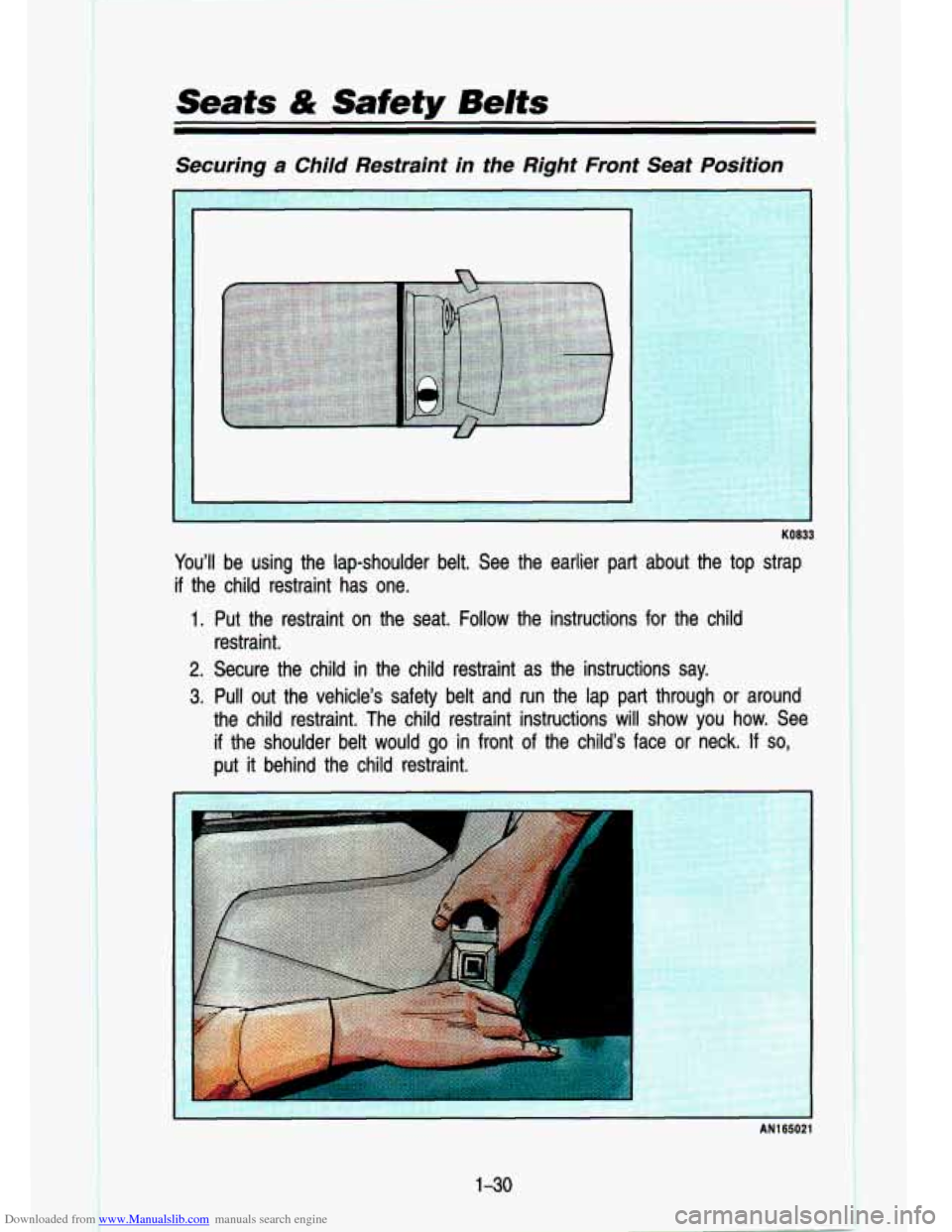
Securing a Child Restraint in the Right Front Seat Position
KO833
You’ll be using the lap-shoulder belt. See the earlier part about the top strap
if the child restraint has one.
1. Put the restraint on the seat. Follow the instructions for the\
child
2. Secure the child in the child restraint as the instructions say.
3. Pull out the vehicle’s safety belt and run the lap part th\
rough or around
the child restraint. The child restraint instructions
will show you how. See
if the shoulder belt would go in front of the child’s face or neck. If so,
put it behind the child restraint.
restraint.
!
AN165021
1 -30
Page 45 of 356
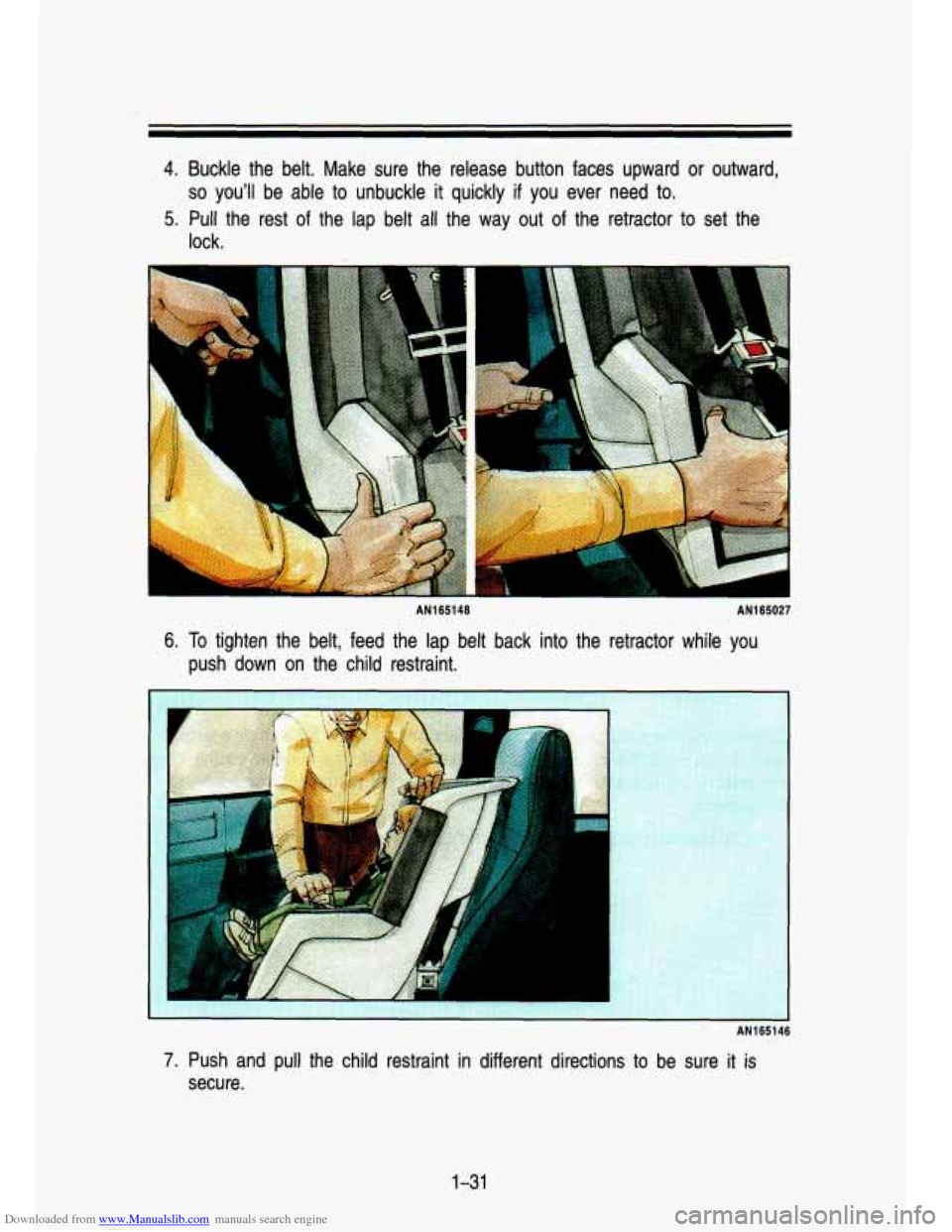
Downloaded from www.Manualslib.com manuals search engine 4. Buckle the belt. Make sure the- release button faces upward or outward,
5. Pull the rest of the lap belt all the way out of the retractor to set the
so you'll be able to unbuckle it quickly if you ever need to.
lock.
AN165148 AN1 65027
6. To tighten the belt, feed the lap belt back into the retractor w\
hile you
push down on the child restraint.
AN165146
7. Push and pull the child restraint in different directions to be sure it is
secure.
1-31
Page 46 of 356
Downloaded from www.Manualslib.com manuals search engine Seats & Safety Belts
If you're using a bucket seat, adjust the seat forward until the \
lap portion of
the safety belt holds the restraint firmly. But, don't move it any more than
needed to tighten the lap belt.
To remove the child restraint, unbuckle the vehicle's safety belt \
and let it go
back all the way. The safety belt
will move freely again and be ready to work
for an adult or larger child passenger.
Larger Children
I/
AN170071
Children who have outgrown child restraints should wear the veh\
icle's safety
belts.
If you have the choice, a child should sit next to a window so \
the child
can wear a lap-shoulder belt and get the additional restraint \
a shoulder belt
can provide.
Children who aren't buckled up can be thrown out in a crash. \
. .. .- i,. : .' ..
r: ! -1
i.
..
..
..
132
Page 47 of 356
Downloaded from www.Manualslib.com manuals search engine PO355
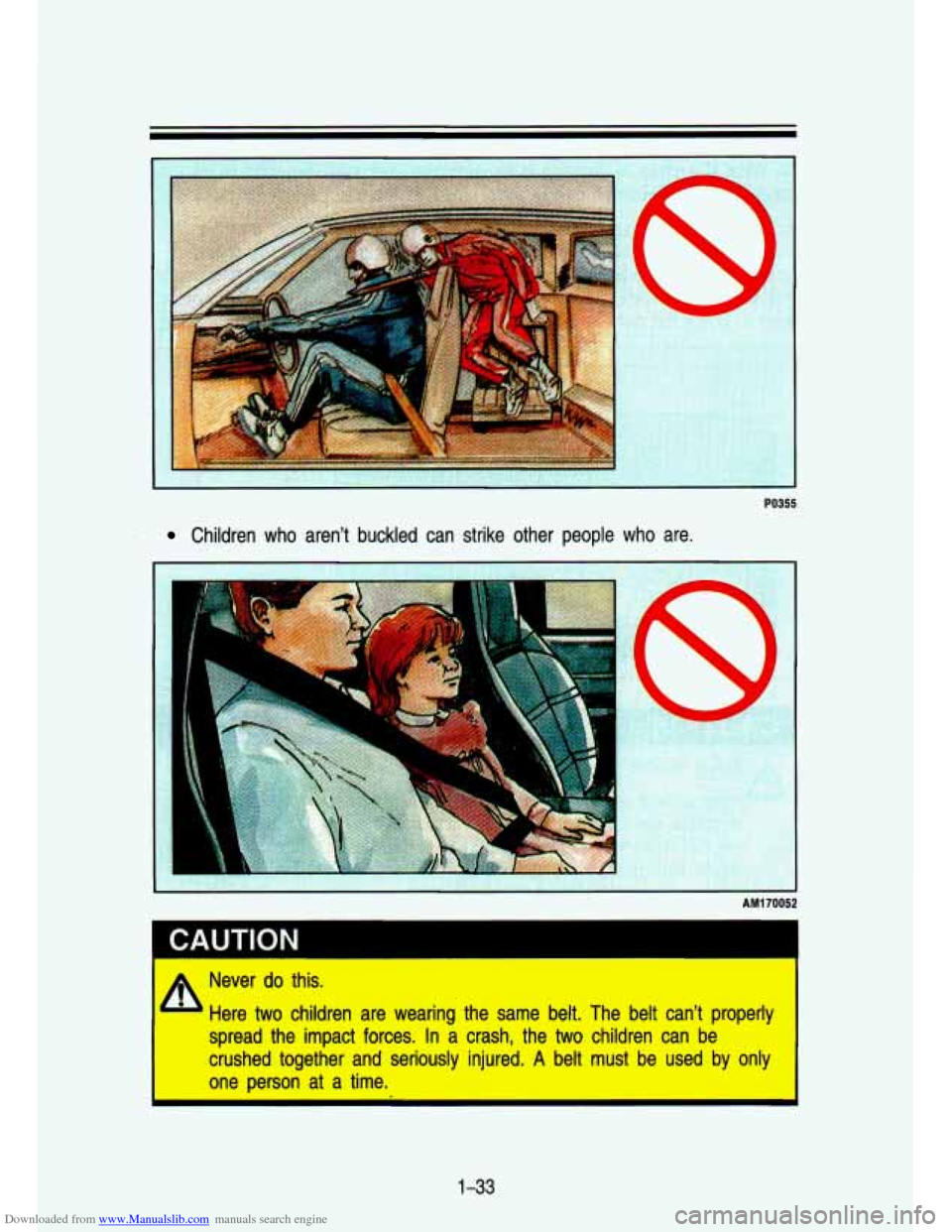
Children who aren’t buckled can strike other people who are.
I
I
AM170052
Never do this.
A Here two children are wearing the same belt. The belt can’t properly \
spread the impact forces. In a crash, the
two children can be
crushed together and seriously injured.
A belt must be used by only
one person at a time.
1-33
Page 48 of 356
Downloaded from www.Manualslib.com manuals search engine f
.-
Seats & Safety Belts
Q: What if a child is wearing a lap-shoulder belt, but the child is so
small that the shoulder belt is very close to the child’s face or neck?
A: Move the child toward the center of the vehicle, but be sure that the
shoulder belt still
is on the child’s shoulder, so that in a crash the child’s
upper body would have the restraint that belts provide.
If the child is so small
that the shoulder belt
still is very close to the child’s face or neck, you might
want
to place the child in a seat that has a lap belt, if your vehicle has one.
I’ -
AM170051
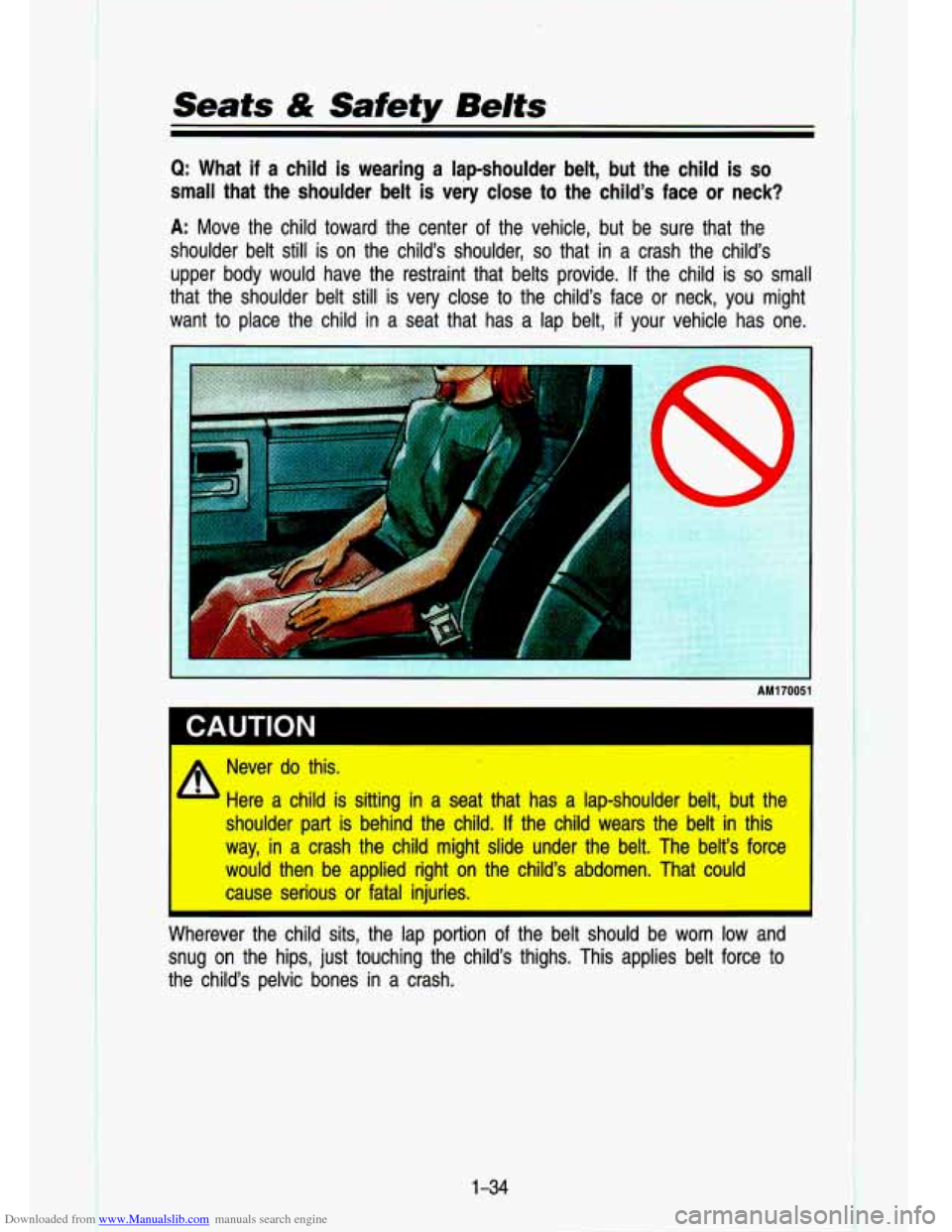
Never do this.
A Here a child is sitting in a seat that has a lap-shoulder be\
lt, but the
shoulder part is behind the child.
If the child wears the belt in this
way, in a crash the child might slide under the belt. The belt’\
s force
would then be applied right on the child’s abdomen. That co\
uld
cause serious or fatal injuries.
Wherever the child sits, the lap portion of the belt should b\
e worn low and
snug
on the hips, just touching the child’s thighs. This applies bel\
t force to
the child’s pelvic bones in a crash.
1-34
Page 55 of 356
Downloaded from www.Manualslib.com manuals search engine 1 CAI ITlnN
~I
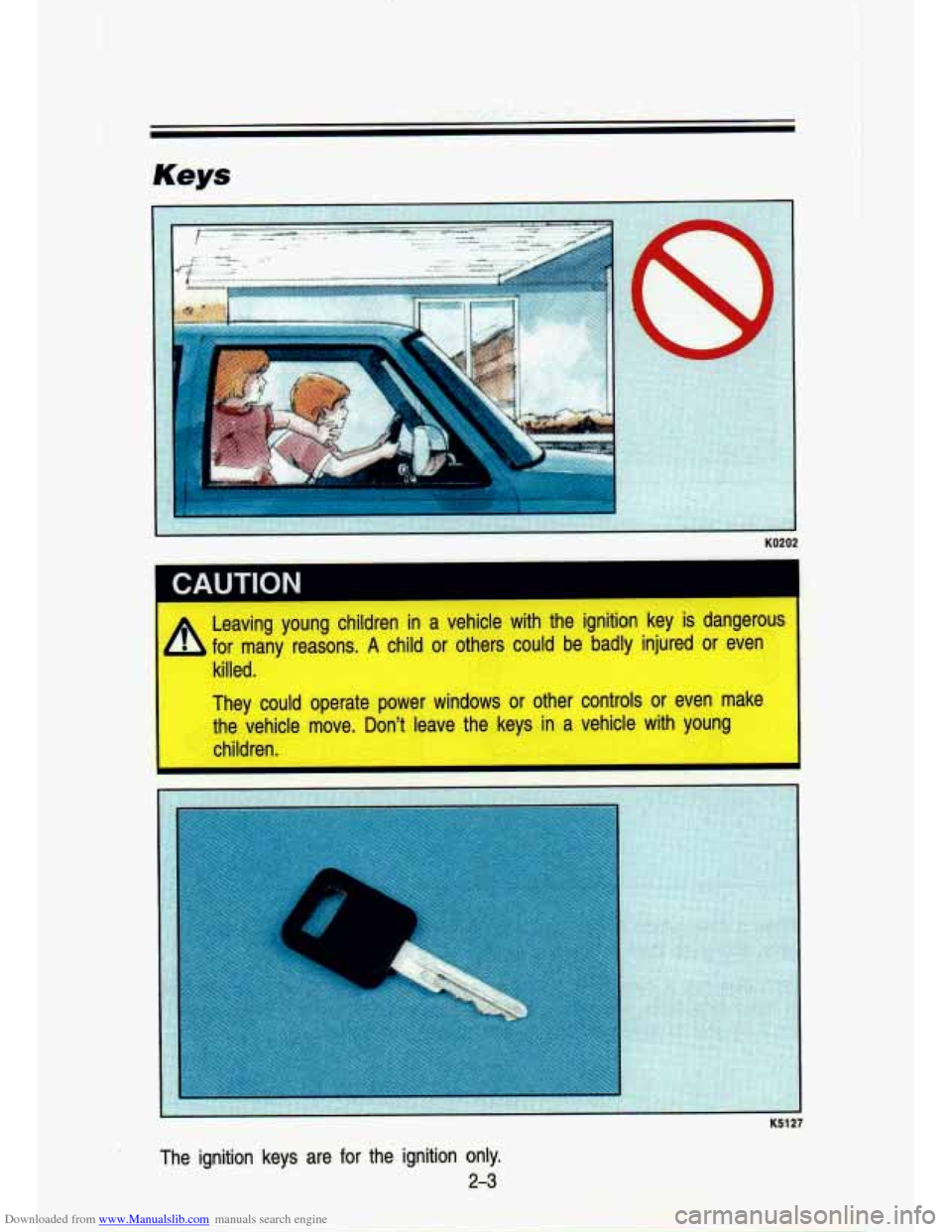
Leaving young children in a vehicle with the ignition key is dangerous
for many reasons.
A child or others could be badly injured or even
killed.
They could operate power windows or other controls or even make
the vehicle move. Don’t leave the keys in a vehicle with young
children.
The ig,nilion keys are for the ignition Only.
2-3
Page 58 of 356
Downloaded from www.Manualslib.com manuals search engine f .. :. . I. .
. .. .-
. . .. ., -. .
Features & Controls
Door Locks
1 A Unlocked doors can be dangerous.
' Passengers-especially children-can easily open the doors and fall
out. When a door is locked, the inside handle won't open it.
Outsiders can easily enter through an unlocked door when you s\
low
down or stop your vehicle.
This may not be
so obvious: You increase the chance of being
thrown out of the vehicle in a crash
if the doors aren't locked. Wear
safety belts properly, lock your doors, and you will be far b\
etter
off
whenever you drive your vehicle.
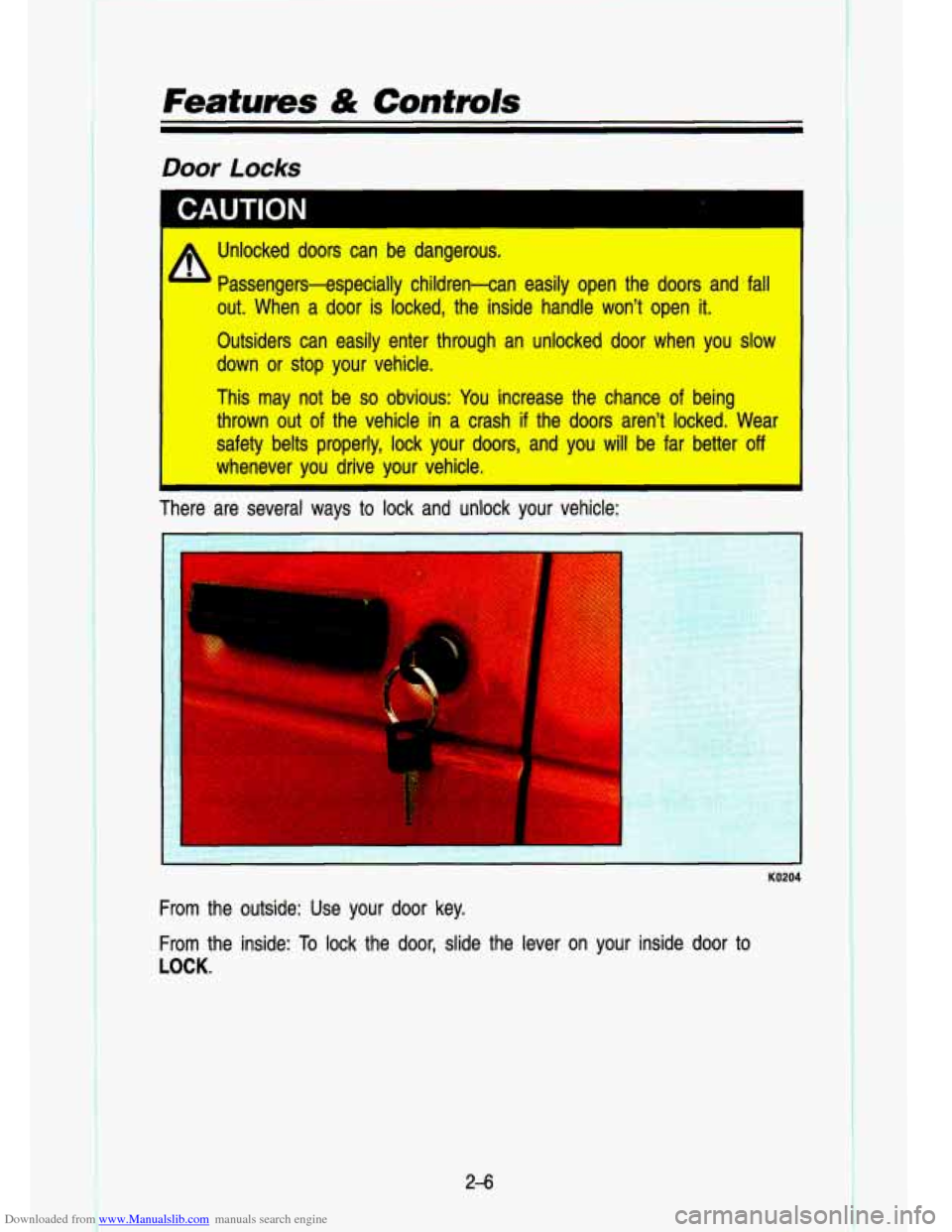
There are several ways to lock and unlock your vehicle:
~~____
KO204
From the outside: Use your door key.
From the inside: To lock the door, slide the lever on your inside door to
LOCK.
~. - -. I.
, .. I
2-6
Page 162 of 356

Downloaded from www.Manualslib.com manuals search engine c. -. .. .
Your Driving and the Road
Turn and lane change signals: Always signal when you plan to \
turn or
change lanes.
If necessary, you can use hand signals out the window: Left arm \
straight out
for a left turn, down for slow or about-to-stop, and up for a right turn.
Slowing down:
If time allows, tap the brake pedal once or twice in advance
of slowing or stopping. This warns the driver behind you.
Disabled: Your four-way flashers signal that your vehicle is disabled or is a
hazard. See “Hazard Warning Flasher’’ in the Index.
Traffic Officer
The traffic police officer is also a source of important information. The officer’s
signals govern, no matter what the traffic lights or other sig\
ns say.
The next part discusses some of the road conditions you may encounter.
Defensive Driving
The best advice anyone can give about driving is: Drive defens\
ively.
Please
start with a very important safety device in your vehicle: Buckle up.
(See “Safety Belts” in the Index.)
Defensive driving really means “be ready for anything.” On\
city streets, rural
roads, or freeways, it means “always expect the unexpected.”
Assume that pedestrians or other drivers are going to be careless and make
mistakes. Anticipate what they might
do. Be ready for their mistakes.
Expect children to dash out from behind parked cars, often followed by other
children. Expect occupants in parked cars to open doors into traffic. Watch for
movement in parked cars-someone may be about to open a door.
Expect other drivers to run stop signs .when you are on a through street. Be
ready to brake
if necessary as you go through intersections. You may not
have to use the brake, but if you
do, you will be ready.
If you’re driving through a shopping center parking lot where there are
well-marked lanes, directional arrows, and designated parking are\
as, expect
some drivers to ignore all these markings and dash straight toward one part
of the lot.
Pedestrians can be careless. Watch for them. In general, you m\
ust give way
to pedestrians even
if you know you have the right of way.
Rear-end collisions are about the most preventable of accidents. Yet they are
common. Allow enough following distance. It’s the best defens\
ive driving
4-8