Page 177 of 1216
![MITSUBISHI ECLIPSE 1991 Service Manual BRAKES - Anti-lock Braking System Troubleshooting5-37
E-4Abnormality of stop light switch circuitI
- [Explanation][Hint]The ABS ECU turns on the warning light in theIf the stop light operates normal,](/manual-img/19/57104/w960_57104-176.png "MITSUBISHI ECLIPSE 1991 Service Manual BRAKES - Anti-lock Braking System Troubleshooting5-37
E-4Abnormality of stop light switch circuitI
- [Explanation][Hint]The ABS ECU turns on the warning light in theIf the stop light operates normal,")
BRAKES - Anti-lock Braking System Troubleshooting5-37
E-4Abnormality of stop light switch circuitI
- [Explanation][Hint]The ABS ECU turns on the warning light in theIf the stop light operates normal, the ABS harness
following cases.
wire for the stop light switch input circuit to the ECU
lStop light switch may remain on for more thanis broken or there is a malfunction in the ABS ECU.
15 minutes without the ABS functions.
lThe harness wire for the stop light switch may
be open.
AUTO-CRUISE
STOP
--I0.85-G
’LIGHT
w
STOPLIGHTSWITCHABSECURESIS-
TOR
14AO610
Do the stop lights light up _ No c Check the stop light re-and go out normally?lated circuit and repair
problem spots.
Yes
isconnect the ABS ECconnector and inspect at
the harness side
connec-
tor.When the brake pedal is
NoHarness wire between
pressed forcefully, does the
* stop light switch and ABS
voltage between connectorECU is broken.
terminal No. 29 and ground
indicate battery voltage?
c
Repair harness.
Yes.
;gSJ;ght switch circuit is
Page 178 of 1216
![MITSUBISHI ECLIPSE 1991 Service Manual 5-38BRAKES - Anti-lock Braking System Troubleshooting
E-5Abnormality of solenoid valve drive circuit
[Explanation]*>The ABS ECU normally monitors the solenoid valve
when turned OFF, the ECU determines](/manual-img/19/57104/w960_57104-177.png "MITSUBISHI ECLIPSE 1991 Service Manual 5-38BRAKES - Anti-lock Braking System Troubleshooting
E-5Abnormality of solenoid valve drive circuit
[Explanation]*>The ABS ECU normally monitors the solenoid valve
when turned OFF, the ECU determines")
5-38BRAKES - Anti-lock Braking System Troubleshooting
E-5Abnormality of solenoid valve drive circuit
[Explanation]*>The ABS ECU normally monitors the solenoid valve
when turned OFF, the ECU determines the solenoid%’ -’drive circuit.coil wire is broken/short circuited or the harness is
If no current flows in the solenoid even if the ECUbroken/short circuited and then the warning light
turns the solenoid ON or if it continues to flow evenlights up.
IGNITIONSWITCH(IGI)
7JIB------_-_tor and check with the
side connector.
Connect HU
1OP connec-
disconnect ECU con-
>Is the solenoid valve resis-
tance value within the range
of the standard values when
measured at the ECU con-
nector?Standard value:
3.0-3.2 Q
Yes1
II
I
Solenoid valve drive circuit isnormal.I
NoReplace HU.I
NoIs the resistance value for
the solenoid valve within the
range ofthe standard
values?Standard value:
3.0-3.2 Q, IYes ,
1
JThe harness wire for the
solenoidvalvecircuit
whose resistance value is
outside the range of the
standard value is broken
or short circuited.,-‘he-
-Repair
Page 179 of 1216
![MITSUBISHI ECLIPSE 1991 Service Manual BRAKES - Anti-lock Braking System Troubleshooting5-39
E-6Abnormality of valve relay drive circuitI
j-a [Explanation]When the ignition switch is turned ON, the ABSnormal. In addition, normally it monit](/manual-img/19/57104/w960_57104-178.png "MITSUBISHI ECLIPSE 1991 Service Manual BRAKES - Anti-lock Braking System Troubleshooting5-39
E-6Abnormality of valve relay drive circuitI
j-a [Explanation]When the ignition switch is turned ON, the ABSnormal. In addition, normally it monit")
BRAKES - Anti-lock Braking System Troubleshooting5-39
E-6Abnormality of valve relay drive circuitI
j-a [Explanation]When the ignition switch is turned ON, the ABSnormal. In addition, normally it monitors whether or
ECU switches the valve relay OFF and ON for annot there is power in the valve power monitor line
initial check, compares the voltage of the signal tosince the valve relay is normally ON. Then, if the
the valve relay and valve power monitor line voltagesupply of power to the valve power monitor line is
to check whether the valve relay operation is
interrupted, the warning light illuminates.
IGNITIONMAIN FUSIBLESWITCHLINK @W-31)When the valve relay is
checked, are the followingconditions found?No.85-No.86:resistancevalue 60-120 Q
No.30-No.87a: continuityNo.30-No.87: No continui-
When battery voltage is ap-plied between terminals
No.86 and No. 85 grounded.
No. 30-No. 87: continuity
No.
30-No. 87a: no continui-
tyremove the HU connec-
NoValve relay malfunction
Replace valve relay.
IConnect the HU
remove the ECU con-
I Yes
IValve relay drive circuit isnormal.I
Page 180 of 1216
![MITSUBISHI ECLIPSE 1991 Service Manual 5-40BRAKES - Anti-lock Braking System Troubleshooting
E-7Abnormality of motor drive circuit
[Explanation]The ABS ECU illuminates the warning light for the
motor relay and motor in the following cases.](/manual-img/19/57104/w960_57104-179.png "MITSUBISHI ECLIPSE 1991 Service Manual 5-40BRAKES - Anti-lock Braking System Troubleshooting
E-7Abnormality of motor drive circuit
[Explanation]The ABS ECU illuminates the warning light for the
motor relay and motor in the following cases.")
5-40BRAKES - Anti-lock Braking System Troubleshooting
E-7Abnormality of motor drive circuit
[Explanation]The ABS ECU illuminates the warning light for the
motor relay and motor in the following cases.
l When the motor relay does not function
lWhen there is trouble with the motor itself and it
does not revolve
[Hint]If there is motor operation noise when wheel speed
exceeds
Gkm/h (4mph) when starting up after the
engine is started, there is a broken or short circuitedmotor monitor wire.
lWhen the motor ground line is disconnected andthe motor does not revolve
l When the motor continues to revolve
Does the motor make a
YesBroken wire or short cir-noise when wheel speed
-cuit in motor monitor line
exceeds 6 km/h (4 mph)?
b
NoRepair the harness between HU and ECU.
emove the motor rela
ABS ECU
14A0105
Remove the motor relav and
check resistance values.
No.
85-No. 86:resistancevalue 30-60 QNo.30-No.87: no continui-
ty
Battery voltage is applied on
terminals No. 86 and No. 85
grounded
No. 30-No. 87: continuity
Yes
q Motor relay malfunction 1
Replace motor relay.I
Is pump motor ground con-netted normally?Connect ground wire.I
b
Does voltage between bodyNo
connector terminal 51 andIBroken wire in pumpmotor power circuit
ground indicate battery vol-
tage?1Repair the harness.
YesIs resistance between body
- No L Malfunction of harness
connector terminal No. 2 andbetween HU and ECU
No.26 30-60 ohms?b
YesRepair harness.
Motor drive circuit is normal.
Page 185 of 1216

BRAKES - Service Adiustment Procedures5-45I
\\14A0416
2314A04.54
BLEEDINGN65FYAN
When the master cylinder is empty of brake fluid, bleed air
from the master cylinder by proceeding with procedures (1)
thru (6). (Because this master cylinder is not equipped with a
check valve.)
When brake fluid remains in the master cylinder, proceed with
step (6).
(1) -Disconnect the brake tube from the master cylinder.
(2) Two persons should conduct the air bleeding, one person
slowly depressing the brake pedal and holding the pedal
depressed.(3) In this condition, the other person should use a finger to
close the outlet part of the master cylinder, and then the
first person should release the brake pedal.
(4) Steps (2) and (3) should be repeated three or four times,
and then the master cylinder should be filled with brake
fluid to the specified level.
NOTE
The air is completely bled from the master cylinder by steps
(1) to (4).
(5) Connect the brake tube to the master cylinder.
(6) Start the engine; then, in the sequence shown in the
illustration, bleed the air from each wheel cylinder.
Specified brake fluid: MOPAR Brake Fluid/
Conforming to DOT3
Caution
1.Use the specified brake fluid. Avoid using a mixture
of the specified brake fluid and other fluid.2. If brake fluid is exposed to the air, it will absorb
moisture; as water is absorbed from the atmos-phere, the boiling point of the brake fluid will
decrease and the braking performance will be
seriously impaired. For this reason, use a hermeti-
cally sealed 1 lit.
(1.06 qt.) or 0.5 lit. (0.52 qt.) brake
fluid container.3. Firmly close the cap of the brake fluid container
after use.
4. For vehicles with the anti-lock braking system, besure to install a filter to the master cylinder
reservoir tank when supplying brake fluid.
ORDINARY AIR-BLEEDING PROCEDURES(1) Depress the brake pedal several times until resistance is
felt; then, with the pedal depressed, loosen the bleeder
screw
l/3 to l/2 turn and then tighten it before the fluid
pressure is all gone.
(2) Release the brake pedal. Repeat this procedure until there
are no more air bubbles in the brake fluid.
Page 191 of 1216
![MITSUBISHI ECLIPSE 1991 Service Manual BRAKES - Service Adjustment Procedures5-51E.C.U. terminal
ILow gear idle condition
[Speed: 5-6 km (3.1-3.16
mph)]Approx.
5V
14A0580When increasing speed
[Speed:
15-20 km (9.3-12.4 mph11OBSERVATION](/manual-img/19/57104/w960_57104-190.png "MITSUBISHI ECLIPSE 1991 Service Manual BRAKES - Service Adjustment Procedures5-51E.C.U. terminal
ILow gear idle condition
[Speed: 5-6 km (3.1-3.16
mph)]Approx.
5V
14A0580When increasing speed
[Speed:
15-20 km (9.3-12.4 mph11OBSERVATION")
BRAKES - Service Adjustment Procedures5-51E.C.U. terminal
ILow gear idle condition
[Speed: 5-6 km (3.1-3.16
mph)]Approx.
5V
14A0580When increasing speed
[Speed:
15-20 km (9.3-12.4 mph11OBSERVATION OF WHEEL SPEED SENSOR
OUTPUT VOLTAGE VARIATIONS
ABS>N65FOAO
(1) Jack up the vehicle and release the parking brake.
(2) Disconnect the electronic control unit harness connector,
and measure the speed sensor output voltage at the
vehicle side harness connector.
(3) With an AWD model, put the shift lever in
1st (MTT) or L(A/T) position, rotate the wheels and observe the wave
shape for each wheel. With an FWD model, put the shift
lever in
1st (M/T) or L (AiT) position, rotate the wheels and
observe the wave shape for the front wheels; for the rear
wheels, rotate the wheels by hand and monitor the wave
shape.
NOTEIt is also
allright to actually drive the car.
ISpeed sensor
E.C.U. terminal No.I
IFront leftI14-15I
IFront right31-33I
IRear right28-30I
IRear left1 10-11IWhen wheel speed is slow, the output voltage is low
and it gets higher as the speed increases.
Wave shape monitoring points
IS THE OUTPUTVOLTAGE (AMPLITUDE) TOO LOW OR ISTHERE NO OUTPUT VOLTAGE?
If it is too low, check each wheel speed sensor,
With FWD rear wheels, check the sensor gap.
IS THERE VARIATION IN THE WAVE SHAPE AMPLITUDE?
If the flicker of the amplitude is large, consider shaking
of the axle hub.
IS THERE NOISE IN THE WAVE SHAPE OR DISTORTION?Broken or disconnected wire due to vibration or
installation malfunction of the wheel speed sensor.
Check rotor teeth meshing, breaks, etc.
Approx. 1 OV
14A0501
Page 192 of 1216
5-52BRAKES - Service Adjustment Procedures
16LO312lOWOO
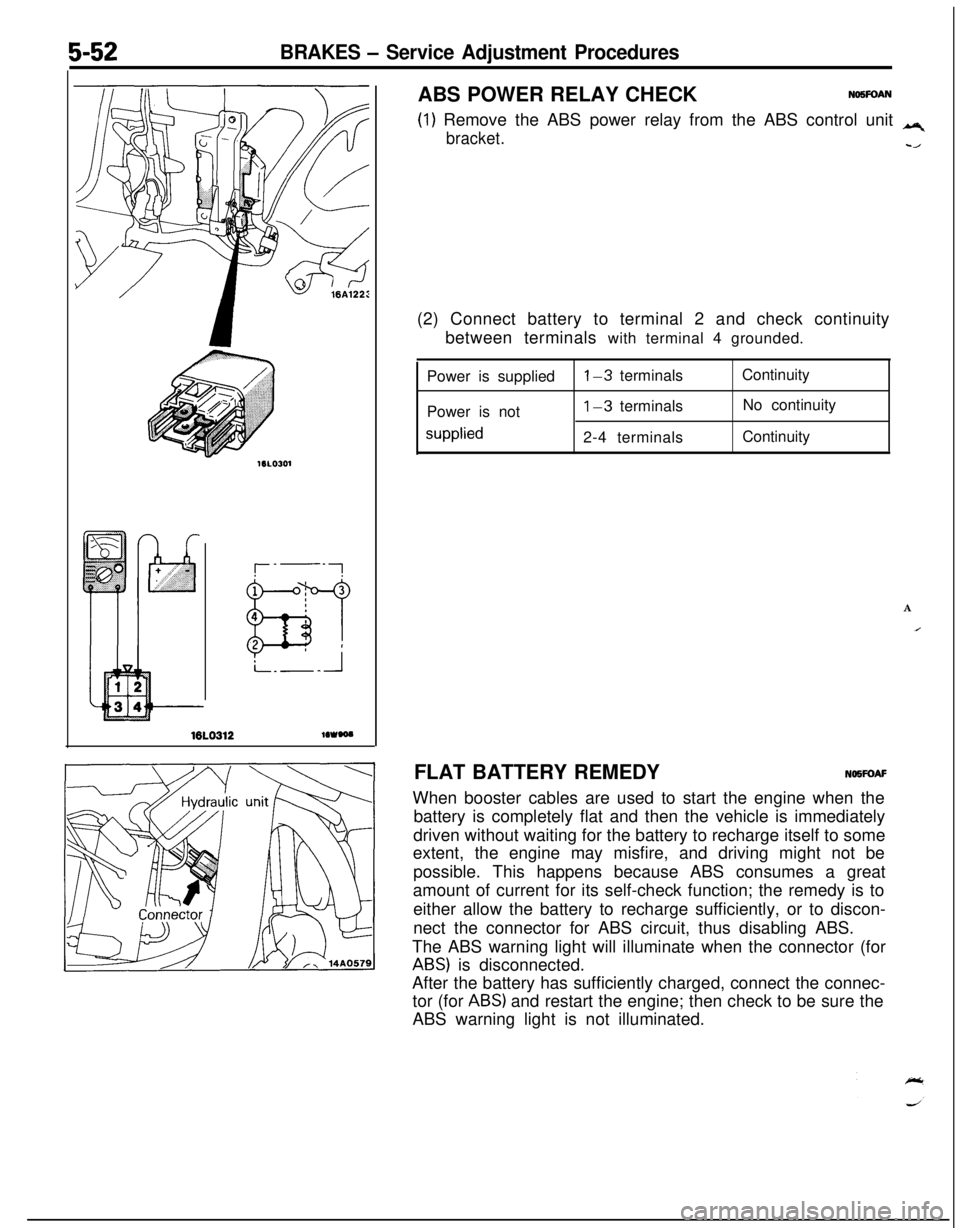
(1) Remove the ABS power relay from the ABS control unit q
bracket.-/ABS POWER RELAY CHECK
NO5FOAN(2) Connect battery to terminal 2 and check continuity
between terminals with terminal 4 grounded.
Power is supplied
Power is not
supplied
l-3 terminals
1-3 terminals
2-4 terminalsContinuity
No continuity
Continuity
A
IFLAT BATTERY REMEDYNOWOAF
When booster cables are used to start the engine when the
battery is completely flat and then the vehicle is immediately
driven without waiting for the battery to recharge itself to some
extent, the engine may misfire, and driving might not be
possible. This happens because ABS consumes a great
amount of current for its self-check function; the remedy is to
either allow the battery to recharge sufficiently, or to discon-
nect the connector for ABS circuit, thus disabling ABS.
The ABS warning light will illuminate when the connector (for
ABS) is disconnected.
After the battery has sufficiently charged, connect the connec-
tor (for
ABS) and restart the engine; then check to be sure the
ABS warning light is not illuminated.
Page 198 of 1216
5-58BRAKES - Master Cylinder
IISASSEMBLY AND REASSEMBLYNOMA-
r------1
11414UO125
Iii
Brake master cylinder kit
6
:.5i340,b;m- . .
; .5F3h0,bfm
- . - +-10
.3.0 Nmft.lbs.
Disassembly steps
1. Reservoir cap assembly2.Diaphragm3.Reservoir cap4.Filter;: ;3r&e fluid level sensor
7.ReservoirI)+8.Nipple9.Reservoir seal
4+10. Piston stopper bolt
MAO57511. Gasket
aLI)12. Piston stopper ring+e ~~ 13. Primary piston assembly+e W 14. Secondary piston assembly
~~ 15. Master cylinder body
FrEeverse the disassembly procedures to reassemble.
(2) 4e : Refer to “Service Points of Disassembly”(3) l + : Refer to “Service Points of Reassembly”I;! m : Non-reusabje parts*: Vehicles with ABS
