1991 FORD FESTIVA transmission
[x] Cancel search: transmissionPage 238 of 454
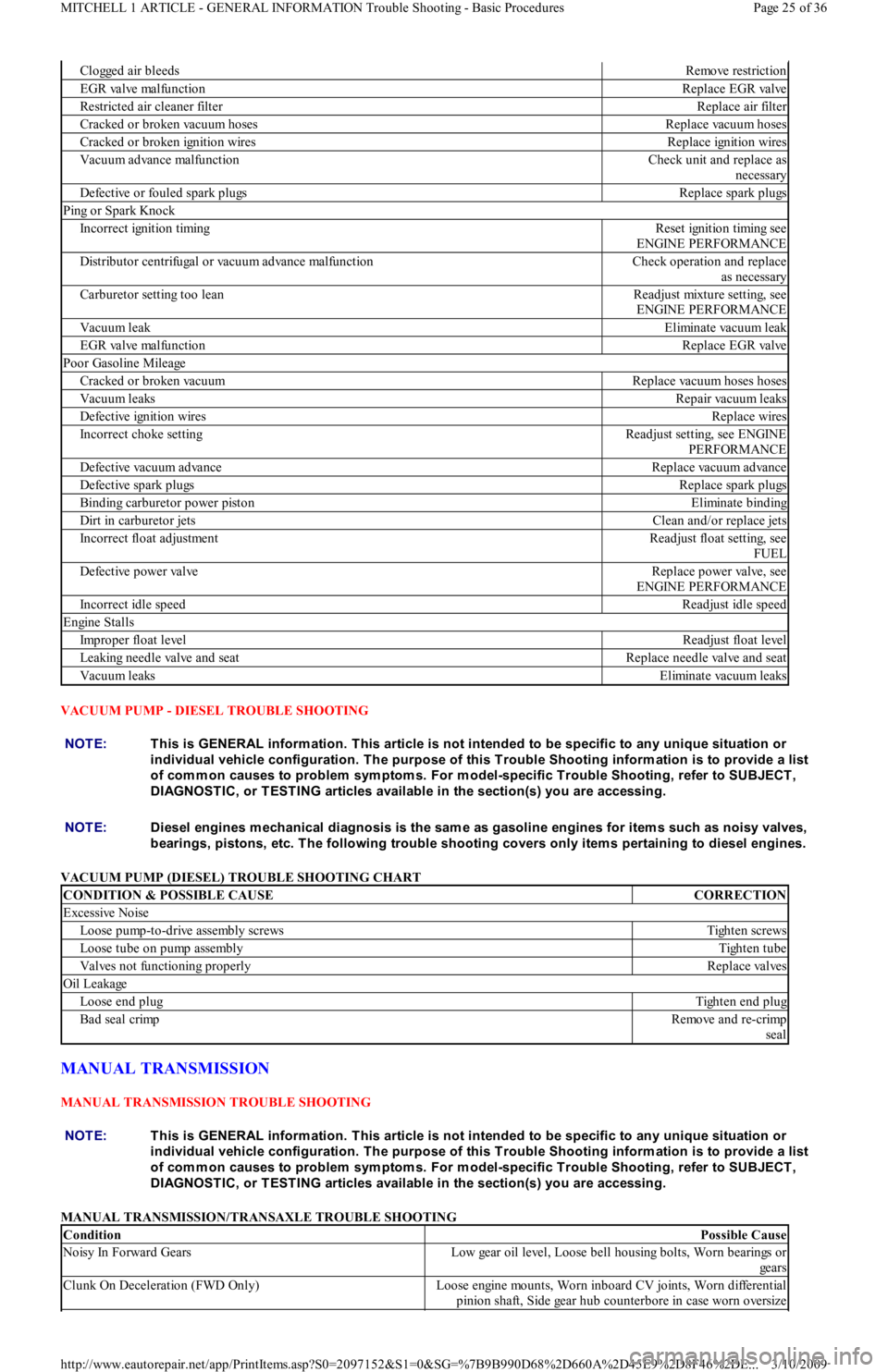
VACUUM PUMP - DIESEL TROUBLE SHOOTING
VACUUM PUMP (DIESEL) TROUBLE SHOOTING CHART
MANUAL TRANSMISSION
MANUAL TRANSMISSION TROUBLE SHOOTING
MANUAL TRANSMISSION/TRANSAXLE TROUBLE SHOOTING
Clogged air bleedsRemove restriction
EGR valve malfunctionReplace EGR valve
Restricted air cleaner filterReplace air filter
Cracked or broken vacuum hosesReplace vacuum hoses
Cracked or broken ignition wiresReplace ignition wires
Vacuum advance malfunctionCheck unit and replace as
necessary
Defective or fouled spark plugsReplace spark plugs
Ping or Spark Knock
Incorrect ignition timingReset ignition timing see
ENGINE PERFORMANCE
Distributor centrifugal or vacuum advance malfunctionCheck operation and replace
as necessary
Carburetor setting too leanReadjust mixture setting, see
ENGINE PERFORMANCE
Vacuum leakEliminate vacuum leak
EGR valve malfunctionReplace EGR valve
Poor Gasoline Mileage
Cracked or broken vacuumReplace vacuum hoses hoses
Vacuum leaksRepair vacuum leaks
Defective ignition wiresReplace wires
Incorrect choke settingReadjust setting, see ENGINE
PERFORMANCE
Defective vacuum advanceReplace vacuum advance
Defective spark plugsReplace spark plugs
Binding carburetor power pistonEliminate binding
Dirt in carburetor jetsClean and/or replace jets
Incorrect float adjustmentReadjust float setting, see
FUEL
Defective power valveReplace power valve, see
ENGINE PERFORMANCE
Incorrect idle speedReadjust idle speed
Engine Stalls
Improper float levelReadjust float level
Leaking needle valve and seatReplace needle valve and seat
Vacuum leaksEliminate vacuum leaks
NOTE:This is GENERAL inform ation. This article is not intended to be specific to any unique situation or
individual vehicle configuration. T he purpose of this T rouble Shooting inform ation is to provide a list
of com m on causes to problem sym ptom s. For m odel-specific T rouble Shooting, refer to SUBJECT ,
DIAGNOST IC, or T EST ING articles available in the section(s) you are accessing.
NOTE:Diesel engines m echanical diagnosis is the sam e as gasoline engines for item s such as noisy valves,
bearings, pistons, etc. T he following trouble shooting covers only item s pertaining to diesel engines.
CONDITION & POSSIBLE CAUSECORRECTION
Excessive Noise
Loose pump-to-drive assembly screwsTighten screws
Loose tube on pump assemblyTighten tube
Valves not functioning properlyReplace valves
Oil Leakage
Loose end plugTighten end plug
Bad seal crimpRemove and re-crimp
seal
NOTE:This is GENERAL inform ation. This article is not intended to be specific to any unique situation or
individual vehicle configuration. T he purpose of this T rouble Shooting inform ation is to provide a list
of com m on causes to problem sym ptom s. For m odel-specific T rouble Shooting, refer to SUBJECT ,
DIAGNOST IC, or T EST ING articles available in the section(s) you are accessing.
ConditionPossible Cause
Noisy In Forward GearsLow gear oil level, Loose bell housing bolts, Worn bearings or
gears
Clunk On Deceleration (FWD Only)Loose engine mounts, Worn inboard CV joints, Worn differential
pinion shaft, Side gear hub counterbore in case worn oversize
Page 25 of 36 MITCHELL 1 ARTICLE - GENERAL INFORMATION Trouble Shooting - Basic Procedures
3/10/2009 http://www.eautorepair.net/app/PrintItems.asp?S0=2097152&S1=0&SG=%7B9B990D68%2D660A%2D45E9%2D8F46%2DE
...
Page 239 of 454
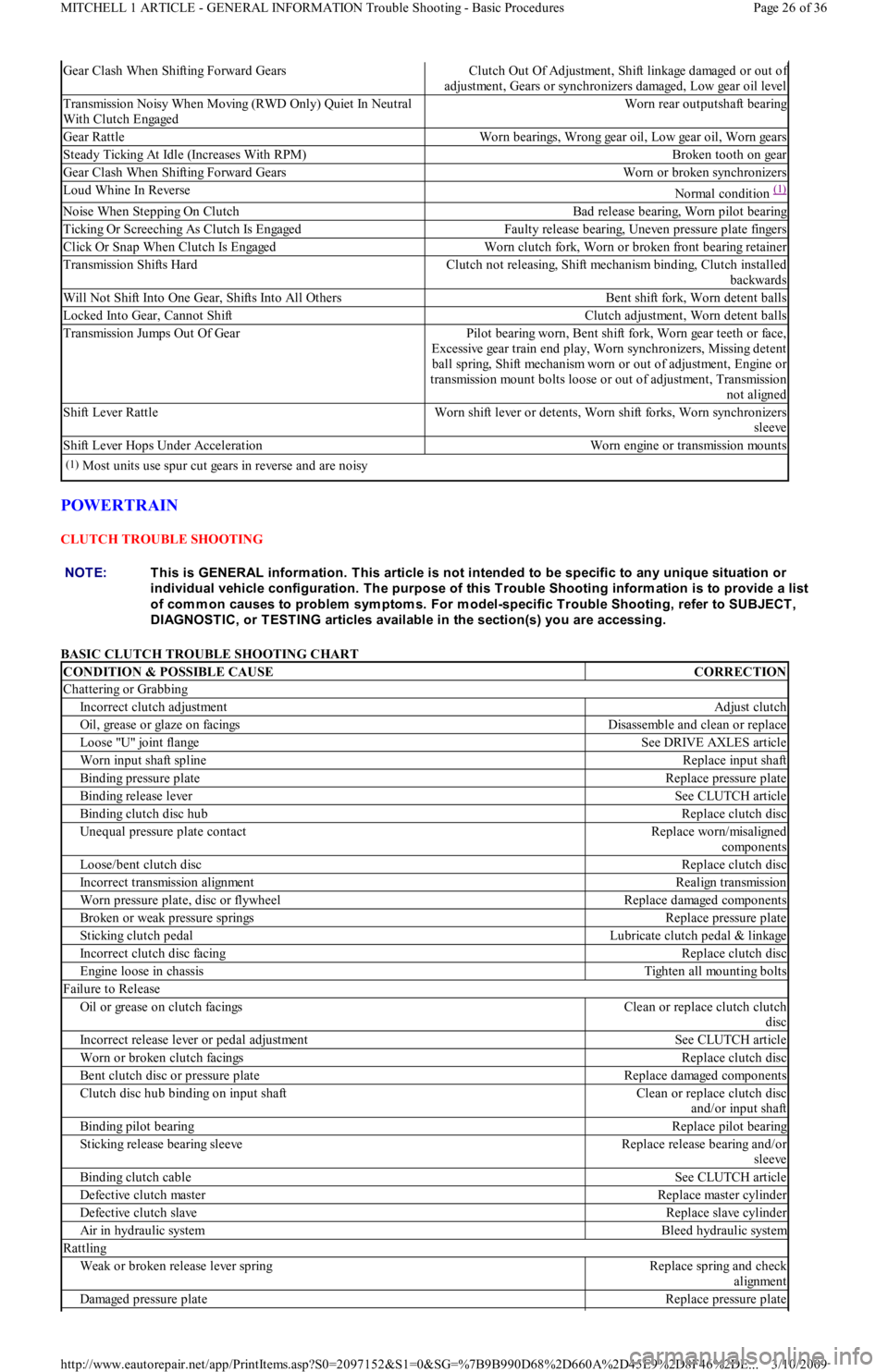
POWERTRAIN
CLUTCH TROUBLE SHOOTING
BASIC CLUTCH TROUBLE SHOOTING CHART
Gear Clash When Shifting Forward GearsClutch Out Of Adjustment, Shift linkage damaged or out of
adjustment, Gears or synchronizers damaged, Low gear oil level
Transmission Noisy When Moving (RWD Only) Quiet In Neutral
With Clutch EngagedWorn rear outputshaft bearing
Gear RattleWorn bearings, Wrong gear oil, Low gear oil, Worn gears
Steady Ticking At Idle (Increases With RPM)Broken tooth on gear
Gear Clash When Shifting Forward GearsWorn or broken synchronizers
Loud Whine In ReverseNormal condition (1)
Noise When Stepping On ClutchBad release bearing, Worn pilot bearing
Ticking Or Screeching As Clutch Is EngagedFaulty release bearing, Uneven pressure plate fingers
Click Or Snap When Clutch Is EngagedWorn clutch fork, Worn or broken front bearing retainer
Transmission Shifts HardClutch not releasing, Shift mechanism binding, Clutch installed
backwards
Will Not Shift Into One Gear, Shifts Into All OthersBent shift fork, Worn detent balls
Locked Into Gear, Cannot ShiftClutch adjustment, Worn detent balls
Transmission Jumps Out Of GearPilot bearing worn, Bent shift fork, Worn gear teeth or face,
Excessive gear train end play, Worn synchronizers, Missing detent
ball spring, Shift mechanism worn or out of adjustment, Engine or
transmission mount bolts loose or out of adjustment, Transmission
not aligned
Shift Lever RattleWorn shift lever or detents, Worn shift forks, Worn synchronizers
sleeve
Shift Lever Hops Under AccelerationWorn engine or transmission mounts
(1)Most units use spur cut gears in reverse and are noisy
NOTE:This is GENERAL inform ation. This article is not intended to be specific to any unique situation or
individual vehicle configuration. T he purpose of this T rouble Shooting inform ation is to provide a list
of com m on causes to problem sym ptom s. For m odel-specific T rouble Shooting, refer to SUBJECT ,
DIAGNOST IC, or T EST ING articles available in the section(s) you are accessing.
CONDITION & POSSIBLE CAUSECORRECTION
Chattering or Grabbing
Incorrect clutch adjustmentAdjust clutch
Oil, grease or glaze on facingsDisassemble and clean or replace
Lo o se "U" jo in t fl an geSee DRIVE AXLES article
Worn input shaft splineReplace input shaft
Binding pressure plateReplace pressure plate
Binding release leverSee CLUTCH article
Binding clutch disc hubReplace clutch disc
Unequal pressure plate contactReplace worn/misaligned
components
Loose/bent clutch discReplace clutch disc
Incorrect transmission alignmentRealign transmission
Worn pressure plate, disc or flywheelReplace damaged components
Broken or weak pressure springsReplace pressure plate
Sticking clutch pedalLubricate clutch pedal & linkage
Incorrect clutch disc facingReplace clutch disc
Engine loose in chassisTighten all mounting bolts
Failure to Release
Oil or grease on clutch facingsClean or replace clutch clutch
disc
Incorrect release lever or pedal adjustmentSee CLUTCH article
Worn or broken clutch facingsReplace clutch disc
Bent clutch disc or pressure plateReplace damaged components
Clutch disc hub binding on input shaftClean or replace clutch disc
and/or input shaft
Binding pilot bearingReplace pilot bearing
Sticking release bearing sleeveReplace release bearing and/or
sleeve
Binding clutch cableSee CLUTCH article
Defective clutch masterReplace master cylinder
Defective clutch slaveReplace slave cylinder
Air in hydraulic systemBleed hydraulic system
Rattling
Weak or broken release lever springReplace spring and check
alignment
Damaged pressure plateReplace pressure plate
Page 26 of 36 MITCHELL 1 ARTICLE - GENERAL INFORMATION Trouble Shooting - Basic Procedures
3/10/2009 http://www.eautorepair.net/app/PrintItems.asp?S0=2097152&S1=0&SG=%7B9B990D68%2D660A%2D45E9%2D8F46%2DE
...
Page 240 of 454
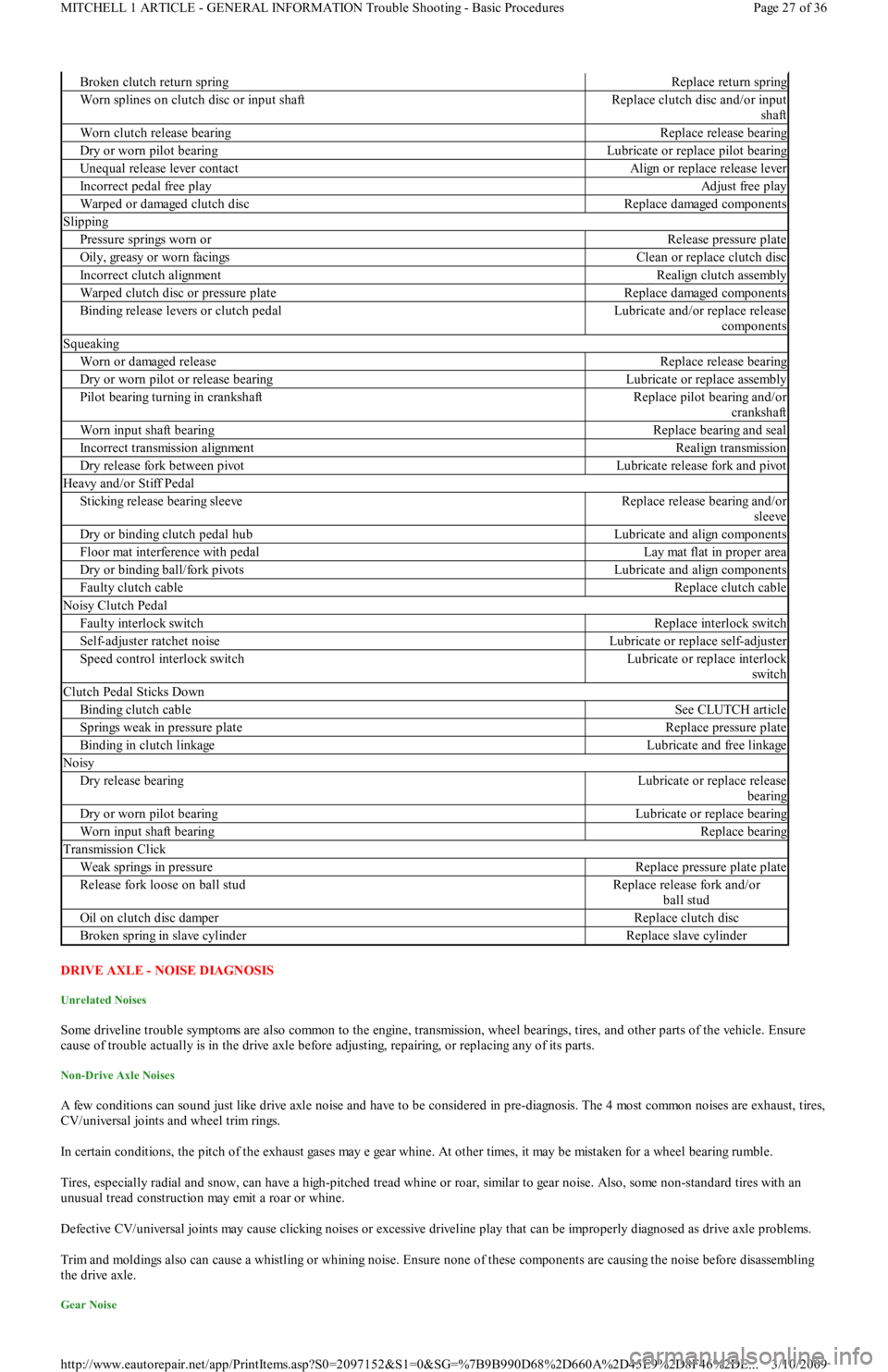
DRIVE AXLE - NOISE DIAGNOSIS
Unrelated Noises
Some driveline trouble symptoms are also common to the engine, transmission, wheel bearings, tires, and other parts of the vehicle. Ensure
cause of trouble actually is in the drive axle before adjusting, repairing, or replacing any of its parts.
Non-Drive Axle Noises
A few conditions can sound just like drive axle noise and have to be considered in pre-diagnosis. The 4 most common noises are exhaust, tires,
CV/universal joints and wheel trim rings.
In certain conditions, the pitch of the exhaust gases may e gear whine. At other times, it may be mistaken for a wheel bearing rumble.
Tires, especially radial and snow, can have a high-pitched tread whine or roar, similar to gear noise. Also, some non-standard tires with an
unusual tread construction may emit a roar or whine.
Defective CV/universal joints may cause clicking noises or excessive driveline play that can be improperly diagnosed as drive axle problems.
Trim and moldings also can cause a whistling or whining noise. Ensure none of these components are causing the noise before disassembling
the drive axle.
Gear Noise
Broken clutch return springReplace return spring
Worn splines on clutch disc or input shaftReplace clutch disc and/or input
shaft
Worn clutch release bearingReplace release bearing
Dry or worn pilot bearingLubricate or replace pilot bearing
Unequal release lever contactAlign or replace release lever
Incorrect pedal free playAdjust free play
Warped or damaged clutch discReplace damaged components
Slipping
Pressure springs worn orRelease pressure plate
Oily, greasy or worn facingsClean or replace clutch disc
Incorrect clutch alignmentRealign clutch assembly
Warped clutch disc or pressure plateReplace damaged components
Binding release levers or clutch pedalLubricate and/or replace release
components
Squeaking
Worn or damaged releaseReplace release bearing
Dry or worn pilot or release bearingLubricate or replace assembly
Pilot bearing turning in crankshaftReplace pilot bearing and/or
crankshaft
Worn input shaft bearingReplace bearing and seal
Incorrect transmission alignmentRealign transmission
Dry release fork between pivotLubricate release fork and pivot
Heavy and/or Stiff Pedal
Sticking release bearing sleeveReplace release bearing and/or
sleeve
Dry or binding clutch pedal hubLubricate and align components
Floor mat interference with pedalLay mat flat in proper area
Dry or binding ball/fork pivotsLubricate and align components
Faulty clutch cableReplace clutch cable
Noisy Clutch Pedal
Faulty interlock switchReplace interlock switch
Self-adjuster ratchet noiseLubricate or replace self-adjuster
Speed control interlock switchLubricate or replace interlock
switch
Clutch Pedal Sticks Down
Binding clutch cableSee CLUTCH article
Springs weak in pressure plateReplace pressure plate
Binding in clutch linkageLubricate and free linkage
Noisy
Dry release bearingLubricate or replace release
bearing
Dry or worn pilot bearingLubricate or replace bearing
Worn input shaft bearingReplace bearing
Transmission Click
Weak springs in pressureReplace pressure plate plate
Release fork loose on ball studReplace release fork and/or
ball stud
Oil on clutch disc damperReplace clutch disc
Broken spring in slave cylinderReplace slave cylinder
Page 27 of 36 MITCHELL 1 ARTICLE - GENERAL INFORMATION Trouble Shooting - Basic Procedures
3/10/2009 http://www.eautorepair.net/app/PrintItems.asp?S0=2097152&S1=0&SG=%7B9B990D68%2D660A%2D45E9%2D8F46%2DE
...
Page 241 of 454
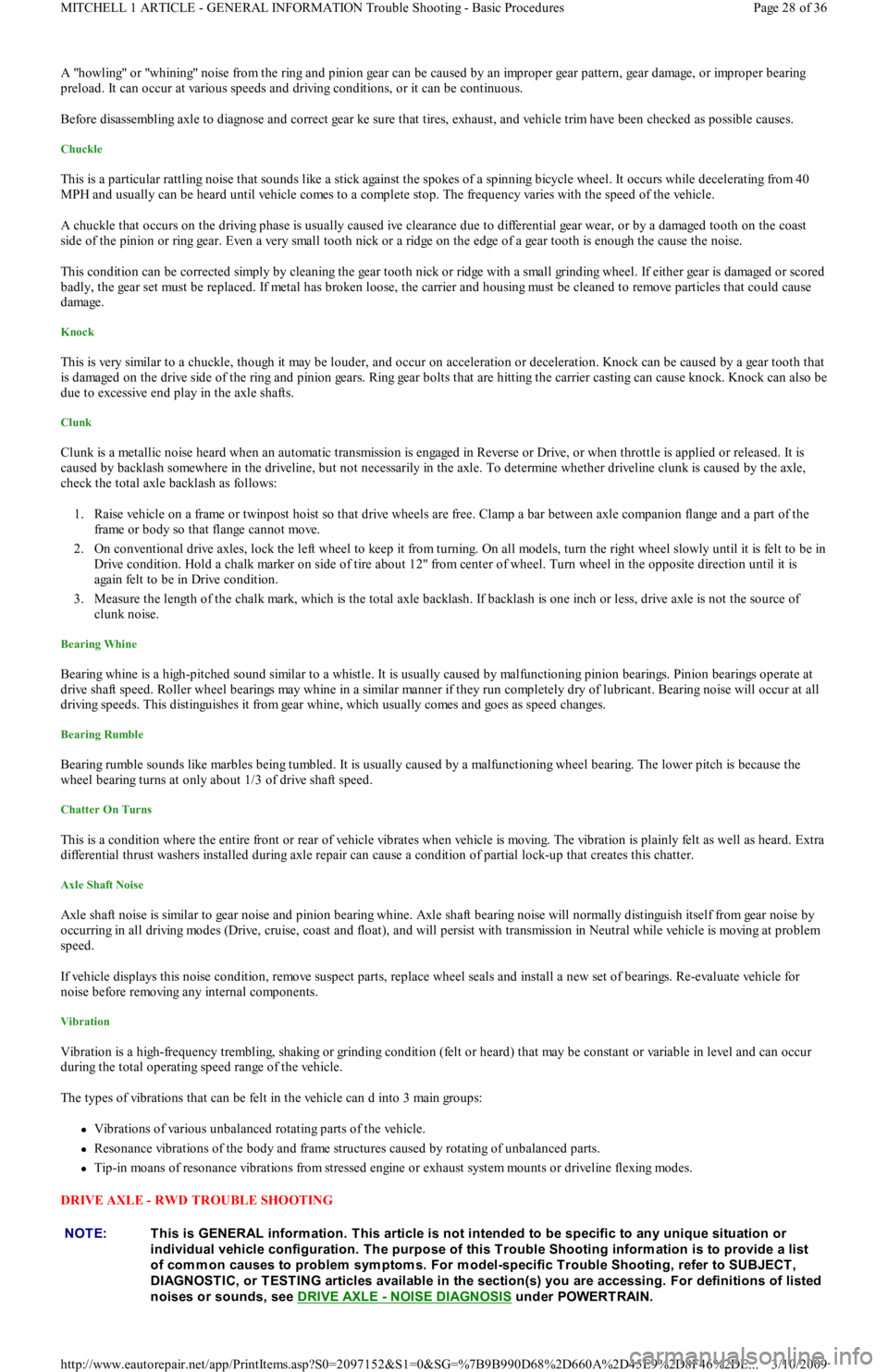
A "howling" or "whining" noise from the ring and pinion gear can be caused by an improper gear pattern, gear damage, or improper bearing
preload. It can occur at various speeds and driving conditions, or it can be continuous.
Before disassembling axle to diagnose and correct gear ke sure that tires, exhaust, and vehicle trim have been checked as possible causes.
Chuckle
This is a particular rattling noise that sounds like a stick against the spokes of a spinning bicycle wheel. It occurs while decelerating from 40
MPH and usually can be heard until vehicle comes to a complete stop. The frequency varies with the speed of the vehicle.
A chuckle that occurs on the driving phase is usually caused ive clearance due to differential gear wear, or by a damaged tooth on the coast
side of the pinion or ring gear. Even a very small tooth nick or a ridge on the edge of a gear tooth is enough the cause the noise.
This condition can be corrected simply by cleaning the gear tooth nick or ridge with a small grinding wheel. If either gear is damaged or scored
badly, the gear set must be replaced. If metal has broken loose, the carrier and housing must be cleaned to remove particles that could cause
damage.
Knock
This is very similar to a chuckle, though it may be louder, and occur on acceleration or deceleration. Knock can be caused by a gear tooth that
is damaged on the drive side of the ring and pinion gears. Ring gear bolts that are hitting the carrier casting can cause knock. Knock can also be
due to excessive end play in the axle shafts.
Clunk
Clunk is a metallic noise heard when an automatic transmission is engaged in Reverse or Drive, or when throttle is applied or released. It is
caused by backlash somewhere in the driveline, but not necessarily in the axle. To determine whether driveline clunk is caused by the axle,
check the total axle backlash as follows:
1. Raise vehicle on a frame or twinpost hoist so that drive wheels are free. Clamp a bar between axle companion flange and a part of the
frame or body so that flange cannot move.
2. On conventional drive axles, lock the left wheel to keep it from turning. On all models, turn the right wheel slowly until it is felt to be in
Drive condition. Hold a chalk marker on side of tire about 12" from center of wheel. Turn wheel in the opposite direction until it is
again felt to be in Drive condition.
3. Measure the length of the chalk mark, which is the total axle backlash. If backlash is one inch or less, drive axle is not the source of
clunk noise.
Bearing Whine
Bearing whine is a high-pitched sound similar to a whistle. It is usually caused by malfunctioning pinion bearings. Pinion bearings operate at
drive shaft speed. Roller wheel bearings may whine in a similar manner if they run completely dry of lubricant. Bearing noise will occur at all
driving speeds. This distinguishes it from gear whine, which usually comes and goes as speed changes.
Bearing Rumble
Bearing rumble sounds like marbles being tumbled. It is usually caused by a malfunctioning wheel bearing. The lower pitch is because the
wheel bearing turns at only about 1/3 of drive shaft speed.
Chatter On Turns
This is a condition where the entire front or rear of vehicle vibrates when vehicle is moving. The vibration is plainly felt as well as heard. Extra
differential thrust washers installed during axle repair can cause a condition of partial lock-up that creates this chatter.
Axle Shaft Noise
Axle shaft noise is similar to gear noise and pinion bearing whine. Axle shaft bearing noise will normally distinguish itself from gear noise by
occurring in all driving modes (Drive, cruise, coast and float), and will persist with transmission in Neutral while vehicle is moving at problem
speed.
If vehicle displays this noise condition, remove suspect parts, replace wheel seals and install a new set of bearings. Re-evaluate vehicle for
noise before removing any internal components.
Vibration
Vibration is a high-frequency trembling, shaking or grinding condition (felt or heard) that may be constant or variable in level and can occur
during the total operating speed range of the vehicle.
The types of vibrations that can be felt in the vehicle can d into 3 main groups:
Vibrations of various unbalanced rotating parts of the vehicle.
Resonance vibrations of the body and frame structures caused by rotating of unbalanced parts.
Tip-in moans of resonance vibrations from stressed engine or exhaust system mounts or driveline flexing modes.
DRIVE AXLE - RWD TROUBLE SHOOTING
NOTE:This is GENERAL inform ation. This article is not intended to be specific to any unique situation or
individual vehicle configuration. T he purpose of this T rouble Shooting inform ation is to provide a list
of com m on causes to problem sym ptom s. For m odel-specific T rouble Shooting, refer to SUBJECT ,
DIAGNOST IC, or T EST ING articles available in the section(s) you are accessing. For definitions of listed
noises or sounds, see DRIVE AXLE
- NOISE DIAGNOSIS under POWERTRAIN.
Page 28 of 36 MITCHELL 1 ARTICLE - GENERAL INFORMATION Trouble Shooting - Basic Procedures
3/10/2009 http://www.eautorepair.net/app/PrintItems.asp?S0=2097152&S1=0&SG=%7B9B990D68%2D660A%2D45E9%2D8F46%2DE
...
Page 252 of 454
Back To Article
GENERAL INFORMATION
Com puter Relearn Procedures
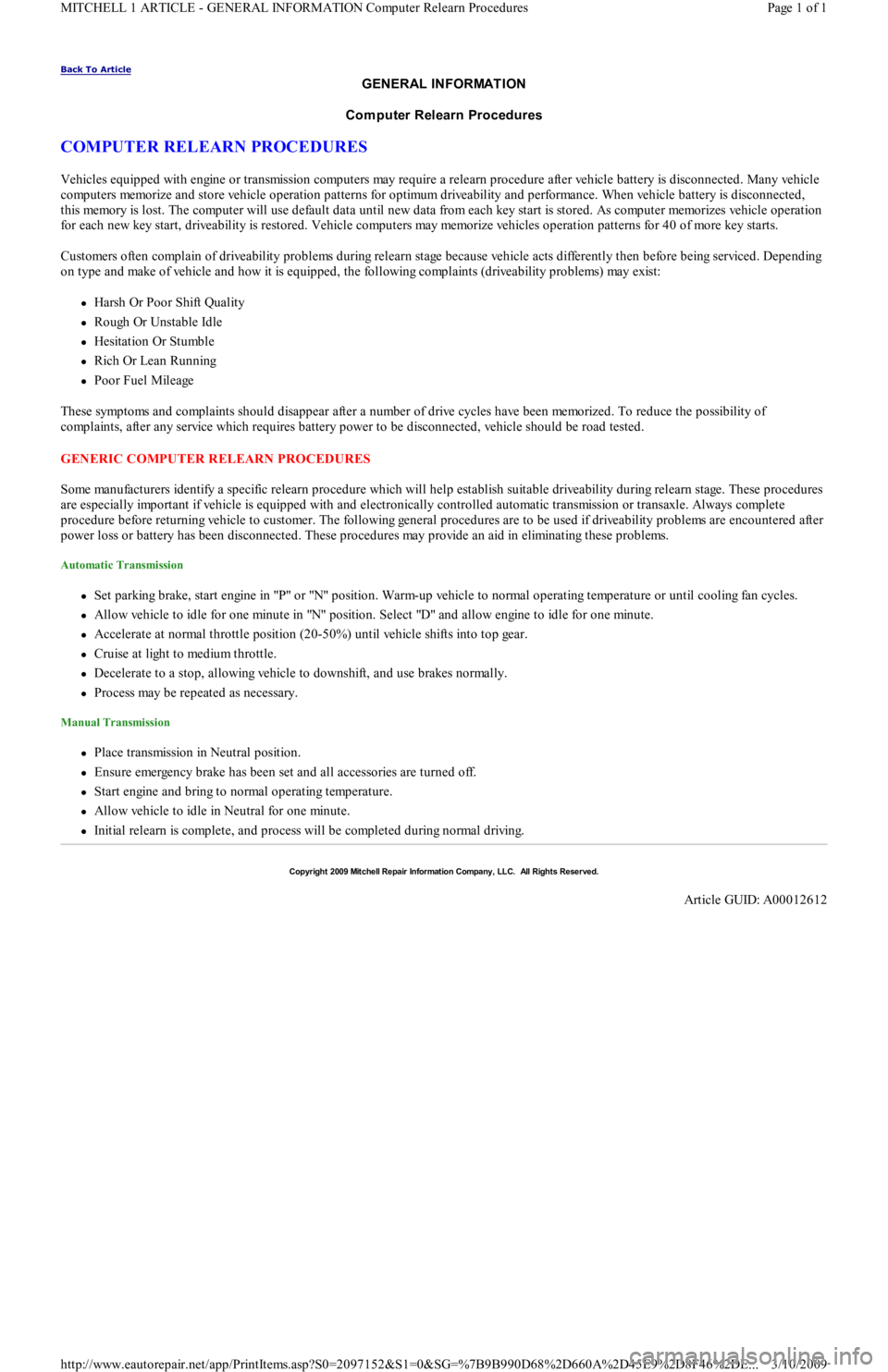
COMPUTER RELEARN PROCEDURES
Vehicles equipped with engine or transmission computers may require a relearn procedure after vehicle battery is disconnected. Many vehicle
computers memorize and store vehicle operation patterns for optimum driveability and performance. When vehicle battery is disconnected,
this memory is lost. The computer will use default data until new data from each key start is stored. As computer memorizes vehicle operation
for each new key start, driveability is restored. Vehicle computers may memorize vehicles operation patterns for 40 of more key starts.
Customers often complain of driveability problems during relearn stage because vehicle acts differently then before being serviced. Depending
on type and make of vehicle and how it is equipped, the following complaints (driveability problems) may exist:
Harsh Or Poor Shift Quality
Rough Or Unstable Idle
Hesitation Or Stumble
Rich Or Lean Running
Poor Fuel Mileage
These symptoms and complaints should disappear after a number of drive cycles have been memorized. To reduce the possibility of
complaints, after any service which requires battery power to be disconnected, vehicle should be road tested.
GENERIC COMPUTER RELEARN PROCEDURES
Some manufacturers identify a specific relearn procedure which will help establish suitable driveability during relearn stage. These procedures
are especially important if vehicle is equipped with and electronically controlled automatic transmission or transaxle. Always complete
procedure before returning vehicle to customer. The following general procedures are to be used if driveability problems are encountered after
power loss or battery has been disconnected. These procedures may provide an aid in eliminating these problems.
Automatic Transmission
Set parking brake, start engine in "P" or "N" position. Warm-up vehicle to normal operating temperature or until cooling fan cycles.
Allow vehicle to idle for one minute in "N" position. Select "D" and allow engine to idle for one minute.
Accelerate at normal throttle position (20-50%) until vehicle shifts into top gear.
Cruise at light to medium throttle.
Decelerate to a stop, allowing vehicle to downshift, and use brakes normally.
Process may be repeated as necessary.
Manual Transmission
Place transmission in Neutral position.
Ensure emergency brake has been set and all accessories are turned off.
Start engine and bring to normal operating temperature.
Allow vehicle to idle in Neutral for one minute.
Initial relearn is complete, and process will be completed during normal driving.
Copyr ight 2009 Mitchell Repair Information Company, LLC. All Rights Reserved.
Article GUID: A00012612
Page 1 of 1 MITCHELL 1 ARTICLE - GENERAL INFORMATION Computer Relearn Procedures
3/10/2009 http://www.eautorepair.net/app/PrintItems.asp?S0=2097152&S1=0&SG=%7B9B990D68%2D660A%2D45E9%2D8F46%2DE
...
Page 253 of 454
Back To Article
GENERAL INFORMATION
Drive Axle Noise Diagnosis
* PLEASE READ THIS FIRST *
UNRELATED NOISES
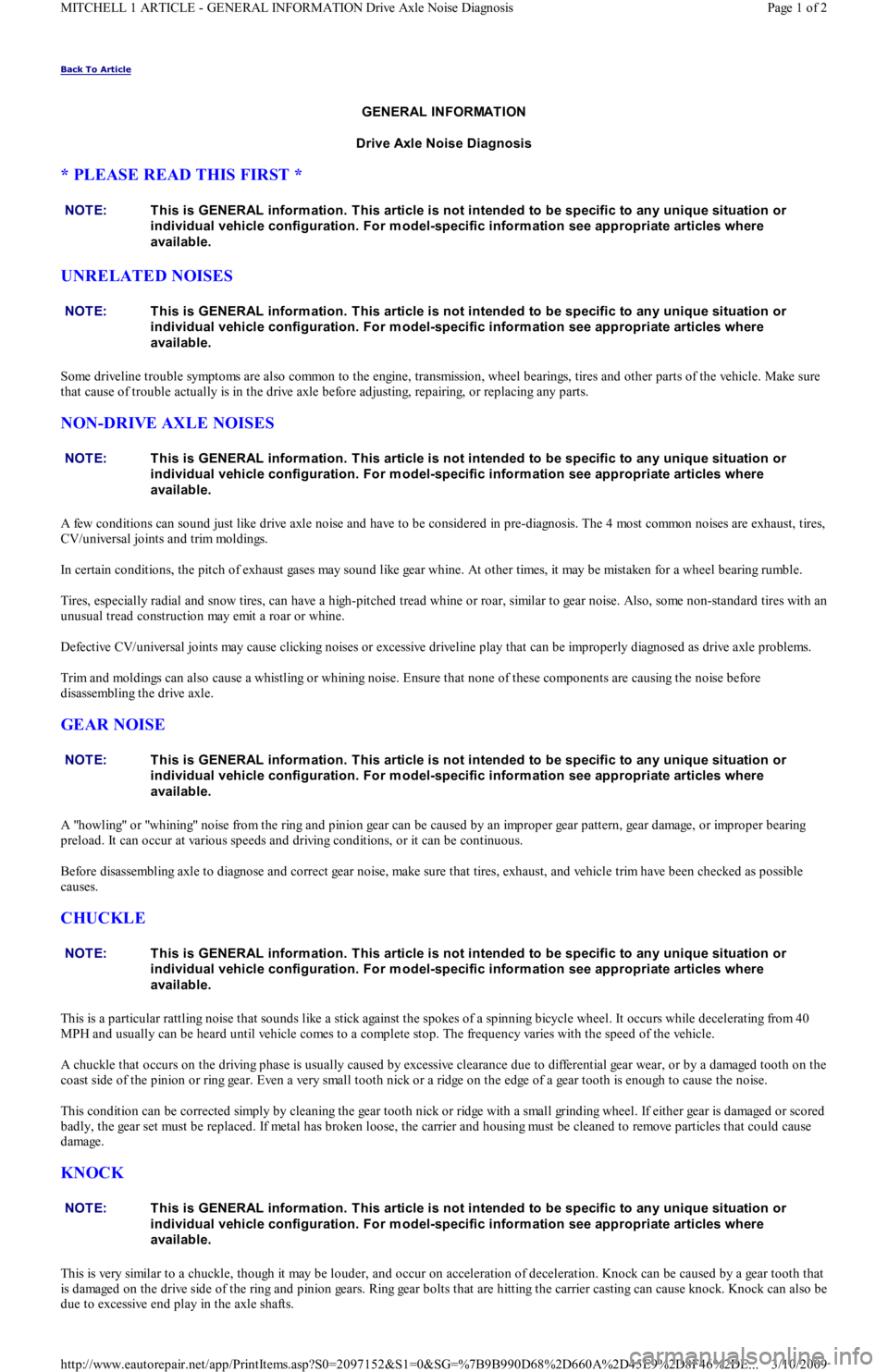
Some driveline trouble symptoms are also common to the engine, transmission, wheel bearings, tires and other parts of the vehicle. Make sure
that cause of trouble actually is in the drive axle before adjusting, repairing, or replacing any parts.
NON-DRIVE AXLE NOISES
A few conditions can sound just like drive axle noise and have to be considered in pre-diagnosis. The 4 most common noises are exhaust, tires,
CV/universal joints and trim moldings.
In certain conditions, the pitch of exhaust gases may sound like gear whine. At other times, it may be mistaken for a wheel bearing rumble.
Tires, especially radial and snow tires, can have a high-pitched tread whine or roar, similar to gear noise. Also, some non-standard tires with an
unusual tread construction may emit a roar or whine.
Defective CV/universal joints may cause clicking noises or excessive driveline play that can be improperly diagnosed as drive axle problems.
Trim and moldings can also cause a whistling or whining noise. Ensure that none of these components are causing the noise before
disassembling the drive axle.
GEAR NOISE
A "howling" or "whining" noise from the ring and pinion gear can be caused by an improper gear pattern, gear damage, or improper bearing
preload. It can occur at various speeds and driving conditions, or it can be continuous.
Before disassembling axle to diagnose and correct gear noise, make sure that tires, exhaust, and vehicle trim have been checked as possible
causes.
CHUCKLE
This is a particular rattling noise that sounds like a stick against the spokes of a spinning bicycle wheel. It occurs while decelerating from 40
MPH and usually can be heard until vehicle comes to a complete stop. The frequency varies with the speed of the vehicle.
A chuckle that occurs on the driving phase is usually caused by excessive clearance due to differential gear wear, or by a damaged tooth on the
coast side of the pinion or ring gear. Even a very small tooth nick or a ridge on the edge of a gear tooth is enough to cause the noise.
This condition can be corrected simply by cleaning the gear tooth nick or ridge with a small grinding wheel. If either gear is damaged or scored
badly, the gear set must be replaced. If metal has broken loose, the carrier and housing must be cleaned to remove particles that could cause
damage.
KNOCK
This is very similar to a chuckle, though it may be louder, and occur on acceleration of deceleration. Knock can be caused by a gear tooth that
is damaged on the drive side of the ring and pinion gears. Ring gear bolts that are hitting the carrier casting can cause knock. Knock can also be
due to excessive end play in the axle shafts. NOTE:This is GENERAL inform ation. This article is not intended to be specific to any unique situation or
individual vehicle configuration. For m odel-specific inform ation see appropriate articles where
available.
NOTE:This is GENERAL inform ation. This article is not intended to be specific to any unique situation or
individual vehicle configuration. For m odel-specific inform ation see appropriate articles where
available.
NOTE:This is GENERAL inform ation. This article is not intended to be specific to any unique situation or
individual vehicle configuration. For m odel-specific inform ation see appropriate articles where
available.
NOTE:This is GENERAL inform ation. This article is not intended to be specific to any unique situation or
individual vehicle configuration. For m odel-specific inform ation see appropriate articles where
available.
NOTE:This is GENERAL inform ation. This article is not intended to be specific to any unique situation or
individual vehicle configuration. For m odel-specific inform ation see appropriate articles where
available.
NOTE:This is GENERAL inform ation. This article is not intended to be specific to any unique situation or
individual vehicle configuration. For m odel-specific inform ation see appropriate articles where
available.
Page 1 of 2 MITCHELL 1 ARTICLE - GENERAL INFORMATION Drive Axle Noise Diagnosis
3/10/2009 http://www.eautorepair.net/app/PrintItems.asp?S0=2097152&S1=0&SG=%7B9B990D68%2D660A%2D45E9%2D8F46%2DE
...
Page 254 of 454
CLUNK
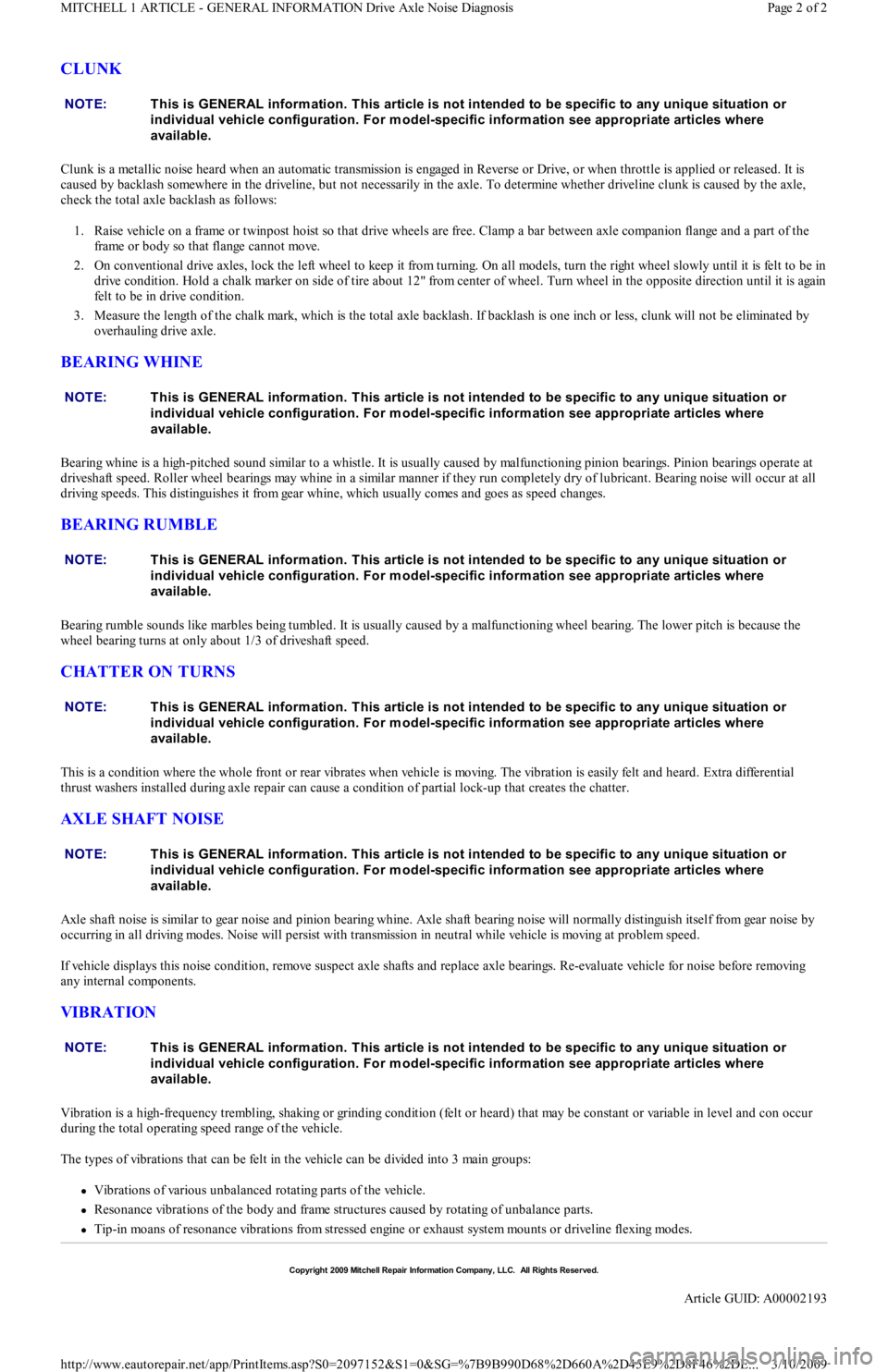
Clunk is a metallic noise heard when an automatic transmission is engaged in Reverse or Drive, or when throttle is applied or released. It is
caused by backlash somewhere in the driveline, but not necessarily in the axle. To determine whether driveline clunk is caused by the axle,
check the total axle backlash as follows:
1. Raise vehicle on a frame or twinpost hoist so that drive wheels are free. Clamp a bar between axle companion flange and a part of the
frame or body so that flange cannot move.
2. On conventional drive axles, lock the left wheel to keep it from turning. On all models, turn the right wheel slowly until it is felt to be in
drive condition. Hold a chalk marker on side of tire about 12" from center of wheel. Turn wheel in the opposite direction until it is again
felt to be in drive condition.
3. Measure the length of the chalk mark, which is the total axle backlash. If backlash is one inch or less, clunk will not be eliminated by
overhauling drive axle.
BEARING WHINE
Bearing whine is a high-pitched sound similar to a whistle. It is usually caused by malfunctioning pinion bearings. Pinion bearings operate at
driveshaft speed. Roller wheel bearings may whine in a similar manner if they run completely dry of lubricant. Bearing noise will occur at all
driving speeds. This distinguishes it from gear whine, which usually comes and goes as speed changes.
BEARING RUMBLE
Bearing rumble sounds like marbles being tumbled. It is usually caused by a malfunctioning wheel bearing. The lower pitch is because the
wheel bearing turns at only about 1/3 of driveshaft speed.
CHATTER ON TURNS
This is a condition where the whole front or rear vibrates when vehicle is moving. The vibration is easily felt and heard. Extra differential
thrust washers installed during axle repair can cause a condition of partial lock-up that creates the chatter.
AXLE SHAFT NOISE
Axle shaft noise is similar to gear noise and pinion bearing whine. Axle shaft bearing noise will normally distinguish itself from gear noise by
occurring in all driving modes. Noise will persist with transmission in neutral while vehicle is moving at problem speed.
If vehicle displays this noise condition, remove suspect axle shafts and replace axle bearings. Re-evaluate vehicle for noise before removing
any internal components.
VIB R AT ION
Vibration is a high-frequency trembling, shaking or grinding condition (felt or heard) that may be constant or variable in level and con occur
during the total operating speed range of the vehicle.
The types of vibrations that can be felt in the vehicle can be divided into 3 main groups:
Vibrations of various unbalanced rotating parts of the vehicle.
Resonance vibrations of the body and frame structures caused by rotating of unbalance parts.
Tip-in moans of resonance vibrations from stressed engine or exhaust system mounts or driveline flexing modes. NOTE:This is GENERAL inform ation. This article is not intended to be specific to any unique situation or
individual vehicle configuration. For m odel-specific inform ation see appropriate articles where
available.
NOTE:This is GENERAL inform ation. This article is not intended to be specific to any unique situation or
individual vehicle configuration. For m odel-specific inform ation see appropriate articles where
available.
NOTE:This is GENERAL inform ation. This article is not intended to be specific to any unique situation or
individual vehicle configuration. For m odel-specific inform ation see appropriate articles where
available.
NOTE:This is GENERAL inform ation. This article is not intended to be specific to any unique situation or
individual vehicle configuration. For m odel-specific inform ation see appropriate articles where
available.
NOTE:This is GENERAL inform ation. This article is not intended to be specific to any unique situation or
individual vehicle configuration. For m odel-specific inform ation see appropriate articles where
available.
NOTE:This is GENERAL inform ation. This article is not intended to be specific to any unique situation or
individual vehicle configuration. For m odel-specific inform ation see appropriate articles where
available.
Copyr ight 2009 Mitchell Repair Information Company, LLC. All Rights Reserved.
Article GUID: A00002193
Page 2 of 2 MITCHELL 1 ARTICLE - GENERAL INFORMATION Drive Axle Noise Diagnosis
3/10/2009 http://www.eautorepair.net/app/PrintItems.asp?S0=2097152&S1=0&SG=%7B9B990D68%2D660A%2D45E9%2D8F46%2DE
...
Page 257 of 454
Back To Article
GENERAL INFORMATION
Clutch Trouble Shooting
* PLEASE READ THIS FIRST *
ALL MODELS
CLUTCH TROUBLE SHOOTING NOTE:This is GENERAL inform ation. This article is not intended to be specific to any unique situation or
individual vehicle configuration. For m odel-specific inform ation see appropriate articles where
available.
NOTE:This is GENERAL inform ation. This article is not intended to be specific to any unique situation or
individual vehicle configuration. For m odel-specific inform ation see appropriate articles where
available.
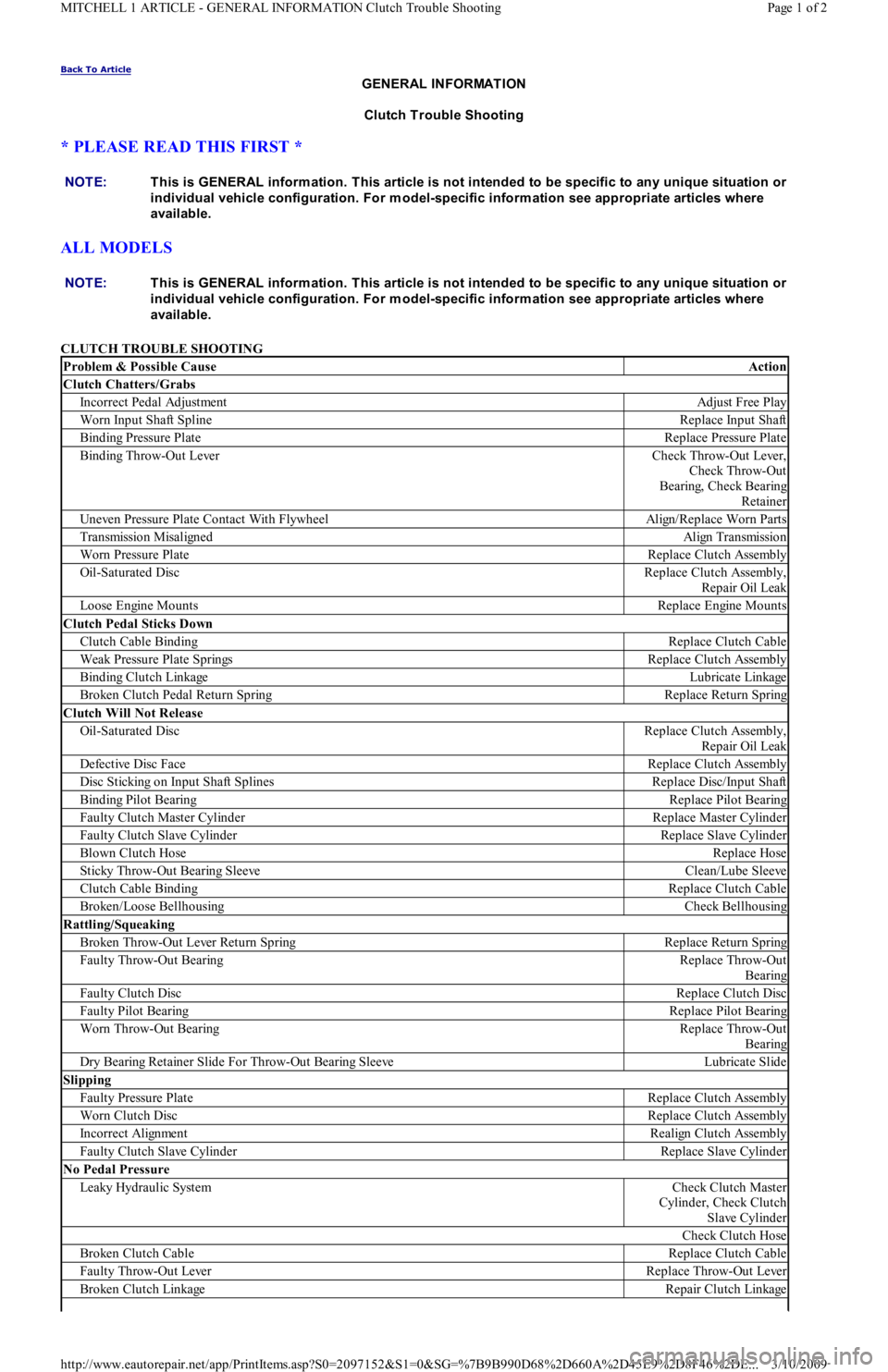
Problem & Possible CauseAction
Clutch Chatters/Grabs
Incorrect Pedal AdjustmentAdjust Free Play
Worn Input Shaft SplineReplace Input Shaft
Binding Pressure PlateReplace Pressure Plate
Binding Throw-Out LeverCheck Throw-Out Lever,
Check Throw-Out
Bearing, Check Bearing
Retainer
Uneven Pressure Plate Contact With FlywheelAlign/Replace Worn Parts
Transmission MisalignedAlign Transmission
Worn Pressure PlateReplace Clutch Assembly
Oil-Saturated DiscReplace Clutch Assembly,
Repair Oil Leak
Loose Engine MountsReplace Engine Mounts
Clutch Pedal Sticks Down
Clutch Cable BindingReplace Clutch Cable
Weak Pressure Plate SpringsReplace Clutch Assembly
Binding Clutch LinkageLubricate Linkage
Broken Clutch Pedal Return SpringReplace Return Spring
Clutch Will Not Release
Oil-Saturated DiscReplace Clutch Assembly,
Repair Oil Leak
Defective Disc FaceReplace Clutch Assembly
Disc Sticking on Input Shaft SplinesReplace Disc/Input Shaft
Binding Pilot BearingReplace Pilot Bearing
Faulty Clutch Master CylinderReplace Master Cylinder
Faulty Clutch Slave CylinderReplace Slave Cylinder
Blown Clutch HoseReplace Hose
Sticky Throw-Out Bearing SleeveClean/Lube Sleeve
Clutch Cable BindingReplace Clutch Cable
Broken/Loose BellhousingCheck Bellhousing
Rattling/Squeaking
Broken Throw-Out Lever Return SpringReplace Return Spring
Faulty Throw-Out BearingReplace Throw-Out
Bearing
Faulty Clutch DiscReplace Clutch Disc
Faulty Pilot BearingReplace Pilot Bearing
Worn Throw-Out BearingReplace Throw-Out
Bearing
Dry Bearing Retainer Slide For Throw-Out Bearing SleeveLubricate Slide
Slipping
Faulty Pressure PlateReplace Clutch Assembly
Worn Clutch DiscReplace Clutch Assembly
Incorrect AlignmentRealign Clutch Assembly
Faulty Clutch Slave CylinderReplace Slave Cylinder
No Pedal Pressure
Leaky Hydraulic SystemCheck Clutch Master
Cylinder, Check Clutch
Slave Cylinder
Check Clutch Hose
Broken Clutch CableReplace Clutch Cable
Faulty Throw-Out LeverReplace Throw-Out Lever
Broken Clutch LinkageRepair Clutch Linkage
Page 1 of 2 MITCHELL 1 ARTICLE - GENERAL INFORMATION Clutch Trouble Shooting
3/10/2009 http://www.eautorepair.net/app/PrintItems.asp?S0=2097152&S1=0&SG=%7B9B990D68%2D660A%2D45E9%2D8F46%2DE
...