Page 862 of 1640
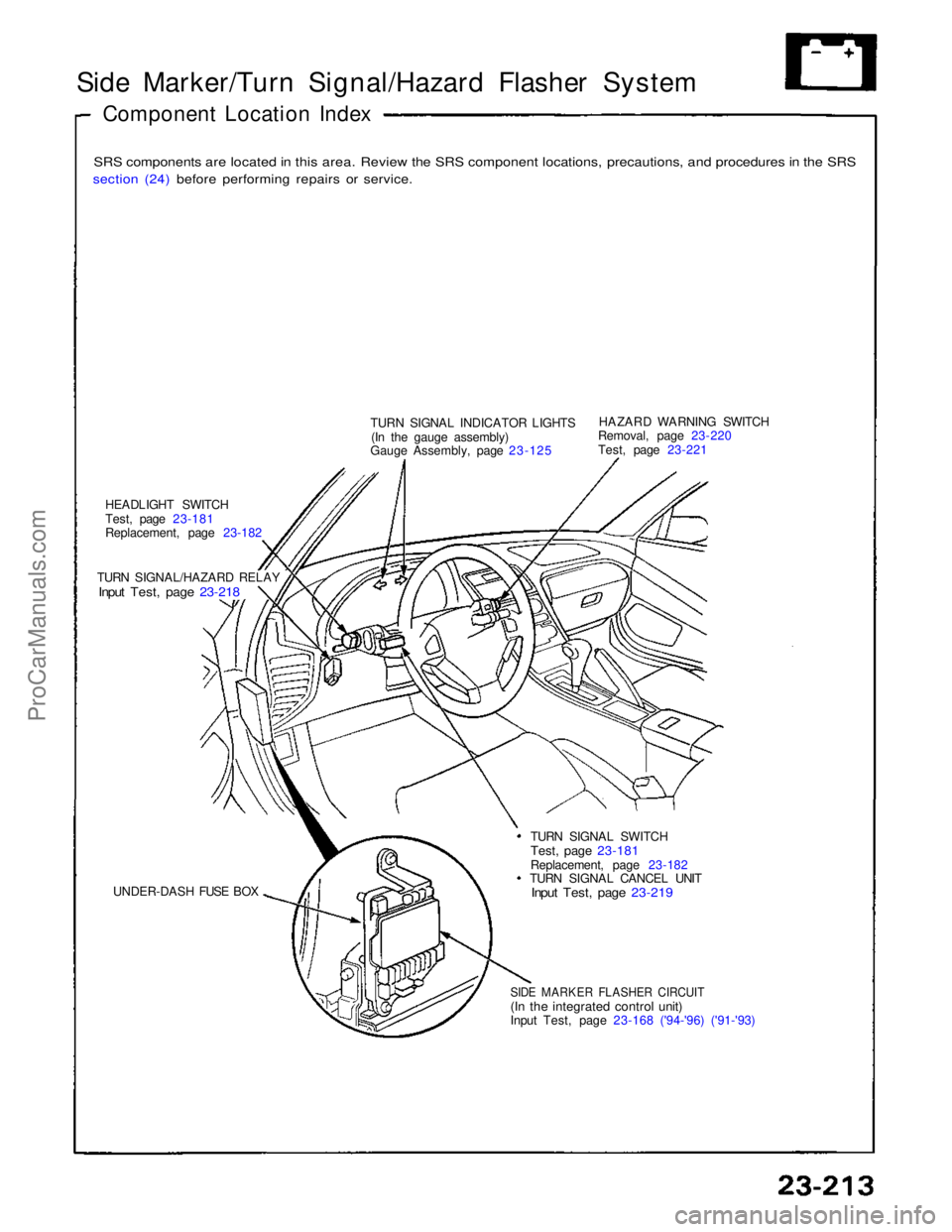
Side Marker/Turn Signal/Hazard Flasher System
Component Location Index
SRS components are located in this area. Review the SRS component locations, precautions, and procedures in the SRS
section (24) before performing repairs or service.
TURN SIGNAL INDICATOR LIGHTS(In the gauge assembly)
Gauge Assembly, page 23-125 HAZARD WARNING SWITCH
Removal, page 23-220
Test, page 23-221
HEADLIGHT SWITCH
Test, page 23-181
Replacement, page 23-182
TURN SIGNAL/HAZARD RELAY
Input Test, page 23-218
UNDER-DASH FUSE BOX TURN SIGNAL SWITCH
Test, page 23-181
Replacement, page 23-182 TURN SIGNAL CANCEL UNIT
Input Test, page 23-219
SIDE MARKER FLASHER CIRCUIT
(In the integrated control unit)
Input Test, page 23-168 ('94-'96) ('91-'93)ProCarManuals.com
Page 971 of 1640
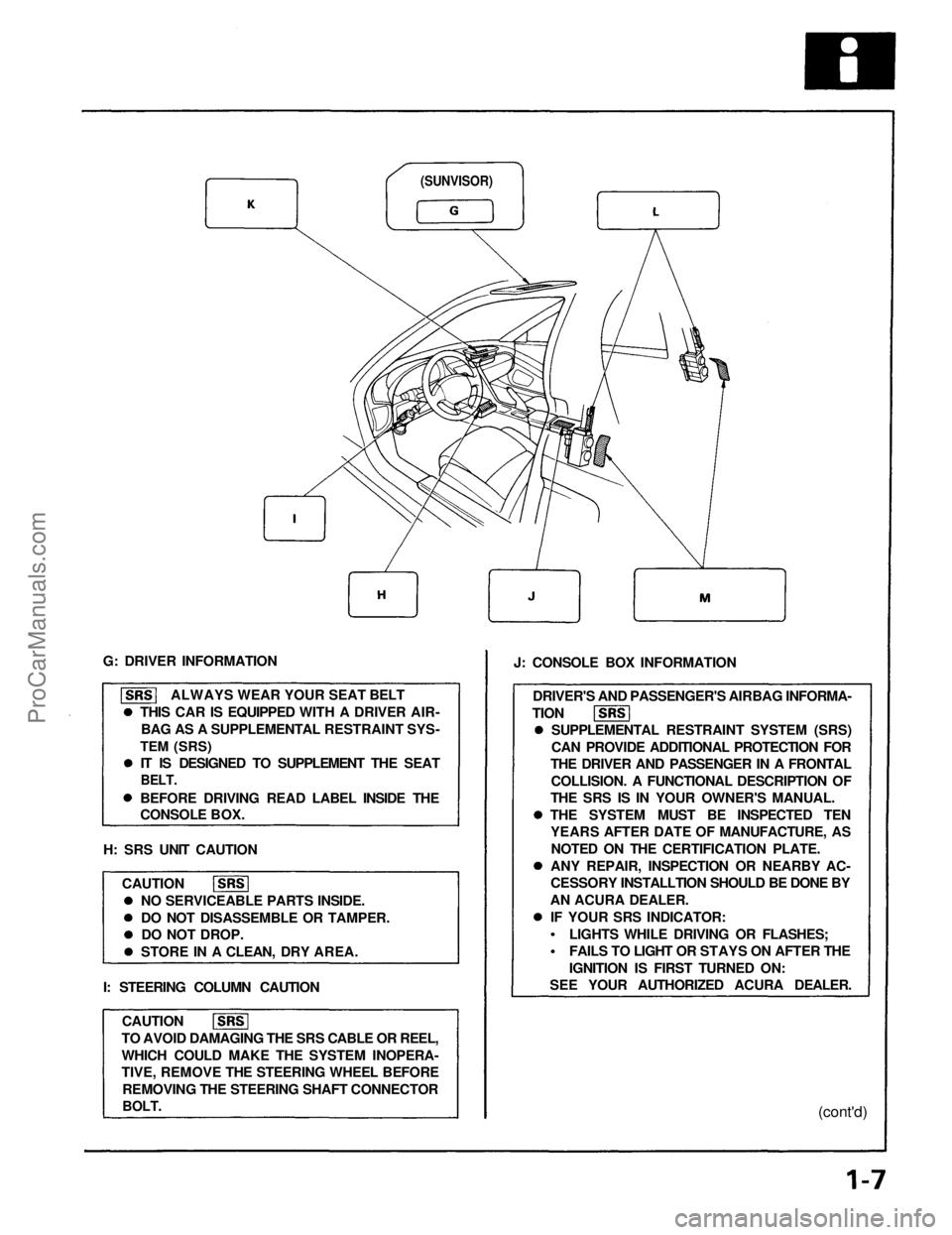
G: DRIVER INFORMATION
ALWAYS WEAR YOUR SEAT BELT
THIS CAR IS EQUIPPED WITH A DRIVER AIR- BAG AS A SUPPLEMENTAL RESTRAINT SYS-
TEM
(SRS) IT IS DESIGNED TO SUPPLEMENT THE SEAT
BELT.
BEFORE DRIVING READ LABEL INSIDE THE
CONSOLE BOX.
H: SRS UNIT CAUTION CAUTION NO SERVICEABLE PARTS INSIDE.
DO NOT DISASSEMBLE OR TAMPER.DO NOT DROP.
STORE IN A CLEAN, DRY AREA.
I: STEERING COLUMN CAUTION CAUTION
TO AVOID DAMAGING THE SRS CABLE OR REEL,
WHICH COULD MAKE THE SYSTEM INOPERA-
TIVE, REMOVE THE STEERING WHEEL BEFORE REMOVING THE STEERING SHAFT CONNECTOR
BOLT.
J: CONSOLE BOX INFORMATION
DRIVER'S AND PASSENGER'S AIRBAG INFORMA-
TION SUPPLEMENTAL RESTRAINT SYSTEM (SRS)
CAN PROVIDE ADDITIONAL PROTECTION FOR
THE DRIVER AND PASSENGER IN A FRONTAL
COLLISION. A FUNCTIONAL DESCRIPTION OF
THE SRS IS IN YOUR OWNER'S MANUAL.
THE SYSTEM MUST BE INSPECTED TEN YEARS AFTER DATE OF MANUFACTURE, AS
NOTED ON THE CERTIFICATION PLATE.
ANY REPAIR, INSPECTION OR NEARBY AC-
CESSORY INSTALLTION SHOULD BE DONE BY
AN ACURA DEALER. IF YOUR SRS INDICATOR:
(cont'd)
LIGHTS WHILE DRIVING OR FLASHES;
FAILS TO LIGHT OR STAYS ON AFTER THE
IGNITION IS FIRST TURNED ON:
SEE YOUR AUTHORIZED ACURA DEALER.
(SUNVISOR)ProCarManuals.com
Page 1024 of 1640
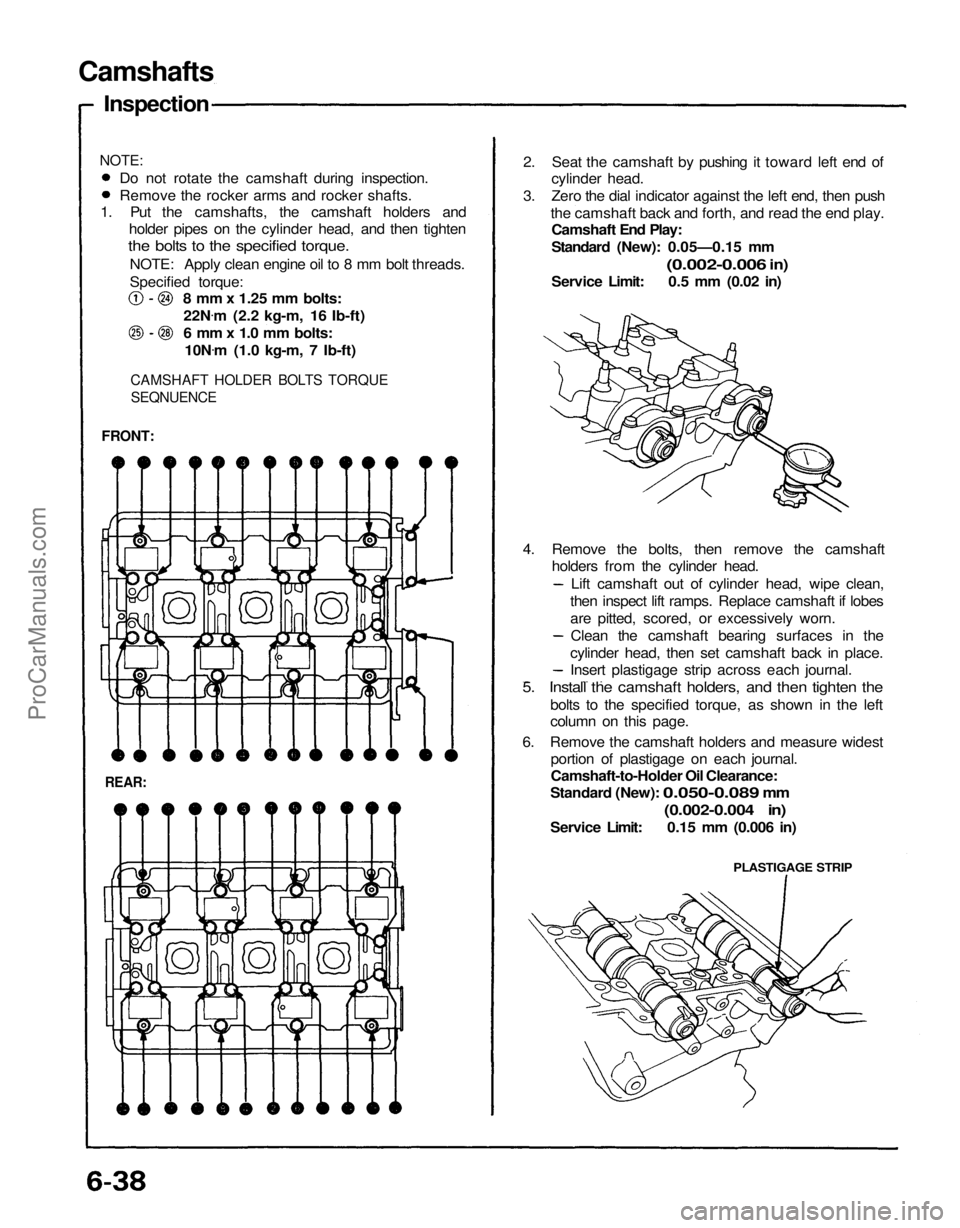
Camshafts
Inspection
1. Put the camshafts, the camshaft holders and holder pipes on the cylinder head, and then tighten
the bolts to the specified torque.
NOTE: Apply clean engine oil to 8 mm bolt threads.
Specified torque: 8 mm x 1.25 mm bolts:
22N .
m (2.2 kg-m, 16 Ib-ft)
6 mm x 1.0 mm bolts: 10N .
m (1.0 kg-m, 7 Ib-ft)
CAMSHAFT HOLDER BOLTS TORQUE
SEQNUENCE
FRONT:
REAR:
PLASTIGAGE STRIP
2. Seat the camshaft by pushing it toward left end of
cylinder head.
3. Zero the dial indicator against the left end, then push the camshaft back and forth, and read the end play.Camshaft End Play:
Standard (New): 0.05—0.15 mm
(0.002-0.006
in)
Service Limit: 0.5 mm (0.02 in)
4. Remove the bolts, then remove the camshaft holders from the cylinder head.
Do not rotate the camshaft during inspection.
Remove the rocker arms and rocker shafts.
NOTE:
Lift camshaft out of cylinder head, wipe clean,
then inspect lift ramps. Replace camshaft if lobes
are pitted, scored, or excessively worn. Clean the camshaft bearing surfaces in the
cylinder head, then set camshaft back in place.
Insert plastigage strip across each journal.
5. Install the camshaft holders, and then tighten the
bolts to the specified torque, as shown in the left
column on this page.
6. Remove the camshaft holders and measure widest portion of plastigage on each journal.
Camshaft-to-Holder Oil Clearance:
Standard (New):
0.050-0.089
mm
(0.002-0.004 in)
Service Limit: 0.15 mm (0.006 in)ProCarManuals.com
Page 1076 of 1640
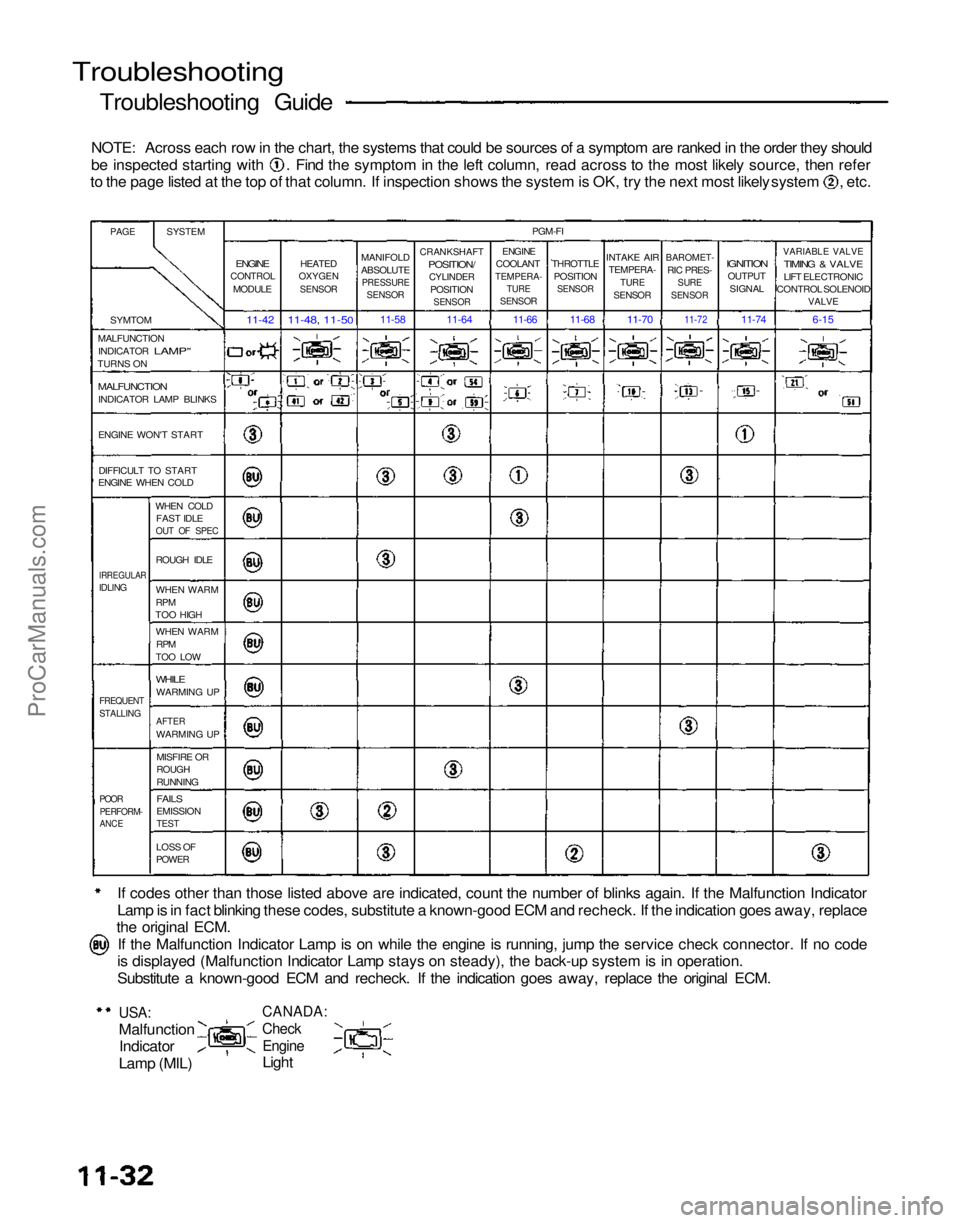
Troubleshooting
Troubleshooting Guide
NOTE: Across each row in the chart, the systems that could be sources of a symptom are ranked in the order they should be inspected starting with . Find the symptom in the left column, read across to the most likely source, then refer
to the page listed at the top of that column. If inspection shows the system is OK, try the next most likely system , etc.
If codes other than those listed above are indicated, count the number of blinks again. If the Malfunction Indicator
Lamp is in fact blinking these codes, substitute a known-good ECM and recheck. If the indication goes away, replace
the original ECM.
If the Malfunction Indicator Lamp is on while the engine is running, jump the service check connector. If no code
is displayed (Malfunction Indicator Lamp stays on steady), the back-up system is in operation.
Substitute a known-good ECM and recheck. If the indication goes away, replace the original ECM.
USA:
Malfunction
Indicator
Lamp (MIL)
CANADA:
Check
Engine
Light
PAGE
SYSTEM
SYMTOM
MALFUNCTION INDICATOR
LAMP"
TURNS ON
MALFUNCTION
INDICATOR LAMP BLINKS
ENGINE WON'T START
DIFFICULT TO START
ENGINE WHEN COLD
WHEN COLDFAST IDLE
OUT OF SPEC
IRREGULAR
IDLING
ROUGH IDLE
WHEN WARM
RPM
TOO HIGH
WHEN WARM
RPM
TOO LOW
WHILE
WARMING UP
FREQUENT
STALLING
AFTER
WARMING UP
MISFIRE OR
ROUGH
RUNNING
POOR
PERFORM-
ANCE
FAILS
EMISSION
TEST
LOSS OF
POWER
ENGINE
CONTROL
MODULE
11-42
HEATED
OXYGEN
SENSOR
11-48, 11-50
MANIFOLD
ABSOLUTE
PRESSURE
SENSOR
11-58
CRANKSHAFT
POSITION/
CYLINDER
POSITION
SENSOR
11-64
PGM-FI
ENGINE
COOLANT
TEMPERA-
TURE
SENSOR
THROTTLE
POSITION
SENSOR
INTAKE AIR
TEMPERA-
TURE
SENSOR
BAROMET-
RIC PRES-
SURE
SENSOR
IGNITION
OUTPUT
SIGNAL
VARIABLE VALVE
TIMING & VALVE
LIFT ELECTRONIC
CONTROL SOLENOID
VALVE
6-15
11-74
11-72
11-70
11-68
11-66
ProCarManuals.com
Page 1078 of 1640
Troubleshooting
Self-diagnostic Procedures
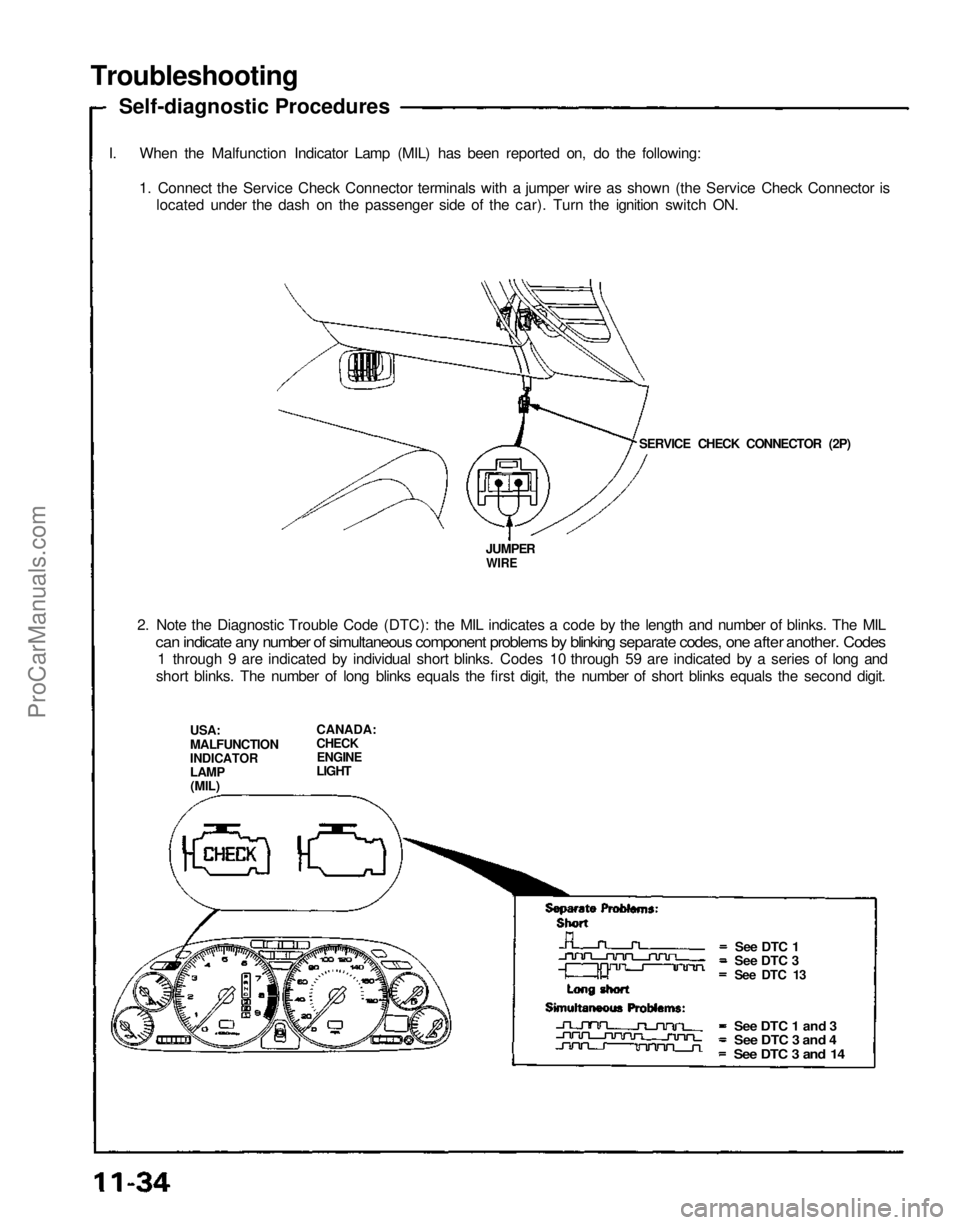
I. When the Malfunction Indicator Lamp (MIL) has been reported on, do the following: 1. Connect the Service Check Connector terminals with a jumper wire as shown (the Service Check Connector islocated under the dash on the passenger side of the car). Turn the ignition switch ON.
SERVICE CHECK CONNECTOR (2P)
JUMPER
WIRE
2. Note the Diagnostic Trouble Code (DTC): the MIL indicates a code by the length and number of blinks. The MIL
can indicate any number of simultaneous component problems by blinking separate codes, one after another. Codes
1 through 9 are indicated by individual short blinks. Codes 10 through 59 are indicated by a series of long and
short blinks. The number of long blinks equals the first digit, the number of short blinks equals the second digit.
USA:
MALFUNCTION
INDICATOR
LAMP
(MIL) CANADA:
CHECK
ENGINE
LIGHT
See DTC 1
See DTC 3
See DTC 13
See DTC 1 and 3
See DTC 3 and 4
See DTC 3 and 14ProCarManuals.com
Page 1080 of 1640
Troubleshooting
Self-diagnostic Procedures (cont'd)
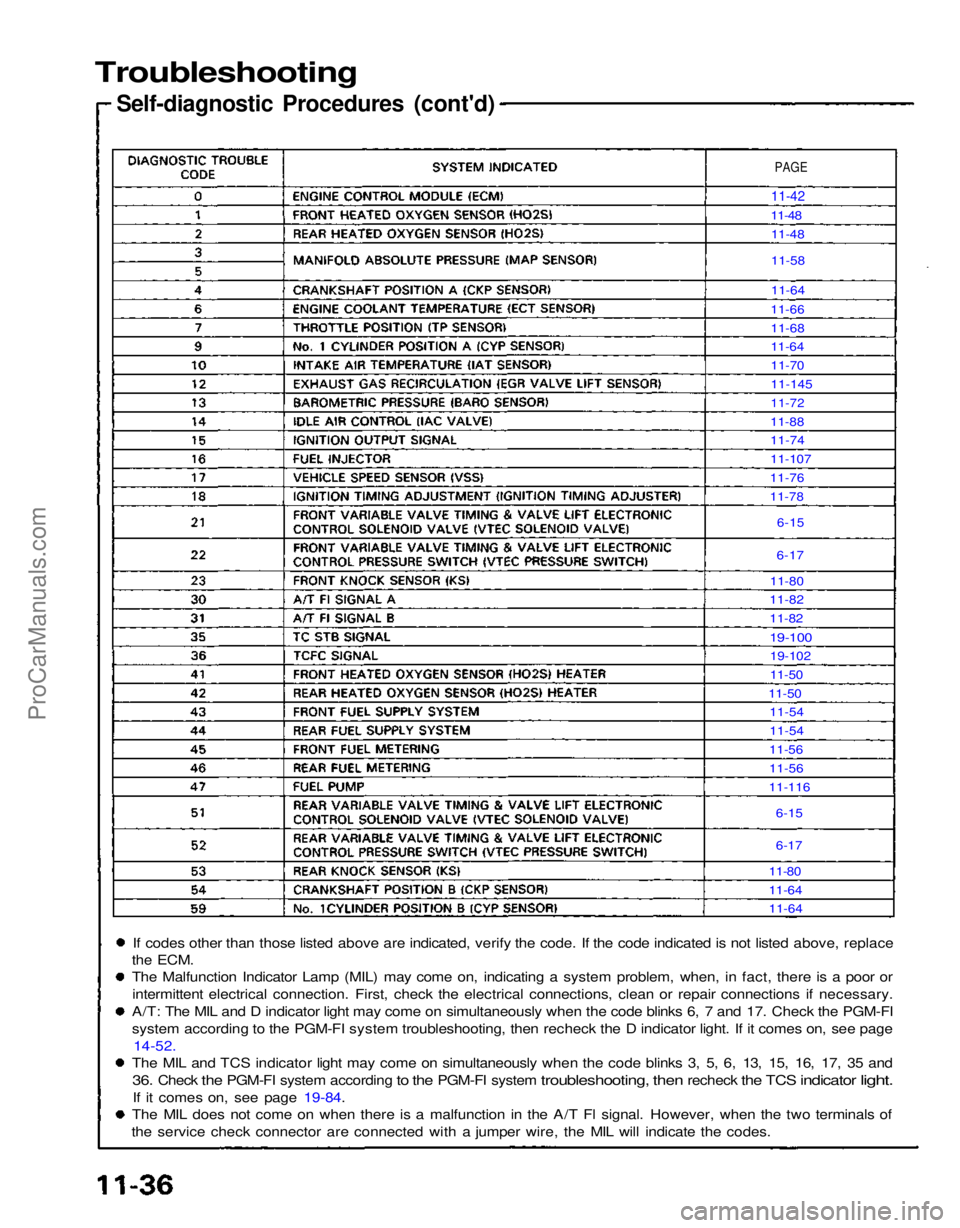
If codes other than those listed above are indicated, verify the code. If the code indicated is not listed above, replace
the
ECM.
The Malfunction Indicator Lamp (MIL) may come on, indicating a system problem, when, in fact, there is a poor or
intermittent electrical connection. First, check the electrical connections, clean or repair connections if necessary.
A/T: The MIL and D indicator light may come on simultaneously when the code blinks 6, 7 and 17. Check the PGM-FI
system according to the PGM-FI system troubleshooting, then recheck the D indicator light. If it comes on, see page 14-52.
The MIL and TCS indicator light may come on simultaneously when the code blinks 3, 5, 6, 13, 15, 16, 17, 35 and
36.
Check
the
PGM-FI system according
to the
PGM-FI system
troubleshooting,
then
recheck
the TCS
indicator
light.
If it comes on, see page 19-84.
The MIL does not come on when there is a malfunction in the A/T Fl signal. However, when the two terminals of
the service check connector are connected with a jumper wire, the MIL will indicate the codes.
PAGE
11-42
11-48 11-48
11-58
11-64
11-66
11-68
11-64
11-70
11-145
11-72
11-88
11-74
11-107
11-76
11-78
6-15
6-17
11-80
11-82
11-82
19-100
19-102
11-50
11-50 11-54
11-54
11-56
11-56
11-116
6-15
6-17
11-80
11-64
11-64ProCarManuals.com
Page 1088 of 1640
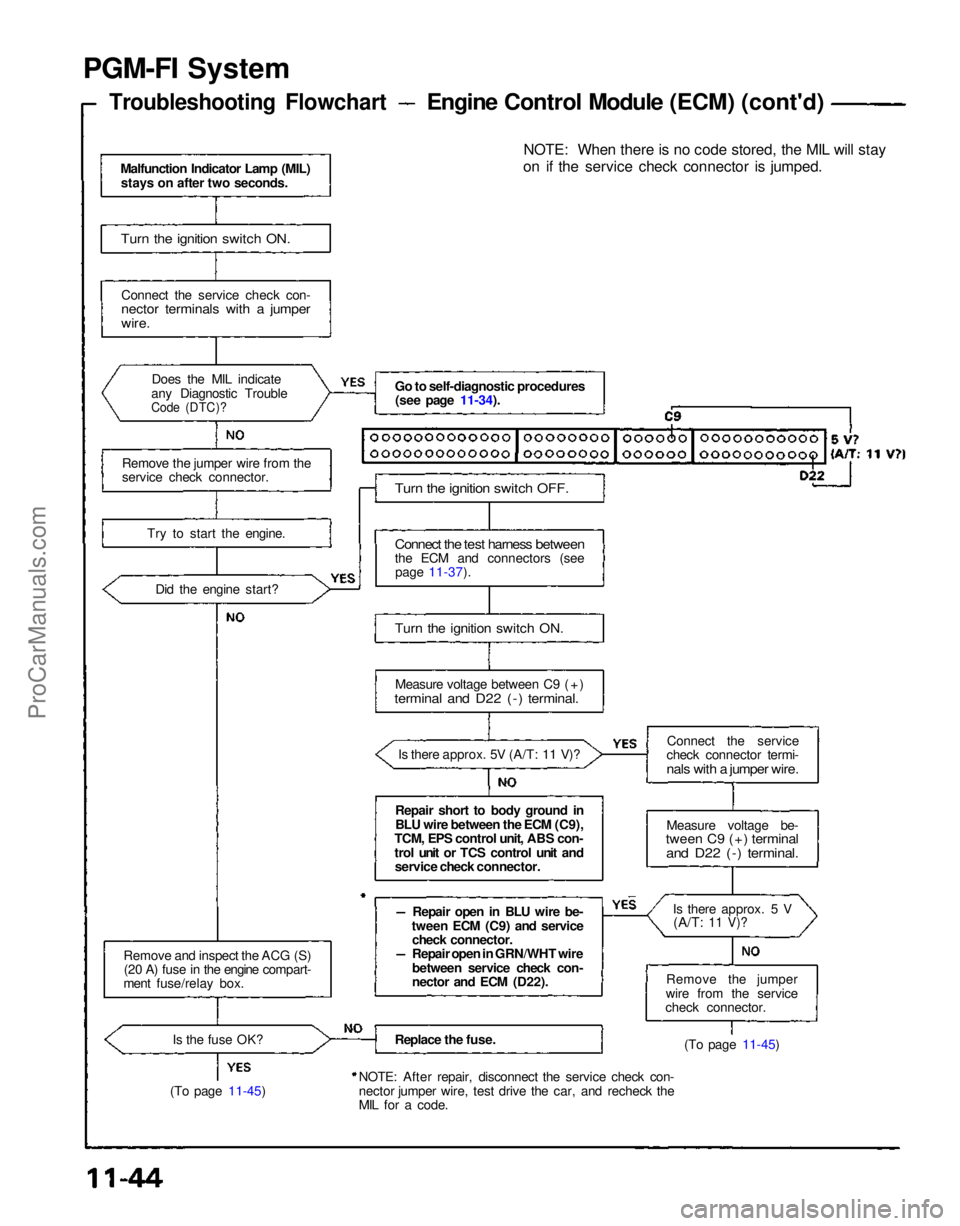
PGM-FI System
Troubleshooting Flowchart
Engine Control Module (ECM) (cont'd)
Malfunction Indicator Lamp (MIL) stays on after two seconds.
Turn the ignition switch ON.
Connect the service check con-
nector terminals with a jumper
wire.
Does the MIL indicate
any Diagnostic Trouble
Code (DTC)?
Remove the jumper wire from the
service check connector.
Try to start the engine.Did the engine start?
Remove and inspect the ACG (S) (20 A) fuse in the engine compart-
ment fuse/relay box.
Is the fuse OK?
(To page 11-45) Go to self-diagnostic procedures
(see page 11-34).
Turn the ignition switch OFF.
Connect the test harness between
the ECM and connectors (see page 11-37).
Turn the ignition switch ON.
Measure voltage between C9 (+)
terminal and D22 (-) terminal.
Is there approx. 5V (A/T: 11 V)?
Repair short to body ground in
BLU wire between the ECM (C9),
TCM, EPS control unit, ABS con-
trol unit or TCS control unit and service check connector.
Repair open in BLU wire be-
tween ECM (C9) and service check connector.
Repair open in GRN/WHT wire
between service check con-
nector and ECM (D22).
Replace the fuse.
NOTE: After repair, disconnect the service check con-
nector jumper wire, test drive the car, and recheck the
MIL for a code. NOTE: When there is no code stored, the MIL will stay
on if the service check connector is jumped.
Connect the service
check connector termi-
nals with a jumper wire.
Measure voltage be-
tween C9 (+) terminal
and D22 (-) terminal.
Is there approx. 5 V(A/T:
11 V)?
Remove the jumper
wire from the service
check connector.
(To page 11-45)ProCarManuals.com
Page 1178 of 1640
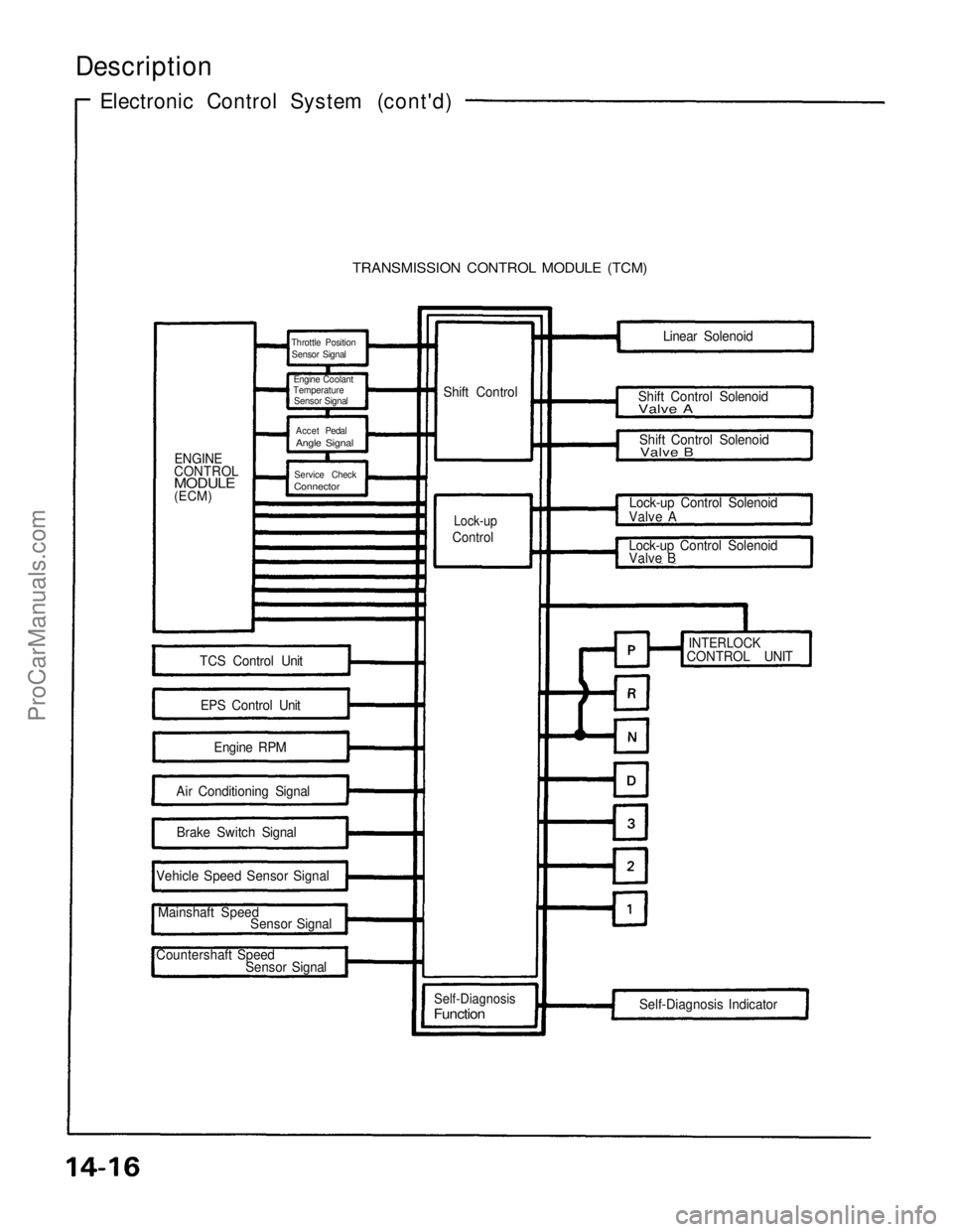
Description
Electronic Control System (cont'd)
TRANSMISSION CONTROL MODULE (TCM)
ENGINE
CONTROL
MODULE
(ECM) Shift Control
Lock-up
Control
TCS Control Unit
EPS Control Unit Engine RPM
Air Conditioning Signal Brake Switch Signal
Vehicle Speed Sensor Signal
Mainshaft Speed Sensor Signal
Countershaft Speed Sensor Signal
Self-Diagnosis
Function
Self-Diagnosis Indicator
INTERLOCK
CONTROL UNIT
Lock-up Control Solenoid
Valve B
Lock-up Control Solenoid
Valve A Shift Control Solenoid
Valve B
Shift Control Solenoid
Valve A
Linear Solenoid
Throttle Position
Sensor Signal
Engine Coolant
Temperature
Sensor Signal
Accet Pedal
Angle Signal
Service Check
Connector
ProCarManuals.com