1990 VOLKSWAGEN TRANSPORTER check engine light
[x] Cancel search: check engine lightPage 59 of 165
Downloaded from www.Manualslib.com manuals search engine
CONTROLS AND EQUIPMENT
Engine
running
Heater
on -
Turn knob clockwise to position 2. Switch knob control light will come on. Adjust
temperature by turning knob between positions 2 and 3.
Heater
off -
Turn switch knob counter-clockwise to position 0. Switch knob control light will go
out.
Notes
• Every time the heater is switched off,
the warm air and combustion air blowers continue running briefly to cool the heater
down quicker.
• To avoid draining the battery, do not
run the heater repeatedly when the engine
is
not running.
• When the heater is running on the
clockwork time switch, it must be switched
off by hand before attempting to start the
engine at low temperatures so
that
the
full
battery capacity is available to
turn
the
engine.
WARNING
Never
start
the
heater
or let the
engine
or the
heater
run in an enclosed, un-
ventilated
area.
Exhaust
fumes
from
the
engine
or the
heater
contain
carbon monoxide,
which
is colorless and
odorless. Carbon monoxide,
however
is a
very
harmful
gas, and may be
fatal
if inhaled.
Due to the
risk
of
fire
the
heater
must
not be used
when
vehicle
is
parked
on
dry grass, brush or leaves.
Maintenance
During the winter and when driving over
very poor roads, mud or snow may tend to
accumulate
in the exhaust and combus
tion air intake pipes. Have these pipes
checked
for blockage from time to time so
that
the heater can continue to work.
58
www.westfaliaT3.info - a useful website for owners and enthusiasts of VW Westfalia T25 / T3 Campervans
Page 71 of 165
Downloaded from www.Manualslib.com manuals search engine
VEHICLE OPERATION
OPERATE
YOUR VEHICLE SAFELY
A
lot has gone
into
the manufacture of your Volkswagen, including advanced engineering techniques, rigid quality
control and demanding inspections.
These
engineering and safety features will be enhanced by you, the safe driver,
• who knows the vehicle and all controls
• who maintains the vehicle properly
• who uses driving skills wisely.
For
your own safety as well as
that
of
those around you - be a responsible
driver. If you
drink,
do not
drive.
The use
of alcohol, drugs and certain medications
will seriously impair perception, reactions and driving ability, substantially increasing
the risk of an accident and personal
injury.
Do not
drive
if you are
tired,
ill or
under
emotional
stress.
The
following
points
are also
important
for
your
safety,
please
observe
them
all.
First
things
first...
• Turn the engine off before performing
any checks or repairs on the vehicle.
• Be sure tires are inflated correctly.
Check
for damage and
tire
wear.
• See
that
wheel bolts or nuts are pro
perly tightened and not loose or missing.
• Check engine oil level, add if neces
sary.
Make it a habit to have engine oil
checked
with
every fuel filling.
• Check coolant level to assure sufficient
engine cooling.
• Be sure you have a well charged
battery.
• Check brake fluid level. If too low, have
brake system checked.
• Replenish windshield washer fluid.
• Replace worn or cracked wiper blades.
• See
that
all windows are clear and un
obstructed.
• Check whether all
light
lenses are
clean.
• Be sure all lights are working and head
lights are aimed correctly.
• Check under vehicle for leaks.
• Make sure the movement of either
brake,
clutch or accelerator pedal is not hampered in any way.
• Be sure all luggage is stored securely.
You'll
find helpful hints on how to perform most of these checks in this manual. If in
doubt, have these checks performed by
your dealer or any other qualified
mechanic.
Emergency
equipment
It is good practice to carry emergency
equipment in your vehicle. Some of the
things you should have are: emergency
light,
first-aid kit, small shovel, and for the
winter
season,
an ice scraper, snow brush,
a
container or bag of sand or salt, etc.
70
www.westfaliaT3.info - a useful website for owners and enthusiasts of VW Westfalia T25 / T3 Campervans
Page 72 of 165
Downloaded from www.Manualslib.com manuals search engine
VEHICLE
OPERATION
In the
driver's
seat
•
Check operation of horn.
•
Adjust seat for easy reach of controls.
•
Adjust head restraints to your
size.
•
Adjust inside and outside rear view mir-
brs.
•
Use safety belts as directed.
•
Assure yourself
that
all passengers,
especially
children, are properly buckled up.
•
Check operation of
foot
and parking
orakes.
•
Check all warning and indicator lights
v/hen starting the engine.
•
Do not leave vehicle idling unattended.
•
Lock all doors
from
inside to prevent in advertent opening of doors
from
inside
and unwanted
entry
from
outside. On the
road
•
Always drive defensively. Expect the
unexpected.
•
Observe speed
limits
and obey road
signs.
•
Use signals to indicate
turns
and lane
changes.
•
Turn on headlights at dusk.
•
Always keep a safe distance
from
the
vehicle in
front
of you, depending on
traf
fic, road and weather conditions.
•
Reduce speed at
night
and during incle
ment weather.
•
If you smell gas fumes in the vehicle,
drive
with
the windows open, but keep the rear lid
closed.
Have the cause im
mediately located and corrected.
•
Make frequent rest stops, at least
after
every two hours of driving.
•
When
tired
pull off the road, stop and
take a rest. Turn the engine off. Do not sit in the vehicle
with
engine idling. Engine exhaust is dangerous if inhaled.
•
When stopped or parked, always set
the parking brake. Move the selector lever
to "P" (Automatic transmission) or move
the gearshift lever to reverse or
first
gear (Manual transmission). When parking on
hills,
turn
wheels
toward
the curb.
•
When stalled or stopped for repairs,
move the vehicle well off the road. Turn on
emergency flasher and use other warning
devices
to alert other motorists. Do not park or operate the vehicle in areas where
the hot exhaust system may come in
con
tact
with
dry
grass,
brush, fuel spill or other material which can cause a fire.
•
Make it a habit to have the engine oil
checked
with
every fuel filling.
www.westfaliaT3.info - a useful website for owners and enthusiasts of VW Westfalia T25 / T3 Campervans
Page 73 of 165
Downloaded from www.Manualslib.com manuals search engine
VEHICLE OPERATION
OPERATE
YOUR VEHICLE ECONOMICALLY AND
MINIMIZE
POLLUTION
Your
personal
style
of
driving
determines your operating costs,
exhaust
emissions and noise levels. To obtain the best
possi
ble fuel economy,
minimize
pollution
and
save
wear and tear on the engine, brakes
and tires, observe the following points:
• Keep a
light
foot
on the accelerator.
• Drive smoothly, avoid abrupt changes
in speed as much as possible.
• Avoid jack rabbit starts and sudden
stops.
• Avoid unnecessary idling. Turn the
engine off.
• "Warm up" idling wastes gas. Start the
engine
just
before you are ready to drive.
Accelerate
slowly and smoothly.
• Do not drive longer than necessary in
the lower gears. By upshifting early you
can
economize on fuel consumption. • Organize your trips to include in several
errands.
• Any additional weight carried in the
vehicle reduces fuel economy. Always keep cargo to a minimum and remove all
unnecessary
items.
• Remove roof and ski racks when not in
use.
• All electrical consumers contribute to
increased
fuel consumption. Therefore,
use
fan, rear window defogger, etc., only
when needed.
• Check your vehicle's fuel consumption
regularly. Keep a
written
tally sheet or use
the
trip
odometer. Fuel consumption will
vary
with
traffic, road and weather condi
tions.
• Have your vehicle serviced by an
Volkswagen
dealer at the specified inter
vals
(see page 95 and your Maintenance brochure). • Air cleaner should be inspected to
assure
proper engine "breathing".
• Battery should be fully charged.
• Wheels should be properly aligned.
• Tires should be inflated to correct pres
sures.
Check
tire
pressures regularly - at least once a month.
• The published ENVIRONMENTAL-
PROTECTION AGENCY (EPA) and Trans
port
Canada
mileage
estimates
may not
agree
with
your
actual
highway
mileage
which
will
vary,
depending
upon
vehicle
load
and speed,
road
and
weather
condi
tions,
trip
length,
etc.
• Have the engine oil level checked
with
every fuel filling. Engine oil consumption
is
normal but tends to be higher when the
engine is new. The use of quality engine oil
and a correct engine oil level are essential
for vehicle performance and economical operation at all times.
72
www.westfaliaT3.info - a useful website for owners and enthusiasts of VW Westfalia T25 / T3 Campervans
Page 74 of 165
Downloaded from www.Manualslib.com manuals search engine
iLER TOWING
VEHICLE OPERATION
phLT .'jlkswagen was primarily designed
pr : assenger transportation. If you plan to
m*
B.
trailer you should be mindful that
MLT
:ar will be performing a service it was
•cr "tended for. The additional load will
Wee durability and economy of per-
m~ ance. • :. :ow a trailer, your Volkswagen may
mc. -9 more frequent maintenance due to
ft* extra
load.
Gc not tow a trailer during the break-in kriod of your vehicle.
Keep an eye on your coolant tempera-
fere gauge. If coolant temperature warn- rc light comes on pull off the road to a sa's place to allow engine to cool down.
Maximum trailer weight
A vailer for your vehicle is limited to a
typi-
ca class I trailer. The maximum gross
Bier weight and the tongue load must not
eoeed the specifications listed in the
[fechnical Information/Data section of this
ranual.
Do not exceed the gross vehicle weight
•rhich is the weight of the driver, passen ger, luggage, trailer hitch and tongue
weight of the loaded trailer. Trailer hitch
Use a weight-carrying hitch conforming to
the gross trailer weight. The hitch must be suitable for your vehicle and trailer and
securely bolted to the body. Always check
with the trailer hitch manufacturer to make
sure that you are using the correct hitch. Do not use a bumper hitch.
The hitch must be installed in a way not to interfere with the impact-absorbing
bumper system. No modifications should
be made to the vehicle exhaust and brake
systems. From time to time check that all hitch mounting bolts remain securely fas
tened.
If not towing a trailer for a long period of
time,
remove the trailer hitch. This pre
vents the hitch from causing damage should your vehicle be struck from behind.
When removing the trailer hitch, seal all bolt holes to prevent water and exhaust
fumes from entering the vehicle.
Trailer brakes If your trailer is equipped with a braking
system,
check to be sure that it conforms
to all regulations.
The trailer brake system must not be di rectly connected to the vehicle's brake sys
tem.
Tire pressure
When towing a trailer, inflate the tires of
your vehicle to the cold tire pressure listed on the label on the left front door jamb. In
flate trailer tires to trailer and tire manufac
turer's specifications.
Safety chains
Always use safety chains between your car and trailer.
Trailer lights
Trailer lights must meet all regulations. Do not connect the trailer light system directly
to the light system of your vehicle. Be sure
to check with your Volkswagen dealer for
correct wiring, switches and relays.
Before you tow a trailer
Correct and even load distribution. All ob
jects inside the trailer should be held securely in place to guard against shifting, be it forward, backward or sideways.
Never allow a passenger in a moving
trailer.
www.westfaliaT3.info - a useful website for owners and enthusiasts of VW Westfalia T25 / T3 Campervans
Page 75 of 165
Downloaded from www.Manualslib.com manuals search engine
VEHICLE OPERATION
For
best roadability adjust your load to the
maximum allowed tongue load. To be sure
measure
tongue load of loaded trailer on
bathroom
scales.
Check
that
both sides of your trailer can be
seen
from the driver's seat. If necessary in
stall extended rear-view mirrors.
Check
proper working of vehicle and
trailer lights.
Check
cold
tire
pressure of both vehicle
and
trailer.
Be
sure trailer safety chains are properly
connected
from trailer to the hitch on the
vehicle.
Leave enough slack in the chains
to permit turning corners.
Trailer
towing
tips
Your
vehicle handles differently when tow ing a trailer because of the additional
weight. Safety, performance and economy
will greatly depend on how carefully you
load
your trailer and operate your "rig."
Before
you actually tow your trailer, prac
tice turning, stopping and reversing in an
area
away from
traffic
until
you learn the
feel of your vehicle and trailer
unit.
Reversing
is
difficult
and requires practice.
Steering
while reversing is generally oppo
site of
that
when backing your vehicle with
out a trailer.
Observe
speed limits. In some areas
speeds
for vehicles towing trailers are lower than for regular vehicles.
Maintain a greater distance between your
vehicle
and the one in
front.
You will need more room to stop.
When
passing remember
that
you cannot
accelerate
as fast as you normally would
because
of the added load. Make sure you
have
enough room to
pass.
After passing
allow plenty of room for your trailer before
changing
lanes again.
Avoid
jerky starts or sudden acceleration.
Slow
down in crosswinds and on rougi"
roads.
Be especially carefull when
pas
sing
other vehicles and trucks.
When
parking always block the wheels o: both vehicle and trailer. Do not park
with
a
trailer on a slope. If it cannot be avoided dc
so
only after the following:
• Apply brakes.
• Have someone place wheel blocks
under both vehicle and trailer wheels.
• With wheel blocks in place slowly re
lease
brakes
until
wheel blocks absorb the
load.
• Apply parking brake.
•
Place
transmission in
"P"
for automatic
or in
first
or reverse gear for manual trans
mission.
74
www.westfaliaT3.info - a useful website for owners and enthusiasts of VW Westfalia T25 / T3 Campervans
Page 89 of 165
Downloaded from www.Manualslib.com manuals search engine
VEHICLE OPERATION
After driving over
difficult
terrain,
espe
cially through water or mud, the following
is
important:
• Disengage the differential lock*.
• After long drives through deep mud, the
brakes must be checked and cleaned if
they are
dirty.
This will prevent damage to
the brakes and premature wear.
• After driving through deep water, take
out oil dipstick and check to see whether
there are drops of water on the dipstick or if the oil level has risen. In
that
case,
the oil
must be changed immediately.
• If during an off-road drive the vehicle
has
become stuck (dug its way
into
the
ground) or the underside was stuck by
rocks
or similar, check undercarriage,
brake lines and oil pan for damage. • The engine compartment and vehicle
underbody must be cleaned if they are
very
dirty
so
that
the function of all mova ble and electrical/electronic parts is main
tained.
•
Clean
heavy soil from wheels and tires,
check
tires for damage or foreign objects in treads.
•
Clean
turn
signals, lights and license
plate.
• Dry brake system by driving a short dis
tance
with
brake pedal slightly depressed.
This
will help regaining normal braking ac
tion
and help prevent the possibility of the
vehicle pulling to one side while braking.
Performance
testing
If the
Vanagon/Transporter
Syncro re
quires
testing
on a
dynamometer
(en
gine
output
analysis and
brake
test)
the
transaxle
drive
shaft
must
be discon nected.
The
differential
lock
must
not be en gaged.
84 "where applicable
www.westfaliaT3.info - a useful website for owners and enthusiasts of VW Westfalia T25 / T3 Campervans
Page 104 of 165
Downloaded from www.Manualslib.com manuals search engine
VEHICLE CARE
ENGINE OIL
Engine oil consumption t 3 normal for your engine to consume oil.
T-Q
rate of oil consumption depends on
re quality and viscosity of
oil,
the speed at
Mich
the engine is operated, the climate,
read
conditions as well as the amount of : ution and oxidation of the lubricant.
Because
of these variables, no standard
•e:e
of oil consumption can be esta-
:
shed,
but drivers should expect an in
creased
oil consumption at high speeds
s.nd when the engine is new.
• The
engine
in your
vehicle
depends
on oil to
lubricate
and cool all of its
mov
ing
parts.
Therefore
the
engine
oil
should be checked
regularly
and
kept
at
the
required
level.
•
Make
it a
habit
to
have
the
engine
oil
level
checked
with
every
fuel
filling.
• Lack of
sufficient
engine
oil may
lead
to
severe
engine
damage.
• The oil pressure
warning
light
is not
an oil
level
indicator.
Always
heed
WARNINGS
on
page
97.
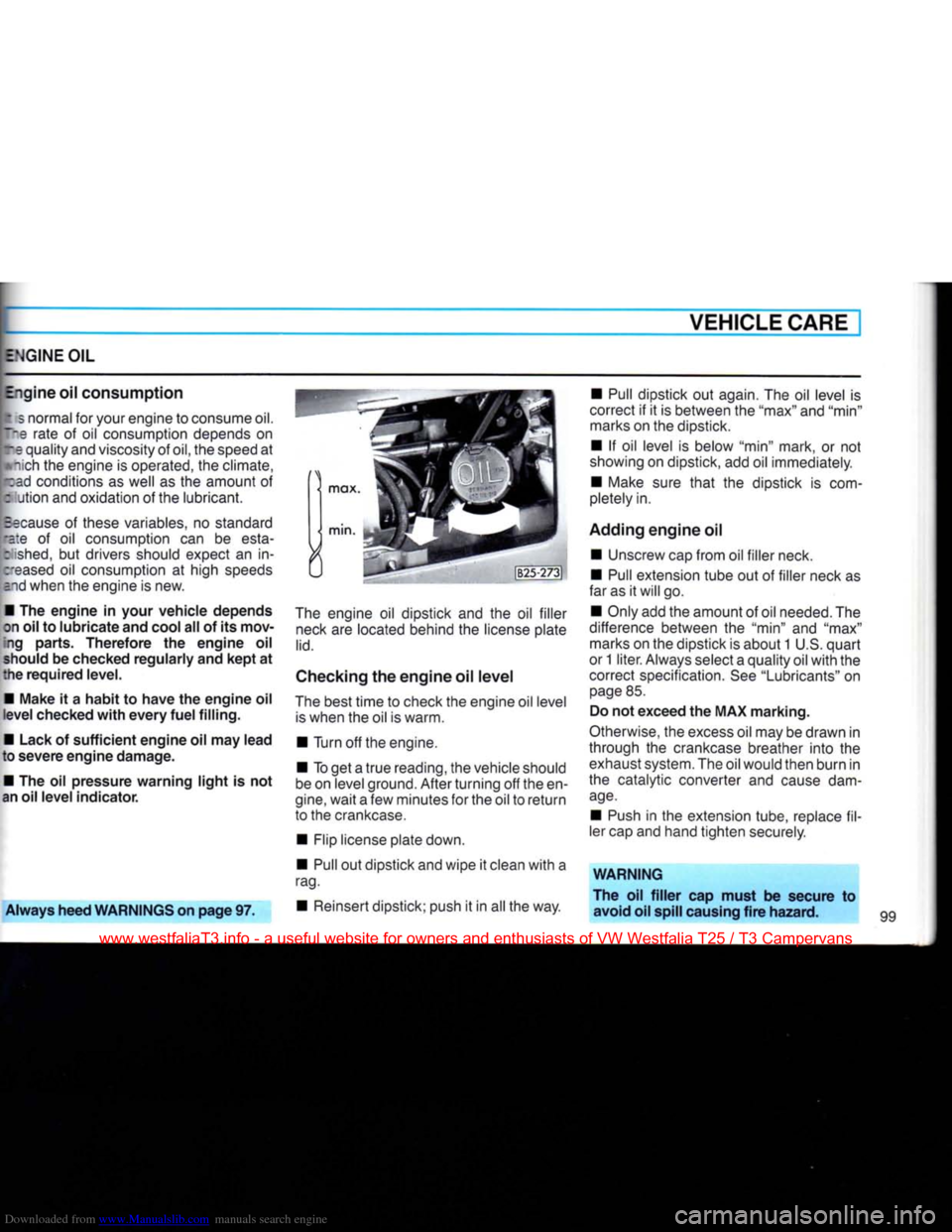
The
engine oil dipstick and the oil filler
neck
are located behind the license plate
lid.
Checking the
engine
oil
level
The
best time to check the engine oil level
is
when the oil is warm.
• Turn off the engine.
• To get a true reading, the vehicle should
be
on level ground. After turning off the en
gine,
wait a few minutes for the oil to return
to the crankcase.
• Flip license plate down.
• Pull out dipstick and wipe it clean
with
a
rag.
• Reinsert dipstick; push it in all the way. • Pull dipstick out again. The oil level is
correct if it is between the "max" and "min" marks on the dipstick.
• If oil level is below "min" mark, or not
showing on dipstick, add oil immediately.
• Make sure
that
the dipstick is com
pletely in.
Adding
engine
oil • Unscrew cap from oil filler neck.
• Pull extension tube out of filler neck as
far as it will go.
• Only add the amount of oil needed. The
difference between the "min" and "max" marks on the dipstick is about
1
U.S. quart
or
1
liter. Always select a quality oil
with
the
correct specification. See "Lubricants" on
page
85.
Do not exceed the MAX
marking.
Otherwise,
the excess oil may be drawn in
through the crankcase breather into the exhaust system. The oil would then burn in
the catalytic converter and cause dam
age.
•
Push
in the extension tube, replace fil
ler cap and hand tighten securely.
WARNING
The oil
filler
cap
must
be secure to avoid oil spill causing
fire
hazard.
www.westfaliaT3.info - a useful website for owners and enthusiasts of VW Westfalia T25 / T3 Campervans