1990 VOLKSWAGEN TRANSPORTER check engine
[x] Cancel search: check enginePage 3 of 165
Downloaded from www.Manualslib.com manuals search engine
Your new
Volkswagen
may have all or some of the equipment
described
in this manual. Therefore, you may find explanations of equipment not
installed in your vehicle.
Check
with
your authorized Volkswagen
dealer
on available options or
accesso
ries.
Note
WARNINGS
concern
safety
and are co lor
identified
throughout
this
manual.
Please
note
that
the items of equipment
marked
with
an asterisk* may be stand
ard on certain models but are only avail
able
as options on other models.
In addition to this Owner's Manual, your
Vanagon/Transporter
comes
with
• the Radio
Operating
Instructions*,
In Canada,
these
manuals are also available in
French.
To obtain a copy, contact your
dealer
or
write
to:
Au
Canada
on peut se procurer un exem- plaire de ce Manuel en francais aupres du
concessionnaire
ou du:
Volkswagen
Canada,
Inc.
Customer
Assistance/
Assistance
a la Clientele 1940 Eglinton Ave. East
Scarborough,
Ontario
M1L2M2
If you sell your
Volkswagen
the Owner's Manual, the Warranty booklet and the Maintenance booklet
should
be
left
in the vehicle to make
Warranty terms as well as all operating, safety and maintenance information avail
able
to the next owner.
If you change your address or if
you
bought
this
Volkswagen
used
be
sure to send in a "Notice of Address
ChangeVNotice
of Used Car Purchase"
post card. This card can be found in the
Warranty booklet or obtained from your
Volkswagen
dealer.
It is in your own
interest
that
we can
contact
you should the
need
arise.
Your
Owner's
Manual
applies
to all Vanagon/Transporter models
currently sold in the USA and
Canada.
It
contains important operating safety infor mation. Keep this booklet in your glove
box at all times for ready reference.
Read
it before you drive your new vehicle.
Pay
particular attention to the "Break-in
period hints" and to all points listed under
"Vehicle
operation".
Acquaint
yourself
with
your vehicle's fea tures and know how to operate it more
safely.
The more you know about your
Volkswagen,
the more you will enjoy driving it. For your own protection and longer service life of your vehicle, always
heed
our instructions and warnings. Igno
ring them could result in extensive da
mage
or serious personal injury. • the
Warranty
Booklet
and
• the
Maintenance
Booklet.
Your
Warranty
booklet
which is a separate brochure, contains
detailed information about the warranties
covering your Volkswagen.
Your
Maintenance
booklet
which is a separate brochure, explains how you can keep your Volkswagen in top
driving condition by having it serviced regularly. Always have the Maintenance
booklet
with
you when you take your
vehicle
to a Volkswagen dealer for service.
Your
Service Adviser will record each
scheduled
service.
www.westfaliaT3.info - a useful website for owners and enthusiasts of VW Westfalia T25 / T3 Campervans
Page 18 of 165
Downloaded from www.Manualslib.com manuals search engine
CONTROLS AND
EQUIPMENT
Belt
height
adjustment
There
are two different anchorage points for the
front
safety belts in the door pillars on each
side.
The
belt relay
fitting
is normally mounted on the upper anchorage point. For proper positioning of the shoulder section of the
safety belt it may be necessary to remount
the relay
fitting
on the lower anchorage point. Lap-shoulder
belt
The
combination lap-shoulder belt is equipped
with
a locking retractor. The
system
adjusts automatically to your
size
and
movements as long as the pull on the
belt is slow.
Hard
braking or a collision locks the belt.
The
belt will also lock when you drive up or down a steep hill or in a sharp curve.
Before
fastening the seat belt
first
adjust
seat
- see page 20.
• To fasten, grasp belt tongue and pull
belt in continuous slow motion across your
chest
and lap.
• Insert belt tongue into buckle on in
board side of seat.
Push
down until it is
securely
locked
with
an audible click.
Pull
belt to check.
•
Pull
upwards on shoulder section to
make
sure belt
fits
snugly across the
pel
vis.
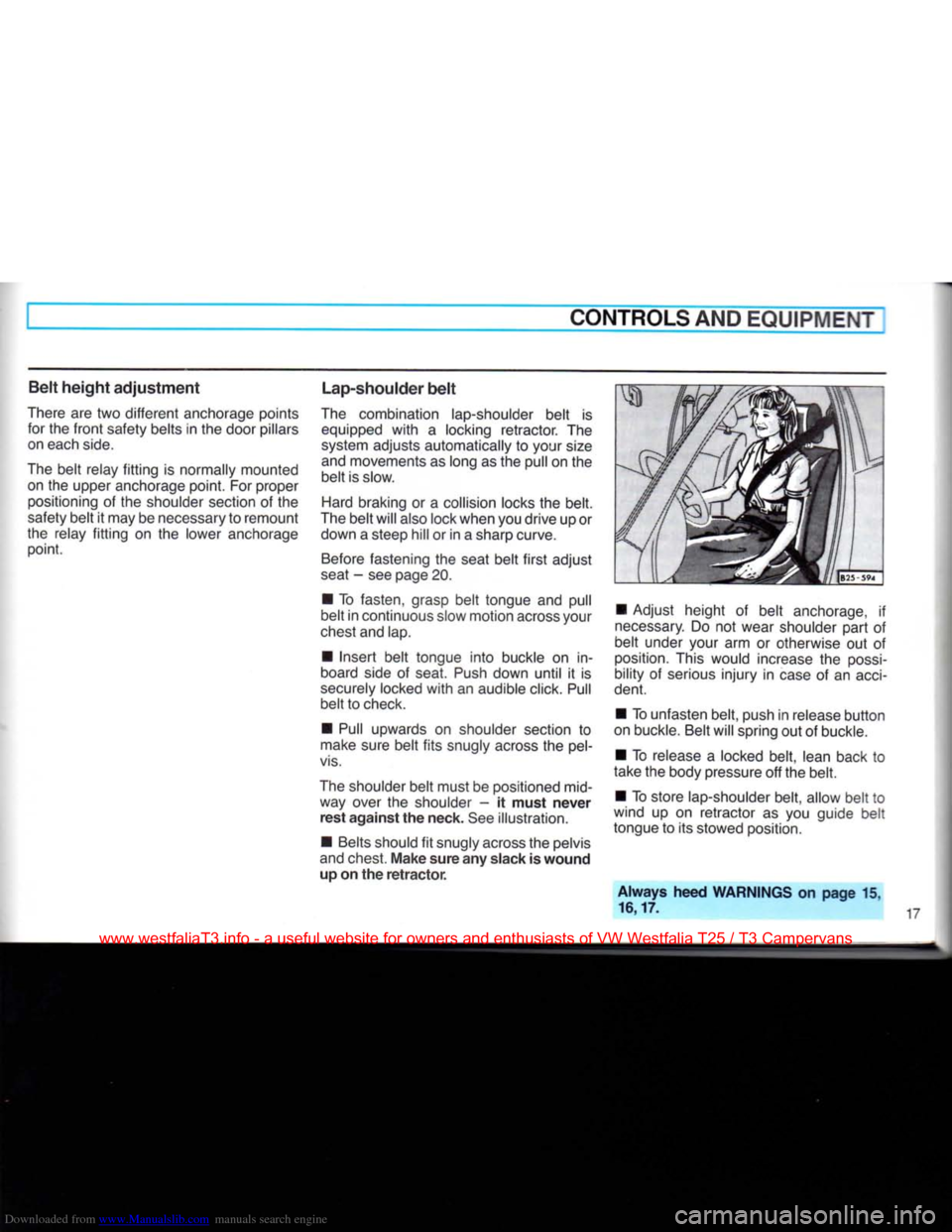
The
shoulder belt must be positioned mid way over the shoulder - it
must
never
rest
against
the neck. See illustration.
• Belts should fit snugly across the pelvis
and
chest.
Make
sure any slack is
wound
up on the
retractor.
• Adjust height of belt anchorage, if
necessary.
Do not wear shoulder part of
belt under your arm or otherwise out of
position.
This would increase the
possi
bility of serious injury in
case
of an
acci
dent.
• To unfasten belt, push in release button
on buckle. Belt will spring out of buckle.
• To release a locked belt, lean back to
take the body pressure off the belt.
• To store lap-shoulder belt, allow belt to
wind up on retractor as you guide belt
tongue to its stowed position.
Always
heed
WARNINGS
on
page
15.
16,17.
www.westfaliaT3.info - a useful website for owners and enthusiasts of VW Westfalia T25 / T3 Campervans
Page 25 of 165
Downloaded from www.Manualslib.com manuals search engine
CONTROLS AND
EQUIPMENT
SINGLE
SEATS*
IN
PASSENGER
COMPARTMENT
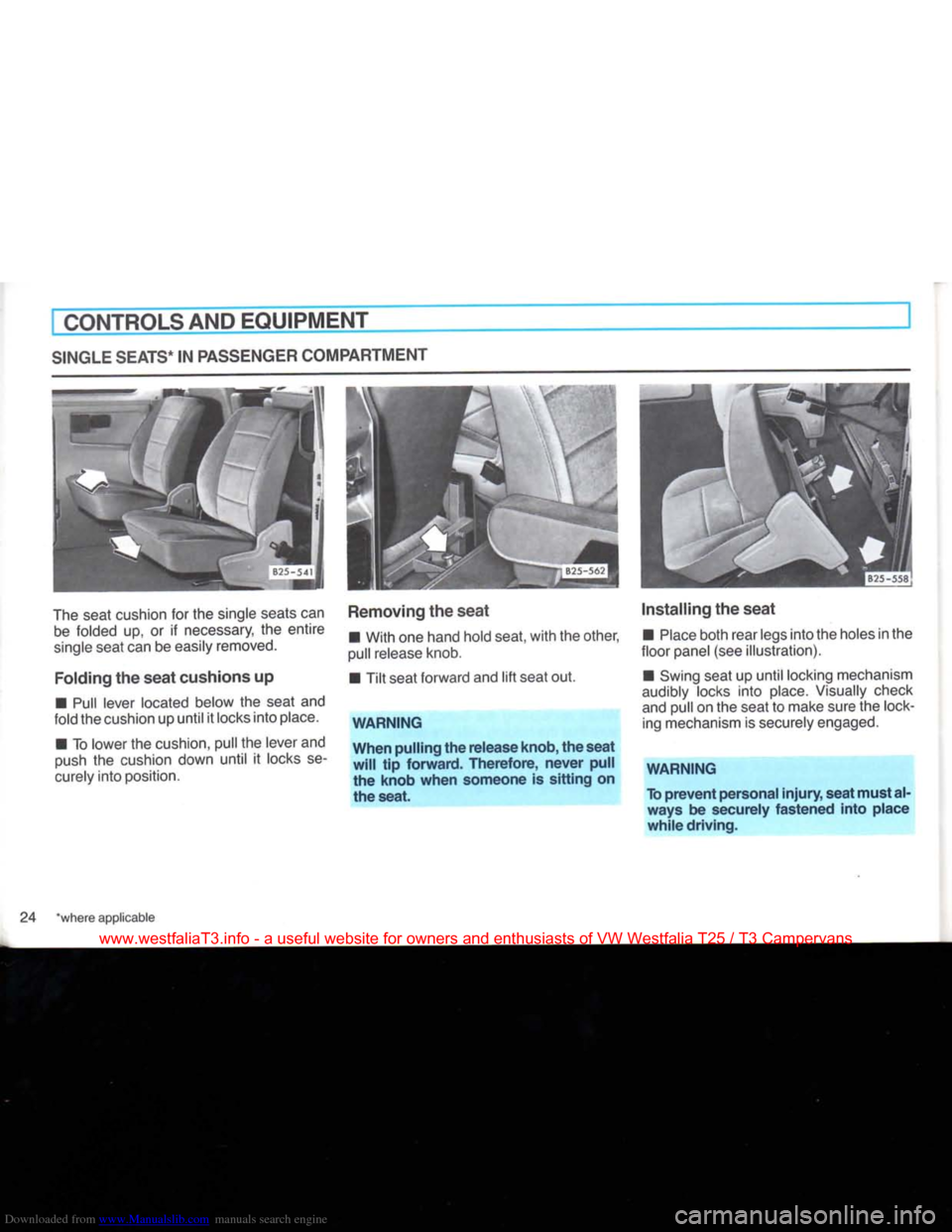
The seat cushion
for
the single seats can be folded
up, or if
necessary,
the
entire
single seat can be easily removed.
Folding
the seat
cushions
up
• Pull lever located below
the
seat
and
fold the cushion up
until
it
locks
into
place.
• To lower the cushion, pull the lever and
push
the
cushion down
until
it
locks
se
curely
into
position.
Removing
the seat
• With one hand hold seat,
with
the other,
pull release knob.
•
Tilt
seat forward and
lift
seat out.
WARNING
When pulling the release
knob,
the seat
will
tip forward. Therefore, never pull
the knob when someone is sitting on
the seat.
Installing
the seat
•
Place
both
rear legs
into
the holes in the
floor panel (see illustration).
• Swing seat
up
until
locking mechanism
audibly locks
into
place. Visually check
and pull on the seat
to
make sure the lock ing mechanism is securely engaged.
WARNING
To
prevent
personal
injury, seat must
al
ways be securely fastened into place
while
driving.
24 'where applicable
www.westfaliaT3.info - a useful website for owners and enthusiasts of VW Westfalia T25 / T3 Campervans
Page 30 of 165
Downloaded from www.Manualslib.com manuals search engine
^EDALS
BRAKES CONTROLS AND EQUIPMENT
WARNING • The movement of the pedals must
never be obstructed by a floor mat or
any other object.
• In case one of the two brake circuits
fails,
increased brake pedal travel is required to bring your vehicle to a full
stop.
• It should always be possible to
depress the clutch and accelerator pedals fully.
• All pedals must be able to return
freely to their normal positions.
Only use floor mats which leave the pedal area free and can be secured with
floor mat fasteners. Functioning of brake system
Your vehicle is equipped with a power assisted hydraulic dual circuit brake
system with disc brakes at the front and
self-adjusting drum brakes at the rear. Both circuits function independently.
One brake circuit operates the front
wheels and the other the rear wheels. In the unlikely event of hydraulic failure of
one circuit, push the brake pedal down
firmly and hold it in that position. A mechanical linkage activates the second
circuit, and you will be able to bring the
vehicle to a stop.
WARNING Failure of one brake circuit will impair
the braking capability resulting in an increased stopping distance. If one brake circuit fails, the other will still
operate. However, you will notice an increased pedal travel when you step on
the brake. Should you encounter such experience, bring your vehicle safely to a
full stop.
Avoid driving the vehicle and have it
towed to the nearest Volkswagen dealer or qualified workshop.
Brake operation and brake
warning light
Make it a habit to check the operation of
your brakes before driving. The brake
warning light will light up while the engine is cranking and the parking brake is pulled
and/or the brake fluid level is too low. For more details see "Brake warning light" on
page 43.
Keep in mind that the braking distance
increases very rapidly as the speed increa
ses.
At 60 mph or at 100 km/h, for example, it is not twice but four times longer than at 30 mph or at 50 km/h. Tire
traction is also less effective when the roads are wet and slippery. Therefore,
always maintain a safe distance from the
vehicle in front of you.
29
www.westfaliaT3.info - a useful website for owners and enthusiasts of VW Westfalia T25 / T3 Campervans
Page 31 of 165
Downloaded from www.Manualslib.com manuals search engine
CONTROLS
AND
EQUIPMENT
Brake
booster
The brake booster works
only
when
the engine is running.
WARNING
When the vehicle is moving while the engine is not running, more force on
the brake pedal is required to bring the
vehicle to
a
stop. Conditions affecting braking
efficiency
Moisture or road salt
WARNING
•
Under
certain
climatic
and
operating
conditions such as passing
through
water, driving in
heavy
rain or after
washing the vehicle the effectiveness of the brakes can be reduced. In
winter
ice
can accumulate on the brake pads,
linings, discs and drums. Cautiously
apply brakes for a test. Brakes will dry,
ice
coatings will be cleaned off after a
few cautious brake applications.
• Driving for an extended period of
time
on salt covered roads
without
using
your
brakes can also affect brak
ing
efficiency. The accumulated salt
coating
must be cleaned off the brake
discs
and brake pads be
a
few cautious brake applications.
• Do not "ride the brakes" by resting
your
foot
on the pedal
when
not in
tending to brake.
This
may cause the brakes to overheat, premature wear
and increased stopping distance. • Before descending
a
steep grade, re
duce speed and shift transmission into
a
lower
gear or
lower
driving position to control speed. Do not
ride
the
brakes or hold the pedal
down
too long, or too
often.
This
could cause the brakes to get hot
and
diminish
braking efficiency.
New brake pads or linings • New brake pads and linings do not have
optimum friction properties and must be
"broken in" during the initial 100 to 150
miles
(150 to 200 kilometers) of normal
city driving. You can compensate for this by applying more pressure on the brake
pedal.
This
also applies later
when
new
pads or linings are installed.
Brake
fluid level • If the brake fluid level is too low,
malfunctions or
even
a failure in the brake
system could result.
Therefore,
it is important to check
your
brake fluid level
regularly. See page 108 for more details.
Low brake fluid is indicated by the brake
warning light (see page 43).
www.westfaliaT3.info - a useful website for owners and enthusiasts of VW Westfalia T25 / T3 Campervans
Page 32 of 165
Downloaded from www.Manualslib.com manuals search engine
CONTROLS AND
EQUIPMENT
=ailure
of one
brake
circuit
I the brake pedal travel should suddenly
icrease,
one of the brake circuits may
_ave
failed. Should this happen, you will
m able to bring your vehicle safely to a
s:op,
however, you will have to push hard
er on the brake pedal and it will take a onger distance to stop the vehicle.
Con
tact your Volkswagen dealership for as
sistance.
Brake
wear
~he brakes on our automobiles are still subject to wear depending largely on operating conditions and driving habits. On ve
hicles
which are driven mostly in stop-and-
50 city
traffic
or which are driven hard, the
crake linings should be checked by your
Volkswagen
dealer more often than
specified
in the Maintenance brochure.
Front
spoiler
If you
install
a
front
spoiler on
your
vehi
cle, be
sure
the air
flow
to the
front
brakes
is not
obstructed,
otherwise
the
brake
system
could
overheat.
Parking
brake
lever
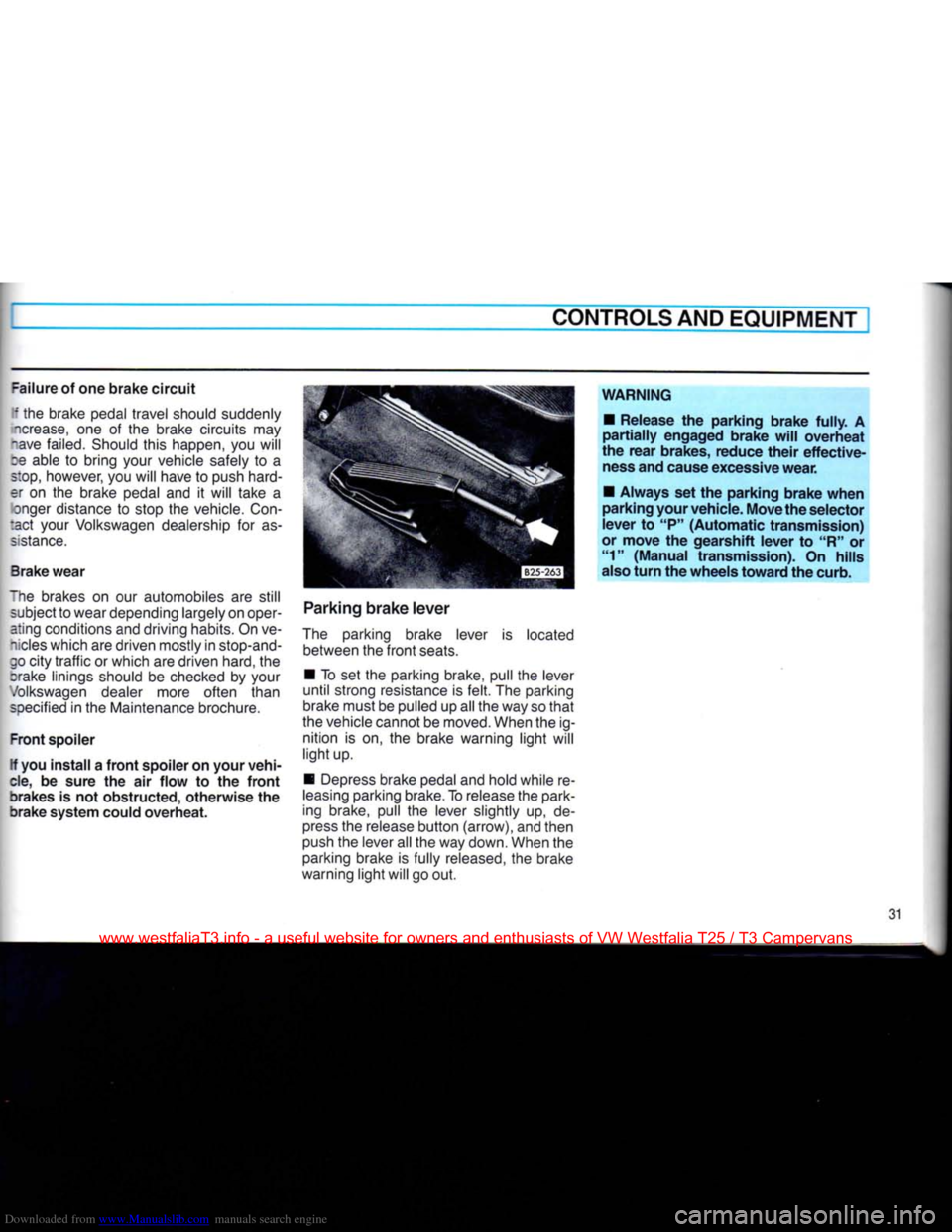
The parking brake lever is located between the
front
seats.
• To set the parking brake, pull the lever
until
strong resistance is
felt.
The parking
brake must be pulled up all the way so
that
the vehicle cannot be moved. When the ig nition is on, the brake warning
light
will
light
up.
• Depress brake pedal and hold while re
leasing
parking brake. To release the park
ing brake, pull the lever slightly up, de
press
the release
button
(arrow), and then
push the lever all the way down. When the parking brake is fully released, the brake
warning
light
will go out.
WARNING
•
Release
the
parking
brake
fully.
A
partially
engaged
brake
will
overheat
the
rear
brakes,
reduce
their
effective
ness and cause excessive
wear.
•
Always
set the
parking
brake
when
parking
your
vehicle.
Move
the
selector
lever
to "P"
(Automatic
transmission)
or
move
the
gearshift
lever
to "R" or "1"
(Manual
transmission).
On
hills
also
turn
the
wheels
toward
the curb.
31
www.westfaliaT3.info - a useful website for owners and enthusiasts of VW Westfalia T25 / T3 Campervans
Page 34 of 165
Downloaded from www.Manualslib.com manuals search engine
CONTROLS AND
EQUIPMENT
THE
DIFFERENTIAL
LOCK*
(SYNCRO)
When driving around a curve, the outside
.vheels
turn
more than the inside wheels.
A
gear set, part of the transmission, called :he differential, compensates for the differ
ence.
If, however, one wheel gets on a slip pery surface and starts to spin, the
differential will not transmit power to the
ether wheel. The car will be stuck. The
dif
ferential lock will allow power to be trans
mitted
to both wheels to help get the vehi-
:!e
moving again. Because the differential
5
then unable to compensate for corner-
~.g, vehicle handling and maneuverability
.'.ill
be reduced. Therefore the differential zck may only be used under limited condi-
:ons.
WARNING
Locked
differential
cannot
compensate
for
cornering
and
therefore
increases
tire
wear,
reduces
vehicle
maneuvera
bility,
driveability
and can
impair
vehi
cle
handling
performance.
See
detailed
instructions
on
next
page.
Using the
differential
lock
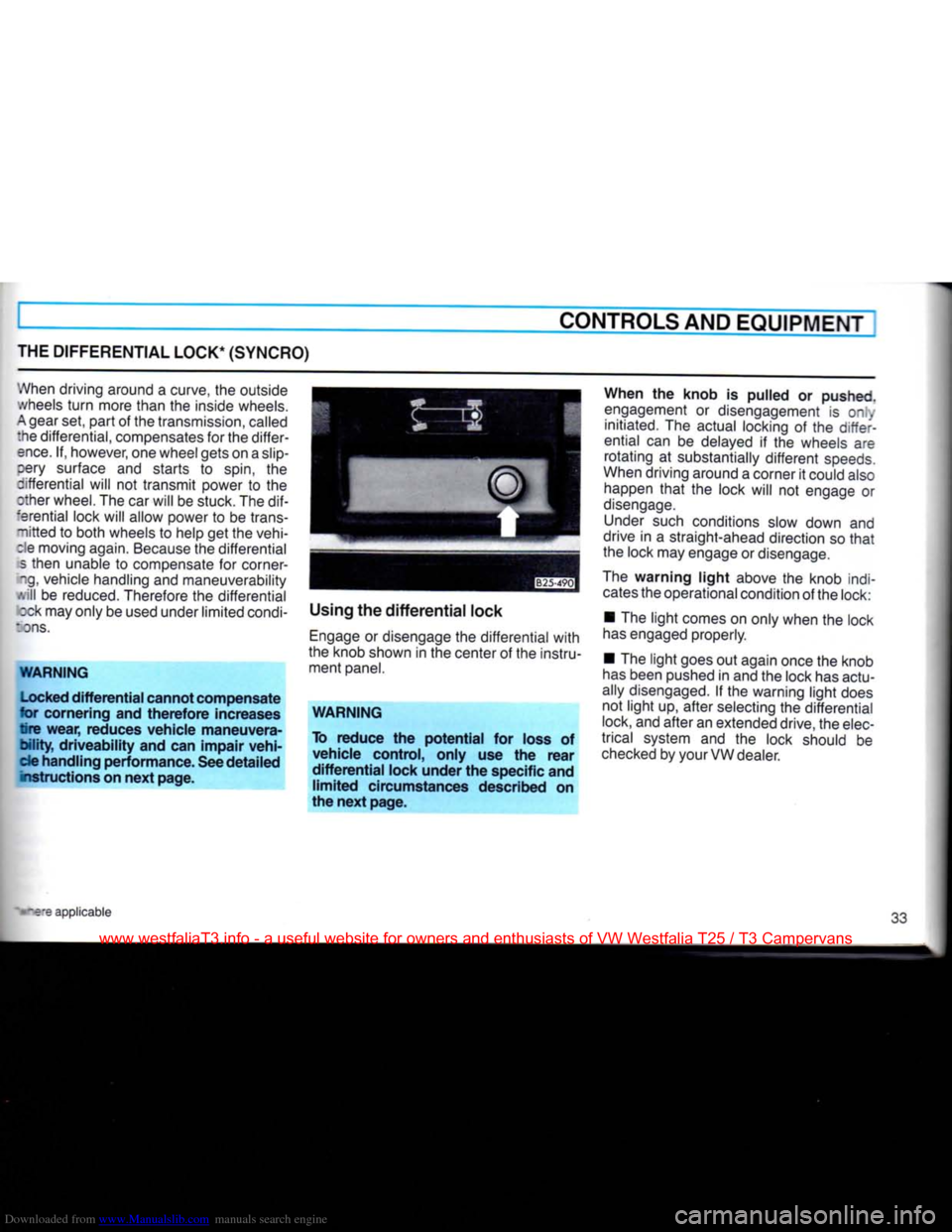
Engage
or disengage the differential
with
the knob shown in the center of the instru ment panel.
WARNING
To
reduce
the
potential
for loss of
vehicle
control,
only
use the
rear
differential
lock
under
the specific and
limited
circumstances described on
the
next
page.
When
the
knob
is
pulled
or pushed.
engagement or disengagement is ony initiated. The actual locking of the differ
ential can be delayed if the wheels are rotating at substantially different speeds.
When driving around a corner it could also happen
that
the lock will not engage or
disengage.
Under
such conditions slow down and
drive in a straight-ahead direction so
that
the lock may engage or disengage.
The
warning
light
above the knob indi
cates
the operational condition of the lock:
• The
light
comes on only when the lock
has
engaged properly.
• The
light
goes out again once the knob
has
been pushed in and the lock has actu
ally disengaged. If the warning
light
does not
light
up, after selecting the differential
lock, and after an extended drive, the elec
trical system and the lock should be
checked
by your VW dealer.
e applicable
www.westfaliaT3.info - a useful website for owners and enthusiasts of VW Westfalia T25 / T3 Campervans
Page 37 of 165
Downloaded from www.Manualslib.com manuals search engine
CONTROLS
AND EQUIPMENT
1 - Position for steep hills
This
position is to be
used
for mountain
driving
or
slow
driving.
It
also
provides
for
maximum
engine
braking effect. To
engage this gear depress the push but
ton in the handle of the selector lever
first. In "1" the
transmission
will
stay
in first
gear
and will not upshift.
The road speed must not exceed 33 mph
or
53 km/h. Only shift down into "1"
when the speed is below this speeds.
WARNING
Do
not shift to a lower driving position
until vehicle speed has dropped below
the specified limits otherwise engine
speed
will
suddenly increase and may
cause
engine damage and
loss
of
vehicle control. Driving the automatic transmission
Starting the engine
The
selector
lever
must be in Neutral or Park. If one of the driving
positions
is
engaged
a
safety
switch will prevent the
engine
from
being
started.
Emergency
starting
Your
Volkswagen
with
Automatic
Transmis
sion
cannot
be started by
pushing
or tow
ing.
If
engine
does
not start
because
of
dis
charged
battery, the
vehicle
can be started
with jumper
cables.
Refer
to
"Emergency
starting
with jumper
cables".
Should
the
engine
fail to start
consult
your
nearest
Volkswagen
dealer.
Selecting
a driving position
WARNING
•
Apply the foot brake before select
ing a driving position when the vehicle
is
stationary.
When the selector lever is in a driving
position,
the vehicle may creep even at
idle speed. Therefore, do not release
the parking brake or foot brake until
you
are ready to move, because power
is
transmitted to the wheels as soon as
a driving position is engaged.
•
Do not accelerate
while
selecting
a driving position. At this
time
the en
gine must run at idle speed so
that
no undue stress
will
be placed on the auto
matic clutches in the transmission.
•
Never have any position engaged
when checking in the engine compart ment. Make sure the selector lever is
securely
locked into the P position
with
the parking brake firmly set. Otherwise, any increase in engine speed may set
the vehicle in motion, even
with
the parking brake applied.
www.westfaliaT3.info - a useful website for owners and enthusiasts of VW Westfalia T25 / T3 Campervans