1990 VOLKSWAGEN TRANSPORTER relay
[x] Cancel search: relayPage 18 of 165
Downloaded from www.Manualslib.com manuals search engine
CONTROLS AND
EQUIPMENT
Belt
height
adjustment
There
are two different anchorage points for the
front
safety belts in the door pillars on each
side.
The
belt relay
fitting
is normally mounted on the upper anchorage point. For proper positioning of the shoulder section of the
safety belt it may be necessary to remount
the relay
fitting
on the lower anchorage point. Lap-shoulder
belt
The
combination lap-shoulder belt is equipped
with
a locking retractor. The
system
adjusts automatically to your
size
and
movements as long as the pull on the
belt is slow.
Hard
braking or a collision locks the belt.
The
belt will also lock when you drive up or down a steep hill or in a sharp curve.
Before
fastening the seat belt
first
adjust
seat
- see page 20.
• To fasten, grasp belt tongue and pull
belt in continuous slow motion across your
chest
and lap.
• Insert belt tongue into buckle on in
board side of seat.
Push
down until it is
securely
locked
with
an audible click.
Pull
belt to check.
•
Pull
upwards on shoulder section to
make
sure belt
fits
snugly across the
pel
vis.
The
shoulder belt must be positioned mid way over the shoulder - it
must
never
rest
against
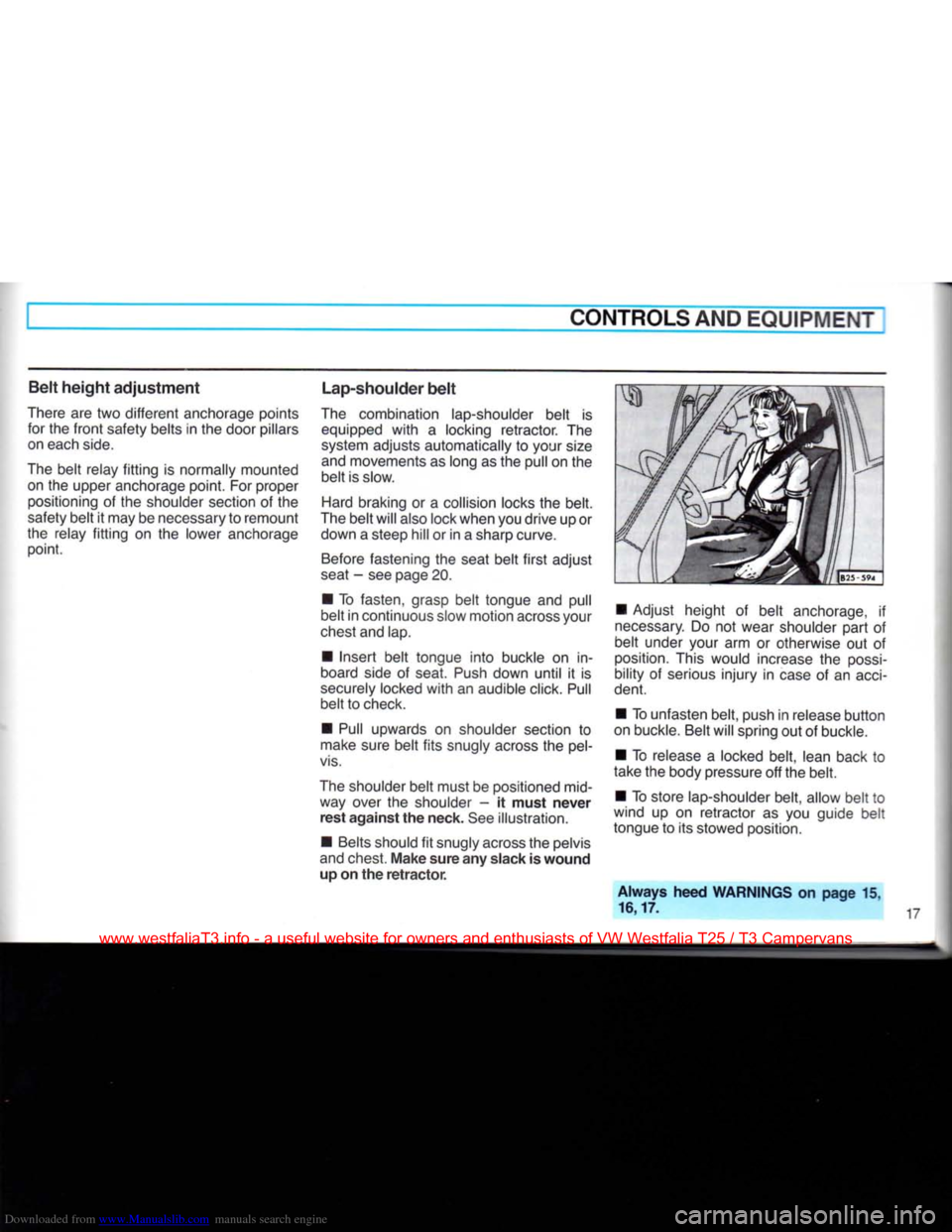
the neck. See illustration.
• Belts should fit snugly across the pelvis
and
chest.
Make
sure any slack is
wound
up on the
retractor.
• Adjust height of belt anchorage, if
necessary.
Do not wear shoulder part of
belt under your arm or otherwise out of
position.
This would increase the
possi
bility of serious injury in
case
of an
acci
dent.
• To unfasten belt, push in release button
on buckle. Belt will spring out of buckle.
• To release a locked belt, lean back to
take the body pressure off the belt.
• To store lap-shoulder belt, allow belt to
wind up on retractor as you guide belt
tongue to its stowed position.
Always
heed
WARNINGS
on
page
15.
16,17.
www.westfaliaT3.info - a useful website for owners and enthusiasts of VW Westfalia T25 / T3 Campervans
Page 74 of 165
Downloaded from www.Manualslib.com manuals search engine
iLER TOWING
VEHICLE OPERATION
phLT .'jlkswagen was primarily designed
pr : assenger transportation. If you plan to
m*
B.
trailer you should be mindful that
MLT
:ar will be performing a service it was
•cr "tended for. The additional load will
Wee durability and economy of per-
m~ ance. • :. :ow a trailer, your Volkswagen may
mc. -9 more frequent maintenance due to
ft* extra
load.
Gc not tow a trailer during the break-in kriod of your vehicle.
Keep an eye on your coolant tempera-
fere gauge. If coolant temperature warn- rc light comes on pull off the road to a sa's place to allow engine to cool down.
Maximum trailer weight
A vailer for your vehicle is limited to a
typi-
ca class I trailer. The maximum gross
Bier weight and the tongue load must not
eoeed the specifications listed in the
[fechnical Information/Data section of this
ranual.
Do not exceed the gross vehicle weight
•rhich is the weight of the driver, passen ger, luggage, trailer hitch and tongue
weight of the loaded trailer. Trailer hitch
Use a weight-carrying hitch conforming to
the gross trailer weight. The hitch must be suitable for your vehicle and trailer and
securely bolted to the body. Always check
with the trailer hitch manufacturer to make
sure that you are using the correct hitch. Do not use a bumper hitch.
The hitch must be installed in a way not to interfere with the impact-absorbing
bumper system. No modifications should
be made to the vehicle exhaust and brake
systems. From time to time check that all hitch mounting bolts remain securely fas
tened.
If not towing a trailer for a long period of
time,
remove the trailer hitch. This pre
vents the hitch from causing damage should your vehicle be struck from behind.
When removing the trailer hitch, seal all bolt holes to prevent water and exhaust
fumes from entering the vehicle.
Trailer brakes If your trailer is equipped with a braking
system,
check to be sure that it conforms
to all regulations.
The trailer brake system must not be di rectly connected to the vehicle's brake sys
tem.
Tire pressure
When towing a trailer, inflate the tires of
your vehicle to the cold tire pressure listed on the label on the left front door jamb. In
flate trailer tires to trailer and tire manufac
turer's specifications.
Safety chains
Always use safety chains between your car and trailer.
Trailer lights
Trailer lights must meet all regulations. Do not connect the trailer light system directly
to the light system of your vehicle. Be sure
to check with your Volkswagen dealer for
correct wiring, switches and relays.
Before you tow a trailer
Correct and even load distribution. All ob
jects inside the trailer should be held securely in place to guard against shifting, be it forward, backward or sideways.
Never allow a passenger in a moving
trailer.
www.westfaliaT3.info - a useful website for owners and enthusiasts of VW Westfalia T25 / T3 Campervans
Page 114 of 165
Downloaded from www.Manualslib.com manuals search engine
VEHICLE CARE
3ATTERY
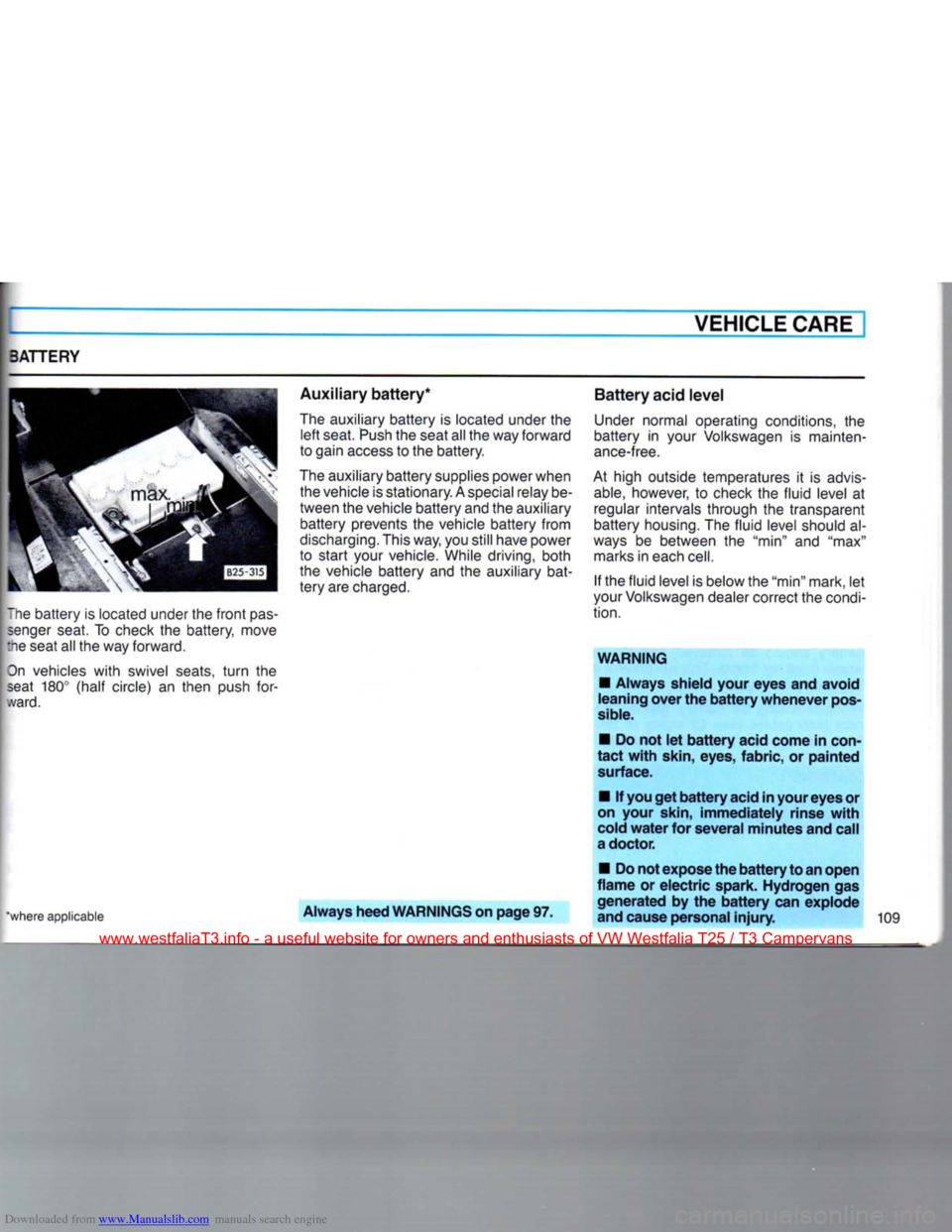
~he battery
is
located under the
front
pas
senger
seat.
To
check
the
battery, move
lie
seat all the way forward.
On
vehicles
with
swivel seats,
turn
the
seat
180°
(half circle)
an
then push
for
ward.
Auxiliary
battery*
The
auxiliary battery
is
located under
the
left
seat.
Push
the
seat all the way forward
to gain
access
to
the battery.
The
auxiliary battery supplies power when the vehicle is stationary.
A
special relay be
tween the vehicle battery and
the
auxiliary battery prevents
the
vehicle battery from
discharging.
This way, you still have power
to start your vehicle. While driving, both
the vehicle battery
and the
auxiliary bat
tery are charged.
'where applicable
Always heed WARNINGS on page 97. Battery acid level
Under
normal operating conditions,
the
battery
in
your Volkswagen
is
mainten
ance-free.
At high outside temperatures
it is
advis
able,
however,
to
check
the
fluid level
at
regular intervals through
the
transparent
battery housing. The fluid level should
al
ways
be
between
the "min" and "max"
marks
in
each
cell.
If
the fluid level
is
below the "min" mark,
let
your Volkswagen dealer correct
the
condi
tion.
WARNING
•
Always shield your eyes and avoid
leaning over the
battery
whenever
pos
sible.
•
Do not let
battery
acid come in
con
tact
with
skin,
eyes, fabric, or painted
surface.
•
If
you
get
battery
acid
in
your eyes or
on
your
skin,
immediately rinse
with
cold
water
for several minutes and call a doctor.
•
Do not expose the
battery
to an open
flame
or electric spark. Hydrogen gas generated by the
battery
can explode
and cause personal injury.
109
www.westfaliaT3.info - a useful website for owners and enthusiasts of VW Westfalia T25 / T3 Campervans
Page 115 of 165
Downloaded from www.Manualslib.com manuals search engine
VEHICLE
CARE
Winter operation During the winter months, battery capacity
tends to decrease as temperatures drop.
Additionally, more power is consumed while starting, and the headlights, heater, rear window defogger, etc., are used more
frequently. Curtail unnecessary power
consumption,
particularly in city traffic or
when travelling short distances only. Let
your
Volkswagen dealer test the battery's
capacity before winter sets in. A well
charged battery will not only prevent
starting
problems but will also live longer.
If
your
vehicle is left standing for several
weeks
at extremely low temperatures, the battery should be removed and stored
where it will not freeze.
This
will prevent it
from being damaged.
When removing the battery, first discon nect both cables (see Charging of Bat
tery),
then unscrew the battery mounting.
WARNING
Always keep the battery well out of the reach of children.
Always heed WARNINGS on page
97.
Charging of battery
WARNING
•
Always shield
your
eyes and avoid
leaning
over
the battery whenever pos
sible.
•
Charge battery in a well ventilated
area.
Keep away from open flame or
electrical
spark. Do not
smoke.
Hydro gen gas generated by the battery is explosive.
•
Battery acid that may spill during
charging should be washed off with a solution of warm water and baking
soda
to neutralize the
acid.
•
If you get battery
acid
in
your
eyes or
on
your
skin,
immediately rinse with
cold
water for several minutes and
call
a
doctor.
•
Never charge
a
frozen battery. It may
explode because of gas trapped in the
ice.
Allow a frozen battery to thaw out
first.
•
Never use a fast charger as a boo
ster to start the engine.
This
will
seri
ously damage sensitive electronic
components,
such as relays, radio,
etc.,
as well as the battery charger.
•
Fast charging
a
battery
is
dangerous
and should only be attempted by a
competent mechanic with the proper
equipment.
Slow battery charging WARNING
•
Heed all WARNINGS and follow in
structions that come with
your
battery
•
It is not necessary to remove the bat
tery
from the engine compartment, and it
is
also not necessary to disconnect the
cables.
•
Make sure the electrolyte level in each
cell
is between the "min" and "max" marks. If the fluid level is below the "min" mark, le:
your
Volkswagen dealer correct the condi
tion.
•
Connect charger cables.
Charger cables must be connected
POSITIVE
(+) to
POSITIVE
(+) and
NEGATIVE
(-) to
NEGATIVE
(-).
Do not connect or disconnect charger
cables
while charger is operating to re
duce the danger of exploding.
www.westfaliaT3.info - a useful website for owners and enthusiasts of VW Westfalia T25 / T3 Campervans
Page 141 of 165
Downloaded from www.Manualslib.com manuals search engine
DO-IT-YOURSELF-SERVICE
EMERGENCY
STARTING
Starting by
pushing
or towing
Vehicles
with
Automatic Transmission
cannot
be started by
pushing
or
towing.
Vehicles
with
Manual
Transmission
must
not
be started by
pushing
or
towing.
Damage to the catalytic converter and/or
other parts of the vehicle may result. Starting
with
jumper
cables
WARNING
•
Always shield your eyes and avoid
leaning over the battery whenever
pos
sible.
•
Do not allow battery acid to contact
eyes
or
skin.
Flush any contacted area
with
water
immediately.
•
Improper use of booster battery to
start a vehicle may
cause
an
explosion.
•
Vehicles batteries generate explo
sive
gases.
Keep sparks, flame and lighted cigarettes away from batteries.
•
Do not charge a frozen battery; allow
it to thaw out first. Gas trapped
in the ice may cause an explosion.
•
Do not try to jump start any vehicle
with
a low electrolyte level in the bat tery.
•
The voltage of the booster battery
must also have a 12-volt rating. The
capacity
(Ah) of the booster battery
should
not be lower than
that
of the
dis
charged
battery. Use of batteries of dif
ferent voltage or substantially different
Ah
rating may cause an explosion and
personal
injury.
•
Applying
a
higher
voltage
booster
battery
will
cause
expensive
damage
tc
sensitive
electronic
components,
such
as
relays,
radio,
etc...
•
Vehicle
with
discharged
battery: turn off
lights
and
accessories,
move
lever
to N or
P
(Automatic
transmission)
or into
Neutra
(Manual
transmission)
and set
parking
brake.
Always
heed WARNINGS on page 97.
www.westfaliaT3.info - a useful website for owners and enthusiasts of VW Westfalia T25 / T3 Campervans