Page 1058 of 1273
Torsion Axle andACTIVE-ELECTRONIC CONTROL SUSPENSION - Arm Assemblv33B-119
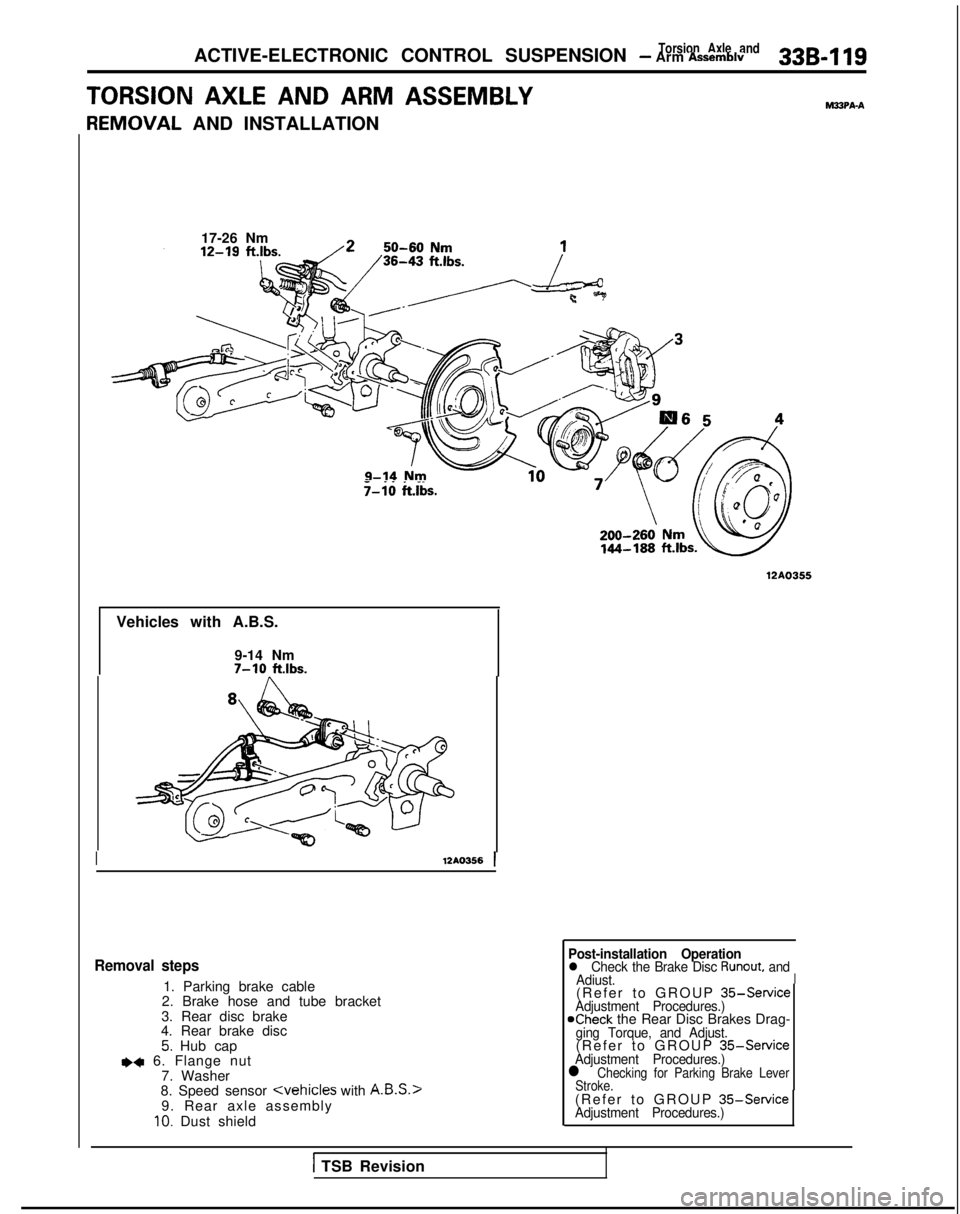
TORSION AXLE AND ARM ASSEMBLYMSPA-A
F
{EMOVAL
AND INSTALLATION
17-26 Nm
._. _.T-10 ftlbs.
12AO355
Vehicles with A.B.S.
9-14 Nm
7-10 ftlbs.
I
12AO356
1
Removal steps
1. Parking brake cable
2. Brake hose and tube bracket
3. Rear disc brake
4. Rear brake disc
5. Hub capea 6. Flange nut
7. Washer
8. Speed sensor
9. Rear axle assembl
y
IO. Dust shield
1 TSB Revision
Post-installation Operationl Check the Brake Disc Runout, and
Adiust.I(Refer to GROUP 35-ServiceAdjustment Procedures.)
NIheck
the Rear Disc Brakes Drag-
ging Torque, and Adjust.(Refer to GROUP 35-ServiceAdjustment Procedures.)l Checking for Parking Brake Lever
Stroke.
(Refer to GROUP 35-ServiceAdjustment Procedures.)
Page 1059 of 1273
33B-120 ACTIVE-ELECTRONIC CONTROL SUSPENSION - Z%iZky8”d
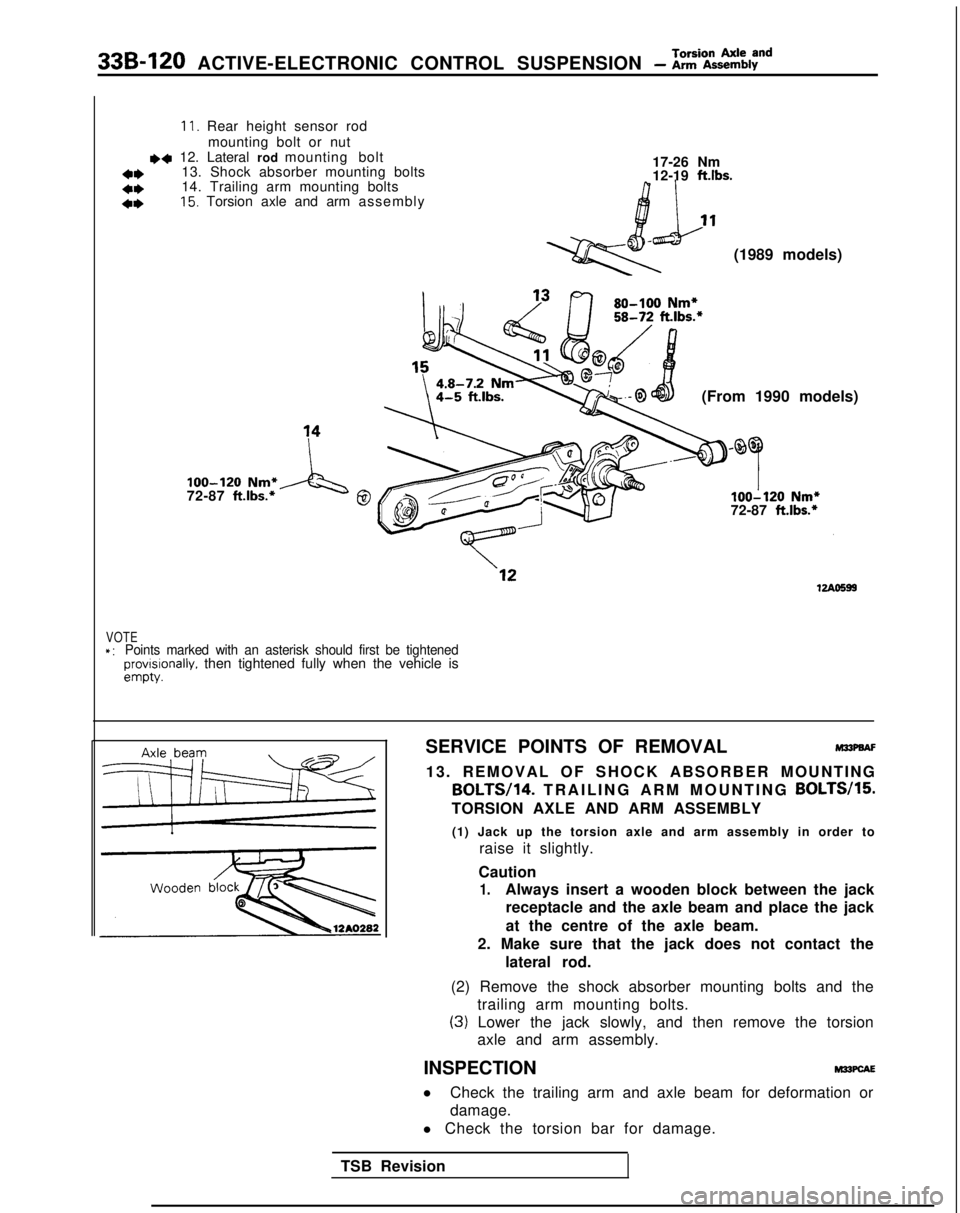
11. Rear height sensor rodmounting bolt or nut
~~ 12. Lateral rod mounting bolt
13. Shock absorber mounting bolts 17-26 Nm
a*12-19 ftlbs.*I)14. Trailing arm mounting bolts
4*15. Torsion axle and arm assembl
y
(1989 models)
(From 1990 models)
loo-120 Nm*
72-87 ft.lbs.*A‘g0loo-120 Nm*
72-87 ft.lbs.*
VOTE*:Points marked with an asterisk should first be tightenedprovrslonally. then tightened fully when the vehicle isempty.
SERVICE POINTS OF REMOVALM33PaAF
13. REMOVAL OF SHOCK ABSORBER MOUNTING BOLTW14.
TRAILING ARM MOUNTING BOLTW15.
TORSION AXLE AND ARM ASSEMBLY
(1) Jack up the torsion axle and arm assembly in order to raise it slightly.
Caution
1.Always insert a wooden block between the jack receptacle and the axle beam and place the jack
at the centre of the axle beam.
2. Make sure that the jack does not contact the lateral rod.
(2) Remove the shock absorber mounting bolts and the trailing arm mounting bolts.
(3) Lower the jack slowly, and then remove the torsionaxle and arm assembly.
INSPECTION
M22PcAE
l Check the trailing arm and axle beam for deformation or
damage.
l Check the torsion bar for damage.
TSB Revision
Page 1070 of 1273

Solenoid Valve and
ACTIVE-ELECTRONIC CONTROL SUSPENSION - Dryer33B-131
3
F
‘G
\
12A0371
>
Rearpressure
sensor
l------i-l
12AO294
TSB Revision
-n
Coat withsoap-and-water
solution.
3. REAR SOLENOID VALVE
Check the No.
l-3 solenoid valves shown in the figure for
correct operation and air leakage.
Check item ConditionResult
Inject air from Part A “click” noise will
GoodA and apply battery be heard, and the
voltage
(12V) to ter- air will be blown
minal
0, and then out from joints B
earth terminal 0.and C.
Other than as de-Malfunction of
scribed above. No. 1 sole-
noid valve
Blow air in at joint A “click” noise will
Good
E, apply batterybe heard, and the
voltage
(12V) to ter- air being blown out
minal
0, and then will change from
earth terminal
0.joint D to joint H. /
: Other than as de-Malfunction of
I scribed above No. 2 sole-
noid valve
Inject air from part A “click” noise will
Good
3 and apply battery i be heard, and the doltage
(12V) to ter- 1 air being blown out
ninal @, and then will change from
sarth terminal 0.joint F to joint H.
I Other than as de-Malfunction of
scribed above. No. 3 sole-
noid valve
i/Vith an air pressureNo air leakageGood
of 1,000 kPa (142
xi) from parts A and Air leakage
Malfunction of -l, apply a
soap-and-solenoid valve
Nater
solution seal Nhere
shown in the
Ilustration.
Page 1074 of 1273
ACTIVE-ELECTRONIC CONTROL SUSPENSION - Heiaht Sensor 33B-135
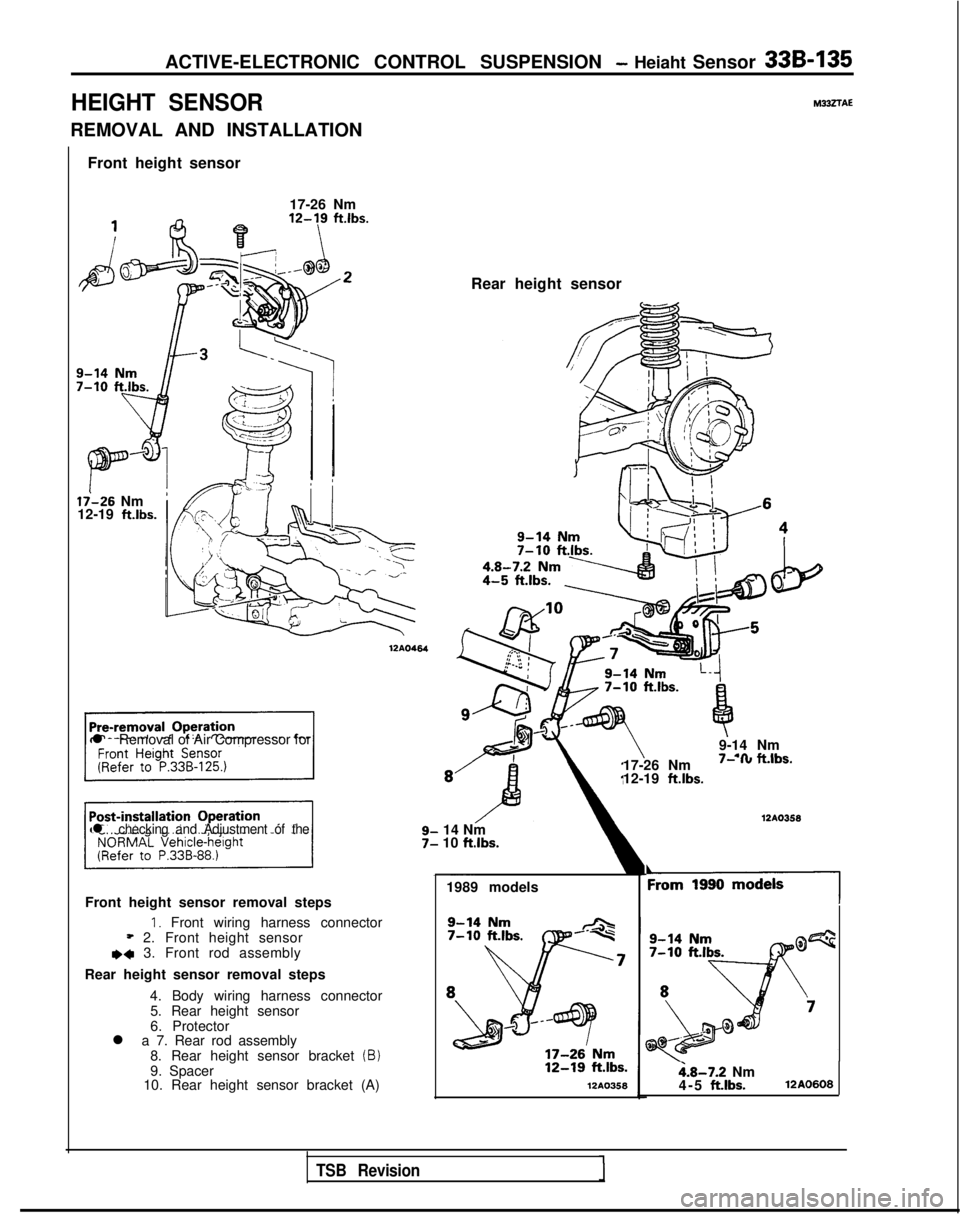
HEIGHT SENSOR
REMOVAL AND INSTALLATION
Front height sensor
17-26 Nm
li-26 Nm
12-19 ft.lbs.
l Removal of Air Compressor for
17-26 Nm
I- I” n.,os.
12-19 ft.lbs.
l checking and Adjustment of the14 Nm
10 ftlbs.
1989 models
Front height sensor removal steps
1. Front wiring harness connector* 2. Front height sensore+ 3. Front rod assembly
Rear height sensor removal steps 4. Body wiring harness connector5. Rear height sensor
6. Protector
l a 7. Rear rod assembly
8. Rear height sensor bracket
(B)9. Spacer
10. Rear height sensor bracket (A)l2A0358 12AO464
M332TAE
Rear height sensor
9-14 Nm
- .a #.&IL- 12AO358
‘19901
i.8-7.2 Nm
4-5 ft.lbs.12A0608
TSB Revision
Page 1075 of 1273
33B-136 ACTIVE-ELECTRONIC CONTROL SUSPENSION - Height Sensor
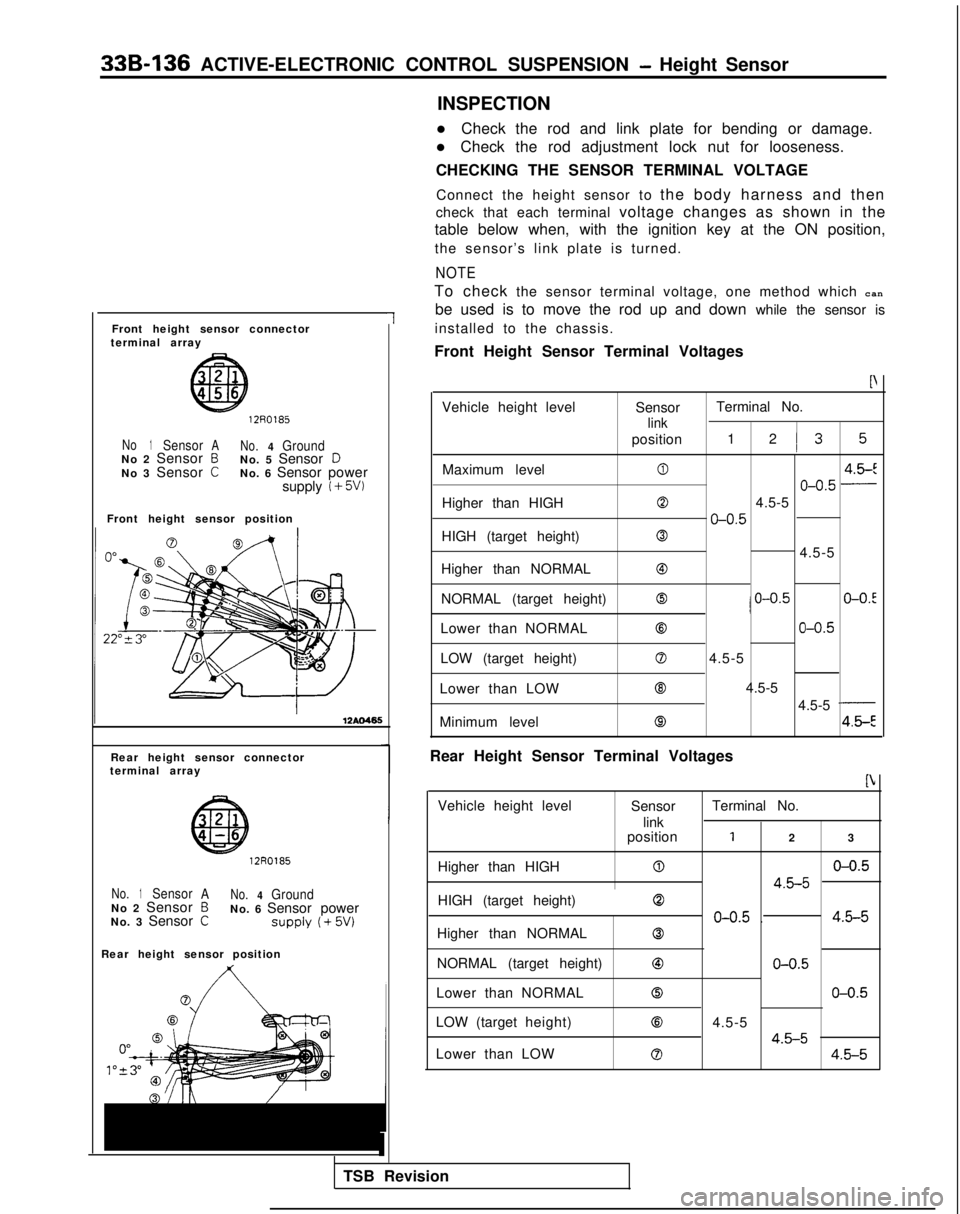
Front height sensor connector
terminal array
1
1270185
No1SensorA No.4GroundNo 2 Sensor BNo. 5 Sensor DNo 3 Sensor CNo. 6 Sensor power
supply i + 5W
Front height sensor position
Rear height sensor connector
terminal array
12R0185
No.1Sensor ANo.4GroundNo 2 Sensor BNo. 6 Sensor power
No. 3 Sensor CSUPPlY (+ 5w
Rear height sensor position
1
TSB Revision INSPECTION
l Check the rod and link plate for bending or damage.
l Check the rod adjustment lock nut for looseness.
CHECKING THE SENSOR TERMINAL VOLTAGE
Connect the height sensor to the body harness and then
check that each terminal voltage changes as shown in the
table below when, with the ignition key at the ON position,
the sensor’s link plate is turned.
NOTE
To check the sensor terminal voltage, one method which can
be used is to move the rod up and down while the sensor is
installed to the chassis.
Front Height Sensor Terminal Voltages
P
Vehicle height level SensorTerminal No.
link
position
1 2I3 5
Maximum level04.5-E
o-o.5 -
Higher than HIGH04.5-5
o-o.5
HIGH (target height)0
4.5-5
Higher than NORMAL
@
NORMAL (target height)0/ o-o.5O-O.!
Lower than NORMAL63o-o.5
LOW (target height)04.5-5
Lower than LOW Q 4.5-5
4.5-5
-
Minimum level84.5-E
Rear Height Sensor Terminal Voltages
b
Vehicle height level SensorTerminal No.
link
position
12 3
Higher than HIGH
0o-o.5
4.5-5
HIGH (target height)0
o-o.5 .4.5-5
Higher than NORMAL0
NORMAL (target height)63o-o.5
Lower than NORMAL0o-o.5
LOW (target height)84.5-5
4.5-5Lower than LOW04.5-5
Page 1076 of 1273
ACTIVE-ELECTRONIC CONTROL SUSPENSION - Height Sensor 33B-137
From1990 models
GoodIBad1
II
12R0363
Bolt centerleft edgesurface
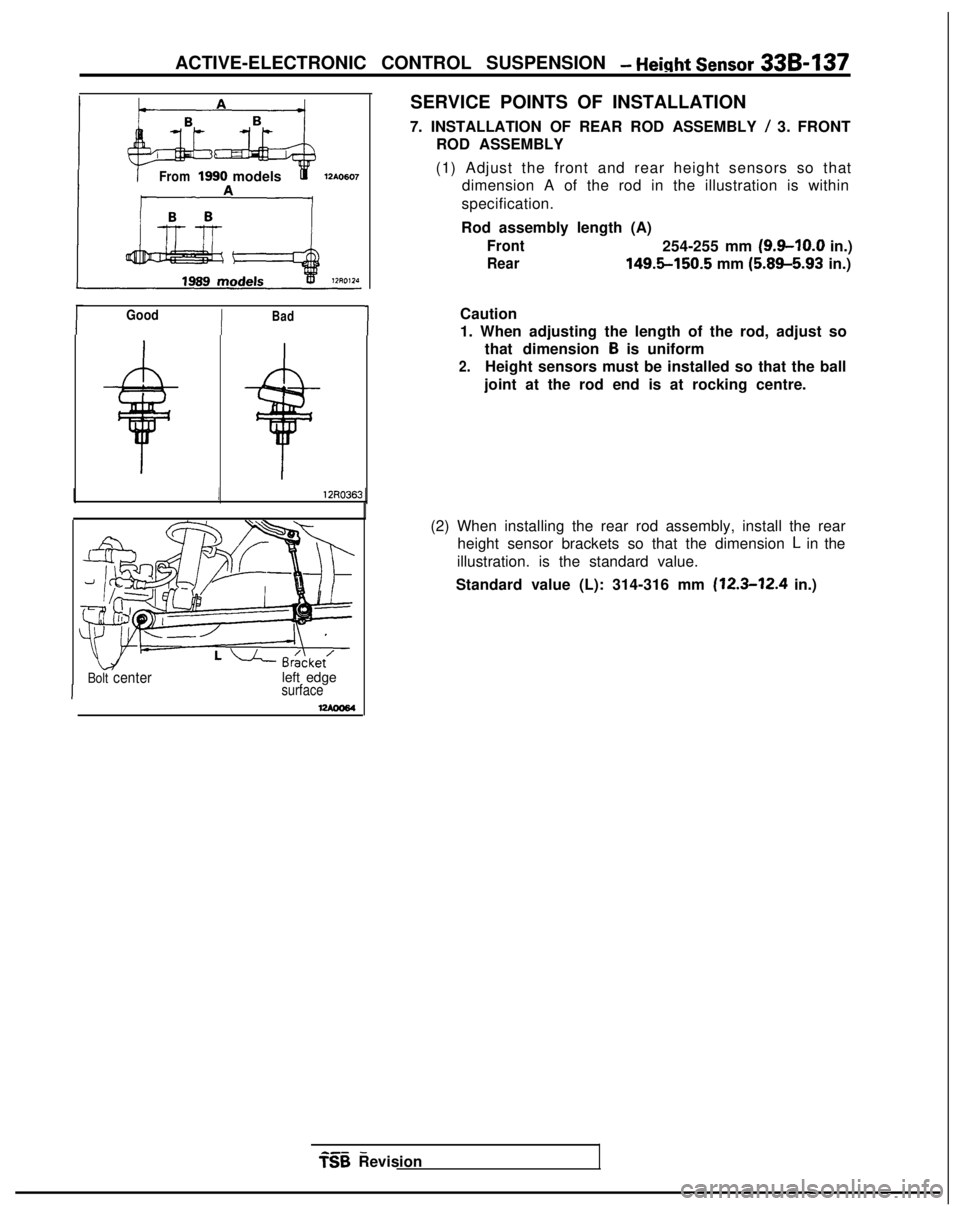
SERVICE POINTS OF INSTALLATION
7. INSTALLATION OF REAR ROD ASSEMBLY
/ 3. FRONT
ROD ASSEMBLY
(1) Adjust the front and rear height sensors so that dimension A of the rod in the illustration is within
specification.
Rod assembly length (A)
Front254-255 mm (9.9-10.0 in.)
Rear 149.5-150.5
mm (5.89-5.93
in.)
Caution
1. When adjusting the length of the rod, adjust so that dimension
B is uniform
2.Height sensors must be installed so that the ball
joint at the rod end is at rocking centre.
(2) When installing the rear rod assembly, install the rear height sensor brackets so that the dimension
L in the
illustration. is the standard value.
Standard value (L): 314-316 mm
(12.3-12.4 in.)
a-- - TSB
Revision
Page 1077 of 1273
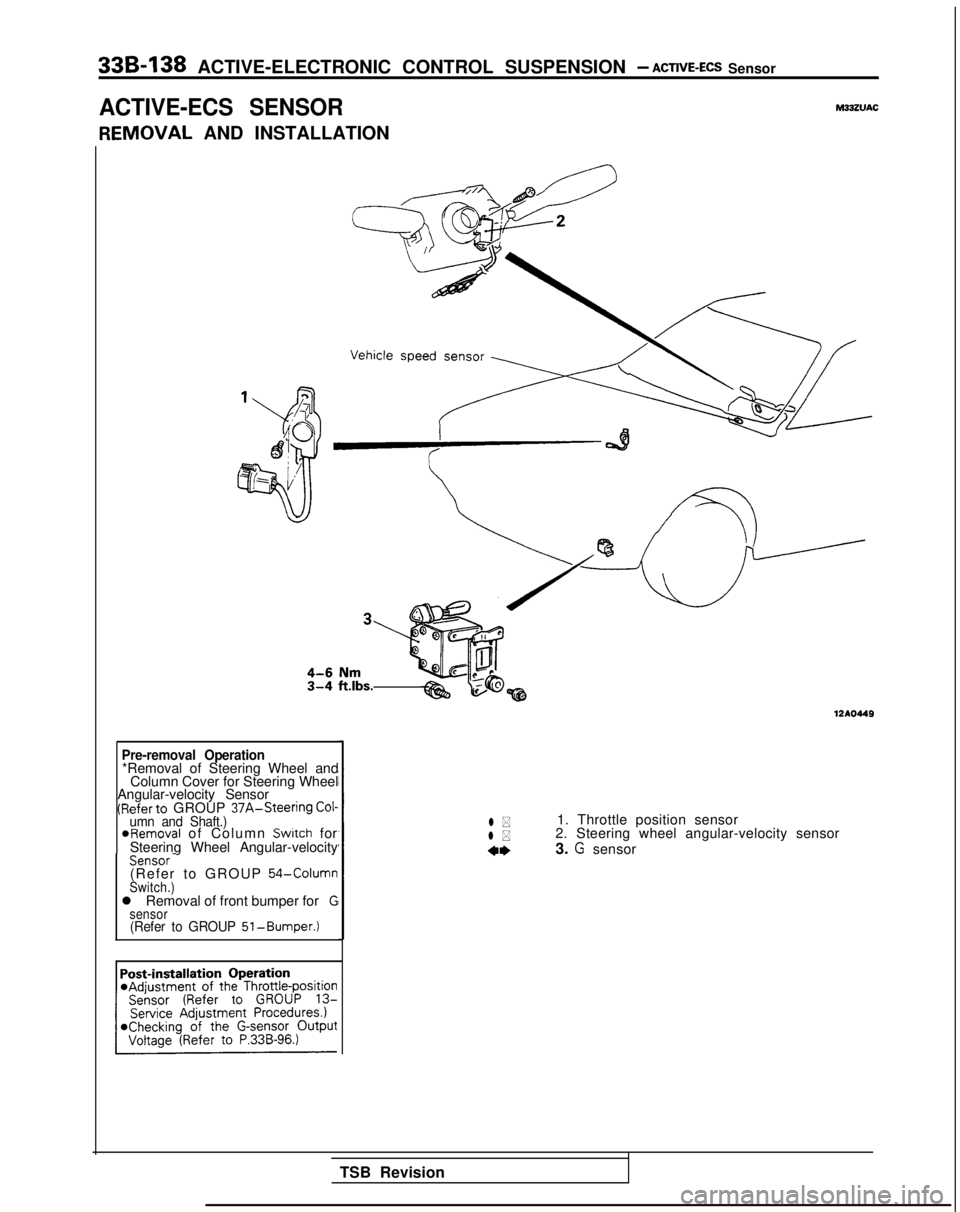
33B-138 ACTIVE-ELECTRONIC CONTROL SUSPENSION - ACTIVE-ECS Sensor
ACTIVE-ECS SENSORM33ZVAC
IEMOVAL
AND INSTALLATION
Pre-removal Operation*Removal of Steering Wheel and
Column Cover for Steering Wheel
Angular-velocity Sensor
(Referto GROUP 37A-Steering Cof-umn and Shaft.) ~
@Removal of Column Switch for
Steering Wheel Angular-velocity
Sensor-(Refer to GROUP 54-ColumnSwitch.)l Removal of front bumper forGsensor(Refer to GROUP 51-Bumper.)
1210449
l *1. Throttle position sensor
l *2. Steering wheel angular-velocity sensor
4*3. G sensor
TSB Revision
Page 1078 of 1273
ACTIVE-ELECTRONIC CONTROL SUSPENSION - ACTIVE-
ECS Sensor 33B-139
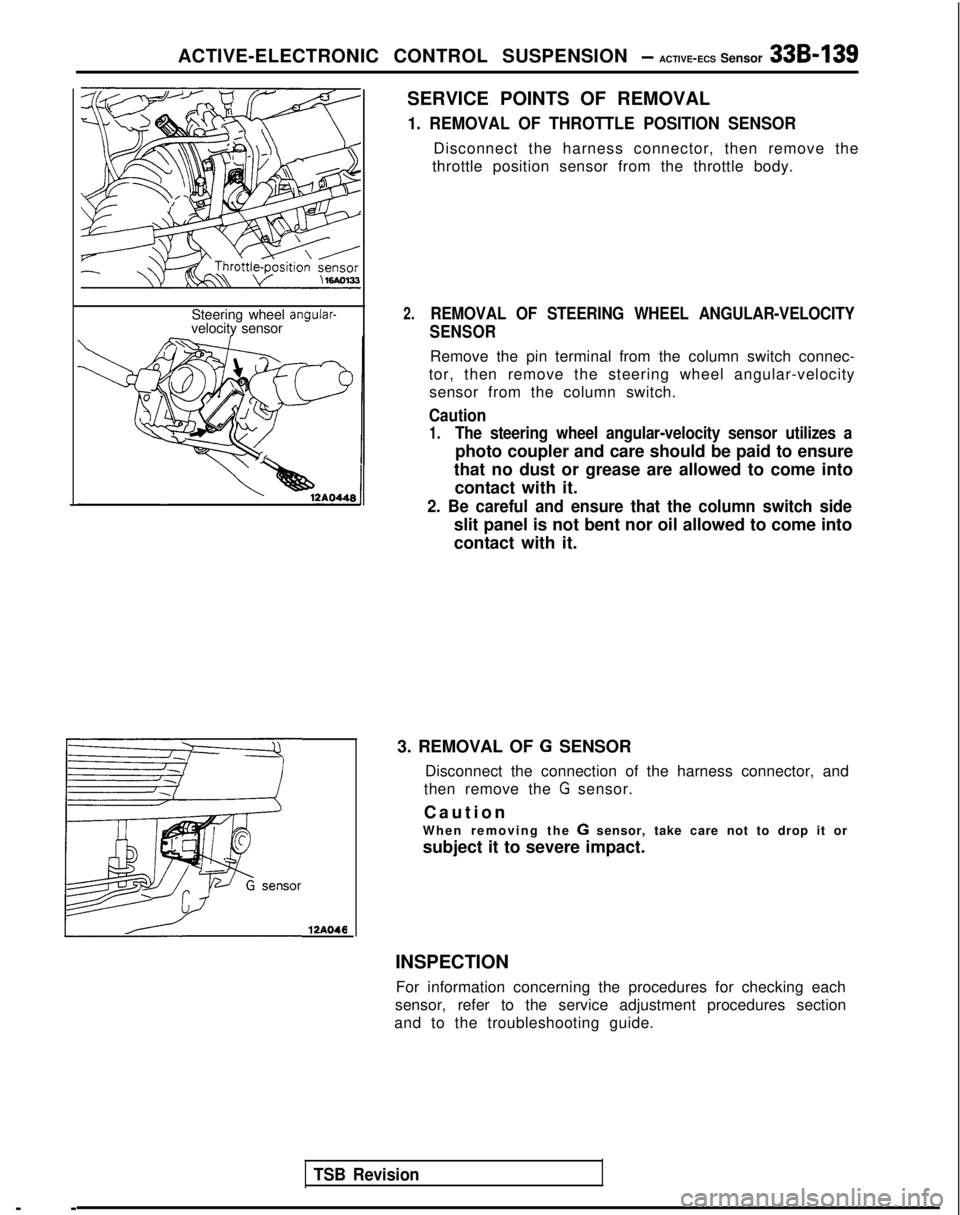
Steering wheel angular-velocity sensor
TSB Revision--
12A046
SERVICE POINTS OF REMOVAL
1. REMOVAL OF THROTTLE POSITION SENSOR
Disconnect the harness connector, then remove the
throttle position sensor from the throttle body.
2.REMOVAL OF STEERING WHEEL ANGULAR-VELOCITY
SENSOR
Remove the pin terminal from the column switch connec-
tor, then remove the steering wheel angular-velocity sensor from the column switch.
Caution
1.The steering wheel angular-velocity sensor utilizes a
photo coupler and care should be paid to ensure
that no dust or grease are allowed to come into contact with it.
2. Be careful and ensure that the column switch side
slit panel is not bent nor oil allowed to come into
contact with it.
3. REMOVAL OF
G SENSOR
Disconnect the connection of the harness connector, and
then remove the
G sensor.
Cautio
n
When removing the
G sensor, take care not to drop it or
subject it to severe impact.
INSPECTION For information concerning the procedures for checking each
sensor, refer to the service adjustment procedures section
and to the troubleshooting guide.